Have a personal or library account? Click to login
One Application of Duistermaat-Heckman Measure in Quantum Information Theory Cover

One Application of Duistermaat-Heckman Measure in Quantum Information Theory

By: Lin Zhang,  Xiaohan Jiang and  Bing Xie  
Open Access
|Mar 2026

Full Article

1.
Introduction

Quantum entanglement, a hallmark of quantum mechanics, is a fundamental resource for quantum information processing. Distinguishing entangled states from separable (non-entangled) states is therefore a central problem in quantum information theory. For bipartite systems, particularly the simplest non-trivial case of two-qubits, determining the likelihood of encountering a separable state within the ensemble of all possible states is a question of significant theoretical interest. This is formalized as the separability probability [1,2].

Under the Hilbert-Schmidt measure—a natural metric induced by the Hilbert-Schmidt distance on the space of density matrices [3]—the exact value of the separability probability for two-qubit states has been a subject of extensive numerical investigation and conjecture. Early numerical studies strongly suggested the fraction 8/33 as the exact value (with 29/64 for the real two-qubit case) [46]. This conjecture was rigorously confirmed recently by Huong and Khoi [7] (separately, the fraction 29/64 was analytically proved by Lovas and Andai [8]). However, while their result establishes the exact separability probability, the detailed mathematical derivation presented in [7] remains inaccessible to a significant portion of the community.

This paper aims to bridge this gap in accessibility and understanding. Our primary contribution is to provide a detailed, self-contained, and pedagogically clear derivation of the 8/331 separability probability for two-qubit states under the Hilbert-Schmidt measure. We achieve this by leveraging a powerful geometric framework centered on the computation of volumes [9] in the relevant state spaces and their substructures. The core of the used approach lies in the systematic computation of Hilbert-Schmidt/symplectic volumes associated with key geometric objects:

  • (1)

    Flag manifold: This is a specific instance constructed by taking the quotient of the unitary group U(N) by its maximal torus.

  • (2)

    A regular adjoint orbit: It is an orbit of a fixed diagonal matrix with distinct diagonal entries under the conjugate action of unitary group U(N). Note that this fixed diagonal matrix can be translated to a regular element in the positive Weyl chamber for the unitary group U(N).

  • (3)

    The space of all qudit states: This is the compact manifold of all density matrices acting on the same underlying space ℂN.

  • (4)

    A regular co-adjoint orbit: It is a orbit of a regular element in the positive Weyl chamber under the coadjoint action of the unitary group U(N).

A critical insight underpinning the derivation is the profound connection between the Hilbert-Schmidt volumes of adjoint orbits and the symplectic volumes of their corresponding regular co-adjoint orbits. This connection is rigorously established through the Duistermaat-Heckman (DH) measure [10], a fundamental tool in symplectic geometry and geometric quantization that intrinsically relates these volume measures. The DH measure’s properties are well-documented, with recent generalizations further extending its scope [11,12]. Crucially, its density relative to the Lebesgue measure on the dual Lie algebra is piecewise polynomial, computable via the Boylal-Vergne-Paradan jump formula [13]. Moreover, the DH formalism has proven instrumental in analyzing joint eigenvalue distributions of marginal states in random multipartite quantum systems [14], demonstrating its utility in quantum information theory.

The remainder of this paper is structured as follows: In Section 2, we review necessary background on the Hilbert-Schmidt metric, the geometry of the quantum state space, and separability criteria. We provide details about the computation of the Hilbert-Schmidt volume of the full quantum state space in Section 3 by calculating volume of flag manifolds and (co)adjoint orbit. Section 4 explores the connection to symplectic geometry via co-adjoint orbits and the Duistermaat-Heckman measure, deriving the corresponding symplectic volumes and linking them back to the Hilbert-Schmidt framework. In Section 5, we synthesizes the volume calculations from the previous sections to compute the volume of the separable set and derives the exact separability probability. Finally, in Section 6, we conclude with a discussion of the significance of the result and potential extensions.

2.
Preliminaries and Notations

Let the set of all N × N complex Hermitian matrices be denoted by Herm(ℂN). Furthermore, Herms(ℂN) denote the set of all elements in Herm(ℂN) with simple spectrum (i.e., those N × N complex Hermitian matrices with N distinct eigenvalues).

Proposition 1 ([15,16]).

It holds that the subset Herms(ℂN) is an open and dense of full measure in Herm(ℂN). Thatis, the Lebesgue measure of the complement is zero, i.e., the Lebesgue measure of Herm(ℂN)\Herms(ℂN) is zero.

Proof

The technical proof is omitted here.

We will denote by ℋN = ℋ1 ⊗ ℋ2 the N-dimensional Hilbert space that describes the composite system of two components ℋ1, ℋ2 with dim ℋ1 = n, dim ℋ2 = m and N = nm. The set D(ℂn ⊗ ℂm) ofbipartite states on ℋN can be represented by complex N × N positive semi-definite matrices of unit trace. Let 1Ds(nm):=D(nm)Herms(nm).{{\rm{D}}_{\rm{s}}}({^n} \otimes {^m}): = {\rm{D}}({^n} \otimes {^m})\mathop \cap \nolimits^ {\rm{Her}}{{\rm{m}}_{\rm{s}}}({^n} \otimes {^m}).

From Proposition 1, we see easily that Ds(ℂn ⊗ ℂm) is also open and dense of full measure in D(ℂn ⊗ ℂm). A bipartite state ρAB in D(ℂn ⊗ ℂm) is called separable if and only if it can be written as a convex combination of local product states: ρAB=k=1KpkρA,kρB,k{\rho _{AB}} = \sum\nolimits_{k = 1}^K {{p_k}{\rho _{A,k}} \otimes {\rho _{B,k}}} for some ρA,k ∈ D(ℂn), ρB,k ∈ D(ℂm), and a probability vector (p1, …, pK).

A natural parametrization of ρ ∈ D(ℂn ⊗ ℂm) makes use of the traceless Hermitian generators of SU(n) and SU( m): 2ρ=1nm(𝟙nm+i=1n21aiAi𝟙m+𝟙nj=1m21bjBj+k=1n21l=1m21cklAkBl)\rho = {1 \over {nm}}\left( {{X_{nm}} + \mathop \sum \limits_{i = 1}^{{n^2} - 1} {a_i}{A_i} \otimes {X_m} + {X_n} \otimes \mathop \sum \limits_{j = 1}^{{m^2} - 1} {b_j}{B_j} + \mathop \sum \limits_{k = 1}^{{n^2} - 1} \mathop \sum \limits_{l = 1}^{{m^2} - 1} {c_{kl}}{A_k} \otimes {B_l}} \right) where

  • all ai, bj, ckl are in ℝ,

  • Ak and Bl are the Hermitian generators of the SU(n) and SU(m), respectively, chosen to satisfy 〈Ai, Aj〉 = 2δij = 〈Bi, Bj〉,

  • two reduced states are: ρn=1n(𝟙n+i=1n21aiAi){\rho _{{^n}}} = {1 \over n}({\diamondsuit _n} + \sum\nolimits_{i = 1}^{{n^2} - 1} {{a_i}{{\bf{A}}_i})} and ρm=1m(𝟙m+j=1m21bjBj){\rho _{{^m}}} = {1 \over m}({\diamondsuit _m} + \sum\nolimits_{j = 1}^{{m^2} - 1} {{b_j}{{\bf{B}}_j})} ,

  • The vector x=(a1,,an21,b1,,bm21,c11,,cn21,m21)(nm)21x = {({a_1}, \ldots ,{a_{{n^2} - 1}},{b_1}, \ldots ,{b_{{m^2} - 1}},{c_{11}}, \ldots ,{c_{{n^2} - 1,{m^2} - 1}})^ \top } \in {^{{{(nm)}^2} - 1}} completely determines the state ρ ∈ D(ℂn ⊗ ℂm) and vice versa. The positivity of density matrices restricts the possible vectors x to a proper subset D(n × m) of ℝ(nm)2 – 1.

According to the parametrization Eq. (2) of bipartite states, the Hilbert-Schmidt distance dHS(ρ,ρ):= ρρ,ρρ HS{d_{{\rm{HS}}}}({\rho ^\prime },\rho ): = \sqrt {{{\left\langle {{\rho ^\prime } - \rho ,{\rho ^\prime } - \rho } \right\rangle }_{{\rm{HS}}}}} (see below Eq. (8)) induces a flat metric on D(n × m) because 3dHS(ρ,ρ)=1nm(2mi=1n21(aiai)2+2nj=1m21(bjbj)2+4k=1n21l=1m21(cklckl)2)12.{d_{{\rm{HS}}}}\left( {{\rho ^\prime },\rho } \right) = {1 \over {nm}}{\left( {2m\sum\limits_{i = 1}^{{n^2} - 1} {{{\left( {a_i^\prime - {a_i}} \right)}^2}} + 2n\sum\limits_{j = 1}^{{m^2} - 1} {{{\left( {b_j^\prime - {b_j}} \right)}^2}} + 4\sum\limits_{k = 1}^{{n^2} - 1} {\sum\limits_{l = 1}^{{m^2} - 1} {{{\left( {c_{kl}^\prime - {c_{kl}}} \right)}^2}} } } \right)^{{1 \over 2}}}.

In particular, for n = m = 2, we get that 4dHS(ρ,ρ)=12(i=13(aiai)2+j=13(bjbj)2+k=13l=13(cklckl)2)12=12dEuclid(x,x),{d_{{\rm{HS}}}}\left( {{\rho ^\prime },\rho } \right) = {1 \over 2}{\left( {\sum\limits_{i = 1}^3 {{{\left( {a_i^\prime - {a_i}} \right)}^2}} + \sum\limits_{j = 1}^3 {{{\left( {b_j^\prime - {b_j}} \right)}^2}} + \sum\limits_{k = 1}^3 {\sum\limits_{l = 1}^3 {{{\left( {c_{kl}^\prime - {c_{kl}}} \right)}^2}} } } \right)^{{1 \over 2}}} = {1 \over 2}{d_{{\rm{Euclid}}}}\left( {{{\bf{x}}^\prime },{\bf{x}}} \right), where x=(a,b,ckl){x^\prime } = ({a^\prime },{b^\prime },c_{kl}^\prime ) and x = (a, b, ckl). In such case, up to an overall constant 12{1 \over 2}, the following mapping is bijective and isometric: 5(D(22),dHS)(D(2×2),dEuclid).({\rm{D}}({^2} \otimes {^2}),{d_{{\rm{HS}}}}) \cong ({D^{(2 \times 2)}},{d_{{\rm{Euclid}}}}).

3.
Riemannian Volumes of Manifolds

Recall that an N-dimensional oriented manifold M with a pseudo-Riemannian metric g has a standard volume form ω, known as the Riemannian volume form, whose expression in an oriented chart (x1, …, xN) is given by 6ω=det(g)dx1dxN,\omega = \sqrt {\det (g)} {\rm{d}}{x^1} \wedge \cdots \wedge {\rm{d}}{x^N}, corresponding to the line element (aka, arc length differential or differential of arc length) ds2=i,j=1Ndxigijdxj{\rm{d}}{s^2} = \sum\nolimits_{i,j = 1}^N {{\rm{d}}{x^i}{g_{ij}}{\rm{d}}{x^j}} .

If D is a domain of integration on M, then 7volg(D):=Dω{\rm{vo}}{{\rm{l}}_g}(D): = \int_D \omega is called the Riemannian volume of D.

In particular, on Ds(ℂN), we have the Hilbert-Schmidt inner product, which is defined by 8X,ϒ :=Tr(Xϒ).\left\langle {X,\Upsilon } \right\rangle : = {\rm{Tr}}({X^\dag }\Upsilon ).

Differentiating this inner product yields a metric on Ds(ℂN) which we denote by gHS. We shall denote by volHS the Riemannian volume form associated with gHS and refer to the volume measured by volHS as the HS volume [17].

3.1.
Hilbert-Schmidt Volumes of Flag Manifolds

A complex matrix Z can always be written as Z = X + iϒ, where X = Re(Z) and ϒ = Im(Z) are real matrices.

Denote 9[dZ]:=[dX][dϒ],[{\rm{d}}Z]: = [{\rm{d}}X][{\rm{d}}\Upsilon ], where [dX] means the product of independent differentials in X, and [dY] has a similar meaning.

Assume that U = (uij) ∈ U(N), where uij ∈ ℂ. Let ukk = |ukk|ek be its polar form, where θk ∈ [— π, π).

Then 10U=(UT1)T,T=diag(eiθ1,,eiθN).U = (U{T^{ - 1}})T,\quad T = {\rm{diag}}({e^{{\rm{i}}{\theta _1}}}, \ldots ,{e^{{\rm{i}}{\theta _N}}}).

This means that any U ∈ U (N) can be factorized into a product of a unitary matrix with diagonal entries being nonnegative and a diagonal unitary matrix. Thus, we have the following diffeomorphism: 11U(N)U(N)/TN×TN,{\rm{U}}(N) \cong {\rm{U}}(N)/{^N} \times {^N}, where TN:={ diag(eiθ1,,eiθN):θk[π,π),k=1,,N }{^N}: = \left\{ {{\mathop{\rm diag}\nolimits} \left( {{e^{{\rm{i}}{\theta _1}}}, \ldots ,{e^{{\rm{i}}{\theta _N}}}} \right):{\theta _k} \in [ - \pi ,\pi ),k = 1, \ldots ,N} \right\}, which is the maximal torus of U(N). For any measurable f over U(N), 12U(N)f(U)[UdU]=U(N)/TNTNf(VT)[VdV][TdT],\int_{{\rm{U}}(N)} {f(U)[{U^\dag }{\rm{d}}U]} = \int_{{\rm{U}}(N)/{^N}} {\int_{{^N}} {f(VT)[{V^\dag }{\rm{d}}V][{T^\dag }{\rm{d}}T]} } , where U = VT for V ∈ U(N)/𝕋N and T ∈ 𝕋N, and [UdU] = [V dV][TdT], where [UdU] is a leftinvariant matrix-valued differential form, called Maurer-Cartan form. Since vkk>0, and moreover vkk is not an independent variable, it follows that 13 [ VdV ]=1i<jNRe(VdV)ij )Im(VdV)ij ),\matrix{ {[{V^\dag }{\rm{d}}V]} & = & {\mathop \prod \limits_{1i < jN} {\mathop{\rm Re}\nolimits} {{({V^\dag }{\rm{d}}V)}_{ij}}){\rm{Im}}{{({V^\dag }{\rm{d}}V)}_{ij}}),} \cr } 14[ UdU ]=k=1NIm((UdU)kk)×1i<jNRe(UdU)ijIm(UdU)ij\matrix{ {[{U^\dag }{\rm{d}}U]} & = & {\mathop \prod \limits_{k = 1}^N {\rm{Im}}({{({U^\dag }{\rm{d}}U)}_{kk}}) \times \mathop \prod \limits_{1i < jN} {\mathop{\rm Re}\nolimits} {{({U^\dag }{\rm{d}}U)}_{ij}}{\rm{Im}}{{({U^\dag }{\rm{d}}U)}_{ij}}} \cr }

The Euclid volume of the flag manifold U(N)/𝕋N is given by [15]: 15volEuclid (U(N)/TN)=U(N)/TN[ VdV ]=π(N2)k=1NΓ(k).{{\mathop{\rm vol}\nolimits} _{{\rm{Euclid }}}}\left( {{\rm{U}}(N)/{^N}} \right) = \int_{{\rm{U}}(N)/{^N}} {\left[ {{{\bf{V}}^\dag }{\rm{d}}{\bf{V}}} \right]} = {{{\pi ^{\left( {\scriptstyle N \atop \scriptstyle 2} \right)}}} \over {\prod\nolimits_{k = 1}^N {\Gamma (k)} }}.

Proposition 2 ([15]).

The Hilbert-Schmidt volume of the flag manifold U(N)/𝕋N is given by 16volHS(U(N)/TN)=2(N2)VolEuclid (U(N)/TN)=(2π)(N2)k=1NΓ(k),{{\mathop{\rm vol}\nolimits} _{{\rm{HS}}}}\left( {{\rm{U}}(N)/{^N}} \right) = {2^{\left( {\scriptstyle N \atop \scriptstyle 2} \right)}}{{\mathop{\rm Vol}\nolimits} _{{\rm{Euclid }}}}\left( {{\rm{U}}(N)/{^N}} \right) = {{{{(2\pi )}^{\left( {\scriptstyle N \atop \scriptstyle 2} \right)}}} \over {\prod\nolimits_{k = 1}^N {\Gamma (k)} }},

Proof

In fact, the line element for the Hilbert-Schmidt inner metric is given by dsHS2= dV,dV = VdV,VdV ,VU(N)/TN.{\rm{d}}s_{{\rm{HS}}}^2 = \left\langle {{\rm{d}}V,{\rm{d}}V} \right\rangle = \left\langle {{V^\dag }{\rm{d}}V,{V^\dag }{\rm{d}}V} \right\rangle ,\quad V \in {\rm{U}}(N)/{^N}.

It is clearly seen that VdV is skew-Hermitian and its diagonal part is real. Thus the diagonal part of VdV must be vanished, and dsHS2=k=1N[(VdV)kk]2+21i<jN([Re(VdV)ij]2+[Im(VdV)ij]2)=21i<jN([Re(VdV)ij]2+[Im(VdV)ij]2).\matrix{ {{\rm{d}}s_{{\rm{HS}}}^2} \hfill & = \hfill & {\mathop \sum \limits_{k = 1}^N {{[{{({V^\dag }{\rm{d}}V)}_{kk}}]}^2} + 2\mathop \sum \limits_{1i < jN} ({{[{\mathop{\rm Re}\nolimits} {{({V^\dag }{\rm{d}}V)}_{ij}}]}^2} + {{[Im{{({V^\dag }{\rm{d}}V)}_{ij}}]}^2})} \hfill \cr {} \hfill & = \hfill & {2\mathop \sum \limits_{1i < jN} ({{[{\mathop{\rm Re}\nolimits} {{({V^\dag }{\rm{d}}V)}_{ij}}]}^2} + {{[Im{{({V^\dag }{\rm{d}}V)}_{ij}}]}^2}).} \hfill \cr }

The corresponding HS volume element is given by dVHS=1i<jN(2Re(VdV)ij2Im(VdV)ij)=2(N2)1i<jN(Re(VdV)ijIm(VdV)ij)=2(N2)[ VdV],\matrix{ {{\rm{d}}{V_{{\rm{HS}}}}} \hfill & = \hfill & {\mathop \prod \limits_{1i < jN} (\sqrt 2 {\mathop{\rm Re}\nolimits} {{({V^\dag }{\rm{d}}V)}_{ij}}\sqrt 2 {\rm{Im}}{{({V^\dag }{\rm{d}}V)}_{ij}})} \hfill \cr {} \hfill & = \hfill & {{2^{(\matrix{ N \cr 2 \cr } )}}\mathop \prod \limits_{1i < jN} ({\mathop{\rm Re}\nolimits} {{({V^\dag }{\rm{d}}V)}_{ij}}{\rm{Im}}{{({V^\dag }{\rm{d}}V)}_{ij}}) = {2^{(\matrix{ N \cr 2 \cr } )}}[{V^\dag }{\rm{d}}V],} \hfill \cr } which leads to the conclusion volHS(U(N)/TN)=U(N)/TNdVHS=2(N2)U(N)/TN[VdV]=2(N2)volEuclid(U(N)/TN)=2(N2)π(N2)k=1NΓ(k)=(2π)(N2)k=1NΓ(k).\matrix{ {{\rm{vo}}{{\rm{l}}_{{\rm{HS}}}}({\rm{U}}(N)/{^N})} \hfill & = \hfill & {{\smallint _{{\rm{U}}(N)/{^N}}}{\rm{d}}{V_{{\rm{HS}}}} = {2^{(\matrix{ N \cr 2 \cr } )}}{\smallint _{{\rm{U}}(N)/{^N}}}[{V^\dag }{\rm{d}}V]} \hfill \cr {} \hfill & = \hfill & {{2^{(\matrix{ N \cr 2 \cr } )}}{\rm{vo}}{{\rm{l}}_{{\rm{Euclid}}}}({\rm{U}}(N)/{^N})} \hfill \cr {} \hfill & = \hfill & {{2^{(\matrix{ N \cr 2 \cr } )}}{{{\pi ^{(\matrix{ N \cr 2 \cr } )}}} \over {\mathop \prod \nolimits_{k = 1}^N {\rm{\Gamma }}(k)}} = {{{{(2\pi )}^{(\matrix{ N \cr 2 \cr } )}}} \over {\mathop \prod \nolimits_{k = 1}^N {\rm{\Gamma }}(k)}}.} \hfill \cr }

This completes the proof.

3.2.
Hilbert-Schmidt Volumes of Regular Adjoint Orbits

Denote the adjoint orbit 𝒰x for x = (x1, …, XN) ∈ ℝN, where x1 > ⋯ > xN, as 17Ux:={Udiag(x1,,xN)U:UU(N)}{{\cal U}_x}: = \{ U{\rm{diag}}({x_1}, \ldots ,{x_N}){U^\dag }:U \in {\rm{U}}(N)\} .

Let VN(x):=1i<jN(xixj){V_N}(x): = \prod\nolimits_{1i < jN} {({x_i} - {x_j})} . The stablizer group of x is just the flag manifold U(N)/𝕋N. Apparently, 𝒰x ≌ {x} × U(N)/𝕋N, where 𝕋N = U(1)×N is N-torus. Suppose that the unitary group U(N) is equipped with Haar probability measure μHaar. Consider the following map π:(U(N),μHaar)(Ux,v:=πμHaar),UUdiag(x1,,xN)U.\matrix{ {\pi :} & {({\rm{U}}(N),{\mu _{{\rm{Haar}}}}) \mapsto ({{\cal U}_x},v: = {\pi _ * }{\mu _{{\rm{Haar}}}}),} \cr {} & {U \mapsto U{\rm{diag}}({x_1}, \ldots ,{x_N}){U^\dag }.} \cr }

The push-forward measure of μHaar along the map π is v := π*μHaar. called the orbital measure [18]. So the integral along the orbit is given by the following formula Uxfdv= v,f =πμHaar,f=μHaar,πf=U(N)f(Udiag(x1,,xN)U)dμHaar(U).\matrix{ {\int_{{{\cal U}_x}} {f{\rm{d}}v = \left\langle {v,f} \right\rangle = \langle {\pi _ * }{\mu _{{\rm{Haar}}}},f\rangle = \langle {\mu _{{\rm{Haar}}}},{\pi ^ * }f\rangle } } \hfill \cr { = \int_{{\rm{U}}(N)} {f(U{\rm{diag}}({x_1}, \ldots ,{x_N}){U^\dag }){\rm{d}}{\mu _{{\rm{Haar}}}}(U).} } \hfill \cr }

The following result [19] is mentioned without proof. Here we provide detailed proof for the reference.

Proposition 3.

The Hilbert-Schmidt volume of the adjoint orbit 𝒰x ≌ U(N)/𝕋N is given by 18volHS(Ux)=VN(x)2volHS(U(N)/TN).{\rm{vo}}{{\rm{l}}_{{\rm{HS}}}}({{\cal U}_x}) = {V_N}{(x)^2}{\rm{vo}}{{\rm{l}}_{{\rm{HS}}}}({\rm{U}}(N)/{^N}).

Proof

Indeed, for X ∈ 𝒰x, i.e., X = Vdiag(x1, …, xN)V, where V ∈ U(N)/𝕋N. Then dX=dVdiag(x1,,xN)V+Vdiag(x1,,xN)dV,{\rm{d}}X = {\rm{d}}V{\rm{diag}}({x_1}, \ldots ,{x_N}){V^\dag } + V{\rm{diag}}({x_1}, \ldots ,{x_N}){\rm{d}}{V^\dag }, which implies that V(dX)V=VdVdiag(x1,,xN)+diag(x1,,xN)dVV.{V^\dag }({\rm{d}}X)V = {V^\dag }{\rm{d}}V{\rm{diag}}({x_1}, \ldots ,{x_N}) + {\rm{diag}}({x_1}, \ldots ,{x_N}){\rm{d}}{V^\dag }V.

Due to the fact that VV =𝟙N, we infer that (dV)V+VdV=0(dV)V=VdV.({\rm{d}}{V^\dag })V + {V^\dag }{\rm{d}}V = 0 \Leftrightarrow ({\rm{d}}{V^\dag })V = - {V^\dag }{\rm{d}}V.

This indicates that V(dX)V = [VdV, diag(x1, …, xN)]. Thus [ dX ]=[ VdXV ]=i<j[ VdV,diag(x1,,xN) ]ij=i<j(xjxi)Re(VdV)ij(xjxi)Im(VdV)ij=VN(x)2[ VdV ],\matrix{ {[{\rm{d}}X]} \hfill & = \hfill & {[{V^\dag }{\rm{d}}XV] = \mathop \prod \limits_{i < j} {{[{V^\dag }{\rm{d}}V,diag({x_1}, \ldots ,{x_N})]}_{ij}}} \hfill \cr {} \hfill & = \hfill & {\mathop \prod \limits_{i < j} ({x_j} - {x_i}){\mathop{\rm Re}\nolimits} {{({V^\dag }{\rm{d}}V)}_{ij}}({x_j} - {x_i}){\rm{Im}}{{({V^\dag }{\rm{d}}V)}_{ij}}} \hfill \cr {} \hfill & = \hfill & {{V_N}{{(x)}^2}[{V^\dag }{\rm{d}}V],} \hfill \cr } where [ VdV ]=1i<jNRe(VdV)ijIm(VdV)ij\left[ {{{\bf{V}}^\dag }{\rm{d}}{\bf{V}}} \right] = \prod\nolimits_{1i < jN} {{\mathop{\rm Re}\nolimits} } {\left( {{{\bf{V}}^\dag }{\rm{d}}{\bf{V}}} \right)_{ij}}{\mathop{\rm Im}\nolimits} {\left( {{{\bf{V}}^\dag }{\rm{d}}{\bf{V}}} \right)_{ij}} is the Euclid volume element on the flag manifold U(N)/𝕋N. We can derive that [dX] = VN(x)2[VdV]. Now volEuclid(Ux)=Ux[dX]=VN(x)2U(N)/TN[VdV]=VN(x)2volEuclid(U(N)/TN).\matrix{ {{\rm{vo}}{{\rm{l}}_{{\rm{Euclid}}}}({{\cal U}_x})} \hfill & = \hfill & {\int_{{{\cal U}_x}} {[{\rm{d}}X] = {V_N}{{(x)}^2}} \int_{{\rm{U}}(N)/{^N}} {[{V^\dag }{\rm{d}}V]} } \hfill \cr {} \hfill & = \hfill & {{V_N}{{(x)}^2}{\rm{vo}}{{\rm{l}}_{{\rm{Euclid}}}}({\rm{U}}(N)/{^N}).} \hfill \cr }

The differential of arc length is given by dsHS2=dX, dX= [ VdV,diag(x1,,xN) ],[ VdV,diag(x1,,xN) ] =i,j=1N| [ VdV,diag(x1,,xN) ]ij |2=i,j=1N| (xjxi)(VdV)ij |2=ij(xjxi)2| (VdV)ij |2=21i<jN(xjxi)2| (VdV)ij |2=1i<jN(2(xjxi)Re(VdV)ij)2+1i<jN(2(xjxi)Im(VdV)ij)2.\matrix{ {{\rm{d}}s_{{\rm{HS}}}^{\rm{2}}} \hfill & = \hfill & {\left\langle {{\rm{d}}X,{\rm{d}}X} \right\rangle = \langle [{V^\dag }{\rm{d}}V,{\rm{diag}}({x_1}, \ldots ,{x_N})],[{V^\dag }{\rm{d}}V,{\rm{diag}}({x_1}, \ldots ,{x_N})]\rangle } \hfill \cr {} \hfill & = \hfill & {\mathop \sum \limits_{i,j = 1}^N {{\left| {{{[{V^\dag }{\rm{d}}V,{\rm{diag}}({x_1}, \ldots ,{x_N})]}_{ij}}} \right|}^2} = \mathop \sum \limits_{i,j = 1}^N {{\left| {({x_j} - {x_i}){{({V^\dag }{\rm{d}}V)}_{ij}}} \right|}^2}} \hfill \cr {} \hfill & = \hfill & {\mathop \sum \limits_{i \ne j} {{({x_j} - {x_i})}^2}{{\left| {{{({V^\dag }{\rm{d}}V)}_{ij}}} \right|}^2} = 2\mathop \sum \limits_{1i < jN} {{({x_j} - {x_i})}^2}{{\left| {{{({V^\dag }{\rm{d}}V)}_{ij}}} \right|}^2}} \hfill \cr {} \hfill & = \hfill & {\mathop \sum \limits_{1i < jN} {{(\sqrt 2 ({x_j} - {x_i}){\mathop{\rm Re}\nolimits} {{({V^\dag }{\rm{d}}V)}_{ij}})}^2} + \mathop \sum \limits_{1i < jN} {{(\sqrt 2 ({x_j} - {x_i}){\rm{Im}}{{({V^\dag }{\rm{d}}V)}_{ij}})}^2}.} \hfill \cr }

The corresponding HS volume is given by dVHS=2(N2)VN(x)2[VdV]{\rm{d}}{V_{{\rm{HS}}}} = {2^{(\matrix{ N \cr 2 \cr } )}}{V_N}{(x)^2}[{{\bf{V}}^\dag }{\rm{d}}{\bf{V}}]. Thus volHS(Ux)=2(N2)volEuclid(Ux)=2(N2)VN(x)2volEuclid(U(N)/TN)=2(N2)VN(x)2π(N)N)k=1NΓ(k)=VN(x)2(2π)(N2)k=1NΓ(k),\matrix{ {{\rm{vo}}{{\rm{l}}_{{\rm{HS}}}}({{\cal U}_x}) = {2^{(\matrix{ N \cr 2 \cr } )}}{\rm{vo}}{{\rm{l}}_{{\rm{Euclid}}}}({{\cal U}_x}) = {2^{(\matrix{ N \cr 2 \cr } )}}{V_N}{{(x)}^2}{\rm{vo}}{{\rm{l}}_{{\rm{Euclid}}}}({\rm{U}}(N)/{^N})} \hfill \cr { = {2^{(\matrix{ N \cr 2 \cr } )}}{V_N}{{(x)}^2}{{{\pi ^{(N)}}\matrix{ N \cr } )} \over {\mathop \prod \nolimits_{k = 1}^N {\rm{\Gamma }}(k)}} = {V_N}{{(x)}^2}{{{{(2\pi )}^{(\matrix{ N \cr 2 \cr } )}}} \over {\mathop \prod \nolimits_{k = 1}^N {\rm{\Gamma }}(k)}},} \hfill \cr } implying that the HS volume of adjoint orbit 𝒰x ≌ U(N)/𝕋N is given by the following formula: volHS(Ux)=VN(x)2(2π)(N2)k=1NΓ(k)=VN(x)2volHS(U(N)/TN).{\rm{vo}}{{\rm{l}}_{{\rm{HS}}}}({{\cal U}_x}) = {V_N}{(x)^2}{{{{(2\pi )}^{(\matrix{ N \cr 2 \cr } )}}} \over {\mathop \prod \nolimits_{k = 1}^N {\rm{\Gamma }}(k)}} = {V_N}{(x)^2}{\rm{vo}}{{\rm{l}}_{{\rm{HS}}}}({\rm{U}}(N)/{^N}).

We are done.

3.3.
Hilbert-Schmidt Volumes of Quantum State Spaces

Let 19CN:={ (x1,,xN)N:x1>>xN },{{\cal C}_N}: = \left\{ {\left( {{x_1}, \ldots ,{x_N}} \right) \in {^N}:{x_1} > \cdots > {x_N}} \right\}, 20ΔN1:={ (x1,,xN)0N:k=1Nxk=1 }.{\Delta _{N - 1}}: = \left\{ {\left( {{x_1}, \ldots ,{x_N}} \right) \in _{0}^N:\sum\limits_{k = 1}^N {{x_k}} = 1} \right\}.

The natural projection U(N) → U(N)/𝕋N, where 𝕋N = {diag(eiθ1, …, eiθN) : θ1, …, θN ∈ ℝ} such that: U[U]UTNU(N)/TN.{\bf{U}} \mapsto [{\bf{U}}] \equiv {\bf{U}}{^N} \in {\rm{U}}(N)/{^N}.

Define the map τ : Herms(ℂN) → 𝒞N × U(N)/𝕋N.

Theorem 1 ([16]).

It holds that the above map τ is a diffeomorphism: 21Herms(N)τCN×(U(N)/TN).{{\mathop{\rm Herm}\nolimits} _{\rm{s}}}\left( {{^N}} \right)\mathop \cong \limits^\tau {{\cal C}_N} \times \left( {{\rm{U}}(N)/{^N}} \right).

Moreover, the map τ induces the following two diffeomorphisms: 22Ds(N)(ΔN1CN)×(U(N)/TN),{{\rm{D}}_{\rm{s}}}\left( {{^N}} \right) \cong \left( {{\Delta _{N - 1}} \cap {{\cal C}_N}} \right) \times \left( {{\rm{U}}(N)/{^N}} \right), 23Ux{x}×(U(N)/TN)U(N)/TN.{{\cal U}_x} \cong \{ x\} \times \left( {{\rm{U}}(N)/{^N}} \right) \cong {\rm{U}}(N)/{^N}.

Proof

The proof is omitted here.

Although the HS volume of the set of all density matrices acting on ℂN is derived already by Życzkowski, we still include the proof here for completeness.

Theorem 2 ([3]).

It holds that 24volHS(D(N))=N(2π)(N2)k=1NΓ(k)Γ(N2).{{\mathop{\rm vol}\nolimits} _{{\rm{HS}}}}\left( {{\rm{D}}\left( {{^N}} \right)} \right) = \sqrt N {(2\pi )^{\left( {\scriptstyle N \atop \scriptstyle 2} \right)}}{{\prod\nolimits_{k = 1}^N \Gamma (k)} \over {\Gamma \left( {{N^2}} \right)}}.

Proof

The infinitesimal distance takes a particularly simple form dsHS2=dρ, dρHS{\rm{d}}s_{{\rm{HS}}}^2 = {\langle {\rm{d}}\rho ,{\rm{d}}\rho \rangle _{{\rm{HS}}}} valid for any dimension N. Making use of the diagonal form ρ = UΛU, we may write dρ=V( dΛ+[ VdV,Λ ])V,{\rm{d}}\rho = V\left( {{\rm{d}}\Lambda + \left[ {{V^\dag }{\rm{d}}V,\Lambda } \right]} \right){V^\dag }, where V ∈ U(N)/𝕋N. Thus the differential of arc length can be rewritten as dsHS2=j=1N dλj2+21i<jNN(λiλj)2| i| VdV |j |2.{\rm{d}}s_{{\rm{HS}}}^2 = \sum\limits_{j = 1}^N {{\rm{d}}} \lambda _j^2 + 2\sum\limits_{1i < jN}^N {{{\left( {{\lambda _i} - {\lambda _j}} \right)}^2}} {\left| {\left\langle {i\left| {{V^\dag }{\rm{d}}V} \right|j} \right\rangle } \right|^2}.

Apparently, j=1Ndλj=0\sum\nolimits_{j = 1}^N {\rm{d}} {\lambda _j} = 0 since j=1Nλj=1\sum\nolimits_{j = 1}^N {{\lambda _j} = 1} . Thus dsHS2=i,j=1N1dλigij dλj+21i<jNN(λiλj)2| i| VdV |j |2.{\rm{d}}s_{{\rm{HS}}}^2 = \sum\limits_{i,j = 1}^{N - 1} {{\rm{d}}{\lambda _i}{g_{ij}}{\rm{d}}{\lambda _j} + 2} \sum\limits_{1i < jN}^N {{{\left( {{\lambda _i} - {\lambda _j}} \right)}^2}} {\left| {\left\langle {i\left| {{V^\dag }{\rm{d}}V} \right|j} \right\rangle } \right|^2}.

The HS volume element is given by dVHS=N2(N2)VN(λ)2k=1N1 dλk1i<jNRe(VdV)ijIm(VdV)ij.{\rm{d}}{V_{{\rm{HS}}}} = \sqrt N {2^{\left( {\scriptstyle N \atop \scriptstyle 2} \right)}}{V_N}{(\lambda )^2}\prod\limits_{k = 1}^{N - 1} {{\rm{d}}} {\lambda _k}\prod\limits_{1i < jN} {{\mathop{\rm Re}\nolimits} } {\left( {{V^\dag }{\rm{d}}V} \right)_{ij}}{\mathop{\rm Im}\nolimits} {\left( {{V^\dag }{\rm{d}}V} \right)_{ij}}.

The corresponding volume element gains a factor det(g)=N\sqrt {\det (g)} = \sqrt N , where g = (gij)(N–1) × (N–1) is the metric in the (N – 1)-dimensional simplex △N 1 of eigenvalues. Note that g = 𝟙N 1 + |e〉〈e| for (N – 1)-dimensional vector e := (1, …, 1). Therefore volHS(D(N))=D(N)dVHS=ΔN1CNVN(λ)2Nk=1N1 dλk×U(N)/TN2(N2)[ VdV ]=volHS(U(N)/TN)ΔN1CNVN(λ)2Nk=1N1 dλk,\matrix{ {{{{\mathop{\rm vol}\nolimits} }_{{\rm{HS}}}}\left( {{\rm{D}}\left( {{^N}} \right)} \right)} \hfill & = \hfill & {\int_{{\rm{D}}\left( {{^N}} \right)} {\rm{d}} {V_{{\rm{HS}}}} = \int_{{\Delta _{N - 1}} \cap {{\cal C}_N}} {{V_N}} {{(\lambda )}^2}\sqrt N \prod\limits_{k = 1}^{N - 1} {{\rm{d}}} {\lambda _k} \times \int_{{\rm{U}}(N)/{^N}} {{2^{\left( {\scriptstyle N \atop \scriptstyle 2} \right)}}} \left[ {{V^\dag }{\rm{d}}V} \right]} \hfill \cr {} \hfill & = \hfill & {{{{\mathop{\rm vol}\nolimits} }_{{\rm{HS}}}}\left( {{\rm{U}}(N)/{^N}} \right)\int_{{\Delta _{N - 1}} \cap {{\cal C}_N}} {{V_N}} {{(\lambda )}^2}\sqrt N \prod\limits_{k = 1}^{N - 1} {{\rm{d}}} {\lambda _k},} \hfill \cr } where ΔN1CNVN(λ)2k=1N1 dλk=1N!0Nδ(1k=1Nλk)VN(λ)2k=1N dλk=(k=1NΓ(k))2Γ(N2).\int_{{\Delta _{N - 1}} \cap {{\cal C}_N}} {{V_N}} {(\lambda )^2}\prod\limits_{k = 1}^{N - 1} {{\rm{d}}} {\lambda _k} = {1 \over {N!}}\int_{_{0}^N} \delta \left( {1 - \sum\limits_{k = 1}^N {{\lambda _k}} } \right){V_N}{(\lambda )^2}\prod\limits_{k = 1}^N {{\rm{d}}} {\lambda _k} = {{{{\left( {\prod\limits_{k = 1}^N \Gamma (k)} \right)}^2}} \over {\Gamma \left( {{N^2}} \right)}}.

Substituting the last result into the above, we get the desired result.

Remark 1.

We can partition the set D(ℂN) of all density matrices acting onN according to the spectrum Λ = (λ1, …, λN) ∈ △N–1 ⋂ 𝒞N: 25D(N)=ΛΔN1CNUΛ.{\rm{D}}\left( {{^N}} \right) = \mathop \uplus \limits_{\Lambda \in {\Delta _{N - 1}} \cap {{\cal C}_N}} {{\cal U}_\Lambda }.

From this observation and previous discussion, we get that volHS(D(N))=N(k=1NΓ(k))2Γ(N2)·volHS(U(N)/TN)=NΔN1CNVN(Λ)2[ dΛ]·volHS(U(N)/TN)=NΔN1CNvolHS(UΛ)[dΛ].\matrix{ {{{{\mathop{\rm vol}\nolimits} }_{{\rm{HS}}}}\left( {{\rm{D}}\left( {{{\rm{C}}^N}} \right)} \right) = \sqrt N {{{{\left( {\prod\nolimits_{k = 1}^N \Gamma (k)} \right)}^2}} \over {\Gamma \left( {{N^2}} \right)}}\cdot{{{\mathop{\rm vol}\nolimits} }_{{\rm{HS}}}}\left( {{\rm{U}}(N)/{^N}} \right)} \hfill \cr { = \sqrt N \int_{{\Delta _{N - 1}} \cap {{\cal C}_N}} {{V_N}} {{(\Lambda )}^2}[{\rm{d}}\Lambda ]\cdot{{{\mathop{\rm vol}\nolimits} }_{{\rm{HS}}}}\left( {{\rm{U}}(N)/{^N}} \right)} \hfill \cr { = \sqrt N \int_{{\Delta _{N - 1}} \cap {{\cal C}_N}} {{{{\mathop{\rm vol}\nolimits} }_{{\rm{HS}}}}} \left( {{{\cal U}_\Lambda }} \right)[{\rm{d}}\Lambda ].} \hfill \cr }

Based on it, we infer that every adjoint orbit 𝒰Λ is subject to the distrubtion 26dm(Λ)=Nδ(1Tr(Λ))[dΛ].{\rm{d}}m(\Lambda ) = \sqrt N \delta (1 - {\mathop{\rm Tr}\nolimits} (\Lambda ))[{\rm{d}}\Lambda ].

It holds that 27volHS(D(N))=CNΔN1volHS(UΛ)dm(Λ).{{\mathop{\rm vol}\nolimits} _{{\rm{HS}}}}\left( {{\rm{D}}\left( {{^N}} \right)} \right) = \int_{{{\cal C}_N} \cap {\Delta _{N - 1}}} {{{{\mathop{\rm vol}\nolimits} }_{{\rm{HS}}}}} \left( {{{\cal U}_\Lambda }} \right){\rm{d}}m(\Lambda ).

4.
Symplectic Volumes of Regular Co-Adjoint Orbits

Consider a compact connected Lie group K with its Lie algebra . Let T be the maximal torus of K with its Lie algebra t, namely, the Cartan subalgebra. Choose an K-invariant inner product on . By restricting such K-invariant inner product on t, we can identify t*, the dual space of t, with t.

Let R+ be the set of all positive roots of K. Then R+ determines the positive Weyl chamber t⩾0 via the way 28t0={ Xit0:α(X)0,αR+ }.{{\rm{t}}_{0}} = \left\{ {{\bf{X}} \in {\rm{i}}{{\rm{t}}_{0}}:\alpha ({\bf{X}})\;\;0,\forall \alpha \in {{\bf{R}}^ + }} \right\}.

Analogously, we also identity t0*t_{0}^* with t⩾0.

Consider an element λ^it>0*\hat \lambda \in {\rm{it}}_{ > 0}^*, the interior of positive Weyl chamber it0*t_{0}^*. Let 29Oλ^:=K·λ^={ Adg*λ^:gK }{{\cal O}_{\hat \lambda }}: = K\cdot\hat \lambda = \left\{ {{\mathop{\rm Ad}\nolimits} _g^*\hat \lambda :g \in K} \right\} be the co-adjoint orbit, identified by co-adjoint action of K on it>0*it>0{\rm{it}}_{ > 0}^* \cong {\rm{i}}{{\rm{t}}_{ > 0}}. There is a K-equivariantly diffeomorphism Oλ^K/T.{{\cal O}_{\hat \lambda }} \cong K/T.

Moreover, the coadjoint orbit Oλ^{{\cal O}_{\hat \lambda }} carry the so-called standard symplectic form, i.e., Kirillov-Kostant-Souriau form ωKKS [20]. Now we get a symplectic form (Oλ^,ωKKS)\left( {{{\cal O}_{\hat \lambda }},{\omega _{{\rm{KKS}}}}} \right). The top degree of ωkks will identify a volume form ωKKSdd!{{\omega _{{\rm{KKS}}}^d} \over {d!}}, where d:=12dim(Oλ)=12dim(K/T)d: = {1 \over 2}\dim ({{\cal O}_\lambda }) = {1 \over 2}\dim (K/T).

Definition 1.

The Liouville measure on Oλ^{{\cal O}_{\hat \lambda }} is defined by 30μOλ^(B):=BωKKSdd!,{\mu _{{{\cal O}_{\hat \lambda }}}}(B): = \int_B {{{\omega _{{\rm{KKS}}}^d} \over {d!}}} , where B is a Borel subset of Oλ^{{\cal O}_{\hat \lambda }}. The symplectic volume of Oλ^{{\cal O}_{\hat \lambda }} is just volsymp(Oλ^)=μOλ^(Oλ^){{\mathop{\rm vol}\nolimits} _{{\mathop{\rm symp}\nolimits} }}\left( {{{\cal O}_{\hat \lambda }}} \right) = {\mu _{{{\cal O}_{\hat \lambda }}}}\left( {{{\cal O}_{\hat \lambda }}} \right).

Proposition 4 ([21]).

Let T be a maximal torus of a compact connected Lie group K. Let λ^it>0*\hat \lambda \in {\rm{it}}_{ > 0}^* for which Oλ^{{\cal O}_{\hat \lambda }} is the coadjoint orbit through λ^{\hat \lambda }. The symplectic volume of Oλ^{{\cal O}_{\hat \lambda }}, with respect to the KKS form ωKKS, is given by 31volsymp(Oλ^)=(αR+λ^,α)(αR+2πρ,α),{{\mathop{\rm vol}\nolimits} _{{\rm{symp}}}}\left( {{{\cal O}_{\hat \lambda }}} \right) = \left( {\prod\limits_{\alpha \in {R^ + }} {\langle \hat \lambda ,\alpha \rangle } } \right)\left( {\prod\limits_{\alpha \in {R^ + }} {{{2\pi } \over {\langle \rho ,\alpha \rangle }}} } \right), where ρ:=12αR+α\rho : = {1 \over 2}\sum\nolimits_{\alpha \in {R^ + }} \alpha .

Remark 2.

According to Harish-Chandra’s volume formula [22], 32volHS(K/T)=αR+2πρ,α.{{\mathop{\rm vol}\nolimits} _{{\rm{HS}}}}(K/T) = \prod\limits_{\alpha \in {R^ + }} {{{2\pi } \over {\langle \rho ,\alpha \rangle }}} .

Based on this formula, we get that 33volsymp (Oλ^)=(αR+λ^,α)volHS(K/T).{{\mathop{\rm vol}\nolimits} _{{\rm{symp }}}}\left( {{{\cal O}_{\hat \lambda }}} \right) = \left( {\prod\limits_{\alpha \in {R^ + }} {\langle \hat \lambda ,\alpha \rangle } } \right){{\mathop{\rm vol}\nolimits} _{{\rm{HS}}}}(K/T).

Example 1.

Let K = U(N). The maximal torus of U(N) is T = 𝕋N, and its Lie algebra t such that it* ≌ it ≌ ℝN. Moreover it>0*CN{\rm{it}}_{ > 0}^* \cong {{\cal C}_N}. Then the set of all positive roots R+, where 34R+={ αiαj:,1i<jN },{R^ + } = \left\{ {{\alpha _i} - {\alpha _j}:,1\;\;i < j\;\;N} \right\}, where αk is a linear functional taking the k-th position’s imaginary part. Moreover d=| R+ |=(N2)d = \left| {{R^ + }} \right| = \left( \matrix{ N \cr 2 \cr} \right). The symplectic volume of the coadjoint orbit Oλ^{{\cal O}_{\hat \lambda }} is 35volsymp (Oλ^)=VN(λ^)volHS(U(N)/TN).{{\mathop{\rm vol}\nolimits} _{{\rm{symp }}}}\left( {{{\cal O}_{\hat \lambda }}} \right) = {V_N}(\hat \lambda ){{\mathop{\rm vol}\nolimits} _{{\rm{HS}}}}\left( {{\rm{U}}(N)/{^N}} \right).

When we consider both HS volume and symplectic volume for the same manifold Oλ^{{\cal O}_{\hat \lambda }}, we will get the following relationship between such volumes.

Proposition 5.

Let λ^it>0*it>0\hat \lambda \in {\rm{it}}_{ > 0}^* \cong {\rm{i}}{{\rm{t}}_{ > 0}} for the unitary group U(N). The HS volume and the symplectic volume of Oλ^{{\cal O}_{\hat \lambda }} are connected via the formula: 36volHS(Oλ^)=VN(λ^)×volsymp (Oλ^).{{\mathop{\rm vol}\nolimits} _{{\rm{HS}}}}\left( {{{\cal O}_{\hat \lambda }}} \right) = {V_N}(\hat \lambda ) \times {{\mathop{\rm vol}\nolimits} _{{\rm{symp }}}}\left( {{{\cal O}_{\hat \lambda }}} \right).

Proof

According to Proposition 3, volHS(Oλ^)=VN(λ^)2volHS(U(N)/TN)=VN(λ^)[ VN(λ^)volHS(U(N)/TN) ]=VN(λ^)volSymp(Oλ^),\matrix{ {{{{\mathop{\rm vol}\nolimits} }_{{\rm{HS}}}}\left( {{{\cal O}_{\hat \lambda }}} \right)} \hfill & = \hfill & {{V_N}{{(\hat \lambda )}^2}{{{\mathop{\rm vol}\nolimits} }_{{\rm{HS}}}}\left( {{\rm{U}}(N)/{^N}} \right) = {V_N}(\hat \lambda )\left[ {{V_N}(\hat \lambda ){{{\mathop{\rm vol}\nolimits} }_{{\rm{HS}}}}\left( {{\rm{U}}(N)/{^N}} \right)} \right]} \hfill \cr {} \hfill & = \hfill & {{V_N}(\hat \lambda ){{{\mathop{\rm vol}\nolimits} }_{{\rm{Symp}}}}\left( {{{\cal O}_{\hat \lambda }}} \right),} \hfill \cr } where the last equality is obtained from Eq. (35).

5.
Duistermaat-Heckman Measure

The Duistermaat-Heckman (DH) Theorem, introduced in [10], revolutionized symplectic geometry and mathematical physics by uncovering profound connections between Hamiltonian dynamics, localization, and topology. Its key conclusions — including the exact stationary phase approximation, the convexity of images of moment map, the polynomiality of reduced symplectic volumes, relations to equivariant cohomology and localization [23], non-Abelian generalizations, applications in Physics, and combinatorial and algebraic consequences — have each had significant impact.

Central to these developments is the powerful Duistermaat-Heckman (DH) measure [24]. This measure provides a crucial tool across symplectic geometry, representation theory, and mathematical physics. Its strength lies in transforming complex global geometric problems into manageable local computations concentrated at fixed points, thereby effectively bridging symplectic geometry with representation theory, combinatorics, and physics.

Definition 2 (Push-forward of a measure).

Given measurable spaces (X, ℱ) and (ϒ, 𝒢), a measurable mapping Φ : Xϒ and a measure μ : ℱ → [0, +∞), the push-forward of μ is defined to be the measure Φμ : 𝒢 → [0, +∞) given by (Φ*μ)(B):=μ(Φ1(B)) for BG.\left( {{\Phi _*}\mu } \right)(B): = \mu \left( {{\Phi ^{ - 1}}(B)} \right)\quad {\rm{ }}for{\rm{ }}\quad B \in {\cal G}.

Proposition 6 (Change of variables formula).

A measurable function f on ϒ is integrable with respect to the pushforward measure Φ∗μ if and only if the composition Φ∗ f = f ∘ Φ is integrable with respect to the measure μ. In that case, the integrals coincide ϒf d(Φ*μ)=XfΦ dμ=XΦ*f dμ.\int_\Upsilon f {\rm{d}}\left( {{\Phi _*}\mu } \right) = \int_X f \circ \Phi {\rm{d}}\mu = \int_X {{\Phi ^*}} f{\rm{d}}\mu .

In the sense of distribution, 〈Φμ, f〉 = 〈μ, Φ*f).

Definition 3 (Liouville measure).

Let (M, ω) be a symplectic manifold of 2n dimension. A Borel set in M is a set generated from compact subsets of M under countable union and complementation. Given a Borel set B in M, the Liouville measure of B is defined as μ(B)=Bωnn!.\mu (B) = \int_B {{{{\omega ^n}} \over {n!}}} .

The symplectic volume of M is defined by volsymp (M)=μ(M)=Mωnn!.{{\mathop{\rm vol}\nolimits} _{{\rm{symp }}}}({\bf{M}}) = \mu ({\bf{M}}) = \int_{\bf{M}} {{{{\omega ^n}} \over {n!}}} .

In order to define Duistermaat-Heckman measure, we need the following notion of moment map (or momentum map) is a fundamental concept in symplectic geometry and mathematical physics, providing a bridge between symplectic group actions and conserved quantities. It generalizes the idea of conserved momenta in Hamiltonian mechanics to more abstract geometric settings.

Definition 4 (Moment map).

Given a smooth manifold M equipped with a symplectic form ω (a closed, non-degenerate 2-form). A Lie group K acts on M via symplectomorphisms (symmetry transformations preserving ω). The so-called moment map is a map satisfying:

  • (i)

    For every , the function ΦX(m) := 〈Φ(m), Xis a Hamiltonian function for the vector field XM on M generated by X: dΦX=ιXMω.{\rm{d}}{\Phi ^X} = {\iota _{{X_M}}}\omega .

  • (ii)

    Φ is K-equivariant with respect to the coadjoint action Ad* on : Φ(gm)=(Adg*Φ)(m),gK.\Phi (g \cdot m) = \left( {{\mathop{\rm Ad}\nolimits} _g^*\Phi } \right)(m),\quad \forall g \in K.

In such a case, this action of K on M is called Hamiltonian action. At this time, (M, K, ω) is called Hamiltonian K-manifold.

Definition 5 (Duistermaat-Heckman measure).

Let (M, K, ω) (here ω is a symplectic form) be a compact, connected Hamiltonian K-manifold of dimension 2n and a choice of moment map .

  • (i)

    The non-Abelian Duistermaat-Heckman measure DHMK{\rm{DH}}_M^K{\rm{DH}}_M^K = {1 \over {{p_K}}}{\left( {{\tau _K}} \right)_*}{\Phi _*}\mu is defined as follows: 37DHMK=1pK(τK)*Φ*μ{\tau _K}\left( {{{\cal O}_{\hat \lambda }}} \right) = \{ \hat \lambda \} where is defined as τK(Oλ^)={λ^}\hat \lambda \in {\rm{it}}_{0}^* for λ^it0*{p_K}(\hat \lambda ) = {{\mathop{\rm vol}\nolimits} _{{\rm{symp }}}}\left( {{{\cal O}_{\hat \lambda }}} \right) and pK(λ^)=volsymp (Oλ^){\rm{DH}}_M^T = {\tau _*}{\Phi _*}\mu ,, which is known from Eq. (31).

  • (ii)

    The Abelian Duistermaat-Heckman measure is defined as: 38DHMT=τ*Φ*μ,{\rm{it}}_{ > 0}^* where is the projection dual to the inclusion map .

The computation of the density of the pushforward measure with respect to the Lebesgue measure on the positive Weyl chamber is governed by the Duistermaat-Heckman (DH) theorem [10] and its generalizations. But in a special case, for instance, where the underlying symplectic manifold is just a coadjoint orbit through a regular element in it>0*{{\cal O}_{\hat \lambda }}, there is an explicit formula for computing the density. In the next subsection, we describe it explicitly.

5.1.
Harish-Chandra Formula and Derivative Principle

The following result gives the Fourier transform formula of Abelian Duistermaat-Heckman measure for the coadjoint orbit Oλ^{\rm{DH}}_{{{\cal O}_{\hat \lambda }}}^T. By this, we can identify the analytical expression of Abelian Duistermaat-Heckman measure.

Theorem 3 (Harish-Chandra, [22]).

The Fourier transform of abelian Duistermaat-Heckman DHOλ^T\left\langle {{\rm{DH}}_{{\cal O}_{{{\hat \lambda }^\prime }}^T}^T{e^{{\rm{i}}\langle - ,X\rangle }}} \right\rangle = \sum\limits_{w \in W} {{{( - 1)}^{l(w)}}} {e^{{\rm{i}}\langle w\hat \lambda ,X\rangle }}\prod\limits_{\alpha > 0} {{1 \over {{\rm{i}}\langle \alpha ,X\rangle }}} . measure is given by 39 DHOλ^T,ei,X =wW(1)l(w)eiwλ^,Xα>01iα,X.{\rm{DH}}_{{{\cal O}_{\hat \lambda }}}^T = \sum\limits_{w \in W} {{{( - 1)}^{l(w)}}} {\delta _{w\hat \lambda }} \star {H_{ - {\alpha _1}}} \star \cdots \star {H_{ - {\alpha _R}}}. for every X in the Lie algebra of T which is not orthogonal to any root. That is, 40DHOλ^T=wW(1)l(w)δwλ^Hα1HαR.{\left. {{\rm{DH}}_{{{\cal O}_{\hat \lambda }}}^K} \right|_{{\rm{it}}_{0}^*}} = {\left. {\left( {\prod\limits_{\alpha > 0} {{\partial _{ - \alpha }}} } \right){\rm{DH}}_{{{\cal O}_{\hat \lambda }}}^T} \right|_{{\rm{it}}_{0}^*}}. Here l(w) is the length of the Weyl group element wW, and δα for the Dirac measure at α;means the convolution.

Subsequently, the so-called derivative principle is provided in which the non-Abelian Duistermaat-Heckman measure is obtained from Abelian Duistermaat-Heckman measure.

Theorem 4 (Derivative principle, [14]).

It holds that DHOλ^K|it0*=(α>0α)DHOλ^T|it0*.{\tilde T}

Consider more generally the action of T˜{{\cal O}_{\hat \lambda }} on a co-adjoint K-orbit Oλ^\tilde T \to T \subset K induced by a group homomorphism T˜TK{\rm{DH}}_{{{\cal O}_{\hat \lambda }}}^{\tilde T} = {\pi _*}{\rm{DH}}_{{{\cal O}_{\hat \lambda }}}^T. Note that it follows directly that DHOλ^T˜=π*DHOλ^T{\rm{DH}}_{{{\cal O}_{\hat \lambda }}}^{\tilde T} = {\pi _*}{\rm{DH}}_{{{\cal O}_{\hat \lambda }}}^T where π:it*it˜*\pi :{\rm{i}}{{\rm{t}}^*} \to {\rm{i}}{\widetilde {\rm{t}}^*} is the restriction map from the dual Lie algebra t* of T to that t˜*{\widetilde ^*} of T˜{\tilde T}. Thus we get that DHOλ^T˜=wW(1)l(w)δπ(wλ^)Hπ(α1)Hπ(αR).{\rm{DH}}_{{{\cal O}_{\hat \lambda }}}^{\tilde T} = \sum\limits_{w \in W} {{{( - 1)}^{l(w)}}} {\delta _{\pi (w\hat \lambda )}} \star {H_{ - \pi \left( {{\alpha _1}} \right)}} \star \cdots \star {H_{ - \pi \left( {{\alpha _R}} \right)}}.

In what follows, we will now use the non-Abelian Heckman algorithm to treat the case of random two-qubit states with fixed, non-degenerate global eigenvalue spectrum. That is, we consider the action of K˜=SU(2)×SU(2)\tilde K = {\rm{SU}}(2) \times {\rm{SU}}(2) on a coadjoint K = SU (4)-orbit through a point λ^{\hat \lambda } in the interior of positive Weyl chamber of K.

  • Let T˜{\tilde T} be the maximal torus of K˜{\tilde K}.

  • Symmetric group W = S4 is the Weyl group of K = SU(4).

  • DHOλ^T˜=wS4sign(w)δπ(wλ^)Hπ(α1)Hπ(α6){\rm{DH}}_{{{\cal O}_{\hat \lambda }}}^{\tilde T} = \sum\nolimits_{w \in {S_4}} {{\mathop{\rm sign}\nolimits} } (w){\delta _{\pi (w\hat \lambda )}} \star {H_{ - \pi \left( {{\alpha _1}} \right)}} \star \cdots \star {H_{ - \pi \left( {{\alpha _6}} \right)}}, where {αk : k = 1, …, 6} is the set of positive roots of K = SU(4).

  • The dual Lie algebra t˜*{\widetilde ^*} of T˜{\tilde T} can be identified with it it˜*2{\rm{i}}{\widetilde {\rm{t}}^*} \cong {^2}.

  • The maps π is given by π(λ^1,,λ^4)=2i(λ^1+λ^2,λ^1+λ^3).\pi \left( {{{\hat \lambda }_1}, \ldots ,{{\hat \lambda }_4}} \right) = 2{\rm{i}}\left( {{{\hat \lambda }_1} + {{\hat \lambda }_2},{{\hat \lambda }_1} + {{\hat \lambda }_3}} \right).

  • One computes readily that the –π(αk) are precisely the weights { (2,2),(2,0)(2),(2,2),(0,2)(2) }.\left\{ {( - 2,2),{{( - 2,0)}_{(2)}},( - 2, - 2),{{(0, - 2)}_{(2)}}} \right\}.

In particular, two negative roots of K˜{\tilde K} are contained in this list (each of them is in fact contained twice).

The following result appears in [14] without proof. We provide a detailed proof for completeness.

Proposition 7.

The non-Abelian Duistermaat-Heckman measure for the action of K˜=SU(2)×SU(2)\tilde K = {\rm{SU}}(2) \times {\rm{SU}}(2) on a coad-joint K-orbit Oλ^=K·λ^{{\cal O}_{\hat \lambda }} = K\cdot\hat \lambda with λ^{\hat \lambda }, where K = SU(4), in the interior of positive Weyl chamber of T is given by 41DHOλ^K˜|it˜0*=(wS4sign(w)δπ(wλ))H(2,2)H(2,0)H(2,2)H(0,2)|it˜0*,{\left. {{\rm{DH}}_{{{\cal O}_{\hat \lambda }}}^{\tilde K}} \right|_{{\rm{i}}\widetilde _{0}^*}} = {\left. {\left( {\sum\limits_{w \in {S_4}} {{\mathop{\rm sign}\nolimits} } (w){\delta _{\pi (w\lambda )}}} \right) \star {H_{( - 2,2)}} \star {H_{( - 2,0)}} \star {H_{( - 2, - 2)}} \star {H_{(0, - 2)}}} \right|_{{\rm{i}}\widetilde _{0}^*}}, where it˜0*02\widetilde {\rm{t}}_{0}^* \cong _{0}^2 is the positive Weyl chamber of T˜{\tilde T}, the maximal torus of K˜{\tilde K}.

Proof

Recall that the Weyl group of K = SU(4) is the symmetric group W = S4, with (–1)l(w) equal to the signum of a permutation wS4. Then DHOλ^T˜=π*DHOλ^T=wS4sign(w)δπ(wλ^)Hπ(α1)Hπ(α6),{\rm{DH}}_{{{\cal O}_{\hat \lambda }}}^{\tilde T} = {\pi _*}{\rm{DH}}_{{{\cal O}_{\hat \lambda }}}^T = \sum\limits_{w \in {S_4}} {{\mathop{\rm sign}\nolimits} } (w){\delta _{\pi (w\hat \lambda )}} \star {H_{ - \pi \left( {{\alpha _1}} \right)}} \star \cdots \star {H_{ - \pi \left( {{\alpha _6}} \right)}}, where T is is the maximal torus of K = SU(4), and T˜{\tilde T} is the maximal torus of K˜=SU(2)×SU(2)\tilde K = {\mathop{\rm SU}\nolimits} (2) \times {\mathop{\rm SU}\nolimits} (2), and {αk : k = 1, … ,6} are the positive roots of K = SU(4), i.e., α1=(1,1,0,0),α2=(1,0,1,0),α3=(1,0,0,1),α4=(0,1,1,0),α5=(0,1,0,1),α6=(0,0,1,1).\matrix{ {{\alpha _1} = (1, - 1,0,0),{\alpha _2} = (1,0, - 1,0),{\alpha _3} = (1,0,0, - 1),} \hfill \cr {{\alpha _4} = (0,1, - 1,0),{\alpha _5} = (0,1,0, - 1),{\alpha _6} = (0,0,1, - 1).} \hfill \cr }

Since λ^1>>λ^4{{\hat \lambda }_1} > \cdots > {{\hat \lambda }_4}, it follows that this π maps each λ^{\hat \lambda } to 2i(λ^1+λ^2,λ^1+λ^3)2{\rm{i}}\left( {{{\hat \lambda }_1} + {{\hat \lambda }_2},{{\hat \lambda }_1} + {{\hat \lambda }_3}} \right), where 2(λ^1+λ^2)2\left( {{{\hat \lambda }_1} + {{\hat \lambda }_2}} \right) and 2(λ^1+λ^3)2\left( {{{\hat \lambda }_1} + {{\hat \lambda }_3}} \right) are the maximal eigenvalues of two reduced density matrices determined by a global density matrix Λ, where Λ=diag(λ^1+14,,λ^4+14)\Lambda = {\mathop{\rm diag}\nolimits} \left( {{{\hat \lambda }_1} + {1 \over 4}, \ldots ,{{\hat \lambda }_4} + {1 \over 4}} \right). One computes readily that the –π(αk) are precisely the weights { (2,2),(2,0)(2),(2,2),(0,2)(2) }.\left\{ {( - 2,2),{{( - 2,0)}_{(2)}},( - 2, - 2),{{(0, - 2)}_{(2)}}} \right\}.

Indeed, π(α1)=π(α6)=(0,2),π(α3)=(2,2),π(α2)=π(α5)=(2,0),π(α4)=(2,2).\matrix{ { - \pi \left( {{\alpha _1}} \right) = - \pi \left( {{\alpha _6}} \right) = (0, - 2), - \pi \left( {{\alpha _3}} \right) = ( - 2, - 2),} \hfill \cr {\;\; - \pi \left( {{\alpha _2}} \right) = - \pi \left( {{\alpha _5}} \right) = ( - 2,0), - \pi \left( {{\alpha _4}} \right) = ( - 2,2).} \hfill \cr }

That is, { π(αk):k[6] }={ (2,2),(2,0)(2),(2,2),(0,2)(2) }.\left\{ { - \pi \left( {{\alpha _k}} \right):k \in [6]} \right\} = \left\{ {( - 2,2),{{( - 2,0)}_{(2)}},( - 2, - 2),{{(0, - 2)}_{(2)}}} \right\}.

In particular, the two negative roots {(–2,0), (0, – 2)} of K˜=SU(2)×SU(2)\tilde K = {\rm{SU}}(2) \times {\rm{SU}}(2) are contained in this list t (each of them is in fact contained twice). From the above discussion, we see that DHOλ^T˜=(wS4sign(w)δπ(wλ^))H(0,2)H(2,0)H(2,2)H(2,2)H(2,0)H(0,2).{\rm{DH}}_{{{\cal O}_{\hat \lambda }}}^{\tilde T} = \left( {\sum\limits_{w \in {S_4}} {{\mathop{\rm sign}\nolimits} } (w){\delta _{\pi (w\hat \lambda )}}} \right) \star {H_{(0, - 2)}} \star {H_{( - 2,0)}} \star {H_{( - 2, - 2)}} \star {H_{( - 2,2)}} \star {H_{( - 2,0)}} \star {H_{(0, - 2)}}.

Therefore, we arrived at the following formula: DHOλ^K˜|it˜0*=(α>0α)DHOλ^T˜|it˜0*=(wS4sign(w)δπ(wλ^))H(2,2)H(2,2)H(2,0)H(0,2)|it˜0*.\matrix{ {{{\left. {{\rm{DH}}_{{{\cal O}_{\hat \lambda }}}^{\tilde K}} \right|}_{\widetilde {\rm{i}}_{0}^*}} = {{\left. {\left( {\prod\limits_{\alpha > 0} {{\partial _{ - \alpha }}} } \right){\rm{DH}}_{{{\cal O}_{\hat \lambda }}}^{\tilde T}} \right|}_{{\rm{i}}\widetilde {\rm{t}}_{0}^*}}} \hfill \cr { = {{\left. {\left( {\sum\limits_{w \in {S_4}} {{\mathop{\rm sign}\nolimits} } (w){\delta _{\pi (w\hat \lambda )}}} \right) \star {H_{( - 2, - 2)}} \star {H_{( - 2,2)}} \star {H_{( - 2,0)}} \star {H_{(0, - 2)}}} \right|}_{\widetilde {\rm{i}}_{0}^*}}.} \hfill \cr }

We are done.

We have already known the fact that a density matrix of a generic two-qubit state is represented by the 2 × 2 block matrix ρ12=(ACCB),{\rho _{12}} = \left( {\matrix{ {\bf{A}} & {\bf{C}} \cr {{{\bf{C}}^\dag }} & {\bf{B}} \cr } } \right), where A, B are 2 × 2 positive semi-definite complex matrices. Now we present the two reduced marginal states, respectively: ρ1=(Tr(A)Tr(C)Tr(C)Tr(B)),ρ2=A+B.{\rho _1} = \left( {\matrix{ {{\mathop{\rm Tr}\nolimits} ({\bf{A}})} & {{\mathop{\rm Tr}\nolimits} ({\bf{C}})} \cr {{\mathop{\rm Tr}\nolimits} \left( {{{\bf{C}}^\dag }} \right)} & {{\mathop{\rm Tr}\nolimits} ({\bf{B}})} \cr } } \right),\quad {\rho _2} = {\bf{A}} + {\bf{B}}.

From this, we see that for ρ12 = Λ with Λ1 ⩾ ⋯ ⩾ Λ4 ⩾ 0 and j=14Λj=1\sum\limits_{j = 1}^4 {{\Lambda _j}} = 1, it can be rewritten as ρ𝟙44=diag(λ^1,,λ^4)\rho - {{{_4}} \over 4} = {\mathop{\rm diag}\nolimits} \left( {{{\hat \lambda }_1}, \ldots ,{{\hat \lambda }_4}} \right), where λ^1λ^4{{\hat \lambda }_1}\;\; \cdots \;\;{{\hat \lambda }_4} and j=14λ^j=0\sum\nolimits_{j = 1}^4 {{{\hat \lambda }_j} = 0} . Thus λ^{\hat \lambda } is in the positive Weyl chamber t⩾0 of T.

Now the map ρ ↦ (ρ1, ρ2), where ρ1 = Tr2(ρ) and ρ2 = Tr1(ρ), can be equivalently represented as π(λ^)=((λ^1+λ^200λ^3+λ^4),(λ^1+λ^300λ^2+λ^4))= def (2(λ^1+λ^2),2(λ^1+λ^3)),\matrix{ {\pi (\hat \lambda )} \hfill & = \hfill & {\left( {\left( {\matrix{ {{{\hat \lambda }_1} + {{\hat \lambda }_2}} & 0 \cr 0 & {{{\hat \lambda }_3} + {{\hat \lambda }_4}} \cr } } \right),\left( {\matrix{ {{{\hat \lambda }_1} + {{\hat \lambda }_3}} & 0 \cr 0 & {{{\hat \lambda }_2} + {{\hat \lambda }_4}} \cr } } \right)} \right)} \hfill \cr {} \hfill & {\mathop = \limits^{{\rm{ def }}} } \hfill & {\left( {2\left( {{{\hat \lambda }_1} + {{\hat \lambda }_2}} \right),2\left( {{{\hat \lambda }_1} + {{\hat \lambda }_3}} \right)} \right),} \hfill \cr } where (λ^1+λ^200λ^3+λ^4)= def λ^1+λ^2(λ^3+λ^4)=2(λ^1+λ^2)\left( {\matrix{ {{{\hat \lambda }_1} + {{\hat \lambda }_2}} & 0 \cr 0 & {{{\hat \lambda }_3} + {{\hat \lambda }_4}} \cr } } \right)\mathop = \limits^{{\rm{ def }}} {{\hat \lambda }_1} + {{\hat \lambda }_2} - \left( {{{\hat \lambda }_3} + {{\hat \lambda }_4}} \right) = 2\left( {{{\hat \lambda }_1} + {{\hat \lambda }_2}} \right) and (λ^1+λ^300λ^2+λ^4)= def λ^1+λ^3(λ^2+λ^4)=2(λ^1+λ^3).\left( {\matrix{ {{{\hat \lambda }_1} + {{\hat \lambda }_3}} & 0 \cr 0 & {{{\hat \lambda }_2} + {{\hat \lambda }_4}} \cr } } \right)\mathop = \limits^{{\rm{ def }}} {{\hat \lambda }_1} + {{\hat \lambda }_3} - \left( {{{\hat \lambda }_2} + {{\hat \lambda }_4}} \right) = 2\left( {{{\hat \lambda }_1} + {{\hat \lambda }_3}} \right).

Denote h = diag(1, –1). Then diag(λ^1+λ^2,λ^3+λ^4)=(λ^1+λ^2)·h{\mathop{\rm diag}\nolimits} \left( {{{\hat \lambda }_1} + {{\hat \lambda }_2},{{\hat \lambda }_3} + {{\hat \lambda }_4}} \right) = \left( {{{\hat \lambda }_1} + {{\hat \lambda }_2}} \right)\cdot{\bf{h}} and diag(λ^1+λ^3,λ^2+λ^4)=(λ^1+λ^3)·h{\mathop{\rm diag}\nolimits} \left( {{{\hat \lambda }_1} + {{\hat \lambda }_3},{{\hat \lambda }_2} + {{\hat \lambda }_4}} \right) = \left( {{{\hat \lambda }_1} + {{\hat \lambda }_3}} \right)\cdot{\bf{h}}. Since λ^1+λ^3λ^2+λ^4{{\hat \lambda }_1} + {{\hat \lambda }_3}\;\;{{\hat \lambda }_2} + {{\hat \lambda }_4} and (λ^1+λ^3)+(λ^2+λ^4)=0\left( {{{\hat \lambda }_1} + {{\hat \lambda }_3}} \right) + \left( {{{\hat \lambda }_2} + {{\hat \lambda }_4}} \right) = 0, thus λ^1+λ^30{{\hat \lambda }_1} + {{\hat \lambda }_3}\;\;0, a fortiori λ^1+λ^2λ^1+λ^30{{\hat \lambda }_1} + {{\hat \lambda }_2}\;\;{{\hat \lambda }_1} + {{\hat \lambda }_3}\;\;0. Note that λ^1+λ^4{{\hat \lambda }_1} + {{\hat \lambda }_4} is not non-negative in general.

5.2.
Boysal-Vergne-Paradan Jump Formula

In 2009, Bosyal and Vergne published a paper [13] in which they investigated the push-forward of Lebesgue measures on the cone 0N_{0}^N along a linear map. Later in his PhD thesis, Walter found that the density of Abelian Duistermaat-Heckman measure with respect to the Lebesgue measure on the affine hull of the Abelian moment polytope is given by the volume of a parametrized polytope [25]. In view of this result, Boysal and Vergne’s result is connected with Abelian Duistermaat-Heckman measure, and can be adapted to calculate the density. To this end, we need firstly introduce some notions involved in question.

Definition 6 ([13]).

Let e ∈ V be a primitive vector. It defines a hyperplane in V* (the dual space of V): W={ αV*:α,e=0 }= def e.W = \left\{ {\alpha \in {V^*}:\langle \alpha ,{\bf{e}}\rangle = 0} \right\}\mathop = \limits^{{\rm{ def }}} {{\bf{e}}^ \bot }.

Let P be a polynomial function on V* and let Ψ be a sequence of vectors not belong to W, i.e., Ψ ⋂ W = ∅. We define, for αV*, 12Pol(P,Ψ,e)(α)=Resz=0[ (P(x)eα,x+zeψΨψ,x+ze)x=0 ].{\mathop{\rm Pol}\nolimits} (P,\Psi ,{\bf{e}})(\alpha ) = {{\mathop{\rm Res}\nolimits} _{z = 0}}\left[ {{{\left( {P\left( {{\partial _x}} \right){{{e^{\langle \alpha ,x + z{\bf{e}}\rangle }}} \over {\prod\nolimits_{\psi \in \Psi } {\langle \psi ,{\bf{x}} + z{\bf{e}}\rangle } }}} \right)}_{x = 0}}} \right].

Remark 3.

Note that the function Pol(P, Ψ, e) depends only on the restriction p of P to W. If p is a polynomial function on W = e. We define Pol(p,Ψ,e):=Pol(P,Ψ,e),{\mathop{\rm Pol}\nolimits} (p,\Psi ,{\bf{e}}): = {\mathop{\rm Pol}\nolimits} (P,\Psi ,{\bf{e}}), where P is any polynomial on V* extending p.

Definition 7 (Wall).

Let Ψ = [ψ1, …, ψN] be a sequence of non-zero, not necessarily distinct, linear forms on V, i.e., ψkV*, lying in an open half-space. If Ψ spans the whole space V* with dim(V) = n, then a wall of Ψ is a (real) hyperplane generated by n – 1 linearly independent elements of Ψ.

Note that V* is separated into two open half-spaces by the wall W := {φV* : 〈φ, e〉 = 0} in V*. Let V±*V_ \pm ^* denote the corresponding open half-spaces, that is, V+*:={ ϕV*:ϕ,e>0 } and V*:={ ϕV*:ϕ,e<0 }.V_ + ^*: = \left\{ {\phi \in {V^*}:\langle \phi ,{\bf{e}}\rangle > 0} \right\}{\rm{ and }}V_ - ^*: = \left\{ {\phi \in {V^*}:\langle \phi ,{\bf{e}}\rangle < 0} \right\}.

Let C1V+*{C_1} \subset V_ + ^* and C2V*{C_2} \subset V_ - ^* be two chambers on two sides of W and adjacent. We choose the measures dx on V and dϕ on V*, respectively, and choose Lebesgue measure dt on ℝN. We also choose the measure dw on W such that dϕ = dwdt with t = 〈ϕ, e〉 for φV*. Based on this, we can write Ψ as Ψ=[ Ψ0,Ψ+,Ψ ],\Psi = \left[ {{\Psi _0},{\Psi ^ + },{\Psi ^ - }} \right], where Ψ±=ΨV±*{\Psi ^ \pm } = \Psi \cap V_ \pm ^*, and Ψ0 = Ψ ⋂ W.

Theorem 5 (Boysal-Vergne-Paradan jump formula, [13]).

Let W be a wall, determined by a vector eV, Ψ be a sequence of vectors spanning the whole space V*. Denote Ψ0 := Ψ ⋂ W. Let v12 = v0, dw, C12) be the polynomial function on W associated to the chamber C12 of Ψ0. Then, ifC1, e〉 > 0 and V12 is any extension of v12 on V*, 43v(Ψ, dx,C1)v(Ψ, dx,C2)=Pol(v12,Ψ\Ψ0,e).v\left( {\Psi ,{\rm{d}}x,{C_1}} \right) - v\left( {\Psi ,{\rm{d}}x,{C_2}} \right) = {\mathop{\rm Pol}\nolimits} \left( {{v_{12}},\Psi \backslash {\Psi _0},{\bf{e}}} \right).

Although the following result is obtained in [14], the details of proof is not provided. For reader’s convenience, we present it here using Boysal-Vergne-Paradan jump formula.

Proposition 8.

The measure H(–2,2)H(–2,0)H(–2,–2)H(0,–2) has Lebesgue density p(r,s)={ p1(r,s)(r+s)264, if (r,s)C1={(r,s):0sr};p2(r,s)r2+2rss264, if (r,s)C2={(r,s):rs0};p3(r,s)r232, if (r,s)C3={(r,s):sr0},p0(r,s)0, if (r,s)C0=2\(C1C2C3). p(r,s) = \left\{ {\matrix{ {{p_1}(r,s) \equiv {{{{(r + s)}^2}} \over {64}},} \hfill & {{\rm{ }}if{\rm{ }}(r,s) \in {C_1} = \{ (r,s):0\;\;s\; - r\} ;} \hfill \cr {{p_2}(r,s) \equiv {{{r^2} + 2rs - {s^2}} \over {64}},} \hfill & {{\rm{ }}if{\rm{ }}(r,s) \in {C_2} = \{ (r,s):r\;\;s\;\;0\} ;} \hfill \cr {{p_3}(r,s) \equiv {{{r^2}} \over {32}},} \hfill & {{\rm{ }}if{\rm{ }}(r,s) \in {C_3} = \{ (r,s):s\;\;r\;\;0\} ,} \hfill \cr {{p_0}(r,s) \equiv 0,} \hfill & {{\rm{ }}if{\rm{ }}(r,s) \in {C_0} = {^2}\backslash \left( {{C_1} \cup {C_2} \cup {C_3}} \right).} \hfill \cr } } \right.

The density function p(r, s) (its graph has already appeared in [14]) and its support that is decomposed into three chammbers can be visualized in the following Figure 1.
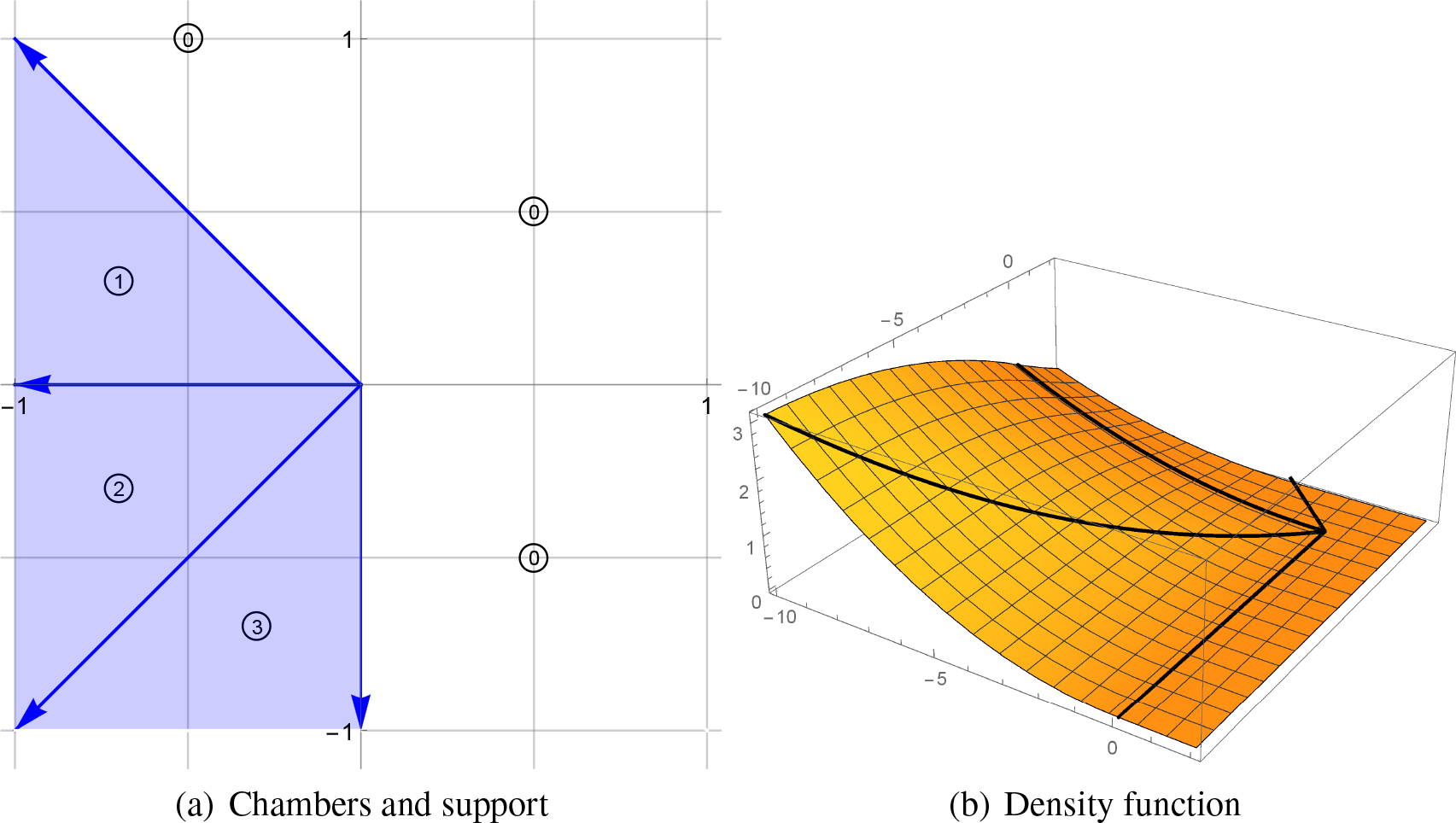
Figure 1.

The support of the iterated convolution and its density over the support.

Proof

The measure H(–2,2)H(–2,0)H(–2,–2)H(0,–2) is, in fact, the non-Abelian Duistermaat-Heckman measure that is on the closures of the regular chambers containing the vertex (0,0) given by the above convolution: δ(0,0)H(2,2)H(2,0)H(2,2)H(0,2).{\delta _{(0,0)}} \star {H_{( - 2,2)}} \star {H_{( - 2,0)}} \star {H_{( - 2, - 2)}} \star {H_{(0, - 2)}}.

Then its density is denote by p(r,s). Denote O(0, 0),P1(–2, 2),P2(–2, 0),P3(–2, –2),P4(0, –2). Then | OP1P2 |:=C1,| OP2P3 |:=C2,| OP3P4 |:=C3.\left| {O{P_1}{P_2}} \right|: = {C_1},\quad \left| {O{P_2}{P_3}} \right|: = {C_2},\quad \left| {O{P_3}{P_4}} \right|: = {C_3}.

Denote ℝ2C1C2C3 := C0. Thus 2=C0C1C2C3.{^2} = {C_0} \cup {C_1} \cup {C_2} \cup {C_3}.

  • (i)

    Clearly p ≡ 0 on C0.

    • The wall W01 separating C0 and C1 is given by the equation: r + s = 0. Its normal vector ξ = (–1, –1). Just only one weights ω1 = (–2,2) lies on the linear hyperplane spanned by W01 (other weights are outside of W01: ω2 = (–2,0), ω3 = (–2, –2), ω4 = (0, –2)).

    • Consider the push-forward of Lebesgue measure on 01_{0}^1 along the linear map PW01 : u1. Its density with respect to dw is given by a single homogeneous polynomial on the wall W01.

    • Denote by pW01 any polynomial function extending it to all of the dual Lie algebra of T˜{\tilde T}.

    • Clearly pW01=12{p_{{W_{01}}}} = {1 \over 2}. Indeed, pW011=dλ(ω1,ξ/ξ2)=| det(221/21/2) |=2pW01=12.\matrix{ {p_{{W_{01}}}^{ - 1} = {\rm{d}}\lambda \left( {{\omega _1},\xi /\xi {^2}} \right) = \left| {\det \left( {\matrix{ { - 2} & 2 \cr { - 1/2} & { - 1/2} \cr } } \right)} \right| = 2} \hfill \cr { \Leftrightarrow {p_{{W_{01}}}} = {1 \over 2}.} \hfill \cr }

Note that, during the proof, we abuse notation by using identical symbols for a differential form and its induced measure. Hence μ = (r, s) p(μ)=12Resz=0(eμ,x+zξk=24 ωk,x+zξ )x=0,p(\mu ) = {1 \over 2}{{\mathop{\rm Res}\nolimits} _{z = 0}}{\left( {{{{e^{\langle \mu ,x + z\xi \rangle }}} \over {\prod\nolimits_{k = 2}^4 {\left\langle {{\omega _k},x + z\xi } \right\rangle } }}} \right)_{x = {\bf{0}}}}, where eμ,x+zξk=24 ωk,x+zξ =exp(r(x1z)+s(x2z))[ 2(x1z) ][ [ 2(x1z)2(x2z) ] ][ 2(x2z) ].{{{e^{\langle \mu ,x + z\xi \rangle }}} \over {\prod\nolimits_{k = 2}^4 {\left\langle {{\omega _k},x + z\xi } \right\rangle } }} = {{\exp \left( {r\left( {{x_1} - z} \right) + s\left( {{x_2} - z} \right)} \right)} \over {\left[ { - 2\left( {{x_1} - z} \right)} \right]\left[ {\left[ { - 2\left( {{x_1} - z} \right) - 2\left( {{x_2} - z} \right)} \right]} \right]\left[ { - 2\left( {{x_2} - z} \right)} \right]}}.

Thus p(μ)=12×(18)Resz=0(exp(r(x1z)+s(x2z))(x1z)(x1+x22z)(x2z))x=0=132Resz=0(e(r+s)zz3)=164(r+s)2.\matrix{ {p(\mu )} \hfill & = \hfill & {{1 \over 2} \times \left( { - {1 \over 8}} \right){{{\mathop{\rm Res}\nolimits} }_{z = 0}}{{\left( {{{\exp \left( {r\left( {{x_1} - z} \right) + s\left( {{x_2} - z} \right)} \right)} \over {\left( {{x_1} - z} \right)\left( {{x_1} + {x_2} - 2z} \right)\left( {{x_2} - z} \right)}}} \right)}_{x = 0}}} \hfill \cr {} \hfill & = \hfill & {{1 \over {32}}{{{\mathop{\rm Res}\nolimits} }_{z = 0}}\left( {{{{e^{ - (r + s)z}}} \over {{z^3}}}} \right) = {1 \over {64}}{{(r + s)}^2}.} \hfill \cr }

  • (ii)

    The wall W12 separating C1 and C2 is given by the equation: s = 0. Its normal vector ξ = (0, –1). Just only one weights ω1 = (–2,0) lies on the linear hyperplane spanned by W12 (other weights are outside of W12: ω2 = (–2,2), ω3 = (–2, – 2), ω4 = (0, – 2)).

    • Consider the push-forward of Lebesgue measure on 01_{0}^1 along the linear map PW12 : 1. Its density with respect to dw is given by a single homogeneous polynomial on the wall W12.

    • Denote by pW12 any polynomial function extending it to all of the dual Lie algebra of T˜{\tilde T}. Clearly pW12=12{p_{{W_{12}}}} = {1 \over 2}. Indeed, pW121=dλ(ω1,ξ/ξ2)=| det(2001) |=2pW12=12.p_{{W_{12}}}^{ - 1} = {\rm{d}}\lambda \left( {{\omega _1},\xi /\xi {^2}} \right) = \left| {\det \left( {\matrix{ { - 2} & 0 \cr 0 & { - 1} \cr } } \right)} \right| = 2 \Leftrightarrow {p_{{W_{12}}}} = {1 \over 2}.

Hence p(μ)164(r+s)2=12Resz=0(eμ,x+zξk=24 ωk,x+zξ )x=0,p(\mu ) - {1 \over {64}}{(r + s)^2} = {1 \over 2}{{\mathop{\rm Res}\nolimits} _{z = 0}}{\left( {{{{e^{\left\langle {\mu ,x + z\xi } \right\rangle }}} \over {\prod\nolimits_{k = 2}^4 {\left\langle {{\omega _k},x + z\xi } \right\rangle } }}} \right)_{x = 0}}, where eμ,x+zξk=24 ωk,x+zξ =erx1+s(x2z)[ 2x1+2(x2z) ][ 2x12(x2z) ][ 2(x2z) ].{{{e^{\langle \mu ,x + z\xi \rangle }}} \over {\prod\nolimits_{k = 2}^4 {\left\langle {{\omega _k},x + z\xi } \right\rangle } }} = {{{e^{r{x_1} + s\left( {{x_2} - z} \right)}}} \over {\left[ { - 2{x_1} + 2\left( {{x_2} - z} \right)} \right]\left[ { - 2{x_1} - 2\left( {{x_2} - z} \right)} \right]\left[ { - 2\left( {{x_2} - z} \right)} \right]}}.

Thus p(μ)(r+s)264=12×18Resz=0(erx1+s(x2z)(x1x2+z)(x1+x2z)(x2z))x=0=116Resz=0(eszz3)=s232.\matrix{ {p(\mu ) - {{{{(r + s)}^2}} \over {64}}} \hfill \cr { = {1 \over 2} \times - {1 \over 8}{{{\mathop{\rm Res}\nolimits} }_{z = 0}}{{\left( {{{{e^{r{x_1} + s\left( {{x_2} - z} \right)}}} \over {\left( {{x_1} - {x_2} + z} \right)\left( {{x_1} + {x_2} - z} \right)\left( {{x_2} - z} \right)}}} \right)}_{x = 0}}} \hfill \cr { = - {1 \over {16}}{{{\mathop{\rm Res}\nolimits} }_{z = 0}}\left( {{{{e^{ - sz}}} \over {{z^3}}}} \right) = - {{{s^2}} \over {32}}.} \hfill \cr }

Therefore, on the chamber C2 p(μ)=p(r,s)=(r+s)264s232=r2+2rss264.p(\mu ) = p(r,s) = {{{{(r + s)}^2}} \over {64}} - {{{s^2}} \over {32}} = {{{r^2} + 2rs - {s^2}} \over {64}}.

  • (iii)

    The wall W23 separating C2 and C3 is given by the equation: rs = 0. Its normal vector ξ = (1, –1). Just only one weights ω1 = (–2, –2) lies on the linear hyperplane spanned by W23 (other weights are outside of W23: ω2 = (–2,2), ω3 = (–2, 0), ω4 = (0, –2)).

    • Consider the push-forward of Lebesgue measure on 01_{0}^1 along the linear map PW23 : u1. Its density with respect to dw is given by a single homogeneous polynomial on the wall W23.

    • Denote by pW23 any polynomial function extending it to all of the dual Lie algebra of T˜{\tilde T}. Clearly pW23=12{p_{{W_{23}}}} = {1 \over 2}.

Indeed,

pW231=dλ(ω1,ξ/ξ2)=| det(221/21/2) |=2pW23=12.p_{{W_{23}}}^{ - 1} = {\rm{d}}\lambda \left( {{\omega _1},\xi /\xi {^2}} \right) = \left| {\det \left( {\matrix{ { - 2} & { - 2} \cr {1/2} & { - 1/2} \cr } } \right)} \right| = 2 \Leftrightarrow {p_{{W_{23}}}} = {1 \over 2}.

Hence p(μ)r2+2rss264=12Resz=0(eμ,x+zξk=24 ωk,x+zξ )x=0,p(\mu ) - {{{r^2} + 2rs - {s^2}} \over {64}} = {1 \over 2}{{\mathop{\rm Res}\nolimits} _{z = 0}}{\left( {{{{e^{\langle \mu ,x + z\xi \rangle }}} \over {\prod\nolimits_{k = 2}^4 {\left\langle {{\omega _k},x + z\xi } \right\rangle } }}} \right)_{x = 0}}, where eμ,x+zξk=24 ωk,x+zξ =er(x1+z)+s(x2z)[ 2(x1+z)+2(x2z) ][ 2(x1+z) ][ 2(x2z) ].{{{e^{\langle \mu ,x + z\xi \rangle }}} \over {\prod\nolimits_{k = 2}^4 {\left\langle {{\omega _k},x + z\xi } \right\rangle } }} = {{{e^{r\left( {{x_1} + z} \right) + s\left( {{x_2} - z} \right)}}} \over {\left[ { - 2\left( {{x_1} + z} \right) + 2\left( {{x_2} - z} \right)} \right]\left[ { - 2\left( {{x_1} + z} \right)} \right]\left[ { - 2\left( {{x_2} - z} \right)} \right]}}.

Thus p(μ)r2+2rss264=12×18Resz=0(er(x1+z)+s(x2z)(x1x2+2z)(x1+z)(x2z))x=0=132Resz=0(e(rs)zz3)=(rs)264.\matrix{ {p(\mu ) - {{{r^2} + 2rs - {s^2}} \over {64}}} \hfill \cr { = {1 \over 2} \times - {1 \over 8}{{{\mathop{\rm Res}\nolimits} }_{z = 0}}{{\left( {{{{e^{r\left( {{x_1} + z} \right) + s\left( {{x_2} - z} \right)}}} \over {\left( {{x_1} - {x_2} + 2z} \right)\left( {{x_1} + z} \right)\left( {{x_2} - z} \right)}}} \right)}_{x = 0}}} \hfill \cr { = {1 \over {32}}{{{\mathop{\rm Res}\nolimits} }_{z = 0}}\left( {{{{e^{(r - s)z}}} \over {{z^3}}}} \right) = {{{{(r - s)}^2}} \over {64}}.} \hfill \cr }

Therefore, on the chamber C3 p(μ)=p(r,s)=r2+2rss264+(rs)264=r232.p(\mu ) = p(r,s) = {{{r^2} + 2rs - {s^2}} \over {64}} + {{{{(r - s)}^2}} \over {64}} = {{{r^2}} \over {32}}.

This completes the proof.

6.
Applications of Duistermaat-Heckman Measure

For λ=(λ1,λ2,λ3,λ4)03\lambda = \left( {{\lambda _1},{\lambda _2},{\lambda _3},{\lambda _4}} \right) \in _{0}^3 with λ1 > λ2 > λ3 > λ4 and k=14λk=1\sum\nolimits_{k = 1}^4 {{\lambda _k}} = 1, denote the SU(4)-adjoint orbit of Λ = diag(λ1, λ2, λ3, λ4) by UΛ:={ UΛU:USU(4) }.{{\cal U}_\Lambda }: = \left\{ {{\bf{U}}\Lambda {{\bf{U}}^\dag }:{\bf{U}} \in {\mathop{\rm SU}\nolimits} (4)} \right\}.

Let Λ^:=Λ𝟙44=diag(λ^1,λ^2,λ^3,λ^4).\hat \Lambda : = \Lambda - {{{_4}} \over 4} = {\mathop{\rm diag}\nolimits} \left( {{{\hat \lambda }_1},{{\hat \lambda }_2},{{\hat \lambda }_3},{{\hat \lambda }_4}} \right). where λ^k=λk14{{\hat \lambda }_k} = {\lambda _k} - {1 \over 4}. Denote by λ^=(λ^1,λ^2,λ^3,λ^4)\hat \lambda = \left( {{{\hat \lambda }_1},{{\hat \lambda }_2},{{\hat \lambda }_3},{{\hat \lambda }_4}} \right). Apparently λ^1>λ^2>λ^3>λ^4{{\hat \lambda }_1} > {{\hat \lambda }_2} > {{\hat \lambda }_3} > {{\hat \lambda }_4} and k=04λ^k=0\sum\nolimits_{k = 0}^4 {{{\hat \lambda }_k}} = 0. It is easily seen that Λ^ih,\hat \Lambda \in , where t is the Cartan subalgebra of 𝔰𝔲(4), the Lie algebra of SU(4). By chosing Ad-invariant inner product on 𝔱, we can identify 𝔱* with t. Let t˜\widetilde be the Lie algebra of maximal torus T˜{\tilde T} of K˜=SU(2)×SU(2)\tilde K = {\mathop{\rm SU}\nolimits} (2) \times {\mathop{\rm SU}\nolimits} (2).

Denote 44c3=2(λ^1+λ^2),c2=2(λ^1+λ^3),c1=2| λ^1+λ^4 |.{c_3} = 2\left( {{{\hat \lambda }_1} + {{\hat \lambda }_2}} \right),\quad {c_2} = 2\left( {{{\hat \lambda }_1} + {{\hat \lambda }_3}} \right),\quad {c_1} = 2\left| {{{\hat \lambda }_1} + {{\hat \lambda }_4}} \right|.

From the above definition, we infer that 45c3>c2>c1>0.{c_{\rm{3}}}\;{\rm{ > }}\;{c_{\rm{2}}}\;{\rm{ > }}\;{c_{\rm{1}}}\;{\rm{ > }}\;{\rm{0}}{\rm{.}}

Proposition 9.

Consider the Lie group K˜=SU(2)×SU(2)\tilde K = {\rm{SU}}(2) \times {\rm{SU}}(2) with its maximal torus T˜{\tilde T} whose Lie algebra is given by t˜\widetilde . The positive Weyl chamber it˜0*{\rm{i}}\widetilde {\rm{t}}_{0}^* can be identified with 02_{0}^2.

Proof.

The Lie group SU (2) has a rank one Lie algebra, 𝔰𝔲(2), with Cartan subalgebra 𝔥 spanned by H = |0〉〈0| – |1〉〈1|. The root system is of a single positive root α satisfying α(H) = 2. The positive Weyl chamber is a subset of the Cartan subalgebra 𝔥 defined by the condition that all positive roots take nonnegative values. Any element h ∈ i𝔥 can be expressed as h = zH for some z ∈ ℝ. Then α(h) = (H) = 2z ⩾ 0. Geometrically, 𝔥 ≌ ℝ. Thus, the positive Weyl chamber for SU(2) is the set of all nonnegative multipliers of H, i.e., h0={zH:z0}0.{_{0}} = \{ z{\bf{H}}:z\;\;0\} \cong {_{0}}.

The Lie group K˜=SU(2)×SU(2)\tilde K = {\rm{SU}}(2) \times {\rm{SU}}(2) has rank two. Its Lie algebra is , and the Cartan subalgebra t˜\tilde K = {\rm{SU}}(2) \times {\rm{SU}}(2) is spanned by the generators H1 from the first su(2) factor and H2 from the second 𝔰𝔲(2) factor. Using the standard representation, the generators areH1=H|00| and H2=H|11|.\widetilde {\rm{t}}

The root system of K˜=SU(2)×SU(2){H_1} = H \otimes |0\rangle \langle 0|{\rm{ and }}{H_2} = H \otimes |1\rangle \langle 1|. is the disjoint union of the root systems of each SU(2) factor. The positive roots are α1 for the first factor and α2 for the second factor, defined α1(H1)=2,α1(H2)=0,α2(H1)=0,α2(H2)=2.\tilde K = {\rm{SU}}(2) \times {\rm{SU}}(2)

The positive Weyl chamber is the subset of the Cartan subalgebra where all positive roots take non-negative values. For an element h=z1H1+z2H2it˜h = {z_1}{{\bf{H}}_1} + {z_2}{{\bf{H}}_2} \in \widetilde , the conditions are α1(h)=α1(z1H2+z2H2)=2z1+0z2=2z10,α2(h)=α2(z1H2+z2H2)=0z1+2z2=2z20.\matrix{ {{\alpha _1}(h) = {\alpha _1}\left( {{z_1}{{\bf{H}}_2} + {z_2}{{\bf{H}}_2}} \right) = 2{z_1} + 0{z_2} = 2{z_1}\;\;0,} \hfill \cr {{\alpha _2}(h) = {\alpha _2}\left( {{z_1}{{\bf{H}}_2} + {z_2}{{\bf{H}}_2}} \right) = 0{z_1} + 2{z_2} = 2{z_2}\;\;0.} \hfill \cr }

Thus, the positive Weyl chamber is identified with it˜0={ z1H1+z2H2:z10,z20 }02.{\rm{i}}{\widetilde {\rm{t}}_{0}} = \left\{ {{z_1}{{\bf{H}}_1} + {z_2}{{\bf{H}}_2}:{z_1}\;\;0,{z_2}\;\;0} \right\} \cong _{0}^2.

We are done.

With it˜0*02\widetilde {\rm{t}}_{0}^* \cong _{0}^2, we have already seen that 46DHOλ^K˜|it˜0*=wS4sign(w)δπ(wλ^)H(2,0)H(2,2)H(0,2)H(2,2)|i˜0*{\left. {{\rm{DH}}_{{{\cal O}_{\hat \lambda }}}^{\tilde K}} \right|_{{\rm{i}}\widetilde _{0}^*}} = {\left. {\sum\limits_{w \in {S_4}} {{\mathop{\rm sign}\nolimits} } (w){\delta _{\pi (w\hat \lambda )}} \star {H_{( - 2,0)}} \star {H_{( - 2, - 2)}} \star {H_{(0, - 2)}} \star {H_{( - 2,2)}}} \right|_{\widetilde _{0}^*}} is supported on it˜0*{\rm{i}}\widetilde {\rm{t}}_{0}^*, which amounts to be also supported on 02_{0}^2. We can write it in the following form:

Proposition 10.

For K˜=SU(2)×SU(2)\tilde K = {\rm{SU}}(2) \times {\rm{SU}}(2), it holds that 47DHOλ^K˜|02=wS4sign(w)δπ(wλ^)H(2,0)H(2,2)H(0,2)H(2,2)|02{\left. {{\rm{DH}}_{{{\cal O}_{\hat \lambda }}}^{\tilde K}} \right|_{_{0}^2}} = {\left. {\sum\limits_{w \in {S_4}} {{\mathop{\rm sign}\nolimits} } (w){\delta _{\pi (w\hat \lambda )}} \star {H_{( - 2,0)}} \star {H_{( - 2, - 2)}} \star {H_{(0, - 2)}} \star {H_{( - 2,2)}}} \right|_{_{0}^2}} with its density function being given by 48wS4sign(w)δπ(wλ^)p(x,y)|02=(δ(c2,±c1)δ(c1,c2)+δ(c1,c3)δ(c3,±c1)+δ(c3,±c2)δ(c2,c3))p(x,y)|02,\matrix{ {{{\left. {\sum\limits_{w \in {S_4}} {{\mathop{\rm sign}\nolimits} } (w){\delta _{\pi (w\hat \lambda )}} \star p(x,y)} \right|}_{_{0}^2}}} \hfill \cr { = {{\left. {\left( {{\delta _{\left( {{c_2}, \pm {c_1}} \right)}} - {\delta _{\left( {{c_1},{c_2}} \right)}} + {\delta _{\left( {{c_1},{c_3}} \right)}} - {\delta _{\left( {{c_3}, \pm {c_1}} \right)}} + {\delta _{\left( {{c_3}, \pm {c_2}} \right)}} - {\delta _{\left( {{c_2},{c_3}} \right)}}} \right) \star p(x,y)} \right|}_{_{0}^2}},} \hfill \cr } where the expression of p(x, y) is from Proposition 8.

Proof

Sketch of proof can be given for Eq. (48): Indeed, we have already known the support of p(x, y) is k=13Ck \cup _{k = 1}^3{C_k}. Then the support of (δπ(wλ^)p)(x,y)\left( {{\delta _{\pi (w\hat \lambda )}} \star p} \right)(x,y) is the shifted version of k=13Ck \cup _{k = 1}^3{C_k} to the point π(wλ^)\pi (w\hat \lambda ). However, points whose corresponding shifted supports do not intersect with >02_{ > 0}^2 do not contribute to the density. In other words, by calculation, we find that it remains only 9 points can contribute to the density.

Remark 4.

Moreover, the non-Abelian moment polytope for the action of K˜=SU(2)×SU(2)\tilde K = {\rm{SU}}(2) \times {\rm{SU}}(2) on a generic coadjoint K = SU (4)-orbit can be identified as 49ΔK˜(Oλ^):={ (x,y)[ 0,c3 ]2:x+yc2+c3,|xy|c3c1 },{\Delta _{\tilde K}}\left( {{{\cal O}_{\hat \lambda }}} \right): = \left\{ {(x,y) \in {{\left[ {0,{c_3}} \right]}^2}:x + y\;\;{c_2} + {c_3},|x - y|\;{c_3} - {c_1}} \right\}, where ck’s are from Eq. (44). This is just the support of the density in Eq. (48). Based on the constraint Eq. (49), we can re-derive the compatibility solution for two-qubit quantum marginal problem. Let me describe it below: Let ρAB ∈ D(ℂ2 ⊗ ℂ2) with two reduced states (ρA, ρB), where the eigenvalues of ρAB are ordered non-increasingly as λ1 ⩾ ⋯ ⩾ λ4 ⩾ 0, and the minimal eigenvalue of ρX(X = A, B) is denoted by λmin. Via λ^j=λj14{{\hat \lambda }_j} = {\lambda _j} - {1 \over 4} for j ∈ {1,2,3,4} and x = 1 – 2λmin(ρ1) and y = 1 – 2λmin(ρ2), we see that the condition x ∈ [0, c3] can be rewritten as 50min{ λmin(ρA),λmin(ρB) }λ3(ρAB)+λ4(ρAB);\min \left\{ {{\lambda _{\min }}\left( {{\rho _A}} \right),{\lambda _{\min }}\left( {{\rho _B}} \right)} \right\}\;\;{\lambda _3}\left( {{\rho _{AB}}} \right) + {\lambda _4}\left( {{\rho _{AB}}} \right); and the condition x + yc2 + c3 can be rewritten as 51λmin(ρA)+λmin(ρB)λ2(ρAB)+λ3(ρAB)+2λ4(ρAB);{\lambda _{\min }}\left( {{\rho _A}} \right) + {\lambda _{\min }}\left( {{\rho _B}} \right)\;\;{\lambda _2}\left( {{\rho _{AB}}} \right) + {\lambda _3}\left( {{\rho _{AB}}} \right) + 2{\lambda _4}\left( {{\rho _{AB}}} \right); and the condition |xy| ⩽ c3c1 can be rewritten as 52| λmin(ρA)λmin(ρB) |min{ λ1(ρAB)λ3(ρAB),λ2(ρAB)λ4(ρAB) }.\left| {{\lambda _{\min }}\left( {{\rho _A}} \right) - {\lambda _{\min }}\left( {{\rho _B}} \right)} \right|\;\;\min \left\{ {{\lambda _1}\left( {{\rho _{AB}}} \right) - {\lambda _3}\left( {{\rho _{AB}}} \right),{\lambda _2}\left( {{\rho _{AB}}} \right) - {\lambda _4}\left( {{\rho _{AB}}} \right)} \right\}.

In summary, for any given 2-tuple (ρA, ρB) of qubit states, there exists a global two-qubit states ρAB such that ρA = TrA(ρAB) and ρB = TrA(ρAB) if and only if the three compatibility conditions Eqs. (50)(52) hold. This result is obtained already by Bravyi [26].

Consider the pushforward measure F*(μOλ^){F_*}\left( {{\mu _{{{\cal O}_{\hat \lambda }}}}} \right) of Liouville measure μOλ^{\mu _{{{\cal O}_{\hat \lambda }}}} along the map F:Oλ^i𝔥0*0F:{{\cal O}_{\hat \lambda }} \to i_{0}^* \cong {_{0}}, where 𝔥0*_{0}^* is the dual Cartan subalgebra of 𝔰𝔲(2) and F = q1π ∘ Φ, 53F:Oλ^(k*)Φik*πit˜0*=i𝔥0*ih0*q1ih0*.F:{{\cal O}_{\hat \lambda }}\left( { \subset {^*}} \right)\mathop \limits^\Phi {\rm{i}}{^*}\buildrel \pi \over \longrightarrow {\rm{i}}\widetilde _{0}^* = {\rm{i}}_{0}^* \oplus {\rm{i}}_{0}^*\buildrel {{q_1}} \over \longrightarrow {\rm{i}}_{0}^*.

Proposition 11.

The pushforward measure F*μOλ^{F_*}{\mu _{{{\cal O}_{\hat \lambda }}}} is just 54F*(μOλ^)=(q1)*π*Φ*(μOλ^)=(q1)*(pK˜DHOλ^K˜){F_*}\left( {{\mu _{{{\cal O}_{\hat \lambda }}}}} \right) = {\left( {{q_1}} \right)_*}{\pi _*}{\Phi _*}\left( {{\mu _{{{\cal O}_{\hat \lambda }}}}} \right) = {\left( {{q_1}} \right)_*}\left( {{p_{\tilde K}}{\rm{DH}}_{{{\cal O}_{\hat \lambda }}}^{\tilde K}} \right) whose density function is given by (2π)6(xλ^){(2\pi )^6}{\cal I}(x\mid \hat \lambda ), where (xλ^):=02xy[ (δ(c2,±c1)δ(c1,c2)+δ(c1,c3)δ(c3,±c1)+δ(c3,±c2)δ(c2,c3))*p ](x,y)dxdy,{\cal I}(x\mid \hat \lambda ): = \int_{_{0}^2} x y\left[ {\left( {{\delta _{\left( {{c_2}, \pm {c_1}} \right)}} - {\delta _{\left( {{c_1},{c_2}} \right)}} + {\delta _{\left( {{c_1},{c_3}} \right)}} - {\delta _{\left( {{c_3}, \pm {c_1}} \right)}} + {\delta _{\left( {{c_3}, \pm {c_2}} \right)}} - {\delta _{\left( {{c_2},{c_3}} \right)}}} \right)*p} \right](x,y){\rm{d}}x{\rm{d}}y, where the expression of p(x, y) is from Proposition 8. Moreover, it holds that 55(xλ^)=1(xλ^)+2(xλ^)+3(xλ^),{\cal I}(x\mid \hat \lambda ) = {{\cal I}_1}(x\mid \hat \lambda ) + {{\cal I}_2}(x\mid \hat \lambda ) + {{\cal I}_3}(x\mid \hat \lambda ), where 561(xλ^)=c32c2264x(xc1)2χ[ 0,c1 ](x),{{\cal I}_1}(x\mid \hat \lambda ) = {{c_3^2 - c_2^2} \over {64}}x{\left( {x - {c_1}} \right)^2}{\chi _{\left[ {0,{c_1}} \right]}}(x), 572(xλ^)=c12c3264x(xc2)2χ[ 0,c2 ](x),{{\cal I}_2}(x\mid \hat \lambda ) = {{c_1^2 - c_3^2} \over {64}}x{\left( {x - {c_2}} \right)^2}{\chi _{\left[ {0,{c_2}} \right]}}(x), 583(xλ^)=c22c1264x(xc3)2χ[ 0,c3 ](x),{{\cal I}_3}(x\mid \hat \lambda ) = {{c_2^2 - c_1^2} \over {64}}x{\left( {x - {c_3}} \right)^2}{\chi _{\left[ {0,{c_3}} \right]}}(x), where ck’s are from Eq. (44), and χA(x) is the indicator of a set A.

Proof

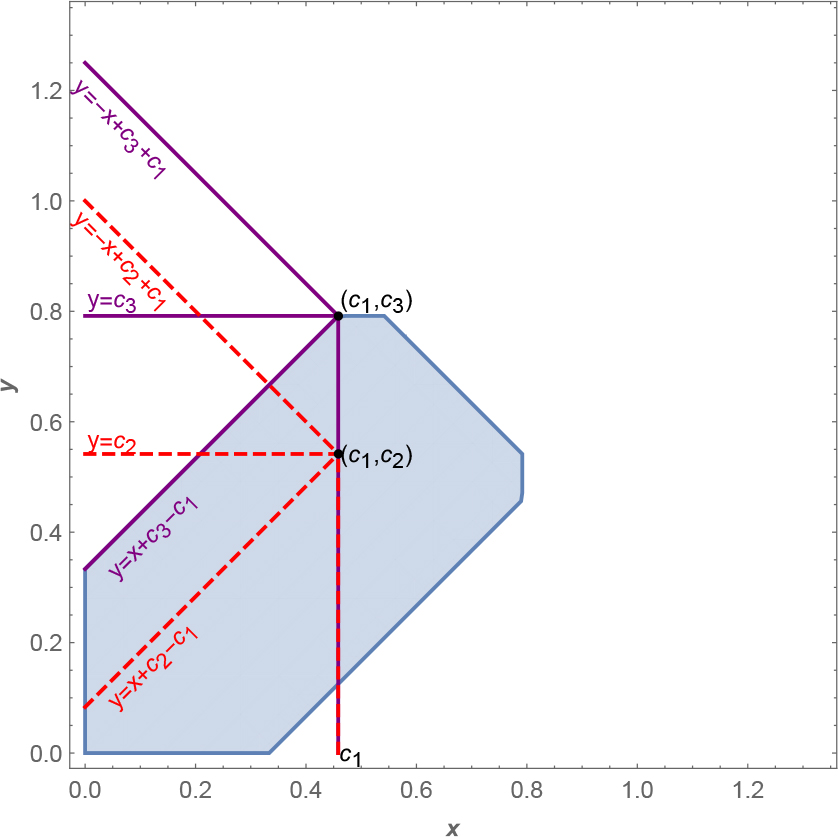
Note that pK˜(x2h,y2h)=pSU(2)(x2h)pSU(2)(y2h)=xy{p_{\tilde K}}\left( {{x \over 2}{\bf{h}},{y \over 2}{\bf{h}}} \right) = {p_{{\rm{SU}}(2)}}\left( {{x \over 2}{\bf{h}}} \right){p_{{\rm{SU}}(2)}}\left( {{y \over 2}{\bf{h}}} \right) = xy We consider the following integral (xλ^):=02xy[ (δ(c2,±c1)δ(c1,c2)+δ(c1,c3)δ(c3,±c1)+δ(c3,±c2)δ(c2,c3))p ](x,y)dxdy=02xy[ (δ(c1,c3)δ(c1,c2))p ](x,y)dxdy+02xy[ (δ(c2,c3)+δ(c2,c1)+δ(c2,c1))p ](x,y)dxdy+02xy[ (δ(c3,c2)+δ(c3,c2)δ(c3,c1)δ(c3,c1))p ](x,y)dxdy\matrix{ {{\cal I}(x\mid \hat \lambda ): = \int_{_{0}^2} x y\left[ {\left( {{\delta _{\left( {{c_2}, \pm {c_1}} \right)}} - {\delta _{\left( {{c_1},{c_2}} \right)}} + {\delta _{\left( {{c_1},{c_3}} \right)}} - {\delta _{\left( {{c_3}, \pm {c_1}} \right)}} + {\delta _{\left( {{c_3}, \pm {c_2}} \right)}} - {\delta _{\left( {{c_2},{c_3}} \right)}}} \right) \star p} \right](x,y){\rm{d}}x{\rm{d}}y} \hfill \cr { = \int_{_{0}^2} x y\left[ {\left( {{\delta _{\left( {{c_1},{c_3}} \right)}} - {\delta _{\left( {{c_1},{c_2}} \right)}}} \right) \star p} \right](x,y){\rm{d}}x{\rm{d}}y} \hfill \cr {\;\; + \int_{_{0}^2} x y\left[ {\left( { - {\delta _{\left( {{c_2},{c_3}} \right)}} + {\delta _{\left( {{c_2},{c_1}} \right)}} + {\delta _{\left( {{c_2}, - {c_1}} \right)}}} \right) \star p} \right](x,y){\rm{d}}x{\rm{d}}y} \hfill \cr {\;\; + \int_{_{0}^2} x y\left[ {\left( {{\delta _{\left( {{c_3},{c_2}} \right)}} + {\delta _{\left( {{c_3}, - {c_2}} \right)}} - {\delta _{\left( {{c_3},{c_1}} \right)}} - {\delta _{\left( {{c_3}, - {c_1}} \right)}}} \right) \star p} \right](x,y){\rm{d}}x{\rm{d}}y} \hfill \cr } which is the density of the Duistermaat-Heckman measure with respect to the Lebesgue measure on the positive Weyl chamber (which is identified with 02_{0}^2) of SU(2) × SU(2). Denote by 591(xλ^)=02xy[ (δ(c1,c3)δ(c1,c2))p ](x,y)dxdy,{{\cal I}_1}(x\mid \hat \lambda ) = \int_{_{0}^2} x y\left[ {\left( {{\delta _{\left( {{c_1},{c_3}} \right)}} - {\delta _{\left( {{c_1},{c_2}} \right)}}} \right) \star p} \right](x,y){\rm{d}}x{\rm{d}}y, 602(xλ^)=02xy[ (δ(c2,c3)+δ(c2,c1)+δ(c2,c1))p ](x,y)dxdy,{{\cal I}_2}(x\mid \hat \lambda ) = \int_{_{0}^2} x y\left[ {\left( { - {\delta _{\left( {{c_2},{c_3}} \right)}} + {\delta _{\left( {{c_2},{c_1}} \right)}} + {\delta _{\left( {{c_2}, - {c_1}} \right)}}} \right) \star p} \right](x,y){\rm{d}}x{\rm{d}}y, 613(xλ^)=02xy[ (δ(c3,c2)+δ(c3,c2)δ(c3,c1)δ(c3,c1))p ](x,y)dxdy.{{\cal I}_3}(x\mid \hat \lambda ) = \int_{_{0}^2} x y\left[ {\left( {{\delta _{\left( {{c_3},{c_2}} \right)}} + {\delta _{\left( {{c_3}, - {c_2}} \right)}} - {\delta _{\left( {{c_3},{c_1}} \right)}} - {\delta _{\left( {{c_3}, - {c_1}} \right)}}} \right) \star p} \right](x,y){\rm{d}}x{\rm{d}}y.

Note that c1=2| λ^1+λ^4 |=2| λ^2+λ^3 |{c_1} = 2\left| {{{\hat \lambda }_1} + {{\hat \lambda }_4}} \right| = 2\left| {{{\hat \lambda }_2} + {{\hat \lambda }_3}} \right| because λ^1+λ^4=(λ^2+λ^3){{\hat \lambda }_1} + {{\hat \lambda }_4} = - \left( {{{\hat \lambda }_2} + {{\hat \lambda }_3}} \right). Thus c1=max{ λ^1+λ^4,λ^2+λ^3 }.{c_1} = \max \left\{ {{{\hat \lambda }_1} + {{\hat \lambda }_4},{{\hat \lambda }_2} + {{\hat \lambda }_3}} \right\}.

  • (a)

    The range [0, c3] of parameter x can be decomposed into two parts [0, c3] = [0, c1] ∪ [c1, c3]. In order to calculate ℐ1, note that ℐ1 ≡ 0 if x ∈ [c1, c3], it suffices to calculate it for x ∈ [0, c1]. Thus 1(xλ^)=0x+c3c1xy·p3(xc1,yc3)dy+x+c3c1c3xyp2(xc1,yc3)dy+c3x+c3+c1xy·p1(xc1,yc3)dy0x+c2c1xyp3(xc1,yc2)dyx+c2c1c2xy·p2(xc1,yc2)dyc2x+c1+c2xyp1(xc1,yc2)dy=c32c2264x(xc1)2,\matrix{ {{{\cal I}_1}(x\mid \hat \lambda )} \hfill & = \hfill & {\int_0^{x + {c_3} - {c_1}} x y\cdot{p_3}\left( {x - {c_1},y - {c_3}} \right){\rm{d}}y + \int_{x + {c_3} - {c_1}}^{{c_3}} x y \cdot {p_2}\left( {x - {c_1},y - {c_3}} \right){\rm{d}}y} \hfill \cr {} \hfill & {} \hfill & { + \int_{{c_3}}^{ - x + {c_3} + {c_1}} x y\cdot{p_1}\left( {x - {c_1},y - {c_3}} \right){\rm{d}}y - \int_0^{x + {c_2} - {c_1}} x y \cdot {p_3}\left( {x - {c_1},y - {c_2}} \right){\rm{d}}y} \hfill \cr {} \hfill & {} \hfill & { - \int_{x + {c_2} - {c_1}}^{{c_2}} x y\cdot{p_2}\left( {x - {c_1},y - {c_2}} \right){\rm{d}}y - \int_{{c_2}}^{ - x + {c_1} + {c_2}} x y \cdot {p_1}\left( {x - {c_1},y - {c_2}} \right){\rm{d}}y} \hfill \cr {} \hfill & = \hfill & {{{c_3^2 - c_2^2} \over {64}}x{{\left( {x - {c_1}} \right)}^2},} \hfill \cr } which leads to 62I1(xλ^)={ c32c2264x(xc1)2, if x[ 0,c1 ],0, if x[ c1,c3 ]. {{\cal I}_1}(x\mid \hat \lambda ) = \left\{ {\matrix{ {{{c_3^2 - c_2^2} \over {64}}x{{\left( {x - {c_1}} \right)}^2},} \hfill & {{\rm{ if }}x \in \left[ {0,{c_1}} \right],} \hfill \cr {0,} \hfill & {{\rm{ if }}x \in \left[ {{c_1},{c_3}} \right].} \hfill \cr } } \right.

    With the help of the following Figure 2, the above calculation is easily obtained.

  • (b)

    The range [0, c3] of parameter x can be decomposed into three parts: [0, c3] = [0, c2c1] ∪ [c2c1, c2] ∪ [c2, c3]. Note that I2 ≡ 0 when x ∈ [c2, c3]. It suffices to calculate I2 on [0, c2c1] ∩ [c2c1, c2]. See the following Figure 3.

    • (b1)

      For x ∈ [0, c2c1], we see that I2(xλ^)=0x+c3c2xyp3(xc2,yc3)dyx+c3c2c3xyp2(xc2,yc3)dyc3x+c3+c2xyp1(xc2,yc3)dy+0c1xyp2(xc2,yc1)dy+c1x+c2+c1xyp3(xc2,yc1)dy+0x+c2c1xyp3(xc2,y+c1)dy=c12c3264x(xc2)2\matrix{ {{{\cal I}_2}(x\mid \hat \lambda )} \hfill & = \hfill & { - \int_0^{x + {c_3} - {c_2}} x y{p_3}\left( {x - {c_2},y - {c_3}} \right){\rm{d}}y - \int_{x + {c_3} - {c_2}}^{{c_3}} x y{p_2}\left( {x - {c_2},y - {c_3}} \right){\rm{d}}y} \hfill \cr {} \hfill & {} \hfill & { - \int_{{c_3}}^{ - x + {c_3} + {c_2}} x y{p_1}\left( {x - {c_2},y - {c_3}} \right){\rm{d}}y + \int_0^{{c_1}} x y{p_2}\left( {x - {c_2},y - {c_1}} \right){\rm{d}}y} \hfill \cr {} \hfill & {} \hfill & { + \int_{{c_1}}^{ - x + {c_2} + {c_1}} x y{p_3}\left( {x - {c_2},y - {c_1}} \right){\rm{d}}y + \int_0^{ - x + {c_2} - {c_1}} x y{p_3}\left( {x - {c_2},y + {c_1}} \right){\rm{d}}y} \hfill \cr {} \hfill & = \hfill & {{{c_1^2 - c_3^2} \over {64}}x{{\left( {x - {c_2}} \right)}^2}} \hfill \cr }

    • (b2)

      For x ∈ [c2c1, c2], I2(xλ^)=0x+c3c2xyp3(xc2,yc3)dyx+c3c2c3xyp2(xc2,yc3)dyc3x+c3+c2xyp1(xc2,yc3)dy+0x+c1c2xyp3(xc2,yc1)dy+x+c1c2c1xyp2(xc2,yc1)dy+c1x+c2+c1xyp1(xc2,yc1)dy=c12c3264x(xc2)2\matrix{ {{{\cal I}_2}(x\mid \hat \lambda )} \hfill & = \hfill & { - \int_0^{x + {c_3} - {c_2}} x y{p_3}\left( {x - {c_2},y - {c_3}} \right){\rm{d}}y - \int_{x + {c_3} - {c_2}}^{{c_3}} x y{p_2}\left( {x - {c_2},y - {c_3}} \right){\rm{d}}y} \hfill \cr {} \hfill & {} \hfill & { - \int_{{c_3}}^{ - x + {c_3} + {c_2}} x y{p_1}\left( {x - {c_2},y - {c_3}} \right){\rm{d}}y + \int_0^{x + {c_1} - {c_2}} x y{p_3}\left( {x - {c_2},y - {c_1}} \right){\rm{d}}y} \hfill \cr {} \hfill & {} \hfill & { + \int_{x + {c_1} - {c_2}}^{{c_1}} x y{p_2}\left( {x - {c_2},y - {c_1}} \right){\rm{d}}y + \int_{{c_1}}^{ - x + {c_2} + - {c_1}} x y{p_1}\left( {x - {c_2},y - {c_1}} \right){\rm{d}}y} \hfill \cr {} \hfill & = \hfill & {{{c_1^2 - c_3^2} \over {64}}x{{\left( {x - {c_2}} \right)}^2}} \hfill \cr }

This leads to 63I2(xλ^)={ c12c3264x(xc2)2, if x[ 0,c2 ],0, if x[ c2,c3 ]. {{\cal I}_2}(x\mid \hat \lambda ) = \left\{ {\matrix{ {{{c_1^2 - c_3^2} \over {64}}x{{\left( {x - {c_2}} \right)}^2},} \hfill & {{\rm{ if }}x \in \left[ {0,{c_2}} \right],} \hfill \cr {0,} \hfill & {{\rm{ if }}x \in \left[ {{c_2},{c_3}} \right].} \hfill \cr } } \right.

  • (c)

    The range [0, c3] of parameter x can be decomposed into three parts: [0, c3] = [0, c3c2] ∪ [c3c2, c3c1] ∪ [c3c1, c3]. It suffices to calculate I2 on [0, c2c1] ∪ [c2c1, c2]. See the following Figure 4.

    • (c1)

      For x ∈ [0, c3c2], we see that I3(xλ^)==0c2xyp2(xc3,yc2)dxdy+c2x+c3+c2xyp1(xc3,yc2)dxdy+0x+c3c2xyp1(xc3,y+c2)dxdy0c1xyp2(xc3,yc1)dxdyc1x+c3+c1xyp1(xc3,yc1)dxdy0x+c3c1xyp1(xc3,y+c1)dxdy=c22c1264x(xc3)2\matrix{ {{{\cal I}_3}(x\mid \hat \lambda )} \hfill & = \hfill & { = \int_0^{{c_2}} x y{p_2}\left( {x - {c_3},y - {c_2}} \right){\rm{d}}x{\rm{d}}y + \int_{{c_2}}^{ - x + {c_3} + {c_2}} x y{p_1}\left( {x - {c_3},y - {c_2}} \right){\rm{d}}x{\rm{d}}y} \hfill \cr {} \hfill & {} \hfill & { + \int_0^{ - x + {c_3} - {c_2}} x y{p_1}\left( {x - {c_3},y + {c_2}} \right){\rm{d}}x{\rm{d}}y - \int_0^{{c_1}} x y{p_2}\left( {x - {c_3},y - {c_1}} \right){\rm{d}}x{\rm{d}}y} \hfill \cr {} \hfill & {} \hfill & { - \int_{{c_1}}^{ - x + {c_3} + {c_1}} x y{p_1}\left( {x - {c_3},y - {c_1}} \right){\rm{d}}x{\rm{d}}y - \int_0^{ - x + {c_3} - {c_1}} x y{p_1}\left( {x - {c_3},y + {c_1}} \right){\rm{d}}x{\rm{d}}y} \hfill \cr {} \hfill & = \hfill & {{{c_2^2 - c_1^2} \over {64}}x{{\left( {x - {c_3}} \right)}^2}} \hfill \cr }

    • (c2)

      For x ∈ [c3c2, c3c1], I3(xλ^)=0x+c2c3xyp3(xc3,yc2)dxdy+x+c2c3c2xyp2(xc3,yc2)dxdy+c2x+c3+c2xyp1(xc3,yc2)dxdy0c1xyp2(xc3,yc1)dxdyc1x+c3+c1xyp1(xc3,yc1)dxdy0x+c3c1xyp1(xc3,y+c1)dxdy=c22c1264x(xc3)2\matrix{ {{{\cal I}_3}(x\mid \hat \lambda )} \hfill & = \hfill & {\int_0^{x + {c_2} - {c_3}} x y{p_3}\left( {x - {c_3},y - {c_2}} \right){\rm{d}}x{\rm{d}}y + \int_{x + {c_2} - {c_3}}^{{c_2}} x y{p_2}\left( {x - {c_3},y - {c_2}} \right){\rm{d}}x{\rm{d}}y} \hfill \cr {} \hfill & {} \hfill & { + \int_{{c_2}}^{ - x + {c_3} + {c_2}} x y{p_1}\left( {x - {c_3},y - {c_2}} \right){\rm{d}}x{\rm{d}}y - \int_0^{{c_1}} x y{p_2}\left( {x - {c_3},y - {c_1}} \right){\rm{d}}x{\rm{d}}y} \hfill \cr {} \hfill & {} \hfill & { - \int_{{c_1}}^{ - x + {c_3} + {c_1}} x y{p_1}\left( {x - {c_3},y - {c_1}} \right){\rm{d}}x{\rm{d}}y - \int_0^{ - x + {c_3} - {c_1}} x y{p_1}\left( {x - {c_3},y + {c_1}} \right){\rm{d}}x{\rm{d}}y} \hfill \cr {} \hfill & = \hfill & {{{c_2^2 - c_1^2} \over {64}}x{{\left( {x - {c_3}} \right)}^2}} \hfill \cr }

    • (c3)

      For x ∈ [c3c1, c3], I3(xλ^)=0x+c2c3xyp3(xc3,yc2)dxdy+x+c2c3c2xyp2(xc3,yc2)dxdy+c2x+c2+c3xyp1(xc3,yc2)dxdy0x+c1c3xyp3(xc3,yc1)dxdyx+c1c3c1xyp2(xc3,yc1)dxdyc1x+c3+c1xyp1(xc3,yc1)dxdy=c22c1264x(xc3)2\matrix{ {{{\cal I}_3}(x\mid \hat \lambda )} \hfill & = \hfill & {\int_0^{x + {c_2} - {c_3}} x y{p_3}\left( {x - {c_3},y - {c_2}} \right){\rm{d}}x{\rm{d}}y + \int_{x + {c_2} - {c_3}}^{{c_2}} x y{p_2}\left( {x - {c_3},y - {c_2}} \right){\rm{d}}x{\rm{d}}y} \hfill \cr {} \hfill & {} \hfill & { + \int_{{c_2}}^{ - x + {c_2} + {c_3}} x y{p_1}\left( {x - {c_3},y - {c_2}} \right){\rm{d}}x{\rm{d}}y - \int_0^{x + {c_1} - {c_3}} x y{p_3}\left( {x - {c_3},y - {c_1}} \right){\rm{d}}x{\rm{d}}y} \hfill \cr {} \hfill & {} \hfill & { - \int_{x + {c_1} - {c_3}}^{{c_1}} x y{p_2}\left( {x - {c_3},y - {c_1}} \right){\rm{d}}x{\rm{d}}y - \int_{{c_1}}^{ - x + {c_3} + {c_1}} x y{p_1}\left( {x - {c_3},y - {c_1}} \right){\rm{d}}x{\rm{d}}y} \hfill \cr {} \hfill & = \hfill & {{{c_2^2 - c_1^2} \over {64}}x{{\left( {x - {c_3}} \right)}^2}} \hfill \cr }

Figure 2.

The calculation of I1 over the non-Abelian moment polytope.
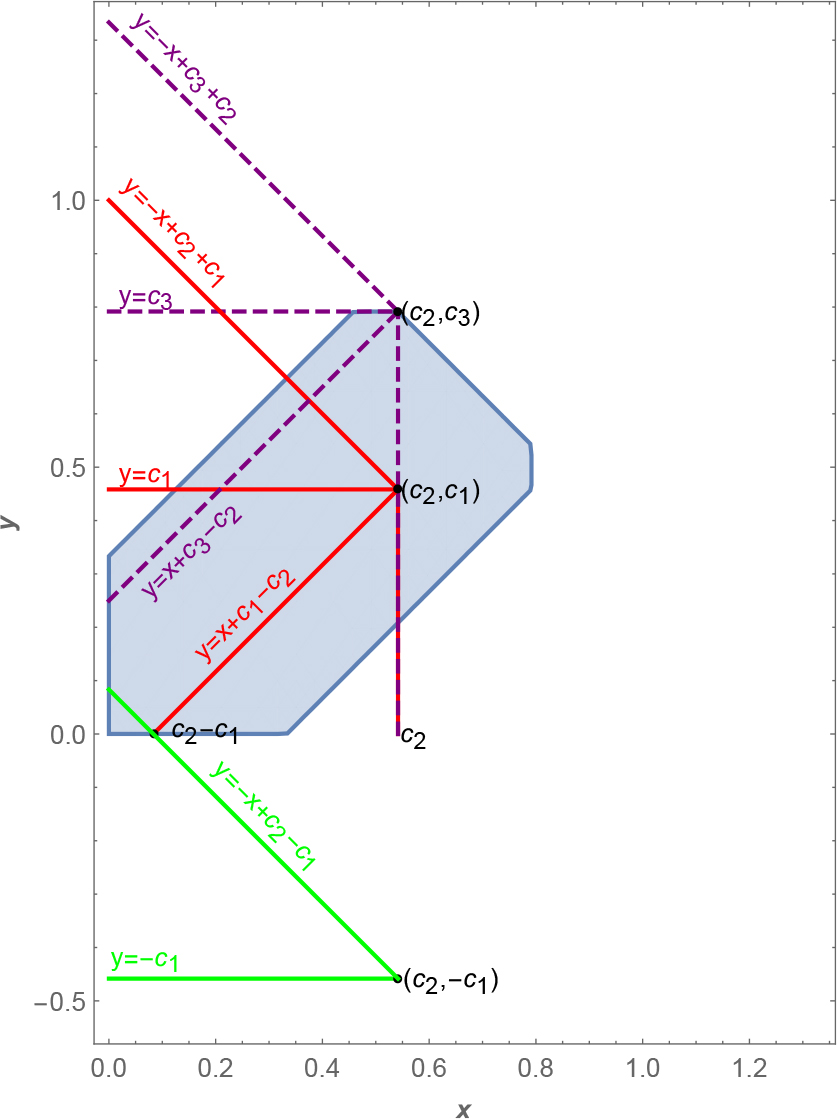
Figure 3.

The calculation of I2 over the non-Abelian moment polytope.
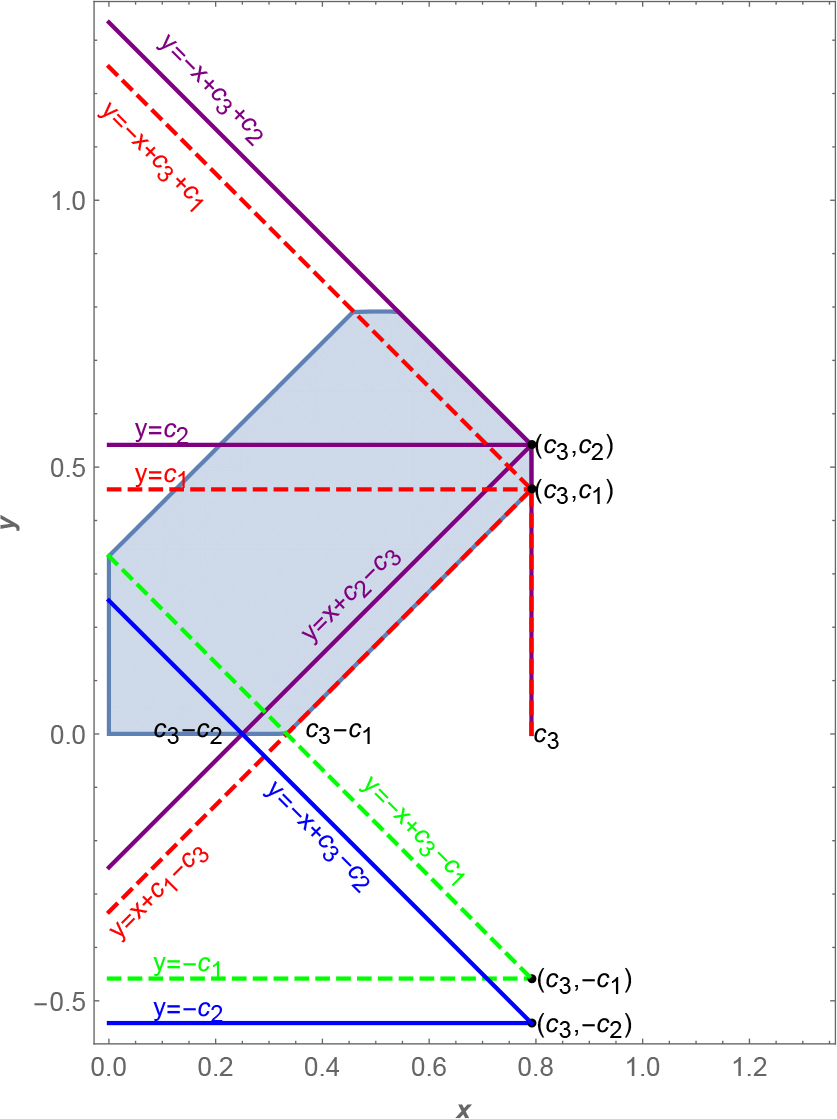
Figure 4.

The calculation of I3 over the non-Abelian moment polytope.

These leads to 64I3(xλ^)=c22c1264x(xc3)2,(x[ 0,c3 ]).{{\cal I}_3}(x\mid \hat \lambda ) = {{c_2^2 - c_1^2} \over {64}}x{\left( {x - {c_3}} \right)^2},\quad \left( {x \in \left[ {0,{c_3}} \right]} \right).

This completes the proof.

6.1.
Separability Probability in the Conditioned State Space

For a given qudit state η ∈ D(ℂn), Milz and Strunz considered the conditioned state space [27] 65Dη(nm):={ ρD(nm):Trm(ρ)=ηD(n) }{{\rm{D}}^\eta }\left( {{^n} \otimes {^m}} \right): = \left\{ {\rho \in {\rm{D}}\left( {{^n} \otimes {^m}} \right):{{{\mathop{\rm Tr}\nolimits} }_{{^m}}}(\rho ) = \eta \in {\rm{D}}\left( {{^n}} \right)} \right\} and the set of separable states in Dη(ℂn ⊗ ℂm), denoted by Dsep η(nm){\rm{D}}_{{\rm{sep }}}^\eta \left( {{^n} \otimes {^m}} \right). They studied the separability probability in the conditioned state space 66Psep(n×m)(η):=volHS(Dsepη(nm))volHS(Dη(nm)).P_{{\rm{sep}}}^{(n \times m)}(\eta ): = {{{{{\mathop{\rm vol}\nolimits} }_{{\rm{HS}}}}\left( {{\rm{D}}_{{\rm{sep}}}^\eta \left( {{^n} \otimes {^m}} \right)} \right)} \over {{{{\mathop{\rm vol}\nolimits} }_{{\rm{HS}}}}\left( {{{\rm{D}}^\eta }\left( {{^n} \otimes {^m}} \right)} \right)}}.

All further considerations will be simplified by the observation that both the Hilbert-Schmidt measure in the set Dη(ℂn ⊗ ℂm) and the separability of a state ρ ∈ Dη(ℂn ⊗ ℂm) are invariant under a transformation U ⊗ 𝟙m, where U ∈ SU(n). Indeed, 67DUηU+(nm)=(U𝟙m)Dη(nm)(U𝟙m).{{\rm{D}}^{{\bf{U}}\eta {{\bf{U}}^ + }}}\left( {{^n} \otimes {^m}} \right) = \left( {{\bf{U}} \otimes {_m}} \right){{\rm{D}}^\eta }\left( {{^n} \otimes {^m}} \right){\left( {{\bf{U}} \otimes {_m}} \right)^\dag }.

For n = 2, the qubit state η ∈ D(ℂ2) can be represented by Bloch vector η=12(𝟙2+aσ)\eta = {1 \over 2}\left( {{1_2} + a \cdot \sigma } \right). We denote by ηa simply. Thus we make the following identifications: Da(2m)=Dη(2m),Dsep a(2m)=Dsep η(2m),Psep (2×m)(a)=Psep (2×m)(η).\matrix{ {{{\rm{D}}^a}\left( {{^2} \otimes {^m}} \right) = {{\rm{D}}^\eta }\left( {{^2} \otimes {^m}} \right),} \cr {{\rm{D}}_{{\rm{sep }}}^a\left( {{^2} \otimes {^m}} \right) = {\rm{D}}_{{\rm{sep }}}^\eta \left( {{^2} \otimes {^m}} \right),} \cr {P_{{\rm{sep }}}^{(2 \times m)}(a) = P_{{\rm{sep }}}^{(2 \times m)}(\eta ).} \cr }

Thus Eq. (66), can be represented as 68Psep(2×m)(a):=volHS(Dsepa(2m))volHS(Da(2m)).P_{{\rm{sep}}}^{(2 \times m)}(a): = {{{{{\mathop{\rm vol}\nolimits} }_{{\rm{HS}}}}\left( {{\rm{D}}_{{\rm{sep}}}^a\left( {{^2} \otimes {^m}} \right)} \right)} \over {{{{\mathop{\rm vol}\nolimits} }_{{\rm{HS}}}}\left( {{{\rm{D}}^a}\left( {{^2} \otimes {^m}} \right)} \right)}}.

We have already known the fact that SU(2) is the double cover of SO(3) from Lie Theory, which leads to the following UηU=12( 𝟙2+(Oa)·σ){\bf{U}}\eta {{\bf{U}}^\dag } = {1 \over 2}\left( {{_2} + ({\bf{Oa}})\cdot{\bf{\sigma }}} \right.), where both U ∈ SU(2) and O = (oij) ∈ SO(3) are connected via oij=12Tr(σiUσjU){o_{ij}} = {1 \over 2}{\mathop{\rm Tr}\nolimits} \left( {{\sigma _i}{\bf{U}}{\sigma _j}{{\bf{U}}^\dag }} \right).

Proposition 12.

It holds that 69Psep(2×m)(Oa)=Psep(2×m)(a)P_{{\rm{sep}}}^{(2 \times m)}({\bf{Oa}}) = P_{{\rm{sep}}}^{(2 \times m)}({\bf{a}}) for any O ∈ SO(3) and a ∈ ℝ3 with |a| ⩽ 1.

Proof

In fact, it is easily seen that volHS((U𝟙m)Dη(nm)(U𝟙m))=volHSn(Dη(nm))volHS((U𝟙m)Dsepη(nm)(U𝟙m))=volHS(Dsepη(nm))\matrix{ {{{{\mathop{\rm vol}\nolimits} }_{{\rm{HS}}}}\left( {\left( {{\bf{U}} \otimes {_m}} \right){{\rm{D}}^\eta }\left( {{^n} \otimes {^m}} \right){{\left( {{\bf{U}} \otimes {_m}} \right)}^\dag }} \right) = {\mathop{\rm vol}\nolimits} {{{\mathop{\rm HS}\nolimits} }^n}\left( {{{\rm{D}}^\eta }\left( {{^n} \otimes {^m}} \right)} \right)} \cr {{{{\mathop{\rm vol}\nolimits} }_{{\rm{HS}}}}\left( {\left( {{\bf{U}} \otimes {_m}} \right){\rm{D}}_{{\rm{sep}}}^\eta \left( {{^n} \otimes {^m}} \right){{\left( {{\bf{U}} \otimes {_m}} \right)}^\dag }} \right) = {\mathop{\rm vol}\nolimits} {\rm{HS}}\left( {{\rm{D}}_{{\rm{sep}}}^\eta \left( {{^n} \otimes {^m}} \right)} \right)} \cr } holds for all U ∈ SU(2), which means that Psep (2×m)(UηU)=Psep (2×m)(η)Psep (2×m)(η)P_{{\rm{sep }}}^{(2 \times m)}\left( {{\bf{U}}\eta {{\bf{U}}^\dag }} \right) = P_{{\rm{sep }}}^{(2 \times m)}(\eta )P_{{\rm{sep }}}^{(2 \times m)}(\eta ). The desired result is obtained by translating it into the Bloch vector form.

Let a = |a| ∈ [0,1]. From the above Proposition 12, we see that Psep (2×m)(a)P_{{\rm{sep }}}^{(2 \times m)}({\bf{a}}) is constant on the sphere Sa := {a ∈ ℝ3: |a| = a}. In view of this reason, we let a = (0,0, a) and 70Psep(2×m)(a):=volHS(Dsepa(2m))volHS(Da(2m)).P_{{\rm{sep}}}^{(2 \times m)}({\bf{a}}): = {{{{{\mathop{\rm vol}\nolimits} }_{{\rm{HS}}}}\left( {{\rm{D}}_{{\rm{sep}}}^a\left( {{^2} \otimes {^m}} \right)} \right)} \over {{{{\mathop{\rm vol}\nolimits} }_{{\rm{HS}}}}\left( {{{\rm{D}}^a}\left( {{^2} \otimes {^m}} \right)} \right)}}. where 71Da(2m):={ ρD(2m):Trm(ρ)=12(𝟙2+aσ3) }.{{\rm{D}}^a}\left( {{^2} \otimes {^m}} \right): = \left\{ {\rho \in {\rm{D}}\left( {{^2} \otimes {^m}} \right):{{{\mathop{\rm Tr}\nolimits} }_{{^m}}}(\rho ) = {1 \over 2}\left( {{_2} + a{\sigma _3}} \right)} \right\}.

Denote the unit ball by B1 := {a ∈ ℝ3 : |a| ⩽ 1}. Then B1 = ∪a∈[0,1]Sa, which leads to the following identifications: 72D(22)=ηD(2)Dη(22)=aB1Da(22){\rm{D}}\left( {{^2} \otimes {^2}} \right) = \bigcup\limits_{\eta \in {\rm{D}}\left( {{^2}} \right)} {{{\rm{D}}^\eta }} \left( {{^2} \otimes {^2}} \right) = \bigcup\limits_{a \in {B_1}} {{{\rm{D}}^a}} \left( {{^2} \otimes {^2}} \right) 73=a[0,1]aSaDa(22). = \bigcup\limits_{a \in [0,1]} {\bigcup\limits_{a \in {S_a}} {{{\rm{D}}^a}} } \left( {{^2} \otimes {^2}} \right)

Thus we get that

Proposition 13.

It holds that 74volHS(D(22))=18B1volHS(Da(22))[da]{{\mathop{\rm vol}\nolimits} _{{\rm{HS}}}}\left( {{\rm{D}}\left( {{^2} \otimes {^2}} \right)} \right) = {1 \over 8}\int_{{B_1}} {{{{\mathop{\rm vol}\nolimits} }_{{\rm{HS}}}}} \left( {{{\rm{D}}^a}\left( {{^2} \otimes {^2}} \right)} \right)[{\rm{d}}a] 75=π201a2volHS(Da(22))da. = {\pi \over 2}\int_0^1 {{a^2}} {{\mathop{\rm vol}\nolimits} _{{\rm{HS}}}}\left( {{{\rm{D}}^a}\left( {{^2} \otimes {^2}} \right)} \right){\rm{d}}a.

Proof

Recall that dHS(ρ,ρ)=12dEuclid (x,x){d_{{\rm{HS}}}}\left( {{\rho ^\prime },\rho } \right) = {1 \over 2}{d_{{\rm{Euclid }}}}\left( {{{\bf{x}}^\prime },{\bf{x}}} \right), where x=(a,b,ckl){{\bf{x}}^\prime } = \left( {{{\bf{a}}^\prime },{{\bf{b}}^\prime },c_{kl}^\prime } \right) and x = (a, b, ckl). Thus three parameters in a determine Euclid volume [da], and thus contribute a scaling factor (12)3{\left( {{1 \over 2}} \right)^3} multiple of Euclid volume [da], i.e., in the HS volume element for D(ℂ2 ⊗ ℂ2). Therefore we get that volHS(D(22))=B1volHS(Da(22))(23[da])=1801 daSavolHS(Da(22))[da]=1801 daδ(a|a|)volHS(Da(22))[da]=1801 davolHS(Da(22))δ(a|a|)[da]=1801(4πa2)volHS(Da(22))daπ201a2volHS(Da(22))da.\matrix{ {{{{\mathop{\rm vol}\nolimits} }_{{\rm{HS}}}}\left( {{\rm{D}}\left( {{^2} \otimes {^2}} \right)} \right) = \int_{{B_1}} {{{{\mathop{\rm vol}\nolimits} }_{{\rm{HS}}}}} \left( {{{\rm{D}}^a}\left( {{^2} \otimes {^2}} \right)} \right)\left( {{2^{ - 3}}[{\rm{d}}{\bf{a}}]} \right)} \hfill \cr { = {1 \over 8}\int_0^1 {{\rm{d}}} a\int_{{S_a}} {{{{\mathop{\rm vol}\nolimits} }_{{\rm{HS}}}}} \left( {{{\rm{D}}^a}\left( {{^2} \otimes {^2}} \right)} \right)[{\rm{d}}{\bf{a}}]} \hfill \cr { = {1 \over 8}\int_0^1 {{\rm{d}}} a\int \delta (a - |{\bf{a}}|){{{\mathop{\rm vol}\nolimits} }_{{\rm{HS}}}}\left( {{{\rm{D}}^a}\left( {{^2} \otimes {^2}} \right)} \right)[{\rm{d}}{\bf{a}}]} \hfill \cr { = {1 \over 8}\int_0^1 {{\rm{d}}} a{{{\mathop{\rm vol}\nolimits} }_{{\rm{HS}}}}\left( {{{\rm{D}}^a}\left( {{^2} \otimes {^2}} \right)} \right)\int \delta (a - |{\bf{a}}|)[{\rm{d}}{\bf{a}}]} \hfill \cr { = {1 \over 8}\int_0^1 {\left( {4\pi {a^2}} \right)} {{{\mathop{\rm vol}\nolimits} }_{{\rm{HS}}}}\left( {{{\rm{D}}^a}\left( {{^2} \otimes {^2}} \right)} \right){\rm{d}}a} \hfill \cr {{\pi \over 2}\int_0^1 {{a^2}} {{{\mathop{\rm vol}\nolimits} }_{{\rm{HS}}}}\left( {{{\rm{D}}^a}\left( {{^2} \otimes {^2}} \right)} \right){\rm{d}}a.} \hfill \cr }

We have done it.

Next, we calculate the HS volume volHS(Da(ℂ2 ⊗ ℂ2)). Indeed,

Proposition 14 ([8]).

It holds that 76volHS(Da(22))=volHS(D0(22))(1a2)6,{{\mathop{\rm vol}\nolimits} _{{\rm{HS}}}}\left( {{{\rm{D}}^a}\left( {{^2} \otimes {^2}} \right)} \right) = {{\mathop{\rm vol}\nolimits} _{{\rm{HS}}}}\left( {{{\rm{D}}^0}\left( {{^2} \otimes {^2}} \right)} \right){\left( {1 - {a^2}} \right)^6}, where a ∈ [0,1). Moreover, 77volHS(D0(22))=π59676800.{{\mathop{\rm vol}\nolimits} _{{\rm{HS}}}}\left( {{{\rm{D}}^0}\left( {{^2} \otimes {^2}} \right)} \right) = {{{\pi ^5}} \over {9676800}}.

Proof

This expression in Eq. (76) is conjectured by Milz and Strunz [27], and proved by Lovas and Andai [8]. From the above formula, we get that 78volHS(D(22))=volHS(D0(22))×π201a2(1a2)6 da{{\mathop{\rm vol}\nolimits} _{{\rm{HS}}}}\left( {{\rm{D}}\left( {{^2} \otimes {^2}} \right)} \right) = {{\mathop{\rm vol}\nolimits} _{{\rm{HS}}}}\left( {{{\rm{D}}^0}\left( {{^2} \otimes {^2}} \right)} \right) \times {\pi \over 2}\int_0^1 {{a^2}} {\left( {1 - {a^2}} \right)^6}{\rm{d}}a 79=29π45045volHS(D0(22)). = {{{2^9}\pi } \over {45045}}{{\mathop{\rm vol}\nolimits} _{{\rm{HS}}}}\left( {{{\rm{D}}^0}\left( {{^2} \otimes {^2}} \right)} \right).

Note that, from Theorem 2, we can see that 80volHS(D(22))=volHS(D(4))=4(2π)(42)k=14Γ(k)Γ(42){{\mathop{\rm vol}\nolimits} _{{\rm{HS}}}}\left( {{\rm{D}}\left( {{^2} \otimes {^2}} \right)} \right) = {{\mathop{\rm vol}\nolimits} _{{\rm{HS}}}}\left( {{\rm{D}}\left( {{^4}} \right)} \right) = \sqrt 4 {(2\pi )^{\left( {\scriptstyle 4 \atop \scriptstyle 2} \right)}}{{\prod\nolimits_{k = 1}^4 \Gamma (k)} \over {\Gamma \left( {{4^2}} \right)}} 81=2(2π)6(2!)(3!)15!. = {{2{{(2\pi )}^6}(2!)(3!)} \over {15!}}.

By combining the above formulas, we can derive that volHS(D0(22))=π59676800{{\mathop{\rm vol}\nolimits} _{{\rm{HS}}}}\left( {{{\rm{D}}^0}\left( {{^2} \otimes {^2}} \right)} \right) = {{{\pi ^5}} \over {9676800}}.

The following result was conjectured in [27], and proven in [8], which is described as a theorem without proof:

Theorem 6 ([8]).

It holds that Psep(2×2)(a)P_{{\rm{sep}}}^{(2 \times 2)}\left( a \right) is constant for all a ∈ [0,1).

Proof

Please see the proof in [8, Corollary 2].

6.2.
Separability Probability of Two-Qubit States

The separability probability is given by 82Psep(n×m):=volHS(Dsep(nm))volHS(D(nm)).P_{{\rm{sep}}}^{(n \times m)}: = {{{{{\mathop{\rm vol}\nolimits} }_{{\rm{HS}}}}\left( {{{\rm{D}}_{{\rm{sep}}}}\left( {{^n} \otimes {^m}} \right)} \right)} \over {{{{\mathop{\rm vol}\nolimits} }_{{\rm{HS}}}}\left( {{\rm{D}}\left( {{^n} \otimes {^m}} \right)} \right)}}.

Here Dsep(ℂn ⊗ ℂm) is the set of separable states in D(ℂn ⊗ ℂm). In what follows, we focus on the case where n = m = 2.

For ρ ∈ D(ℂ2 ⊗ ℂ2), we can view ρ as a 4 × 4 matrix acting on ℂ4 and then its partial transpose w.r.t. 1st subsystem, are respectively: 83ρ=(ρ11ρ12ρ13ρ14ρ21ρ22ρ23ρ24ρ31ρ32ρ33ρ34ρ41ρ42ρ43ρ44) and ρΓ=(ρ11ρ21ρ13ρ23ρ12ρ22ρ14ρ24ρ31ρ41ρ33ρ43ρ32ρ42ρ34ρ44).\rho = \left( {\matrix{ {{\rho _{11}}} \hfill & {{\rho _{12}}} \hfill & {{\rho _{13}}} \hfill & {{\rho _{14}}} \hfill \cr {{\rho _{21}}} \hfill & {{\rho _{22}}} \hfill & {{\rho _{23}}} \hfill & {{\rho _{24}}} \hfill \cr {{\rho _{31}}} \hfill & {{\rho _{32}}} \hfill & {{\rho _{33}}} \hfill & {{\rho _{34}}} \hfill \cr {{\rho _{41}}} \hfill & {{\rho _{42}}} \hfill & {{\rho _{43}}} \hfill & {{\rho _{44}}} \hfill \cr } } \right){\rm{ and }}{\rho ^\Gamma } = \left( {\matrix{ {{\rho _{11}}} & {{\rho _{21}}} & {{\rho _{13}}} & {{\rho _{23}}} \cr {{\rho _{12}}} & {{\rho _{22}}} & {{\rho _{14}}} & {{\rho _{24}}} \cr {{\rho _{31}}} & {{\rho _{41}}} & {{\rho _{33}}} & {{\rho _{43}}} \cr {{\rho _{32}}} & {{\rho _{42}}} & {{\rho _{34}}} & {{\rho _{44}}} \cr } } \right).

Let En(i, j) be the elementary matrix, obtained by changing the i-th and j-th rows/columns of identity matrix 𝟙n. Now 84E4(2,3)ρE4(2,3)=(ρ11ρ13ρ12ρ14ρ31ρ33ρ32ρ34ρ21ρ23ρ22ρ24ρ41ρ43ρ42ρ44)=(ABCD){E_4}(2,3)\rho {E_4}(2,3) = \left( {\matrix{ {{\rho _{11}}} \hfill & {{\rho _{13}}} \hfill & {{\rho _{12}}} \hfill & {{\rho _{14}}} \hfill \cr {{\rho _{31}}} \hfill & {{\rho _{33}}} \hfill & {{\rho _{32}}} \hfill & {{\rho _{34}}} \hfill \cr {{\rho _{21}}} \hfill & {{\rho _{23}}} \hfill & {{\rho _{22}}} \hfill & {{\rho _{24}}} \hfill \cr {{\rho _{41}}} \hfill & {{\rho _{43}}} \hfill & {{\rho _{42}}} \hfill & {{\rho _{44}}} \hfill \cr } } \right) = \left( {\matrix{ A \hfill & B \hfill \cr C \hfill & D \hfill \cr } } \right) and 85E4(2,3)ρΓE4(2,3)=(ρ11ρ13ρ21ρ23ρ31ρ33ρ41ρ43ρ12ρ14ρ22ρ24ρ32ρ34ρ42ρ44)=(ABCD).{E_4}(2,3){\rho ^\Gamma }{E_4}(2,3) = \left( {\matrix{ {{\rho _{11}}} & {{\rho _{13}}} & {{\rho _{21}}} & {{\rho _{23}}} \cr {{\rho _{31}}} & {{\rho _{33}}} & {{\rho _{41}}} & {{\rho _{43}}} \cr {{\rho _{12}}} & {{\rho _{14}}} & {{\rho _{22}}} & {{\rho _{24}}} \cr {{\rho _{32}}} & {{\rho _{34}}} & {{\rho _{42}}} & {{\rho _{44}}} \cr } } \right) = \left( {\matrix{ A & C \cr B & D \cr } } \right).

Denote 86Dss(22):={ D(22):λmax(ρ)12 }.{{\rm{D}}_{{\rm{ss}}}}\left( {{^2} \otimes {^2}} \right): = \left\{ {{\rm{D}}\left( {{^2} \otimes {^2}} \right):{\lambda _{\max }}(\rho )\;\;{1 \over 2}} \right\}.

Proposition 15 ([7]).

Let ρ ∈ D0(ℂ2 ⊗ ℂ2). It holds that ρ is separable if and only if ρ ∈ Dss(ℂ2 ⊗ ℂ2). In other words, 87Dsep 0(22)=D0(22)Dss(22).{\rm{D}}_{{\rm{sep }}}^0\left( {{^2} \otimes {^2}} \right) = {{\rm{D}}^0}\left( {{^2} \otimes {^2}} \right) \cap {{\rm{D}}_{{\rm{ss}}}}\left( {{^2} \otimes {^2}} \right).

Proof

Note that the characteristic polynomial of ρ is given by fρ(λ) = det(ρλ𝟙4). Then fρ(λ)=det(E4(2,3)ρE4(2,3)λ𝟙4)=det(Aλ𝟙2BCDλ𝟙2)=det(Aλ𝟙2)det((Dλ𝟙2)C(Aλ𝟙2)1B).\matrix{ {{f_\rho }(\lambda ) = \det \left( {{{\bf{E}}_4}(2,3)\rho {{\bf{E}}_4}(2,3) - \lambda {_4}} \right) = \det \left( {\matrix{ {{\bf{A}} - \lambda {_2}} & {\bf{B}} \cr {\bf{C}} & {{\bf{D}} - \lambda {_2}} \cr } } \right)} \hfill \cr { = \det \left( {{\bf{A}} - \lambda {_2}} \right)\det \left( {\left( {{\bf{D}} - \lambda {_2}} \right) - {\bf{C}}{{\left( {{\bf{A}} - \lambda {_2}} \right)}^{ - 1}}{\bf{B}}} \right).} \hfill \cr }

Similarly, the characteristic polynomial of ρΓ is given by fρΓ(λ)=det(E4(2,3)ρΓE4(2,3)λ𝟙4)=det(Aλ𝟙2CBDλ𝟙2)=det(Aλ𝟙2)det((Dλ𝟙2)B(Aλ𝟙2)1C)=det(Dλ𝟙2)det((Aλ𝟙2)C(Dλ𝟙2)1B).\matrix{ {{f_{{\rho ^\Gamma }}}(\lambda ) = \det \left( {{{\bf{E}}_4}(2,3){\rho ^\Gamma }{{\bf{E}}_4}(2,3) - \lambda {_4}} \right) = \det \left( {\matrix{ {{\bf{A}} - \lambda {_2}} & {\bf{C}} \cr {\bf{B}} & {{\bf{D}} - \lambda {_2}} \cr } } \right)} \hfill \cr { = \det \left( {{\bf{A}} - \lambda {_2}} \right)\det \left( {\left( {{\bf{D}} - \lambda {_2}} \right) - {\bf{B}}{{\left( {{\bf{A}} - \lambda {_2}} \right)}^{ - 1}}{\bf{C}}} \right)} \hfill \cr { = \det \left( {{\bf{D}} - \lambda {_2}} \right)\det \left( {\left( {{\bf{A}} - \lambda {_2}} \right) - {\bf{C}}{{\left( {{\bf{D}} - \lambda {_2}} \right)}^{ - 1}}{\bf{B}}} \right).} \hfill \cr }

Due to the fact that ρ ∈ D0(ℂ2 ⊗ ℂ2), we see that Tr2(ρ)=12𝟙2{{\mathop{\rm Tr}\nolimits} _2}(\rho ) = {1 \over 2}{_2}, which is equivalent to A+D=12𝟙2{\bf{A}} + {\bf{D}} = {1 \over 2}{_2}. Now we have shown that 88fρΓ(λ)=det(Dλ𝟙2)det((Aλ𝟙2)C(Dλ𝟙2)1B).{f_{{\rho ^\Gamma }}}(\lambda ) = \det \left( {{\bf{D}} - \lambda {_2}} \right)\det \left( {\left( {{\bf{A}} - \lambda {_2}} \right) - {\bf{C}}{{\left( {{\bf{D}} - \lambda {_2}} \right)}^{ - 1}}{\bf{B}}} \right).

Thus replacing the 2-tuple (λ, D) by (12λ,12𝟙2A)\left( {{1 \over 2} - \lambda ,{1 \over 2}{_2} - {\bf{A}}} \right) in the first factor of Eq. (88), we get that the first factor det(Dλ𝟙2) is transformed into det((12𝟙2A)(12λ)𝟙2)=det(λ𝟙2A)=det(Aλ𝟙2).\det \left( {\left( {{1 \over 2}{_2} - {\bf{A}}} \right) - \left( {{1 \over 2} - \lambda } \right){_2}} \right) = \det \left( {\lambda {_2} - {\bf{A}}} \right) = \det \left( {{\bf{A}} - \lambda {_2}} \right).

Thus replacing λ by 12λ{1 \over 2} - \lambda and using A+D=12𝟙2{\bf{A}} + {\bf{D}} = {1 \over 2}{_2} in the second factor of Eq. (88), we get that the second factor det((Aλ𝟙2) – C(Dλ𝟙2)−1 B) is transformed into det(((12𝟙2D)(12λ)𝟙2)C((12𝟙2A)(12λ)𝟙2)1B).\det \left( {\left( {\left( {{1 \over 2}{_2} - {\bf{D}}} \right) - \left( {{1 \over 2} - \lambda } \right){_2}} \right) - {\bf{C}}{{\left( {\left( {{1 \over 2}{_2} - {\bf{A}}} \right) - \left( {{1 \over 2} - \lambda } \right){_2}} \right)}^{ - 1}}{\bf{B}}} \right).

That is, the last expression is reduced to the following: det((D+λ𝟙2)C(A+λ𝟙2)1B)=det((Dλ𝟙2)C(Aλ𝟙2)1B).\det \left( {\left( { - {\bf{D}} + \lambda {_2}} \right) - {\bf{C}}{{\left( { - {\bf{A}} + \lambda {_2}} \right)}^{ - 1}}{\bf{B}}} \right) = \det \left( {\left( {{\bf{D}} - \lambda {_2}} \right) - {\bf{C}}{{\left( {{\bf{A}} - \lambda {_2}} \right)}^{ - 1}}{\bf{B}}} \right).

Thus fρΓ(12λ)=det(Aλ𝟙2)det((Dλ𝟙2)C(Aλ𝟙2)1B)=fρ(λ).{f_{{\rho ^\Gamma }}}\left( {{1 \over 2} - \lambda } \right) = \det \left( {{\bf{A}} - \lambda {_2}} \right)\det \left( {\left( {{\bf{D}} - \lambda {_2}} \right) - {\bf{C}}{{\left( {{\bf{A}} - \lambda {_2}} \right)}^{ - 1}}{\bf{B}}} \right) = {f_\rho }(\lambda ).

In summary, we get that fρΓ(12λ)=fρ(λ){f_{{\rho ^\Gamma }}}\left( {{1 \over 2} - \lambda } \right) = {f_\rho }(\lambda ). With these preparations, we can now present the proof below.

  • (⇒)

    Now suppose that ρDsep 0(22)\rho \in {\rm{D}}_{{\rm{sep }}}^0\left( {{^2} \otimes {^2}} \right). That is, ρ ∈ D0(ℂ2 ⊗ ℂ2) is separable. Choose any eigenvalue t ⩾ 0 of the separable state ρ, i.e., fρ(t) = 0, then fρΓ(12t)=fρ(t)=0{f_{{\rho ^\Gamma }}}\left( {{1 \over 2} - t} \right) = {f_\rho }(t) = 0, namely, 12t{1 \over 2} - t satisfying the eigen-equation fργ(λ) = 0, thus 12t0{1 \over 2} - t0 is an eigenvalue of ρΓ ⩾ 0 by Peres-Horodecki criterion. Therefore t12t{1 \over 2}, or ρ ∈ Dss(ℂ2 ⊗ ℂ2).

  • (⇐)

    If ρ ∈ D0(ℂ2 ⊗ ℂ2) ∩ Dss(ℂ2 ⊗ ℂ2), i.e., any generic eigenvalue t of ρ satisfying 0t120t{1 \over 2}, and moreover fρΓ(12t)=fρ(t)=0{f_{{\rho ^\Gamma }}}\left( {{1 \over 2} - t} \right) = {f_\rho }(t) = 0, which means that 12t0{1 \over 2} - t0 is an eigenvalue of ρΓ. All eigenvalues of ρΓ are nonnegative, that is, ρΓ ⩾ 0. By Peres-Horodecki criterion, ρ is separable.

This completes the proof.

Denote 89f(a):=volHS(Da(22)Dss(22)),f(a): = {{\mathop{\rm vol}\nolimits} _{{\rm{HS}}}}\left( {{{\rm{D}}^a}\left( {{^2} \otimes {^2}} \right) \cap {{\rm{D}}_{{\rm{ss}}}}\left( {{^2} \otimes {^2}} \right)} \right), where a ∈ [0,1). Since the partial trace is a linear map, the function f(a) is continuous. Therefore, we can find f(0)=lima0+f(a)f(0) = {\lim _{a \to {0^ + }}}f(a). Clearly f(0)=volHS(Dsep 0(22))f(0) = {{\mathop{\rm vol}\nolimits} _{{\rm{HS}}}}\left( {{\rm{D}}_{{\rm{sep }}}^0\left( {{^2} \otimes {^2}} \right)} \right) by Proposition 15. So we firstly calculate f(a) in a small neighborhood of 0. Denote 90C4={ (x1,x2,x3,x4)4:x1>x2>x3>x4 },{{\cal C}_4} = \left\{ {\left( {{x_1},{x_2},{x_3},{x_4}} \right) \in {^4}:{x_1} > {x_2} > {x_3} > {x_4}} \right\}, 91C^=[ 14,14 ]4C4.\hat C = {\left[ { - {1 \over 4},{1 \over 4}} \right]^4} \cap {{\cal C}_4}.

In fact, we have the following result:

Proposition 16 ([7]).

It holds that 92f(a)=π5319334400(1a)9(33a3+162a2+72a+8),a(0,13).f(a) = {{{\pi ^5}} \over {319334400}}{(1 - a)^9}\left( {33{a^3} + 162{a^2} + 72a + 8} \right),\quad a \in \left( {0,{1 \over 3}} \right).

Proof

For all t ∈ (0,1), denote Bt := {a ∈ ℝ3 : |a| ⩾ t}. Denote DBt(22):=aBtDa(22){{\rm{D}}^{{B_t}}}\left( {{^2} \otimes {^2}} \right): = \bigcup\limits_{a \in {B_t}} {{{\rm{D}}^a}} \left( {{^2} \otimes {^2}} \right)

Note that volHS(DBt(22) Dss(22))=volHS(aBtDa(22) Dss(22))=0t davolHS(aSaDa(22) DsS(22))=0t da[ 18Sa[da]volHS(Da(22) Dss(22)) ]=0t da[ 18[da]δ(a|a|)volHS(Da(22) Dss(22)) ]=π80t davolHS(Da(22) Dss(22))δ(a|a|)[da].\matrix{ {{{{\mathop{\rm vol}\nolimits} }_{{\rm{HS}}}}\left( {{{\rm{D}}^{{B_t}}}\left( {{^2} \otimes {^2}} \right)\bigcap {{{\rm{D}}_{{\rm{ss}}}}} \left( {{^2} \otimes {^2}} \right)} \right) = {{{\mathop{\rm vol}\nolimits} }_{{\rm{HS}}}}\left( {\bigcup\limits_{a \in {B_t}} {{{\rm{D}}^a}} \left( {{^2} \otimes {^2}} \right)\bigcap {{{\rm{D}}_{{\rm{ss}}}}} \left( {{^2} \otimes {^2}} \right)} \right)} \hfill \cr { = \int_0^t {{\rm{d}}} a{{{\mathop{\rm vol}\nolimits} }_{{\rm{HS}}}}\left( {\bigcup\limits_{{\bf{a}} \in {S_a}} {{{\rm{D}}^a}} \left( {{^2} \otimes {^2}} \right)\bigcap {{{\rm{D}}_{{\rm{sS}}}}} \left( {{^2} \otimes {^2}} \right)} \right)} \hfill \cr { = \int_0^t {{\rm{d}}} a\left[ {{1 \over 8}{\mkern 1mu} \int_{{S_a}} {[{\rm{d}}a]{{{\mathop{\rm vol}\nolimits} }_{{\rm{HS}}}}\left( {{{\rm{D}}^a}\left( {{^2} \otimes {^2}} \right)\bigcap {{{\rm{D}}_{{\rm{ss}}}}} \left( {{^2} \otimes {^2}} \right)} \right)} } \right]} \hfill \cr { = \int_0^t {{\rm{d}}} a\left[ {{1 \over 8}\int {[{\rm{d}}a]\delta (a - |a|){{{\mathop{\rm vol}\nolimits} }_{{\rm{HS}}}}\left( {{{\rm{D}}^a}\left( {{^2} \otimes {^2}} \right)\bigcap {{{\rm{D}}_{{\rm{ss}}}}} \left( {{^2} \otimes {^2}} \right)} \right)} } \right]} \hfill \cr { = {\pi \over 8}\int_0^t {{\rm{d}}} a{{{\mathop{\rm vol}\nolimits} }_{{\rm{HS}}}}\left( {{{\rm{D}}^a}\left( {{^2} \otimes {^2}} \right)\bigcap {{{\rm{D}}_{{\rm{ss}}}}} \left( {{^2} \otimes {^2}} \right)} \right)\int \delta (a - |a|)[{\rm{d}}a].} \hfill \cr }

Since f(a)=volHS(Da(22)DSS(22))f(a) = {{\mathop{\rm vol}\nolimits} _{{\rm{HS}}}}\left( {{{\rm{D}}^a}\left( {{^2} \otimes {^2}} \right) \cap {{\rm{D}}_{{\rm{SS}}}}\left( {{^2} \otimes {^2}} \right)} \right), it follows that 93π20ta2f(a)da=volHS(DBt(22) Dss(22)).{\pi \over 2}\int_0^t {{a^2}} f(a){\rm{d}}a = {{\mathop{\rm vol}\nolimits} _{{\rm{HS}}}}\left( {{{\rm{D}}^{{B_t}}}\left( {{^2} \otimes {^2}} \right)\bigcap {{{\rm{D}}_{{\rm{ss}}}}} \left( {{^2} \otimes {^2}} \right)} \right).

Now we partition the set Dss(ℂ2 ⊗ ℂ2) by adjoint SU(4)-orbits as 94Dss(22)=λ[ 0,12 ]4C4Uλ,{{\rm{D}}_{{\rm{ss}}}}\left( {{^2} \otimes {^2}} \right) = \bigcup\limits_{\lambda \in {{\left[ {0,{1 \over 2}} \right]}^4} \cap {{\cal C}_4}} {{{\cal U}_\lambda }} , where 𝒰λ := {UΛU : U ∈ SU(4)} for Λ = diag(λ1, …, λ4), obtained from λ = (λ1, …, λ4). Itis easily seen that the adjoint orbit 𝒰λ can be identified with the co-adjoint orbit Oλ^{{\cal O}_{\hat \lambda }}, where λ^=λ(14,,14)\hat \lambda = \lambda - \left( {{1 \over 4}, \ldots ,{1 \over 4}} \right). That is, UλOλ^,{{\cal U}_\lambda } \cong {{\cal O}_{\hat \lambda }}, where λ[ 0,12 ]4C4iffλ^[ 14,14 ]4C4\lambda \in {\left[ {0,{1 \over 2}} \right]^4} \cap {{\cal C}_4}\;{\rm{iff}}\;\hat \lambda \in {\left[ { - {1 \over 4},{1 \over 4}} \right]^4} \cap {{\cal C}_4}. Under the above identification, X=ρ14𝟙4{\bf{X}} = \rho - {1 \over 4}{_4}, we get that DBt(22)={ ρD(22):Tr2(ρ)=12(𝟙2+a·σ),|a|t }{ XHerm(4):Tr2(X)=a2·σ,|a|t }={ XHerm(4):Tr(X)=0,| λ±(Tr2(X)) |t2 }:=εt.\matrix{ {{{\rm{D}}^{{B_t}}}\left( {{^2} \otimes {^2}} \right) = \left\{ {\rho \in {\rm{D}}\left( {{^2} \otimes {^2}} \right):{{{\mathop{\rm Tr}\nolimits} }_2}(\rho ) = {1 \over 2}\left( {{_2} + {\bf{a}}\cdot{\bf{\sigma }}} \right),|{\bf{a}}|t} \right\}} \hfill \cr { \cong \left\{ {{\bf{X}} \in {\mathop{\rm Herm}\nolimits} \left( {{^4}} \right):{{{\mathop{\rm Tr}\nolimits} }_2}({\bf{X}}) = {{\bf{a}} \over 2}\cdot{\bf{\sigma }},|{\bf{a}}|t} \right\}} \hfill \cr { = \left\{ {{\bf{X}} \in {\mathop{\rm Herm}\nolimits} \left( {{^4}} \right):{\mathop{\rm Tr}\nolimits} ({\bf{X}}) = 0,\left| {{\lambda _ \pm }\left( {{{{\mathop{\rm Tr}\nolimits} }_2}({\bf{X}})} \right)} \right|{t \over 2}} \right\}: = {{\cal E}_t}.} \hfill \cr }

That is, the set DBt(ℂ2 ⊗ ℂ2) is translated into the set εt. Thus the HS volume is invariant under the translation and volHS(DBt(22) DSs(22))=volHS(λ[ 0,12 ]4C4DBt(22) Uλ)=volHS(λ^C^εt Oλ^)=λ^C^volHS(Oλ^ εt)dm(λ^),\matrix{ {{{{\mathop{\rm vol}\nolimits} }_{{\rm{HS}}}}\left( {{{\rm{D}}^{{B_t}}}\left( {{^2} \otimes {^2}} \right)\bigcap {{{\rm{D}}_{{\rm{Ss}}}}} \left( {{^2} \otimes {^2}} \right)} \right) = {{{\mathop{\rm vol}\nolimits} }_{{\rm{HS}}}}\left( {\bigcup\limits_{\lambda \in {{\left[ {0,{1 \over 2}} \right]}^4} \cap {{\cal C}_4}} {{{\rm{D}}^{{B_t}}}} \left( {{^2} \otimes {^2}} \right)\bigcap {{{\cal U}_\lambda }} } \right)} \hfill \cr { = {{{\mathop{\rm vol}\nolimits} }_{{\rm{HS}}}}\left( {\bigcup\limits_{\hat \lambda \in \hat C} {{{\cal E}_t}} \bigcap {{{\cal O}_{\hat \lambda }}} } \right) = \int_{\hat \lambda \in \hat C} {{{{\mathop{\rm vol}\nolimits} }_{{\rm{HS}}}}} \left( {{{\cal O}_{\hat \lambda }}\bigcap {{{\cal E}_t}} } \right){\rm{d}}m(\hat \lambda ),} \hfill \cr } where we used the facts in Eq. (26) and Eq. (27). Up to now, we have already obtained that 95π20ta2f(a)da=λ^C^volHS(Oλ^ εt)dm(λ^){\pi \over 2}\int_0^t {{a^2}} f(a){\rm{d}}a = \int_{\hat \lambda \in \hat C} {{{{\mathop{\rm vol}\nolimits} }_{{\rm{HS}}}}} \left( {{{\cal O}_{\hat \lambda }}\bigcap {{{\cal E}_t}} } \right){\rm{d}}m(\hat \lambda ) 96=λ^C^V4(λ^)volsymp (Oλ^ εt)dm(λ^), = \int_{\hat \lambda \in \hat C} {{V_4}} (\hat \lambda ){{\mathop{\rm vol}\nolimits} _{{\rm{symp }}}}\left( {{{\cal O}_{\hat \lambda }}\bigcap {{{\cal E}_t}} } \right){\rm{d}}m(\hat \lambda ), where we used the relationship (36) between HS volume of adjoint orbit and symplectic volume of co-adjoint orbit in the last equality. Consider the map F in Eq. (53), F:(Oλ^,μOλ^)(>0, da),F:\left( {{{\cal O}_{\hat \lambda }},{\mu _{{{\cal O}_{\hat \lambda }}}}} \right) \to \left( {{_{ > 0}},{\rm{d}}a} \right), where F(X) = λ +(Tr2(X)) – λ(Tr2(X)) = 2λ+(Tr2(X)) for any XOλ^{\bf{X}} \in {{\cal O}_{\hat \lambda }}, i.e., twice the positive eigenvalue of Tr2(X). By the definition of F, we see that F1([0,t])=Oλ^ εt,{F^{ - 1}}([0,t]) = {{\cal O}_{\hat \lambda }}\bigcap {{{\cal E}_t}} , implying that 97volsymp (εtOλ^)=volsymp (F1([0,t]))=μOλ^(F1([0,t])){{\mathop{\rm vol}\nolimits} _{{\rm{symp }}}}\left( {{{\cal E}_t} \cap {{\cal O}_{\hat \lambda }}} \right) = {{\mathop{\rm vol}\nolimits} _{{\rm{symp }}}}\left( {{F^{ - 1}}([0,t])} \right) = {\mu _{{{\cal O}_{\hat \lambda }}}}\left( {{F^{ - 1}}([0,t])} \right) 98=(F*μOλ^)([0,t])=0t dF*μOλ^da da, = \left( {{F_*}{\mu _{{{\cal O}_{\hat \lambda }}}}} \right)([0,t]) = \int_0^t {{{{\rm{d}}{F_*}{\mu _{{{\cal O}_{\hat \lambda }}}}} \over {{\rm{d}}a}}} {\rm{d}}a, where dF*μOλ^da:=(2π)6I(aλ^){{{\rm{d}}{F_*}{\mu _{{{\cal O}_{\hat \lambda }}}}} \over {{\rm{d}}a}}: = {(2\pi )^6}{\cal I}(a\mid \hat \lambda ) is the Radon-Nikodym derivative of push-forward measure F*μOλ^{F_*}{\mu _{{{\cal O}_{\hat \lambda }}}} with respect to Lebesgue measure on the ray ℝ>0. Moreover, the analytical expression of such Radon-Nikodym derivative dF*μOλ^da=(2π)6I(aλ^){{{\rm{d}}{F_*}\mu {{\cal O}_{\hat \lambda }}} \over {{\rm{d}}a}} = {(2\pi )^6}{\cal I}(a\mid \hat \lambda ) is given by Eq. (55). Once again, we have obtained that π20ta2f(a)da=λ^C^V4(λ^)volsymp (εt Oλ^)dm(λ^)=λ^C^V4(λ^)(0t dF*μO^da da)dm(λ^)=λ^C^V4(λ^)(0t(2π)6I(aλ^)da)dm(λ^)=(2π)60t(λ^C^V4(λ^)I(aλ^)dm(λ^))da,\matrix{ {{\pi \over 2}\int_0^t {{a^2}} f(a){\rm{d}}a = \int_{\hat \lambda \in \hat C} {{V_4}} (\hat \lambda ){{{\mathop{\rm vol}\nolimits} }_{{\rm{symp }}}}\left( {{{\cal E}_t}\bigcap {{{\cal O}_{\hat \lambda }}} } \right){\rm{d}}m(\hat \lambda )} \hfill \cr { = \int_{\hat \lambda \in \hat C} {{V_4}} (\hat \lambda )\left( {\int_0^t {{{{\rm{d}}{F_*}{\mu _{\widehat {\cal O}}}} \over {{\rm{d}}a}}} {\rm{d}}a} \right){\rm{d}}m(\hat \lambda ) = \int_{\hat \lambda \in \hat C} {{V_4}} (\hat \lambda )\left( {\int_0^t {{{(2\pi )}^6}} {\cal I}(a\mid \hat \lambda ){\rm{d}}a} \right){\rm{d}}m(\hat \lambda )} \hfill \cr { = {{(2\pi )}^6}\int_0^t {\left( {\int_{\hat \lambda \in \hat C} {{V_4}} (\hat \lambda ){\cal I}(a\mid \hat \lambda ){\rm{d}}m(\hat \lambda )} \right)} {\rm{d}}a,} \hfill \cr } implying that 99π20ta2f(a)da=(2π)60t(λ^C^V4(λ^)I(aλ^)dm(λ^))da.{\pi \over 2}\int_0^t {{a^2}} f(a){\rm{d}}a = {(2\pi )^6}\int_0^t {\left( {\int_{\hat \lambda \in \hat C} {{V_4}} (\hat \lambda ){\cal I}(a\mid \hat \lambda ){\rm{d}}m(\hat \lambda )} \right)} {\rm{d}}a.

By taking the derivative with respect to t, and then replacing t by a, we get that 100π2a2f(a)=(2π)6λ^C^V4(λ^)I(aλ^)dm(λ^){\pi \over 2}{a^2}f(a) = {(2\pi )^6}\int_{\hat \lambda \in \hat C} {{V_4}} (\hat \lambda ){\cal I}(a\mid \hat \lambda ){\rm{d}}m(\hat \lambda ) \Rightarrow 101f(a)=2πa2(2π)6λ^C^V4(λ^)I(aλ^)dm(λ^),f(a) = {2 \over \pi }{a^{ - 2}}{(2\pi )^6}\int_{\hat \lambda \in \hat C} {{V_4}} (\hat \lambda ){\cal I}(a\mid \hat \lambda ){\rm{d}}m(\hat \lambda ), where a(0,13)a \in \left( {0,{1 \over 3}} \right). Now we compute the following integral 102λ^C^V4(λ^)I(aλ^)dm(λ^)=2[ 14,14 ]4C41i<j4(λ^iλ^j)I(aλ^)δ(k=14λ^k)l=14 dλ^l\int_{\hat \lambda \in \hat C} {{V_4}} (\hat \lambda ){\cal I}(a\mid \hat \lambda ){\rm{d}}m(\hat \lambda ) = 2\int_{{{\left[ { - {1 \over 4},{1 \over 4}} \right]}^4} \cap {{\cal C}_4}} {\prod\limits_{1i < j4} {\left( {{{\hat \lambda }_i} - {{\hat \lambda }_j}} \right)} } {\cal I}(a\mid \hat \lambda )\delta \left( {\sum\limits_{k = 1}^4 {{{\hat \lambda }_k}} } \right)\prod\limits_{l = 1}^4 {{\rm{d}}} {{\hat \lambda }_l}

Let the change of variables be given below: 103{ λ^1=t1+t22+t33+t4414,λ^2=t22+t33+t4414,λ^3=t33+t4414,λ^4=t4414. \left\{ {\matrix{ {{{\hat \lambda }_1} = {t_1} + {{{t_2}} \over 2} + {{{t_3}} \over 3} + {{{t_4}} \over 4} - {1 \over 4},} \hfill \cr {{{\hat \lambda }_2} = {{{t_2}} \over 2} + {{{t_3}} \over 3} + {{{t_4}} \over 4} - {1 \over 4},} \hfill \cr {{{\hat \lambda }_3} = {{{t_3}} \over 3} + {{{t_4}} \over 4} - {1 \over 4},} \hfill \cr {{{\hat \lambda }_4} = {{{t_4}} \over 4} - {1 \over 4}.} \hfill \cr } } \right.

Its Jacobian is given by J=det((λ^1,λ^2,λ^3)(t1,t2,t3))=| 341411214141121414112 |=14!J = \det \left( {{{\partial \left( {{{\hat \lambda }_1},{{\hat \lambda }_2},{{\hat \lambda }_3}} \right)} \over {\partial \left( {{t_1},{t_2},{t_3}} \right)}}} \right) = \left| {\matrix{ {{3 \over 4}} & {{1 \over 4}} & {{1 \over {12}}} \cr { - {1 \over 4}} & {{1 \over 4}} & {{1 \over {12}}} \cr { - {1 \over 4}} & { - {1 \over 4}} & {{1 \over {12}}} \cr } } \right| = {1 \over {4!}}

We note that

  • (i)

    tk ⩾ 0(k = 1, … ,4) due to the fact that λ^1>λ^2>λ^3>λ^4{{\hat \lambda }_1} > {{\hat \lambda }_2} > {{\hat \lambda }_3} > {{\hat \lambda }_4}.

  • (ii)

    t1 + t2 + t3 ⩽ 1 because t4 ⩾ 0 and k=14tk=1\sum\nolimits_{k = 1}^4 {{t_k}} = 1 due to the fact that k=14λ^4=0\sum\nolimits_{k = 1}^4 {{{\hat \lambda }_4}} = 0.

  • (iii)

    3t1+t2+t3313{t_1} + {t_2} + {{{t_3}} \over 3}1 because t1+t22+t33+t441414{t_1} + {{{t_2}} \over 2} + {{{t_3}} \over 3} + {{{t_4}} \over 4} - {1 \over 4}{1 \over 4} and k=14tk=1\sum\nolimits_{k = 1}^4 {{t_k}} = 1.

In summary, C^=[ 14,14 ]4C4\widehat {\rm{C}} = {\left[ { - {1 \over 4},{1 \over 4}} \right]^4} \cap {{\cal C}_4} is transformed into the following form: 104R={ (t1,t2,t3)03:t1+t2+t31,3t1+t2+t331 }.R = \left\{ {\left( {{t_1},{t_2},{t_3}} \right) \in _{0}^3:{t_1} + {t_2} + {t_3}1,3{t_1} + {t_2} + {{{t_3}} \over 3}1} \right\}.

According to such change of variables, we get that 105{ c3=2(λ^1+λ^2)=t1+t2+t33c2=2(λ^1+λ^3)=t1+t33c1=2| λ^1+λ^4 |=| t1t33 |V4(λ^)=t1t2t3(2t1+t2)(3t2+2t3)(6t1+3t2+2t3)432=:V(t1,t2,t3) \left\{ {\matrix{ {{c_3} = 2\left( {{{\hat \lambda }_1} + {{\hat \lambda }_2}} \right) = {t_1} + {t_2} + {{{t_3}} \over 3}} \hfill \cr {{c_2} = 2\left( {{{\hat \lambda }_1} + {{\hat \lambda }_3}} \right) = {t_1} + {{{t_3}} \over 3}} \hfill \cr {{c_1} = 2\left| {{{\hat \lambda }_1} + {{\hat \lambda }_4}} \right| = \left| {{t_1} - {{{t_3}} \over 3}} \right|} \hfill \cr {{V_4}(\hat \lambda ) = {{{t_1}{t_2}{t_3}\left( {2{t_1} + {t_2}} \right)\left( {3{t_2} + 2{t_3}} \right)\left( {6{t_1} + 3{t_2} + 2{t_3}} \right)} \over {432}} = :V\left( {{t_1},{t_2},{t_3}} \right)} \hfill \cr } } \right.

Therefore we get that via change of variables 106I˜1(xt)=t2(t1+t22+t33)32(| t1t33 |x)2x,| t1t33 |x{\widetilde {\cal I}_1}(x\mid {\bf{t}}) = {{{t_2}\left( {{t_1} + {{{t_2}} \over 2} + {{{t_3}} \over 3}} \right)} \over {32}}{\left( {\left| {{t_1} - {{{t_3}} \over 3}} \right| - x} \right)^2}x,\quad \left| {{t_1} - {{{t_3}} \over 3}} \right|x 107I˜2(xt)=(t1+t22)(t22+t33)16(t1+t33x)2x,t1+t33x{\widetilde {\cal I}_2}(x\mid {\bf{t}}) = {{\left( {{t_1} + {{{t_2}} \over 2}} \right)\left( {{{{t_2}} \over 2} + {{{t_3}} \over 3}} \right)} \over {16}}{\left( {{t_1} + {{{t_3}} \over 3} - x} \right)^2}x,\quad {t_1} + {{{t_3}} \over 3}x 108I˜3(xt)=t1t348(t1+t2+t33x)2x,t1+t2+t33x{\widetilde {\cal I}_3}(x\mid {\bf{t}}) = {{{t_1}{t_3}} \over {48}}{\left( {{t_1} + {t_2} + {{{t_3}} \over 3} - x} \right)^2}x,\quad {t_1} + {t_2} + {{{t_3}} \over 3}x

With these preparations, we can transform the integral in Eq. (102) into the following form: λ^C^V4(λ^)I(xλ^)dm(λ^)=24!RV(t1,t2,t3)(I˜1(xt)+I˜2(xt)+I˜3(xt))dt1 dt2 dt3=24!RV(t1,t2,t3)I˜1(xt)dt1 dt2 dt3+24!RV(t1,t2,t3)I˜2(xt)dt1 dt2 dt3+24!RV(t1,t2,t3)I˜3(xt)dt1 dt2 dt3=M1+M2+M3.\matrix{ {\int_{\hat \lambda \in \hat C} {{V_4}} (\hat \lambda ){\cal I}(x\mid \hat \lambda ){\rm{d}}m(\hat \lambda )} \hfill & = \hfill & {{2 \over {4!}}\int_R V \left( {{t_1},{t_2},{t_3}} \right)\left( {{{\widetilde {\cal I}}_1}(x\mid {\bf{t}}) + {{\widetilde {\cal I}}_2}(x\mid {\bf{t}}) + {{\widetilde {\cal I}}_3}(x\mid {\bf{t}})} \right){\rm{d}}{t_1}{\rm{d}}{t_2}{\rm{d}}{t_3}} \hfill \cr {} \hfill & = \hfill & {{2 \over {4!}}\int_R V \left( {{t_1},{t_2},{t_3}} \right){{\widetilde {\cal I}}_1}(x\mid {\bf{t}}){\rm{d}}{t_1}{\rm{d}}{t_2}{\rm{d}}{t_3}} \hfill \cr {} \hfill & {} \hfill & { + {2 \over {4!}}\int_R V \left( {{t_1},{t_2},{t_3}} \right){{\widetilde {\cal I}}_2}(x\mid {\bf{t}}){\rm{d}}{t_1}{\rm{d}}{t_2}{\rm{d}}{t_3}} \hfill \cr {} \hfill & {} \hfill & { + {2 \over {4!}}\int_R V \left( {{t_1},{t_2},{t_3}} \right){{\widetilde {\cal I}}_3}(x\mid {\bf{t}}){\rm{d}}{t_1}{\rm{d}}{t_2}{\rm{d}}{t_3}} \hfill \cr {} \hfill & = \hfill & {{M_1} + {M_2} + {M_3}.} \hfill \cr }

  • Note that the following three planes { t1+t2+t3=1,3t1+t2+t33=1,t1t33=0 }\left\{ {{t_1} + {t_2} + {t_3} = 1,3{t_1} + {t_2} + {{{t_3}} \over 3} = 1,{t_1} - {{{t_3}} \over 3} = 0} \right\} intersects at the line segment in 03_{0}^3 109{ t1=tt2=14tt3=3t(t[ 0,14 ]) .\left\{ {\matrix{ {{t_1} = t} \hfill \cr {{t_2} = 1 - 4t} \hfill \cr {{t_3} = 3t} \hfill \cr } \quad \left( {t \in \left[ {0,{1 \over 4}} \right]} \right)} \right..

  • The following two planes { 3t1+t2+t33=1,t1t33=x }\left\{ {3{t_1} + {t_2} + {{{t_3}} \over 3} = 1,{t_1} - {{{t_3}} \over 3} = x} \right\} intersects at the line segment in 03_{0}^3: 110{ t1=tt2=1+x4tt3=3x+3t(t[ x,1+x4 ]) .\left\{ {\matrix{ {{t_1} = t} \hfill \cr {{t_2} = 1 + x - 4t} \hfill \cr {{t_3} = - 3x + 3t} \hfill \cr } \quad \left( {t \in \left[ {x,{{1 + x} \over 4}} \right]} \right)} \right..

  • The following two planes { t1+t2+t3=1,t1t33=x }\left\{ {{t_1} + {t_2} + {t_3} = 1,{t_1} - {{{t_3}} \over 3} = - x} \right\} intersects at the line segment in 03_{0}^3: 111{ t1=tt2=13x4tt3=3x+3t(t[ 0,13x4 ]) .\left\{ {\matrix{ {{t_1} = t} \hfill \cr {{t_2} = 1 - 3x - 4t} \hfill \cr {{t_3} = 3x + 3t} \hfill \cr } \quad \left( {t \in \left[ {0,{{1 - 3x} \over 4}} \right]} \right)} \right..

In summary, the plane | t1t33 |=x\left| {{t_1} - {{{t_3}} \over 3}} \right| = x intersects with R iff x[ 0,13 ]x \in \left[ {0,{1 \over 3}} \right]. For m ⩾ 2, denote Δm:={ (p1,,pm)0m:p1++pm1 }.{\Delta _m}: = \left\{ {\left( {{p_1}, \ldots ,{p_m}} \right) \in _{0}^m:{p_1} + \cdots + {p_m}1} \right\}.

Now for x[ 0,13 ]x \in \left[ {0,{1 \over 3}} \right], we get that

  • (1)

    For the domain of the first integral for a given x, we get thatR1(x):={ (t1,t2,t3)03:t1+t2+t31,3t1+t2+t331,| t1t33 |x }=R1,a(x)R1,b(x),\matrix{ {{R_1}(x)} \hfill & {: = } \hfill & {\left\{ {\left( {{t_1},{t_2},{t_3}} \right) \in _{0}^3:{t_1} + {t_2} + {t_3}1,3{t_1} + {t_2} + {{{t_3}} \over 3}1,\left| {{t_1} - {{{t_3}} \over 3}} \right|x} \right\}} \hfill \cr {} \hfill & = \hfill & {{R_{1,a}}(x) \cup {R_{1,b}}(x),} \hfill \cr } where R1,a(x):={ (t1,t2,t3)03:t1+t2+t31,3t1+t2+t331,t1t33x }={ (t1,t2,t3)03:0t33(13x)4,0t213x4t33,x+t33t113t23t39 }R1,b(x):={ (t1,t2,t3)03:t1+t2+t31,3t1+t2+t331,t1t33x }={ (t1,t2,t3)03:0t213x,0t113xt24,3(x+t1)t31t1t2 }.\matrix{ {{R_{1,a}}(x)} \hfill & {: = } \hfill & {\left\{ {\left( {{t_1},{t_2},{t_3}} \right) \in _{0}^3:{t_1} + {t_2} + {t_3}1,3{t_1} + {t_2} + {{{t_3}} \over 3}1,{t_1} - {{{t_3}} \over 3}x} \right\}} \hfill \cr {} \hfill & = \hfill & {\left\{ {\left( {{t_1},{t_2},{t_3}} \right) \in _{0}^3:0{t_3}{{3(1 - 3x)} \over 4},0{t_2}1 - 3x - {{4{t_3}} \over 3},x + {{{t_3}} \over 3}{t_1}{1 \over 3} - {{{t_2}} \over 3} - {{{t_3}} \over 9}} \right\}} \hfill \cr {{R_{1,b}}(x)} \hfill & {: = } \hfill & {\left\{ {\left( {{t_1},{t_2},{t_3}} \right) \in _{0}^3:{t_1} + {t_2} + {t_3}1,3{t_1} + {t_2} + {{{t_3}} \over 3}1,{t_1} - {{{t_3}} \over 3} - x} \right\}} \hfill \cr {} \hfill & = \hfill & {\left\{ {\left( {{t_1},{t_2},{t_3}} \right) \in _{0}^3:0{t_2}1 - 3x,0{t_1}{{1 - 3x - {t_2}} \over 4},3\left( {x + {t_1}} \right){t_3}1 - {t_1} - {t_2}} \right\}.} \hfill \cr }

    In such case, we can evaluate M1 as follows: For x(0,13)x \in \left( {0,{1 \over 3}} \right), M1=24!RV(t1,t2,t3)I˜1(xt)dt1 dt2 dt3=24!R1(x)V(t1,t2,t3)I˜1(xt)dt1 dt2 dt3=24!R1,a(x)V(t1,t2,t3)I˜1(xt)dt1 dt2 dt3+24!R1,b(x)V(t1,t2,t3)I˜1(xt)dt1 dt2 dt3=x(3x1)9(567x43564x3+5526x23152x1345)774741019852800+x(3x1)9(567x43564x3+5526x23152x1345)774741019852800=x(3x1)9(567x43564x3+5526x23152x1345)387370509926400\matrix{ {{M_1}} \hfill & = \hfill & {{2 \over {4!}}\int_R V \left( {{t_1},{t_2},{t_3}} \right){{\widetilde {\cal I}}_1}(x\mid t){\rm{d}}{t_1}{\rm{d}}{t_2}{\rm{d}}{t_3} = {2 \over {4!}}\int_{{R_1}(x)} V \left( {{t_1},{t_2},{t_3}} \right){{\widetilde {\cal I}}_1}(x\mid t){\rm{d}}{t_1}{\rm{d}}{t_2}{\rm{d}}{t_3}} \hfill \cr {} \hfill & = \hfill & {{2 \over {4!}}\int_{{R_{1,a}}(x)} V \left( {{t_1},{t_2},{t_3}} \right){{\widetilde {\cal I}}_1}(x\mid t){\rm{d}}{t_1}{\rm{d}}{t_2}{\rm{d}}{t_3} + {2 \over {4!}}\int_{{R_{1,b}}(x)} V \left( {{t_1},{t_2},{t_3}} \right){{\widetilde {\cal I}}_1}(x\mid t){\rm{d}}{t_1}{\rm{d}}{t_2}{\rm{d}}{t_3}} \hfill \cr {} \hfill & = \hfill & {{{x{{(3x - 1)}^9}\left( {567{x^4} - 3564{x^3} + 5526{x^2} - 3152x - 1345} \right)} \over {774741019852800}}} \hfill \cr {} \hfill & {} \hfill & { + {{x{{(3x - 1)}^9}\left( {567{x^4} - 3564{x^3} + 5526{x^2} - 3152x - 1345} \right)} \over {774741019852800}}} \hfill \cr {} \hfill & = \hfill & {{{x{{(3x - 1)}^9}\left( {567{x^4} - 3564{x^3} + 5526{x^2} - 3152x - 1345} \right)} \over {387370509926400}}} \hfill \cr } thus M1=x(3x1)9(567x43564x3+5526x23152x1345)387370509926400.{M_1} = {{x{{(3x - 1)}^9}\left( {567{x^4} - 3564{x^3} + 5526{x^2} - 3152x - 1345} \right)} \over {387370509926400}}.

  • (2)

    For the domain of the second integral for a given x, we get that R2(x):={ (t1,t2,t3)03:t1+t2+t31,3t1+t2+t331,t1+t33x }=(Δ3R2,ab(x))\(R2,a(x)R2,b(x)),\matrix{ {{R_2}(x)} \hfill & {: = } \hfill & {\left\{ {\left( {{t_1},{t_2},{t_3}} \right) \in _{0}^3:{t_1} + {t_2} + {t_3}1,3{t_1} + {t_2} + {{{t_3}} \over 3}1,{t_1} + {{{t_3}} \over 3}x} \right\}} \hfill \cr {} \hfill & = \hfill & {\left( {{\Delta _3} \cup {R_{2,ab}}(x)} \right)\backslash \left( {{R_{2,a}}(x) \cup {R_{2,b}}(x)} \right)} \hfill \cr } where { R2,a(x):={ (t1,t2,t3)03:t1+t2+t31,3t1+t2+t33>1 }R2,b(x):={ (t1,t2,t3)03:t1+t2+t31,t1+t33<x }R2,ab(x):=R2,a(x)R2,b(x). \left\{ {\matrix{ {{R_{2,a}}(x)} \hfill & {: = } \hfill & {\left\{ {\left( {{t_1},{t_2},{t_3}} \right) \in _{0}^3:{t_1} + {t_2} + {t_3}1,3{t_1} + {t_2} + {{{t_3}} \over 3} > 1} \right\}} \hfill \cr {{R_{2,b}}(x)} \hfill & {: = } \hfill & {\left\{ {\left( {{t_1},{t_2},{t_3}} \right) \in _{0}^3:{t_1} + {t_2} + {t_3}1,{t_1} + {{{t_3}} \over 3} < x} \right\}} \hfill \cr {{R_{2,ab}}(x)} \hfill & {: = } \hfill & {{R_{2,a}}(x) \cap {R_{2,b}}(x).} \hfill \cr } } \right.

    Note that R2,a(x)={ (t1,t2,t3)3:0t3<34,0t2<14t33,13t23t39<t11t2t3 },R2,b(x)={ (t1,t2,t3)3:0t3<3x,0t1<xt33,0t21t1t3 },R2,ab(x)={ (t1,t2,t3)3:0t3<3x2,t33<t1<xt33,13t1t33<t21t1t3 }.\matrix{ {{R_{2,a}}(x)} \hfill & = \hfill & {\left\{ {\left( {{t_1},{t_2},{t_3}} \right) \in {^3}:0{t_3} < {3 \over 4},0{t_2} < 1 - {{4{t_3}} \over 3},{1 \over 3} - {{{t_2}} \over 3} - {{{t_3}} \over 9} < {t_1}1 - {t_2} - {t_3}} \right\},} \hfill \cr {{R_{2,b}}(x)} \hfill & = \hfill & {\left\{ {\left( {{t_1},{t_2},{t_3}} \right) \in {^3}:0{t_3} < 3x,0{t_1} < x - {{{t_3}} \over 3},0{t_2}1 - {t_1} - {t_3}} \right\},} \hfill \cr {{R_{2,ab}}(x)} \hfill & = \hfill & {\left\{ {\left( {{t_1},{t_2},{t_3}} \right) \in {^3}:0{t_3} < {{3x} \over 2},{{{t_3}} \over 3} < {t_1} < x - {{{t_3}} \over 3},1 - 3{t_1} - {{{t_3}} \over 3} < {t_2}1 - {t_1} - {t_3}} \right\}.} \hfill \cr }

    In such case, we can evaluate M2 as follows: For x(0,13)x \in \left( {0,{1 \over 3}} \right), M2=24!RV(t1,t2,t3)I˜2(xt)dt1 dt2 dt3=24!R2(x)V(t1,t2,t3)I˜2(xt)dt1 dt2 dt3=24!Δ3V(t1,t2,t3)I˜2(xt)dt1 dt2 dt3+24!R2,ab(x)V(t1,t2,t3)I˜2(xt)dt1 dt2 dt324!R2,a(x)V(t1,t2,t3)I˜2(xt)dt1 dt2 dt324!R2,b(x)V(t1,t2,t3)I˜2(xt)dt1 dt2 dt3=x(725985x2560326x+123355)96842627481600x8(2894x624570x5+81900x4150150x3+160875x296525x+25740)177124147200+x(637485030x2525965687x+120181250)99166850541158400x7(1572x717550x6+62712x5120835x4+141570x3106821x2+51480x12870)132843110400,\matrix{ {{M_2}} \hfill & = \hfill & {{2 \over {4!}}\int_R V \left( {{t_1},{t_2},{t_3}} \right){{\widetilde {\cal I}}_2}(x\mid {\bf{t}}){\rm{d}}{t_1}{\rm{d}}{t_2}{\rm{d}}{t_3} = {2 \over {4!}}\int_{{R_2}(x)} V \left( {{t_1},{t_2},{t_3}} \right){{\widetilde {\cal I}}_2}(x\mid {\bf{t}}){\rm{d}}{t_1}{\rm{d}}{t_2}{\rm{d}}{t_3}} \hfill \cr {} \hfill & = \hfill & {{2 \over {4!}}\int_{{\Delta _3}} V \left( {{t_1},{t_2},{t_3}} \right){{\widetilde {\cal I}}_2}(x\mid {\bf{t}}){\rm{d}}{t_1}{\rm{d}}{t_2}{\rm{d}}{t_3} + {2 \over {4!}}\int_{{R_{2,ab}}(x)} V \left( {{t_1},{t_2},{t_3}} \right){{\widetilde {\cal I}}_2}(x\mid {\bf{t}}){\rm{d}}{t_1}{\rm{d}}{t_2}{\rm{d}}{t_3}} \hfill \cr {} \hfill & {} \hfill & { - {2 \over {4!}}\int_{{R_{2,a}}(x)} V \left( {{t_1},{t_2},{t_3}} \right){{\widetilde {\cal I}}_2}(x\mid {\bf{t}}){\rm{d}}{t_1}{\rm{d}}{t_2}{\rm{d}}{t_3} - {2 \over {4!}}\int_{{R_{2,b}}(x)} V \left( {{t_1},{t_2},{t_3}} \right){{\widetilde {\cal I}}_2}(x\mid {\bf{t}}){\rm{d}}{t_1}{\rm{d}}{t_2}{\rm{d}}{t_3}} \hfill \cr {} \hfill & = \hfill & { - {{x\left( {725985{x^2} - 560326x + 123355} \right)} \over {96842627481600}}} \hfill \cr {} \hfill & {} \hfill & { - {{{x^8}\left( {2894{x^6} - 24570{x^5} + 81900{x^4} - 150150{x^3} + 160875{x^2} - 96525x + 25740} \right)} \over {177124147200}}} \hfill \cr {} \hfill & {} \hfill & { + {{x\left( {637485030{x^2} - 525965687x + 120181250} \right)} \over {99166850541158400}}} \hfill \cr {} \hfill & {} \hfill & { - {{{x^7}\left( {1572{x^7} - 17550{x^6} + 62712{x^5} - 120835{x^4} + 141570{x^3} - 106821{x^2} + 51480x - 12870} \right)} \over {132843110400}},} \hfill \cr } implying that M2=499x1417712414720+41x131513881601061x121135411200+653x11371589120163x1082575360+557x941287680011x820643840+x71032192090533x384757991915520+3677549x27628219272396800613427x9916685054115840.\matrix{ {{M_2}} \hfill & = \hfill & { - {{499{x^{14}}} \over {17712414720}} + {{41{x^{13}}} \over {151388160}} - {{1061{x^{12}}} \over {1135411200}} + {{653{x^{11}}} \over {371589120}} - {{163{x^{10}}} \over {82575360}} + {{557{x^9}} \over {412876800}}} \hfill \cr {} \hfill & {} \hfill & { - {{11{x^8}} \over {20643840}} + {{{x^7}} \over {10321920}} - {{90533{x^3}} \over {84757991915520}} + {{3677549{x^2}} \over {7628219272396800}} - {{613427x} \over {9916685054115840}}.} \hfill \cr }

  • (3)

    For the domain of the third integral for a given x, we get that R3(x):={ (t1,t2,t3)03:t1+t2+t31,3t1+t2+t331,t1+t2+t33x }=(Δ3R3,ab(x))\(R3,a(x)R3,b(x)),\matrix{ {{R_3}(x)} \hfill & {: = } \hfill & {\left\{ {\left( {{t_1},{t_2},{t_3}} \right) \in _{0}^3:{t_1} + {t_2} + {t_3}1,3{t_1} + {t_2} + {{{t_3}} \over 3}1,{t_1} + {t_2} + {{{t_3}} \over 3}x} \right\}} \hfill \cr {} \hfill & = \hfill & {\left( {{\Delta _3} \cup {R_{3,ab}}(x)} \right)\backslash \left( {{R_{3,a}}(x) \cup {R_{3,b}}(x)} \right),} \hfill \cr } where { R3,a(x):={ (t1,t2,t3)03:t1+t2+t31,3t1+t2+t33>1 },R3,b(x):={ (t1,t2,t3)03:t1+t2+t33<x },R3,ab(x):=R3,a(x)R3,b(x), \left\{ {\matrix{ {{R_{3,a}}(x)} \hfill & {: = } \hfill & {\left\{ {\left( {{t_1},{t_2},{t_3}} \right) \in _{0}^3:{t_1} + {t_2} + {t_3}1,3{t_1} + {t_2} + {{{t_3}} \over 3} > 1} \right\},} \hfill \cr {{R_{3,b}}(x)} \hfill & {: = } \hfill & {\left\{ {\left( {{t_1},{t_2},{t_3}} \right) \in _{0}^3:{t_1} + {t_2} + {{{t_3}} \over 3} < x} \right\},} \hfill \cr {{R_{3,ab}}(x)} \hfill & {: = } \hfill & {{R_{3,a}}(x) \cap {R_{3,b}}(x),} \hfill \cr } } \right.

    Note that R3,a(x)={ (t1,t2,t3)3:0t3<34,0t2<14t33,13t23t39<t11t2t3 },R3,b(x)={ (t1,t2,t3)3:0t3<3x,0t2<xt33,0t1xt2t33 },R3,ab(x)=R3,a(x)R3,b(x)=.\matrix{ {{R_{3,a}}(x)} \hfill & = \hfill & {\left\{ {\left( {{t_1},{t_2},{t_3}} \right) \in {^3}:0{t_3} < {3 \over 4},0{t_2} < 1 - {{4{t_3}} \over 3},{1 \over 3} - {{{t_2}} \over 3} - {{{t_3}} \over 9} < {t_1}1 - {t_2} - {t_3}} \right\},} \hfill \cr {{R_{3,b}}(x)} \hfill & = \hfill & {\left\{ {\left( {{t_1},{t_2},{t_3}} \right) \in {^3}:0{t_3} < 3x,0{t_2} < x - {{{t_3}} \over 3},0{t_1}x - {t_2} - {{{t_3}} \over 3}} \right\},} \hfill \cr {{R_{3,ab}}(x)} \hfill & = \hfill & {{R_{3,a}}(x) \cap {R_{3,b}}(x) = \emptyset .} \hfill \cr }

    In such case, we can evaluate M3 as follows: For x(0,13)x \in \left( {0,{1 \over 3}} \right), M3=24!RV(t1,t2,t3)I˜3(xt)dt1 dt2 dt3=24!R3(x)V(t1,t2,t3)I˜2(xt)dt1 dt2 dt3=24!Δ3V(t1,t2,t3)I˜3(xt)dt1 dt2 dt324!R3,a(x)V(t1,t2,t3)I˜3(xt)dt1 dt2 dt324!R3,b(x)V(t1,t2,t3)I˜3(xt)dt1 dt2 dt3=x(2340x23341x+1220)1513166054400x(135789030x2199046263x+74163970)99166850541158400x14691891200,\matrix{ {{M_3}} \hfill & = \hfill & {{2 \over {4!}}\int_R V \left( {{t_1},{t_2},{t_3}} \right){{\widetilde {\cal I}}_3}(x\mid {\bf{t}}){\rm{d}}{t_1}{\rm{d}}{t_2}{\rm{d}}{t_3} = {2 \over {4!}}\int_{{R_3}(x)} V \left( {{t_1},{t_2},{t_3}} \right){{\widetilde {\cal I}}_2}(x\mid {\bf{t}}){\rm{d}}{t_1}{\rm{d}}{t_2}{\rm{d}}{t_3}} \hfill \cr {} \hfill & = \hfill & {{2 \over {4!}}\int_{{\Delta _3}} V \left( {{t_1},{t_2},{t_3}} \right){{\widetilde {\cal I}}_3}(x\mid {\bf{t}}){\rm{d}}{t_1}{\rm{d}}{t_2}{\rm{d}}{t_3}} \hfill \cr {} \hfill & {} \hfill & { - {2 \over {4!}}\int_{{R_{3,a}}(x)} V \left( {{t_1},{t_2},{t_3}} \right){{\widetilde {\cal I}}_3}(x\mid {\bf{t}}){\rm{d}}{t_1}{\rm{d}}{t_2}{\rm{d}}{t_3} - {2 \over {4!}}\int_{{R_{3,b}}(x)} V \left( {{t_1},{t_2},{t_3}} \right){{\widetilde {\cal I}}_3}(x\mid {\bf{t}}){\rm{d}}{t_1}{\rm{d}}{t_2}{\rm{d}}{t_3}} \hfill \cr {} \hfill & = \hfill & {{{x\left( {2340{x^2} - 3341x + 1220} \right)} \over {1513166054400}} - {{x\left( {135789030{x^2} - 199046263x + 74163970} \right)} \over {99166850541158400}} - {{{x^{14}}} \over {691891200}},} \hfill \cr } implying that M3=x14691891200+15013x3847579919155201531501x27628219272396800+115799x1983337010823168.{M_3} = - {{{x^{14}}} \over {691891200}} + {{15013{x^3}} \over {84757991915520}} - {{1531501{x^2}} \over {7628219272396800}} + {{115799x} \over {1983337010823168}}.

In summary, 112M1+M2+M3=(1x)9x2(33x3+162x2+72x+8)40874803200.{M_1} + {M_2} + {M_3} = {{{{(1 - x)}^9}{x^2}\left( {33{x^3} + 162{x^2} + 72x + 8} \right)} \over {40874803200}}.

This indicates, together with Eq. (101), that 113f(a)=π5319334400(1a)9(33a3+162a2+72a+8),f(a) = {{{\pi ^5}} \over {319334400}}{(1 - a)^9}\left( {33{a^3} + 162{a^2} + 72a + 8} \right), where a(0,13)a \in \left( {0,{1 \over 3}} \right).

Remark 5.

We see that the parameter x is restricted to the open interval (0,13)\left( {0,{1 \over 3}} \right) due to fact that the plane | t1t33 |=x\left| {{t_1} - {{{t_3}} \over 3}} \right| = x intersects with R iff x[ 0,13 ]x \in \left[ {0,{1 \over 3}} \right]. Note that the integrations involved are performed by the mathematical software Mathematica.

In the recent paper [7], Huong and Khoi published a proof of the exact separability probability 833{8 \over {33}} for the two-qubit system, resolving a long-standing conjecture originally proposed by Slater. Their result demonstrates that within the Hilbert-Schmidt measure, the proportion of separable states among all two-qubit density matrices is precisely 833{8 \over {33}} This breakthrough provides a definitive answer to a fundamental question in quantum information theory concerning the geometric prevalence of entanglement in simple quantum systems, achieved through a novel combination of advanced geometric probability techniques and symmetry arguments applied to the structure of the two-qubit state space.

Theorem 7.

The separability probability of all two-qubit states is given by 114Psep(2×2)=volHS(Dsep(22))volHS(D(22))=833.P_{{\rm{sep}}}^{(2 \times 2)} = {{{{{\mathop{\rm vol}\nolimits} }_{{\rm{HS}}}}\left( {{{\rm{D}}_{{\rm{sep}}}}\left( {{^2} \otimes {^2}} \right)} \right)} \over {{{{\mathop{\rm vol}\nolimits} }_{{\rm{HS}}}}\left( {{\rm{D}}\left( {{^2} \otimes {^2}} \right)} \right)}} = {8 \over {33}}.

Proof

From Theorem 6, we have seen that Psep (2×2)(a)P_{{\rm{sep }}}^{(2 \times 2)}(a) is independent of a ∈ [0,1), which means that Psep (2×2)(a)=Psep (2×2)(0)P_{{\rm{sep }}}^{(2 \times 2)}(a) = P_{{\rm{sep }}}^{(2 \times 2)}(0) for all a ∈ [0,1). Then 115volHS(Dsepa(22))=Psep(2×2)(0)volHS(Da(22)).{{\mathop{\rm vol}\nolimits} _{{\rm{HS}}}}\left( {{\rm{D}}_{{\rm{sep}}}^a\left( {{^2} \otimes {^2}} \right)} \right) = P_{{\rm{sep}}}^{(2 \times 2)}(0){{\mathop{\rm vol}\nolimits} _{{\rm{HS}}}}\left( {{{\rm{D}}^a}\left( {{^2} \otimes {^2}} \right)} \right).

By multiplying π2a2{\pi \over 2}{a^2} on both sides above, and taking the integration over [0,1), we see that π201a2volHS(Dsepa(22))da=Psep(2×2)(0)π201a2volHS(Da(22))da=Psep(2×2)(0)volHS(D(22)),\matrix{ {{\pi \over 2}\int_0^1 {{a^2}} {{{\mathop{\rm vol}\nolimits} }_{{\rm{HS}}}}\left( {{\rm{D}}_{{\rm{sep}}}^a\left( {{^2} \otimes {^2}} \right)} \right){\rm{d}}a} \hfill & = \hfill & {P_{{\rm{sep}}}^{(2 \times 2)}(0){\pi \over 2}\int_0^1 {{a^2}} {{{\mathop{\rm vol}\nolimits} }_{{\rm{HS}}}}\left( {{{\rm{D}}^a}\left( {{^2} \otimes {^2}} \right)} \right){\rm{d}}a} \hfill \cr {} \hfill & = \hfill & {P_{{\rm{sep}}}^{(2 \times 2)}(0){{{\mathop{\rm vol}\nolimits} }_{{\rm{HS}}}}\left( {{\rm{D}}\left( {{^2} \otimes {^2}} \right)} \right),} \hfill \cr } where we used the result in Proposition 13. Analogously, π201a2volHS(Dsepa(22))da=volHS(Dsep(22)).{\pi \over 2}\int_0^1 {{a^2}} {{\mathop{\rm vol}\nolimits} _{{\rm{HS}}}}\left( {{\rm{D}}_{{\rm{sep}}}^a\left( {{^2} \otimes {^2}} \right)} \right){\rm{d}}a = {{\mathop{\rm vol}\nolimits} _{{\rm{HS}}}}\left( {{{\rm{D}}_{{\rm{sep}}}}\left( {{^2} \otimes {^2}} \right)} \right).

These formulas indicate that Psep (2×2)=Psep (2×2)(0)P_{{\rm{sep }}}^{(2 \times 2)} = P_{{\rm{sep }}}^{(2 \times 2)}(0). With Eq. (115), it suffices to calculate 116Psep(2×2)(0)=volHS(Dsep0(22))volHS(D0(22)).P_{{\rm{sep}}}^{(2 \times 2)}(0) = {{{{{\mathop{\rm vol}\nolimits} }_{{\rm{HS}}}}\left( {{\rm{D}}_{{\rm{sep}}}^0\left( {{^2} \otimes {^2}} \right)} \right)} \over {{{{\mathop{\rm vol}\nolimits} }_{{\rm{HS}}}}\left( {{{\rm{D}}^0}\left( {{^2} \otimes {^2}} \right)} \right)}}.

To this end, it suffices to calculate volHS (Dsep 0(22)){\rm{vo}}{{\rm{l}}_{{\rm{HS}}}}\left( {{\rm{D}}_{{\rm{sep }}}^0\left( {{^2} \otimes {^2}} \right)} \right) since we have already know the denominator volHS(D0(22))=π59676800{{\mathop{\rm vol}\nolimits} _{{\rm{HS}}}}\left( {{{\rm{D}}^0}\left( {{^2} \otimes {^2}} \right)} \right) = {{{\pi ^5}} \over {9676800}} from Eq. (77). Clearly, from Proposition 16, f(0)=volHS(Dsep0(22))=π539916800,f(0) = {{\mathop{\rm vol}\nolimits} _{{\rm{HS}}}}\left( {{\rm{D}}_{{\rm{sep}}}^0\left( {{^2} \otimes {^2}} \right)} \right) = {{{\pi ^5}} \over {39916800}}, implying that 117Psep(2×2)(0)=volHS(Dsep0(22))volHS(D0(22))=π539916800π59676800=833.P_{{\rm{sep}}}^{(2 \times 2)}(0) = {{{{{\mathop{\rm vol}\nolimits} }_{{\rm{HS}}}}\left( {{\rm{D}}_{{\rm{sep}}}^0\left( {{^2} \otimes {^2}} \right)} \right)} \over {{{{\mathop{\rm vol}\nolimits} }_{{\rm{HS}}}}\left( {{{\rm{D}}^0}\left( {{^2} \otimes {^2}} \right)} \right)}} = {{{{{\pi ^5}} \over {39916800}}} \over {{{{\pi ^5}} \over {9676800}}}} = {8 \over {33}}.

This completes the proof.

7.
Concluding Remarks

This study establishes a comprehensive geometric derivation of the exact separability probability 8/33 for two-qubit states under the Hilbert-Schmidt measure — a rigorously confirmed result previously inaccessible. By leveraging the intrinsic connection between Hilbert-Schmidt geometry and symplectic geometry formalized through the Duistermaat-Heckman (DH) measure, and explicitly computing the Hilbert-Schmidt volume of the full state space, volumes of critical substructures (flag manifolds and regular adjoint orbits), and the symplectic volumes of corresponding regular co-adjoint orbits, we integrate these perspectives to isolate the volume of separable states and rigorously confirm the 8/33 ratio.

This work achieves pedagogical clarity through a self-contained derivation of a fundamental quantum information constant and conceptual synthesis by unifying Hilbert-Schmidt geometry, symplectic mechanics, and representation-theoretic tools within a coherent probabilistic framework. Beyond providing an alternative pathway to this constant, our results elucidate the geometric structure governing the transition from classical correlation to quantum entanglement. Future work may extend this framework to higher-dimensional systems, alternative metrics (e.g., Bures), and generalized entanglement witnesses, underscoring its potential as a universal paradigm for probing the classical-quantum correlation boundary.

DOI: https://doi.org/10.2478/qic-2025-0033 | Journal eISSN: 3106-0544 | Journal ISSN: 1533-7146
Language: English
Page range: 598 - 632
Submitted on: Jul 7, 2025
|
Accepted on: Sep 10, 2025
|
Published on: Mar 9, 2026
In partnership with: Paradigm Publishing Services
Publication frequency: 1 issue per year

© 2026 Lin Zhang, Xiaohan Jiang, Bing Xie, published by Cerebration Science Publishing Co., Limited
This work is licensed under the Creative Commons Attribution-NonCommercial-NoDerivatives 4.0 License.