Have a personal or library account? Click to login
Quantum Entanglement Dynamics and Concurrence Preservation in a Noisy Two-Qubit System with External Control Field Cover

Quantum Entanglement Dynamics and Concurrence Preservation in a Noisy Two-Qubit System with External Control Field

By: Karim Ghorbani and  Reza Rezaee  
Open Access
|Jul 2025

Figures & Tables

Figure 1.

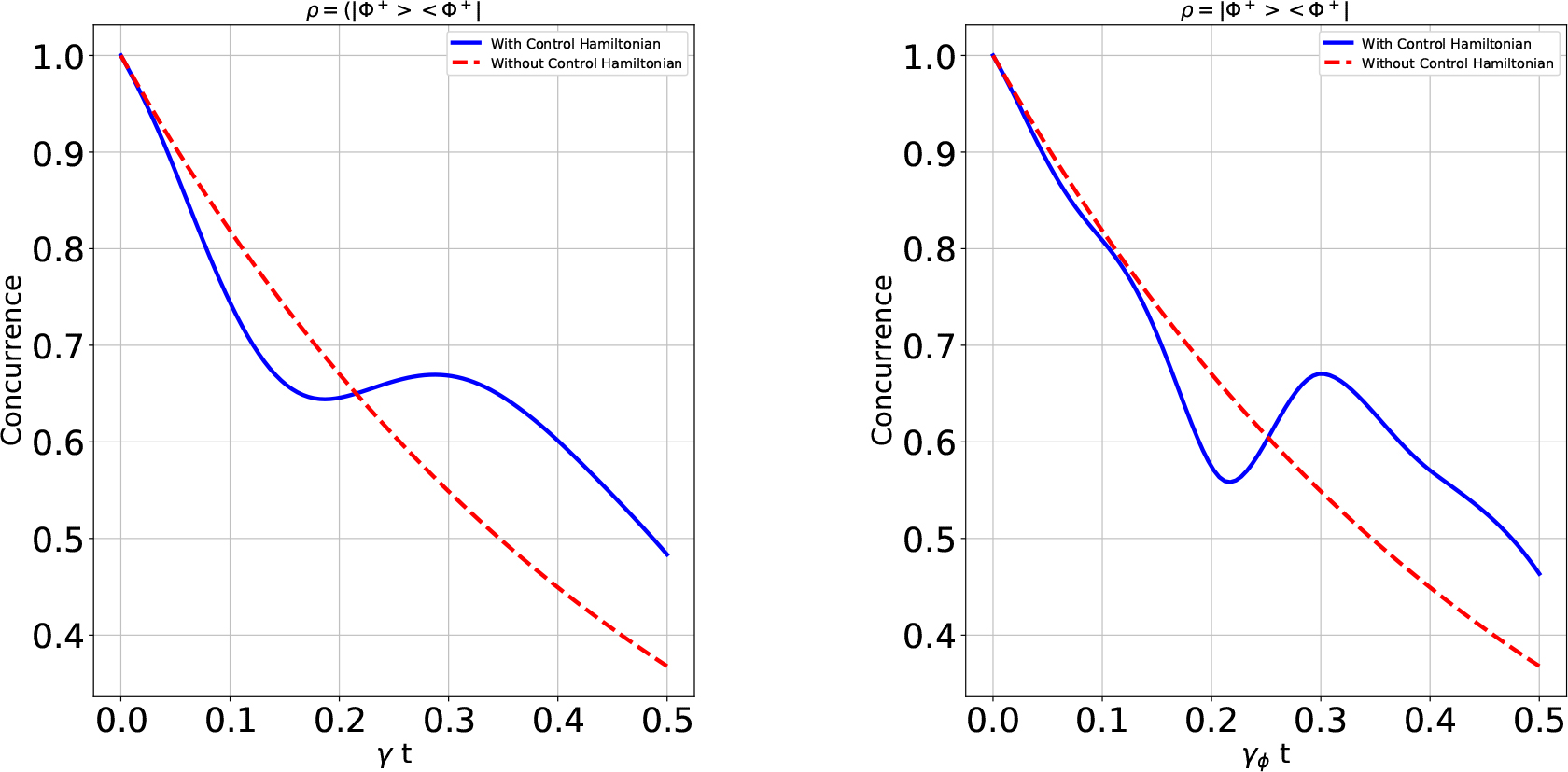
Time evolution of the concurrence for maximally entangled initial state |Φ+〉 when the included decoherence is spontaneous emission (left panel) and when the included decoherence is dephasing (right panel). The effect of control Hamiltonian is shown.
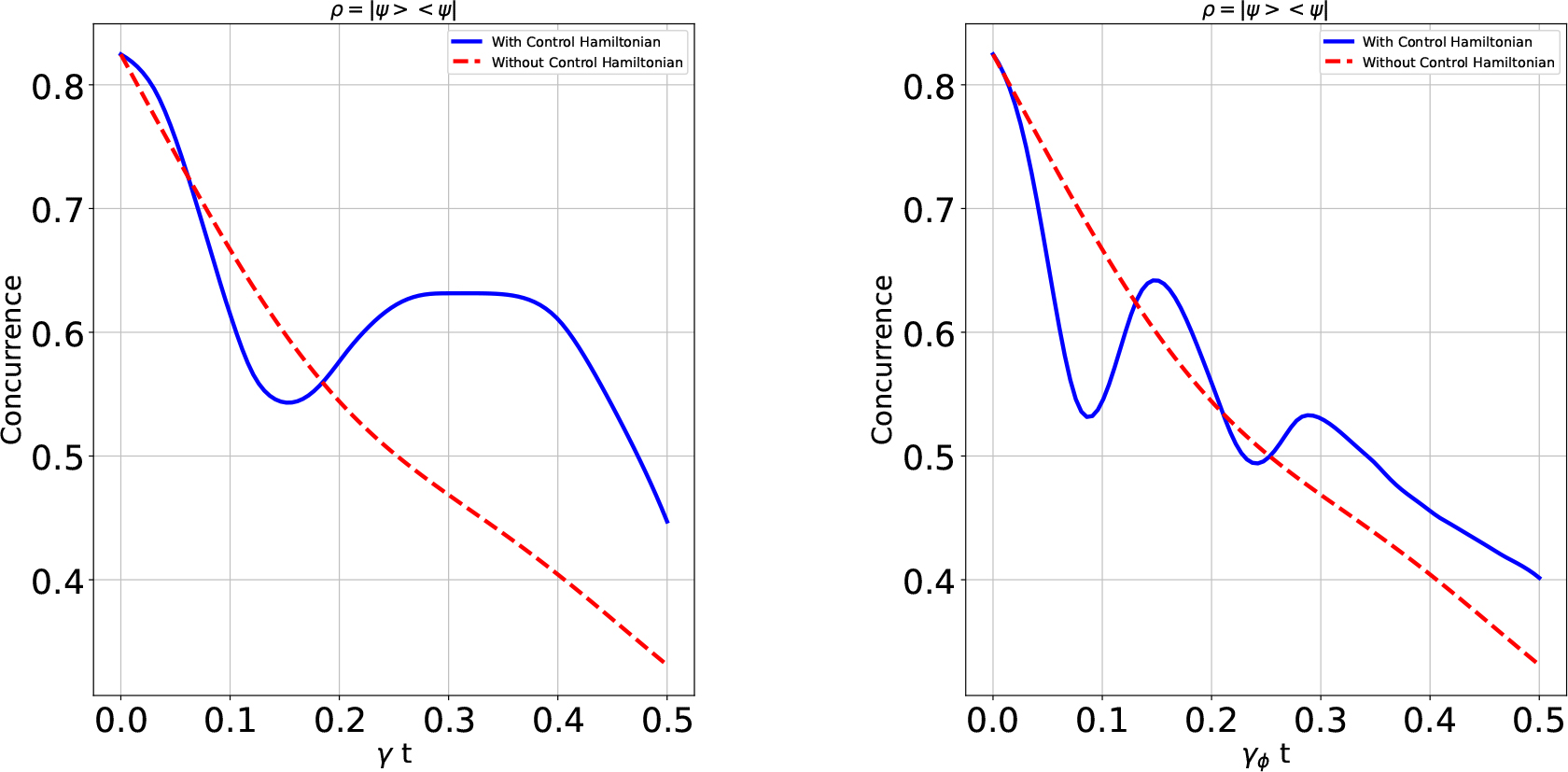

Figure 2.

Time evolution of the concurrence for the initial state |ψ〉 when the included decoherence is spontaneous emission (left panel) and when the included decoherence is dephasing (right panel). The effect of the control Hamiltonian is shown and compared when there is no control Hamiltonian.

Figure 3.

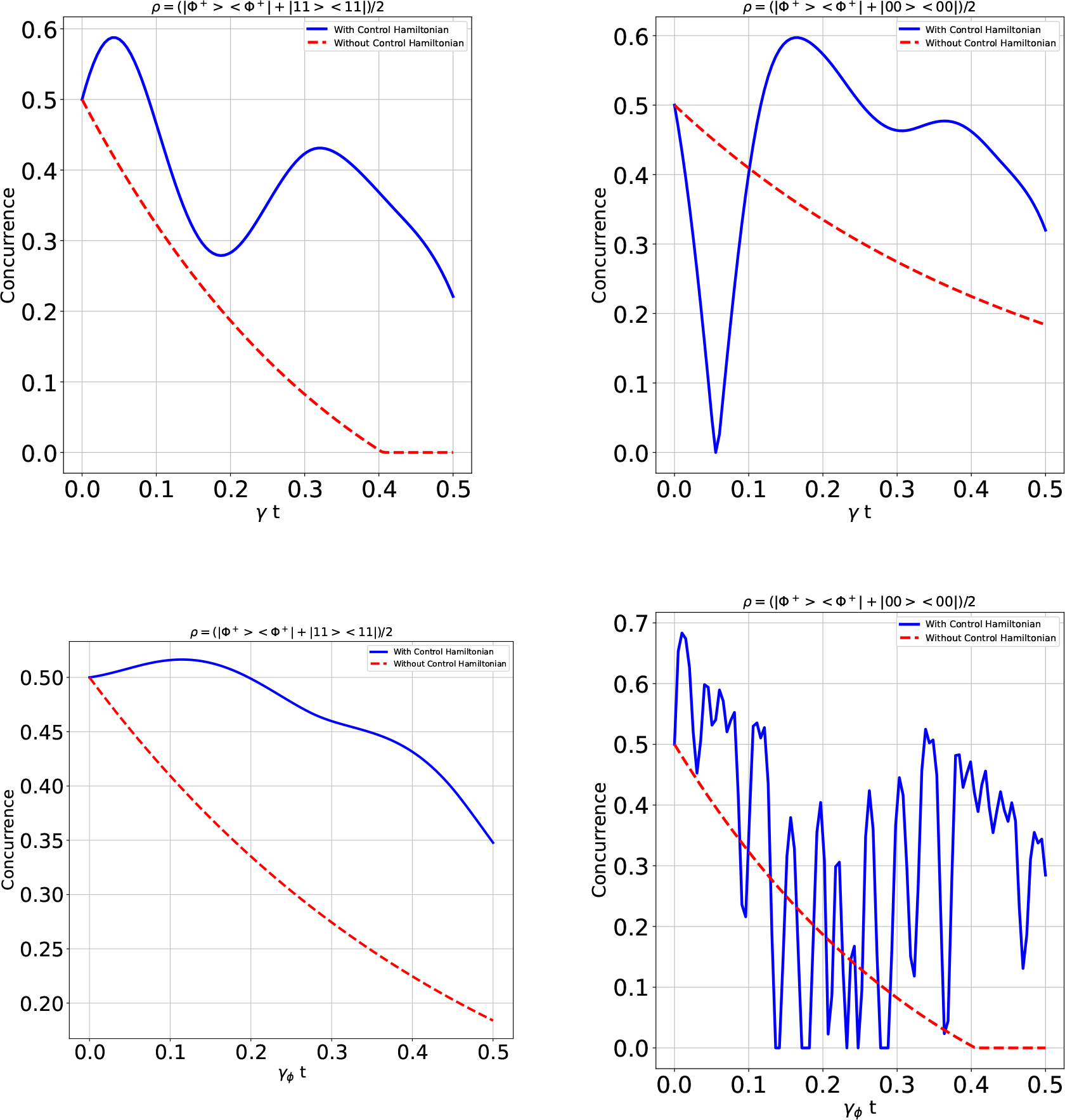
Time evolution of the concurrence for the initially prepared mixed state is defined as equal mixture of |Φ+〉 and |ii〉, where |ii〉 = |11〉, |00〉. In the top panel the included decoherence is spontaneous emission and in the bottom panel the included decoherence is dephasing. The effect of control Hamiltonian is shown for comparison.

The optimized control parameters for decoherence type being spontaneous emission_

γ ≠ 0A1A2A3ω1ω2ω3
+〉 〈Φ+| + |11〉 〈11|0.5851.4700.1503.5975.5990
+〉 〈Φ+| + |00〉 〈00|0.9221.243–0.27910.295–1.906.258

The optimized control parameters for decoherence type being dephasing_

γϕ ≠ 0A1A2A3ω1ω2ω3
+〉 〈Φ+| + |11〉 〈11|0.2230.2760.3483.1918.5454.945
+〉 〈Φ+| + |00〉 〈00|–2.628–11.256–2.18851.38875.11317.965

The optimized control parameters for decoherence type being spontaneous emission or dephasing_ The initial state is a superposition of product and entangled states_

A1A2A3ω1ω2ω3
γ ≠ 0 (spontaneous emission)0.3620.714–0.13013.4165.6755.456
γϕ ≠ 0 (dephasing)–1.2440.2701.07919.64216.7550.508
DOI: https://doi.org/10.2478/qic-2025-0015 | Journal eISSN: 3106-0544 | Journal ISSN: 1533-7146
Language: English
Page range: 290 - 298
Submitted on: Mar 19, 2025
Accepted on: May 6, 2025
Published on: Jul 1, 2025
Published by: Cerebration Science Publishing Co., Limited
In partnership with: Paradigm Publishing Services
Publication frequency: 1 issue per year
Related subjects:

© 2025 Karim Ghorbani, Reza Rezaee, published by Cerebration Science Publishing Co., Limited
This work is licensed under the Creative Commons Attribution-NonCommercial-NoDerivatives 4.0 License.