
Table 1.
Comparison of the primary scope of the surveys.
| Survey | Primary Scope |
|---|---|
| Abane et al. [44] | Quantum internet. |
| Ayral et al. [23] | Quantum computing. |
| Barrala et al. [32] | Distributed quantum computing. |
| Baseri et al. [39] | Quantum communication. |
| Bochkarev et al. [15] | Quantum computation. |
| Boschero et al. [33] | Distributed quantum computing. |
| Caleffi et al. [31] | Distributed quantum computing. |
| Chae et al. [14] | Quantum computation. |
| Cuomo et al. [30] | Distributed quantum computing. |
| Dutta et al. [40] | Quantum communication. |
| Dwivedi et al. [29] | Quantum development tools. |
| Garcia et al. [22] | Quantum computing, quantum machine learning. |
| Garhwal et al. [28] | Quantum programming languages. |
| Gill et al. [13] | Quantum computing. |
| Gyongyosi et al. [12] | Quantum computing. |
| Gyongyosi et al. [7] | Quantum communication. |
| Gyongyosi et al. [45] | Quantum internet. |
| Jimnez-Navajas et al. [27] | Quantum programming languages, quantum development tools. |
| Jones et al. [34] | Distributed quantum computing. |
| Khan et al. [26] | Quantum programming languages, quantum development tools. |
| Kusyk et al. [17] | Quantum computation, quantum machine learning. |
| Li et al. [47] | Quantum internet. |
| Li et al. [41] | Quantum communication. |
| Li et al. [16] | Quantum computation, quantum machine learning. |
| Massoli et al. [19] | Quantum computing, quantum machine learning. |
| Mehic et al. [42] | Quantum cryptography, quantum communication. |
| Memon et al. [8] | Quantum computation. |
| Moguel et al. [37] | Development and deployment of quantum services. |
| Moguel et al. [24] | Quantum programming languages, quantum development tools. |
| Nguyen et al. [36] | Quantum cloud computing. |
| Peral-Garcia et al. [21] | Quantum machine learning. |
| Phillipson [38] | Quantum computing, quantum communication. |
| Pira et al. [35] | Distributed quantum neural networks. |
| Popa et al. [43] | Quantum cryptography, quantum communication. |
| Ramezani et al. [20] | Quantum machine learning. |
| Sahu et al. [10] | Quantum computation, quantum development tools. |
| Serrano et al. [25] | Quantum programming languages, quantum development tools. |
| Singh et al. [11] | Quantum computation, quantum programming languages. |
| Upama et al. [18] | Quantum programming languages, quantum simulators. |
| Wehner et al. [46] | Quantum internet. |
| Yang et al. [9] | Quantum computation, quantum communication, quantum machine learning. |
Table 2.
Superiority of networked quantum services to classical distributed computing.
| Reference | Result | Superiority |
|---|---|---|
| Ang et al. [48] | Multinode quantum computing architecture. | Fast distributed computations. |
| Barz et al. [49], Ruiting et al. [50], Mantri et al. [51] | Demonstration of blind quantum computing. | Enhanced privacy. |
| Cirac et al. [52] | Distributed phase estimation problem over noisy channels. | Fast distributed estimation of the phase of eigenvalues of unitary operators. |
| Collins et al. [53] | Nonlocal content of quantum operations. | Local implementation of non-local quantum gates in a distributed quantum computer. |
| Eisert et al. [54] | Resource-optimized protocols for non-local quantum gates. | Local implementation of non-local quantum gates in a distributed quantum computer. |
| Gidney et al. [55] | Factoring RSA integers via distributed Shor algorithm. | Exponential speedup in distributed integer factorization and in discrete logarithm problems. |
| Gyongyosi et al. [56] | Distributed multiple access QKD. | Enhanced security. |
| Gyongyosi et al. [57] | Distributed resource allocation. | Improved resource prioritization and balancing. |
| Gyongyosi et al. [58] | Distributed problem-solving. | Fast distributed computations for optimization problems. |
| Li et al. [59] | Distributed Deutsch-Jozsa algorithm. | Exponential speedup over distributed deterministic classical computers. |
| Neumann et al. [60] | Distributed quantum phase estimation. | Fast distributed estimation of the phase of eigenvalues of unitary operators. |
| Nguyen et al. [36] | Quantum cloud computing. | Improved security, faster distributed computations. |
| Shi et al. [61] | Quantum message passing interface. | Fast distributed computations for statistical and optimization problems, constraintsatisfaction and graph isomorphism problems. |
| Tan et al. [62] | Distributed Simon’s quantum algorithm. | Exponential speedup over distributed probabilistic classical computers. |
| Van Meter et al. [63] | Arithmetic on a distributed quantum computer. | Exponential speedup in distributed integer factorization and in discrete logarithm problems. |
| Xiao et al. [64] | Distributed quantum-classical factoring algorithm. | Exponential speedup in distributed integer factorization and in discrete logarithm problems. |
| Zhang et al. [65], Degen et al. [66] | Distributed quantum sensing. | Improved accuracy in distributed environment sensoring and data acquisition. |
| Zhou et al. [67] | Distributed Bernstein-Vazirani algorithm. | Efficient distributed solution of black-box problems. |
| Zhou et al. [68] | Distributed quantum searching algorithm. | Quadratic speedup in searching of elements in unstructured databases. |
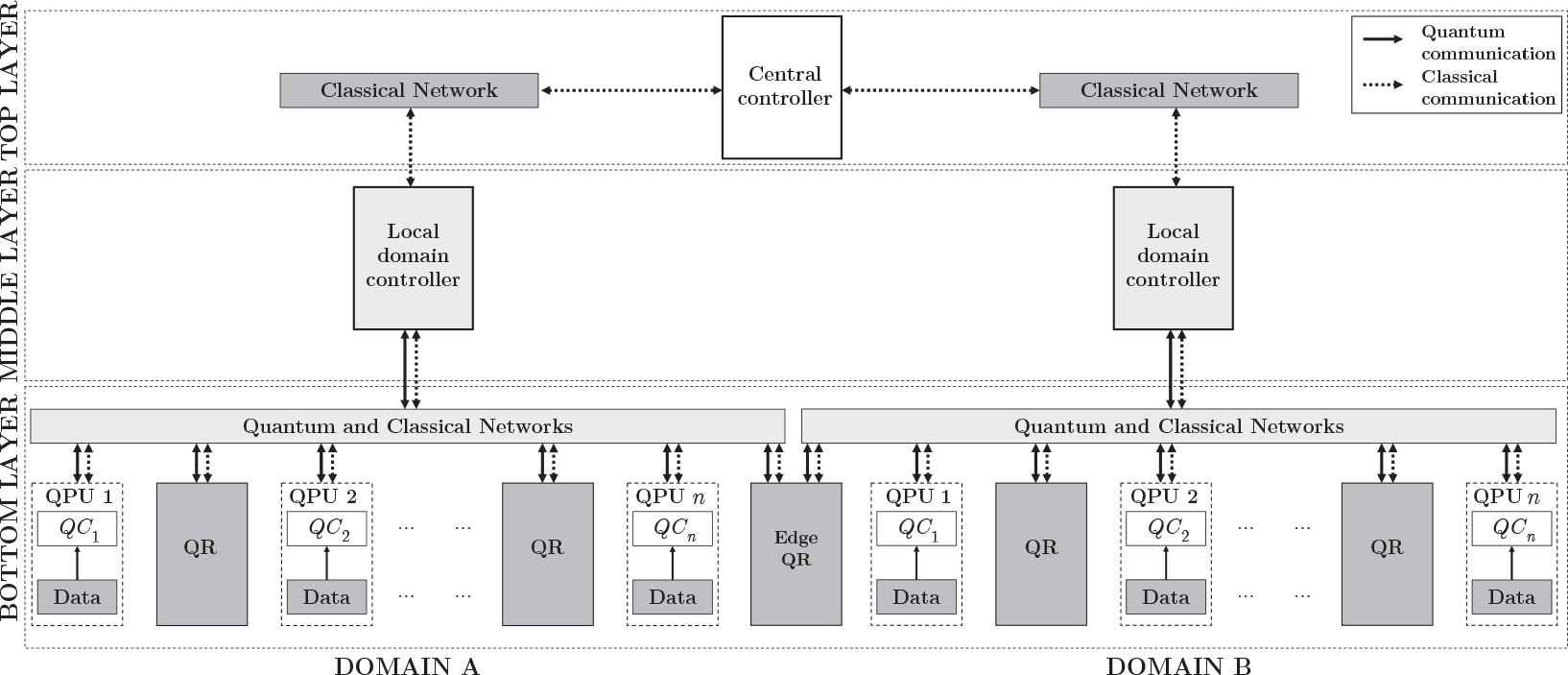
Figure 1.
A hierarchical quantum internet architecture for networked quantum services in compliance with the RFC 9340 standard [69,70]. The n QPUs, QPU i, i = 1,…, n, process in parallel using their local input quantum data (Data) and local quantum circuits QCi. The outputs of the QPUs are combined via post-processing. A given domain integrates n QPUs, n – 1 intermediate quantum repeaters (QR), and a local domain controller unit. The edge quantum repeater (Edge QR) logically separates the domains (Domains A and B). Classical and quantum communications are depicted by dashed and solid-lined arrows.
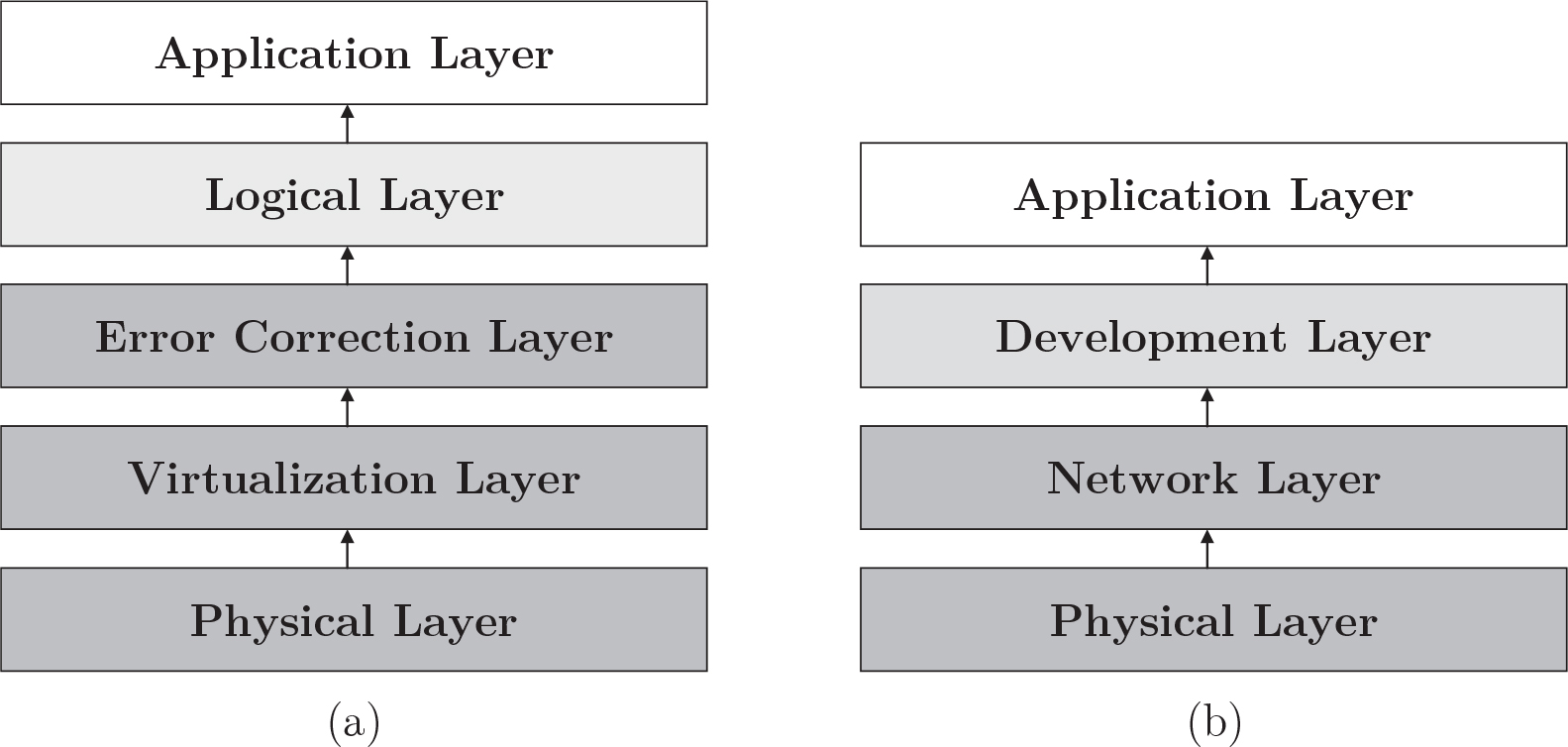
Figure 2.
Layer architectures. (a) Layer architecture of a quantum computer (general gate-model quantum device). (b) A general layer architecture for distributed quantum computation.
Table 3.
Different layer architectures for distributed quantum computation.
| Approach | No. of layers | Layer architecture |
|---|---|---|
| Quantum networking via bipartite entanglement [93,94] | 5 | Physical Layer, Link Layer, Network Layer, Transport Layer, Application Layer. |
| Quantum networking via multipartite entanglement [95] | 4 | Physical Layer, Connectivity Layer, Link Layer, Network Layer. |
| Quantum recursive network architecture [96,97] | 5 | Physical Layer, Link Layer, Remote State Composition Layer, Error Management Layer, Application Layer. |
| Multinode quantum computing architecture [48] | 6 | Physical Layer, Distillation Layer, Data Link Layer, Network Layer, Transport Layer, Application Layer. |
Table 4
Multichip approaches.
| Attribute | Description and related works |
|---|---|
| Multichip | Smaller quantum circuits are executed in parallel, outputs of the quantum circuits are combined via post-processing [32]. |
| Workload distribution:the QPUs are scheduled for the computation of a subset of an input problem [138,146–149]. | |
| Offloading:execution of programs with quantum tasks that are offloaded to a given QPU [150–154]. | |
| Mapping:quantum circuits are physically mapped to the QPUs [155–157]. | |
| Quantum communication is implementation-specific, and classical communication is available. | |
| Quantum and classical communication Applications | Phase estimation [158], amplitude estimation [159], quantum searching [160,161], multiprogramming of quantum computers [162–166]. |
| NISQ compatibility | Partial compatibility: multichip approaches with no entanglement between the circuits, due to the current quantum hardware and quantum resource limitations. |
Table 5
Circuit distribution approaches.
| Attribute | Description and related works |
|---|---|
| Circuit distribution | Partitioning:the large quantum circuit is mapped onto a graph, and the optimal partitioning of the graph has to be found with minimal teleportation or distributed (non-local) gates between the nodes [32,167]. |
| Partitioning methods for quantum circuits:deep reinforcement learning (DRL) [168], Karlsruhe hypergraph partitioning [167,169–176], Kernighan-Lin partitioning [177–181], Fiduccia-Mattheyses algorithm [182,183], tree-based directed acyclic graph (TDAG) [184], relaxed-overall extreme exchange (rOEE) [185,186], Hungarian qubit assignment (HQA) [187], quadratic unconstrained binary optimization (QUBO) [188]. | |
| Distribution of partitions:via entanglement generation and quantum communications between the QPUs. | |
| Partition mapping to QPUs:the subcircuit is mapped to the physical structure in the QPU via a local map. Primary method: Fine Grained Partitioning (FGP) [186,189]. | |
| Quantum and classical communication Applications | Quantum communication is available, classical communication is available. |
| Distributed quantum gates [63], estimating the mean of numbers [190], distributed Simon’s algorithm [62], distributed quantum phase estimation [52,60,61], distributed Deutsch-Jozsa algorithm [59], distributed Bernstein-Vazirani algorithm [67], distributed quantum searching [68,191], distributed quantum Fouriertransform [192], distributed integer factoring [55,64,193]. | |
| NISQ compatibility | Partial compatibility, due to the current limitations of quantum hardware and quantum resources. |
Table 6
Circuit splitting approaches.
| Attribute | Description and related works |
|---|---|
| Circuit splitting | Horizontal splitting:a quantum circuit is split horizontally between distant nodes [143–145]. |
| Horizontal, incoherent splitting:the quantum circuit is simulated by a sequence of local circuits followed by a quantum measurement of the qubits [143,144,194–199]. | |
| Horizontal, coherent splitting:the quantum circuit is simulated by a sequence of local circuits with no quantum measurement on the qubits to preserve quantum information [143,200–202]. | |
| Horizontal, combined incoherent and coherent splitting:combination of incoherent and coherent splitting [203]. | |
| Vertical splitting:a quantum circuit is split vertically between distant nodes. | |
| Quantum and classical communication | Quantum communication is not available, classical communication is available. Horizontal split requires classical communication between the nodes [199–201,203,204], vertical split requires quantum tomography [196]. Utilization of quantum datasets [200]. |
| Applications | Simulation of large quantum circuits [144], optimal quantum circuit cuts to clustered Hamiltonian simulation [205], combinatorial optimization [198,206], solution of chemical problems [195], complex problem solving via small quantum circuits [207], high-dimensional quantum machine learning [208]. |
| NISQ compatibility | Partial compatibility: horizontal, incoherent splitting due to the current limitations of quantum hardware. |
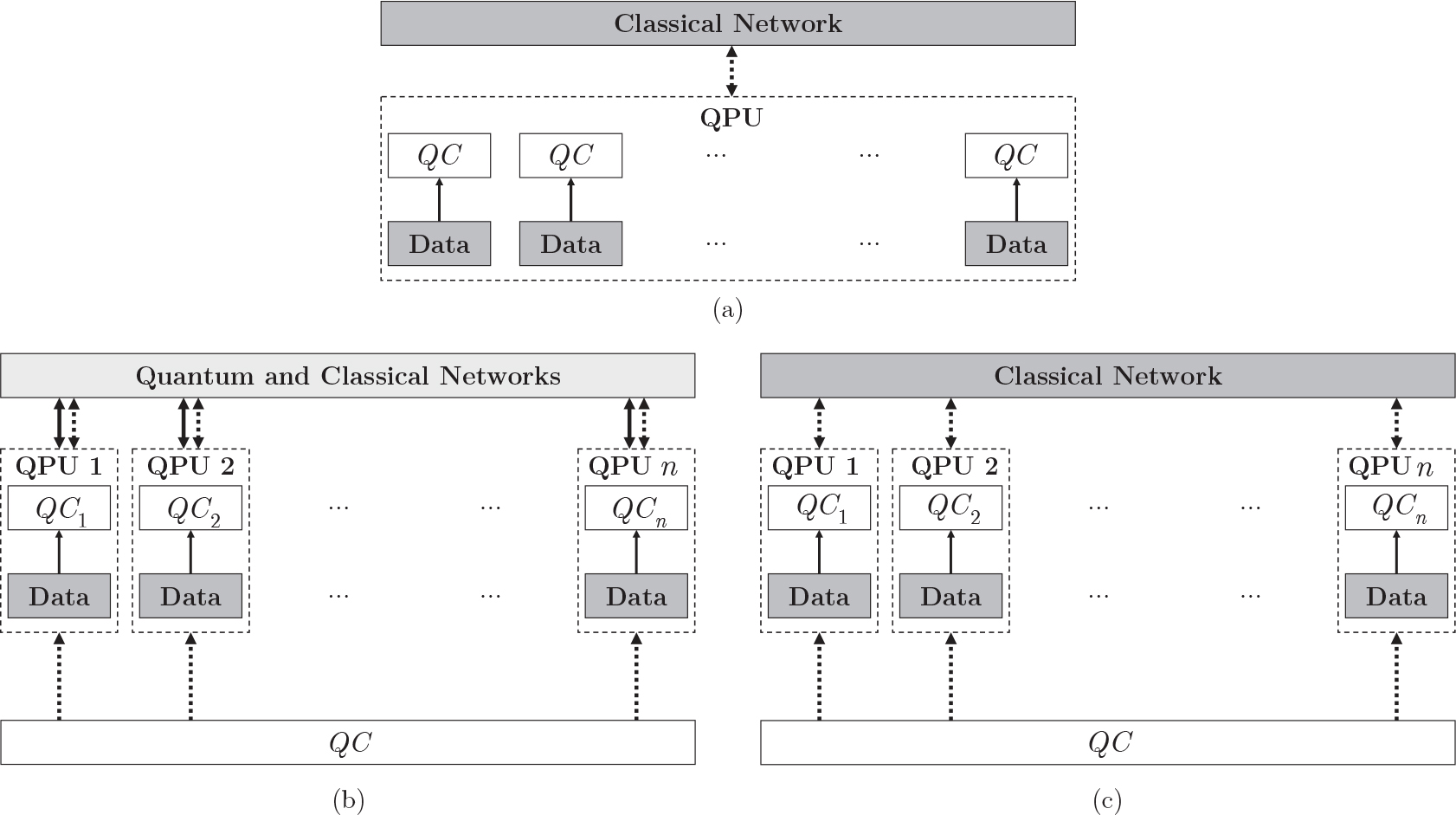
Figure 3.
Distributed quantum computer architectures. (a) Multichip: the n smaller quantum circuits (QC) fit in a quantum processing unit (QPU), quantum communication is implementation-specific, classical communication is always available via Classical Network. (b) Circuit distribution: a large quantum circuit (QC) is distributed among the n QPUs such that each node realizes a smaller subcircuit of it with relation where QCi is the local circuit of the i -th QPU, while wi is a real weighting coefficient. Quantum communication is available (via Quantum Network), classical communication is available (via Classical Network). (c) Circuit splitting approach: a large quantum circuit (QC) is split among the n QPUs, such that each node realizes a smaller subcircuit with relation no quantum communication is available, classical communication is available.
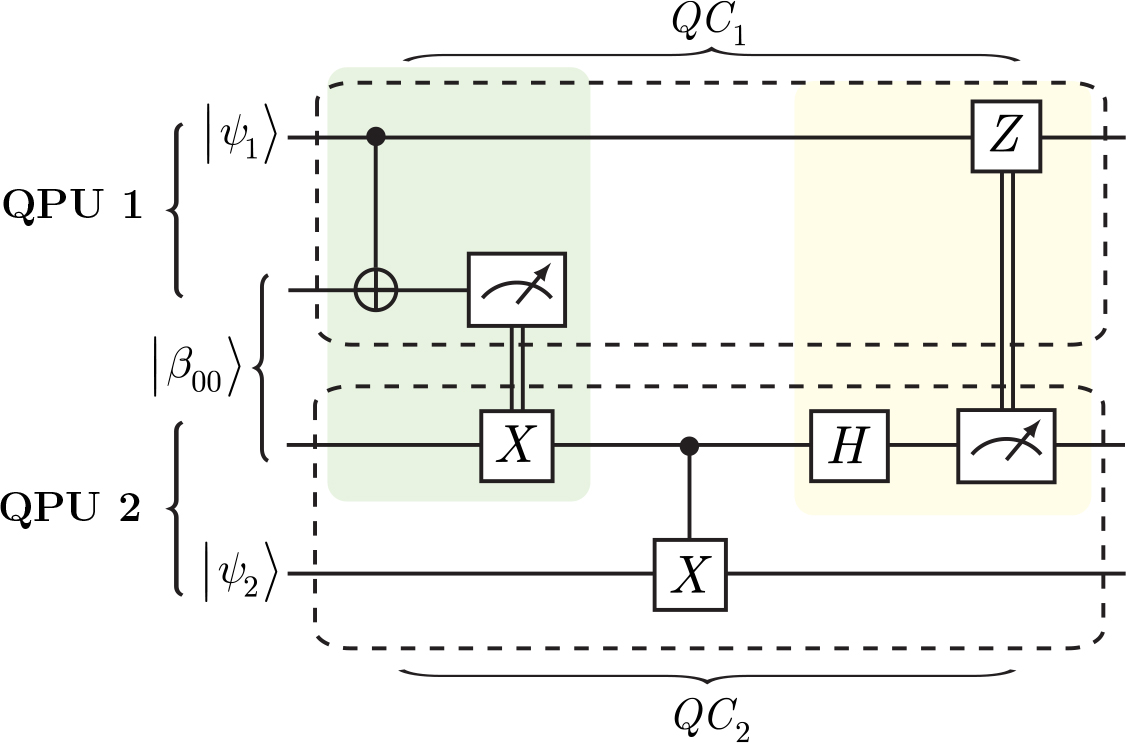
Figure 4.
A distributed CNOT gate realized by two QPUs between distant quantum states |ψ 1〉 and |ψ 2〉. Local system |ψ 1〉 is at QPU 1, while |ψ 2〉 is at QPU 2. QPU 1 has the quantum circuit QC 1(dashed line frame) and QPU 2 has QC 2(dashed line frame). The quantum nodes also share a Bell state The QPUs use their local quantum circuits and classical communication (doubled lines) to realize the CNOT gate between |ψ 1〉 and |ψ 2〉 in a distributed manner. The greenshaded box is the cat-entangler sequence [192], and the yellow-shaded box is the cat-disentangler sequence. Related implementations: [209–213].
Table 7
Recent distributed quantum computing approaches and implementations.
| Approach | Description and related works |
|---|---|
| Multichip | Architecture for multicore quantum computers with double full-stack communication [90]. |
| Quantum data networking for distributed quantum computing [214]. | |
| Multi-qubit generation, development of multichip quantum computing platform [215]. | |
| Scalable multichip quantum architecture using hybrid wireless/quantum-coherent network [216]. | |
| Multichip multidimensional quantum network with entanglement retrievability [217]. | |
| Modular superconducting-qubit architecture with a multichip tunable coupler [218]. | |
| Variational quantum algorithms [219–224]. | |
| Circuit distribution | Arithmetic on a distributed-memory quantum multicomputer [63]. |
| Scalable distributed gate-model quantum computers for distributed problem-solving [58]. | |
| Architectures for multinode superconducting quantum computers [48]. | |
| Modular quantum compilation framework for distributed quantum computing [225]. | |
| Factoring 2048 bit RSA integers using 20 million noisy qubits [55]. | |
| Distributed quantum-classical hybrid factoring algorithm [64]. | |
| Imperfect distributed quantum phase estimation [60]. | |
| Implementation for a quantum message passing interface [61]. | |
| Distributed quantum algorithm for Simon’s problem [62]. | |
| Distributed quantum algorithms for Deutsch-Jozsa problem [59]. | |
| Distributed Bernstein-Vazirani algorithm [67]. | |
| Distributed Grover’s algorithm [68]. | |
| Scalable quantum computing infrastructure using superconducting electronics [226]. | |
| Distributed quantum computation with circuit splitting [198]. | |
| Quantum circuit cutting with maximum-likelihood tomography [196]. | |
| A smart quantum circuit cutting method [227]. | |
| Circuit splitting | Hypergraphic partitioning of quantum circuits for distributed quantum computing [183]. |
| Fast quantum circuit cutting with randomized measurements [199]. | |
| Clifford-based circuit cutting for quantum simulation [228]. | |
| Scalable emulation of quantum algorithms on high-performance computers [229]. | |
| Dimensionality reduction via circuit splitting for quantum reinforcement learning [230]. |
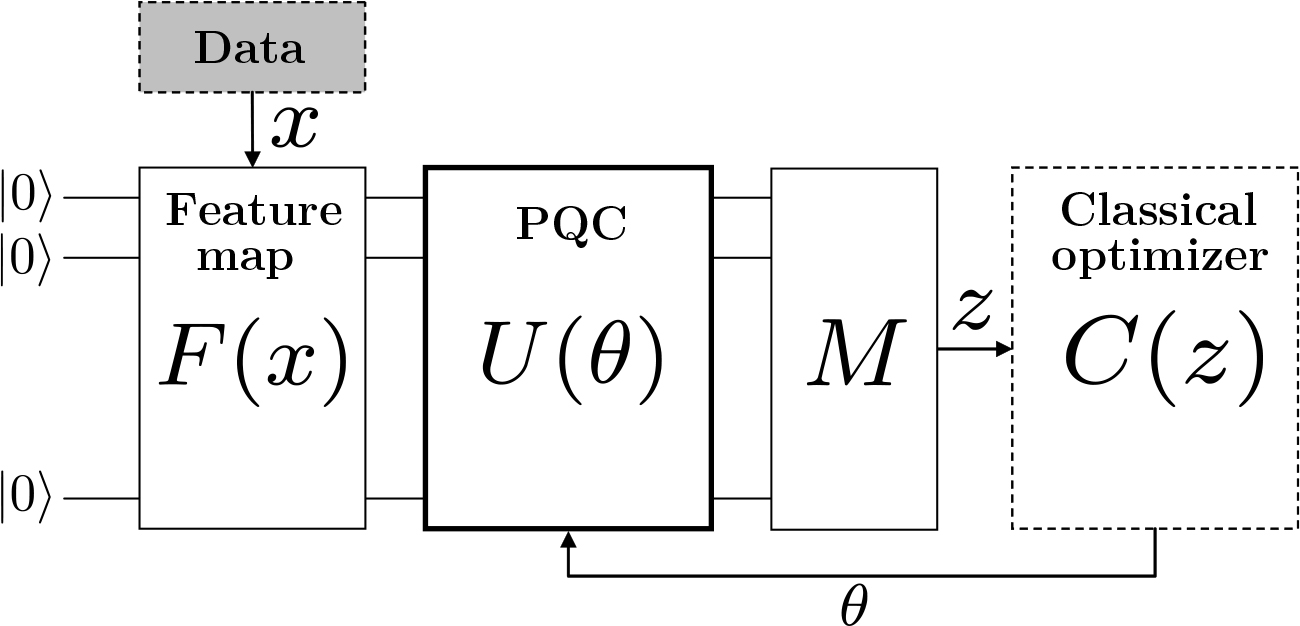
Figure 5.
Schematic model of a VQA. The classical data is mapped onto qubits via feature map F (x), and fed into the parameterized quantum circuit U (θ) (PQC), where θ is the parameter of unitary U The output of U (θ) is measured via measurement M in the computational basis, which results in a classical bit string z ∈ {0, 1}n of length n This string is fed to a classical computer to evaluate a cost function C (z). Depending on the value of C (z), the parameter ¸ is updated via a classical optimizer and propagated back to U (θ). The circuit is re-run multiple times until a convergence or other stopping criterion is fulfilled.
Table 8
Classes of quantum machine learning based on the data type (classical or quantum) and the algorithm (classical or quantum).
| Data | Algorithm | |
|---|---|---|
| Classical | Quantum | |
| Classical | Classical-Classical: classical data and classical machine learning algorithms inspired by quantum mechanics [246]. | quantum-classical: classical data encoded into quantum states and processed by quantum processors for quantum speedups [247–250], NISQ applications [112,251]. |
| Quantum | Quantum-Classical: quantum data augmented by classical computations [252–259]. | Quantum-Quantum: quantum data on quantum processors [260,261]. |
Table 9
Data splitting approaches in distributed quantum neural networks.
| Attribute | Description and related works |
|---|---|
| Data encoding | Encoding of a classical dataset into quantum states. |
| Basis encoding:the data is encoded in a computational basis state. The dataset is encoded as superposition of the computational basis states [270–272]. | |
| Amplitude encoding:uses amplitudes of the quantum state for dataset encoding [273,274]. | |
| Angle encoding:tensor product encoding at the single-qubit level without entanglement within feature vectors [275–278]. | |
| Hamiltonian encoding:encoding is made at the Hamiltonian level mostly by two-qubit entangling gates [139,242,279,280]. | |
| Data storage | Quantum random access memory [248–250]. |
| Quantum and classical communication Applications | Quantum communication is available, quantum simulators are available, quantum AI software packages [274], classical communication is available [281,282]. |
| Classification problems [112,251,283], quantum data compression [284], quantum Boltzmann machines [285], feature mapping [139,242,279,280,286], machine learning problems [275–278]. | |
| NISQ compatibility | Partial compatibility: basis encoding, angle encoding, and Hamiltonian encoding, due to the current limitations of quantum hardware. |
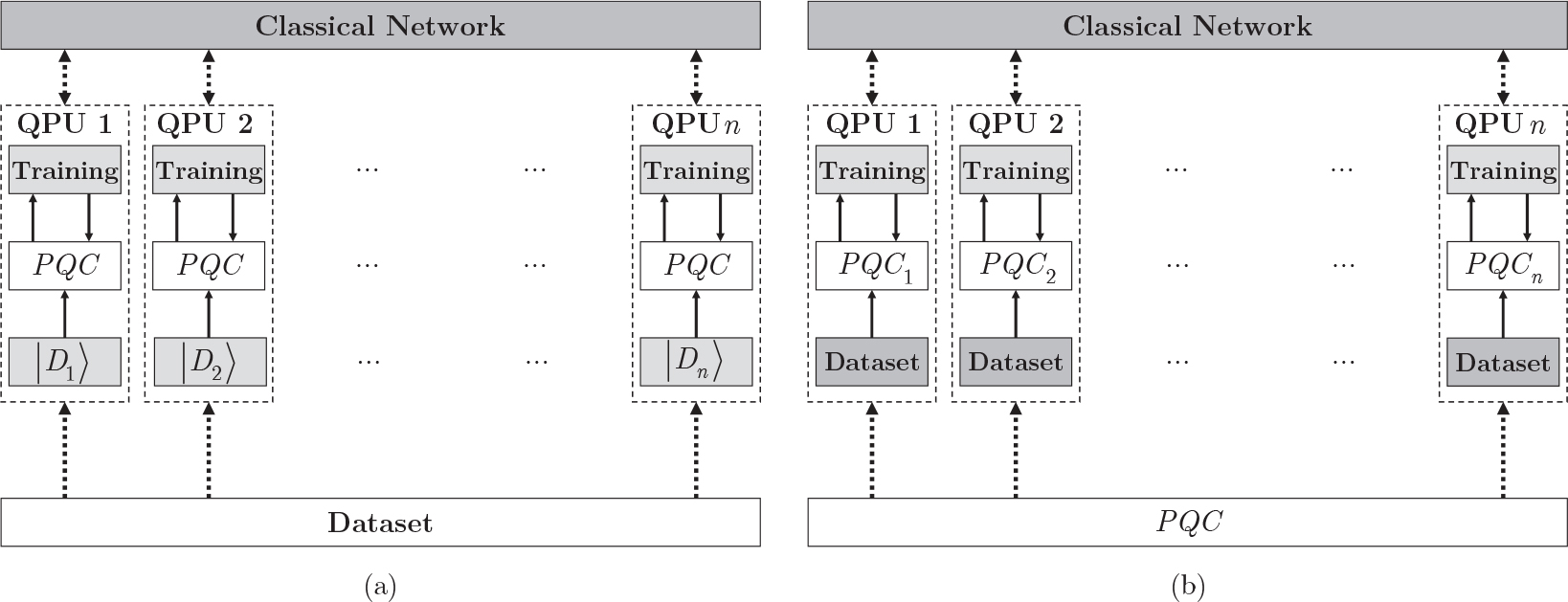
Figure 6.
Data splitting and circuit splitting in distributed quantum neural networks. (a) Data splitting. The full dataset (Dataset) is split into parts, denoted by |ψ 1〉,…, |Dn 〉, across the n quantum nodes (QPUs), while satisfying The model (PQC) is loaded into each QPU. The QPUs process and train in parallel, each QPU has access to a classical network (Classical Network). (b) Circuit splitting. The input PQC is split into n parts, PQC 1…,PQCn and loaded into the n QPUs along with the full quantum dataset (Dataset); PQCi where is the local PQC of the i -th QPU, while ci is a real weighting coefficient. The QPUs process and train in parallel; each QPU has access only to a classical network in general.
Table 10
Data reduction and data distribution approaches in distributed quantum neural networks.
| Approach | Description and related works |
|---|---|
| Data reduction (coreset) | Approximation of an original dataset. Application in variational algorithms [287], and in hybrid quantum-classical architectures [287,288]. |
| Data distribution | Parameters are distributed as classical information between the quantum nodes in parallel for optimization [251,289]. |
| Quantum and classical communication | Quantum communication is available, classical communication is available. |
| NISQ compatibility | Full compatibility. |
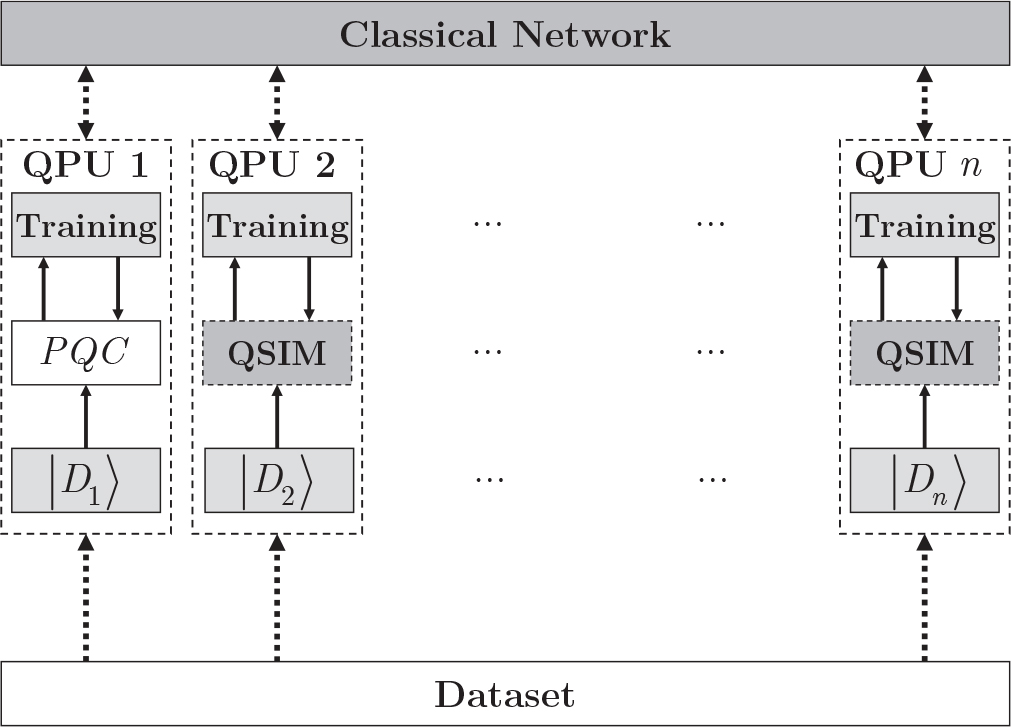
Figure 7.
A QUDIO model for VQAs. The nodes are trained in parallel using a PQC or a quantum simulator (QSIM). A classical central server communicates with all local quantum nodes to synchronize the trainable parameters of the nodes.
Table 11
Recent quantum cloud platforms.
| Platform | Computing Model | Quantum hardware vendor | Description and related works |
|---|---|---|---|
| IBM Cloud | Gate-model, quantum simulation | IBM Quantum (1121 qubits) [297] | Remote access to the IBM quantum computing hardware, serverless model [298], supported quantum software: Qiskit. |
| Google Cloud | Gate-model, quantum simulation | Google (54 qubits) [299], IonQ (36 qubits) [300] | Remote access to Google’s quantum computing hardware [299], supported quantum software: Cirq. |
| Microsoft Azure Quantum | Gate-model, quantum simulation | Quantinuum (32 qubits) [301], Rigetti (84 qubits) [294], IonQ (36 qubits) [300], Pasqal (100 qubits) [302] | Remote access to a diverse portfolio of current quantum hardware [303], supported quantum software: Q#, Qiskit, Cirq. |
| Amazon Braket | Gate-model, quantum simulation | Rigetti (84 qubits) [294], OCQ (32 qubits), IonQ (36 qubits) [300], QuEra (256 qubits) [304] | Access to different types of quantum computers, simulators and quantum-classical algorithms, serverless model [305,306], supported quantum software: Braket, Qiskit, Pennylane. |
| PlanQK | Gate-model, quantum annealing, quantum simulation | IBM Quantum [297], Amazon Braket [305,306], Azure Quantum [303] | Remote running of quantum tasks and algorithms, provides access to major quantum backends and simulators, serverless model [307,308], supported quantum software: Qiskit, Pennylane. |
| QuantumPath | Gate-model, quantum annealing, quantum simulation | IBM Quantum [297], Amazon Braket [305,306], D-Wave (5000 annealing qubits), QuTech (5 qubits) [309] | Industry-ready hybrid quantum-classical solutions [310,311], supported software: Qiskit, Ocean, Braket, Q#. |
| Strangeworks | Gate-model, quantum annealing, quantum simulation | IBM Quantum [297], Amazon Braket [305,306], Azure Quantum [303] | Hybrid quantum-classical solutions, serverless model [312], supported quantum software: Qiskit, Braket, Forest. |
| QFaaS | Gate-model, quantum annealing, quantum simulation | IBM Quantum [297], Strangeworks [312] | A function-as-a-service framework for quantum computing, open-source, serverless model [313,314], supported quantum software: Qiskit, Cirq, Q#. |
| 1Qloud | Quantum simulation | 1Qbit [315] | Hybrid quantum-classical solutions [315], supported quantum software: 1Qbit. |
| QEMIST | Quantum simulation | 1Qbit [315] | Hybrid quantum-classical solutions [316], supported quantum software: OpenQEMIST. |
Table 12
Quantum software for networked quantum services.
| Quantum Software | Description and related works |
|---|---|
| CutQC | Software package for circuit splitting [197]. |
| Interlin-q | Software package for the development of distributed quantum algorithms [166]. |
| Pennylane | Quantum software for simulations and experiments on current NISQ quantum devices, by Xanadu [370]. |
| Qiskit | Quantum software for simulations and experiments on current NISQ quantum devices, by IBM [363,371]. |
| QuantumCircuitOpt | Software for the implementation of mathematical optimization and algorithms for decomposing arbitrary unitary gates into a sequence of hardware-native gates [372]. |
| QuPanda | Software for creating and executing complex quantum circuits and algorithms, by Origin Quantum [373]. |
| QuNetSim | Software for real time quantum networks simulation [374]. |
| Qurzon | A compiler that uses CutQC and other tools [375]. |
| ScaleQC | A software tool for circuit splitting [376]. |
| SuperSim | A software tool for circuit splitting [377]. |
| TorchQuantum | A software for merging quantum computing with deep learning, by MIT [378]. |
| Tensorflow Quantum | Distributed quantum machine learning [379], distributed training of quantum neural networks [349,380], by Google and NASA Ames. |
Table 13
Quantum programming languages, quantum SDKs, and quantum SLs for networked quantum services.
| Approach | Description and related works |
|---|---|
| Programming language | Qiskit: an integrated programming language and quantum SDK for quantum simulations and quantum algorithms, by IBM [363,371,381–383]. |
| PyQuil: a Python library for quantum programming using Quil, the quantum instruction language developed by Rigetti Computing [384]. | |
| Q#: programming language for quantum computing, by Microsoft. Integrated support for different program languages and quantum development kit [385]. | |
| Quipper: an embedded, scalable functional programming language for quantum computing [386,387], by Microsoft and the University of Oxford. | |
| Ocean: quantum SDK for quantum annealing algorithms, by D-Wave [388,389]. | |
| Forest: quantum SDK for quantum computing using the quantum services of Rigetti [390,391]. | |
| Quantum SDK | Microsoft QSDK: quantum SDK for quantum computing using Microsoft quantum services [392,393]. |
| Strawberry Fields: a cross-platform Python library for simulating and executing programs on the quantum photonic hardware of Xanadu [394]. | |
| ProjectQ: a Python-based open source framework for quantum computing [395]. | |
| Cirq: a quantum software library by Google for the development of quantum circuits and noise modeling. Cirq provides abstractions for NISQ quantum computers [396]. | |
| Quantum SL | OpenFermion: a quantum software library and electronic structure package for quantum computers [397]. |
| QuTiP: an open-source Python quantum software library for the dynamics of open quantum systems [398]. |
Table 14
Standardization approaches for networked quantum services.
| Approach | Description and related works |
|---|---|
| Quantum API Gateway | A machine learning-based middleware for the integration of different quantum vendors for quantum service access [37,399–402,404]. |
| Open API Quantum | A vendor-independent description format for quantum services [405,406]. |
| Qiskit Runtime | API for hybrid quantum-classical computing [37]. |
| Universal Quantum Intermediate | API for hybrid quantum-classical computing [407]. |
| Compilation protocol | Simultaneous execution of quantum circuits on NISQ systems [408]. |
| Quantum simulators | Connection of different quantum simulators and online AI platforms [366]. |
| Cloud computing with load balancing | Quantum-based security approach for cloud computing with load balancing [409]. |
| Communication with quantum providers | Quantum secure communication between service provider and subscriber identity module [410]. |
| Quantum service prioritization | Integration of different quantum hardware and quantum compilers [411]. |
| Quality of quantum services | Improving the quality of quantum services via additional layer [412,413]. |
| Programming of quantum services | Python-based programming in the quantum cloud for quantum services [414]. |
| Development and deployment | Tools for the development of quantum services [369], and hybrid quantum-classical services [403]. |
| Provenance system | A provenance method for the selection of a quantum computer [415]. |
| Hybrid quantum applications | Orchestration of quantum and classical services in hybrid systems [416]. |
Table 15
Gate error rates of quantum processors.
| Quantum processor | Error rate (%) | Release date |
|---|---|---|
| IBM Quantum Eagle | ~0.9 | 2019 |
| Google Sycamore | ~0.6 | 2020 |
| Rigetti Aspen-9 | ~0.5 | 2021 |
| IonQ Harmony | ~0.3 | 2022 |
| IBM Quantum Hummingbird | ~0.2 | 2023 |
| Google Quantum Bristlecone | ~0.15 | 2023 |
| Rigetti Aspen-12 | ~0.1 | 2024 |
| IonQ Symphony | ~0.01 | 2024 |
Table 16
Error correction and management in quantum networks.
| Network type | Loss tolerance scheme | Error tolerance scheme | Delay | Cost |
|---|---|---|---|---|
| Type I. | Heralded entanglement generation with bidirectional classical side-information | Entanglement distillation with bidirectional classical side-information | High | Polynomial scaling with total distance |
| Type II. | Heralded entanglement generation with bidirectional classical side-information | Entanglement distillation with unidirectional classical side-information, or QEC with no classical side-information | Moderate | Polylogarithmic scaling with total distance |
| Type III. | QEC with no classical sideinformation | QEC with no classical sideinformation | Low | Polylogarithmic scaling with total distance |
Table 17
Error correction in Type II-III quantum networks.
| Network type | QEC code | Application |
|---|---|---|
| Type II. | Repetition code, Shor code, Calderbank-Shor-Steane (CSS) code | Correction of operational errors. |
| Type III. | Surface code, Gottesman-Kitaev-Preskill (GKP) code | Correction of photon loss and operational errors. |