
Introduction
A Pancoast tumour, also known as a superior sulcus tumour, is a rare apical lung malignancy accounting for approximately 3%–5% of all lung cancers and remains among the most challenging forms of non–small cell lung cancer (NSCLC) to manage because of its anatomical location and frequent involvement of critical surrounding neurovascular structures. Owing to early invasion of adjacent structures such as the brachial plexus, cervical sympathetic chain and stellate ganglion, patients most commonly present with ipsilateral shoulder and arm pain, reported in up to 96% of cases (1, 2). This pain may radiate to the head and neck, axilla, scapular region or anterior chest (1).
We report a case of a 62-year-old male smoker with a Pancoast tumour whose initial presentation posed a diagnostic challenge, requiring differentiation from cardiac and infectious aetiologies in a tuberculosis-endemic setting.
Case presentation
A 62-year-old man presented to the emergency department after referral from a primary healthcare centre due to severe left-sided chest pain. The pain had been present for approximately 3 months and had progressively worsened over the past month, with an acute exacerbation 1 day prior to presentation. It was described as deep, persistent and non-pleuritic, radiating to the back, left scapular region and left upper extremity. The pain was non-exertional, not relieved by rest and was not associated with diaphoresis, nausea or palpitations, making an ischaemic cardiac aetiology less likely. In addition to chest pain, the patient reported pain involving the neck, left shoulder and left axillary region. He also experienced progressive neurological symptoms affecting the left upper limb, including paraesthesia, reduced grip strength and subjective sensory impairment.
The patient reported intermittent low-grade fever prior to presentation but was afebrile at the time of evaluation. He had a mild cough over the past 3 months, which occurred only occasionally. He denied haemoptysis, night sweats or a prior history of pulmonary disease. Notably, he reported significant unintentional weight loss over the preceding 2 months. Bowel and bladder functions were normal.
There was no history of hypertension, diabetes mellitus, malignancy, coronary artery disease or previous tuberculosis treatment. The patient had a history of 12 cigarettes per day for 15 years of smoking (Brinkman Index of 180). No similar illnesses were reported among family members.
On physical examination, the patient appeared chronically ill but was fully conscious and oriented. Vital signs were within normal limits, except for a numeric pain rating scale of 8 per 10 and a respiratory rate of 24 breaths per minute. Inspection of the chest revealed no deformity or asymmetry. No palpable masses or lymphadenopathy were detected in the cervical, supraclavicular or left axillary regions (Figure 1). Respiratory examination revealed decreased breath sounds over the left apical lung field, without wheezes or crackles. Cardiac examination revealed no elevation of jugular venous pressure, with normal heart sounds and no murmurs. There were no signs of ipsilateral ptosis, miosis, anhidrosis or facial asymmetry. No peripheral pitting oedema was observed.
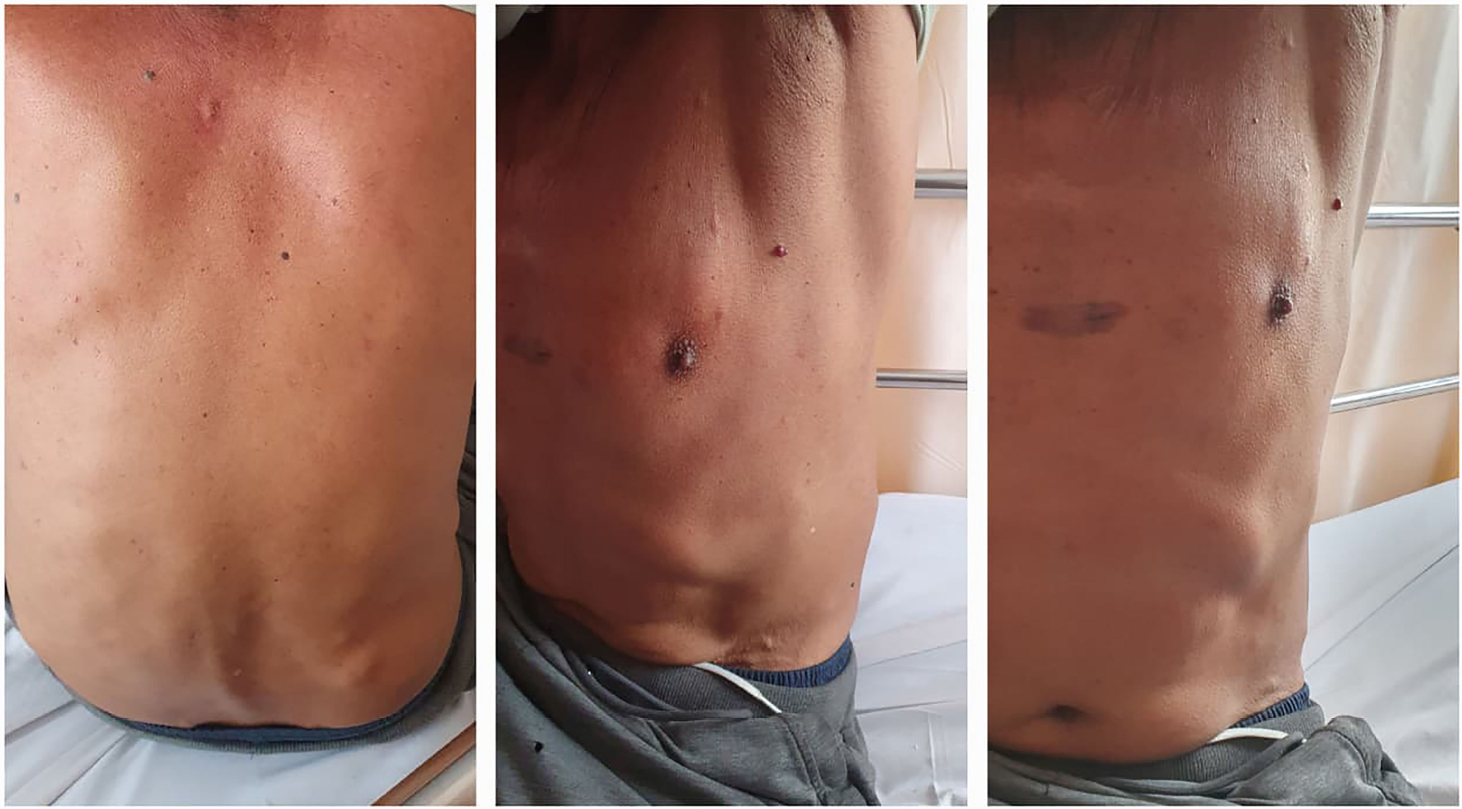
Figure 1.
Physical examination of the chest and back revealed no deformity, asymmetry or palpable mass.
A 12-lead electrocardiogram on admission demonstrated a regular sinus rhythm at approximately 90 beats per minute, with narrow QRS complexes, and a normal axis. No ST-segment changes, abnormal T-waves or pathological Q waves were observed, suggesting no evidence of acute myocardial ischemia or arrhythmia.
Neurological examination of the left upper extremity revealed reduced muscle strength, predominantly affecting hand grip. Sensory examination demonstrated diminished sensation along the ulnar aspect of the left forearm and hand, including the fourth and fifth digits. Paraesthesia was present in the same distribution, consistent with involvement of the lower brachial plexus. Deep tendon reflexes were preserved, and no muscle atrophy or swelling was observed. Examination of the right upper extremity and both lower extremities was unremarkable.
Laboratory investigations showed a haemoglobin level of 14.9 g/dL, erythrocyte count of 5.06 × 10⁶/μL and haematocrit of 43.4%, all within normal ranges. The leukocyte count was mildly elevated at 13,240/μL, with neutrophilia (78%) and relative lymphopenia (13%). Platelet count was normal at 299,000/μL. Serum urea was elevated at 57 mg/dL, with creatinine at the upper limit of normal (1.2 mg/dL). Liver function tests were within normal limits. Random blood glucose was 63 mg/dL. HIV serology was non-reactive. Chest radiography revealed a mass in the upper zone of the left lung, accompanied by destruction of the left posterior second and third ribs. The cardiac silhouette was normal (Figure 2). Based on the clinical and radiographic findings, the initial working diagnosis was suggestive of an apical lung mass, with differential diagnoses including a Pancoast tumour and pulmonary tuberculosis. Given that the patient resided in Indonesia, where lung tuberculosis is endemic, he was initially managed in an isolation room as a precautionary measure. Subsequent sputum examination did not detect M. tuberculosis.
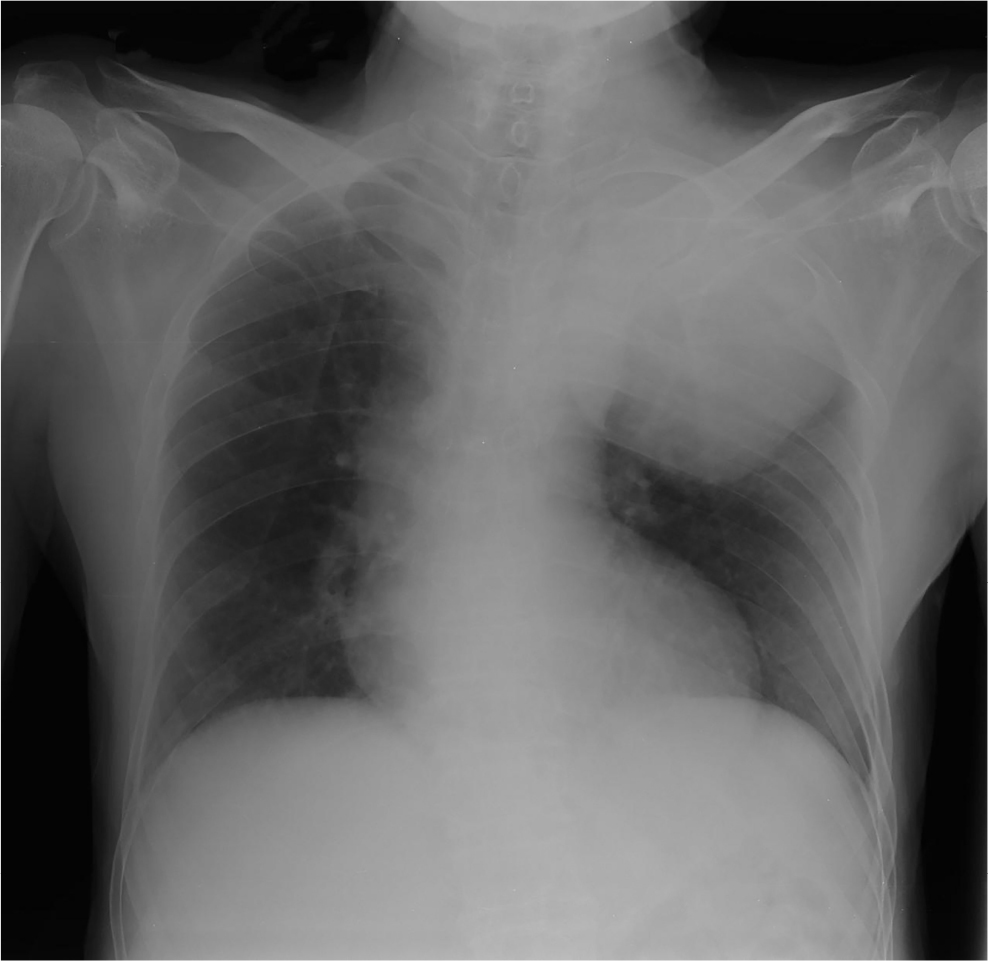
Figure 2.
Chest X-ray showing a mass in the upper zone of the left lung, accompanied by destruction of the left posterior second and third ribs.
To further characterise the lesion, contrast-enhanced computed tomography of the thorax was performed. Imaging revealed an isodense, non-calcified lesion in the apical segment of the left lung, measuring approximately 8.9 × 9.9 × 11.4 cm. The lesion demonstrated well-defined, regular margins and was adherent to the posterior thoracic wall, with destruction of the left posterior second and third ribs and invasion of adjacent soft tissues. These findings were highly suggestive of a Pancoast tumour (Figure 3).
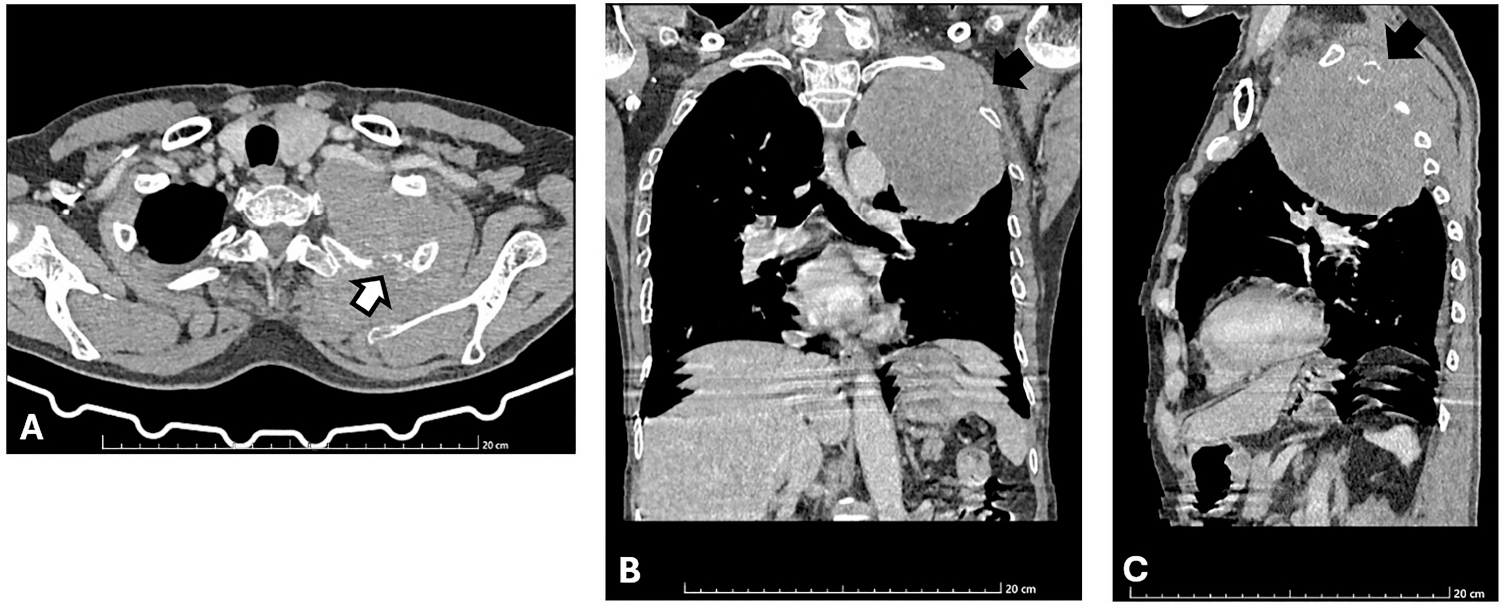
Figure 3.
Contrast-enhanced thoracic computed tomography (A) axial, (B) coronal, (C) sagittal shows left apical lung mass with posterior second and third rib destruction (open arrow) and adjacent tissue involvement (solid arrow).
At the primary healthcare centre, the patient received intravenous fluids, analgesics, gastric protection and sublingual isosorbide dinitrate for symptomatic management. Upon arrival at the emergency department, hypoglycaemia (random blood glucose of 63 mg per dL) was treated with a 10% dextrose infusion and the patient was started on intravenous antibiotics, analgesics and antiemetics and nebulised bronchodilators. During hospitalisation, supportive therapy was continued, including dexketoprofen and morphine sulphate for pain control. The patient was referred to the tertiary referral centre for further diagnostic evaluation.
After follow-up on the tertiary referral centre, the patient had undergone bronchoscopy and was found to have infiltrative stenosis and hyperaemic mucosa and was prone to bleeding in the left anterior inferior region. Transthoracic needle biopsy was also conducted. Cytology demonstrated atypical squamous and glandular cells with pleomorphic nuclei in an inflammatory background. Histopathology revealed atypical pleomorphic cells with abnormal mitoses in an inflamed stroma. These findings confirmed left-sided pulmonary adenosquamous cell carcinoma. Based on further clinical and radiological evaluation, the disease was classified as stage IIIC (T4N3M0).
Discussion
Pancoast tumours present a unique clinical challenge due to their locally invasive nature and anatomical location at the thoracic inlet, which often results in symptoms distinct from typical bronchogenic carcinomas (1). Their peripheral origin often leads to subtle or absence of respiratory symptoms, shifting initial clinical suspicion toward alternative diagnoses, including cardiac aetiologies in patients presenting with acute chest or shoulder pain (3). In tuberculosis-endemic regions, infectious causes may also remain part of the differential diagnosis despite the absence of classic constitutional symptoms, potentially delaying definitive oncologic evaluation and treatment (4).
Cardiac mimicry
This patient’s severe chest pain initially prompted acute coronary syndrome protocols and nitrate administration. While Pancoast tumours are primarily characterised by local invasion of the thoracic inlet, rare instances of cardiac metastasis and intracardiac thrombosis can further simulate primary cardiovascular disease, significantly intensifying the diagnostic challenge (5).
Several case reports have noted chest pain at presentation. Darmadi et al. (6) described a 59-year-old man with left-sided chest pain radiating to the arm, initially suggestive of a cardiac origin. Similarly, Tedjo et al. (7) reported a 50-year-old man with right-sided chest pain radiating to the back and hand. These cases highlight that Pancoast tumours can manifest with chest pain resembling cardiovascular conditions.
TB mimicry
In TB-endemic Indonesia, apical lesions and weight loss frequently trigger a presumptive tuberculosis diagnosis and isolation. This diagnostic overlap often delays definitive oncological therapy, as evidenced by local reports of Pancoast tumours being mismanaged with anti-tuberculosis regimens for months before a malignancy was finally identified (4). Pancoast syndrome secondary to infectious aetiologies is uncommon. Reported cases have been linked to pulmonary infections such as tuberculosis, as well as bacterial, fungal and parasitic organisms that invade and compromise the apical bony framework of the thoracic inlet. Despite these associations, infectious causes remain rare, and no single pathogen has been consistently identified as the predominant agent (8, 9).
Other clinical mimicry
Several published case reports also describe unusual clinical presentations that led to diagnostic delays. In some instances, the condition masqueraded as cervical radiculopathy or other musculoskeletal disorders such as frozen shoulder or cervical spondylosis, with patients reporting mainly neck, shoulder or arm pain in the absence of respiratory complaints (10). One report by Cruz et al. (11) described a patient misdiagnosed and treated as a peripheral cervical radiculopathy since magnetic resonance imaging of the cervical spine suggested disc protrusion at cervical segment C8 before a chest X-ray revealed an opacity at the right lung apical region, and chest computed tomography (CT) was performed. Kočan et al. (12) reported a case initially treated as lateral epicondylitis, while Al Shamari et al. (13) described a patient misdiagnosed with rotator cuff injury before imaging revealed an apical lung mass with rib destruction and chest wall invasion (12, 13). These cases highlight how persistent shoulder or arm pain may lead to musculoskeletal diagnoses, delaying recognition of an underlying apical lung malignancy.
Neurological clues
Invasion of the sympathetic chain can lead to Horner’s syndrome, a classic hallmark found in a significant percentage of cases (14). As the malignancy progresses, neurological manifestations such as paraesthesia and motor weakness in the ipsilateral arm commonly occur (15). The patient’s neurological deficits provided a clear roadmap to the tumour’s location. Weakness in hand grip and paraesthesia along the ulnar distribution (C8-T1) are classic indicators of lower brachial plexus involvement. While the posterior compartment of the superior sulcus contains both the plexus and the sympathetic chain, our patient’s specific vector of invasion appeared predominantly posterolateral. This accounted for the significant posterior rib destruction and plexopathy while sparing the more medially situated stellate ganglion, explaining the absence of Horner’s syndrome. This anatomical localisation was definitively confirmed via contrast-enhanced CT, correlating the deep, non-pleuritic pain with direct bone destruction and soft-tissue invasion (15).
Diagnostic pitfalls
This ‘dual mimicry’, masking as a cardiac emergency and subsequently as an endemic TB infection, reflects a significant diagnostic overlap that often delays definitive oncological therapy. Due to the tumour’s peripheral location and the frequent absence of early respiratory symptoms such as cough or haemoptysis, the diagnosis is often delayed. This delay allows the malignancy to advance and invade adjacent structures, making early clinical recognition vital to improving patient outcomes (12, 16, 17).
Histopathology remains the gold standard for confirming NSCLC subtype and informing staging and therapy. In this case, histopathology confirmed adenosquamous cell carcinoma of the lung. In settings where biopsy is high-risk or delayed, the presentation of an apical mass, rib erosion and C8-T1 plexopathy constitutes a sufficient diagnostic pillar to mandate urgent oncological referral and prevent further neurological deterioration (3).
The patient also demonstrated mild hypoglycaemia. Although non-islet cell tumour hypoglycaemia (NICTH) is a rare complication of lung malignancies, it may occur due to tumour secretion of insulin-like growth factor-2 (IGF-2) (18, 19). In this case, the hypoglycaemia was mild and asymptomatic, and measurement of big IGF-2 was not available at our facility, limiting further evaluation for NICTH.
Conclusion
Pancoast tumours may present with a wide range of complaints involving the cardiovascular, neurological or musculoskeletal systems, which may lead to diagnostic delay. Clinicians should maintain a high index of suspicion in patients with persistent or atypical neck, shoulder or upper limb symptoms. Careful history taking, thorough physical examination and appropriate diagnostic investigations are essential for early recognition and timely management, particularly in tuberculosis-endemic settings.
Notes
[1] Contributed by Authors’ contribution
Steven Alvianto was responsible for conceptualisation, methodology, validation, investigation, data curation, resources, project administration, drafting the original manuscript, and review and editing.
Hendrawan Chandra Kusuma was involved in conceptualisation, methodology, investigation, resources and drafting the original manuscript.
Dean Ascha Wijaya was responsible for conceptualisation, methodology, investigation, resources and writing the original draft.
Elaine Purnomo contributed to conceptualisation, methodology, investigation, resources and drafting the original manuscript.
Eva Lydia Munthe provided oversight for conceptualisation, supervision, validation, and review and editing.
Budhi Hartoko provided oversight for conceptualisation, supervision, validation, and review and editing.
Nelly provided oversight for conceptualisation, supervision, validation, and review and editing.
All authors have read and approved the final manuscript and agree to be accountable for all aspects of the work.
[2] Conflict of interest
There is no conflict of interest.
[3] Ethics approval
Ethics Committee approval has been granted by Yayasan Pelayanan Kasih Agustinian Rumah Sakit FATIMA, and the number of the decision is DK/67/DIR/II/2026.
[4] Informed consent statement
Informed consent was obtained from all subjects involved in the study.