
Introduction
Primary ciliary dyskinesia (PCD), also known as the immotile cilia syndrome (ICS), is an autosomal recessive disorder affecting ciliary motility, with an incidence of 1 in 20,000–30,000. Ciliary dysmotility or complete immotility results in a multisystem disease of variable severity, characterised by recurrent respiratory infections, leading to bronchiectasis and male subfertility (1). The first reported case, described in the early 1900s and characterised by the triad of chronic sinusitis, bronchiectasis and situs inversus, became known as Kartagener syndrome (2).
The hallmark of the disease is the defect of respiratory tract cilia, which may be unable to move (ciliary immotility), unable to beat normally (ciliary dyskinesia), or completely absent (ciliary aplasia). Respiratory epithelial cells have approximately 200 cilia per cell that beat in a coordinated manner to propel airway secretions outward. Mutations in genes encoding axonemal structure and accessory components of cilia can lead to PCD. Some mutations result in abnormal ultrastructure, whereas others cause functional impairment despite preserved ultrastructure (3).
To date, more than 50 causative genes responsible for the disease have been described. Within the same family, different mutant genes may coexist while producing similar clinical manifestations. The most frequently implicated are mutations in DNAI1 (encoding intermediate-weight dynein proteins) and DNAH5 (encoding outer dynein arm proteins), present in approximately 30%–38% of cases. The disease is most commonly caused by the absence or structural defects of the inner and outer dynein arms, but other abnormalities may also be involved, including radial spoke defects, microtubular transposition, or complete absence of cilia. In some cases, combinations of these defects are present (4).
Diagnosis can be challenging, especially when using non-genetic methods. The gold standard test is ultrastructural analysis of respiratory cilia obtained via nasal brushing or bronchial biopsy. In specialised centres, high-speed video microscopy is used to assess ciliary beat pattern, as specific patterns may correlate with particular ultrastructural defects. Additionally, recent studies have shown that nasal nitric oxide (NO) levels are significantly reduced in patients with PCD compared with healthy subjects, making it a useful screening or adjunct diagnostic tool (5).
Given the rarity of these genetic defects and their significant respiratory impact, we present the case of a young patient with the exceptional coexistence of PCD (Kartagener syndrome) and cystic fibrosis (CF), two distinct genetic diseases with convergent effects on the respiratory system.
Case presentation and medical history
We report the case of a 21-year-old male patient with a history of recurrent hospital admissions, known with Kartagener syndrome, CF, bronchiectasis, intestinal malabsorption, chronic serous otitis media and complete situs inversus, receiving chronic treatment with inhaled dornase alfa and pancreatic enzyme replacement.
The patient has a complex medical history characterised by recurrent hospitalisations since childhood. The first symptoms appeared early in life and consisted of recurrent lower respiratory tract infections, chronic productive cough and recurrent episodes of serous otitis media requiring repeated medical evaluation. In 2016, during a comprehensive assessment in Italy, a sweat chloride test returned a clearly positive result (83 mmol/L), prompting the diagnosis of CF. Although genetic testing was proposed, it was declined by the family due to financial constraints. The diagnosis was further supported by the patient’s respiratory phenotype and by digestive manifestations, including altered bowel habits, abdominal discomfort, difficulty maintaining normal weight and markedly reduced faecal elastase levels, suggestive of exocrine pancreatic insufficiency. These findings justified the initiation of pancreatic enzyme supplementation.
Concomitantly, the presence of complete situs inversus raised suspicion for PCD. A respiratory epithelial brushing biopsy examined by transmission electron microscopy (TEM) revealed numerous well-preserved ciliated cells in which all examined axonemes (>100) lacked both dynein arms. Other axonemal structures (peripheral microtubules and central pair, central sheath and radial spokes) were morphologically normal in approximately 80% of the evaluated cilia, while the remaining 20% showed peripheral microtubule disarrangement (Figure 1). The ultrastructural appearance was considered indicative of PCD. Based on these results, the diagnosis of PCD was established, coexisting with sweattest–confirmed CF.
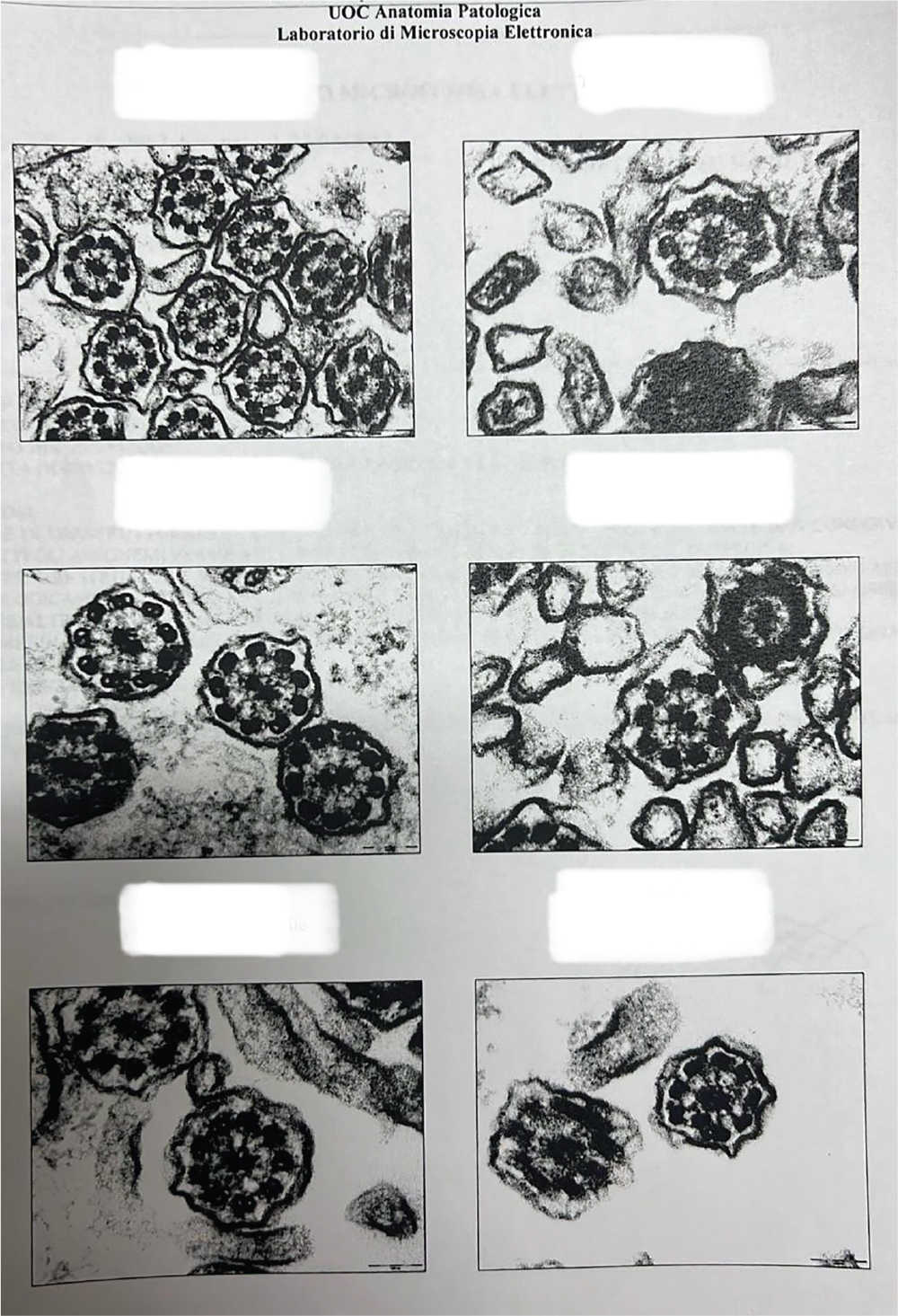
Figure 1.
TEM of respiratory cilia obtained by bronchial brushing, showing the absence of outer dynein arms and microtubular disorganisation. Findings are characteristic of PCD. PCD, primary ciliary dyskinesia; TEM, transmission electron microscopy.
The patient was subsequently included in a monitoring programme and started on chronic treatment with dornase alfa for airway secretion clearance and pancreatic enzyme supplementation for intestinal malabsorption due to exocrine pancreatic insufficiency. Childhood and adolescence were marked by recurrent respiratory and otorhinolaryngological infections, requiring frequent hospitalisations and repeated antibiotic treatments.
Tuberculosis episode and subsequent evolution
In December 2016, the patient developed smear-positive pulmonary tuberculosis. Mycobacterial testing identified Mycobacterium tuberculosis in sputum (9 AFB/100 fields) and in bronchial aspirate (5 AFB/100 fields). Standard HRZE therapy was initiated but soon complicated by severe drug-induced hepatocitolysis (AST 594 U/L, ALT 172 U/L), necessitating temporary discontinuation of treatment and hepatoprotective management. A tailored regimen consisting of isoniazid 200 mg, ethambutol 800 mg and ofloxacin 600 mg (due to the patient’s known allergy to levofloxacin) was subsequently initiated, achieving bacteriological conversion after 1 month, without residual fibrotic sequelae. This episode is notable given that CF is traditionally associated with a lower incidence of tuberculosis, possibly due to altered airway surface liquid composition and chronic antimicrobial exposure, making this case atypical.
Recent clinical course
Until 2025, the patient required multiple hospitalisations for recurrent infectious exacerbations. A contrast-enhanced chest CT performed in 2022 demonstrated complete situs inversus, bilateral cylindrical bronchiectasis, fibro-atelectatic areas and bronchiolar changes in the right lower lobe suggestive of infectious bronchiolitis.
Throughout 2025, the patient presented with increasingly frequent exacerbations. During four separate clinical evaluations, sputum cultures repeatedly isolated Haemophilus influenzae, suggesting chronic airway colonisation.
At his most recent admission in May 2025, the patient reported fever, productive cough and anterior chest pain. Chest radiography revealed patchy opacities interspersed with rounded hyperlucent areas and branching tubular structures in the middle lobe, consistent with bronchiectasis and alternating hyperinflation and inflammatory consolidations (Figure 2).
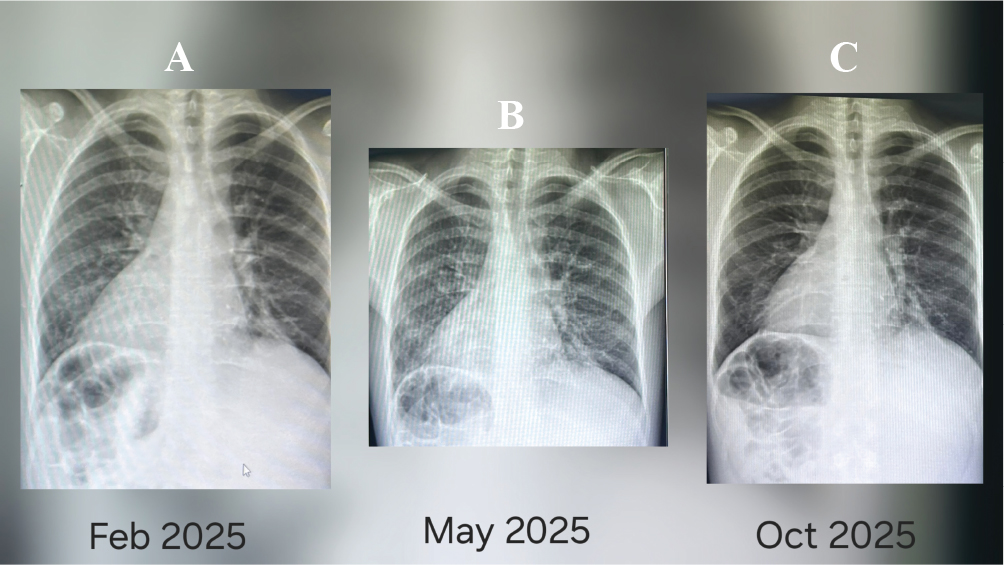
Figure 2.
Serial chest radiographs showing fluctuating bronchiectasis and inflammatory changes in the context of situs inversus totalis. (A) February 2025: bilateral bronchiectasis with basal predominance. (B) May 2025: interval worsening with prominent bronchiectasis and patchy consolidations. (C) October 2025: partial improvement with persistent chronic bronchiectasis.
Empirical antibiotic therapy was initiated and subsequently adjusted based on antibiogram results. Treatment included intravenous and aerosolized antibiotics (colistin), expectorants and antipyretics, while chronic CF therapy (dornase alfa and pancreatic enzyme supplementation) was continued. The patient improved clinically, with defervescence, reduction in sputum volume and improved respiratory parameters. He was discharged in stable condition with recommendations for continued multidisciplinary follow-up.
Summary
This case illustrates the cumulative impact of two rare genetic disorders, PCD and CF, manifesting with recurrent severe respiratory infections, chronic airway colonisation, extensive bronchiectasis and multisystem involvement. The coexistence of these disorders creates a synergistic impairment of mucociliary clearance, leading to complex clinical trajectories and significant therapeutic challenges.
Discussion
The coexistence of PCD and CF is exceptionally rare, as the two disorders arise from distinct genetic mechanisms yet converge pathophysiological through severe impairment of mucociliary clearance. Each condition independently predisposes to chronic airway infection, progressive bronchiectasis and recurrent exacerbations; however, when present together, their effects become synergistic rather than simply additive, resulting in a more severe and accelerated clinical course.
Diagnostic considerations
In this case, both diagnoses were established during the same clinical evaluation. CF was confirmed through a clearly positive sweat chloride test (83 mmol/L) and compatible gastrointestinal manifestations, including exocrine pancreatic insufficiency, evidenced by markedly reduced faecal elastase levels. Genetic testing was recommended but declined for financial reasons; thus, the diagnosis relied on concordant clinical and functional criteria.
Suspicion of PCD arose due to the presence of complete situs inversus. In clinical practice, PCD and CF are often considered alternatives in the differential diagnosis, and their coexistence is rarely anticipated. Typically, establishing a diagnosis of CF tends to reduce clinical suspicion for PCD, as the two diseases are generally approached as mutually exclusive diagnostic possibilities. In this patient, however, the presence of complete situs inversus prompted further evaluation despite the established diagnosis of CF. It is important to emphasise that although situs inversus is characteristic of Kartagener syndrome, only approximately 50% of patients with PCD exhibit the full triad (situs inversus, bronchiectasis and chronic sinusitis). Therefore, the presence of situs inversus warrants investigation but does not invariably predict the classical complete phenotype. Electron microscopy ultimately confirmed the diagnosis by revealing the complete absence of both dynein arms in all examined axonemes, establishing definitive evidence of PCD.
Impact of dual pathology on respiratory disease expression
The combined effect of CF and PCD profoundly influenced the patient’s respiratory trajectory. Extensive and early-onset bronchiectasis indicated a longstanding impairment of airway clearance. Persistent lower airway colonisation with Haemophilus influenzae, identified repeatedly in 2025, further supports the presence of chronic mucus stasis. This stasis is driven both by the increased viscosity characteristic of CF secretions and by the ineffective or absent ciliary transport typical of PCD. Together, these factors reduce the efficacy of both physiological and therapeutic clearance mechanisms, contributing to fluctuating radiologic inflammatory changes, recurrent purulent sputum production and challenges in achieving sustained infection control.
Complexity of management
Management of patients with concomitant CF and PCD requires substantially greater clinical vigilance than management of either disease alone, as both conditions impair mucociliary clearance through distinct mechanisms. In such cases, airway-clearance strategies may have reduced efficacy, since therapies aimed at decreasing mucus viscosity cannot compensate for intrinsically absent or ineffective ciliary transport. This results in more frequent and clinically significant exacerbations, often necessitating repeated or prolonged courses of intravenous and inhaled antibiotics, as illustrated by this patient’s multiple admissions in 2025. Persistent airway colonisation further increases the burden of microbiologic surveillance and radiologic monitoring, while fluctuating clinical symptoms may complicate the differentiation between exacerbations related to CF versus those driven by PCD. These overlapping challenges explain the patient’s recurrent hospitalisations and underscore the need for coordinated multidisciplinary care involving pulmonology, infectious disease, gastroenterology and otorhinolaryngology specialists.
Tuberculosis in the context of CF and PCD overlap
The development of smear-positive tuberculosis in 2016 is noteworthy, as CF patients are traditionally thought to have a reduced risk of Mycobacterium tuberculosis infection, possibly due to altered airway surface liquid composition and frequent antibiotic exposure unfavourable to mycobacterial survival. The occurrence of tuberculosis in this patient likely reflects the cumulative structural lung damage, impaired local immunity and chronic colonisation associated with the dual pathology. The treatment course was further complicated by hepatotoxicity from standard antituberculosis therapy, necessitating an individualised regimen that ultimately achieved bacteriologic conversion.
Clinical relevance
This case underscores the importance of recognising atypical respiratory phenotypes and pursuing comprehensive diagnostic evaluation when clinical severity exceeds expectations for a single genetic disorder. The coexistence of CF and PCD creates a distinct pathophysiologic profile characterised by accelerated structural lung deterioration, recurrent infectious complications and higher therapeutic complexity. Although extremely rare, such cases highlight the heterogeneity of genetic lung diseases and demonstrate the need for individualised, multidisciplinary long-term management.
Conclusions
The coexistence of PCD and CF, although exceptionally rare, profoundly amplifies respiratory vulnerability by combining two distinct mechanisms of impaired mucociliary clearance. This overlap leads to early and extensive bronchiectasis, recurrent infections, chronic airway colonisation and significant multisystem involvement, thereby accelerating disease progression and complicating therapeutic management.
Early recognition of atypical clinical features – such as situs inversus, recurrent otitis media or unusually severe bronchiectasis – is essential for avoiding diagnostic delay, particularly in patients initially evaluated for CF alone. Accurate identification of dual pathology enables more appropriate clinical monitoring, tailored antimicrobial therapy and optimised supportive care.
This case underscores the importance of comprehensive, multidisciplinary follow-up in patients with rare genetic lung diseases and highlights the need for heightened clinical awareness regarding the potential coexistence of disorders with overlapping respiratory manifestations.
Notes
[1] Informed consent statement
Written informed consent was obtained from the patient for publication of this case report and any accompanying images.
[2] Conflicts of interest Conflict of interest
The authors declare no conflict of interest.
[3] Contributed by Authors’ contributions
All authors contributed to the clinical management of the patient, data collection and interpretation, drafting and critical revision of the manuscript. All authors approved the final version of the manuscript.