
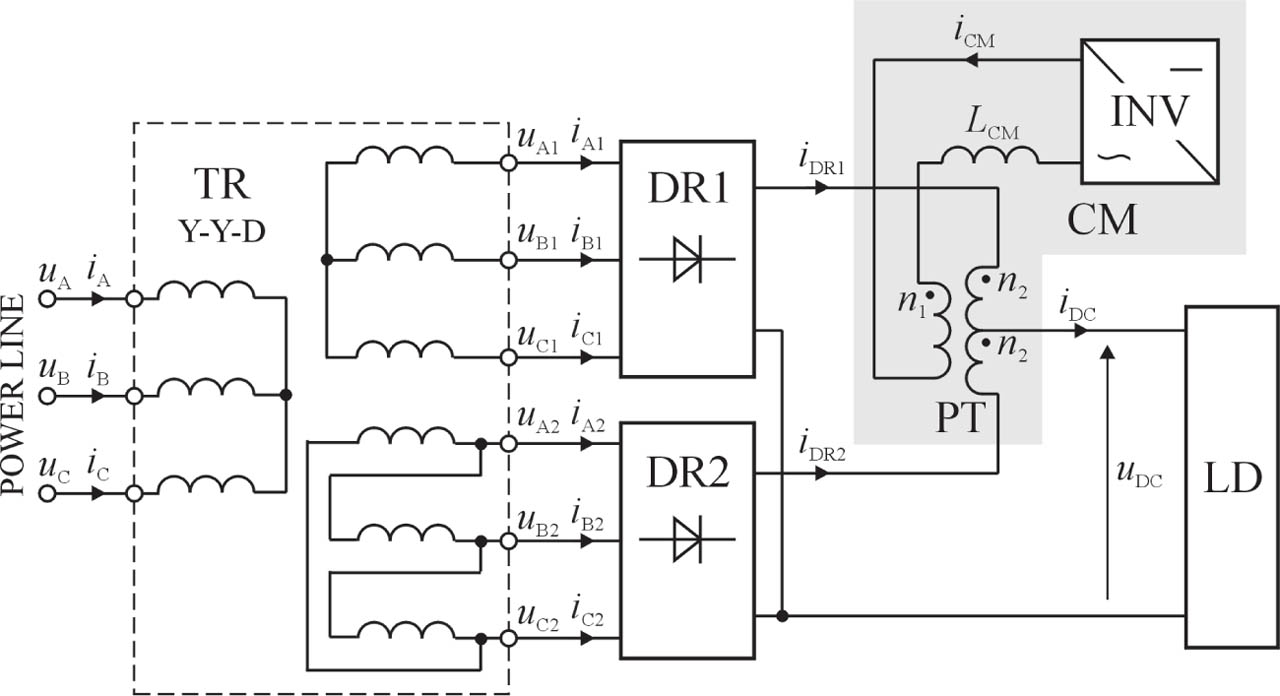
Figure 1.
Block diagram showing the proposed three-phase diode rectifier system with current modulator block in the DC link.
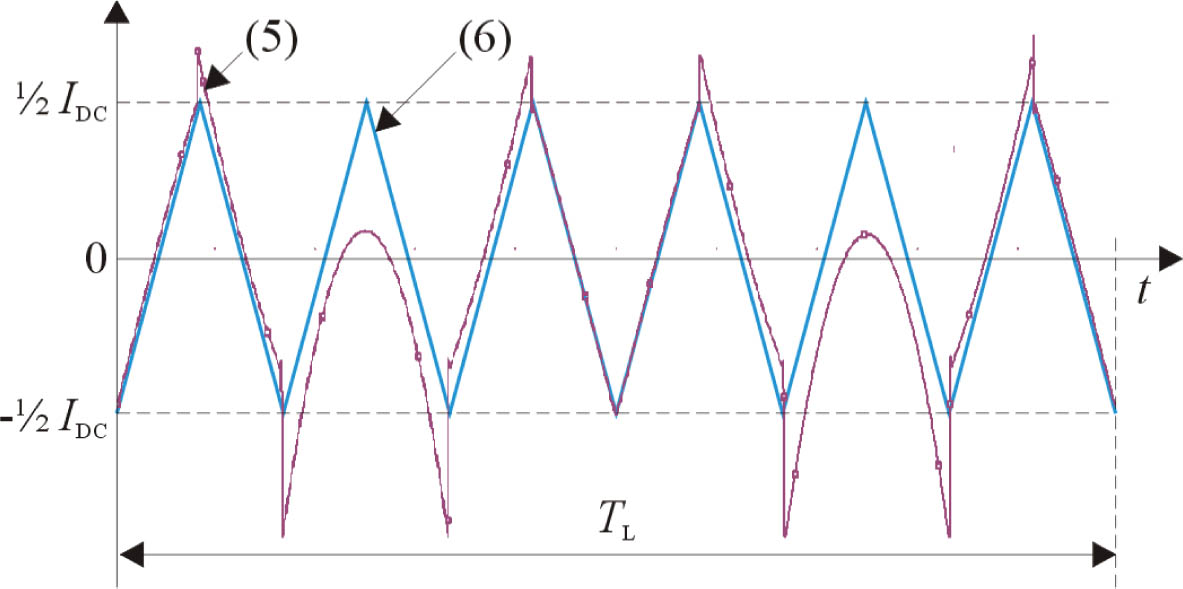
Figure 2.
Shape of the theoretical current at the modulator output given in Eq. (5) (shown in red), and the current with a triangular shape given in Eq. (6) (shown in blue).
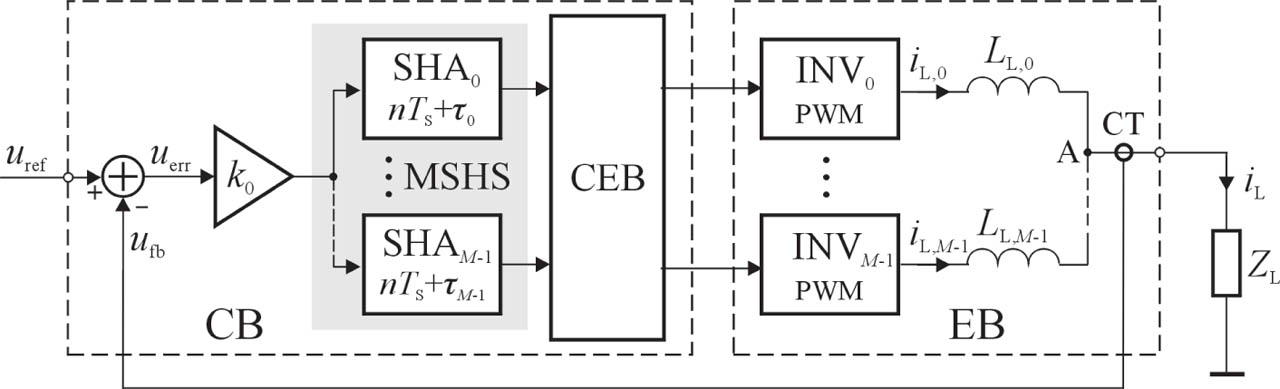
Figure 3.
VCCS block diagram, using a dual-channel topology. CB, controller block; CEB, currents equalisation block; CT, current transducer; EB, execution block; MSHS, multichannel sample-and-hold amplifier block; VCCS, wide-pass band controlled current source.
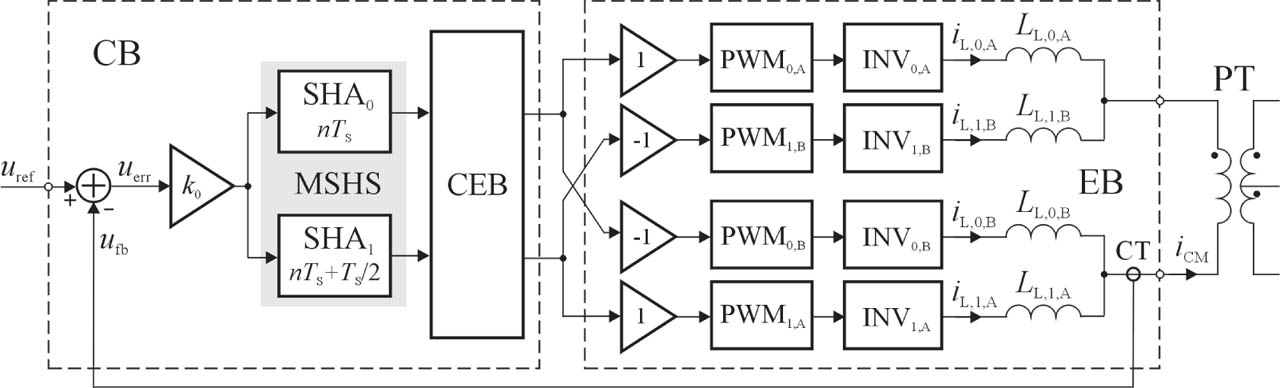
Figure 4.
Block diagram of the current source in the dual-channel version, operating as a driver of the pulse transformer. CB, controller block; CEB, currents equalisation block; CT, current transducer; EB, execution block; MSHS, multichannel sample-and-hold amplifier block.
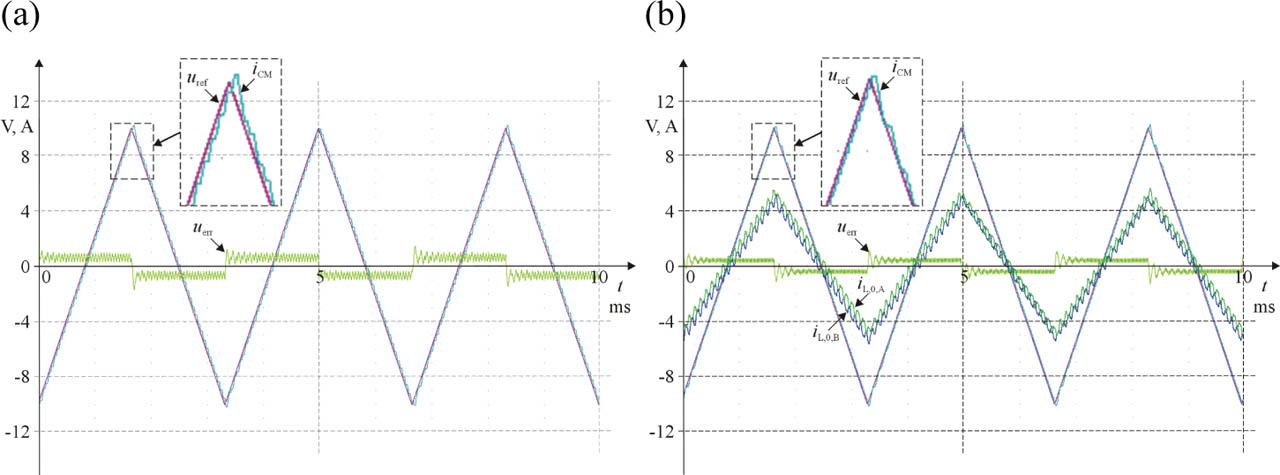
Figure 5.
The measured signals for the simulation model of the current modulation stage, with desired signal (red), current at the modulator output (blue), error signal (green), for (a) the single-channel VCCS; (b) the two-channel VCCS, with currents in the individual channels. VCCS, wide-pass band controlled current source.
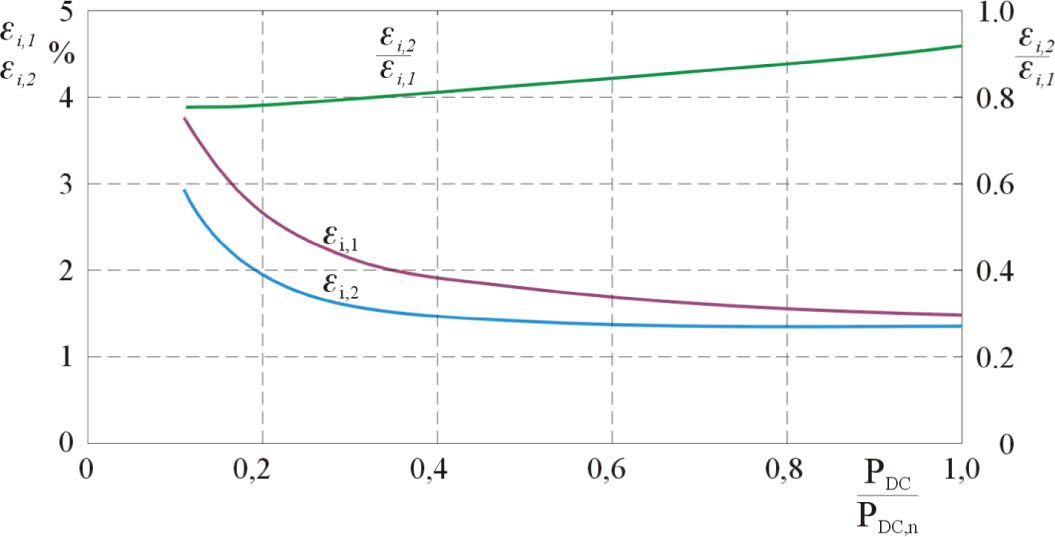
Figure 6.
Curves for error functions for the one- and dual-channel versions of the VCCS and its reciprocal relationship vs. the relative power delivered to the load. VCCS, wide-pass band controlled current source.
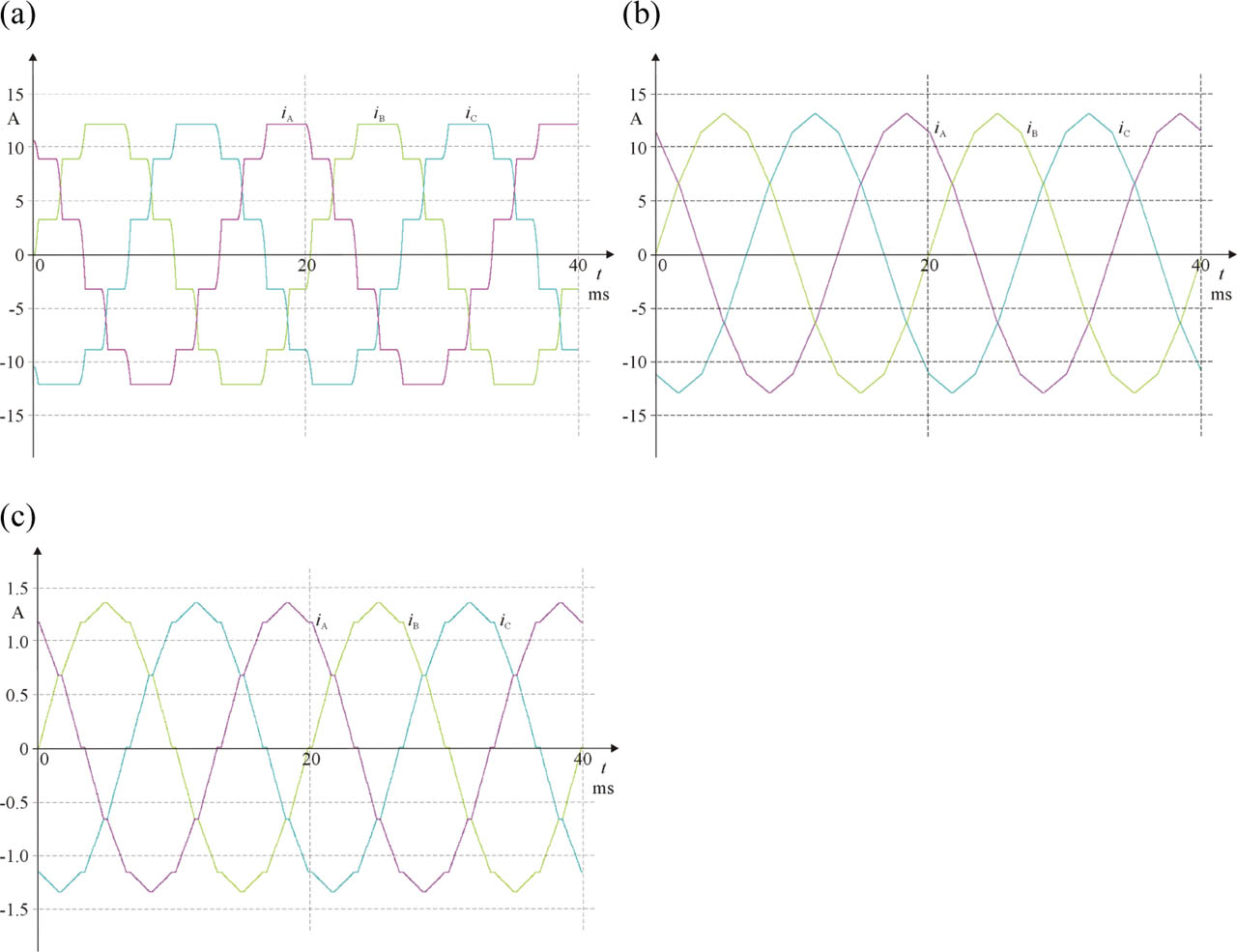
Figure 7.
The measured signals for the supply currents in the simulated rectifier model.
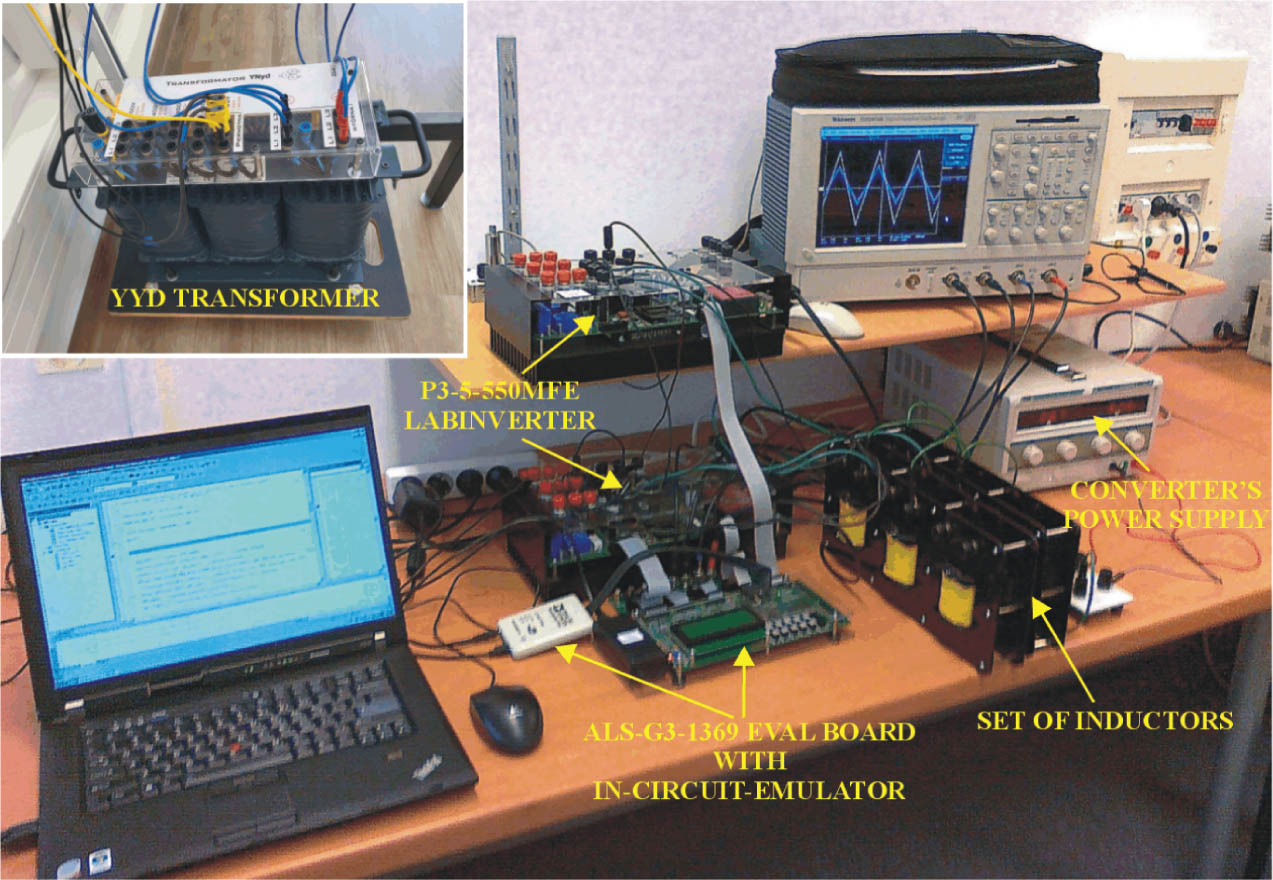
Figure 8.
The general view of the laboratory setup.
Table 1.
Parameters of the laboratory setup.
| Parameters | Values |
|---|---|
| Power supply | 230V, 50 Hz |
| Rated power delivered to the load | 6 kW |
| Rated current magnitude at the modulator output | 10 A |
| Voltage in the current modulation stage (DC rails) | 60V |
| Coil inductance in an individual channel of the VCCS | 1.25 mH |
| Frequency of the PWM signal in the VCCS execution unit | 10 kHz |
| Frequency of signal sampling in the VCCS controller unit | 10 kHz |
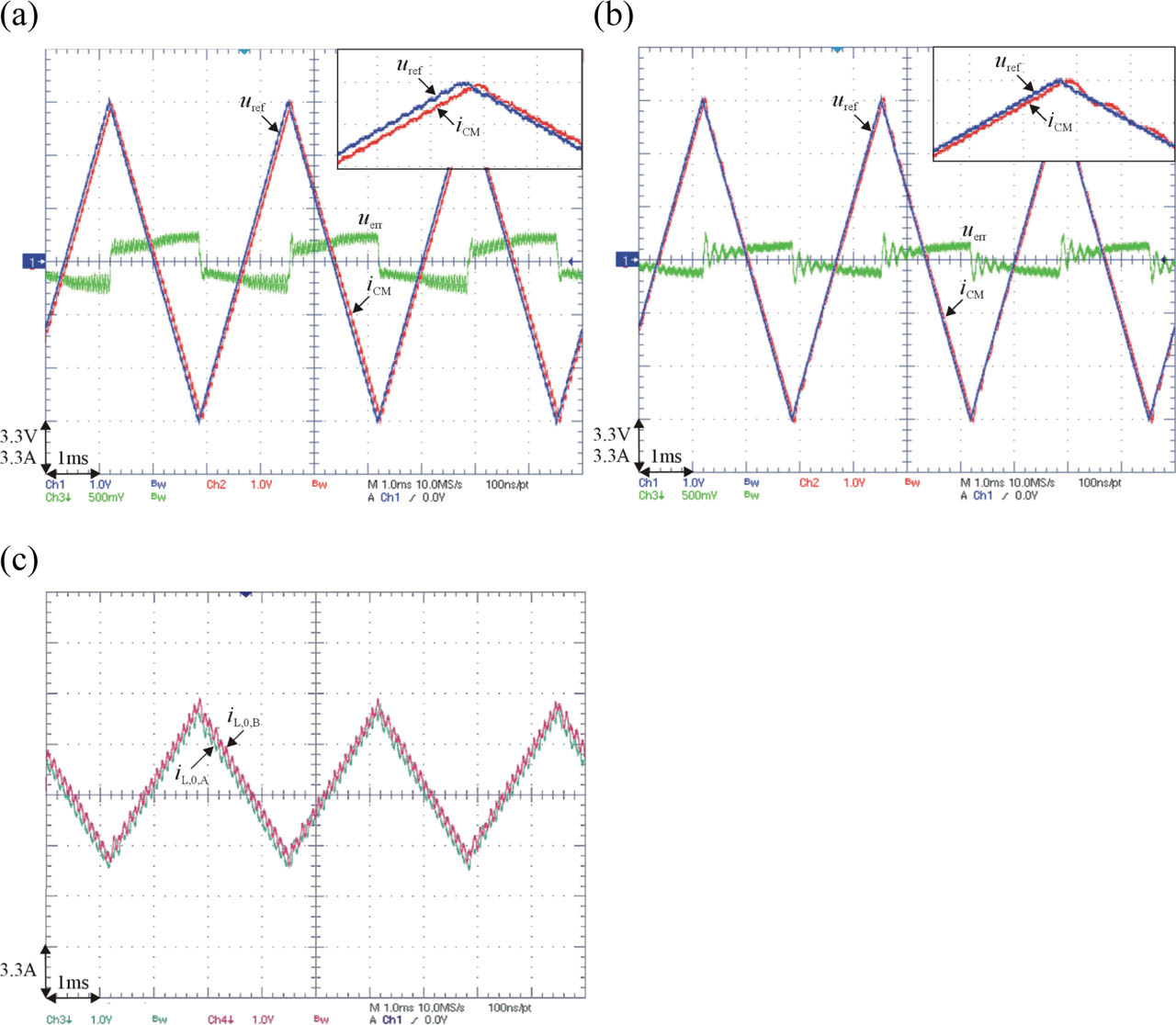
Figure 9.
The measured signals for the laboratory setup of the current modulation stage for: (a) a single-channel VCCS, (b) the proposed dual-channel VCCS, showing the reference voltage (blue), current at the modulator output (red), error signal (green), and (c) currents in the individual converter's channels for the proposed dual-channel VCCS (horizontal axis: 1 ms/div, vertical axis: 3.3V/div, 3.3 A/div). VCCS, wide-pass band controlled current source.
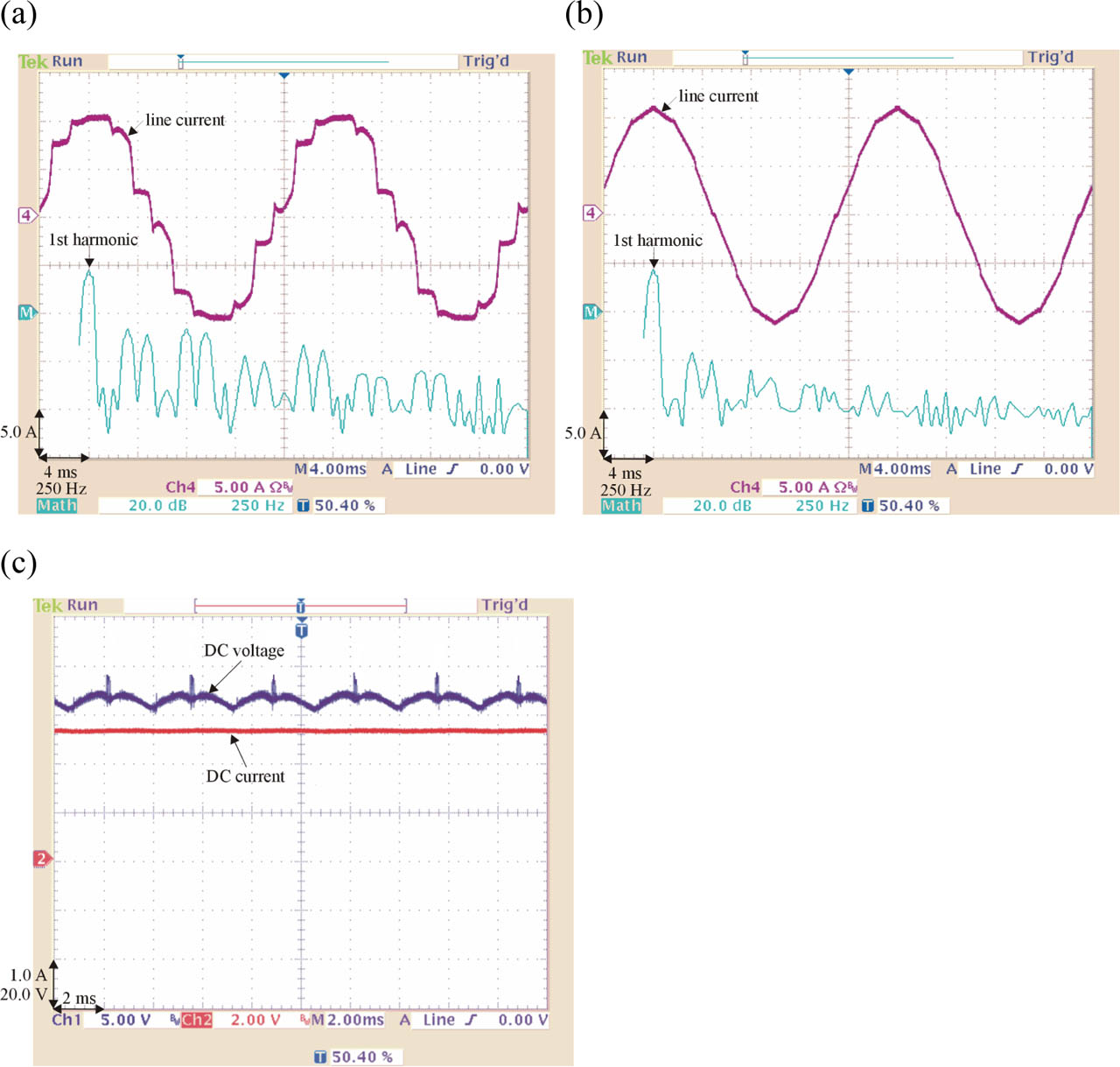
Figure 10.
The measured signals of the line current in the laboratory setup of the rectifier system (red) and its spectrum (blue), with the current modulation stage: (a) turned off; (b) turned on (horizontal axis: 4 ms/div (waveform) and 250 Hz/div (spectrum), vertical axis: 5 A/div<highlightH>)), and</highlightH> (c) turned-on – magnified portion of current (red) and voltage (blue) in the DC output circuit (horizontal axis: 2 ms/div, vertical axis: 1 A/div, 20V/div).