
1. Introduction
Electrical motors are a major component of industrial infrastructure worldwide. Induction motors are used in many industrial applications due to their reliability, ease of maintenance, and control. Increasing process automation and technological development are leading to higher requirements for the safety and stable operation of production systems (Tiwari et al., 2021). Malfunctions in drive units containing induction motors are the subject of ongoing research in the literature (Choi et al., 2018; Garcia-Calva et al., 2022). Due to their design and operating principle, induction motors are susceptible to various types of mechanical and electrical damage, each of which can pose a problem for the entire production system. The literature presents the probabilities of damage to individual components, which show that the diagnosis of winding damage in induction motors is one of the main types of damage occurring in these machines (Cardoso, 2018). Interturn short circuits in the stator winding are among the most common and critical faults, accounting for approximately 66% of all high-power motor failures. Insulation damage is the first stage of faults that leads to interturn short circuits, which can quickly cause severe damage to the entire machine, resulting in costly downtime and repairs. Effective and rapid detection of this type of damage is therefore critical to maintaining the continuity of drive systems and ensuring the safety of production processes. Drive systems with damage can affect safety issues and generate significant economic losses (Tiwari et al., 2021).
Modern control systems are equipped with electrical and mechanical sensors that record the operation of the entire system and control its performance. Installed sensors can also be successfully used to detect faults in drive systems (Cardoso, 2018). Over the years, diagnostic methods have been divided into categories based on signal analysis, including Fourier transforms (Rosero et al., 2008), wavelets (Rosero et al., 2008), spectral analysis (Babaa and Bennis, 2021), and time-frequency methods (Dash and Subudhi, 2010); mathematical modelling enabling the simulation of machine behaviour under various operating conditions; and artificial intelligence (Skowron et al., 2019) using neural networks, machine learning algorithms, and expert systems.
In the field of electrical machine design and optimisation, field circuit modelling, which combines electromagnetic field analysis with a system circuit model, has become increasingly important (Liang et al., 2020). Although preparing such a model requires significant computing resources, specialised knowledge, and time, it allows for realistic simulation of machine behaviour in both undamaged and damaged states. Finite element modelling (FEM) is currently one of the most accurate tools for mapping complex electromagnetic and thermal phenomena occurring in motors, enabling failure prediction and diagnostic process optimisation. This method allows for the precise design of machine geometry, considering irregularities and geometric details, simulation of electromagnetic fields for various operating conditions, and analysis of temperature distribution and thermal state of the machine. Based on this data, failure prediction can be successfully implemented by identifying sensitive areas and components, and diagnostic procedures can be optimised based on theoretical predictions. The use of FEM in diagnostics allows for a better understanding of damage mechanisms and the development of more effective strategies for their detection.
In diagnostic practice, effective methods based on advanced detectors using artificial intelligence and advanced signal processing techniques are sought (Zachariades and Xavier, 2025). However, from an industrial implementation perspective (Pietrzak et al., 2024), especially in real-time systems, methods that provide an optimal compromise between accuracy and computational complexity are preferred methods that are simple, reliable, and computationally efficient, and these can be implemented on controllers with limited computing power.
In the diagnostics of electric motors, information is obtained from electrical signals, that is, voltage (Dong et al., 2024), currents (Jung et al., 2006; Schoen et al., 1995), magnetic fluxes (Toni et al., 2007; Wolkiewicz and Skowron, 2017), and mechanical signals, that is, vibrations and acoustic noise. There is also growing interest in the use of instantaneous power (Kowalski and Wolkiewicz, 2009), which can be determined based on signals recorded in modern voltage inverters. These devices record both phase currents and phase voltages, which allows the instantaneous power to be calculated. Power signals, which are the product of voltage and current at a given moment, contain a rich set of symptoms characteristic of the condition of the machine, which can be used in diagnostics. Analysis of the instantaneous power signal enables the detection of distortions and harmonics, which are symptoms of electrical faults such as interturn short circuits in the stator winding.
In the rest of the paper, the authors present the theoretical foundations, including the field-circuit model of an induction motor, considering winding short-circuit faults. Next, they describe the essence of the proposed diagnostic method, the principle of operation of the triple Park transforms, understood as the application of the Park transformation with a triple rotating angle corresponding to the third harmonic of the machine fundamental component, which allows the extraction of fault components in electrical signals. The next section presents the procedure for validating the FEM model and provides a comprehensive description of the experimental setup used for acquiring the power signal. The article focuses on the diagnostic results, describing in detail the method of short-circuit detection using the instantaneous power signal and the triple Park transform, as well as analysing the effectiveness of the proposed approach in the context of different degrees of damage. The whole study was summarised by presenting key conclusions concerning the effectiveness of the method used, pointing out its limitations, and suggesting directions for further research.
2. Modelling Winding Short Circuits in an Induction Motor
As part of the research, an analysis was performed on the operation of the Sh90L-4 induction motor, whose key technical parameters are shown in Table 1. This study aimed to develop and verify a field circuit model reflecting the actual operating conditions of the machine, both in an undamaged state and in the event of damage in the form of metal winding short circuits, using the FEM. Commercial Ansys Electronics Desktop software was used to perform the numerical simulations.
Table 1.
Parameters of Sh90L-4 motor.
| Parameter | Rated value | Unit |
|---|---|---|
| Power | 1.5 | kW |
| Voltage | 400 | V |
| Current | 3.61 | A |
| Efficiency | 79.0 | % |
| Power factor | 0.755 | - |
| Rotational speed | 1,410 | rpm |
| Torque | 10.1 | Nm |
A two-dimensional geometric model of the machine was developed, the diagram of which is presented in Figure 1. The geometry considered essential information, that is, the appropriate arrangement of phase windings, the air gap, and the structure of the cage rotor. In the analysed Sh90-L4 motor model, the winding data were selected so that the total number of turns corresponded to the actual machine. A single coil consisted of 49 turns (±1 turn), which resulted in a total of 294 (±6 turns) series-connected turns per phase.
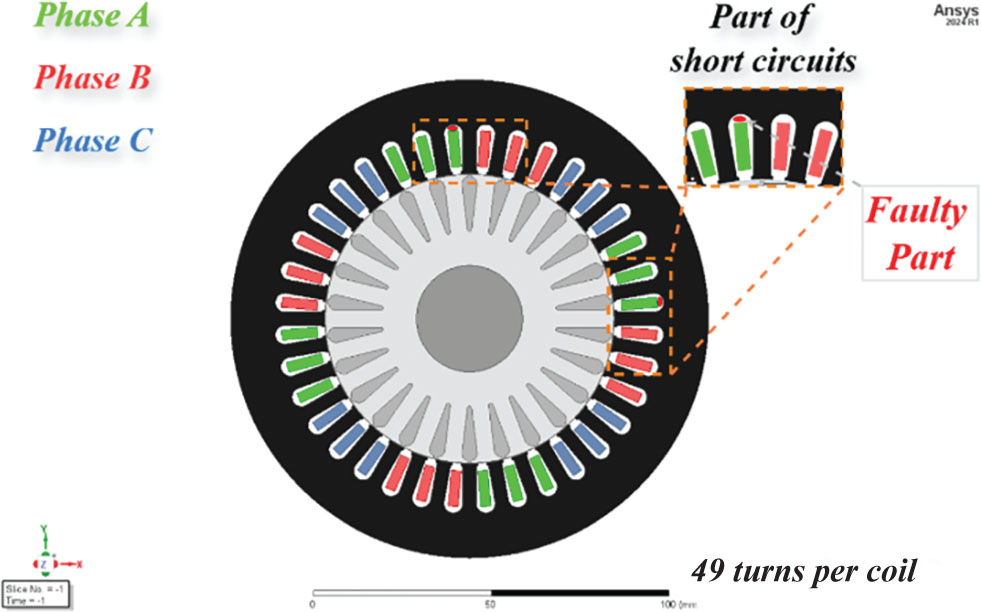
Figure 1.
Geometry Sh90L-4 of an electric motor with a faulty stator part.
The model was supplemented with a circuit section containing the electrical parameters of the circuit and the machine’s motion equation, which made it possible to map the phenomena occurring in the electromagnetic system. The entire circuit section, including the control system, is shown in Figure 2. The tests were conducted as part of a co-simulation, where the executive part was in the Ansys programme, while the motor control with the implemented detection method was carried out in the Matlab-Simulink programme. The simulation tests also analysed the impact of stator winding damage on the machine’s operation. Interturn short circuits were simulated by changing the resistance in the short-circuit circuit from 1 MΩ to 1 mΩ, which corresponds to the operating state without damage to the transition to metallic damage of several turns. This enabled the analysis of the machine’s behaviour in various stator damage scenarios.
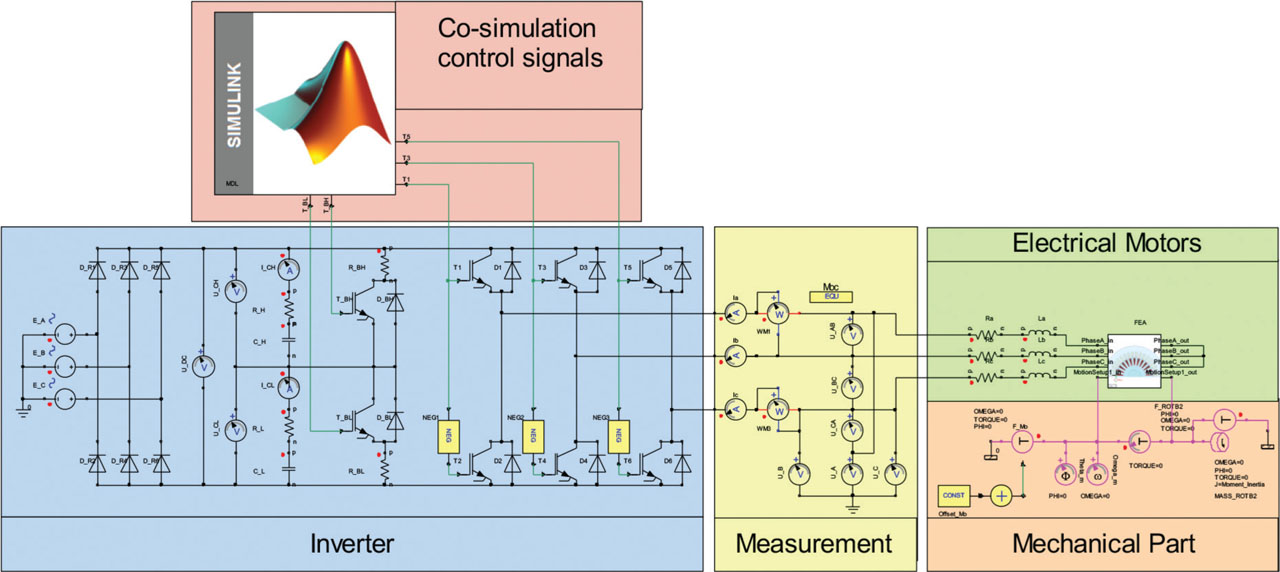
Figure 2.
Simulation of the circuitry performed in the Ansys Maxwell software.
3. Proposed Excitation of Damage Features for Short-Circuits
Stator failure in induction motors is observable in current and voltage signals. The stator faults lead to asymmetry in the phase windings, which causes characteristic harmonics to appear in the electrical signals associated with the development of the fault. Short circuits in the winding cause an increase in effective and instantaneous currents in the damaged phase, which affects both the operating parameters of the machine and provides richer diagnostic information obtained from measurements of these signals. Despite the ease of obtaining current signals and their high diagnostic usefulness, fault detection based solely on the analysis of effective and instantaneous values proves to be insufficient. Therefore, it is crucial to use analytical methods to extract fault characteristics, which can be described by the following Eqs. (1) and (2):
The discussed relationships, confirmed both by observations of the signal spectrum recorded during experimental tests and by analyses based on mathematical models, are a crucial element of the induction motor diagnostics process. Particularly noteworthy is the presence of a harmonic component with a frequency three times higher than the supply frequency 3fs, whose amplitude strongly correlates with the level of stator winding asymmetry. Analysis of this component allows not only for early detection of emerging asymmetries but also for assessment of their development during motor operation.
In field-oriented induction motor control systems, the Park transformation is commonly used to control the current components in the x and y axes. This transformation allows signals from the rotating system associated with the machine’s magnetic field to be converted to a stationary x-y coordinate system
where θe is the electrical angle, which is the actual position of rotor.Using Eq. (3) and substituting the triple electrical angle (3θe) of rotation of the rotor allows for the use of a simple but effective feature extractor, enabling the visualisation of changes in parameters related to drive damage.
3.1. Signal instantaneous power
The instantaneous power in a three-phase ABC system is defined as the sum of the instantaneous powers of individual phases:
where uabc is the voltage supply and iabc is the phase current.In the case of an undamaged motor, the voltage and current waveforms are symmetrical and sinusoidal. For a single phase, we can therefore write:
where φ is the phase shift between voltage and current.It can be shown that instantaneous power contains a constant component responsible for average active power, UmImcos(φ), and periodic components UmImcos(φ)cos(ωt), UmImsin(φ)sin(2ωt), UmImsin(φ)sin(2ωt), one of which is responsible for reactive power pulsations (Watanabe et al., 1993). In a balanced three-phase system, these components cancel each other out, resulting in the total instantaneous power having a constant value over time. In the event of failure of one of the phases, these components do not compensate each other completely, which causes additional pulsations and the appearance of new frequency components in the power spectrum. However, the 3fs component appearing in the current spectrum is transferred to the 2fs and 4fs components. Thanks to triple Park’s transformation, these pulsations can be isolated and observed as fluctuation components in the motor equations.
4. Research Stand and Model Verification
Experimental tests were carried out at a measuring station, the block diagram of which is presented in Figure 3. The object of the tests is an induction motor, Indukta Sh90L-4, with a special design that allows modelling of winding short circuits in each phase of the motor. The system allows for the short-circuiting of several stator windings by making a metallic connection between them without adding additional resistance. The terminal board used to model the fault is shown in Figure 4.
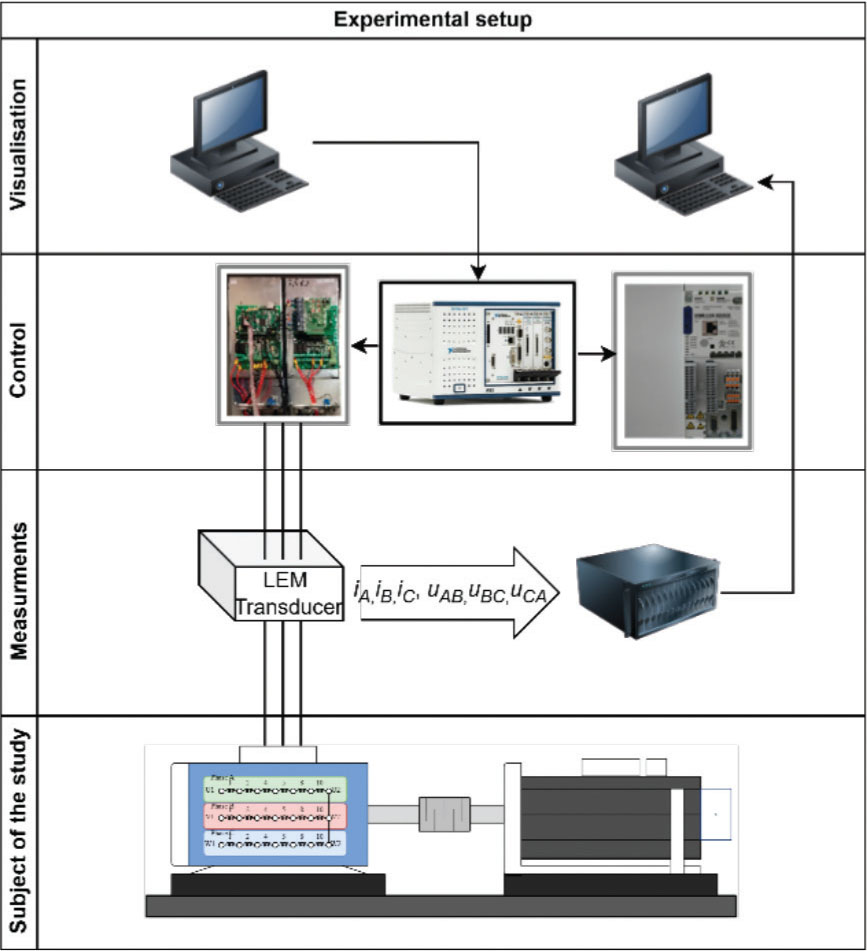
Figure 3.
Experimental setup for testing an induction motor with interturn short circuits.
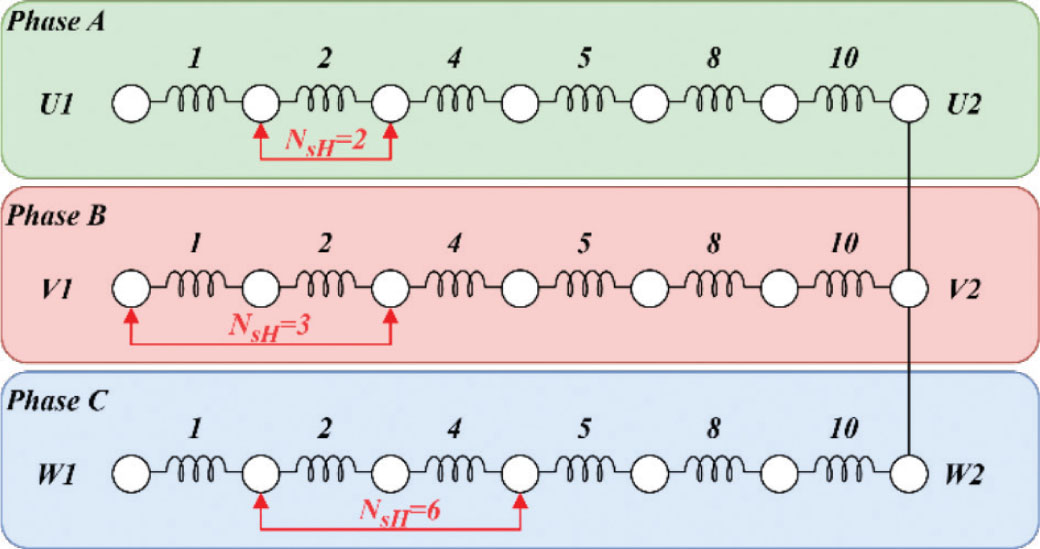
Figure 4.
Terminal board method of performing coil short circuits at a stand.
The test bench enables the analysis of the operation of a three-phase squirrel cage induction motor under conditions of stator winding damage, particularly interturn short circuits. The tested induction motor is mechanically connected to a rigid coupling with a Lenze MCS14H32 synchronous motor, which acts as a load machine. Due to the possibility of controlling the torque generated by the synchronous motor, it is possible to precisely reproduce various load conditions of the tested motor, including dynamic and steady states. The induction motor is powered by a 5.5 kW TWERD MFC 710 frequency converter equipped with a two-level voltage inverter. The inverter is controlled by fibre optic cables, which ensures the control system’s resistance to electromagnetic interference and high accuracy of control signal transmission. The synchronous motor is powered by a Lenze 8400 converter, which allows for smooth regulation of torque and load speed.
The measuring system of the stand is equipped with an incremental encoder and a resolver, which provide feedback signals regarding the rotational speed and angular position of the shaft. These data are used in the control system to synchronise the operation of both machines and to record dynamic parameters. Phase currents are measured using LEM current sensors, which are characterised by high accuracy and a wide measurement range. During the experiments, phase currents iA, iB, iC, and interphase voltages uAB, uBC, uCA are recorded, which are then used to determine the instantaneous power according to formula (4). The analysis of the waveforms allows for the assessment of the impact of winding faults on power characteristics and the identification of new frequency components appearing in the signal spectrum.
The field circuit model presented in Section 2 of the article was used as a reference point, enabling the comparison of measurement results with the results of numerical simulations. This allows for the validation of the mathematical model and verification of the accuracy of the representation of electromagnetic phenomena in stator windings during interturn short circuits. During the tests, several motor operating states were recorded—from a non-faulty state, through partial short circuits of several windings, to a short circuit of eight windings (Nsh = 8). The tests were carried out for different motor supply frequencies, which allowed for the assessment of the impact of frequency on the amplitude and nature of power pulsations and on changes in the harmonic spectrum of current and voltage.
4.1. Comparison of signals
The first step preceding the proper data analysis was to verify the correctness of the signals recorded during the simulation model operation. This allowed us to detect any errors in the numerical model. This stage aimed to confirm that the data obtained during the simulation were dependable and could be directly compared with the results of the experiments. Such a preliminary check is crucial because it allows for reliable verification of the results of further research. Before proceeding with the actual data analysis, the correctness of the signals generated during the operation of the experimental setup was verified. The verification was performed by comparing the undamaged states for selected frequencies—the results from the circuit model were compared with the results of experimental tests. In addition, the instantaneous values of phase currents during the occurrence of damage were compared.
A comparison of the selected case, that is, the phase current waveforms in a fault condition at a frequency of f = 10 Hz and the rated load is presented in Figure 5. The comparative analysis showed a high degree of consistency between the phase current waveforms obtained from the model and the experimental data. In both cases, characteristic signal distortions resulting from the presence of interturn short circuits are visible, which confirms the correct representation of electromagnetic phenomena in the model.
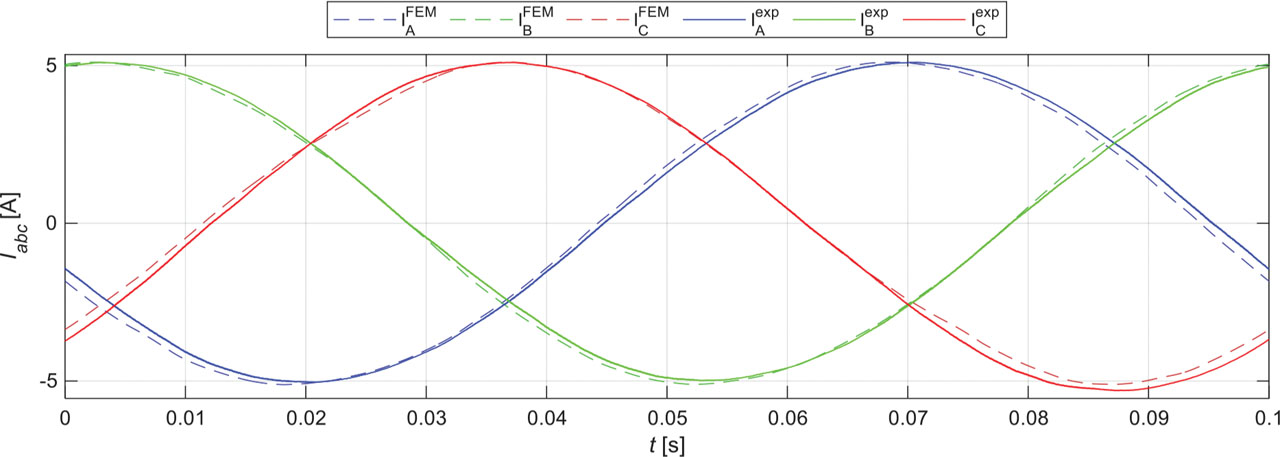
Figure 5.
Comparison of instantaneous phase current waveforms for the mathematical model and the tested motor at f = 10 Hz, Tl = 100%, and fault Nsh = 5. FEM, finite element model.
5. Diagnostic Results and Analysis
The graphs presented, both for the field circuit model (Figure 6) and the experimental results (Figure 7), show the instantaneous power amplitude spectra of a three-phase induction motor in an undamaged state and with varying degrees of winding damage, for a supply frequency of 50 Hz. The analysis of the spectra consists in comparing the distribution and amplitudes of instantaneous power harmonics in an ideal situation and after introducing asymmetry caused by interturn short-circuit.
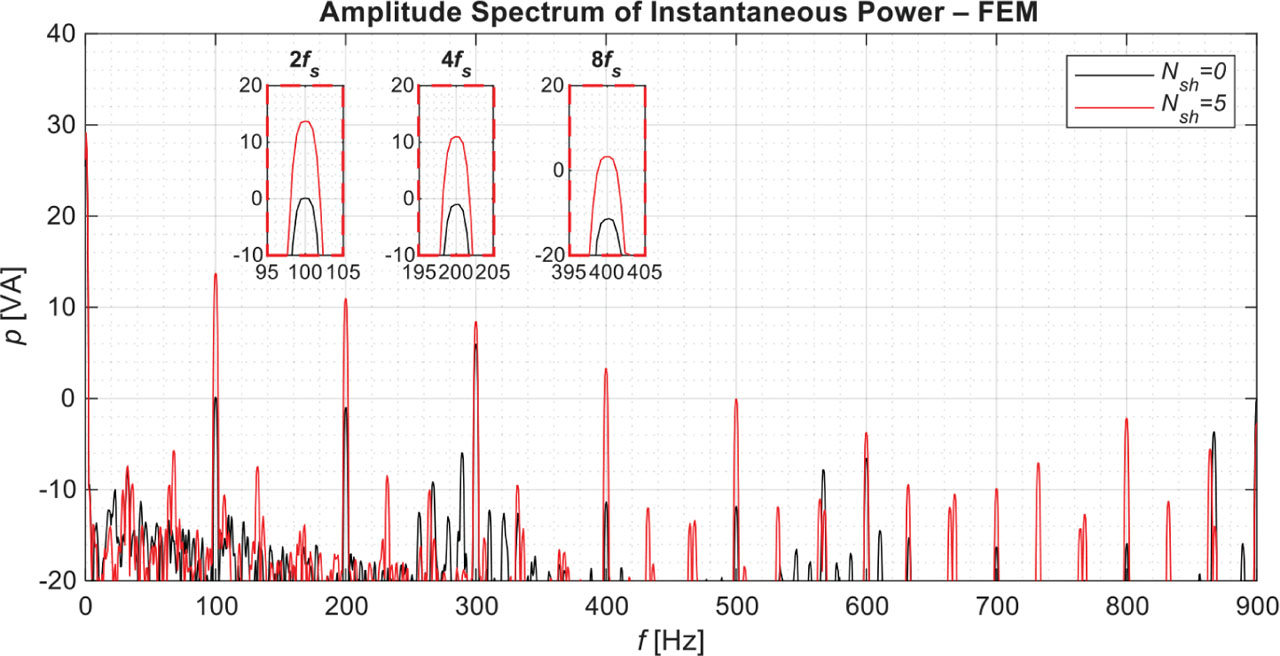
Figure 6.
Amplitude spectrum of instantaneous power obtained from the field-circuit (FEM) model for a three-phase induction motor, at f = 50 Hz, Tl = 100%, and fault Nsh = var. FEM, finite element model.
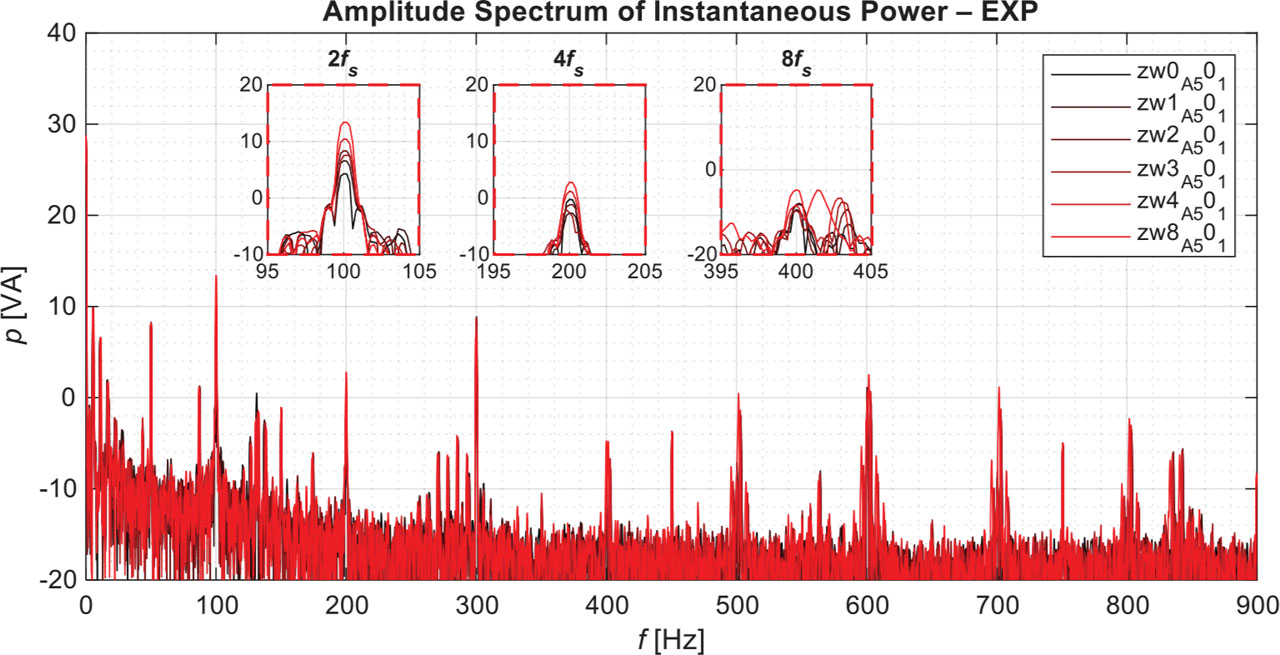
Figure 7.
Amplitude spectrum of instantaneous power obtained from laboratory experiments for the three-phase induction, at f = 50 Hz, Tl = 100%, and fault Nsh = var.
In both cases, it can be seen that in an undamaged state, the instantaneous power spectrum is mainly characterised by bands corresponding to the normal operating frequencies of the machine, resulting from the symmetry of the three-phase system and its harmonics. However, the introduction of damage causes an increase in the amplitude of pulsations at characteristic frequencies that are multiples of the fundamental frequency, such as 2fs, 4fs and 8fs. This trend is visible in both model results, while in the experiment, changes in the vicinity of 2fs and 4fs are particularly noticeable, which fully correspond to the analysis presented in Chapter 3.
The enlarged fragments of the spectra in the graphs highlight the development of these harmonics as the degree of damage increases. In practice, the amplitudes of these components can serve as a diagnostic indicator of the presence and severity of interturn short circuits in the motor. Furthermore, the consistency of the location and nature of the bands between the simulation and the experiment confirms the effectiveness of the numerical model and the validity of its use for the analysis and verification of this type of phenomenon in electric motor research.
It is also worth noting that experimental studies show higher noise levels and additional minor components in the spectra. Figure 8 focuses on component extraction using triple Park transformation, which calculates power in the d–q system, and isolates features indicative of damage. In order to stabilise the response, the last 400 signal samples were averaged, allowing for a reliable assessment of the damage.
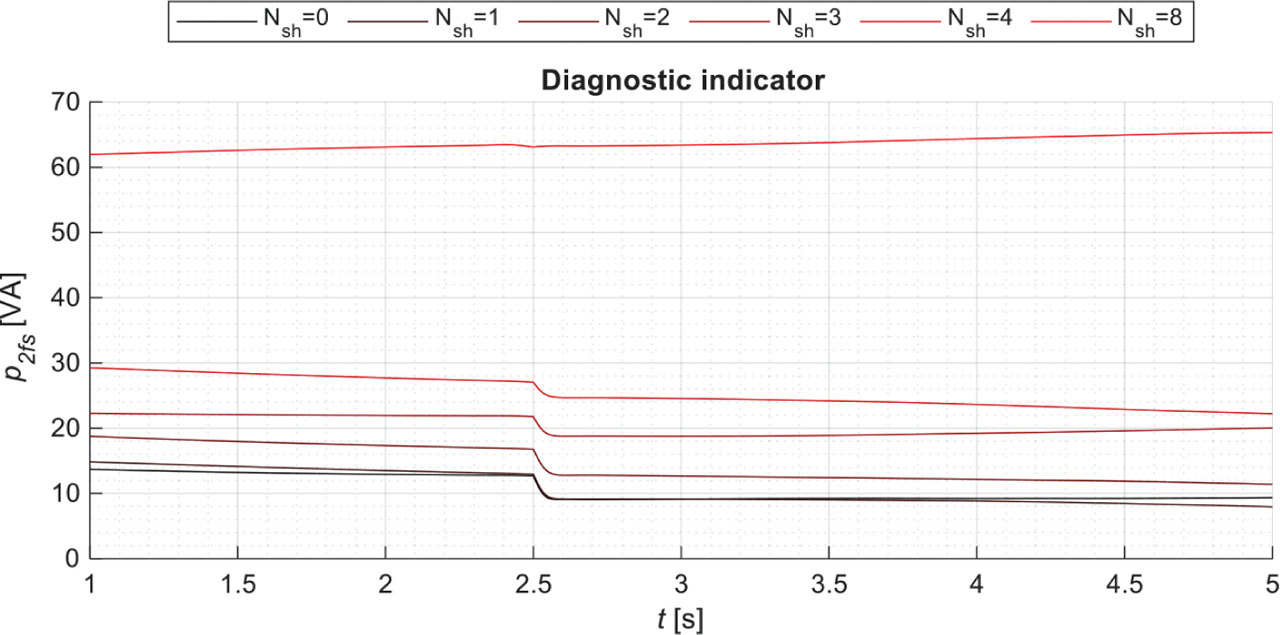
Figure 8.
Indicator for proposal method f = 50 Hz, Tl = 100%, and fault Nsh = var.
6. Conclusions
The summarised research study results showed a high degree of agreement between the instantaneous power spectrum obtained from the field circuit model and the experimental results for a three-phase induction motor. In both cases, the undamaged state was characterised by a spectrum containing machine operating harmonics typical for symmetrical systems. The introduction of an interturn short circuit caused a significant increase in the amplitude of instantaneous power pulsations at frequencies 2fs, 4fs and 8fs, which are diagnostically significant indicators of the presence and degree of winding damage. A comparative analysis confirmed that both the numerical model and the measuring equipment allow for the effective identification of characteristic changes in the spectrum associated with the occurrence of asymmetry and damage inside the machine. This approach allows us to conclude that instantaneous power spectrum analysis is a useful signal and a universal method for assessing the technical condition of an induction motor and identifying specific faults, such as interturn short circuits. In addition, the diagnostic indicator based on triple Park transforms significantly facilitates damage detection. This simple diagnostic method can be implemented at low cost, and a properly selected sampling period provides a reliable damage indicator. This approach enables fast and effective monitoring of the technical condition of the machine, both in laboratory and industrial conditions.
Acknowledgements
This work is funded by the European Union under GA no. 101101961—HECATE. The views and opinions expressed are, however, those of the author(s) only, and do not necessarily reflect those of the European Union or the Clean Aviation Joint Undertaking. Neither the European Union nor the granting authority can be held responsible for them. This project is supported by the Clean Aviation Joint Undertaking and its Members.