
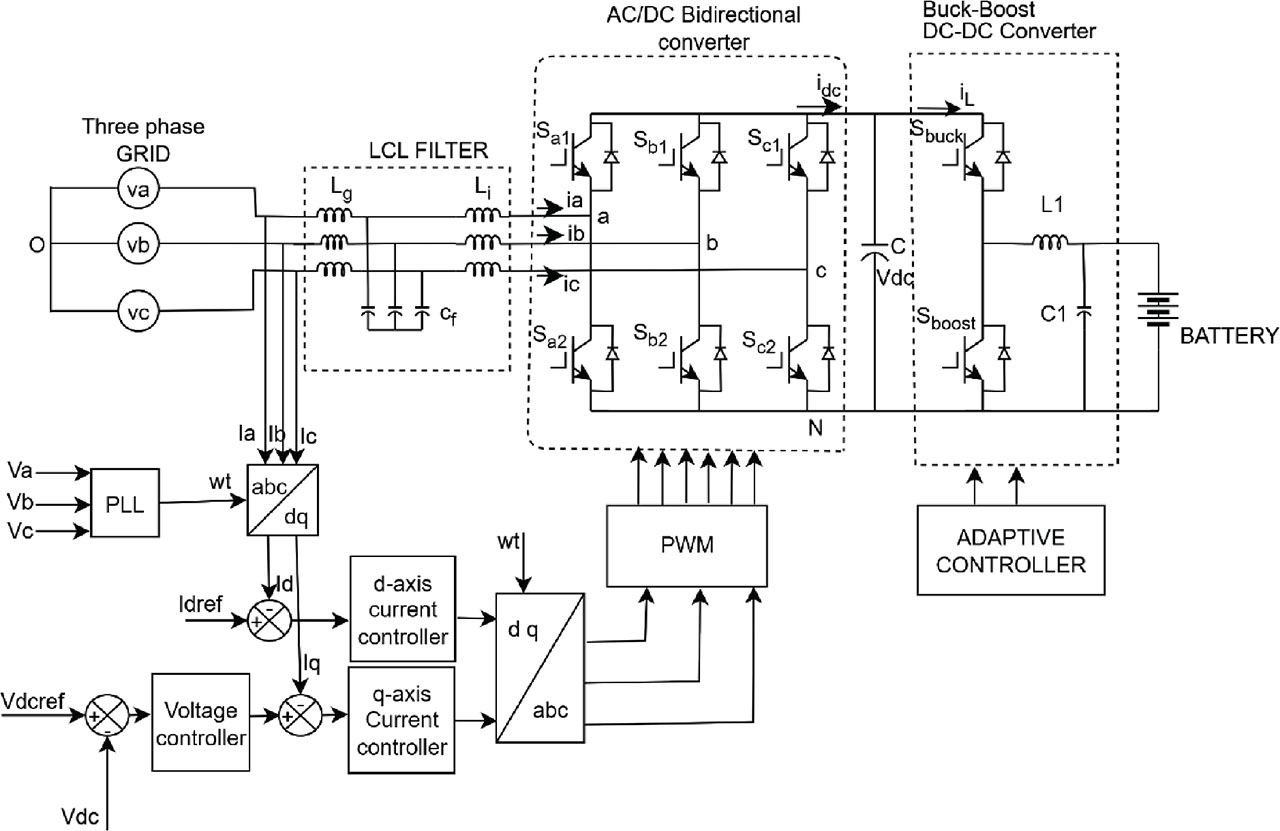
Figure 1.
Block diagram of three-phase bidirectional on-board charger. PLL, phase-locked loop.
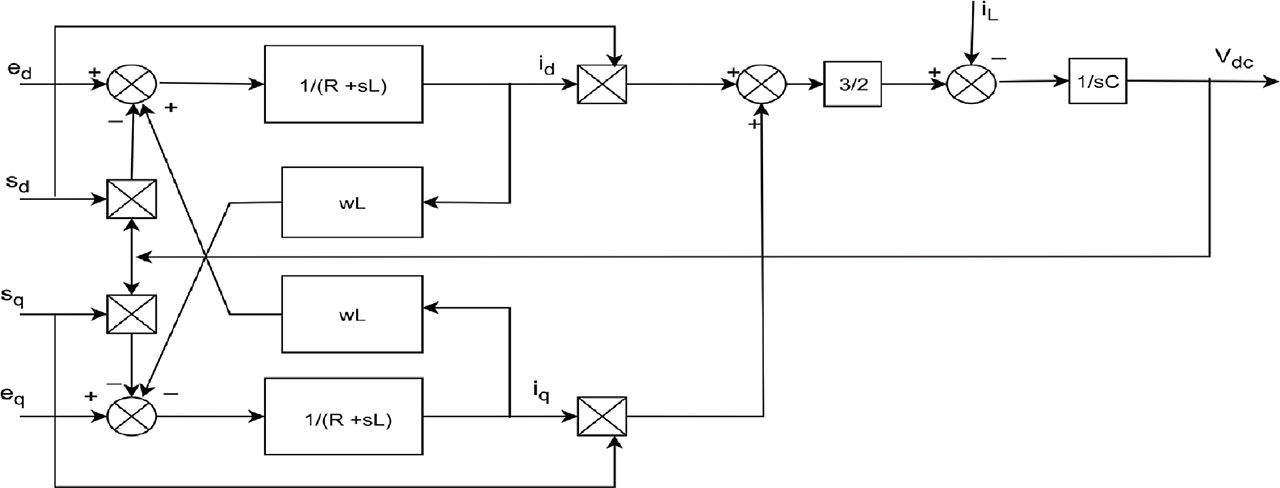
Figure 2.
Synchronous d-q frame model of a three-phase converter.
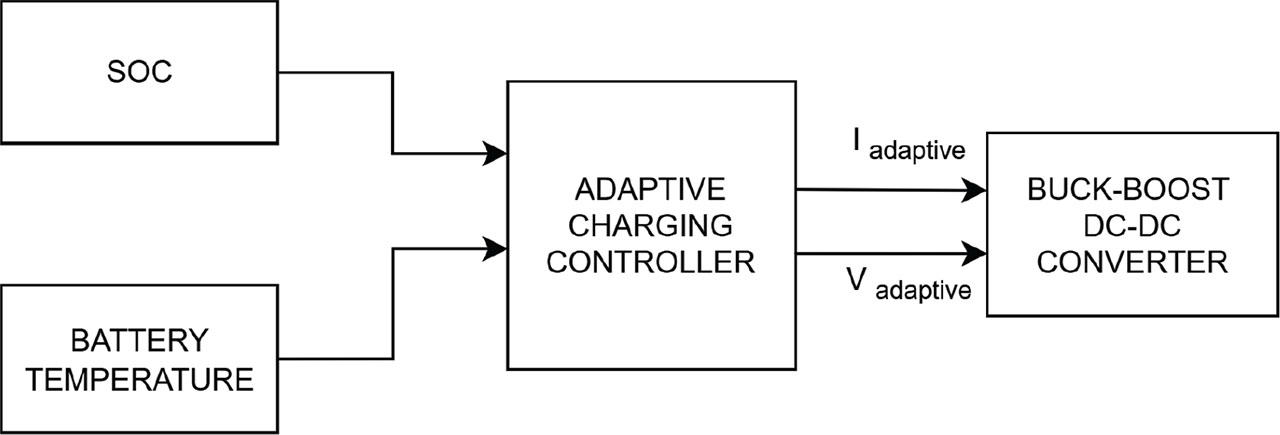
Figure 3.
An adaptive charging controller block diagram. SOC, state of charge.

Figure 4.
Controller for the buck-boost DC–DC converter.
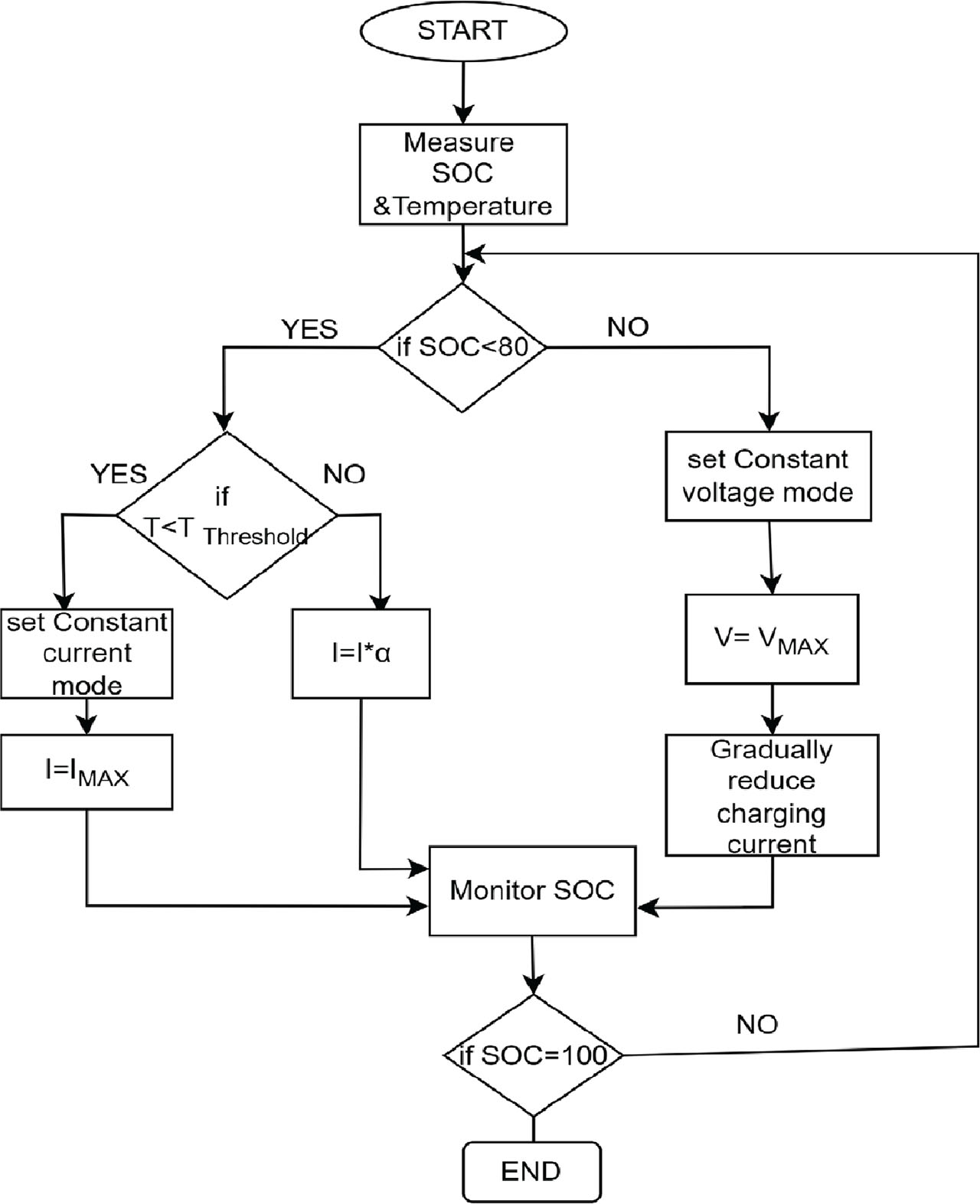
Figure 5.
Flow chart for an adaptive controller. SOC, state of charge.
Table 1.
Parameters of the system.
| Parameter | Value |
|---|---|
| Grid voltage | 325 V |
| Grid current | 25 A |
| Grid frequency | 50 Hz |
| Switching frequency | 10 kHz |
| DC-link voltage | 800 V |
| LCL filter inductance (each side) | 5 mH |
| LCL filter capacitance | 30 µF |
| DC link capacitance | 5,600 µF |
Table 2.
Battery specifications.
| Parameter | Value |
|---|---|
| Battery rated voltage | 415 V |
| Maximum charging current | 30 A |
| Rated capacity | 50 kWh |
| Initial SOC | 20% |
| SOC threshold (CC CV) | 80% |
| Internal battery resistance | 0.1 Ω |
| Temperature limit | 45°C |
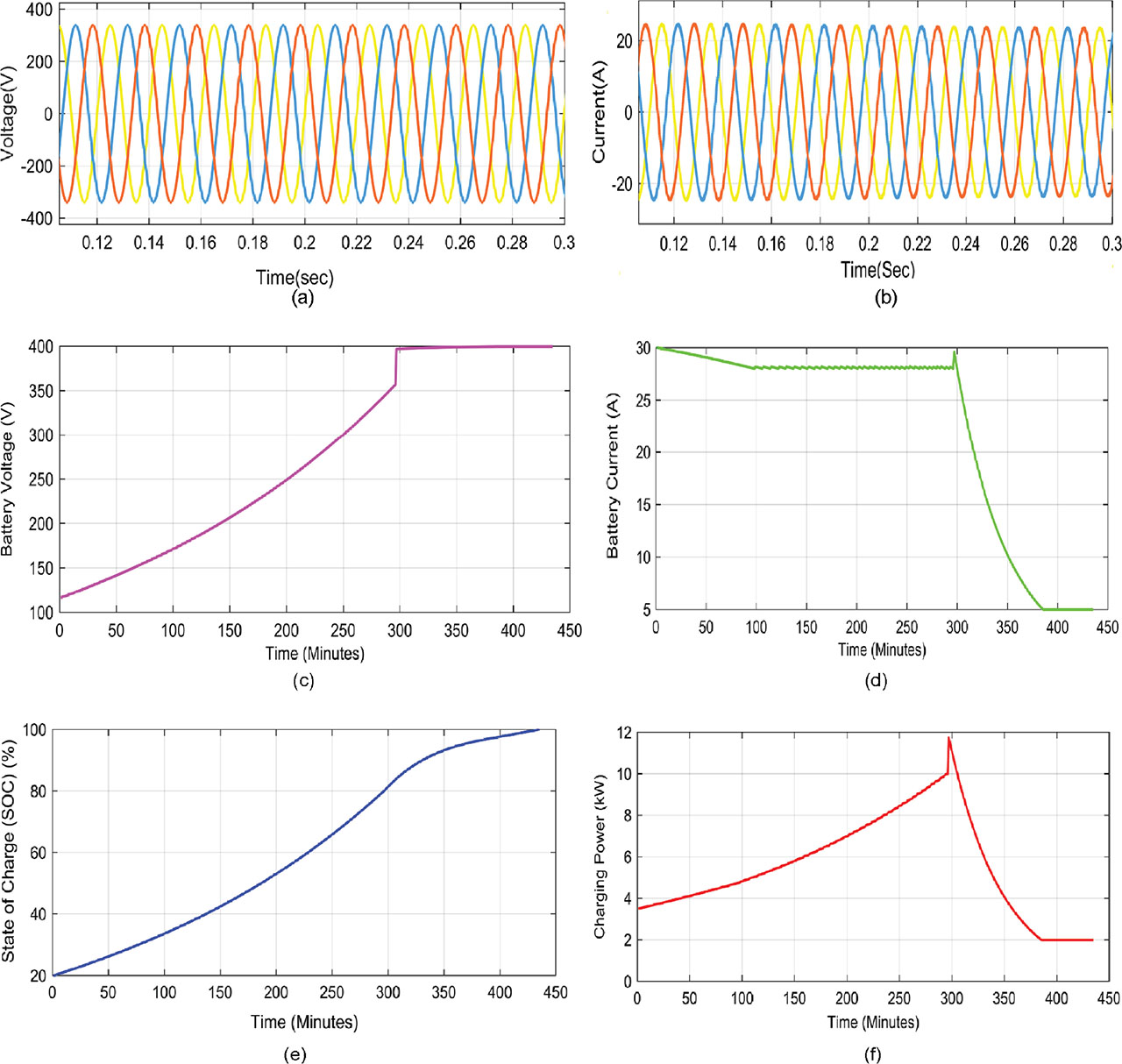
Figure 6.
Three-phase bidirectional on-board charger performance during G2V mode: (a) Grid voltage, (b) Grid current, (c) Battery voltage, (d) Battery current, (e) Battery SOC and (f) Charging power. G2V, grid-to-vehicle; SOC, state of charge.
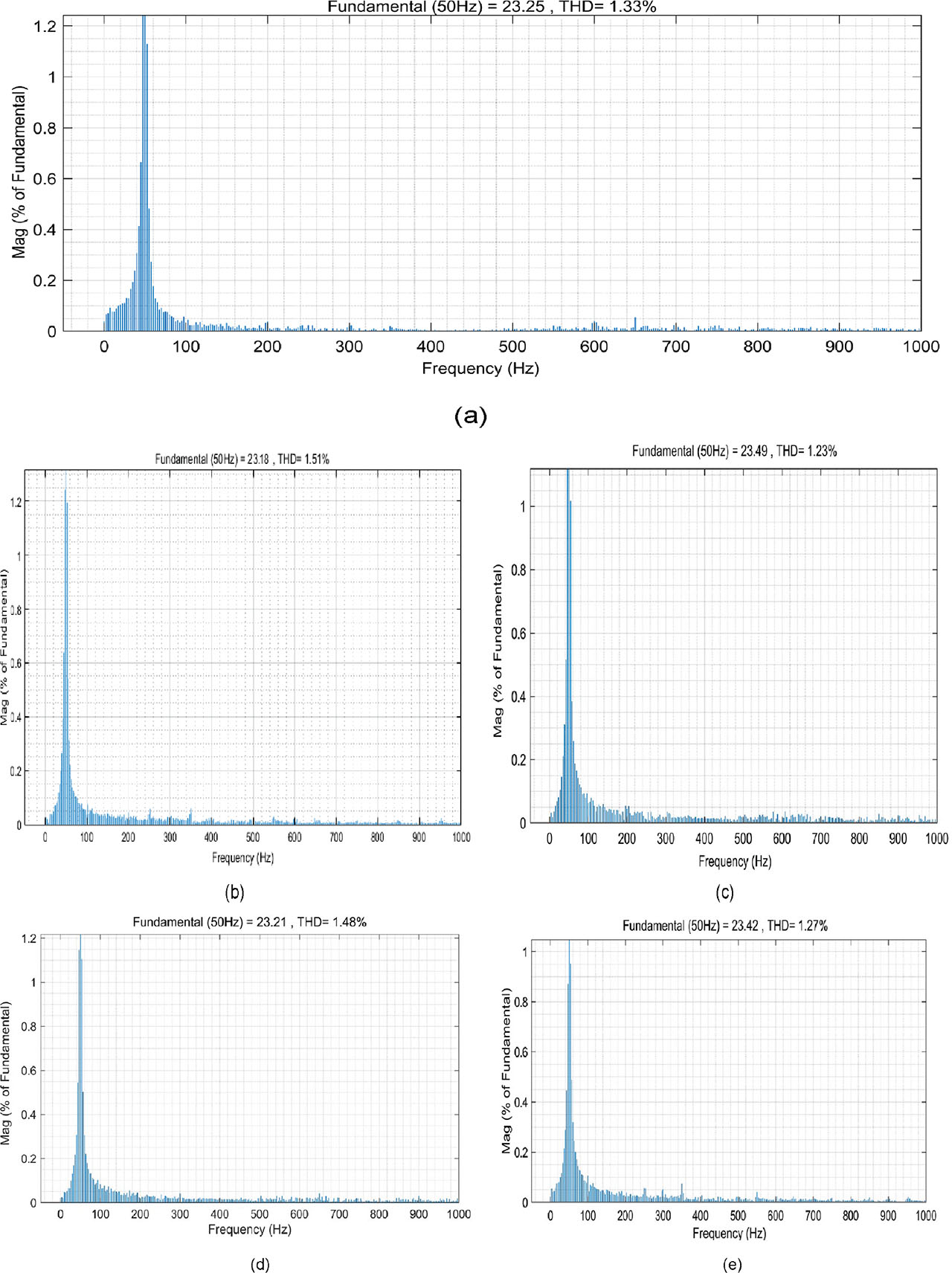
Figure 7.
THD of grid current at different operating conditions in G2V mode: (a) at a grid inductance of Lg = 5 mH, (b) at a grid inductance of Lg = 4.5 mH, (c) at a grid inductance of Lg = 5.5 mH, (d) at a grid voltage of 370 V and (e) at a grid voltage of 460 V. G2V, grid-to-vehicle; THD, total harmonic distortion.
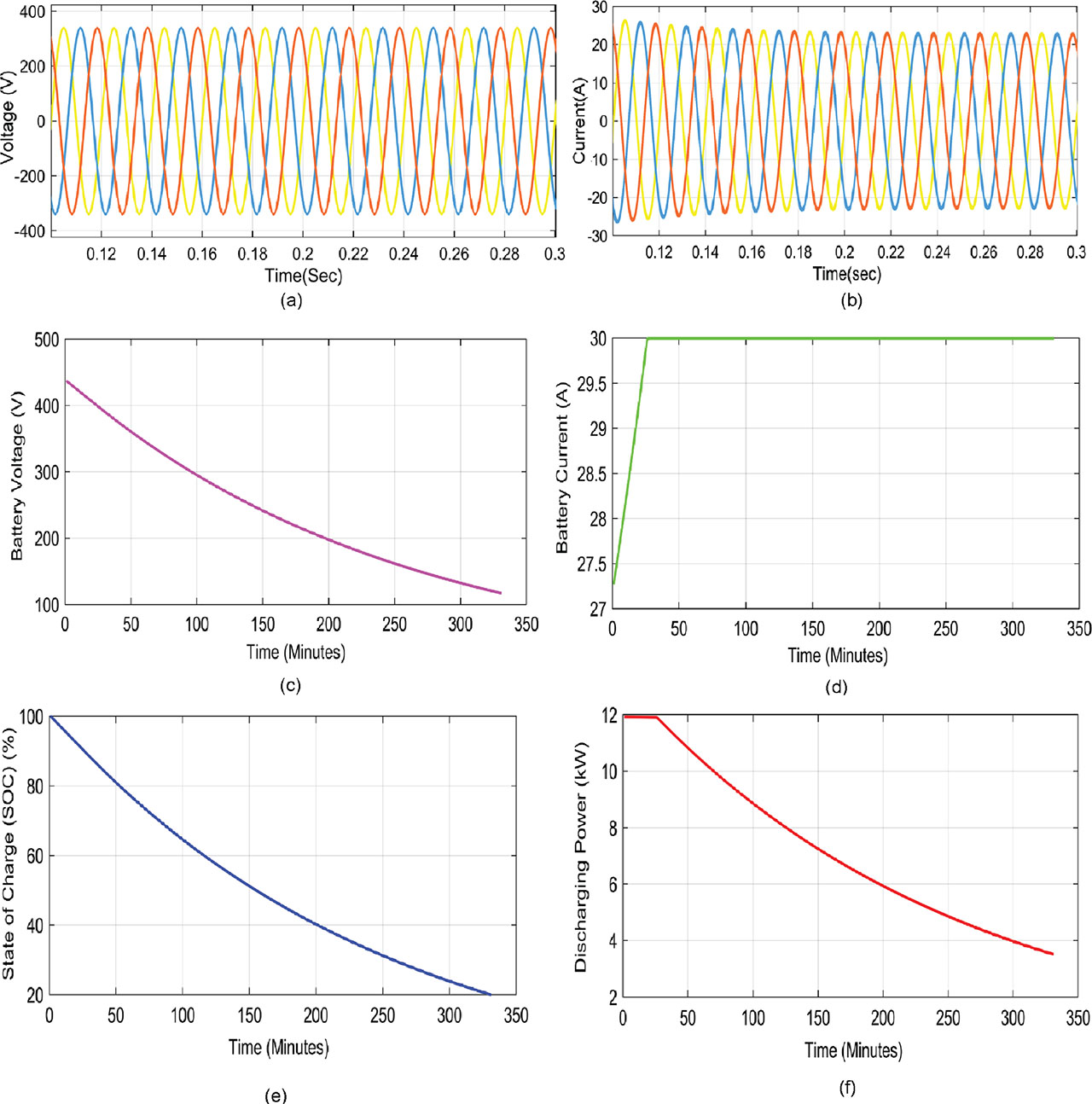
Figure 8.
Three-phase bidirectional on-board charger performance during V2G mode: (a) Grid voltage, (b) Grid current, (c) Battery voltage, (d) Battery current, (e) Battery SOC, and (f) Discharging power. SOC, state of charge.
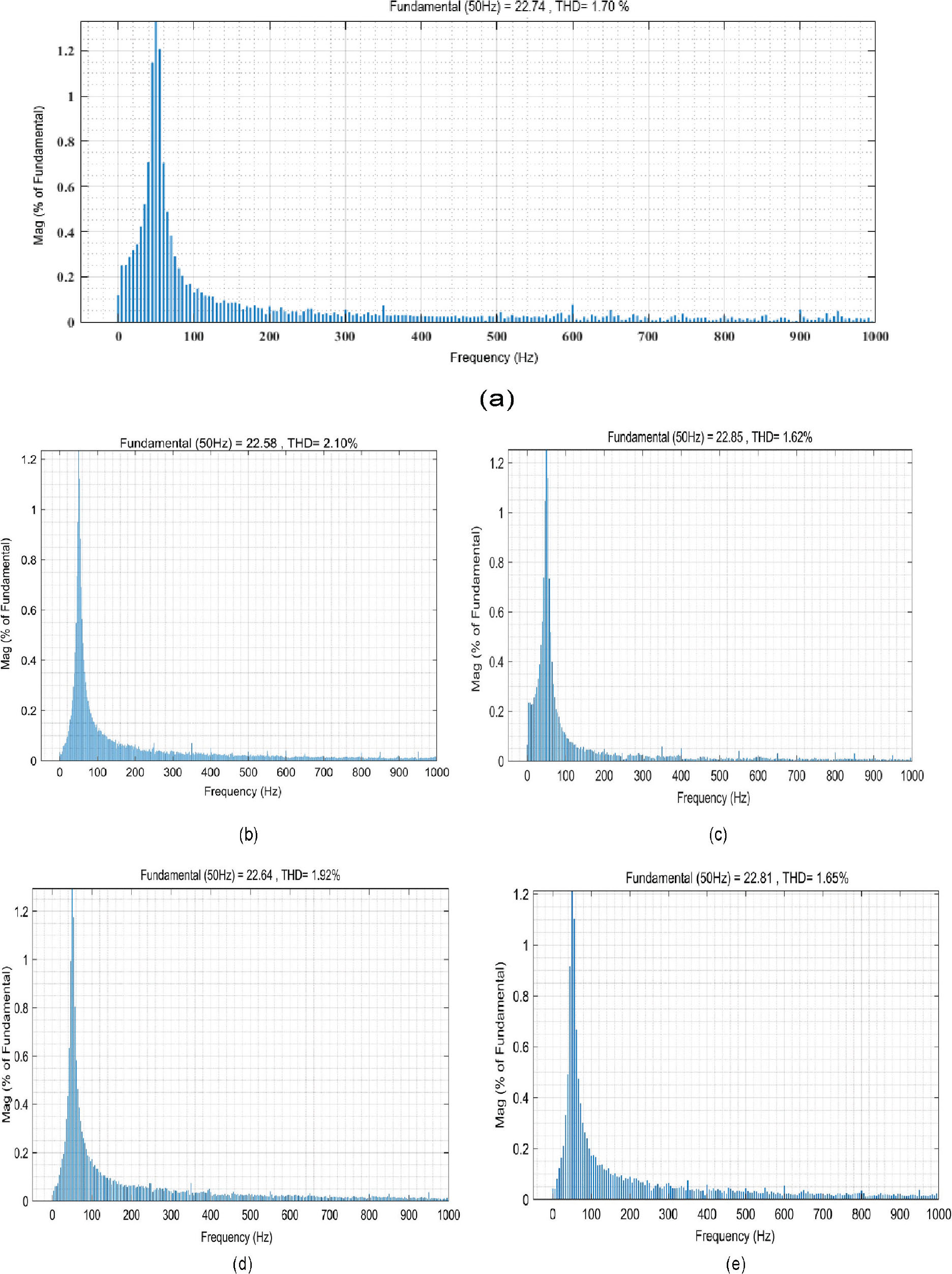
Figure 9.
THD of grid current at different operating conditions in V2G mode: (a) at a grid inductance of Lg = 5 mH, (b) at a grid inductance of Lg = 4.5 mH, (c) at a grid inductance of Lg = 5.5 mH, (d) at a grid voltage of 370 V and (e) at a grid voltage of 460 V. THD, total harmonic distortion; V2G, vehicle-to-grid.
Table 3.
Sensitivity analysis with parameter variation.
| Parameter | Variation | THD (G2V) | THD (V2G) |
|---|---|---|---|
| Lg (mH) | 4.5–5.5 (±10% change in grid side inductance) | 1.23%–1.51% | 1.62%–2.1% |
| Grid voltage (V) | 370–460 V (±10% change in grid voltage) | 1.27%–1.48% | 1.65%–1.92% |
Table 4.
Comparative analysis of the proposed charging method to the existing charging methods.
| Parameter | Existing charging systems | Proposed adaptive charging system | Reference(s) |
|---|---|---|---|
| Charging mode | Fixed CC/CV | Adaptive CC–CV with SOC and temperature feedback | Zdraveski et al. (2022), Etemesi et al. (2024) and Balasundar et al. (2021) |
| Charging power | 7–10 kW | 12 kW | Sethuraman and Rudhramoorthy (2024), Rivera et al. (2021) and Pradhan et al. (2023) |
| Charging time (20%–80% SOC) | 6.5–8 h | 5 h (reduced by 30%) | Hammerschmitt et al. (2024), Pradhan et al. (2023) and Rivera et al. (2021) |
| THD (grid current—G2V) | 4%–5% | 1.33% | Balasundar et al. (2021) and IEEE Standards Association (2014) |
| THD (grid current—V2G) | 4.5%–5% | 1.7% | Balasundar et al. (2021) and IEEE Standards Association (2014) |
| Control strategy | Fixed PI control without real-time adaptation | Adaptive controller with real-time SOC & temperature feedback | Etemesi et al. (2024) |
| Thermal management | Passive or external cooling-based cut-off | Real-time thermal model with current derating | Shahjalal et al. (2021) |
| Battery stress | High during fast charging (no thermal limit) | Reduced due to derating and smooth mode transitions | Zdraveski et al. (2022) and Etemesi et al. (2024) |
| Grid compliance | Limited harmonic mitigation | Enhanced via LCL filter | Han et al. (2020) and Balasundar et al. (2021) |
| Bidirectional operation (V2G) | Limited or not supported | Fully supported with control reversibility | Bera et al. (2022) |
| Charging efficiency | 88%–95% | 98.3% | Han et al. (2020) and Rivera et al. (2021) |
| Battery life span | Degrades with uncontrolled fast charging | Improved | Pradhan et al. (2023) and Levek and Steffan (2019) |