
1. Introduction
1.1. Introduction to anxiety
Anxiety represents a critical domain of psychological assessment and intervention in sports, given its potential to indirectly and significantly influence athletic performance (Ong & Chua, 2021). It typically emerges as a behavioral and emotional response when individuals encounter stressors they perceive as unmanageable, despite having access to adequate internal and external coping resources. In competitive contexts, anxiety may impair performance, increase the risk of failure, and contribute to the onset of sport-specific competitive anxiety.
Several theoretical models have been developed to elucidate the relationship between anxiety and sports performance. Landers and Boutcher (1998) proposed that competitive anxiety can be explained through the arousal–performance relationship. According to their model, performance is suboptimal at low levels of arousal, improves as arousal increases, but only up to an optimal threshold – beyond which further arousal leads to performance deterioration. This inverted-U pattern was originally described by Yerkes and Dodson (1908), and later refined by Hebb (1955), who emphasized that the optimal arousal level is not universal but varies between individuals. Building on this, Hanin’s (2000) Individual Zones of Optimal Functioning model posits that each athlete has a unique optimal zone in which anxiety facilitates peak performance. This zone is idiosyncratic and does not correspond to a fixed or universally “low” level of anxiety.
The theoretical frameworks discussed above provided the foundation for the development of the Multidimensional Anxiety Theory proposed by Martens et al. (1990). This model distinguishes three core components of competitive anxiety: cognitive anxiety, somatic anxiety, and self-confidence. Cognitive anxiety refers to performance-related worry and negative expectations, which may diminish as performance improves. Somatic anxiety manifests through physiological symptoms such as increased heart rate and sweating. Self-confidence, by contrast, is considered a factor that can buffer the negative effects of anxiety on performance. Both excessively high and low levels of somatic anxiety can be detrimental to athletic performance. Elevated somatic anxiety may lead to autonomic symptoms such as nausea or palpitations, whereas abnormally low levels may contribute to fatigue, under-arousal, or even boredom. High levels of self-confidence, on the other hand, have been shown to buffer the effects of competitive anxiety. Competitive anxiety remains a central topic in sport psychology, with numerous studies investigating its variation across gender, age groups, and sport types. Empirical findings consistently report gender-related differences in the experience and expression of competitive anxiety (Kemarat et al., 2022; Tóth et al., 2022) and, to a lesser extent, differences between individual and team athletes (Khan et al., 2017).
1.2. Introduction to recovery
Recovery is another pillar of athlete performance that is discussed in this article. Athletic performance is shaped by a combination of physical, mental, motivational, and social factors, all within a structured training cycle (Kovács & Szakál, 2024). Fundamental to performance are anabolic and catabolic processes, which must be carefully planned. Catabolic processes involve energy expenditure during training, while anabolic processes support recovery and adaptation. The training-rest dynamic is essential for performance improvement, and effective recovery is crucial for enhancing performance. Various recovery modalities – including water-based therapies, active recovery, sleep and relaxation, stretching, massage, compression garments, nutritional support, and breathing techniques – are employed to alleviate training-induced stress and fatigue. Recovery strategies are commonly classified as active, passive, or proactive, with low-intensity aerobic activities further divided into land-based and water-based formats (Crowther et al., 2017). In the present study, recovery methods were categorized into natural, physical, and psychological domains, drawing on existing literature. However, the three categories were specifically tailored to align with the conceptual framework of this research and to accommodate additional recovery techniques not included in the classification by Crowther et al. (2017).
Identifying the most effective recovery strategies remains a complex task, as their efficacy can vary significantly across sport types, genders, and age groups. Current practices are often informed more by tradition and anecdotal experience than by empirical evidence, and the integration of novel recovery methods into athletic routines continues to pose challenges (Wiewelhove et al., 2018).
In a German study investigating recreational male runners following a half-marathon, cold water immersion (CWI) and massage (MAS) were found to be more effective than passive recovery (PAS) in reducing perceived fatigue; however, active recovery (ACT) appeared to have adverse effects. Notably, none of the interventions significantly improved objective markers of fatigue (Wiewelhove et al., 2018).
Similarly, an Australian study found no significant differences in recovery efficacy across various techniques at 24 and 48 h post-exhaustive exercise (Crowther et al., 2017). A systematic review by Van Hooren and Peake (2018) concluded that while active cool-downs support lactate clearance and cardiovascular regulation, they may impair glycogen resynthesis. Other physiological and performance-related outcomes – such as neuromuscular function, muscle stiffness, range of motion, immune response, and athletic performance – were found to be largely unaffected.
Regional differences in recovery preferences are also notable. Among South African team sport athletes, sleep, hydration, and social interaction were identified as key recovery components (Venter et al., 2010). South African rugby players commonly utilize stretching, CWI, and active recovery protocols (Nédélec, 2013; Reilly & Ekblom, 2005). In New Zealand, cold water therapy (CWT) is widely adopted (Poppendieck et al., 2013), whereas Australian coaches emphasize nutrition, stretching, active recovery, and CWT (Moreno et al., 2015). French soccer teams regularly implement CWT and CWI (Nédélec, 2013), and Australian team-sport athletes frequently rely on active land- and water-based recovery, stretching, CWI, and CWT (Simjanovic et al., 2009).
1.3. The present study
To the best of our knowledge, the relationship between competitive anxiety and the use of recovery techniques has not yet been examined among athletes – particularly not within a Hungarian context. Accordingly, the primary aim of this study is to investigate the potential association between competitive anxiety and the frequency of recovery technique usage among Hungarian athletes.
Furthermore, previous international research indicates that athletes across different countries employ a wide range of recovery strategies, with substantial variation in both their application and perceived effectiveness. Therefore, this study also seeks to identify the most commonly used recovery methods among Hungarian athletes and to assess whether competitive anxiety differs as a function of gender, sport type (individual vs. team), and performance level (recreational vs. professional). Based on previous empirical findings and practical experience, we formulated three hypotheses: Recovery techniques popularized in elite sport and media representations – such as CWI and contrast water therapy (CWT) – are among the most frequently used recovery methods among Hungarian athletes (H1); Professional athletes use recovery techniques significantly more frequently than amateur athletes, likely due to higher training demands and greater access to professional resources and support (H2). The components of competitive state anxiety – cognitive anxiety, somatic anxiety, and self-confidence – show significant correlations with the frequency of recovery technique use (H3).
2. Method
2.1. Participants and procedure
The study involved 216 Hungarian athletes (M = 26.42, SD = 12.00), 56% (N = 120) women and 44% (N = 96) men. The participating athletes were recruited through various sports associations and completed the questionnaire package online. Following individual coordination, each athlete received a personalized link to access and submit the survey.
They included athletes, both recreational (N = 140) and professional (N = 76), as well as individual (N = 81) and team (N = 135) sports. All participants gave informed consent prior to the study. The study was approved by the Research Ethics Committee of the Hungarian University of Sports Science (TE-KEB/07/2022) in accordance with the Declaration of Helsinki.
2.2. Measures
Athletes’ state anxiety was assessed using the Competitive State Anxiety Inventory-2 (CSAI-2; Martens et al., 1990). This instrument comprises 27 items and evaluates the three components outlined in the multidimensional anxiety theory: cognitive anxiety, somatic anxiety, and self-confidence. The Hungarian adaptation developed by Sipos et al. (1999) has demonstrated high internal consistency, with Cronbach’s alpha coefficients ranging from 0.80 to 0.85.
The questionnaire assessing recovery techniques was developed based on relevant literature (Altarriba-Bartes et al., 2021; Barnett, 2006; Crowther et al., 2017; Ghigiarelli et al., 2020; Saw et al., 2016; Van Hooren & Peake, 2018). In addition, it included several recovery strategies known to the authors but not explicitly covered in the referenced sources. The final instrument comprised 27 items, allowing athletes to indicate when they typically used each technique: never, before, during, or after training/competition. The 27 recovery strategies were categorized into three domains: natural strategies (e.g., active cool-down, stretching and slow jogging, refueling and rehydration, dietary supplements, breathing techniques, sleep, and appropriate clothing during post-competition recovery), physical strategies (e.g., cryotherapy, contrast temperature therapy, massage, photobiomodulation therapy, microcurrent therapy, passive recovery, topical ointments, acupuncture, and acupressure), psychological strategies (e.g., progressive muscle relaxation, autogenic training, mental imagery, meditation, prayer, and listening to music). Participants could select multiple time points for each item (e.g., both before and after training/competition). To calculate the frequency of use, a score of 0 was assigned to “never,” and a score of 1 was assigned for each time point selected. For example, if an athlete reported using a given technique both before and after training/competition, a total score of 2 was recorded for that item. The maximum number of points were 3. The athlete’s overall frequency score was then computed by averaging these values across all 27 items. In the recovery questionnaire, 19 items were included to assess athletes’ motivations for using recovery techniques. Participants selected from literature-based statements reflecting common reasons for recovery use, such as “helps to relax and rest” or “enhances muscle recovery,” among others.
2.3. Data analysis
First, the normality of the data was assessed. Based on the skewness (–0.40 to 0.73) and kurtosis (–0.42 to 0.02) values (Table 1), the sample met the assumptions of normal distribution, as all skewness values were within |3| and all kurtosis values within |10| (Kline, 2023). To analyze group differences, one-sample and independent-samples t-tests were conducted. Linear regression analysis was used to examine the predictive effects of recovery technique frequency on competitive anxiety. All statistical analyses were performed using IBM SPSS Statistics, Version 28.
Table 1
Descriptive statistics, scales reliability, and intercorrelations.
| M | SD | α | Skewness | Kurtosis | REG | CAN | SAN | SFC | |
|---|---|---|---|---|---|---|---|---|---|
| REG | 0.47 | 0.17 | — | 0.40 | 0.02 | — | 0.03 | 0.04 | 0.04 |
| CAN | 2.29 | 0.62 | 0.83 | 0.59 | −0.42 | 0.03 | — | 0.67* | −0.64* |
| SAN | 2.01 | 0.53 | 0.75 | 0.73 | 0.02 | 0.04 | 0.67* | — | −0.54* |
| SFC | 2.89 | 0.57 | 0.85 | −0.40 | −0.08 | 0.04 | −0.64* | −0.54* | — |
*p < 0.01.
REG: recovery techniques, CAN: cognitive anxiety, SAN: somatic anxiety, SFC: self-confidence.
Source: Author’s contribution.
3. Results
3.1. Descriptive statistics and correlations
Table 1 presents the mean scores and standard deviations for the frequency of recovery technique use (M = 0.47, SD = 0.17), cognitive anxiety (M = 2.29, SD = 0.62), somatic anxiety (M = 2.01, SD = 0.53), and self-confidence (M = 2.89, SD = 0.57).
The internal consistency of the competitive state anxiety scales was acceptable across all measures, with Cronbach’s alpha values ranging from 0.75 to 0.85. The results also indicate that the frequency of recovery technique use does not show a significant correlation with cognitive anxiety, somatic anxiety, or self-confidence. However, cognitive anxiety was found to be significantly positively correlated with somatic anxiety (r = 0.67, p < 0.001), and significantly negatively correlated with self-confidence (r = –0.64, p < 0.001). Additionally, somatic anxiety and self-confidence were also significantly negatively associated (r = –0.54, p < 0.001). Furthermore, dichotomous variables were used to assess athletes’ reasons for using recovery techniques. The most frequently endorsed reason was that recovery “helps the athlete to be able to perform at maximum effort again in the next training/competition,” while the least selected reason was that it “induces a pumping effect in the muscles.”
3.2. Difference analysis
The most and least used recovery techniques were analyzed using a one-sample T-test, where the frequency of recovery techniques that differed significantly from the mean (M = 0.47) was examined. The five most frequently used recovery techniques by athletes were: food replenishment and rehydration (M = 2.23, t(215) = 25.50, p < 0.001), stretching and slow jogging (M = 1. 58, t(215) = 29.76, p < 0.001), listening to music (M = 1.54, t(215) = 18.43, p < 0.001), power nap (M = 1.40, t(215) = 19.64, p < 0.001), nutritional supplements (M = 1.33, t(215) = 12. 00, p < 0.001). The five least used recovery techniques were: compression with Rocket skins (M = 0.03, t(215) = −28.73, p < 0.001), arnica ice (M = 0.03, t(215) = −26.39, p < 0. 001), microcurrent therapy (M = 0.03, t(215) = −34.05, p < 0.001), drugs (medicaments) (M = 0.01, t(215) = −44.14, p < 0.001), acupuncture, acupressure (M = 0.01, t(215) = −100.52, p < 0.001). Table 2 presents the frequency counts for the use of individual recovery methods, specifically highlighting the five most frequently and the five least frequently used techniques.
Table 2
Frequency of the use of individual recovery methods.
| Five most used | N (%) | Five least used | N (%) |
|---|---|---|---|
| Food replenishment and rehydration | 212 (98%) | Compression with Rocket skins | 5 (2%) |
| Stretching and jogging | 210 (97%) | arnica ice | 4 (2%) |
| Power nap | 198 (92%) | Microcurrent therapy | 4 (2%) |
| Listening to music | 194 (90%) | Drugs | 2 (1%) |
| Nutritional supplements | 161 (75%) | Acupuncture, acupressure | 1 (0.5%) |
Source: Author’s contribution.
Differences in the frequency of recovery techniques and cognitive and somatic anxiety and self-confidence between gender (female, male), sport type (individual, team), and sport level (amateur, professional) were examined using independent samples T-tests. Table 3 illustrates that there is a significant difference in the frequency of use of recovery techniques between the quality levels of the athletes (t(214) = 2.91, p = 0.04, d = 0.42, CI [95%] = 0.14–0.70). Professional athletes used recovery techniques more frequently (M reg = 0.52, SDreg = 0.16) than their amateur counterparts (M reg = 0.45, SDreg = 0.17). The frequency of recovery techniques did not show significant differences between gender and sport type. Cognitive (t(214) = 4.91, p < 0.01, d = 0.69, CI [95%] = 0.42–0.97) and somatic (t(214) = 2.19, p = 0.03, d = 0.31, CI [95%] = 0.04–0.58) anxiety, and self-confidence (t(214) = −3.90, p < 0.01, d = 0.55, CI [95%] = 0.28–0.82) also showed significant differences between women and men. Women show higher levels of cognitive (M can = 2.52, SDcan = 0.65) and somatic (M san = 2.10, SDsan = 0.57) anxiety than men (M can = 2.11, SDcan = 0.54; M san = 1.94, SDsan = 0.47), while women’s levels of self-efficacy (M sfc = 2.72, SDsfc = 0. 59) are lower than those of male athletes (M sfc = 3.02, SDsfc = 0.51). There are no significant differences in the level (professional or amateur) and type (individual or team) of competitive anxiety (cognitive and somatic) and self-confidence between athletes.
Table 3
Results of independent samples T-tests.
| Sex | M ± SD | p | d | Type of sport | M ± SD | p | d | Level of sport | M ± SD | p | d | |
|---|---|---|---|---|---|---|---|---|---|---|---|---|
| Recovery | female (n = 96) | 0.47 ± 0.17 | 0.51 | 0.06 | individual (n = 81) | 0.45 ± 0.19 | 0.09 | 0.23 | pro (n = 76) | 0.52 ± 0.16 | <0.01* | 0.42 |
| male (n = 120) | 0.48 ± 0.17 | team (n = 135) | 0.49 ± 0.16 | amateur (n = 140) | 0.45 ± 0.17 | |||||||
| Cognitive anxiety | female (n = 96) | 2.52 ± 0.65 | <0.01 | 0.69 | individual (n = 81) | 2.26 ± 0.65 | 0.56 | 0.08 | pro (n = 76) | 2.27 ± 0.58 | 0.76 | 0.05 |
| male (n = 120) | 2.11 ± 0.54 | team (n = 135) | 2.31 ± 0.61 | amateur (n = 140) | 2.30 ± 0.65 | |||||||
| Somatic anxiety | female (n = 96) | 2.10 ± 0.57 | 0.03 | 0.31 | individual (n = 81) | 2.08 ± 0.53 | 0.13 | 0.21 | pro (n = 76) | 1.99 ± 0.48 | 0.72 | 0.06 |
| male (n = 120) | 1.94 ± 0.47 | team (n = 135) | 1.97 ± 0.52 | amateur (n = 140) | 2.02 ± 0.55 | |||||||
| Self Confidence | female (n = 96) | 2.72 ± 0.59 | <0.01 | 0.55 | individual (n = 81) | 2.80 ± 0.56 | 0.09 | 0.25 | pro (n = 76) | 2.90 ± 0.61 | 0.84 | 0.04 |
| male (n = 120) | 3.02 ± 0.51 | team (n = 135) | 2.94 ± 0.56 | amateur (n = 140) | 2.88 ± 0.54 |
Source: Author’s contribution.
3.3. Linear regression
Linear regression analysis was conducted to examine whether the reasons for using recovery techniques predict levels of anxiety and self-confidence. In addition to the reason for applying recovery techniques, gender and level of sport participation were included in the models as control variables, as they showed significant differences in relation to certain outcome variables (Table 2).
As shown in Table 4, the reasons provided by athletes significantly predicted cognitive anxiety (F(21,194) = 3.68, p < 0.001) and self-confidence (F(21,194) = 2.20, p = 0.003), but not somatic anxiety. The model explained 20% of the variance in cognitive anxiety and 10% in self-confidence. Figure 1 illustrates which specific reasons had a significant predictive effect on cognitive anxiety and self-confidence.
Table 4
Results of linear regression.
| R | R 2 | F | p | |
|---|---|---|---|---|
| Cognitive anxiety | 0.53 | 0.29 | 3.68 | <0.001 |
| Somatic anxiety | 0.36 | 0.05 | 1.54 | 0.07 |
| Self confidence | 0.40 | 0.08 | 1.97 | 0.01 |
Source: Author’s contribution.
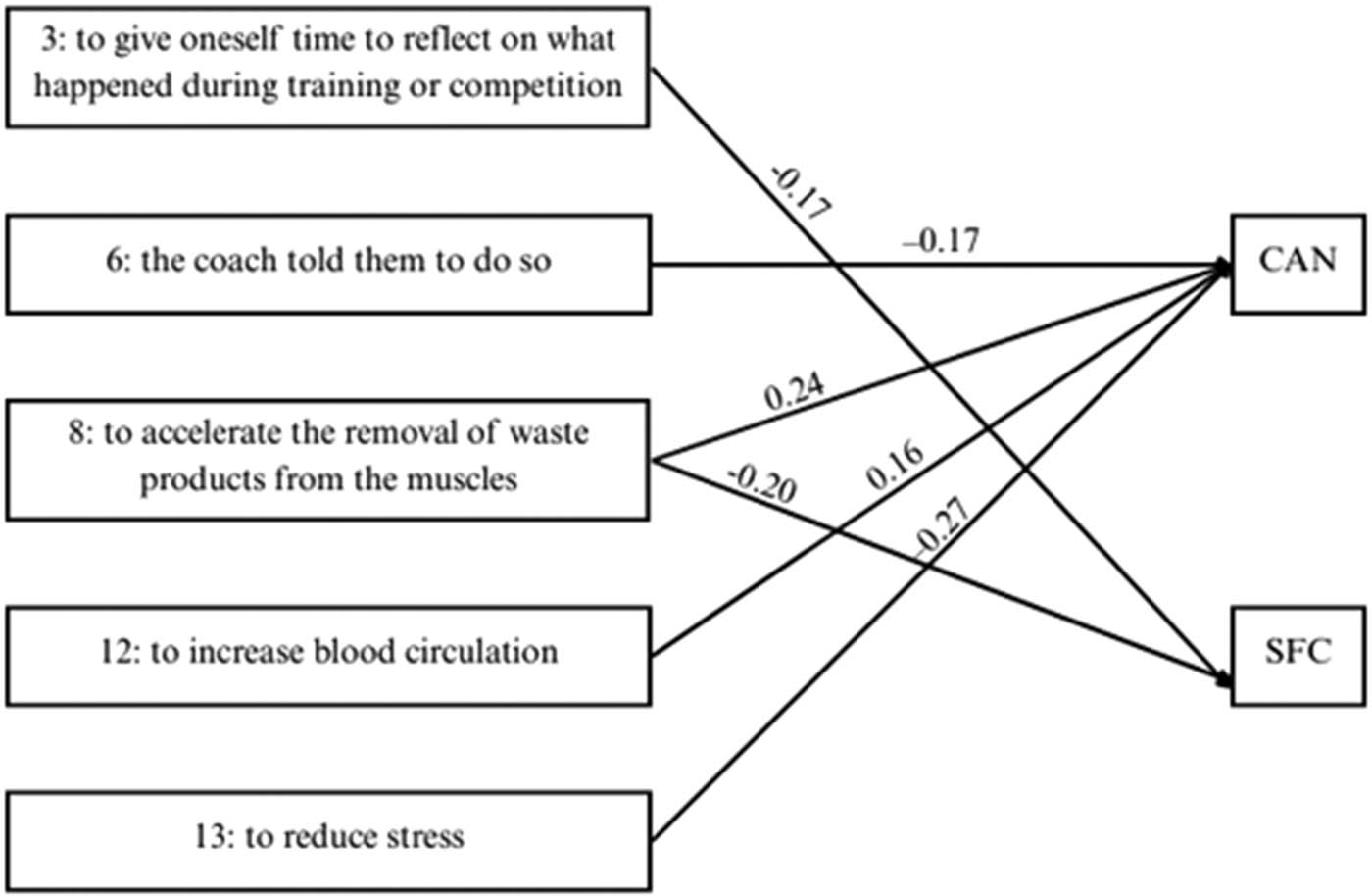
Figure 1
Significant regression weights for the linear regression model with cognitive anxiety (CAN) and self-confidence (SFC).
Source: From ref. Martens et al., 1990.
Regarding cognitive anxiety, significant negative predictors included using recovery techniques because “the coach told them to do so” (Item 6; β = –0.17, p = 0.01) and “to reduce stress” (Item 13; β = –0.27, p < 0.001). In contrast, significant positive predictors were using recovery techniques “to accelerate the removal of waste products from the muscles” (Item 8; β = 0.24, p = 0.03) and “to increase blood circulation” (Item 12; β = 0.16, p = 0.05). Gender, as a covariate, showed a significant prediction (β = −0.19, p = 0.01), whereas the level of sport participation did not.
As for self-confidence, significant negative predictors included using recovery techniques “to give oneself time to reflect on what happened during training or competition” (Item 3; β = –0.17, p = 0.03) and again, “to accelerate the removal of waste products from the muscles” (Item 8; β = –0.20, p = 0.02). Similarly to cognitive anxiety, gender as a covariate showed a significant prediction (β = 0.18, p = 0.02), whereas the level of sport participation did not.
4. Discussion
The widespread adoption of recovery methods among elite athletes often contributes to the broader promotion of specific techniques. For example, the Argentinian national football team’s use of yerba mate during the Qatar World Cup not only increased public awareness of the beverage but also triggered a significant rise in its market demand and price across South America (Yerba Mate Market, 2024). Similar effects can be observed in the case of top athletes such as Novak Djokovic and Cristiano Ronaldo, whose endorsement and use of recovery strategies have amplified public and professional interest in these methods, largely through the influence of their personal brands (Gawrysiak et al., 2020).
As previously noted, the five most frequently used recovery techniques reported by participants were: nutrition and rehydration, stretching and slow jogging, listening to music, power napping, and the use of dietary supplements. These results are consistent with prior research that underscores the effectiveness of evidence-based recovery practices, including adequate hydration and nutrition (Sawka et al., 2007; Venter, 2014), low-intensity exercise and stretching (Herbert & Gabriel, 2002), music as a psychoregulatory strategy (Terry et al., 2020), short-duration naps for neurocognitive recovery (Fullagar et al., 2015), and scientifically validated supplementation (Maughan et al., 2018). It is important to highlight that some of the examined techniques could not be applied in every context (e.g., during training), which may have influenced their reported frequency of use. Consequently, lower frequency scores do not necessarily indicate a lack of preference or perceived effectiveness, but may rather reflect situational constraints limiting their applicability.
Although stretching was not ranked first – as anticipated based on earlier findings (Van Hooren & Peake, 2018) – it remains one of the most widely adopted recovery methods among the athletes surveyed.
In contrast, the techniques reported as least frequently used included compression garments, arnica ice applications, microcurrent therapy, and acupuncture or acupressure.
Although less frequently reported in our sample, the regenerative potential of compression garments (Hill et al., 2014), herbal-based cryotherapy like arnica, microcurrent stimulation, and Eastern modalities such as acupuncture and acupressure (Vickers et al., 2018) is supported by emerging scientific evidence. The relatively low usage of these methods may be attributed to limited accessibility, cultural attitudes, or lack of practitioner availability.
It is both evident and well-supported that the most widely adopted recovery methods tend to be essential, easily accessible, and cost-effective – such as eating, drinking, and sleeping. In contrast, less commonly used techniques often require specialized knowledge, equipment, or facilities, making them less accessible to the broader athletic population.
Our first hypothesis that recovery techniques popularized by elite athletes and depicted in the media – such as CWI and contrast water therapy (CWT) – would also rank among the most frequently used methods in Hungary was not supported (Crowther et al., 2017; van Hooren & Peake, 2018).
However, our second hypothesis – that the frequency of recovery technique use would differ significantly between professional and amateur athletes – was confirmed. Professional athletes reported significantly higher usage rates of recovery strategies. This disparity may be explained by the more advanced training demands faced by professionals, which often lead to the pursuit of indirect performance-enhancing methods. Furthermore, differences in cultural norms, access to professional support, and availability of resources between professional and amateur sport contexts likely contribute to this distinction. Our findings are consistent with previous studies suggesting that professional athletes, owing to structured training environments and resource access, tend to employ recovery strategies more frequently and systematically than their amateur counterparts (Kellmann, 2010; Nédélec et al., 2013). This difference is partly rooted in training load management practices and recovery culture present in elite sports. For instance, Djokovic’s sustained tennis success is partly attributed to his meticulous recovery strategies, which have played a critical role in preserving his performance capacity despite a history of injury vulnerability during the early stages of his career.
In contrast, marked gender differences have been identified in levels of cognitive and somatic anxiety as well as self-confidence. Female athletes tend to report higher anxiety and lower self-confidence compared to their male counterparts. These disparities can be interpreted from both biological and socialization perspectives. Research suggests that fluctuations in estrogen and progesterone contribute to a heightened vulnerability to prolonged anxiety responses in women, while traditional masculine traits may serve as a psychological buffer against anxiety in men (Else-Quest et al., 2012; Farhane-Medina et al., 2022; Walton et al., 2021).
This study investigates the potential interrelationships between recovery methods, competitive anxiety, and self-confidence. In this context, the findings cannot be fully corroborated by existing literature, as prior research has not examined recovery and anxiety in an integrated framework. Although no significant correlation was found between the frequency of recovery technique use and levels of cognitive and somatic anxiety or self-confidence (H3), the results suggest that thoughtfully selected and clearly communicated recovery strategies may contribute to enhancing self-confidence and mitigating anxiety. Notably, recovery activities initiated by coaches appear to strengthen self-confidence and reduce anxiety, likely due to the embedded elements of trust and social support (Oláh, 2005). Another noteworthy finding is that recovery undertaken with the explicit goal of “stress reduction” has a beneficial effect on both anxiety and self-confidence. This association implies that when athletes prioritize general well-being and adopt a holistic approach – particularly emphasizing stress management – the outcomes are predominantly positive. Conversely, recovery methods narrowly targeting specific physiological functions, such as “removal of metabolic waste from muscles,” are associated with increased cognitive anxiety and diminished self-confidence. Similarly, while recovery efforts aimed at “improving circulation” do not appear to undermine self-confidence, they are linked to elevated levels of cognitive anxiety.
At first glance, the observed self-reflective effect of recovery on self-confidence may appear counterintuitive. However, this correlation may suggest that athletes tend to focus on their perceived mistakes rather than the constructive purpose of recovery (Martens et al., 1990), leading to an immediate mental impact. Over time, however, this reflective approach – especially when combined with other supportive mental strategies – may prove beneficial, as it can facilitate error correction and contribute to the refinement of sport-specific movements or the development of greater tactical maturity.
Naturally, this study has several limitations. First, the cross-sectional design precludes causal inferences; thus, future longitudinal studies are recommended to build upon and extend the current findings. Second, the sample consisted exclusively of Hungarian athletes, which limits the generalizability of the results to broader populations. Nevertheless, the study contributes to the scientific advancement of underrepresented regions – such as Hungary – and supports the exploration of cultural influences in sport psychology. Overall, although cognitive and somatic anxiety, as well as self-confidence, show significant differences across gender and between professional and amateur athletes (Smith et al., 2006), the findings suggest that appropriately tailored recovery strategies can positively influence these psychological variables. The results underscore the importance of integrating recovery practices into training programs to optimize both athletic performance and mental well-being. Another limitation is that some of the examined techniques could not be applied in every situation (e.g., during training), which may have influenced the reported frequency of use. Therefore, lower frequency scores may not necessarily reflect a lower preference for a technique but rather contextual constraints on its applicability.
5. Conclusions
While anxiety in athletes cannot be entirely eliminated, it can be positively modulated through the implementation of appropriate recovery strategies (Crowther et al., 2017). It is essential that key stakeholders – such as coaches and club staff – actively recommend recovery methods while providing clear and comprehensive guidance. A broad and holistic focus is particularly important, as an excessive preoccupation with detailed physiological processes may inadvertently exacerbate cognitive anxiety. Recovery techniques are often preferred due to their accessibility and cost-effectiveness (Venter et al., 2010). By acquiring and applying effective recovery strategies, coaches and team managers can play a pivotal role in enhancing athletic performance. The existing literature highlights the importance of adopting scientifically validated recovery practices, emphasizing their critical role in optimizing both physical performance and psychological resilience (Van Hooren & Peake, 2018).
Acknowledgments
The authors would like to thank the participants who took part in this study.
Funding information
This research received no specific grant from any funding agency in the public, commercial, or not-for-profit sectors.
Author contributions
Tibor Kökény, Renátó Tóth, László Tóth: conception and design of the study; Tibor Kökény, Renátó Tóth: acquisition of data; Renátó Tóth: analysis and interpretation of data; Tibor Kökény, Renátó Tóth, Eszter Radnóti, Renáta Horváth, and László Tóth: manuscript preparation; László Tóth: obtaining funding.
Conflict of interest statement
The authors hereby declare that there is no competing interest.
Ethics approval and informed consent
All participants gave informed consent prior to the study. The study was approved by the Research Ethics Committee of the Hungarian University of Sports Science (TE-KEB/07/2022) in accordance with the Declaration of Helsinki.
Data availability statement
The data that support the findings of this study are available upon reasonable request from the corresponding author.