
1. Introduction
Concrete is the most widely used construction material in the world due to its versatility, strength, and ease of production. With technological advancements in materials engineering, new developments have emerged that have optimised its mechanical properties and durability, including high-performance concrete (HPC) and self-compacting concrete (SCC). While these materials are not recent discoveries, they have gained prominence in the construction field due to their ability to flow and compact under their own weight without the need for mechanical vibration, which facilitates placement in structures with complex geometries and reduces labour costs and construction time (Shi et al. 2015; Mehdipour and Khayat 2018b). Despite the documented benefits, the design and implementation of these concretes still largely depend on information provided by manufacturers, who highlight their high mechanical strength and improved durability due to their low porosity and reduced permeability to aggressive substances, such as chlorides and sulphates (Alam et al. 2024b).
Historically, the evolution of concrete has been marked by the incorporation of chemical and mineral additives that modify its properties in both the fresh and hardened states. In the case of SCC, the use of high-range water-reducing additives (HRWR) is required to improve its flowability without compromising mechanical strength, which has raised concerns about their impact on the microstructure and long-term durability of the material (Ben Aicha 2020). Unlike conventional concrete, where these additives were optional, they are essential in SCC to achieve the required properties. However, their use has raised concerns regarding potential effects on volumetric stability, drying shrinkage, and chemical resistance of the concrete, necessitating a more detailed analysis of their influence on structural behaviour and their feasibility in various environmental conditions (Wang et al. 2024b).
In this context, this systematic literature review aims to identify, analyse, and synthesise the most relevant scientific studies on the physical, mechanical, and durability properties of high-performance self-compacting concretes (HPSCC) that incorporate high-range water-reducing additives in their formulation. By collecting and evaluating specialised literature, the goal is to establish the state of the art in this research area, providing key information to optimise mix design, improve performance, and expand its application in sustainable infrastructure projects with high structural demands.
2. Methods
2.1. Scope
This study applies to a systematic literature review following the methodology proposed by Torres-Carrion et al. (2018), which consists of three main phases: planning, review development, and results reporting. The research focuses on the analysis of HPSCC, particularly on the influence of high-range water-reducing additives (HRWR) on their physical, mechanical, and durability properties. The objective is to identify the most relevant advancements in this field and provide a reference framework for future research.
The study examines the evolution of HPC, the materials used in its production, the environmental impact of its manufacturing process, and current trends in its development. Additionally, the approaches adopted in different regions worldwide are analysed, emphasising the importance of sustainability and material optimisation in the concrete industry.
2.2. Instruments and techniques
For data collection, high-impact scientific databases such as Web of Science, Scopus, and ScienceDirect were used. A structured search syntax was established based on key terms extracted from the conceptual mind map of SCC to ensure the relevance and accuracy of the results. A filtering process was conducted to focus the analysis exclusively on literature reviews published between 2015 and 2025, ensuring the up-to-date nature of the collected information. Table 1 presents the search structure used in each database along with the results obtained.
Tab. 1:
Search structure employed.
| Database | Search syntax | Initial results | Filtered results |
|---|---|---|---|
| Web of Science | High-performance concrete, self-compacting properties, and durability | 389 | 30 |
| Scopus | TITLE-ABS-KEY (high AND performance AND concrete AND self-compacting AND properties AND durability) | 170 | 11 |
| ScienceDirect | High performance concrete self-compacting properties and durability AND SP AND NOT uhpc AND NOT recycled concrete AND NOT geopolymer | 672 | 21 |
2.2.1. Inclusion and exclusion criteria
To ensure the relevance of the selected studies, general and specific criteria were applied. The review included research analysing the physical, mechanical, and durability properties of HPSCC, focusing on publications in high-impact journals from 2015 onwards. Additionally, studies presenting HPSCC mix design methodologies and evaluating different families of high-range water-reducing additives (HRWR) were prioritised. Research on geopolymers and recycled concrete was excluded to maintain the focus on conventional SCC formulations.
2.3. Procedure
The development of this systematic review was structured into three fundamental stages: review planning, review execution, and results reporting, following the methodology of Torres-Carrion et al. (2018). The study focused on HPSCC and the impact of high-range water-reducing additives (HRWR) on its mechanical and durability properties. A rigorous approach was established, including a structured search in high-impact scientific databases, bibliometric tools to analyse research trends, and the identification of collaboration networks among authors. This process helped consolidate a robust theoretical framework on the state of the art in HPSCC, providing key insights for future research in this field.
2.3.1. Planning stage
In the planning phase, research questions were defined to assess the influence of HRWR on the behaviour of HPSCC in its fresh and hardened states, as well as its long-term durability. A conceptual mind map was developed to guide the selection of key terms and the formulation of a structured search syntax. The literature search was conducted in high-impact databases, such as Web of Science, Scopus, and ScienceDirect, ensuring the relevance and up-to-date nature of the collected studies.
2.3.2. Development
During the development phase, information was collected and filtered using inclusion and exclusion criteria, prioritising studies on mixed design, mechanical properties, and durability of HPSCC. To analyse research trends and collaboration networks, VOSviewer software was used, enabling the identification of thematic clusters and the visualisation of research evolution in this field. The analysis revealed that recent studies primarily focus on cementitious material replacement, fibre reinforcement, and additive optimisation.
2.3.3. Result stage
In the results reporting phase, the main scientific journals publishing relevant research on HPSCC and HRWR were analysed, highlighting construction and building materials and cement and concrete research due to their high impact in the field. Relationship maps and term cooccurrence networks were created to identify publication patterns and gaps in the literature. The findings indicate significant growth in HPSCC research across Asia, Europe, and North America, with an increasing focus on sustainability and the use of recycled materials in its composition.
3. Results and analysis
Based on the information obtained from the systematic review, a bibliometric analysis was conducted using VOSviewer software, which allows for the visualisation of collaboration networks and relationships between authors, reference terms, and thematic trends within the field of study. The processing of data from indexed databases revealed the existence of well-defined clusters based on the terminology used and the interconnection between studies. Figure 2a shows the distribution of documents according to the most recurrent terms, where a significant concentration of records focused on the analysis of concrete compaction, mix design, and the behaviour of its components is evident. Specifically, studies on aggregates, filler materials, and fibre inclusion in concrete production are highlighted (Elyamany et al. 2015; Jain et al. 2019).
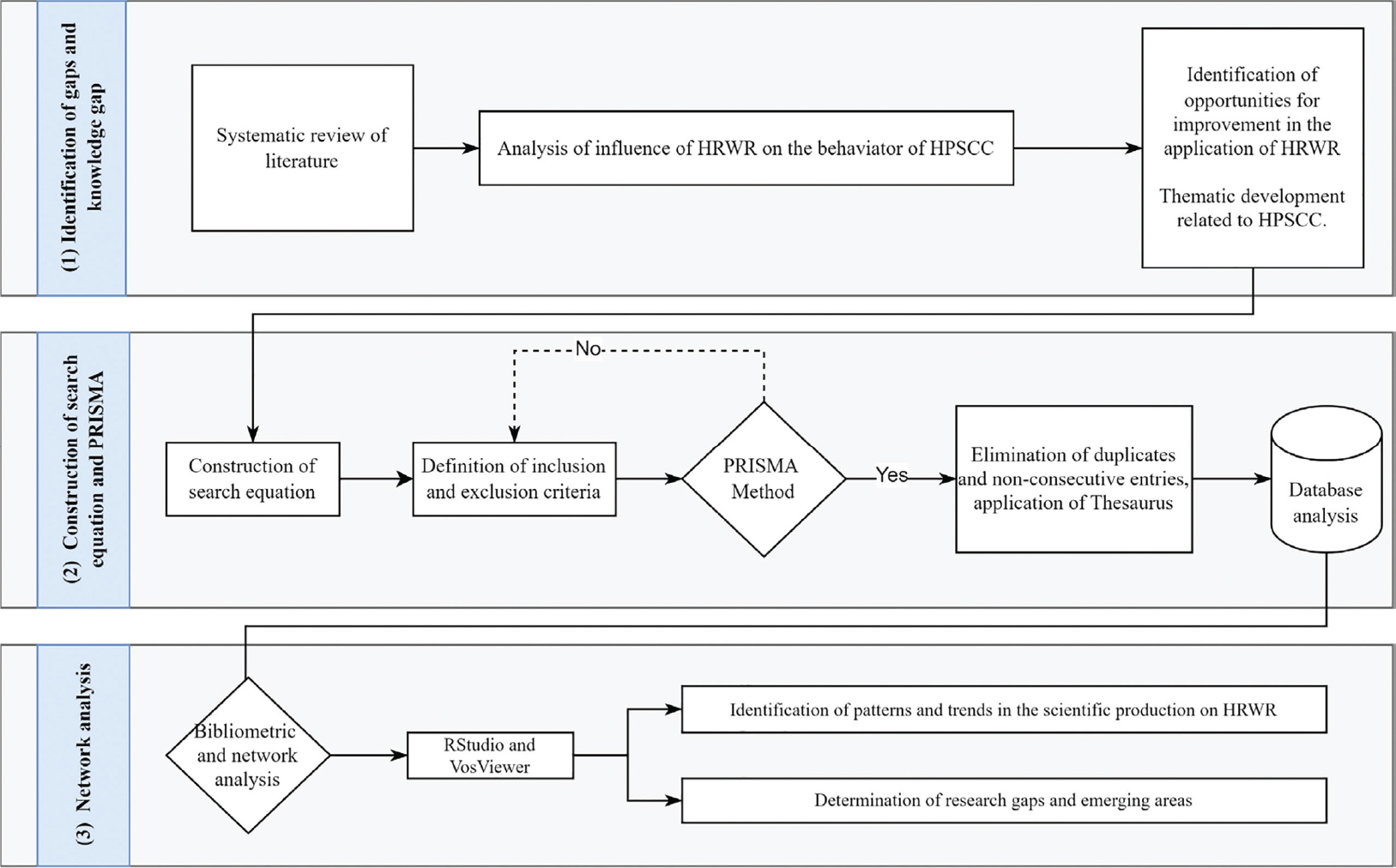
Fig. 1:
Methodology. HPSCC, high-performance self-compacting concrete.
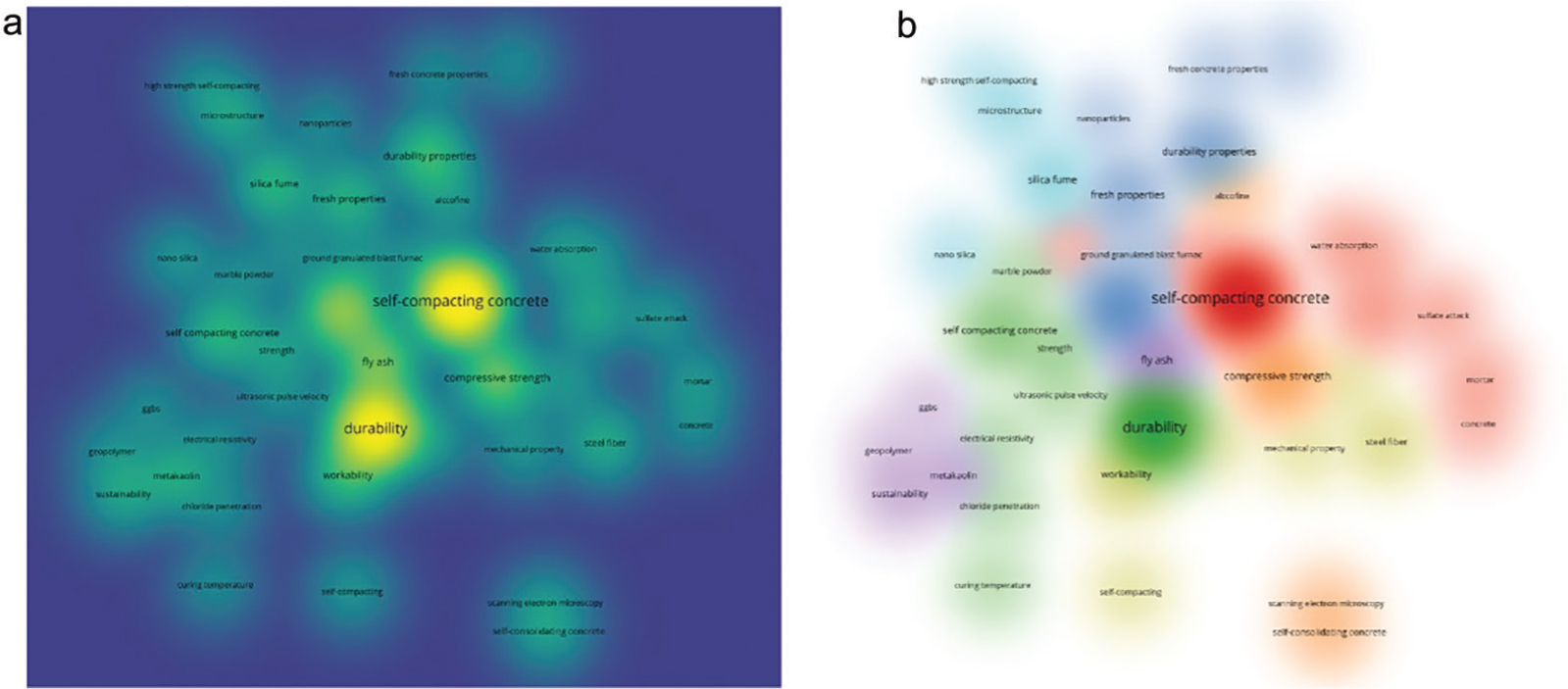
Fig. 2:
(a) Concurrency and (b) concept clustering.
Additionally, although with less presence in the analysed literature, studies focusing on the mechanical and durability properties of SCC were identified, highlighting aspects such as compressive strength, modulus of elasticity, and long-term performance under aggressive conditions (Zega et al. 2020; Alam et al. 2024b). The reference term analysis also identified five main thematic groups, which reflect the research trends in this field. As shown in Figure 2b, the smallest cluster consists of studies that directly refer to the abbreviation for SCC, indicating a lower frequency of use compared to other more specific technical terms. These findings provide a clear view of the knowledge structure in this area, guiding future research towards less explored areas or those with potential for development in improving the performance of SCC.
Figure 3a illustrates the network of reference terms and the thematic links generated in the research on HPC. The bibliometric analysis reveals the presence of multiple variables involved in the formation of these materials, reflecting the complexity of their design and behaviour. The diversity of interconnected terms demonstrates the need to approach the study of SCC from different perspectives, considering aspects such as mix design, rheological properties, compaction, and optimisation of its components. This highlights the dynamism and evolution of knowledge in this field.
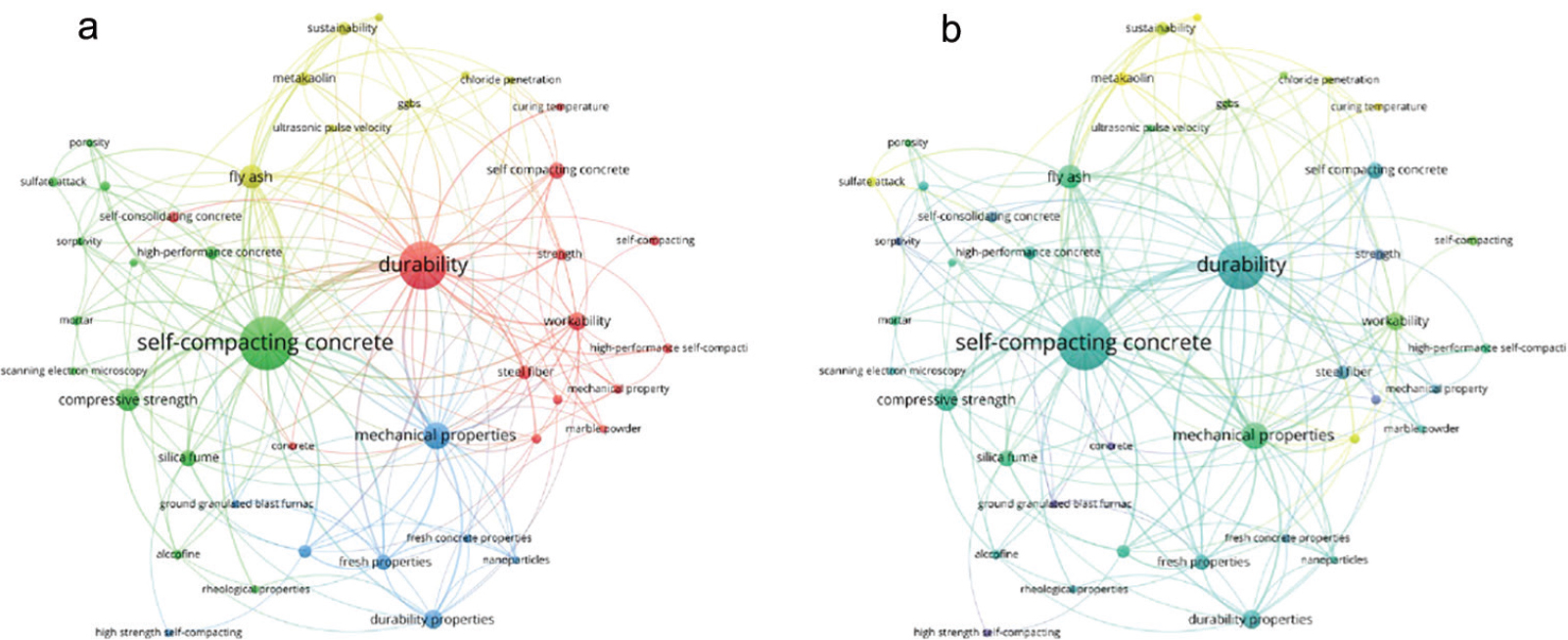
Fig. 3:
(a) Relationship between concepts and (b) Concepts by year.
On the other hand, Figure 3b allows for the visualisation of the temporal evolution of publications related to these reference terms. It can be observed that more recent research has focused on concrete compaction, the substitution of filler materials and binders, and the incorporation of fibres into mixes. This trend may align with the growing concern for sustainability in the construction industry, driven by the scarcity of natural resources and the need to reduce the environmental impact of concrete. The exploration of new material alternatives responds to the search for more efficient and sustainable solutions, promoting the inclusion of industrial by-products and recycled materials as partial replacements for cement and aggregates, to optimise both the mechanical performance and durability of SCC.
The bibliometric analysis allowed for the identification of the leading authors and researchers currently contributing to the study of self-compacting high-performance concrete (SCHPC). A significant increase in scientific production in recent years was observed, reflecting the growing interest in optimising this material, particularly in terms of mix design, durability, and sustainability. Figure 4a shows the temporal evolution of publications, highlighting a greater involvement of researchers in the last 5 years, with an increase in interdisciplinary collaboration.
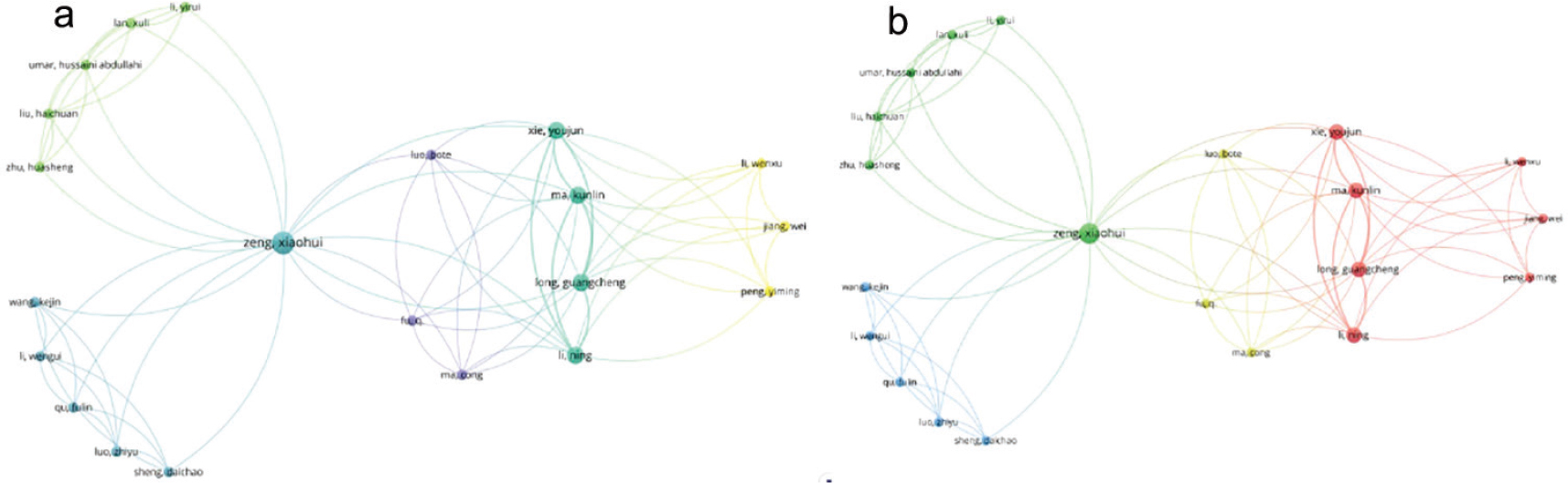
Fig.4 :
(a) Historical records by author and (b) Cooperation between authors.
Furthermore, using analysis tools like VOSviewer, the formation of collaboration networks between authors was visualised, indicating a trend towards increased international cooperation in this field. Figure 4b illustrates the emerging associations between different research groups, highlighting the interconnectivity between experts from various regions of the world, particularly in Asia, Europe, and North America. Additionally, the density of scientific production by author was identified, allowing for the recognition of the most influential researchers in the field based on the number of published articles. These findings provide a solid foundation for establishing new collaborations and strengthening the exchange of knowledge in the development of HPSCC.
4. Discussion
HPC has experienced rapid evolution in the construction industry due to the growing demand for materials with strengths exceeding 80 MPa. These concretes have been developed to meet the structural requirements of taller buildings, innovative geometries, and slender elements, offering efficient solutions in terms of both strength and durability (Mehdipour and Khayat 2018a). Furthermore, the development of HPC has focused on reducing environmental impact by promoting the use of local raw materials and the recycling of industrial waste, although the incorporation of these materials still requires further research and regulation (Alam et al. 2024a).
In this context, various combinations of supplementary cementitious materials (SCMs) have been explored to improve the properties of concrete. Among the most used are ground granulated blast-furnace slag (GGBS), fly ash, and rice husk ash (RHA), as well as mineral additives, such as silica fume (SF), ultrafine slag (UFS), and nanosilica (nS). These materials, when combined with Ordinary Portland cement (OPC), have shown significant improvements in concrete’s strength, workability, and durability (Su et al. 2022). However, while the incorporation of industrial waste represents a sustainable alternative, challenges remain regarding the homogeneity of the mixes and uncertainty about their long-term behaviour, which has led to caution in their widespread adoption (Iqbal et al. 2025). Recent studies have reported that some of these combinations can achieve strengths greater than 100 MPa at 28 days, leading to their incorporation in road and industrial infrastructure that requires early strength to optimise construction time-lines (Bhuva and Bhogayata 2022).
In addition to mechanical strength, the demand for concrete is also driven by the need to form structural elements with unconventional shapes or those that must overcome obstacles, such as high reinforcement densities, where traditional compaction methods are not feasible. In response to these challenges, HPSCC has been developed, a variant of HPC capable of flowing and compacting by itself without the need for mechanical vibration (Roussel et al. 2020). This type of concrete achieves its workability through the incorporation of chemical additives that modify viscosity and superplasticisers (SP) that improve the flow of the mix. However, its high cost has driven the search for more economical and sustainable alternatives, such as the inclusion of fibres and recycled aggregates, although certain materials, like rubber waste, may negatively affect the mechanical strength of the concrete (Gao et al. 2025).
The manufacturing of SCHPC has been accompanied by advances in third-generation SP, such as high-range water reducers (HRWR), which have shown greater efficiency in particle dispersion within the mix. These additives not only optimise the flow and cohesion of SCC but have also been applied in the development of self-healing concretes, which can self-repair through the formation of cementitious compounds in microcracks. Due to their impact on reducing water consumption and improving workability, ARAAR continues to be the subject of numerous studies aimed at enhancing the sustainability and performance of SCHPC in various construction applications (Wang et al. 2024a).
The development and evolution of SCC have been extensively analysed in scientific literature. Since its origin in Japan in the 1980s, this type of concrete has revolutionised materials engineering due to its ability to flow and consolidate without the need for mechanical vibration. Thematic maps obtained from bibliometric analysis help identify key trends in SCC research, grouping the main study areas and establishing connections between its mechanical properties, durability, sustainability, and structural applications. This analysis presents the main findings on SCC evolution, providing a detailed review of the most studied concepts and the most influential authors in the field.
One of the main focuses in SCC research has been the evaluation of its rheological properties, specifically how fresh concrete flows and behaves before setting. These properties, including flowability, viscosity, and stability, are essential to ensuring that the concrete can fully fill moulds without segregation or consolidation issues. Authors such as Mehdipour and Khayat (2018b), Kuzmenko et al. (2022), and Kaya et al. (2024) have explored the modelling of SCC’s rheological characteristics, developing equations that explain its behaviour in terms of thixotropy and shear resistance. Studies by Bernal (2016) and Scrivener et al. (2018) have demonstrated that the combination of SP and viscosity-modifying agents optimises the rheological performance of SCC without compromising its mechanical strength. Additionally, the use of nanomaterials, such as graphene oxide and silica nanoparticles, has been explored to enhance stability and reduce segregation. Research by Zeyad and Almalki (2020) and Kaya et al. (2024) has addressed the relationship between mix design and workability, establishing that a balance between the water-to-binder ratio and fine aggregate content is crucial for achieving highly SCC.
Another key aspect in this field is the experimental evaluation of the self-compacting ability of SCC. Methods such as the Abrams cone slump test, the L-box test, and the V-funnel test have been widely used to measure the flow capacity and stability of the concrete. Studies by Lambrechts et al. (2018), Sahlol et al. (2021), Kantamaturapoj et al. (2022), and Walraven et al. (2022) have led research on the correlation between these tests and the actual performance of SCC in structural applications, emphasising the importance of establishing acceptance criteria in international standards such as EN 206-9 and ASTM C1611.
4.1. Durability of SCC against chemical agents and environmental factors
The durability of SCC is a central topic in the research of this material, as its use in large-scale infrastructure requires superior performance under aggressive environmental conditions. The exposure of SCC to sulphates, acids, chlorides, and freeze-thaw cycles has been extensively studied by authors such as Mohseni et al. (2017), Zhu et al. (2021), Su et al. (2022), Tanyildizi (2023) and Xia et al. (2023) who have analysed the impact of these agents on the concrete’s microstructure.
In particular, the resistance of SCC to chloride penetration, which is a critical factor in structures exposed to marine environments or freeze-thaw cycles, has been extensively studied by Tangadagi et al. (2021) who have developed methods to evaluate ionic diffusivity in dense cementitious matrices. The results indicate that the incorporation of pozzolanic additions, such as high-volume fly ash and SF, significantly improves the impermeability of SCC, reducing the rate of chloride ingress and mitigating the risk of reinforcement corrosion. Another common issue in SCC is its behaviour under sulphate attack, which can cause expansion and cracking in structures exposed to aggressive soils. Research by Chinchón-Payá et al. (2015) has identified that using cements with low alumina content and the inclusion of supplementary materials can improve sulphate resistance. Furthermore, research on the carbonation of SCC, led by Chinè-Polito et al. (2019) has shown that this process is slower in concretes with high compactness and low permeability, which enhances long-term durability.
4.2. Sustainability and use of alternative materials in SCC
The sustainability of SCC is an increasing concern in the scientific community, given the need to reduce the environmental impact of construction. In this context, studies such as those by Barroqueiro et al. (2020), Sun et al. (2020), Kelechi et al. (2022), and Jasim et al. (2023) have explored the potential of incorporating recycled materials and industrial by-products in the production of SCC. One of the most promising approaches is the use of recycled concrete aggregates, which have been widely studied by Evangelista et al. (2019), Tang et al. (2020), Yuliani et al. (2020), Cárdenas et al. (2021), and Steinman et al. (2022). Although recycled aggregates can affect the workability and strength of SCC, the use of surface modification agents and chemical treatments has allowed for improvements in its properties. Another significant development in the sustainability of SCC is the evaluation of its life cycle (life cycle assessment [LCA]), a method that quantifies the environmental impact from material production to the demolition of structures. Authors such as Kurda et al. (2018), Abokersh et al. (2020), and Marinković et al. (2023) have applied this methodology to compare SCC with conventional concrete, concluding that the reduction in energy consumption and CO2 emissions justifies its implementation in sustainable infrastructure projects.
SCC has been used in a wide variety of structural applications, ranging from high-rise buildings to bridges and tunnels. Research by Gebremariam et al. (2021) and Alarab et al. (2022) has analysed its performance in structural elements subjected to extreme loads, high-lighting its ability to improve construction quality and reduce maintenance costs. Recent studies have explored the use of metallic and synthetic fibres in SCC to enhance its flexural strength and crack resistance. Authors such as Yalçlnkaya and Yazlcl (2016), Yazici and Tanacan (2020), and Cappellesso et al. (2023) have demonstrated that the addition of steel, polypropylene, and basalt fibres increases the ductility of SCC, making it ideal for applications in pavements and structures subjected to repetitive impacts.
5. Conclusions
SCHPC has been extensively studied in scientific literature, with numerous articles analysing it from various perspectives. Among the most frequently addressed approaches are those related to mixed design, where the proportions of constituent materials are optimised to improve flowability and strength, as well as the analysis of their physical and mechanical properties, both in the fresh and hardened states. Furthermore, research has been developed on its internal structure and microstructural behavior, evaluating the influence of components such as aggregates, filler materials, and the inclusion of fibers in its production—factors that have been shown to enhance its performance in terms of strength, ductility, and controlled deformation capacity (Zega et al. 2020; Gao et al. 2025). However, despite these studies providing greater knowledge of the material, gaps remain in the research, particularly regarding its long-term durability, behaviour in aggressive environments, and interaction with structures subjected to extreme conditions, highlighting the need to continue exploring these aspects in future investigations (Alam et al. 2024a).
Currently, the largest scientific production related to SCHPC comes from Asia, followed by Europe and North America. This suggests a strong research activity in countries such as China, Japan, and India, where the development of advanced technologies and the need to optimise materials in infrastructure have driven its study and application (Bhuva and Bhogayata 2022). In these countries, efforts have focused on the use of SCM and the integration of artificial intelligence for mixed optimisation. In Europe and North America, while research on this material is also significant, authors tend to be more dispersed, which has made it challenging to consolidate collaborative networks. However, in recent years, interdisciplinary research groups have begun to emerge, aiming to establish standardised methodologies and expand knowledge on its structural and sustainable applicability (Roussel et al. 2020). This scenario reflects the need to strengthen international cooperation and promote studies that not only improve the performance of SCHPC but also ensure its viability and durability in different construction contexts.