
Tab. 1
Construction conflict prevention and construction conflict resolution strategies.
| Author | Contribution to construction conflict | |
|---|---|---|
| Prevention | Resolution | |
| Leung et al. (2002) | Effective and reasonable conflict prevention enhances team productivity and creativity, which helps overcome obstacles. A manager needs to build a relationship between conflict and satisfaction levels. Determining the best stage of conflict is key to a successful project because it provides a stimulus. | Positive interaction between participants of the project is essential to prevent negative conflict or to enable its resolution at least. Conflicts are stimulated in multiple tasks at a predetermined level to eliminate obstacles, leading to high participant satisfaction. Excessive task conflict should be prevented in the decision process. |
| Wang et al. (2005) | Goal setting is a major task that helps prevent negative conflict. The most appropriate method for construction, cultural, and legal issues in arbitration after the negotiation is to resolve disputes. | No universal formula exists to resolve conflicts except that the parties should respect each other to gain the contract's trust. |
| Harmon (2009) | Parties should oblige to work in good faith. A focus on DRBs helps reduce the cost of construction. | New claims and orders expedite the resolution of issues. Daily and hourly payments save cost and time, resolve problems, and eradicate conflicts. |
| Fenn and Gameson (1992) | Improvement in training and education of construction panels prevents conflicts. | Less-conflictual attitudes of parties and technical education overcome obstacles to the resolution of conflicts. |
| Udechukwu et al. (2018) | The role of technology is very crucial for the prevention of construction conflicts. | The rule of law is considered the most moderate method to eliminate conflicts. |
| Kanishka et al. (2019) | Conflict arises at pre-contract stages and, therefore, should be resolved at that stage to avoid later problems. | Observation of pre-contract practice may eliminate conflicts in construction plans. |
| Hemanth et al. (2019) | Keeping a proper check on the contract document helps eliminate disputes. | Categorization of reason, which helps in recognizing the root problems of the obstacle, provides a suitable solution. Litigation is helpful in the resolution of conflicts. |
[i] DRBs, dispute review boards.
Tab. 2
Summary of theoretical research on prevention and resolution of construction disputes.
| Author | Methodology | Research contribution |
|---|---|---|
| Liu et al. (2019) | A practical method for making settlement of dispute for international construction projects grounded on CBR and validates the CBR model in certain dispute cases | The dispute settlement approach improves the theoretical framework and also relies on the case study method |
| Jagannathan and Delhi (2020) | Objective and analytical research | Direction for the construction industry to reduce the adoption of litigation to solve disputes |
| Zhu et al. (2020) | Measurement theory | Five ways to manage conflicts and reduce disputes – the quality of construction, fairness perception, conflict prevention, acceptable resolution result, and post-conflict influence |
| Lee et al. (2016) | Application of the theory of planned behavior | An alternative dispute resolution (ADR) method is suggested to mitigate conflicts |
| O’Connor et al. (1993) | Utilization of hierarchal decomposition | Creative management of conflict and change can provide benefits to eliminate construction disputes |
| Stipanowich (1997) | SOI | The AAA has commenced some reforms to the dispute resolution process that minimize conflicts |
| Li et al. (2012) | A framework with a questionnaire survey and multiple interviews with several respondents | Policy and decision-makers need to struggle for resolving at least the common conflicts that arise throughout the lifecycle of main projects |
| Eyad and Ali (2014) | Qualitative research | Executing possible measures as early as possible to evade conflicts in the partnership |
| Akiner (2014) | Theoretical framework | Analyzing multicultural or multinational presentations in construction projects can be a somber tool for the avoidance of disputes between the involved parties |
| Gardiner and Simmons (1992) | ARD | Avoiding disputes through the application of documentation policies and cooperative communication between parties is considered worthy of avoiding and resolving disputes |
| Alaloul et al. (2019) | Questionnaire survey to gather data | Conflict is perhaps not a context-based effect on project presentation, and comprehending it helps in its resolution |
| Essex (1996) | Survey | Escrow bid documents, DRBs, and partnerships help in the prevention and resolution of conflicts in construction projects |
| Brower (2005) | The theoretical model, along with an organized questionnaire survey | Contractual elasticity (term and process elasticity) are interrelated and eliminated disputes by expressively and definitely affecting the accomplishment of construction projects |
| Hosseini et al. (2017) | Qualitative research | Disputes can be resolved or at least avoided when construction project owners go through the deficit of the transactional agreement models when executing a problematic project with tentative scope |
| Arditi and Pattanakitchamroon (2006) | Questionnaire survey | Claims can be prevented through rigorous reviews of policies and specifications and by necessitating greater project planning work on the part of the contractor |
| Wu et al. (2018) | Application of the theory of conflict management | Develop trust relations between project crews based on equivalent collaboration to take benefit of the positive effects of project conflict and to resolve the negative effects of procedure and correlation conflicts |
| John (1987) | Survey | Owners and contractors should retain suitable levels of employment during claim disputes |
| Zhu and Cheung (2020) | Case study | Incentivization in governing the slits in risks and control among manager, contractor, and involved parties during project construction |
| Apt and Witzel (2009) | Measurement theory | Five proportions in the administration of quality of conflict: fairness perception, effective resolution result, procedure, conflict prevention, post-conflict influence, and integrated resolution. |
| Tazelaar and Snijders (2010) | Questionnaire survey | Dispute Resolution Board Foundation model helps eliminate disputes |
| Bröchner et al. (2002) | Theoretical approach | An open doubt of elitism and tough occupations has been conveyed as a propensity for two construction parties to resolve disputes without mentioning it to impartial third parties |
| Mohamed et al. (2014) | Questionnaire survey | Behavioral, contractual, and operational matters to avoid altering claims into disputes |
| Akintoye et al. (2015) | Web-based system | The web-based system serves as a communication platform among owners, contractors, and planners to help resolve conflicts |
| Alpkokin and Capar (2019) | Questionnaire survey | ADR has been established in the worldwide construction division to reduce disputes and prevent litigation; an alternate solution is the DRB |
| Charkhakan and Heravi (2019) | Application of risk management theory | Healthy association between causes of conflict, factors, construction project parties, and consistency between project participants and conflict help avoid disputes |
| You et al. (2018) | Application of pattern classification theory | Suitable behavior of similar construction parties helps avoid conflicts |
| Elziny et al. (2016) | Application of TCE approach | A healthy association between uncertainty and the supplier's positive attitude helps overcome disputes |
| Hamimah et al. (2012) | Application of planned behavior theory | A well-drafted contract may be essential but not adequate to stimulate friendly resolution of disputes between contract participants. Factors affecting conflicts should be understood well |
| Junying and Martin (2019) | Utilization of the ITA framework | Working productive groups and examples of good behavior help eliminate conflicts |
| Adnan et al. (2012) | Questionnaire method | Evaluation of literature throws light on the significance of dealing with the people and their attitude to make construction tasks less prone to litigation |
| Malak et al. (2020) | Application of the analytical framework | Corporate office, high competency, and qualification of parties avoid and resolve conflicts |
[i] AAA, American Arbitration Association; ARD, Alternative methods of resolving disputes; CBR, case-based reasoning; DRBs, dispute review boards; ITA, International tunneling association; SOI, settlement-oriented interventions; TCE, transaction cost economics.
Tab. 3
Iterative development of the search string.
| Search number | Addition to the search string (Scopus search format) | ScienceDirect | Scopus | ASCE |
|---|---|---|---|---|
| 1 | TITLE-ABS-KEY (“dispute” AND avoidance AND “construction”) | 2069 (12) | 69 (11) | 1865 (34) |
| 2 | OR TITLE-ABS-KEY (“conflict” AND avoidance AND “construction”) | 10211 (17) | 43 (13) | 4497 (17) |
| 3 | OR TITLE-ABS-KEY (“dispute” AND prevention AND “construction”) | 3539 (4) | 57 (22) | 1418 (14) |
| 4 | OR TITLE-ABS-KEY (“conflict” AND prevention AND “construction”) | 20132 (23) | 91 (19) | 3567 (9) |
| 5 | OR TITLE-ABS-KEY (“dispute” AND “avoidance” AND roads OR tunnels) | 139 (1) | 4 (1) | 6 (0) |
| 6 | OR TITLE-ABS-KEY (“conflict” AND “prevention” AND roads OR tunnels) | 968 (0) | 237 (3) | 15 (0) |
| 7 | OR TITLE-ABS-KEY (“dispute” AND “resolve” AND construction) | 9172 (19) | 106 (8) | 2342 (8) |
| 8 | OR TITLE-ABS-KEY (“conflict” AND “resolve” AND construction) | 37073 (29) | 117 (6) | 3679 (3) |
| 9 | OR TITLE-ABS-KEY (“conflict” AND “resolution” AND “construction”) | 35171 (14) | 290 (12) | 3680 (6) |
| 10 | OR TITLE-ABS-KEY (“dispute” AND “resolution” AND construction) | 7709 (9) | 589 (10) | 2342 (4) |
| 11 | OR TITLE-ABS-KEY (“claims” AND “construction”) | 175367 (18) | 2446 (15) | 6757 (21) |
[i] ASCE, American Society for Civil Engineers.
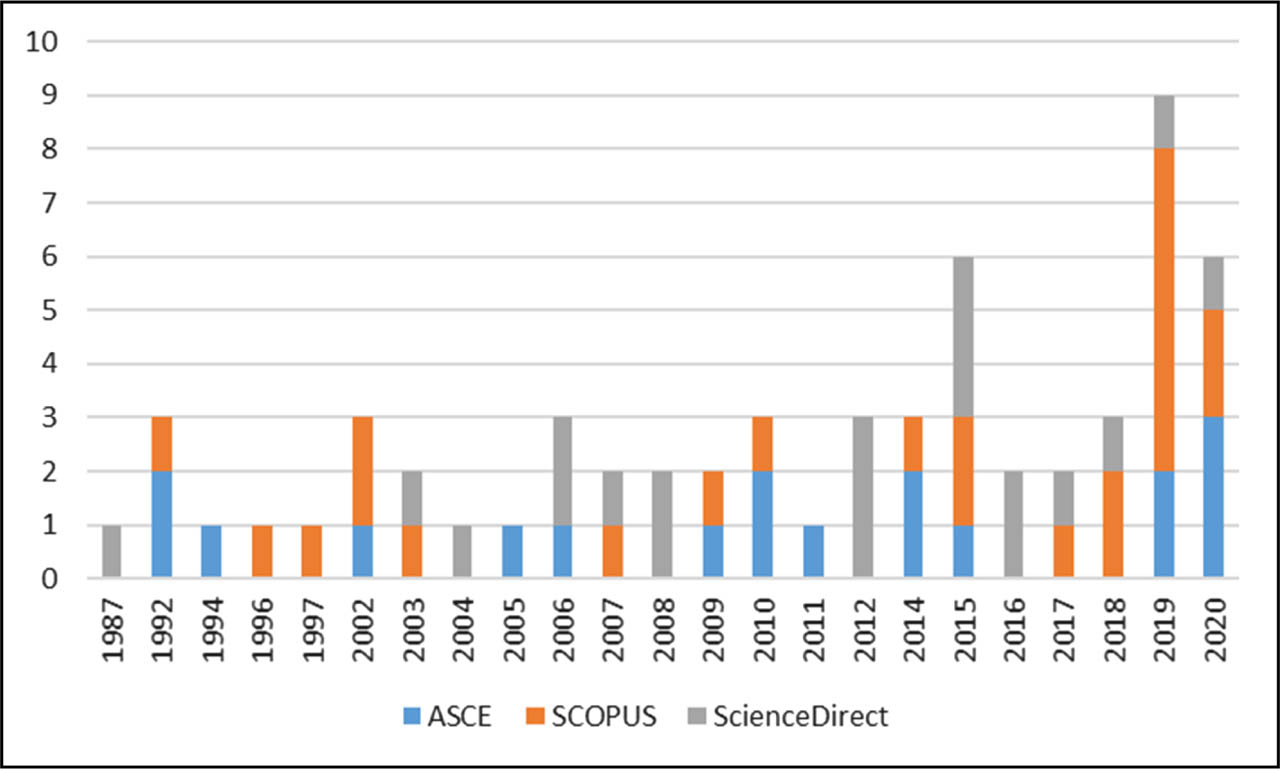
Fig. 1
Selected articles for this literature review by database and publication year. ASCE, American Society for Civil Engineers.
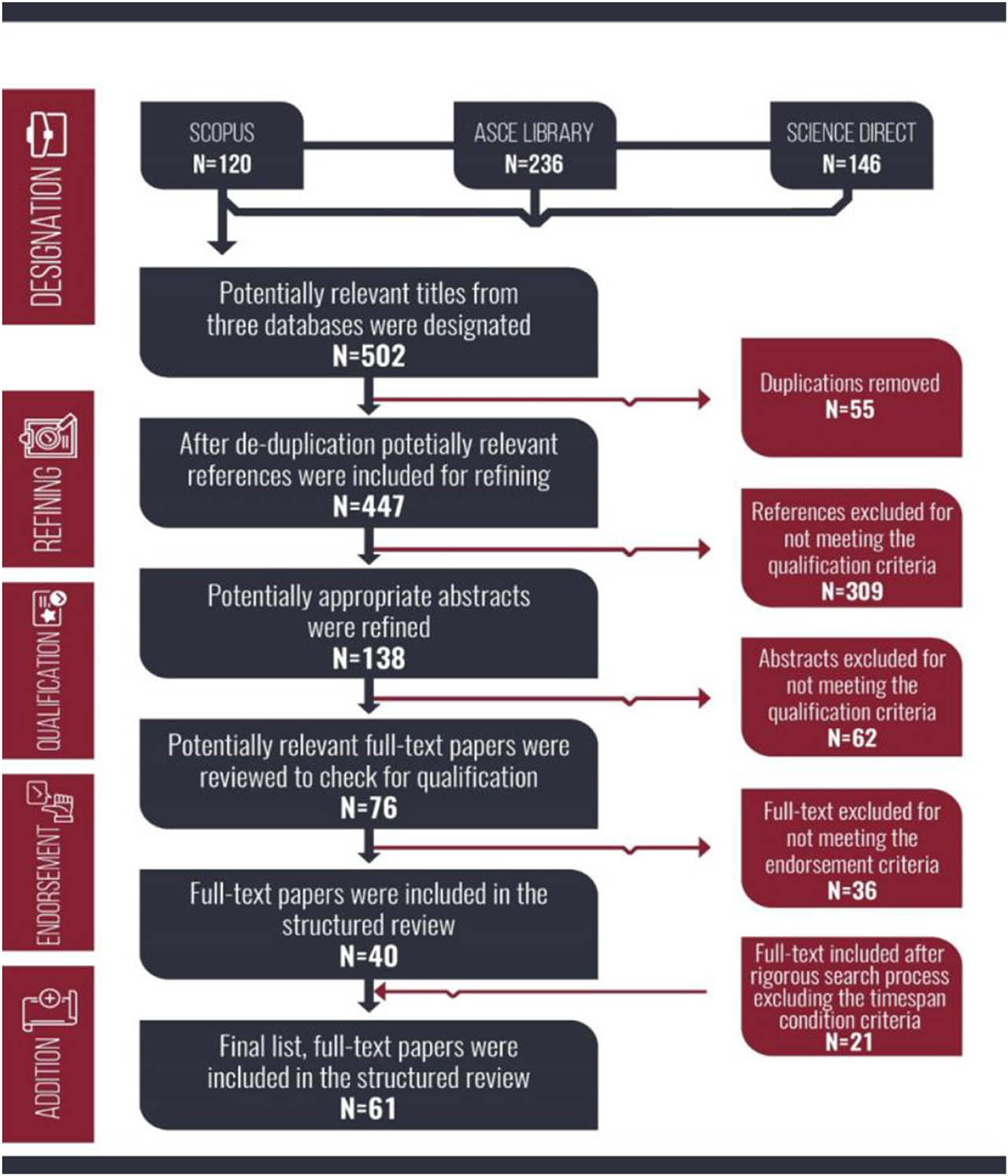
Fig. 2
The MORISE flow diagram for database search and literature selection. MORISE, Modified Reporting Items for Structured Reviews in Engineering and Technology.
Tab. 4
Summary of research on the prevention of construction conflicts.
| Authors | Methodologies | Contribution in dispute prevention |
|---|---|---|
| Ojiako et al. (2018) | ODR | Helped identified four factors: demographics, ADR culture, personal culture, and layout and design issues – all of which combined provide a suitable study framework for examining the many interrelated risks to ODR effectiveness. |
| Jones (2006) | Dispute resolution process | Conflicts may be avoided through traditional dispute resolution procedures like litigation and arbitration. These approaches are also useful for preventing construction-related disputes in the first place. |
| Leung et al. (2002) | Case study | Appropriate level of conflicts enhances team productivity and creativity, which prevent obstacles; managers need to build a relationship between conflict and satisfaction; determining the best stage of conflict is the key to a successful project because it provides a stimulus; goal setting is one of the major tasks that helps prevent negative conflict |
| Chaphalkar et al. (2015) | Case Study | A set of neural model systems; both MLP and GFF were used in this study. The system worked impartially and did not favor any of the disputing parties. Thus, the decision-maker was free from prejudice. |
| Lee et al. (2016) | Theory of Planned Behavior | ADR selection and usage may be linked to a number of different characteristics. TPB's attitude construct may be used to reclassify the inherent benefits and advantages of ADR, dispute complexity, transactional costs, and current project risks. |
| Yousefi et al. (2010) | Attitude-based negotiation methodology | Negotiation techniques could be acquired via observation and experience to avoid disputes. Therefore, the management must create a negotiation support system with the assistance of negotiation to prevent conflicts due to multiple attitudes. |
| Ren and Anumba (2002) | Mixed-method approach | Provides ease of negotiation among diverse participants in the construction task |
| Akintoye et al. (2015) | Web-based system | To minimize disagreement, payment delays and short-term partnerships should be avoided; unfair payment practices should be abolished. |
| Kalyan and Prakash (2019) | Development of an Expert System | Categorization of causes aids in determining the root cause of the issue and developing an appropriate remedy. |
| Mohammadi and Birgonul (2016) | RII approach | Potential legal hazards associated with sustainable development assist in avoiding future conflict risks; professional development of construction professionals reduces the degree of all disputes. |
| Boateng et al. (2015) | Qualitative study | Conflicts are avoided via the use of analytical networks; projects should be classified to minimize the potential of conflict, and project owners and financiers must establish a good relationship. |
| Arditi and Pattanakitchamroon (2006) | Qualitative Study | Conflicts are avoided by having a variety of suitable analytical techniques that are both fair and effective; float ownership should be stated in the contract. |
| Menassa and Mora (2010) | Qualitative study | DRB's efficacy as a preventative approach was shown on roughly 50% of the 810 projects where no disagreements were ever resolved via a formal hearing before a DRB panel. |
| Gajaman et al. (2019) | Interview-based questionnaire | The contractor should prepare a realistic program, and the work should be correctly identified when pricing. The contractor should send tender questionnaires for clarifications in the tender document and define a completion date as an important practice among all practices identified through a survey. |
| Chan and Suen (2005) | Interview-based questionnaire | Arbitration after the negotiation is the best way to settle international conflicts in China to avoid construction, cultural, and legal problems. |
| Tabassi et al. (2019) | Questionnaire survey | Realistic team objectives must be set; otherwise, equity-based, win-win outcomes in relationships may be illusory. An ideal of normative mutuality in relationships can never be achieved by the members of the temporary organization and the project's team. |
| Alaloul et al. (2019) | Questionnaire survey | Assisting the parties in the development of effective conflict prevention methods, this DRB provided value. |
[i] ADR, Alternative dispute resolution; DRBs, Dispute Review Boards; GFF, general feedforward; ODR, online dispute resolution; RII, Relative Importance Index.
Tab. 5
Summary of research on the resolution of construction conflicts.
| Authors | Methodologies | Contribution in dispute resolution |
|---|---|---|
| Ojiako et al. (2018) | ODR | A platform from which to develop a variety of practical recommendations for assessing the possible role of technology-mediated interfaces in resolving disputed claims. |
| Jones (2006) | Dispute resolution process | The dispute resolution process as a whole discusses the most effective method for the various ADR tools to work together to create an overall conflict settlement procedure. |
| Leung et al. (2002) | Case study | Conflicts are generated in various activities at a preset level, leading to high participant satisfaction and eliminating barriers due to positive interaction between project participants. inability to make decisions and a high level of task conflict reduce conflict |
| Chaphalkar et al. (2015) | Case Study | Identified 16 fundamental variables that affect arbitrators’ decision-making in settling claims of variance in Indian building contracts |
| Lee et al. (2016) | Theory of Planned Behavior | By asking disputants about their salient behavioral beliefs about various conflict resolution methods such as mediation, arbitration, and adjudication, it is possible to better understand and explain their differing attitudes toward each other. |
| Yousefi et al. (2010) | Attitude-based negotiation methodology | Positive attitude of the manager is mandatory for implementation and the best outcome from negotiation. |
| Ren and Anumba (2002) | Mixed-method approach | Bayesian learning approach is assimilated into negotiation methods to resolve the conflicts in construction projects; multi-agent systems reduce conflict among human ideas. |
| Akintoye et al. (2015) | Web-based system | The web-based system serves as a communication platform among owners, contractors, and planners to help resolve conflicts. |
| Kalyan and Prakash (2019) | Development of an Expert System | Alternative solutions to the problem are provided based on its nature and the variables taken into account, including its fault. It helps. |
| Mohammadi and Birgonul (2016) | RII approach | Failure to achieve third-party certification lost incentives due to certification failure, warranty breach (violation), decertification of projects later in the project life cycle, and the elevated standard of care of various professionals were all identified as risk factors to be taken into account in the evaluation. |
| Boateng et al. (2015) | Qualitative study | Developers may use this method to prioritize risks throughout the project supply network and begin mitigating them in a timely manner before they have major financial and schedule implications for the success of the megaproject. |
| Arditi and Pattanakitchamroon (2006) | Qualitative Study | Policies and specifications should be thoroughly reviewed to avoid claims, and the contractor's project planning should be increased. |
| Menassa and Mora (2010) | Qualitative study | A study comparing the number of disputes resolved as a result of DRB recommendations with those that were heard at a DRB hearing session showed that DRB's effectiveness as an ADR method was >90%. |
| Gajaman et al. (2019) | Interview-based questionnaire | Classifies construction techniques and offers a framework for integrating the practices in order to remove the root problems. |
| Chan and Suen (2005) | Interview-based questionnaire | It was suggested that no universal formula exists to resolve conflicts except that the parties should respect each other to gain the contract's trust. |
| Tabassi et al. (2019) | Questionnaire survey | The mediating effects of group coordination were studied in relation to conflict management and group performance. |
| Alaloul et al. (2019) | Questionnaire survey | Understanding conflict helps in its resolution, even if it does not impact project presentation context-based. |
[i] ADR, Alternative dispute resolution; DRBs, dispute review boards; ODR, online dispute resolution; RII, Relative Importance Index.
Tab. 6
Summary of methodologies and their contributions.
| Methodologies | Contribution in dispute prevention | Contribution in dispute resolution |
|---|---|---|
|
|
|
[i] ADR, Alternative dispute resolution; DRBs, dispute review boards; GFF, general feedforward; ODR, online dispute resolution; RII, Relative Importance Index.