
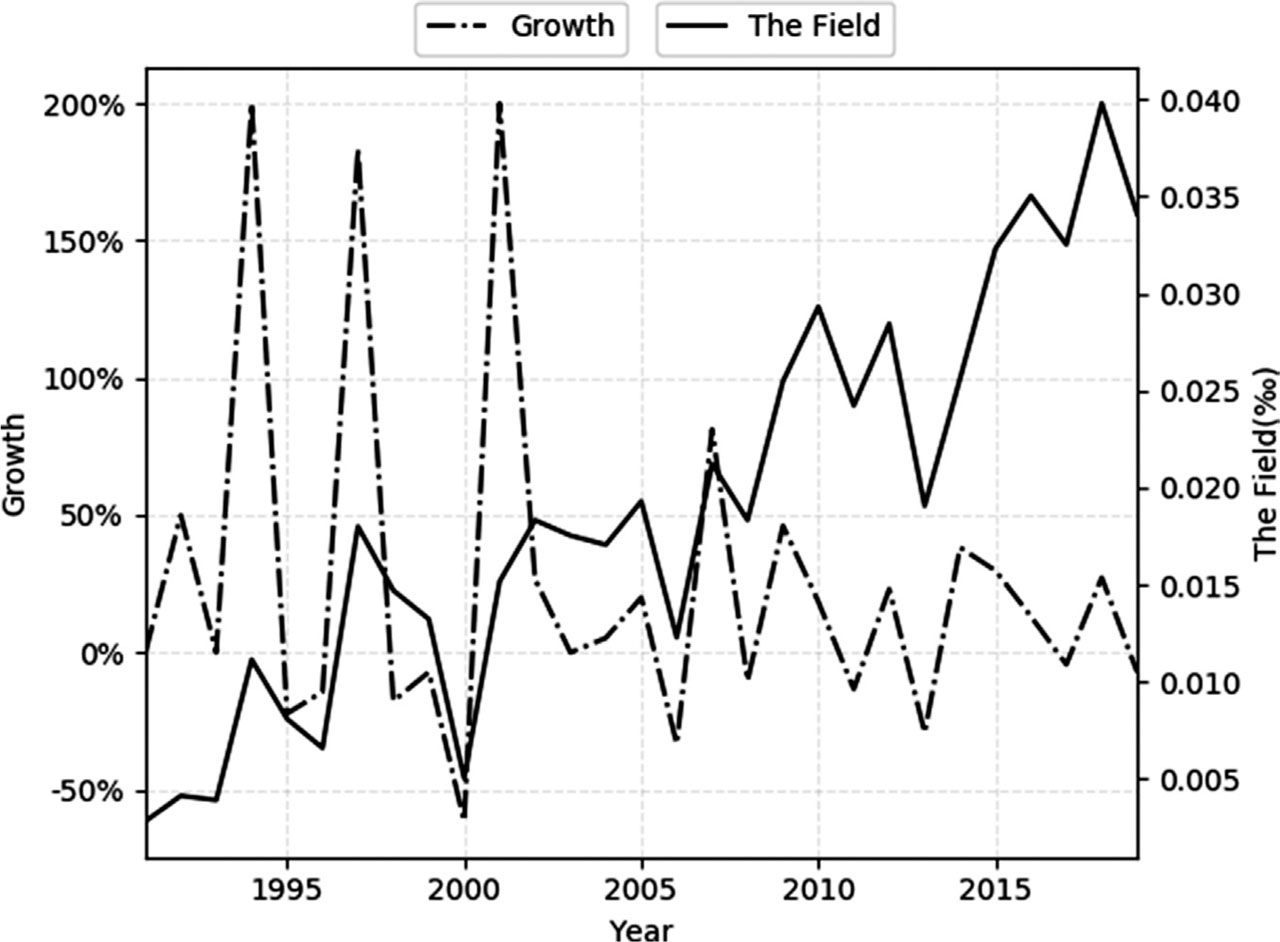
Fig. 1
The publication percentage and its growth rate of “construction health and safety”.
Tab. 1
Top 10 most active research institutions
| Institution | Country/region | Percentage (%) |
|---|---|---|
| Hong Kong Polytech University | Hong Kong, China | 3.35 |
| University of Michigan | US | 3.13 |
| University of Washington | US | 2.68 |
| National Institute for Occupational Safety and Health | US | 2.68 |
| Umea University | Sweden | 2.46 |
| Karolinska Institute | Sweden | 2.35 |
| Duke University | US | 2.23 |
| City University of Hong Kong | Hong Kong, China | 2.12 |
| Vrije University Amsterdam | Netherlands | 2.12 |
| Harvard University | US | 2.12 |
[i] OSH, occupational safety and health; US, United States.
Tab. 2
Top 10 research areas
| Research area | #Article | Percentage (%) |
|---|---|---|
| Public, environmental and occupational health | 493 | 55.08 |
| Engineering | 186 | 20.78 |
| Environmental sciences and ecology | 86 | 9.61 |
| Construction and building technology | 69 | 7.71 |
| Business and economics | 45 | 5.03 |
| Psychology | 35 | 3.91 |
| Toxicology | 30 | 3.35 |
| General and internal medicine | 28 | 3.13 |
| Operations research and management science | 26 | 2.91 |
| Transportation | 25 | 2.79 |
Tab. 3
Top 10 research journals
| Journal name | #Article | Percentage (%) |
|---|---|---|
| American Journal of Industrial Medicine | 91 | 10.17 |
| Journal of Occupational and Environmental Medicine | 36 | 4.02 |
| Journal of Construction Engineering and Management | 34 | 3.80 |
| Occupational and Environmental Medicine | 32 | 3.58 |
| International Journal of Environmental Research and Public Health | 28 | 3.13 |
| Scandinavian Journal of Work Environment and Health | 26 | 2.91 |
| Safety Science | 25 | 2.79 |
| International Archives of Occupational and Environmental Health | 19 | 2.12 |
| Automation in Construction | 17 | 1.90 |
| Journal of Safety Research | 16 | 1.79 |
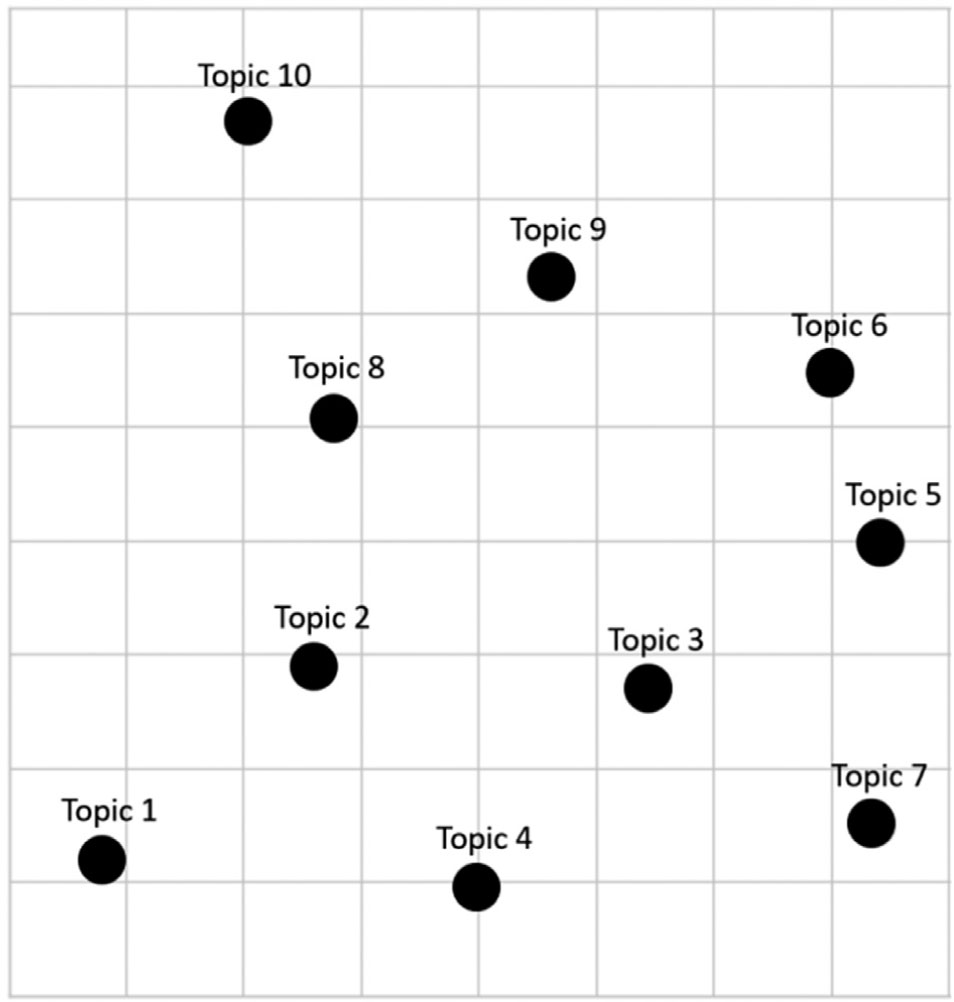
Fig. 2
Inter-topic distance in a two-dimensional space using MDS. MDS, multidimensional scaling.
Tab. 4
Description of the extracted 10 distinct topics
| Topic ID | Topic label | Key features | Description |
|---|---|---|---|
| 1 | Physical health and disease | Health status and various related indicators. Correlation of strain-related diseases and other diseases. | Construction workers need more education on nutrition, healthy behaviors, and workplace injury prevention. Training and education programs can promote nutrition and health and safety knowledge such that the dietary behavior of construction workers can be improved, and workplace injuries can be reduced. Existing studies demonstrate that obesity and high physical workload have a synergistic, negative effect on work ability. |
| 2 | Mental health and dysphrenia | Mental health problems, work pressure, suicidal behavior, and mental disorders. | Management should focus on improving construction workers’ engagement with the workplace and work/life balance. Many male construction workers do not seek out help despite experiencing mental health issues. Active interventions and self-compassion are important and can medicate and adjust workers’ adverse emotional and mental states. |
| 3 | Gender and age | Gender ratio Differences in personal income due to gender and age. Aging of the labor market Labor replacement and updating. | Trade-specific age trends within the construction industry reveals that age is a boundary condition of job resources stress link. In addition, female construction workers are exposed to various safety hazards as they hardly find properly fitting Personal Protective Equipment (PPE). Understanding the needs and motivations of construction employees of different genders and ages is crucial to their health and safety and well-being. |
| 4 | Migrant and race | Income difference between ethnicities and immigrants. Behavior and awareness of health and safety. | The construction industry is multicultural, containing a large number of migrants. Effective communication on construction sites is crucial to improve construction performance. Cultural barriers affect the clarity of communication between construction workers, which in turn, affect the jobsite safety and productivity. Understanding and managing various cultures and improving work practice can help improve the health and safety, and the economic and social construction of migrant workers. |
| 5 | Vocational ability and training | Degree of skill proficiency. Improvement and importance of vocational skill training for health and safety. | Jobsite accident rate remains high despite substantial efforts have spent in improving the health and safety education, Existing one-size-fits-all training program does not cater to the needs to construction workers who are heterogeneous in nature. The major factor contributing to ineffective training is the information delivery gaps during the knowledge-transfer process, i.e., ineffectiveness of transferring their knowledge and skills to job sites. Personalized training with active interventions is a promising approach for a diverse group of construction workers. |
| 6 | Occupational exposure and accident | Effects of occupational exposure on health and safety. Workplace accidents and work-related injuries. | The construction industry is a dangerous workplace. Construction workers are highly likely to exposed to reactive chemicals, solar Ultraviolet (UV) radiation, poor safety environment and PPE, stress, and other health and safety hazards, which cause occupational injuries. However, most of the factors significantly associated with these dangers and injuries can be prevented and controlled. It is essential to increase workers’ health and safety awareness and implement comprehensive exposure control programs, including regulations in regional and national legislation, in order to minimize accidents and injuries. |
| 7 | Safety climate and management | Knowledge of the construction safety. Relationship between management and workers Management strategies and methodologies. | Different factors impact the health and safety of jobsite construction workers. Prior studies explored whether construction workers’ social capital affects their safety behaviors and showed that structural and relational dimensions of workers’ social capital have a significant and direct effect on workers’ safety behaviors, whereas the cognitive dimensions does not. Effective and trustful interpersonal relationships between construction workers and management can improve workers’ safety behaviors. Organizational factors have the greatest impact on construction workers’ safety while human factors have the least. |
| 8 | Job situation, security and policies | Working conditions, job security, pensions, subsidies and other welfare benefits provided by management. | Jobsite facilities and labor welfare benefits directly or indirectly affect the productivity of the construction workforce. |
| 9 | Tobacco, alcohol and drugs | Addiction to smoking, alcohol, and drugs. Quitting behavior. | The construction is a generally male-dominated industry that is more susceptible to tobacco, alcohol, and drug use, which pose a serious risk to construction workers’ health and safety. The influence of tobacco, alcohol, and drug workplace availability and norms highlight the importance of workplace culture and health. Hybrid and multifaceted approaches involving culture change and personal-level responses targeting vulnerable, low-acculturation-level, and migrant construction workers are necessary in order to minimize risk from smoking-, alcohol-, and drug-related harm and effects. Specific tobacco, alcohol, and drug treatments tailored for vulnerable and migrant workers’ culture are essential to support sustainable worksite cessation efforts and can be integrated into other health and safety programs. |
| 10 | Smart devices | Use of smart products. Use of intelligent monitoring and management devices. Intelligent management systems. | One major reason for unsatisfactory occupational health and safety records in the construction industry is attributed to high physical requirements and dynamic and hostile working environments. Construction workers are subjected to ergonomic risks and other potential injuries. Traditional jobsite worker monitoring relies on construction workers’ self-reporting and subjective questionnaires. Both intrusive (e.g., wearable devices and attached sensors) and non-intrusive (e.g., computer-vision-based motion capturing) methods are used to monitor workers’ status by effectively and objectively collecting their physical and mental data and then used to access workers’ physical states. |
Tab. 5
Topic Label and Hi values for the 10 topics
| Topic ID | Topic label | # Article (%) | Hi (%) | σ |
|---|---|---|---|---|
| 1 | Physical health and disease | 193 (29.15) | 0.06 | 0.40 |
| 2 | Mental health and dysphrenia | 41 (6.19) | 0.34 | 0.22 |
| 3 | Gender and age | 15 (2.27) | 0.65 | 0.11 |
| 4 | Migrant and race | 14 (2.11) | 0.80 | 0.11 |
| 5 | Vocational ability and training | 29 (4.38) | 0.42 | 0.18 |
| 6 | Occupational exposure and accident | 183 (27.64) | 0.05 | 0.42 |
| 7 | Safety climate and management | 102 (15.41) | 0.10 | 0.33 |
| 8 | Job situation, security and policies | 28 (4.23) | 0.45 | 0.18 |
| 9 | Tobacco, alcohol and drugs | 26 (3.93) | 0.51 | 0.17 |
| 10 | Smart devices | 31 (4.68) | 0.21 | 0.20 |
Tab. 6
The most popular authors per topic
| Topic ID | Authors (Surname, First name) |
|---|---|
| 1 | van der Beek, Allard J.; Brenner, H; Proper, Karin I. |
| 2 | Gullestrup, Jorgen; LaMontagne, Anthony D.; Milner, Allison |
| 3 | Chan, Alan H. S.; Dong, Xiuwen Sue; Wang, Xuanwen |
| 4 | Evia, Carlos; Dietz, Noella A.; Asfar, Taghrid |
| 5 | Hess, Jennifer A.; Weeks, Douglas L.; Anton, Dan |
| 6 | Dong, Xiuwen Sue; Jarvholm, Bengt; Heederik, Dick |
| 7 | Chan, Albert P. C.; McCabe, Brenda; Li, Shuquan |
| 8 | Jarvholm, Bengt; Stattin, Mikael; Burdorf, Alex |
| 9 | Ye, Weimin; Duraisingam, Vinita; Pidd, Ken |
| 10 | Lee, SangHyun; Li, Heng; Jebelli, Houtan |
Tab. 7
The most popular journals per topic
| Topic ID | Journals |
|---|---|
| 1 | American Journal of Industrial Medicine Journal of Occupational and Environmental Medicine Scandinavian Journal of Work Environment and Health |
| 2 | International Journal of Environmental Research and Public Health Journal of Construction Engineering and Management Engineering Construction and Architectural Management |
| 3 | American Journal of Industrial Medicine International Journal of Environmental Research and Public Health Journal of Occupational and Environmental Medicine |
| 4 | American Journal of Industrial Medicine Journal of Construction Engineering and Management Journal of Occupational and Environmental Medicine |
| 5 | American Journal of Industrial Medicine Safety Science Journal of Occupational and Environmental Medicine |
| 6 | American Journal of Industrial Medicine Occupational and Environmental Medicine Journal of Occupational and Environmental Medicine |
| 7 | Journal of Construction Engineering and Management Safety Science American Journal of Industrial Medicine |
| 8 | American Journal of Industrial Medicine Journal of Occupational and Environmental Medicine Journal of Construction Engineering and Management |
| 9 | American Journal of Industrial Medicine International Journal of Cancer Journal of Occupational and Environment Medicine |
| 10 | Automation in Construction Journal of Construction Engineering and Management Journal of Computing in Civil Engineering |
Tab. 8
Topic 3 representative articles per topic
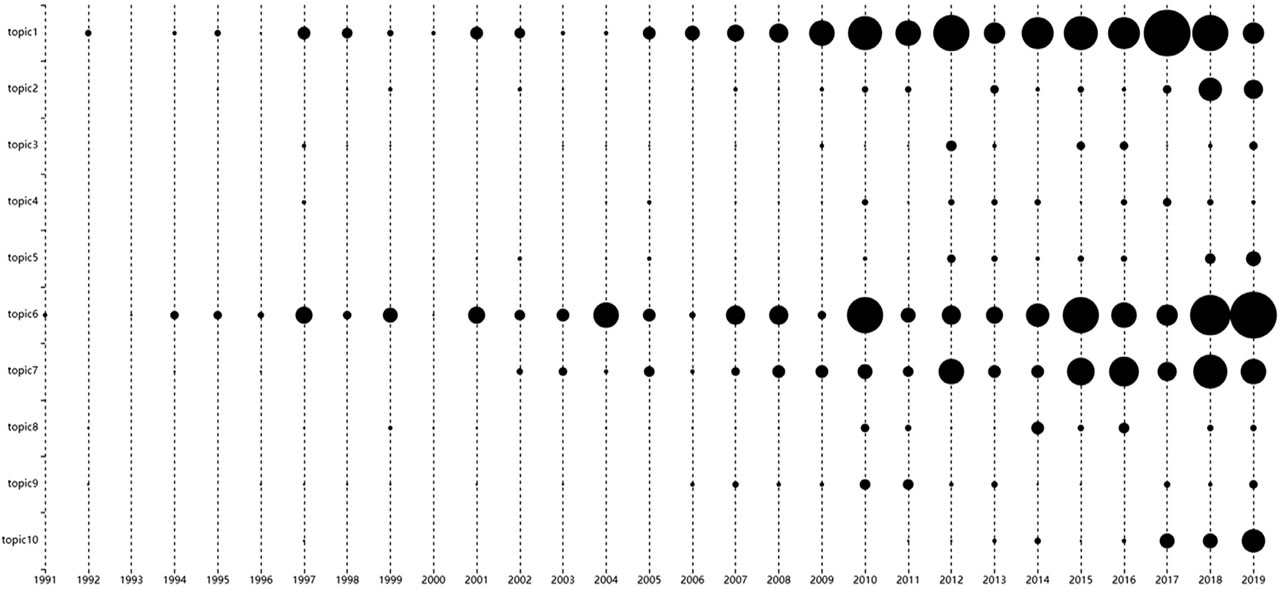
Fig. 3
Topics development over the past three decades.
Tab. 9
ARIMA results and forecasting
| Topic | Order1 | logLik | AIC | BIC | HQIC2 | RMSE | LBstat3 | Avg Future Gth (%) | Category |
|---|---|---|---|---|---|---|---|---|---|
| The field | (0,1,1) | −93.83 | 193.65 | 197.76 | 194.94 | 6.14 | 0.53 | 2.57 | Benchmark |
| 1 | (0,1,1) | −69.63 | 145.26 | 149.14 | 146.41 | 3.16 | 0.88 | 8.65 | Hot |
| 2 | (0,1,1) | −42.77 | 91.54 | 94.67 | 92.22 | 1.85 | 0.99 | 3.62 | Hot |
| 3 | (0,1,1) | −27.98 | 61.95 | 64.45 | 62.20 | 1.22 | 0.87 | 0.91 | Stable |
| 4 | (0,1,1) | −21.71 | 49.43 | 51.74 | 49.54 | 0.92 | 0.57 | 7.85 | Hot |
| 5 | (0,2,2) | −31.74 | 71.47 | 75.03 | 71.96 | 1.26 | 0.85 | 7.56 | Hot |
| 6 | (0,2,4) | −78.14 | 164.28 | 169.61 | 165.91 | 3.66 | 0.21 | 3.52 | Hot |
| 7 | (0,1,2) | −45.62 | 97.25 | 100.23 | 97.83 | 2.29 | 0.09 | 4.95 | Hot |
| 8 | (0,0,0) | −34.89 | 73.78 | 75.67 | 74.10 | 1.52 | 0.14 | −2.98 | Cold |
| 9 | (0,2,1) | −34.48 | 76.95 | 80.94 | 77.73 | 1.27 | 0.92 | 1.70 | Stable |
| 10 | (0,2,1) | −19.84 | 47.67 | 48.88 | 46.34 | 1.57 | 0.81 | 15.74 | Hot |