
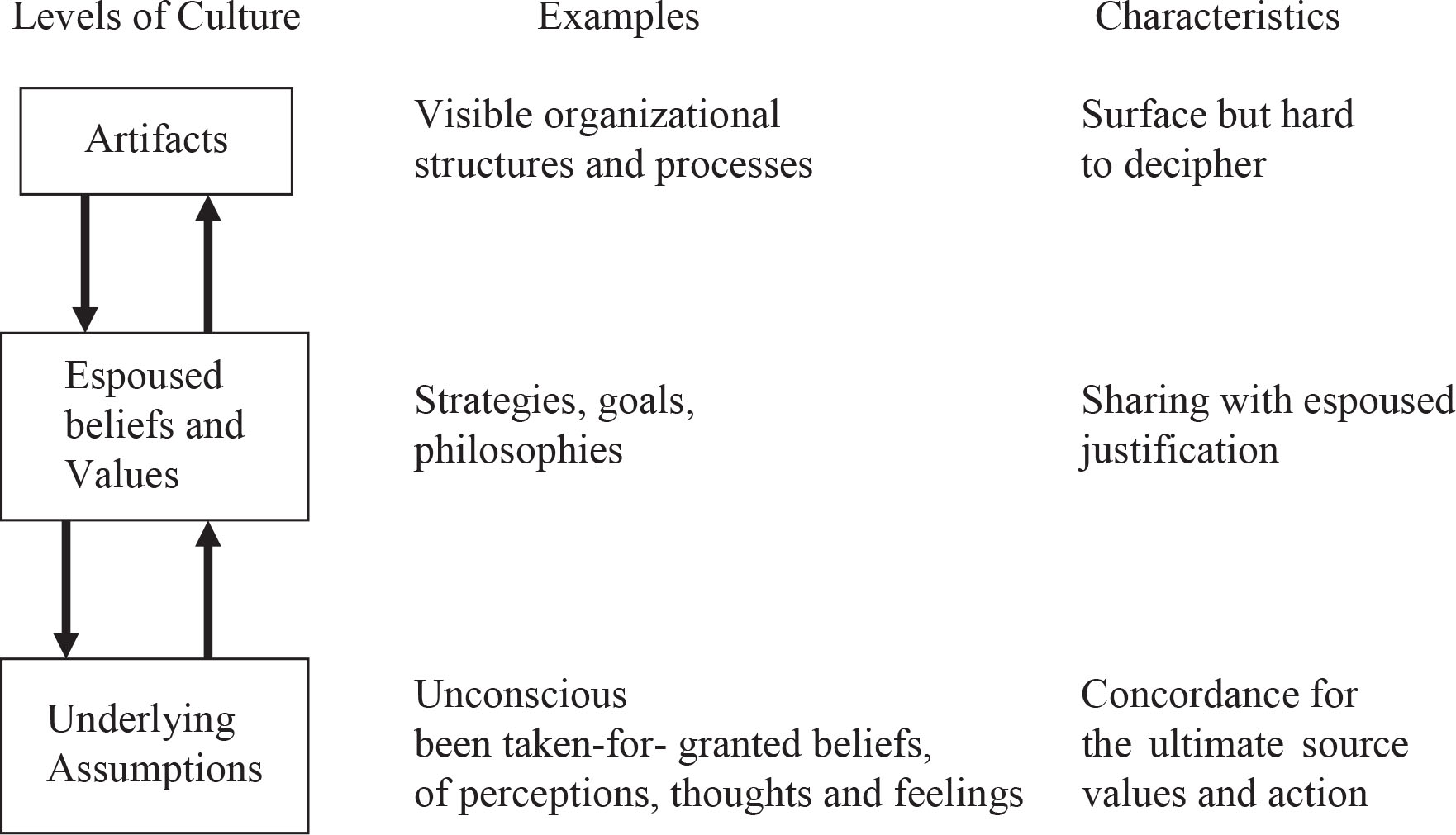
Fig. 1
Organisational culture framework. Source: Schein (2004).
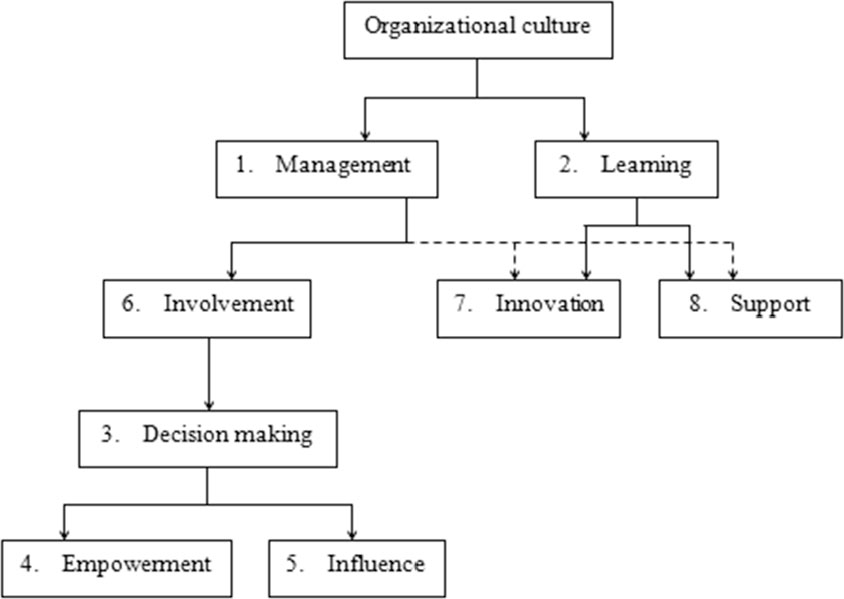
Fig. 2
Corrected relationships between dimensions. Source: Ginevičius and Vaitkūnaitė (2006).
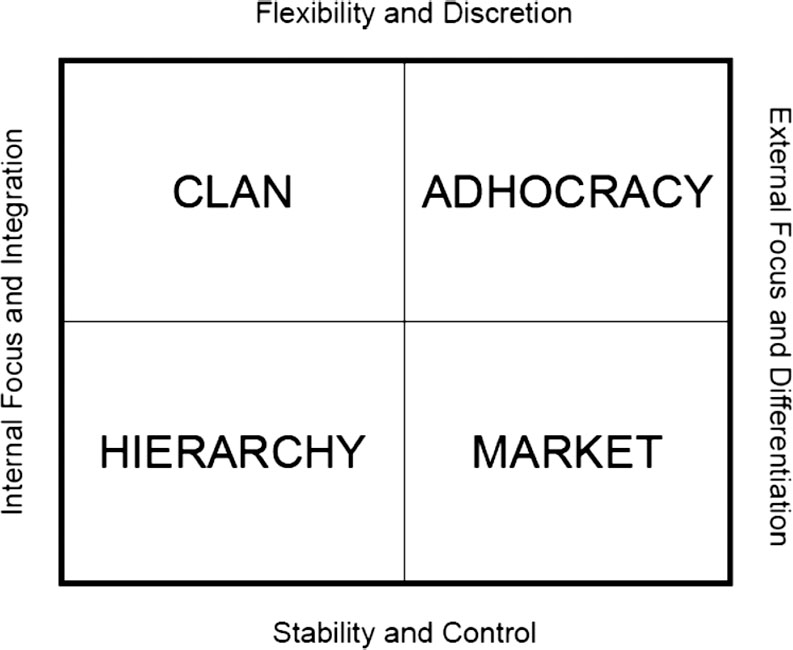
Fig. 3
The Competing Values Framework. Source: Cameron and Quinn (2006).
Tab. 1
General information of respondents
| Frequency (f) | Percentage | |
|---|---|---|
| Educational qualification | ||
| OND | 6 | 4.3 |
| HND | 31 | 22.1 |
| BSc | 62 | 44.3 |
| MBA/MArch/MSc | 39 | 27.9 |
| NCE | 2 | 1.4 |
| Respondent's profession | ||
| Architect | 30 | 21.4 |
| Builder | 55 | 39.3 |
| Engineer | 26 | 18.6 |
| Quantity surveyor | 2 | 1.4 |
| Accountant | 2 | 1.4 |
| Facility manager | 4 | 2.9 |
| Office manager | 9 | 6.4 |
| Public admin/secretary | 12 | 8.6 |
| Total | 140 | 100 |
| Year of company's operation | ||
| 0–5 | 19 | 13.6 |
| 10-Jun | 38 | 27.1 |
| 15-Nov | 35 | 25 |
| 16–20 | 24 | 17.1 |
| Above 20 | 24 | 17.1 |
| Total | 140 | 100 |
| Number of years of professional experience | ||
| 0–5 | 65 | 46.4 |
| 10-Jun | 56 | 40 |
| 15-Nov | 11 | 7.9 |
| 16–20 | 4 | 2.9 |
| Above 20 | 4 | 2.9 |
| Total | 140 | 100 |
| Respondents’ professional qualification | ||
| NSE | 20 | 14.3 |
| NIA | 20 | 14.3 |
| NIOB | 28 | 20 |
| NIQS | 2 | 1.4 |
| NIM | 8 | 5.7 |
| CIPM | 2 | 1.4 |
| ICAN | 4 | 2.9 |
| OSH | 2 | 3.6 |
| No qualification | 54 | 38.6 |
| Total | 140 | 100 |
| Types of project | ||
| Public | 20 | 14.3 |
| Private | 89 | 63.6 |
| Both | 31 | 22.1 |
| Total | 140 | 100 |
Tab. 2
Factor analysis, Kaiser–Meyer–Olkin (KMO) index and Bartlett’s test
| KMO and Bartlett’s test | ||
|---|---|---|
| KMO measure of sampling adequacy | 0.575 | |
| Bartlett’s test of sphericity | Approx. Chi-Square | 1,515.086 |
| Df | 435 | |
| Sig. | 0.000 | |
Tab. 3
Total variance explained
| Factors | Total Eigen value | Percentage of variance | Cumulative percentage |
|---|---|---|---|
| Strategic direction | 5.318 | 17.726 | 17.726 |
| Communication | 2.899 | 9.662 | 27.388 |
| Adaptability | 2.530 | 8.433 | 35.820 |
| Involvement | 2.063 | 6.875 | 42.695 |
| Reward orientation | 1.660 | 5.534 | 48.229 |
| Agreement | 1.494 | 4.981 | 53.210 |
| Coordination and integration | 1.428 | 4.760 | 57.970 |
| Organisational learning | 1.309 | 4.362 | 62.332 |
| Confidence in leadership | 1.193 | 3.978 | 66.310 |
Tab. 4
Factor analysis: rotated component matrix
| Factors | Components | ||||||||
|---|---|---|---|---|---|---|---|---|---|
| Factor 1 | Factor 2 | Factor 3 | Factor 4 | Factor 5 | Factor 6 | Factor 7 | Factor 8 | Factor 9 | |
| The company works with specific strategies, plans and a long-term goal | 0.780 | ||||||||
| The company reflects a leader showing direction and employees “follow it” | 0.772 | ||||||||
| If a client is dissatisfied, it is duly noted and removed | 0.594 | ||||||||
| There is continuous improvement of service quality | 0.547 | ||||||||
| Managers’ advices and attitudes are always at variance | 0.799 | ||||||||
| Managers are authoritative | 0.726 | ||||||||
| The person who is the leader of a work group is often recognised as being more important than the company | 0.537 | ||||||||
| Employees and/or managers often misunderstand each other | 0.501 | ||||||||
| Employees most often agree when solving problems or conflicts | 0.842 | ||||||||
| Existing rules and norms show more of direction than restrictions | 0.530 | ||||||||
| Sometimes there are situations when norms are only partially followed | 0.527 | ||||||||
| There is investigation of product characteristics and personnel needs | 0.820 | ||||||||
| Employees have favourable conditions for decision making and for giving ideas, suggestions and so on | 0.510 | ||||||||
| Factor Analysis. Rotated Component Matrix | |||||||||
| Training programmes are encouraged to enhance skill of employees | 0.743 | ||||||||
| Feedback, new or other important information reaches employee in due time | 0.709 | ||||||||
| There are fringe benefits and managers prioritise the welfare of employees | 0.511 | ||||||||
| Employees agree about most rules, norms and values | 0.786 | ||||||||
| Employees have too much freedom and autonomy | 0.642 | ||||||||
| Different departments (groups) have many common things (goals, tasks etc.) | 0.816 | ||||||||
| There are created good conditions for the interesting work, therefore employees get used to their work willingly | 0.661 | ||||||||
| Reward system is correct (employees get paid according to results and efforts) | 0.584 | ||||||||
| Managers are eager to advise employees and motivate with charisma | 0.759 | ||||||||
| Team approach is used more than individual work especially when solving important questions on a project | 0.647 | ||||||||
| Sanctions and punishment are sometimes overlooked, i.e., managers get away from regulations and try another solution | 0.857 | ||||||||
| There is great dependence on the leaders of the company | 0.703 | ||||||||
Tab. 5
Summary of factors and corresponding mean score
| Factors | Mean | Rank |
|---|---|---|
| Strategic direction | ||
| • The company works with specific strategies, plans and a long-term goal | 4.0970 | 2 |
| • The company reflects a leader showing direction and employees “follow” it | 4.0290 | 4 |
| • If a client is dissatisfied, it is duly noted and removed | 3.8986 | 7 |
| • There is continuous improvement of service quality | 3.9343 | 6 |
| Communication | ||
| • Managers advices and attitudes are always at variance | 2.9701 | 22 |
| • Managers are authoritative | 2.9275 | 24 |
| • The person who is the leader of a work group is often recognised as being more important than the company | 2.1314 | 29 |
| • Employees and/or managers often misunderstand each other | 2.3582 | 27 |
| Adaptability | ||
| • Employees most often agree when solving problems or conflicts | 4.0870 | 3 |
| • Existing rules and norms show more of direction than restrictions | 3.5580 | 12 |
| • Sometimes there are situations when norms are only partially followed | 2.9627 | 23 |
| • It is difficult for employees to adapt to changes in culture and they sometimes resist it | 2.6194 | 26 |
| Involvement | ||
| • There is investigation of product characteristics and personnel needs | 3.4697 | 18 |
| • Employees have favourable conditions for decision making and for giving various ideas, suggestions, notes and so on | 3.6014 | 11 |
| Reward orientation | ||
| • Training programmes are encouraged to enhance skills of employees | 3.5580 | 12 |
| • New or other important information reaches employees in due time | 3.5580 | 12 |
| • There are fringe benefits and managers prioritise the welfare of employees | 3.1504 | 21 |
| Agreement | ||
| • Employees agree about most rules, norms and values | 3.4779 | 16 |
| • Employees have too much freedom and autonomy | 2.4203 | 27 |
| Coordination and integration | ||
| • Different departments (groups) have many common things (goals, tasks etc.) | 3.5294 | 14 |
| • There are created good conditions for the interesting work, therefore employees get used to their work willingly | 3.6397 | 10 |
| • Reward system is correct (employees get paid according to the results and efforts) | 3.2391 | 19 |
| Organisational learning | ||
| • Managers are eager to advise employees and motivate with charisma | 3.8162 | 8 |
| • Team approach is used more often than individual work especially when solving important questions on a project | 4.0870 | 3 |
| Confidence in leadership | ||
| • Sanctions and punishment are sometimes overlooked, i.e., managers get away from regulations and try another solution | 2.7826 | 25 |
| • There is great dependence on the leaders of the company | 3.7971 | 9 |
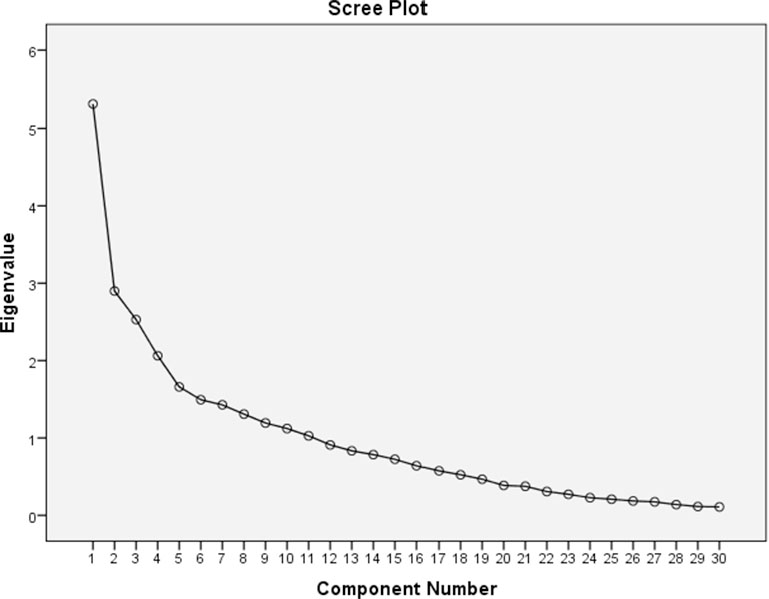
Fig. 4
Scree plot
Tab. 6
Organisational culture profile
| Dominant characteristics | Mean | Overall rank |
|---|---|---|
| Clan culture (CC) | 3.4681 | 4 |
| Adhocracy culture (AC) | 3.5622 | 3 |
| Market culture (MC) | 3.6188 | 1 |
| Hierarchy culture (HC) | 3.6036 | 2 |
| Organisational leadership | Rank | |
| There is mentoring (CC) | 3.3261 | 4 |
| Entrepreneur, innovator or a risk-taker (AC) | 3.4779 | 2 |
| Hard-driver, producer or competitor (MC) | 3.3456 | 3 |
| Coordinator, organiser or an efficiency expert (HC) | 3.7029 | 1 |
| Management of employees | ||
| Presence of teamwork, consensus, and participation (CC) | 3.5217 | 3 |
| Innovation, freedom and uniqueness is encouraged (AC) | 3.6812 | 2 |
| Production and achievement orientation (MC) | 4.0072 | 1 |
| Security of employment (job stability) and predictability (HC) | 3.4412 | 4 |
| Organisational glue | ||
| Existence of loyalty and tradition (CC) | 3.2464 | 4 |
| Innovation and development (AC) | 3.5362 | 3 |
| Focus on production and goal accomplishment (MC) | 4.0870 | 1 |
| Rules and Policies (HC) | 3.6565 | 2 |
| Strategic emphases | ||
| Participative and comfortable atmosphere (CC) | 3.3551 | 3 |
| Dynamics and readiness (AC) | 3.5217 | 1 |
| Atmosphere is competitive and confrontational (MC) | 3.2426 | 4 |
| There is permanence and stability (HC) | 3.4058 | 2 |
| Criteria of success | ||
| There is sensitivity to customers, concern for people (CC) | 3.8913 | 1 |
| Product leader and innovator (AC) | 3.5942 | 3 |
| Market penetration and market share (MC) | 3.4118 | 4 |
| Dependable delivery, smooth scheduling of task (HC) | 3.8116 | 2 |
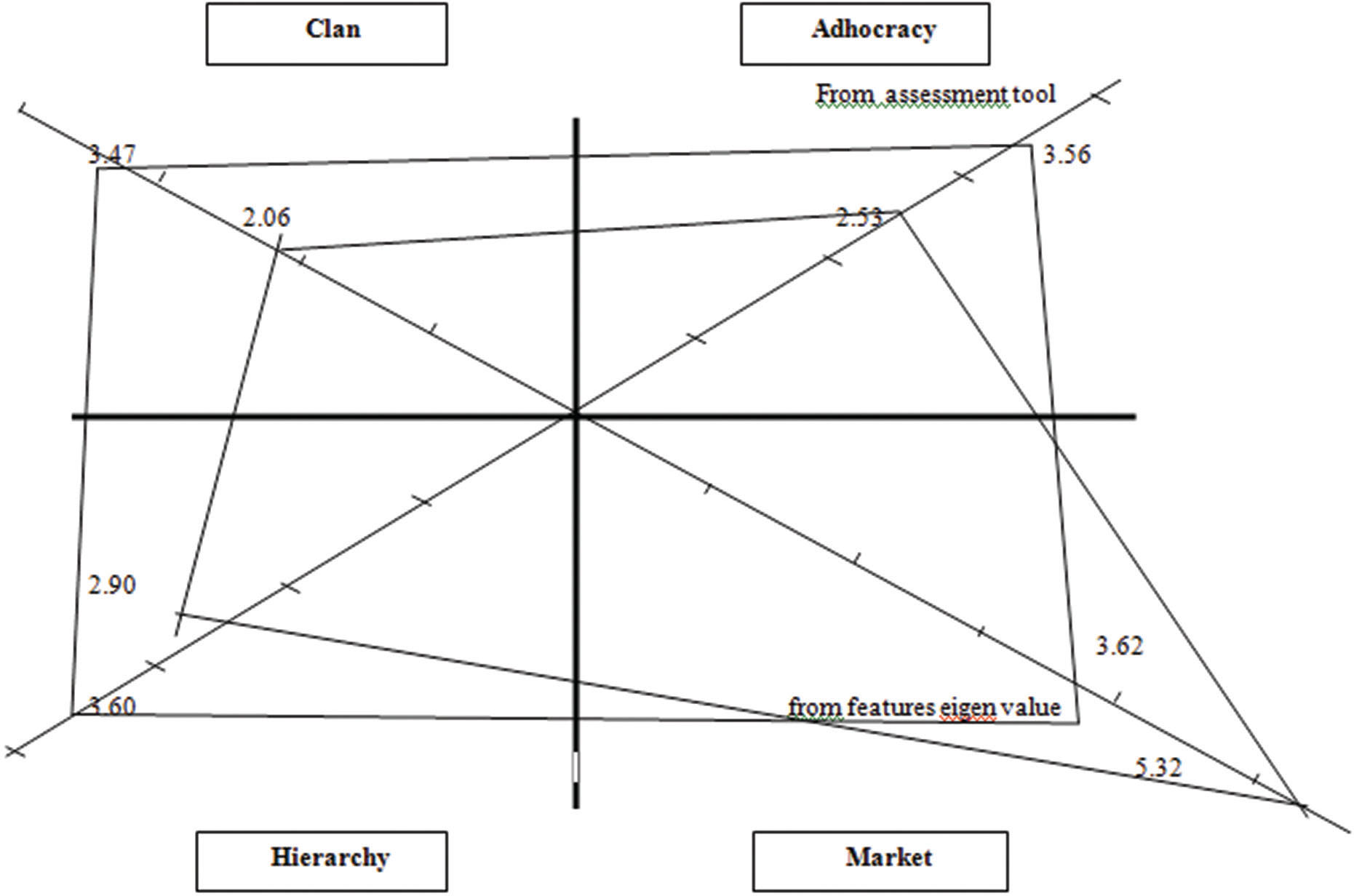
Fig. 5
Organisational culture profile