
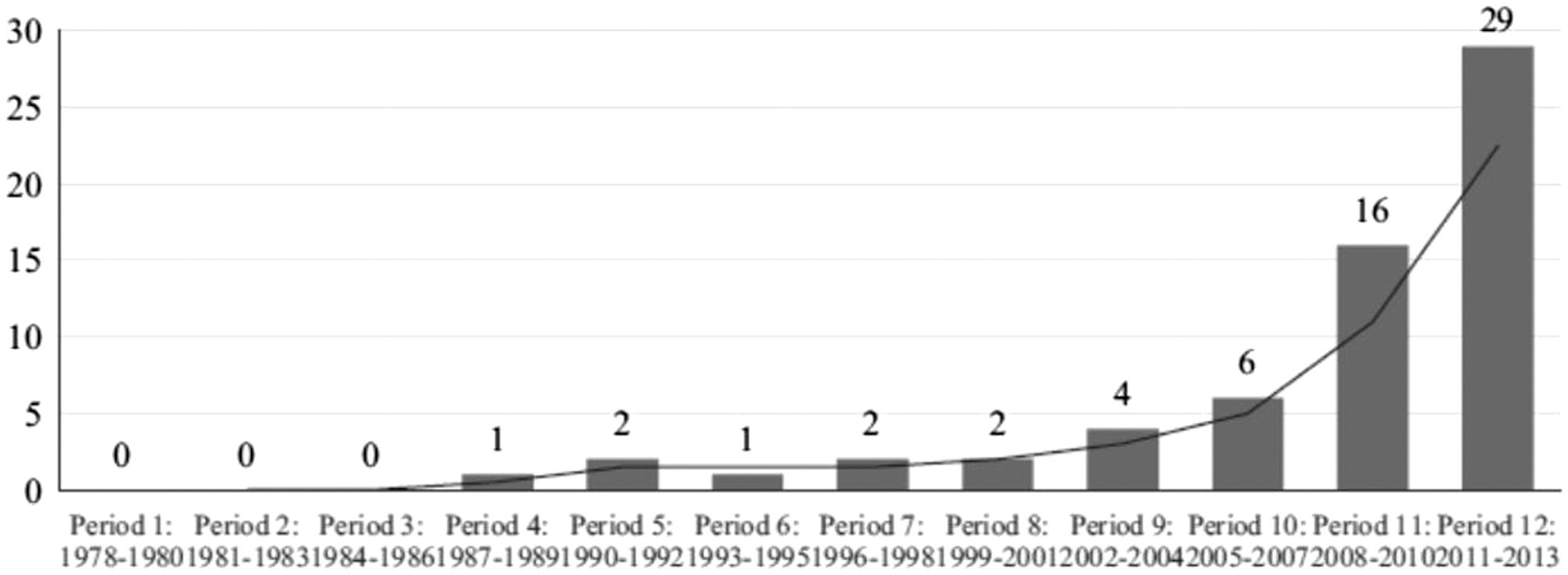
Fig. 1
The increase in the number of publications regarding application of innovative technologies in H&S (Zhou et al. 2015).
Tab. 1
Application of building information modelling (BIM) in health and safety (H&S) research.
| Title of the tool (if applicable) and title of the paper | Technology type(s) | Application(s) | Reference |
|---|---|---|---|
| Use of building information modeling in design to prevent construction worker falls | BIM | Design for safety suggestions | Qi et al. (2013) |
| 8D BIM modelling tool for accident prevention through design | BIM | Design for safety suggestions | Kamardeen (2010) |
| Integration of construction worker fall safety in design through the use of building information modeling | BIM | Design for safety suggestions | Qi (2011) |
| Integration of safety in design through the use of building information modelling | BIM | Design for safety suggestions | Qi et al. (2011) |
| BIM-based planning of temporary structures for construction safety | BIM | H&S issues with temporary structures | Kim and Cho (2015) |
| Integrated building information model to identify possible crane instability caused by strong winds | BIM | H&S issues with temporary structures | Hasan et al. (2012) |
| Temporary facility planning of a construction project using BIM (building information modeling) | BIM | H&S issues with temporary structures | Kim and Ahn (2011) |
| Automatic design and planning of scaffolding systems using building information modeling | BIM | H&S issues with temporary structures | Kim and Teizer (2014) |
| Using BIM for smarter and safer scaffolding and formwork construction: a preliminary methodology | BIM | H&S issues with temporary structures | Chi et al. (2012) |
| Integration of safety risk factors in BIM for scaffolding construction | BIM | H&S issues with temporary structures | Collins et al. (2014) |
| Leveraging project models for automated identification of construction safety requirements | BIM | Hazard identification | Wang and Boukamp (2007) |
| Tuning up BIM for safety analysis proposing modeling logics for application of BIM in Design for Safety (DfS) | BIM | Hazard identification (fall hazards), rule checking, design for safety suggestions | Taiebat (2011) |
| Building information modeling (BIM) and safety: automatic safety checking of construction models and schedules | BIM | Hazard identification (fall hazards), rule checking | Zhang et al. (2013) |
| Utilization of BIM-based automated safety checking in construction planning | BIM | Hazard identification (fall hazards), rule checking | Sulankivi et al. (2013) |
| A case study on automated safety compliance checking to assist fall protection design and planning in building information models | BIM | Hazard identification (fall hazards), rule checking | Melzner et al. (2013) |
| Framework for work-space planning using four-dimensional BIM in construction projects | BIM | Hazard identification (workplace congestion hazards) | Choi et al. (2014) |
| Design for safety: theoretical framework of the safety aspect of BIM system to determine the safety index | BIM | Hazard identification, others – determining safety index | Teo et al. (2016) |
| BIM-based fall hazard identification and prevention in construction safety planning | BIM | Hazard identification, rule checking, fall hazards | Zhang et al. (2015b) |
| Classification of rules for automated BIM rule checking development | BIM | Rule checking | Solihin and Eastman (2015) |
| Automatic rule-based checking of building designs | BIM | Rule checking | Eastman et al. (2009) |
| Construction safety risk drivers: a BIM approach | BIM | Safety risk drivers, hazard identification | Malekitabar et al. (2016) |
| Developing a BIM-enabled bilingual safety training module for the construction industry | BIM | Safety training | Clevenger et al. (2014) |
| The development of a framework for a design for safety BIM tool | BIM | Safety training | Hayne et al. (2014) |
| A BIM-based approach for communicating and implementing a construction site safety plan | BIM | Site safety plan | Azhar and Behringer (2013) |
Tab. 2
Research combining building information modelling (BIM) with other innovative technologies.
| Title of the tool (if applicable) and title of the paper | Technology type(s) | Application(s) | Reference |
|---|---|---|---|
| Information retrieval framework for hazard identification in construction | BIM, database | Automated information retrieval | Kim et al. (2013) |
| CoSMoS CoSMoS: A BIM and wireless sensor based integrated solution for worker safety in confined spaces | BIM, wireless sensors | Hazard identification (confined spaces) | Riaz et al. (2014) |
| Challenges in data management when monitoring confined spaces using BIM and wireless sensor technology | BIM, wireless sensors | Hazard identification (confined spaces) | Riaz et al. (2015) |
| Integrating safety and BIM: automated construction hazard identification and prevention | BIM, ontology | Hazard identification (fall hazards and congestion hazards), job hazard analysis (JHA), rule checking, design evaluation | Zhang (2014) |
| Automated hazardous area identification using laborers’ actual and optimal routes | BIM, radiofrequency identification (RFID) | Hazard identification (hazards from moving through a construction site) | Kim et al. (2016) |
| CAVE Building safely by design | BIM, virtual reality (VR) | Hazard identification, education | Whyte et al. (2013) |
| Ontology-based semantic modeling of safety managementknowledge | BIM, ontology | Hazard identification, JHA | Zhang et al. (2014) |
| Geotechnical and safety protective equipment planning using range point cloud data and rule checking in building information modeling | BIM, laser scanning, point cloud | Hazard identification, rule checking | Wang et al. (2015) |
| Ontology-based semantic modeling of construction safety knowledge: towards automated safety planning for job hazard analysis (JHA | BIM, ontology | JHA | Zhang et al. (2015a) |
| Collecting fire evacuation performance data using BIM-based immersive serious games for performance-based fire safety design | BIM, serious games | Others – collecting data related to evacuation performance | Zhang and Issa (2015) |
| SAVES Design and development of SAVES: a construction safety training augmented virtuality environment for hazard recognition and severity identification | BIM, augmented virtuality (AV) | Safety training | Chen et al. (2013) |
| SAVES SAVES: an augmented virtuality strategy for training construction hazard recognition | BIM, AV | Safety training | Chen et al. (2014) |
| Construction safety training using immersive virtual reality | BIM, VR | Safety training | Sacks et al. (2013) |
| A BIM-RFID unsafe on-site behavior warning system | BIM, RFID | Sensing and warning | Guo et al. (2014) |
| A framework for construction safety management and visualization system | BIM, augmented reality (AR), Game technologies | Visualization, education | Park and Kim (2013) |
| CAVE Hazard recognition and risk perception in construction | VR, BIM | Visualization, others – hazard identification testing | Perlman et al. (2014) |
| Safety by design: dialogues between designers builders using virtual reality | VR, BIM | Visualization, others – testing collaboration potential | Sacks et al. (2015) |
Tab. 3
H&S research in innovative technologies that does not include BIM.
| Title of the tool (if applicable) and title of the paper | Technology type(s) | Application(s) | Reference |
|---|---|---|---|
| Automated content analysis for construction safety: a natural language processing system to extract precursors and outcomes from unstructured injury reports | Natural language processing | Data extraction and structuring | Tixier et al. (2016) |
| Safety hazard identification on construction projects | Database | Decision support system | Carter and Smith (2006) |
| Computer-aided DSS for safety monitoring of geotechnicalconstruction | Geographic information system (GIS) | Decision support system | Cheng et al. (2002) |
| OHS Log Integrated safety in design | Conceptual framework | Design for safety suggestions | Schultz and Jørgensen (2014) |
| Design for construction safety toolbox Tool to design for construction worker safety | Database | Design for safety suggestions | Gambatese et al. (1997) |
| ToolSHeD™: the development and evaluation of a decision support tool for health and safety in constructiondesign | Knowledge-based system | Design for safety suggestions | Cooke et al. (2008) |
| The development of a knowledge-based system to deliver health and safety information to designers in the construction industry | Knowledge-based system | Design for safety suggestions | NNC Limited (2003) |
| MAARD Prevention guide for designers based on analysis of about 2000 accidents | Management model | Design for safety suggestions | Soeiro et al. (2014) |
| Integrative model for quantitative evaluation of safety on construction sites with tower cranes | Model for quantitative evaluation of safety levels | H&S issues with temporary structures | Shapira et al. (2012) |
| Application of 4D visualization technology for safety management in metro construction | Four-dimensional computer-aided design (4D CAD) | Hazard identification | Zhou et al. (2013) |
| ASPP Automated safety planning approach for residential construction sites in Malaysia | Database | Hazard identification | Zolfagharian et al. (2014) |
| Application of geographic information systems in construction safety planning | GIS, database | Hazard identification | Bansal (2011) |
| PECASO Dynamic quantification and analysis of the construction workspace congestion utilizing 4D visualization | 4D CAD | Hazard identification (workplace congestion hazards) | Mallasi (2006) |
| CHAIR Safety in design tool | Prompt words | Hazard identification, design for safety suggestions | Workcover (2011) |
| CHASTE Construction job safety analysis | Database | Hazard identification, job hazard analysis | Rozenfeld et al. (2010) |
| CHASTE ‘CHASTE’: construction hazard assessment with spatial and temporal exposure | Database | Hazard identification, job hazard analysis | Rozenfeld et al. (2009) |
| CHASTE Spatial and temporal exposure to safety hazards in construction | Database | Hazard identification, job hazard analysis | Sacks et al. (2009) |
| Activity-based safety risk quantification for concrete formwork construction | Risk assessment software | Hazard identification, risk classification | Hallowell and Gambatese (2009) |
| Design-for-safety-process tool Capturing safety knowledge using design-for-safety-process tool | Knowledge-based system | Hazard identification, safety training | Hadikusumo and Rowlinson (2004) |
| Design-for-safety-process tool Integration of virtually real construction model and design-for-safety-process database | Knowledge-based system | Hazard identification, safety training | Hadikusumo and Rowlinson (2002) |
| VP-based safety management in large-scale construction projects: a conceptual framework | Virtual prototyping | Hazard identification, safety training | Guo et al. (2013) |
| CVP The use of virtual prototyping for hazard identification in the early design stage | Virtual reality (VR), 4D CAD | Hazard identification, visualization | Chan King et al. (2012) |
| CHSM CSHM: web-based safety and health monitoring system for construction management | Web-based system | Monitoring and assessing construction health and safety (H&S) performance | Cheung et al. (2004) |
| Heat map generation for predictive safety planning: preventing struck-by and near miss interactions between workers-on-foot and construction equipment | Hazard index heat map | Preventing struck-by hazards | Golovina et al. (2016) |
| Risk assessor model Risk assessment in construction | Risk assessment software | Quantifying safety risk for activities | Jannadi and Almishari (2003) |
| SliDeRulE Quantification and assessment of safety risk in the design of multistory buildings | Online tool | Quantifying safety risk for building elements | Dharmapalan et al. (2014) |
| Safety planning and control model Safety and production: an integrated planning and control model | Safety management tool | Safety planning | Saurin et al. (2004) |
| A pilot study of a 3D game environment for construction safety education | Serious games | Safety training | Lin et al. (2011) |
| Predicting movements of onsite workers and mobile equipment for enhancing construction site safety | Sensing technologies (cameras) | Sensing and warning | Zhu et al. (2016) |
| Autonomous pro-active real-time construction worker and equipment operator proximity safety alert system | Sensing technologies (radiofrequency identification [RFID]) | Sensing and warning | Teizer et al. (2010) |
| Recommendations for evaluating & implementing proximity warning systems on surface mining equipment | Sensing technologies (RFID, radar, sonar, infrared, sonar, cameras) | Sensing and warning | Ruff (2007) |
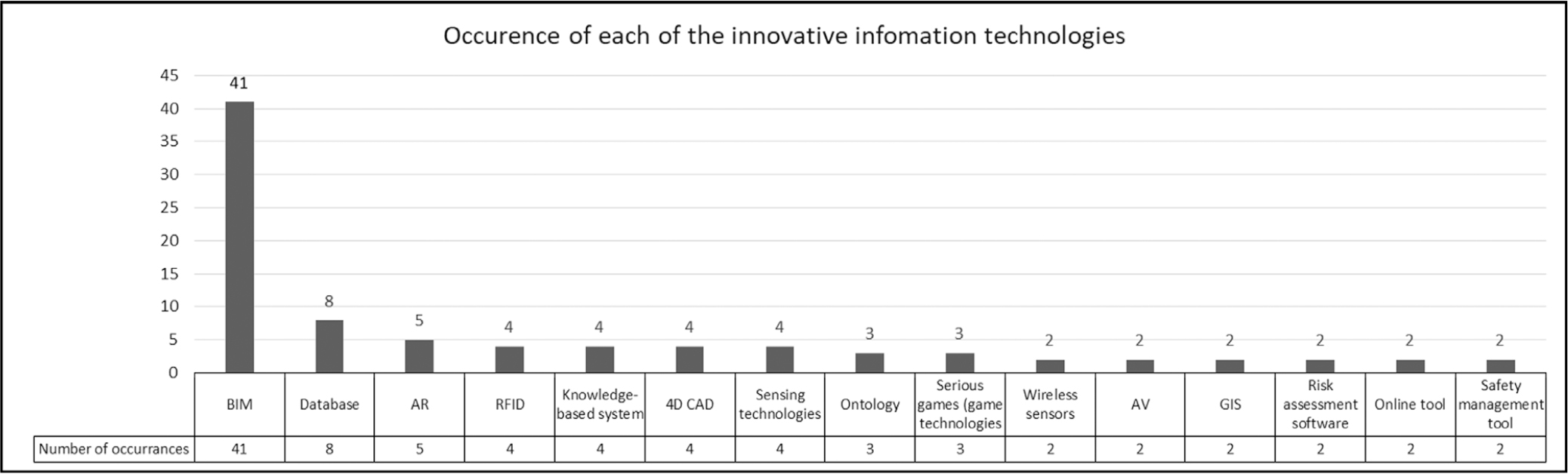
Fig. 2
Occurrence of each of the innovative information technologies.
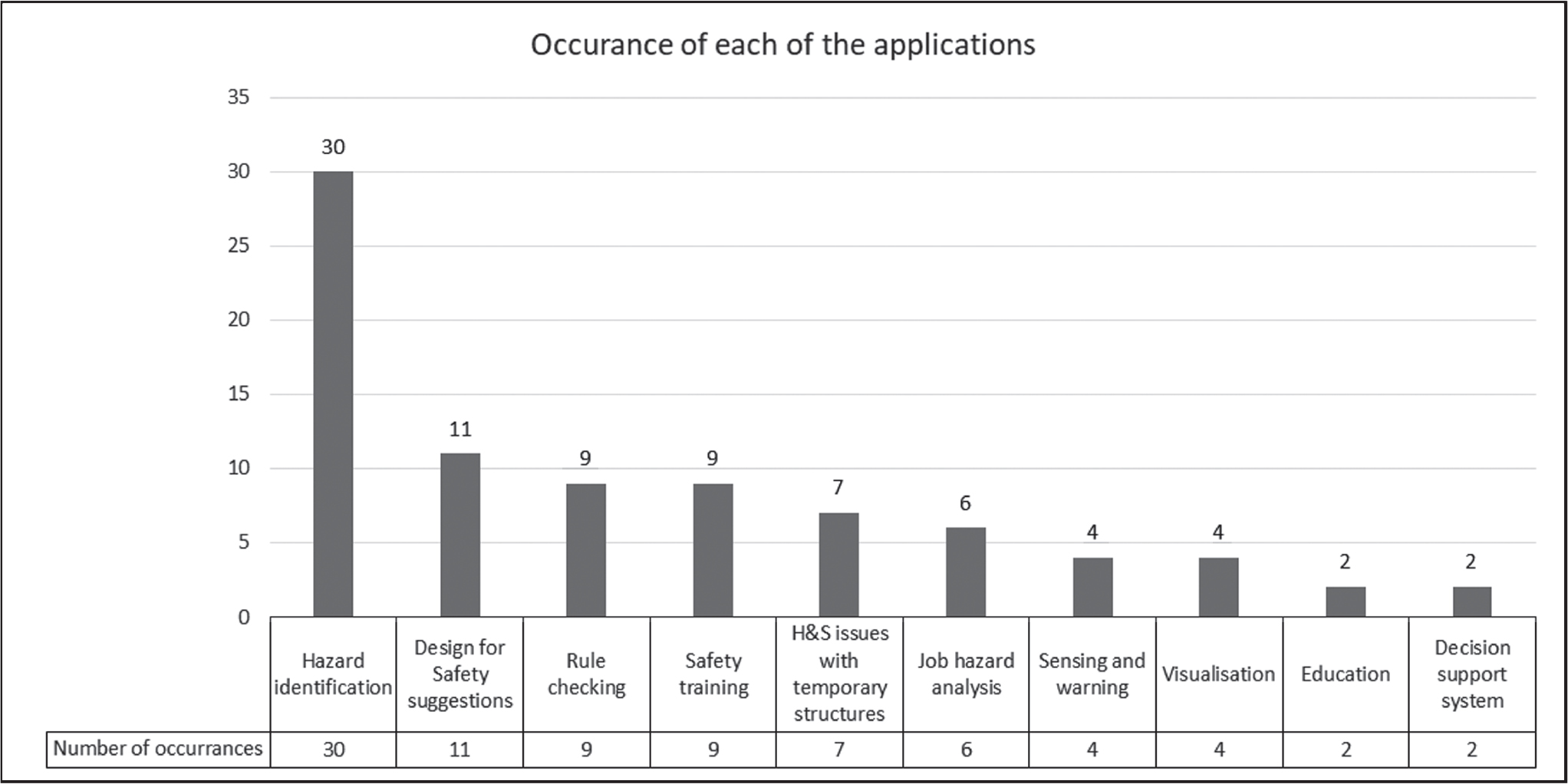
Fig. 3
Occurrence of each of the applications.
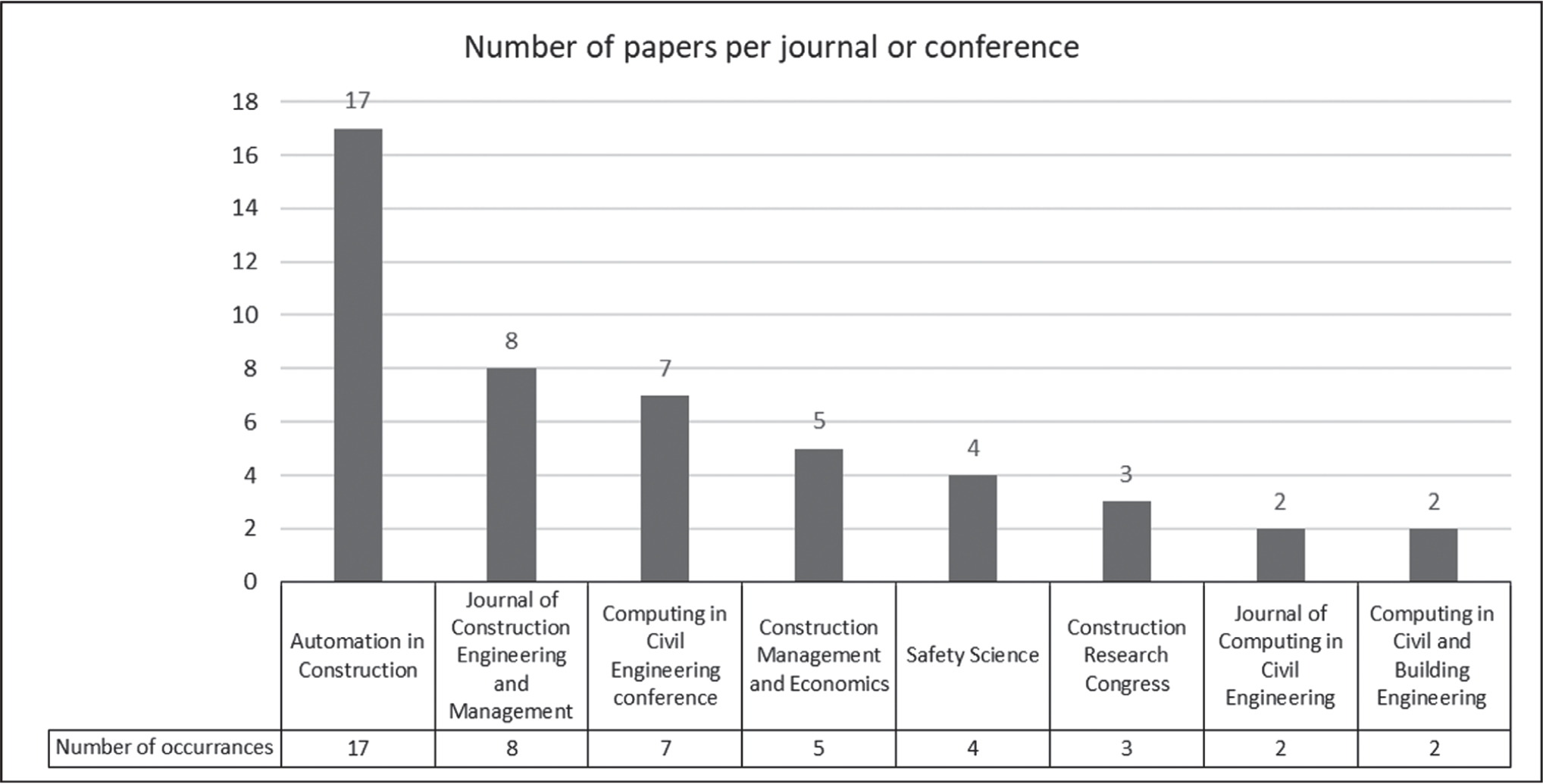
Fig. 4
Number of papers per journal or conference.