
Tab. 1
Time–cost performance for civil engineering projects in the expanded Hong Kong sample
| Project type | K | B | R | Total projects |
|---|---|---|---|---|
| Total civil works | 250.5 | 0.206 | 0.79 | 148 |
| Roadworks | 251.2 | 0.225 | 0.87 | 57 |
| Other civil works | 262.5 | 0.185 | 0.69 | 91 |
[i] Source: Chan and Kumaraswamy (1995).
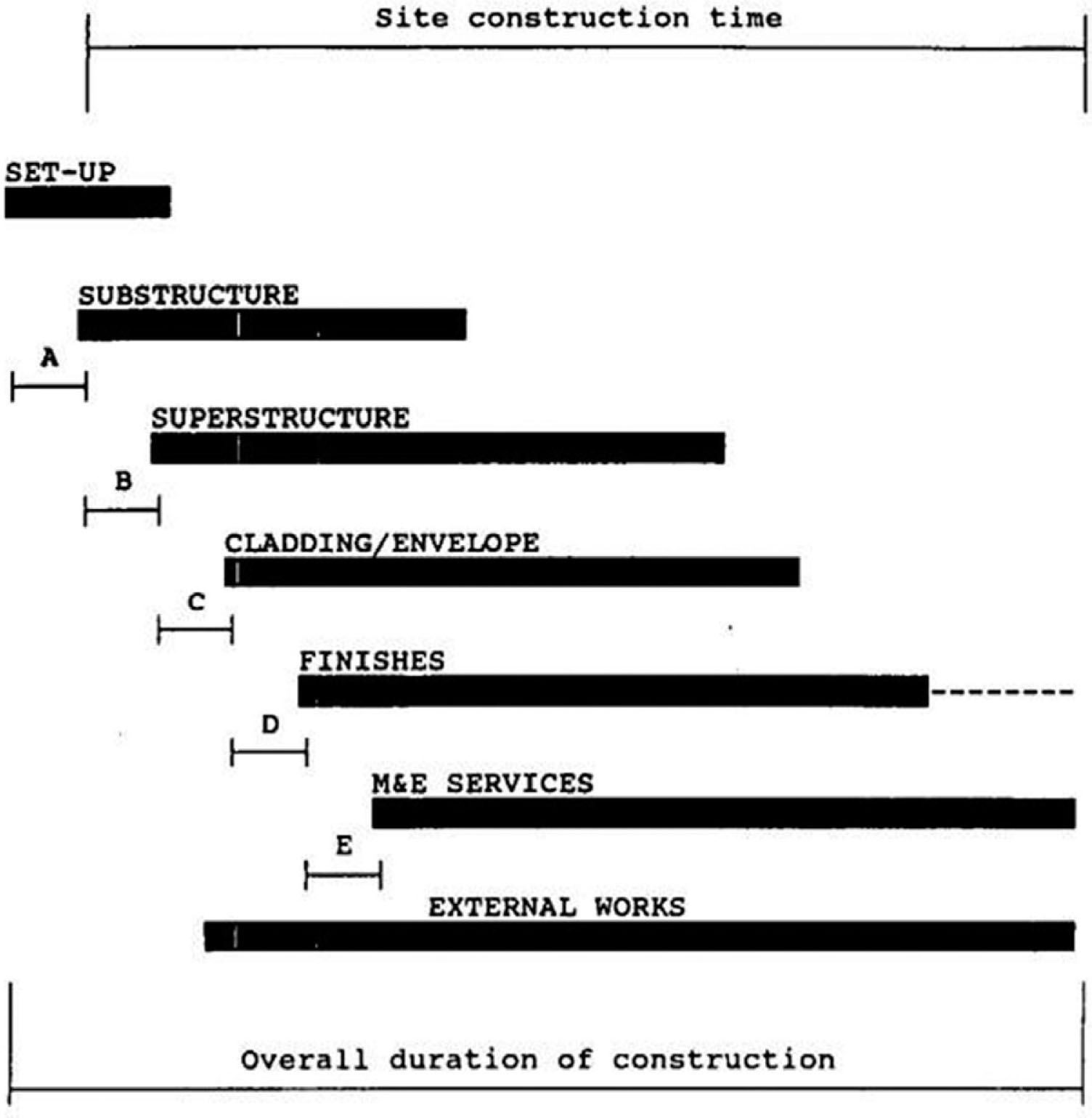
Fig. 1
Simplified outline of the construction plan based on condensed work packages.
Source: Nkado (1992).
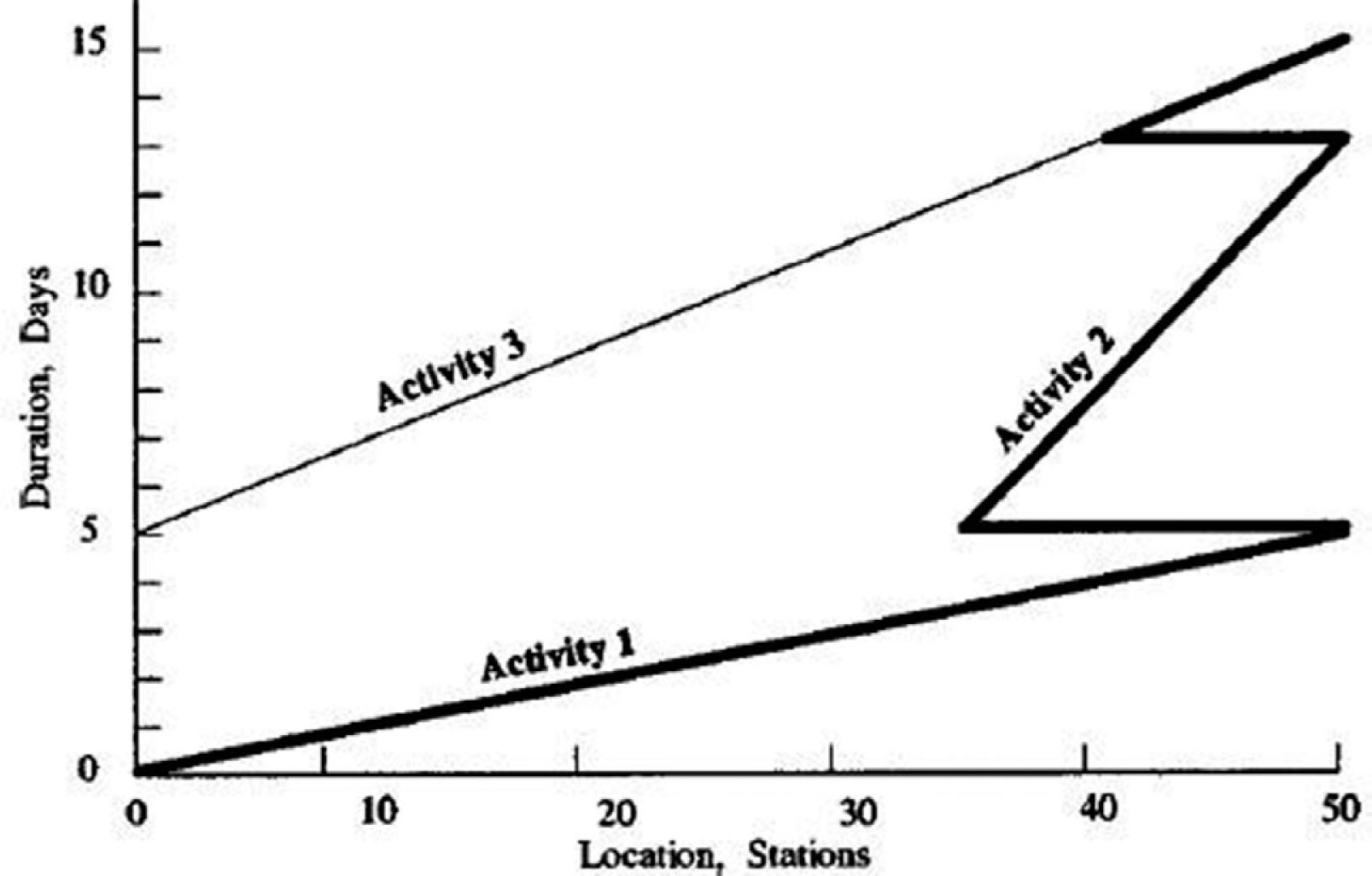
Fig. 2
Example of controlling activity path (CAP) in time–location diagram.
Source: Mattila and Park (2003).
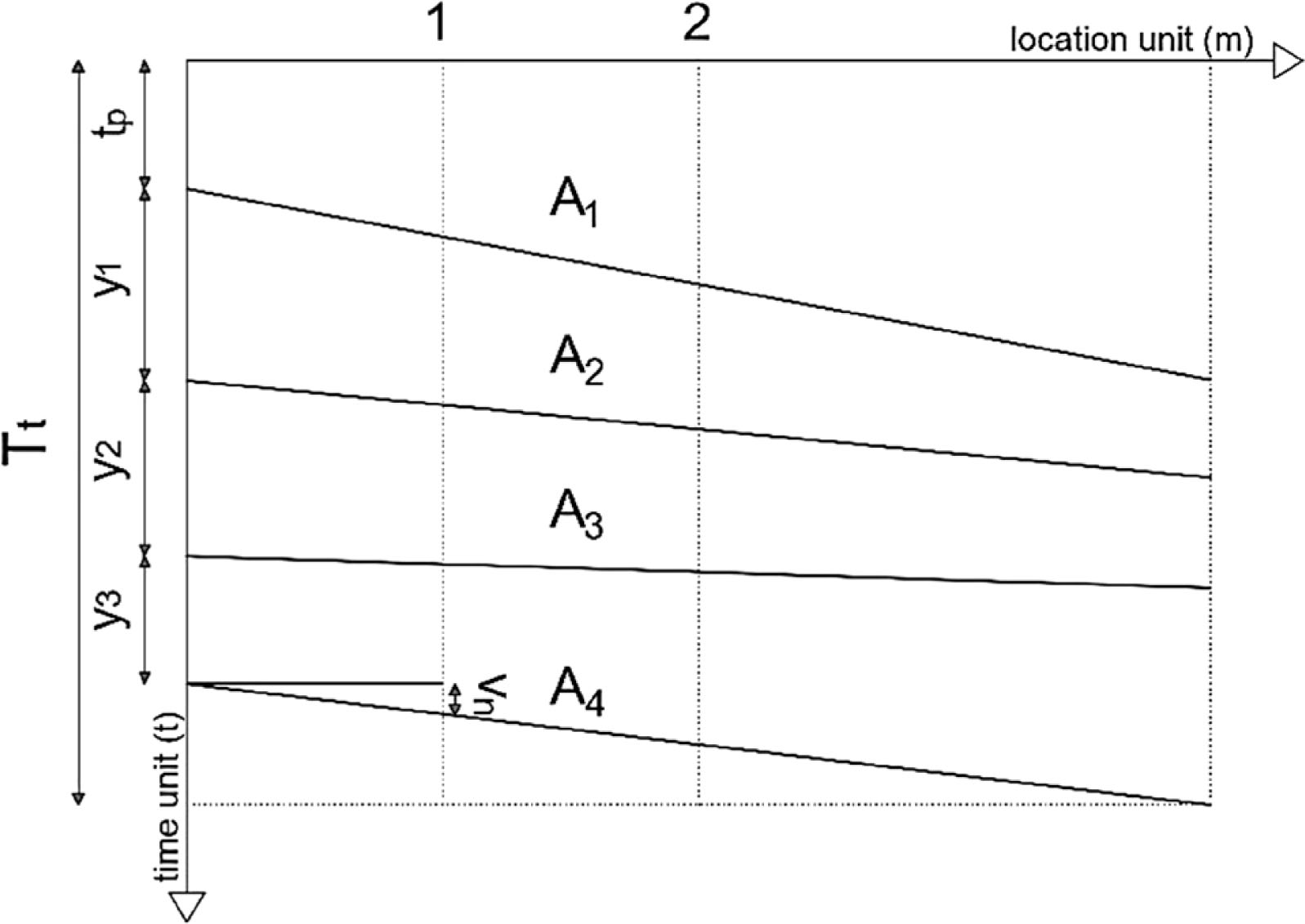
Fig. 3
Graphical representation of the equation of total project time in LSM for continuous full-span activities.
Source: Radujkovic (2012).
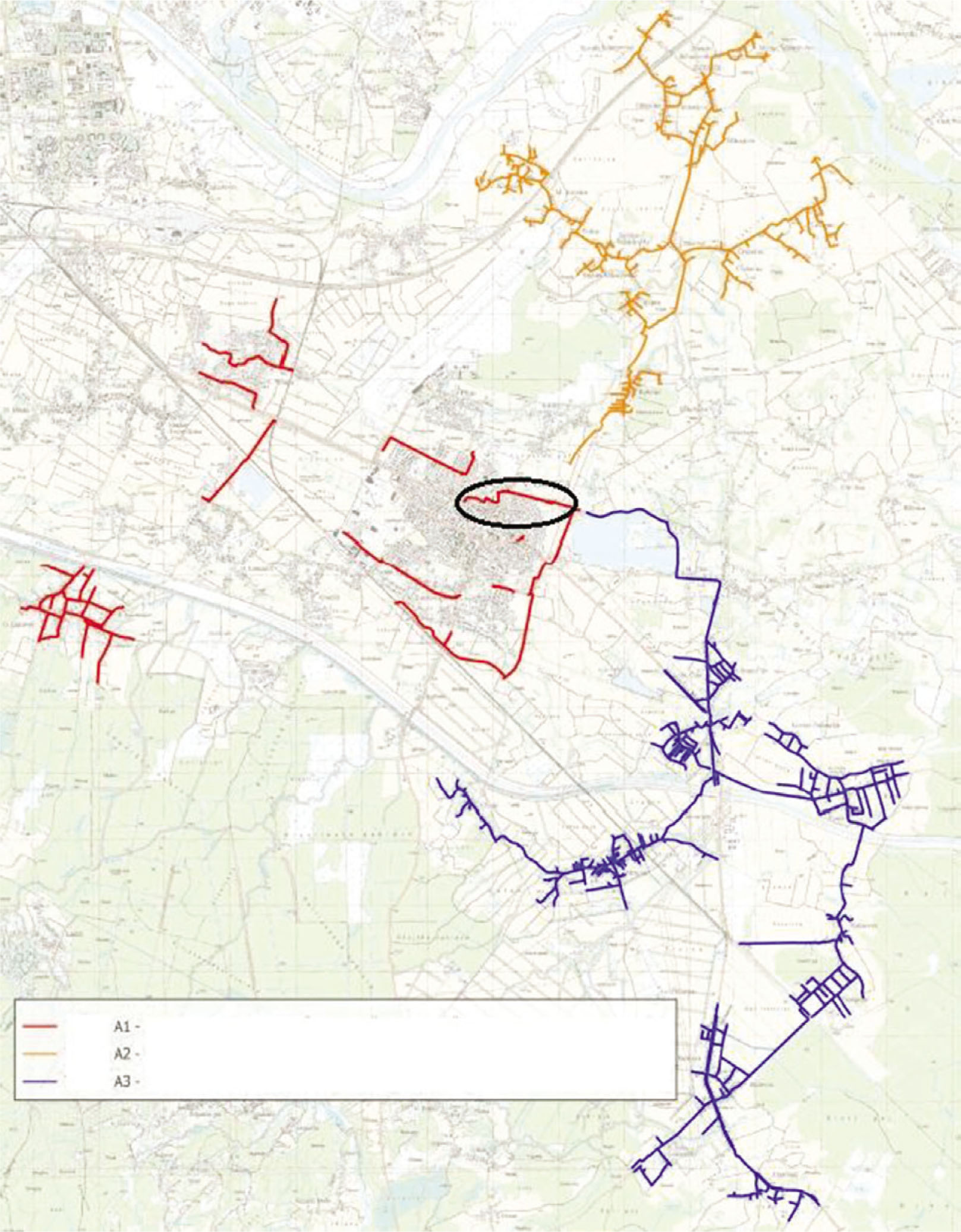
Fig. 4
Representative pipeline project from the analyzed sewer system.
Source: project technical documentation
Tab. 2
The equations for calculation of time buffer and duration of two adjacent activities
| Situation 1. α = β Production rate: tasks A1 and A2 are equal. Recommended task link: Start–Start (S–S) Total duration: T = k + t(A2) Time buffer: y = k | Situation 2. α < β Production rate: task A1 is faster than task A2. Recommended task link: Start–Start (S–S) Total duration: T = k + t(A2) Time buffer: y = k |
| Situation 3. α > β Production rate: task A2 is faster than task A1. Recommended task link: Finish–Finish (F–F) Total duration: T = k + t(A1) - t(A2) + t(A2) Time buffer: y = k + Δt = k + t(A1) - t(A2) | |
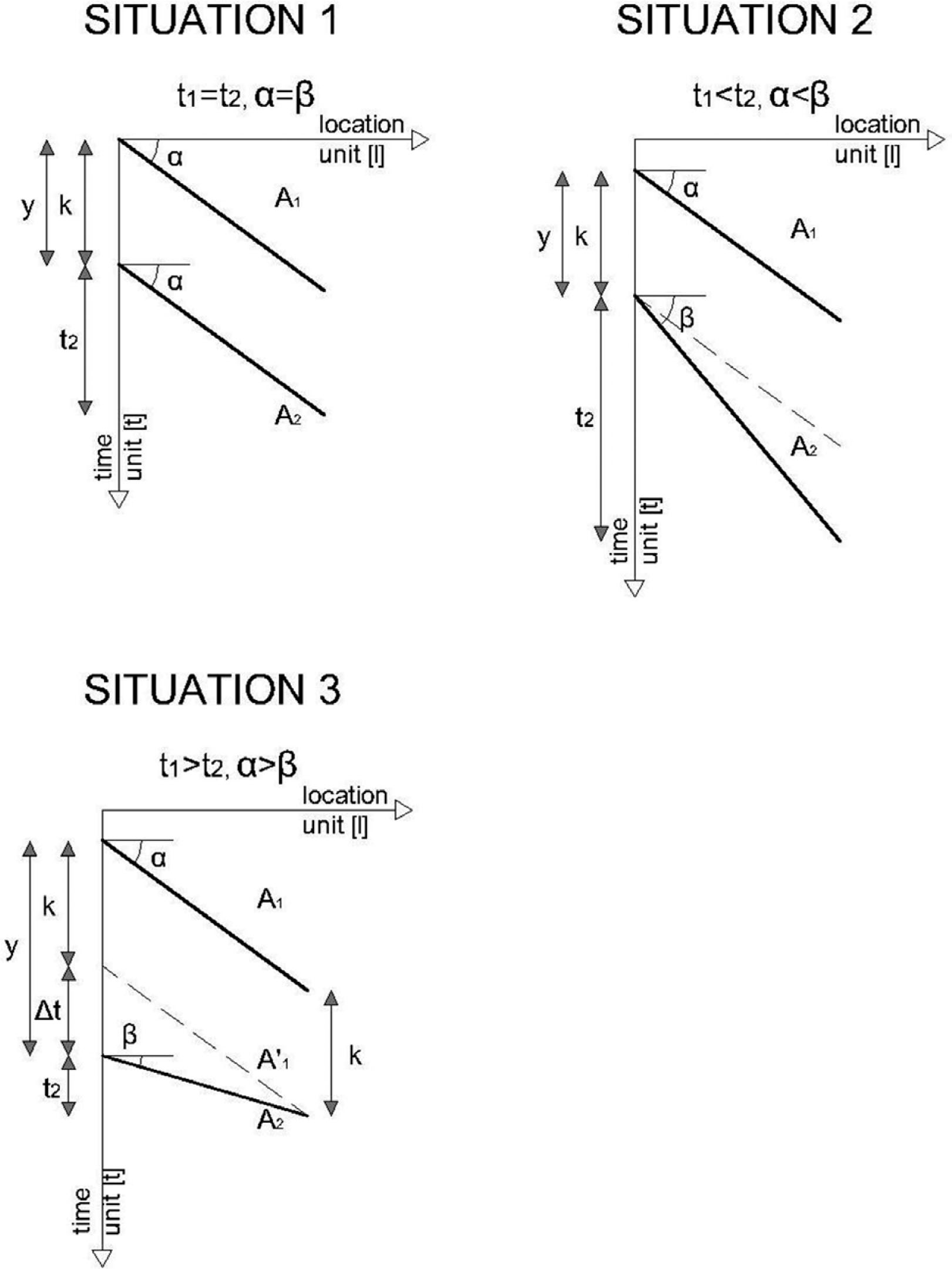
Fig. 5
Task links and the three possible variations between two activities.
Tab. 3
Linear continuous activities of the analyzed pipeline project and their related variables
| Leading activities | First three variables determined from technical documentation | ||||||||
|---|---|---|---|---|---|---|---|---|---|
| ΔQ | Up | Δl | α, β (tan−1) | tn (days) | Task link | k | y | ||
| 1 | Pulverizing and grinding of existing roadway asphalt or concrete curtain | 2662.807 | 292.08 | 920 | 0.009909 | 10 | F-F | 1 | 6 |
| 2 | Mechanical excavation | 2949.962 | 669.76 | 920 | 0.004787 | 5 | F-F | 1 | 4 |
| 3 | Manual excavation | 737.49 | 669.76 | 920 | 0.001199 | 2 | F-F | 0 | 1 |
| 4 | Replacement of low foundation material | 474.896 | 878.40 | 920 | 0.000588 | 1 | S-S | 1 | 1 |
| 5 | Trimming, leveling, and grading of the landfill base | 1637.047 | 2927.9 | 920 | 0.000608 | 1 | F-F | 1 | 1 |
| 6 | Spreading filter pedestrian finishing base | 248.39 | 878.40 | 920 | 0.00030 | 1 | S-S | 1 | 1 |
| 7 | Installation of manholes | 47 | 2.00 | 920 | 0.012771 | 24 | S-S | 0 | 0 |
| 8 | Lowering of pipe into trench | 849.38 | 36.40 | 920 | 0.025358 | 24 | F-F | 1 | 23 |
| 9 | Spreading rounded gravel above the pipes | 1273.79 | 878.40 | 920 | 0.001576 | 2 | S-S | 1 | 1 |
| 10 | Backfill | 2815.45 | 1152.9 | 920 | 0.002654 | 3 | F-F | 1 | 3 |
| 11 | Embankment-road compacting | 941.31 | 1112.6 | 920 | 0.000920 | 1 | S-S | 1 | 1 |
| 12 | Base pavement-base course layer | 2344.797 | 1145.4 | 920 | 0.002225 | 3 | S-S | 1 | 1 |
| 13 | Surface pavement-binder and wearing course | 2344.797 | 1145.4 | 920 | 0.002225 | 3 | |||
| Total time | 46d | ||||||||
Tab. 4
Leading activities and their related variables of another pipeline project from the same sewer system
| Leading activities | ΔQ | Up | Δl | α, β (tan−1) | ta (days) | Task link | k | y | |
|---|---|---|---|---|---|---|---|---|---|
| 1 | Pulverizing and grinding of existing roadway asphalt or concrete curtain | 4500 | 292.08 | 2113 | 0.0073 | 16 | F-F | 1 | 8 |
| 2 | Mechanical excavation | 5653.52 | 669.76 | 2113 | 0.0040 | 9 | F-F | 1 | 7 |
| 3 | Manual excavation | 1413.38 | 669.76 | 2113 | 0.0010 | 3 | F-F | 0 | 2 |
| 4 | Replacement of low foundation material | 559.98 | 878.40 | 2113 | 0.0003 | 1 | S-S | 1 | 1 |
| 5 | Trimming, leveling, and grading the landfill base | 1610 | 2927.9 | 2113 | 0.0003 | 1 | S-S | 1 | 1 |
| 6 | Spreading filter pedestrian finishing base | 209 | 878.40 | 2113 | 0.0001 | 1 | S-S | 1 | 1 |
| 7 | Installation of manholes | 133 | 2.00 | 2113 | 0.0197 | 42 | S-S | 0 | 0 |
| 8 | Lowering pipe into trench | 2113.6 | 36.40 | 2113 | 0.0275 | 59 | F-F | 1 | 58 |
| 9 | Spreading rounded gravel above the pipes | 1071.1296 | 878.40 | 2113 | 0.0006 | 2 | S-S | 1 | 1 |
| 10 | Backfill | 2480 | 1152.9 | 2113 | 0.0010 | 3 | F-F | 1 | 2 |
| 11 | Embankment-road compacting | 2080 | 1112.6 | 2113 | 0.0009 | 2 | S-S | 1 | 1 |
| 12 | Base pavement-base course layer | 5195 | 1145.4 | 2113 | 0.0021 | 5 | S-S | 1 | 1 |
| 13 | Surface pavement-binder and wearing course | 5195 | 1145.4 | 2113 | 0.0021 | 5 | |||
| Total time: 88 days | |||||||||
Tab. 5
Comparison of the new LSM-based method for time estimation with the two existing methods
| Integrated CPM–LOB model (Ammar, 2013) | PSM (Lucko, 2007, 2008) | LSM-based method for early time estimation |
|---|---|---|
| 1) LOB calculations This step consists of (at least) four (sub)steps. First is to draw a unit network (of repetitive activities for single work unit); second is to estimate the crew size for each activity; third is to establish a target rate of output (this (sub)step can be further divided into smaller steps); fourth is to derive the LOB diagram. | 1) Initial equations The execution of PSM starts with describing all activities in the Macaulay bracket notation (e.g., singularity functions). However, no links are considered for the initial equations (one equation for each activity). | 1) Activity list Based on available technical documentation, devise the list of linear activities of the projects, along with their parameters of work quantity and work group productivity (average). Work quantity is spread through work units using linear interpolation to make every activity continuous. Their sequence must be established unambiguously. |
| 2) Calculating activity duration Overlapping activities are generalized to represent repetitive activities. For this generalization to be possible, the duration is assumed constant in all units of a repetitive activity. | 2) Buffer equations In the second step, the singularity functions for buffers are set up (one equation for each buffer). | 2) Calculating activity durations and slopes Calculate durations and unit production rates (e.g., slopes) for every linear continuous activity. |
| 3) Specifying logical relationships using overlapping activities (buffer time) To specify relationships, the actual progress rate of each activity is compared with that of its successors. Three scenarios can be encountered: diverging, converging, and parallel activities. Based on the scenario, the buffer time is placed on the first or the last unit. | 3) Initial stacking In the third step, the initial activity and buffer equations are stacked up in the order of precedence with the set of singularity functions (one equation for each activity). | 3) Using the newly developed algorithm for determination of buffers between activities Pair of activities can converge, can diverge, or be parallel depending on the relation of production rates of two adjacent activities. Depending on this relation, the equation for every buffer y is determined, and calculation of the buffer is performed. |
| 4) Time scheduling 1. Forward pass – the early timings (belong to the first and last units only) are determined for each activity. 2. Backward pass – the late timings (belong to the first and last units only) are determined for each activity. | 4) Minimum differences In the fourth step, the differences between neighboring predecessor buffer equations and successor equations are taken and the minima of these difference equations are determined across all positive values of x (one equation for each activity–buffer link). | 4) Using the newly developed algorithm for calculation of project duration Based on the determined buffer times, the project duration is calculated as the sum of the buffers and the duration of the last activity. |
| 5) Criticality analysis | 5) Differentiation Differences are differentiated using equations to confirm the nature of the vertices (set of equations) | |
| 6) Final consolidation In the sixth step, the vertex distances between a neighboring predecessor buffer equation and successor equation are compared to identify the overall minimum distance (set of equations). | ||
| 7) Criticality analysis The equivalent of a critical path from CPM is calculated (set of equations). |