
1. INTRODUCTION
Understanding the scale of food waste and loss generated at different stages of the value chain is essential for monitoring and reducing waste. A key element is qualitatively characterizing what constitutes food waste and what does not, as well as the variability of parameters [Machate 2020]. The United Nations Food and Agriculture Organization (FAO) estimates that a third of all food produced globally for human consumption is lost or wasted, representing more than 1.3 billion metric tonnes per year. The financial cost is significant at around $1 trillion annually [Food Waste Index 2021]. FAO defines food waste as edible material intended for human consumption that is lost, discarded, degraded, or wasted by animals at a specific food supply factor [Hermanussen et al. 2024].
According to Regulation (EC) No 1069/2009 of the European Parliament and of the Council of 21 October 2009 laying down health rules as regards animal by-products and derived products not intended for human consumption and repealing Regulation (EC) No 1774/2002 (Animal by-products Regulation), Category III material shall be:
(a) disposed of as waste by incineration, with or without prior processing;
(b) recovered or disposed of by co-incineration, with or without prior processing, if the Category 3 material is waste;
(c) disposed of in an authorised landfill, following processing;
(d) processed, except in the case of Category 3 material, which has changed through decomposition or spoilage to present an unacceptable risk to public or animal health, through that product, and used:
(i) for the manufacturing of feed for farmed animals other than fur animals, to be placed on the market in accordance with Article 31, except in the case of material referred to in Article 10(n), (o) and (p);
(ii) for the manufacturing of feed for fur animals, to be placed on the market in accordance with Article 36;
(iii) for the manufacturing of pet food, to be placed on the market in accordance with Article 35; or (iv) for the manufacturing of organic fertilisers or soil improvers, to be placed on the market in accordance with Article 32;
(e) used for the production of raw petfood, to be placed on the market in accordance with Article 35;
(f) composted or transformed into biogas;
(g) in the case of material originating from aquatic animals, ensiled, composted or transformed into biogas;
(h) in the case of shells from shellfish, other than those referred to in Article 2(2)(f), and egg shells, used under conditions determined by the competent authority which prevent risks arising to public and animal health;
(i) used as a fuel for combustion with or without prior processing;
(j) used for the manufacture of derived products referred to in Articles 33, 34 and 36 and placed on the market in accordance with those Articles;
(k) in the case of catering waste referred to in Article 10(p) processed by pressure sterilization or by processing methods referred to in point (b) of the first subparagraph of Article 15(1) or composted or transformed into biogas; or (l) applied to land without processing, in the case of raw milk, colostrum and products derived therefrom, which the competent authority does not consider to present a risk of any disease communicable through those products to humans or animals.
Market practice shows that over 90% of expired animal waste is subjected to thermal conversion or co-incineration. Due to the sanitary risk, it is rarely subjected to other processes.
In biogas generation, food waste refers to any un-edible or wholly spoiled edible food at any stage of the food chain that can generate biogas [Pradeshwaran et al. 2024]. Food loss and waste contribute to climate change, accounting for approximately 8% of global anthropogenic greenhouse gas emissions. It represents a waste of scarce resources, such as land, energy, and water, throughout the life cycle of products. 4.5 kg of CO2 is released into the atmosphere for every kilogram of food produced. Food waste has adverse ethical effects and substantial social, economic, and environmental costs. Seven hundred ninety-three million people worldwide are malnourished, according to the FAO [Ferdes et al. 2022].
Currently, an estimated 625 million people lack access to electricity, and 2,3 billion lack access to clean energy sources for household cooking, resulting in an estimated 2 million deaths worldwide each year, with over 600,000 (approximately 30% of deaths) in Sub-Saharan Africa. Only the Group of Twenty (G20) countries with high economies have access to more than 90% of the total clean energy produced globally, leaving the rest of the world's population, particularly in Sub-Saharan Africa and Asia, at a disadvantage [Klintenberg et al. 2024; Eluwa et al. 2024]. Today, many food waste treatment technologies exist for energy recovery and extracting valuable products (including bio-oils, bio-fuels, proteins, acids, etc.). However, from an economic perspective, biogas production methods are the most viable option [Arun et al. 2020; Cristóbal et al. 2018; Kaur et al. 2020; Talan et al. 2021].
The use of food waste as a feedstock for bioenergy production, particularly biogas, is a topic frequently discussed by researchers, but it is associated with numerous challenges [Manyi-Loh et al. 2023; Duque-Acevedo et al. 2020]. In the case of food waste of plant origin, for example, lignocellulosic biomass is resistant to biodegradation, which can be a problem [Deng et al. 2023; Čater et al. 2014]. Food waste contains many nutrients, such as proteins, lipids, fats, polysaccharides, carbohydrates, and metal ions, which can be reused in some processes to produce value-added products. Following an appropriate pretreatment method, they can be recycled to make valuable products, such as green fuels, organic acids, bioplastics, enzymes, fertilizers, charcoal, and single-cell proteins. However, converting them into energy is the most economical and technologically optimal [Elgarahy et al. 2024]. The primary issue with biogas production from food waste is the unevenness of the protein-to-nitrogen concentration ratio [Maroušek et al. 2024].
In addition, the combustion of biogas, compared to fossil fuels, is known to have lower environmental impacts, including reduced greenhouse gas (GHG) emissions and a lesser impact on climate change. Ongoing evaluation studies for three scenarios for the use of biogas for energy production based on the Life Cycle Assessment (LCA) method for biogas combustion in a Combined Heat and Power (CHP) unit, biogas combustion in a steam boiler and biogas enrichment using a pressure swing adsorption (PSA) unit showed that the enrichment scenario was the best option, achieving emission savings in 8 of the 10 impact categories studied. The CHP scenario was the second-best option, while the boiler scenario was the worst. The latter two scenarios also exhibited the worst environmental performance in the ozone depletion potential category, but were still more environmentally favorable than fossil fuel-based systems [Alengebawy et al. 2022].
In September 2015, the Member States of the United Nations (UN) adopted the 2030 Agenda, which includes 17 Sustainable Development Goals (SDGs) aimed at achieving economic growth, social inclusion, and environmental protection. Goal 12, which refers to “Responsible production and consumption,” links with the concept of food loss and waste management (FLW) through SDG 12.3: “By 2030, halve global food waste per capita at the retail and consumer level and reduce food losses along production and supply chains (SC), including post-harvest losses” [Lemaire et al. 2019].
Reducing food losses and waste is part of the SDGs outlined in the 2030 Agenda (target 12,3). It is, therefore, one of the EU's political priorities in the field of the circular economy. In this context, Goal 12,3 of the UN 2030 Agenda for Sustainable Development assumed a non-quantified reduction in post-harvest losses and halving food waste at retail and consumer levels by 2030; the European Commission's findings assume a 10% reduction in food losses at the processing and production stages and a 30% reduction in food waste at the retail and consumption stages. Food losses and waste should be primarily treated as an expression of the inefficiency of agricultural production processes, which determines the number of environmental, social, and economic impacts [Calabró et al. 2024].
Of course, there are food waste reduction and closed-loop programs; however, due to population growth and the persistence of widespread consumerism, the problem of food waste remains a pressing issue globally [Zhang et al. 2023; Van Herpen et al. 2019; Schanes et al. 2018]. In addition, food labeling and understanding of use-by dates, as opposed to the concept of being unsafe to eat, must be revised [Gong et al. 2022; Charlebois et al. 2023]. Most activities include information, environmental campaigns, and customer preference surveys [Aschemann-Witzel et al. 2015; 2020]. Meanwhile, food waste results in the loss of valuable resources, including energy, water, land, and labor, as well as unnecessary emissions of pollutants [Brancoli et al. 2017; Priefer et al. 2016]. A review study conducted in Korea between 1997 and 2005 revealed a significant shift in food waste management, with a transition from landfilling to other recycling and thermal transformation methods. However, it has been demonstrated that some recycling processes can lead to increased environmental burdens and toxicity. Projections in Korea show that total food supply, total wastage, water footprint, and greenhouse gas emissions will be 54,89 million tonnes, 16,91 million tonnes, 18,63 billion m3, and 27,41 megatonnes CO2eq by 2030, respectively [Suk-Hui Lee et al. 2007; Adelodun et al. 2020].
According to a study in Sweden, only 1,570 tonnes of food were wasted in the six shops surveyed over three years. The results of this study show that approximately 2,500 t CO2eq were emitted in vain due to food waste. The average carbon footprint (CF) per tonne of food waste in the shops was 1,6 t CO2eq. Fresh fruit and vegetables accounted for 85% of the wasted mass, or 74 t per shop per year. The associated CF of wastage was 60 t CO2eq yr-1 store-1, corresponding to 46% of the shop's total waste. However, there is a clear difference between the distribution of wasted mass and CF wastage in the different departments. While the meat department only accounts for 3.5% of the mass, it accounts for 29% of the total CF wastage. On the other hand, the fruit and vegetable department contributed 85% of wasted weight but only 46% of wasted CF [Scholz et al. 2015].
An analysis of the climate change and economic impacts of food waste in the US for 134 food commodities, using life-cycle assessment, and the financial cost of waste based on retail prices, reveals that avoidable food waste in the US exceeds 55 million metric tonnes per year, equivalent to almost 29% of annual production. This waste results in life-cycle GHG emissions of at least 113 million metric tonnes of CO2eq per year, equivalent to 2% of national emissions and costing $198 billion [Venkat 2011]. It has also been found that GHG reductions can reach 800–1400 kg CO2eq per tonne of food waste, which can be achieved by reducing food waste by 35% in multi-family housing.
A study in Sweden clearly shows that, although modern alternatives to food waste treatment can result in avoided Global Warming Potential (GWP) through nutrient and energy recovery, food waste prevention offers a significantly higher GWP benefit compared to both incineration and anaerobic digestion [Schott et al. 2015; Oldfield et al. 2016].
It has also been estimated that per capita food waste among consumers in Latin America reaches 25 kg/year, with the sum of food loss and waste rising to 225 kg/capita [Gustavsson et al. 2011].
The results show that, with anaerobic digestion technology, food waste (FW) alone cannot contribute significantly to biogas production. However, co-digestion of food waste with animal manure, such as cow manure, poultry manure, and goat manure, can dramatically increase the biogas generation efficiency. As part of the process optimization, co-digestion of food waste with cow dung (cow manure) - (CD) was used at a ratio of 2:1 (FW: CD), while co-digestion of FW with CD and poultry manure (PD) is at a ratio of 2:2:1 (FW: PD: CD), and using FW, goat manure (GM) and PL the mixing ratio is best at 2:1:1 (FW:PL: GM). Ongoing research suggests that utilizing food waste as a feedstock for biogas production can reduce overdependence on fossil fuels and contribute to achieving the UN's 2030 clean energy target, thereby indirectly influencing the reduction of water resource use and the number of landfill sites [Emmanuel et al. 2024].
In addition, while out-of-date food waste of plant origin, which can be subjected to biological processes after shredding (such as composting or biogas production), is not a problem, the market for animal waste, i.e., category III waste, must be more manageable. This waste poses a sanitary risk and is subject to thermal treatment. According to the adopted EU environmental policy, this does not align with the waste hierarchy [Huttunen et al. 2014].
It, therefore, makes sense to use out-of-date food waste of animal origin as a substrate for biogas production because of its physical and chemical characteristics.
The market for biogas installations worldwide is mainly developed in the US, where biomethane is used primarily for power generation. The US biogas market is expected to grow at a CAGR of 4.5% by 2027 [United States Biogas… 2024]. China is also a powerhouse of bioenergy production, with a focus on heating energy production. In Europe, Germany is leading the way in terms of the number of installations. Still, the biogas market is also growing successfully in Italy, Switzerland, France, the Czech Republic, Austria, and the UK, thanks to the green economy [Europe Biogas 2024].
The US's federal Electricity Production Tax Credit (PTC) policy provides tax credits per kilowatt-hour (kWh) of qualified energy resources, such as biogas. Currently, the PTC is valued at about 2.3 cents/kWh [Gasper et al. 2018].
Under this policy, a facility modification can also receive investment credits, provided it is an electricity generation facility. New market tax credits are another policy that allocates credits for projects located in low-income regions. Apart from these policies and acts of legislation, numerous policies, such as the National Gas Act, Clean Air Act, Clean Energy Standard, Carbon Pricing, and Renewable Portfolio Standards, directly or indirectly support the application of biogas at the national level (American Biogas Council—State Profiles).
Similarly, many direct/indirect policies are initiated at the state level. Most of the states in the US have Renewable Portfolio Standards (RPSs) that indirectly influence the generation and application of biogas through AD. States have a wide disparity in motivation to generate and use biogas. This may be because of a lack of policies benchmarking the application of biogas.
The essence of the methanogenesis process is a four-stage methane fermentation process (hydrolysis, acidogenesis, acetogenesis, and methanogenesis), which takes place under anaerobic conditions [Nganyira et al. 2023]. To ensure the highest possible biogas production, it is necessary to provide the proper environmental parameters, including anaerobic conditions that allow methanogenic bacteria to function successfully and the optimal temperature. The decomposition process of organic matter occurs under both psychrophilic conditions (although with a lower intensity) and mesophilic conditions. There are also several installations running the process under thermophilic conditions, which, from an economic perspective, may not be cost-effective for every location and with not all substrates used.
Also, the valuable nutrients in the digest, such as nitrogen, phosphorus, and organic matter, suggest their potential use in agriculture to enhance sustainability [Cichy et al. 2024].
According to studies from operating plants, maintaining the correct pH of the fermentation mixture is essential, with a pH of around 7 being optimal. Therefore, the quantity and type of substrates used must be chosen. Furthermore, the higher the content of sugars and fats in the substrates, the higher the biomethane production. When selecting substrates, it is also necessary to maintain the correct C:N ratio so that the fermentation process can proceed without inhibition [Jameel et al. 2024; Rajkumar et al. 2022]. Predictive modeling and optimization of the biogas generation potential from anaerobic organic waste co-digestion are underway [Ahmad et al. 2024].
When considering the various options for applying food waste in a closed-loop economy, anaerobic digestion results in the lowest environmental impact and best CRoI of −0.84 kg CO2-eq per euro. From an economic point of view, a reduction in food waste of 0,15 kg per euro spent would be required to be beneficial for minimization [Oldfield et al. 2016].
In terms of substrates and commonly used organic waste for biogas plants, human feces, agricultural waste, industrial food residues, municipal waste, food waste and residues, fish waste, aquatic plants, and forest residues are among the ordinary organic wastes from which biogas is currently produced [Ngabala et al. 2024; Arthur et al. 2011]. Municipal solid waste in the form of kitchen waste occupies a special place as a substrate. These contain more than 90% organic matter and often end up in landfills [Shukl et al. 2016; Karak et al. 2012]. Some publications address additives that enhance fermentation by providing an additional substrate. A popular additive is waste from the brewing industry, specifically the co-fermentation process of Brewers' Spent Grains (BSG) and cattle manure [Nganyira et al. 2023; Carlini et al. 2021; Kebede et al. 2016; Emmanuel et al. 2022]. Ongoing research also examines corn straw and rice husks [Fu et al. 2022; Olugbemide et al. 2020; Ghatak et al. 2018].
A separate part of biogas production work is the treatment of sludge from wastewater treatment plants. This sometimes involves the anaerobic co-digestion of internal organic waste collected at wastewater treatment plants and external waste, e.g., food waste and organic agro-industrial waste. Successful case studies related to biogas plant operations are presented, including the alkaline pretreatment of fats, the use of low-cost waste-based enzymes, and co-digestion with the organic fraction of municipal solid waste [Miranzadeh et al. 2024; Azevedo et al. 2023].
In general, food waste as a substrate is usually divided into: waste from Dairy Industry [Sar et al. 2022; Awasthi et al. 2021], waste from the Fruit and Vegetable Industry [Tedesco et al. 2021; Jiang et al. 2016; More et al. 2018], waste from Cereals Processing Industry [Skendi et al. 2020], waste from the Brewing Industry [Fillaudeau et al. 2006; Karlovic et al. 2020; Miller et al. 2021], waste from Wine Industry [Kalli et al. 2018; DaRos et al. 2014; Rodríguez et al. 2007; Montalvo et al. 2020] and Catering Waste [Tayyab et al. 2019; Elwakeel et al. 2023; Anjum et al. 2018].
There are also technologies and studies on using coffee waste to produce biogas or garden waste [Czekała et al. 2023; Mahmoud et al. 2022; Cherukuri et al. 2023; Zhang et al. 2022].
Regarding animal waste and its potential for biogas production, references in the literature are primarily focused on the meat industry, which generates substantial amounts of waste from slaughtering cattle, pigs, sheep, lambs, and other animals, excluding poultry. These wastes include animal tissue, non-recyclable materials, fat, bones after processing, intestinal contents and bladders, bristles, blood, and production residues.
In the slaughterhouse, a series of waste, including inedible organs, hair, and skeletal material, is generated, for which the recovery or reuse of some parts is economically challenging due to their content. They can extract fat and obtain the protein flour used in animal feed. Additionally, manure, gut manure, and generated wastewater, which have a very high pollutant load and solid content, can be utilized in anaerobic digestion. Most of the waste and by-products generated by the meat industry still contain a high content of essential nutrients, which is why they are used for the separation of various commercially valuable products, including amino acids, hormones, minerals, vitamins, fatty acids, and glue and gelatin, among others. Waste resulting from these processing operations can also be used in biogas production.
The poultry industry generates waste similar to the meat industry, producing substantial amounts of solid waste and wastewater. The most crucial poultry processing wastes are those generated in slaughterhouses: feathers, blood, feet, head, bone, trimmings, and organs. All these wastes have a high content of proteins (around 32%) and lipids (54%) and can be used as a substrate in biogas production, with high yields and short digestion times (especially for blood and bone meal). However, as in the case of waste from the meat industry, poultry waste contains a large amount of protein nitrogen, which decreases the value of the C/N ratio between 7 and 10 (the optimal ratio for a stable process is 25–30). Additionally, inhibition of methanogenesis may occur due to the presence of long-chain fatty acids in the substrate; therefore, co-digestion with other substrates, such as cattle manure and crop waste, should be considered [Salminen et al. 2002; Mozhiarasi et al. 2022].
The research primarily focuses on the pretreatment of slaughterhouse waste and its enhanced process availability [Arman et al. 2024; Ripoll et al. 2023; Marchioro et al. 2018; Mahyari et al. 2021]. The research also examines the addition of slaughterhouse waste to co-digestion with food waste [Samadi et al. 2024; Mozhiarasi et al. 2023]. Research also focuses on utilizing slaughterhouse waste in pyrolysis to produce bio-oil and bio-coal [Cuixia et al. 2020; Kantarli et al. 2018; Lee et al. 2021]. There is little research and work on using fish production waste for biogas production. The percentage of by-products and waste from fish processing can be relatively high, depending on the anatomy of the fish species and the final product obtained, varying between 20% and 80%. This waste typically contains bones, scales, viscera, heads, skin, and fins in different proportions. This waste comprises many proteins and lipids and can be utilized as a co-substrate to enhance biogas yield in anaerobic co-digestion [Coppola et al. 2021; Wu et al. 2021].
The bare substrates used in methane fermentation have been animal manure and high-energy crops (sugar beet and maize) for years. However, the use of these products is associated with several problems. The high odor nuisance of manure, the potential for pharmaceutical residues in manure, the negative impact on crop biodiversity, and the reliance on monocultures are key features of these substrates. The subsidy program for high-energy crops has had a particularly negative impact on the environment. This has led farmers to abandon traditional crops in favor of maize. This has resulted in decreased biodiversity and excessive soil depletion in agricultural areas. Added to this is the seasonality and availability of these materials, which implies an uneven load on installations.
Of course, besides traditional methods of managing expired waste, such as composting for food waste and thermal conversion for animal waste (Waste to Energy), there are several biotechnological methods for producing usable materials. Renewable agricultural and biomass leftovers are employed as eco-friendly biomaterials and components of composite biocement. [Sivalinga et al. 2024]. Bioproducts produced by microorganisms include: xanthan, ethanol, pectinase, α-amylase, invertase, cellulase, PHB (polyhydroxybutyrate), citric acid, lactic acid, amino acids, glutamic acid, antibiotics, and others [Aslam et al. 2020; Musa et al. 2024].
Out-of-date waste contains a variety of biochemical markers, including sugars, fats, carbohydrates, and vitamins. They are subjected to fermentation, biocatalysis, bioconversion, and biological oxidation processes. The SFF (Simultaneous saccharification and co-fermentation), SSF (Solid-State Fermentation), and SHF (Separate Hydrolysis and Fermentation) processes are used on a large scale [Dahnum et al. 2015; Ge et al. 2017].
However, it should be noted that in the case of biotechnological processes, the waste products are food products that are byproducts of production, e.g., molasses, sewage sludge, corn mash, malt pomace, potato starch, and others. These come from distilleries, breweries, and the food industry. In addition, biotechnological methods are considerably more expensive for producing bioplastics, for example, than traditional methods. It is challenging to imagine processing outdated food waste, especially of animal origin, as a more economically viable alternative to thermal treatment. In this case, the waste hierarchy is influenced by technological and cost considerations.
Given the above and the priority policy adopted in the EU and the UN regarding food waste, using refood in biogas installations seems expedient. Using out-of-date food as a substrate for installations eliminates the problem of uneven plant supply. However, this raises the issue of substrate diversity and microbiological stability, particularly when it must be transported over long distances. To date, waste products in the form of expired products have only been used as a minor addition to biogas substrates from the agri-food or municipal industry (e.g., slurry, malts, silage). Although their addition increases overall biogas production, the problem was the proper preparation and handling of these materials. Proper homogenization, grinding, composition, and sanitary safety hindered their direct use in biogas plants.
Little research has been conducted on the disposal of expired food waste, including animal waste, to prepare substrates for biogas plants. Such a solution offers numerous technological advantages and is economically justifiable.
The proposed installation ensures the optimal preparation of the correct feedstock with defined physical and chemical properties. Comminution, homogenization, and sterilization of the final product ensure it is used directly in the biogas plant.
Additionally, it is essential to note that the cost of acquiring them primarily determines the selection of suitable substrates for a biogas investment. The cost of transporting the feedstock from the producer to the biogas plant is also a significant element influencing the economics of the investment. It is usually assumed that an optimal and profitable investment is within 30 km of the substrate supplier. The quantity and quality of the substrate must also be sufficient to ensure an efficient biogas production process. Sterilization of the final product in the plant enables it to be transported over long distances, thereby minimizing the problem of spoilage and rot. The year-round cycle of out-of-date waste in retail chains reduces the risk of irregularities in its supply.
According to research, waste in out-of-date food products has a high biogas production potential compared to traditional substrates. The AMPTS (Automatic Methane Potential Test System) result for the biogas potential of supermarket waste is 524 Nml/g d.m. This indicator for green waste is set at 295 Nml/g d.m. A comparison of biogas/methane production for different substrates is shown in Tables 1 and 2 [Owczuk et al. 2013].
Table 1.
Potential for producing methane from waste
| Waste | Methane production [ml CH4/g d.o.m.*] |
|---|---|
| Bio Municipal | 400 |
| Green | 100–300 |
| Fish | 400–550 |
| Expired dairy products | 520 |
| Malt | 350 |
Source: [Ngabala et al. 2024; Owczuk et al. 2013]
Table 2.
Methane content potential in substrates
| Substrate | Biogas yield [m3/t d.o.m.*] | Methane content [%vol] |
|---|---|---|
| Pig slurry | 300–700 | 60–70 |
| Corn silage | 450–700 | 50–55 |
| Brewing malt | 580–750 | 59–60 |
| Grass | 550–680 | 55–65 |
| Shop waste | 400–600 | 60–65 |
Source: [Ngabala et al. 2024; Owczuk et al. 2013]
As can be seen from the presented research results, the use of a feedstock in the form of out-of-date food waste prepared with the proposed technology is justified both technically and economically. It represents an innovative approach to biogas production, addressing the challenges of reducing food waste, utilizing raw materials, and minimizing the amount of biodegradable waste sent to landfills.
This research aimed to select a sterilization method for expired food waste while maintaining the highest possible biogas production potential. Based on this research, a project was developed to construct a plant for producing substrates for biogas plants using expired food waste, including category III waste.
2. RESEARCH
The study aimed to analyze basic physicochemical parameters, perform microbiological tests, conduct a model analysis in terms of biogas yield, and examine the methane potential of animal and plant substrate samples that had been previously subjected to radiation, UV radiation, and pasteurization processes.
2.1. Methodology
2.1.1. Sample preparation
The waste samples consisted of expired waste from a supermarket. The plant waste was a mixture of vegetables and fruit. The animal waste consisted of expired meat waste from boneless poultry and pork. Based on this waste, samples of plant origin, animal origin, and mixed samples of plant and animal origin were prepared in a 50/50 weight ratio using expired food products.
The first essential element of the research was to conduct substrate sterilization tests to inform further studies on the effect of sterilization on physicochemical parameters [Żegota 2005; Krzysztofik et al. 2015].
Three sterilization methods were used for the prepared samples:
– the temperature pasteurization method was heating the samples for over 30 min. at 800 °C.
– the UV sterilization method consisted of a 30 min. irradiation of the waste samples. A 15W low-pressure UV irradiator was used, and the UVC radiation power at 254 nm was 46W.
– the radiation method consisted of irradiating the samples once with an electron beam dose of 20 kGy (transporter 0.680 m/min., set current 600 mA, energy 10 MeV, sampling 0.3 s).
2.1.2. Microbiological studies
The microbiological tests involved determining the number of microorganisms at 30°C using the plate method on the MPA substrate (spread plate method) according to the Polish Standard [PN-EN ISO 4833-1:2013-12].
2.1.3. Physico-chemical tests
Physicochemical determinations were then made for the raw and the sterilized samples in the mixed sample variant of plant-animal origin (50/50 weight ratio).
Physicochemical tests were conducted according to the Polish Standard methods: Loss on ignition of dry mass (600 °C) - PN-EN 12879:2004 (weight method); Dry mass content (at a temperature of 105 °C) - PN-EN 12880:2004 (thermogravimetric method); Kjeldahl nitrogen - PN-EN 16169:2012 (titration method); Petroleum ether extractable substances PB/PFO-1, 5th edition, dated 1 October 2018 (The technique involves extracting organic substances with petroleum ether from an acidified and desalted sample and determining the content of the extracted substances by weight); pH - PN-EN 12176:2004 (potentiometric method).
2.1.4. Determination of methane potential
The following research stage aimed to determine the methane potential of plant-animal substrate samples (50/50) that had been previously subjected to radiation, UV light, and pasteurization. A batch from the secondary fermenter of an agricultural biogas plant was used as inoculum.
Table 3 shows the characteristics of methane and biogas measurement equipment. To reduce the duration of the tests, available thermophilic fermentation was used. Table 4 shows the starting conditions for the methane potential test.
Table 3.
Characteristics of measuring equipment for methane and biogas measurements
| A measuring device used to determine the amount of methane produced | A measuring device is used to determine the composition of the biogas |
|---|---|
|
|
Table 4.
Methane potential test conditions
| Sample | Fermentation time/active fermenter volume | Fermenter organic dry matter load [kg d.o.m./m3] | The time when 90% of the methane volume was created | Fermented substrate mass [g] |
|---|---|---|---|---|
| Mixed 50/50 plant-animal sample after heat sterilization | 21 days/400 ml | 4.994 | 15 days | 14.365 |
| 50/50 mixed plant-animal sample after UV sterilization | 21 days/400 ml | 5.008 | 14 days | 15.082 |
| 50/50 mixed plant-animal sample after radiation sterilization | 21 days/400 ml | 5.025 | 15 days | 13.678 |
2.2. Results
2.2.1. Results of microbiological and physicochemical tests
In waste samples before sterilization, plant waste samples had the lowest microorganism content at 106 cfu/g. Mixed 50/50 waste samples had the highest microorganism content at 109 cfu/g. The radiation method proved to be the most effective sterilization method, with all samples showing a microorganism content of less than 10 cfu/g. The same level was found for the plant waste sample after thermal sterilization. In the case of UV sterilization, the highest efficiency was observed for the plant waste sample, where the number of microorganisms decreased to 103 cfu/g. For the other samples using the UV sterilization method, the level of microorganisms remained unchanged. This was due to the low transparency of the samples undergoing sterilization. In the case of thermal sterilization, a clear decrease in the microbial content to 104 cfu/g was observed for meat waste samples and 50/50 samples. The results obtained are shown in Tables 5–8.
Table 5.
Results of microbiological tests of samples without sterilization
| Sample Type | cfu*/g |
|---|---|
| Sample of expired plant waste | 1.5*106 |
| Sample of out-of-date animal waste | 6.0*108 |
| Mixed sample 50/50 | 1.1*109 |
Table 6.
Results of microbiological tests of samples after thermal sterilization
| Sample Type | cfu*/g |
|---|---|
| Sample of expired plant waste | <10 |
| Sample of out-of-date animal waste | 1.3*104 |
| Mixed sample 50/50 | 1.2*104 |
Table 7.
Results of microbiological tests of samples after UV sterilization
| Sample Type | cfu*/g |
|---|---|
| Sample of expired plant waste | 8.6*103 |
| Sample of out-of-date animal waste | 9.8*108 |
| Mixed sample 50/50 | 1.1*109 |
Table 8.
Results of microbiological tests of samples after radiation sterilization
| Sample Type | cfu*/g |
|---|---|
| Sample of expired plant waste | <10 |
| Sample of out-of-date animal waste | <10 |
| Mixed sample 50/50 | <10 |
Further studies of physicochemical parameters and methane and biogas production were carried out on four mixed waste samples (mixed samples of plant and animal origin were prepared in a 50/50 weight ratio based on expired food products), which consisted of raw waste (MiS), waste after pasteurisation (MiP), waste after UV sterilization (MiUV) and waste after radiation sterilization (MiR).
Physico-chemical analyses of the samples showed no significant changes in the indicators analyzed (SD = 0,6). In terms of the indicators examined, the highest contents were found in the sample before sterilization. The content of substances extractable with petroleum ether was 41.000 mg/kg d.m., and Kieldhal nitrogen was 9430 mg/kg d.m.
In the case of post-sterilization samples, virtually the same level of loss on drying parameter was observed at 94% dry matter (d.m.) as in the sample before sterilization. However, the dry matter content was lower for the samples after sterilization, ranging from 14.1% for the MiUV sample to 15.6% for the MiR sample, compared to the sample before sterilization (17.5%). For the pH parameter of MiP and MiR samples, an increase in reaction to level 5 was observed compared to the sample before sterilization (4.5).
The highest decrease in petroleum ether extractability was observed for samples treated with UV sterilization and the thermal method, amounting to 24% and 27%, respectively. In the case of radiation sterilization, the decrease was only 7.4%. The most significant reduction in dry matter was also observed in samples after UV and thermal sterilization, at 19% and 16%, respectively. The Kjeldahl nitrogen determinations showed the highest reduction for the UV-sterilised sample at 24%. In the other thermal and radiation method variants, the decreases were 1.3% and 2.3%, respectively (Table 9).
Table 9.
Results of physicochemical tests of samples before and after sterilization
| Tested parameter | Unit | Raw sample (MiS) | UV sample (MiUV) | Heat-sterilized sample (MiP) | Radiation-sterilized sample (MiR) |
|---|---|---|---|---|---|
| Loss on ignition of dry mass | % d.m. | 94.9 | 94.2 | 94.6 | 94.2 |
| Dry mass content | % | 17.5 | 14.1 | 14.7 | 15.6 |
| Kjeldahl nitrogen | mg/kg w.m.* | 9430 | 7160 | 9310 | 9220 |
| Petroleum ether extractable substances | mg/kg w.m.* | 41000 | 31000 | 30000 | 38000 |
| pH | - | 4.5 | 4.3 | 5.1 | 5 |
2.2.2. Model analysis
Based on the results of physicochemical tests on substrates, a model analysis was prepared to determine the indirect nutrient content in the substrate, the theoretical biogas yield, the theoretical percentage of methane in biogas, and the possible electricity yield from the resulting biogas. According to the model analysis, the sample after radiation sterilization (128 m3/t) should show the highest biogas production compared to the sample before sterilization (143 m3/t). According to the model analysis, the samples after thermal and UV sterilization should have similar biogas production parameters (118 m3/t and 113 m3/t, respectively), average methane concentrations (62% and 61%, respectively), and energy production at 291 kWh and 275 kWh, respectively. In the case of radiation sterilization, these values should be higher, with an average biogas concentration of 63% and an electricity production of 317 kWh (compared to 350 kWh before sterilization).
For the remaining parameters (dry mass content, organic dry matter content, fat content in organic dry matter, protein content in organic dry matter, and carbohydrate content in dry organic matter), the values should be similar to each other both in relation to the sample before sterilization and between samples after sterilization.
The results of the model analysis of substrates are summarised in Table 10.
Table 10.
Results of the model analysis of substrates
| Tested parameter | MiS | MiP | MiUV | MiR |
|---|---|---|---|---|
| Dry mass content | 17.5% | 14.7% | 14.1% | 15.6% |
| Organic dry matter content | 94.9% | 94.6% | 94.2% | 94.2% |
| Fat content in organic dry matter | 24.69% | 21.57% | 23.34% | 25.86% |
| Protein content in organic dry matter | 35.49% | 41.84% | 33.69% | 39.21% |
| Carbohydrate content in dry organic matter | 39.82% | 36.58% | 42.97% | 34.93% |
| Biogas production in m3/t of fresh substrate mass | 143 m3/t | 118 m3/t | 113 m3/t | 128 m3/t |
| Average methane concentration (model) | 62% | 62% | 61% | 63% |
| Production of electricity from 1 ton of substrate | 350 kWh | 291 kWh | 275 kWh | 317 kWh |
2.2.3. Methane production
Methane production for each substrate was tested in duplicate. The results of methane and biogas production obtained during the experiment are presented in Figures 1, 2, and 3.
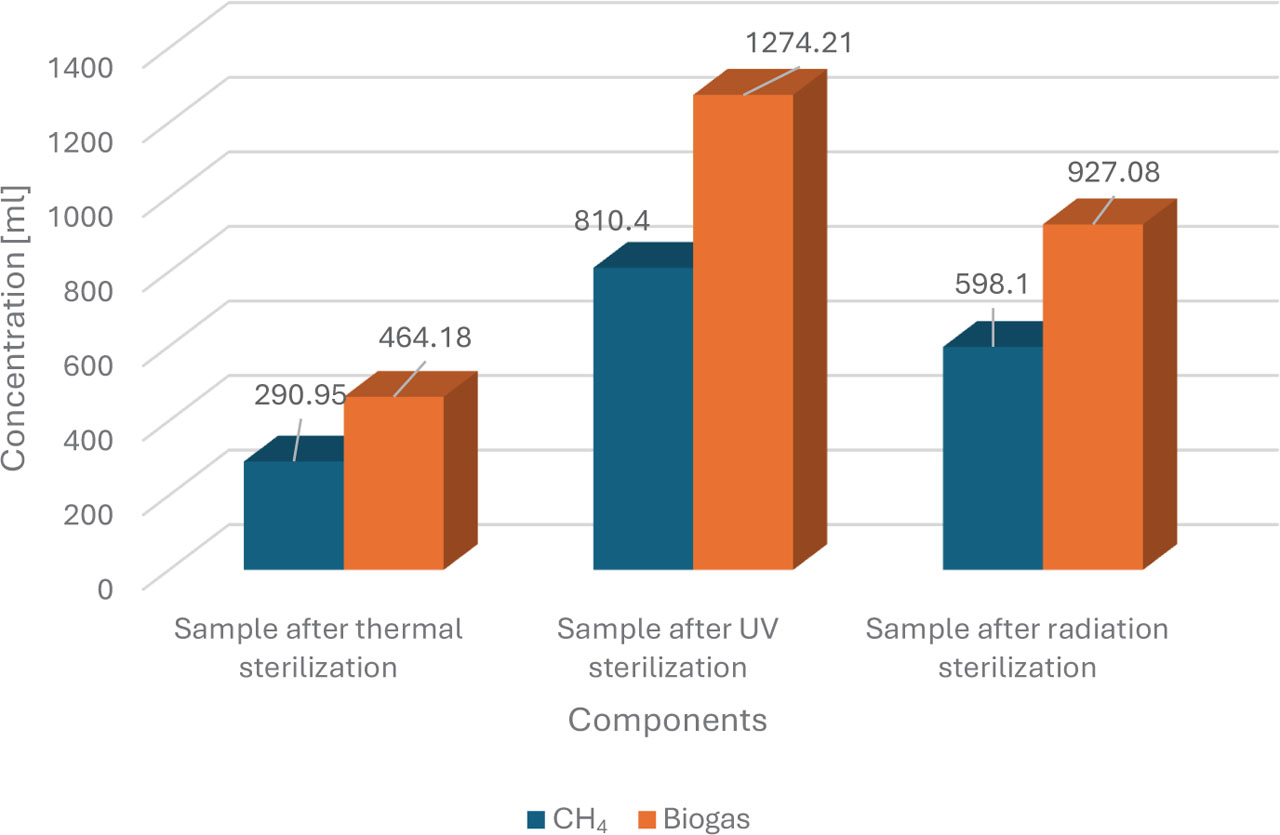
Figure 1.
Production of methane and biogas from substrates
Source: in-house studies
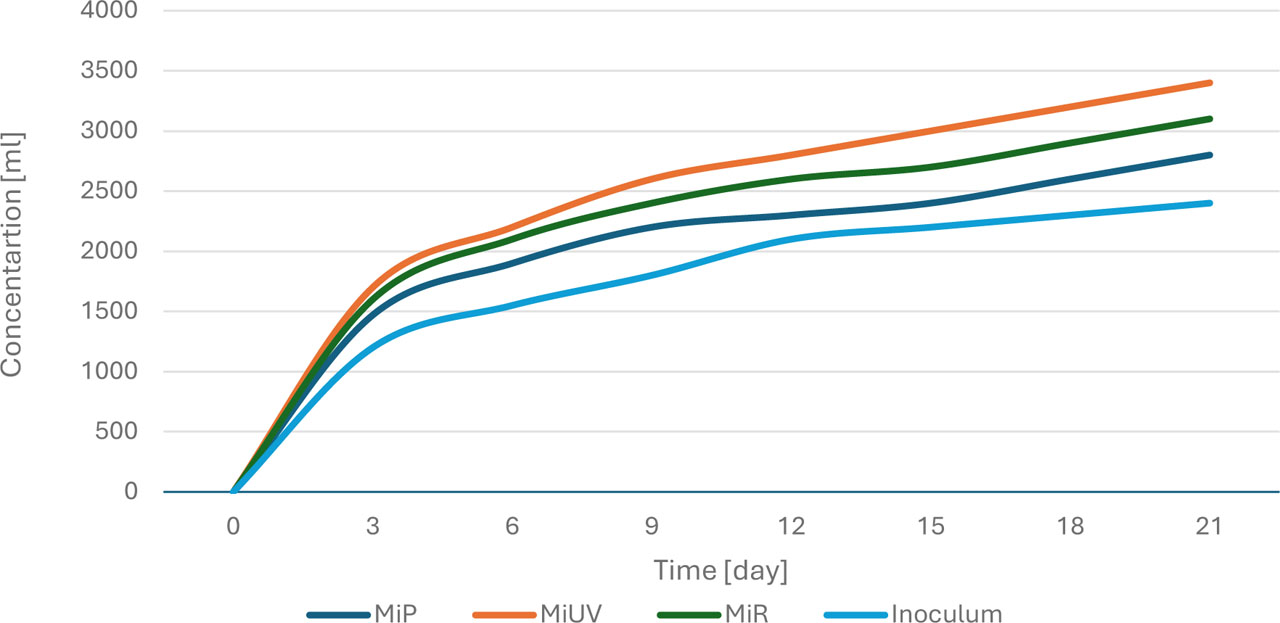
Figure 2.
Cumulative methane volume [ml/day]
Source: in-house studies
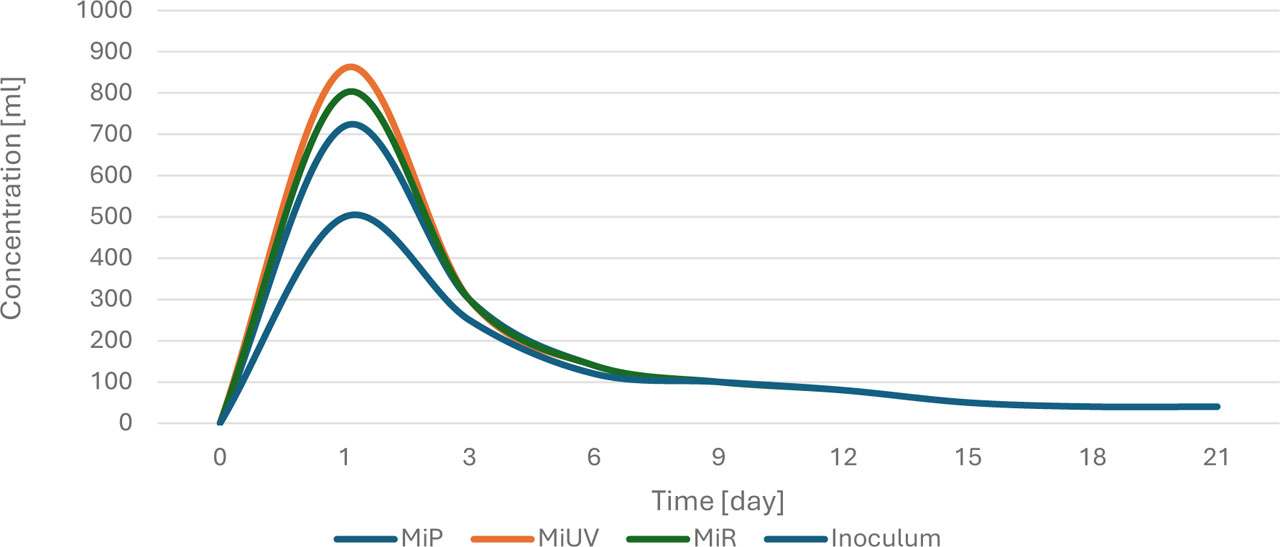
Figure 3.
Daily methane volume [ml/day]
Source: in-house studies
Based on studies on methane and biogas formation efficiency, it can be concluded that the UV method has the highest efficiency. In terms of partial polymer decomposition for intensifying the methane fermentation process, the UV sterilization method is also the most suitable. In the case of the thermal sterilization method, it was noted that the structure of the substrate was inappropriate and would require re-crushing (agglomerate formation). Additionally, it is worth noting that this method incurs the highest operating costs, which could impact the process economics and the overall plant operation.
The highest methane production was recorded during the first week of the experiment, amounting to 72.05% for the MiP sample, 74.05% for the MiUV sample, and 73.97% for the MiR sample, respectively.
2.2.4. Biogas composition and methane and biogas production efficiency
In the case of biogas composition testing, the highest average methane content was found in the sample after radiation sterilization (64.5%) compared to the samples after thermal sterilization (62.7%) and UV sterilization (63.6%). However, the highest maximum methane content was obtained for the sample after thermal sterilization (67.8%).
For carbon dioxide content, the highest average value was obtained for the sample after thermal sterilization, at 31.2%. For samples after UV and radiation sterilization, the average carbon dioxide content was 30.8% and 30.2%, respectively.
The average oxygen content for all samples was similar, ranging from 1.2% for the sample after radiation sterilization to 1.4% for the sample after thermal sterilization. The maximum content was found in the sample after thermal and UV sterilization, at 2.3%.
In terms of hydrogen sulfide content, the highest average value was observed for the sample after UV sterilization at 458 ppm, while the lowest average value was found for the sample after radiation sterilization at 416 ppm. The maximum content was also found in the sample after UV sterilization, at 585 ppm, while the lowest maximum was found in the sample after thermal sterilization, at 533 ppm. The minimum, maximum, and average contents of the tested biogas components are summarised in Figures 4 and 5.
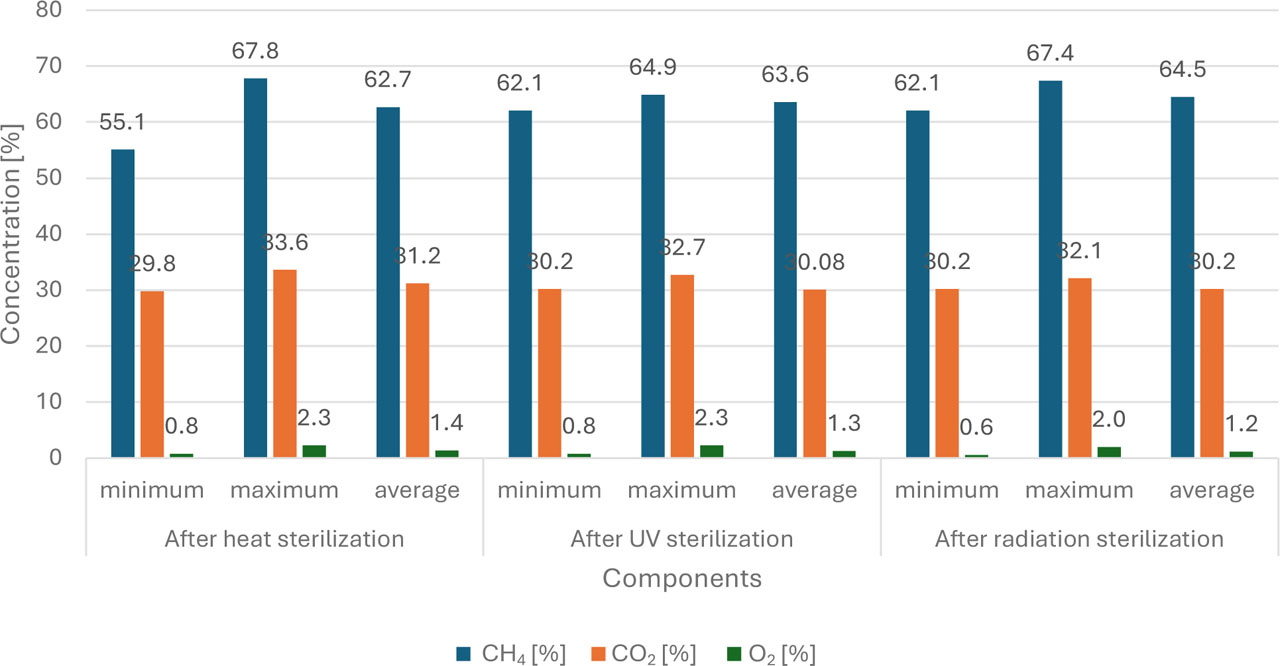
Figure 4.
The minimum, maximum, and average contents of the tested biogas components (CH4, CO2, O2)
Source: in-house studies
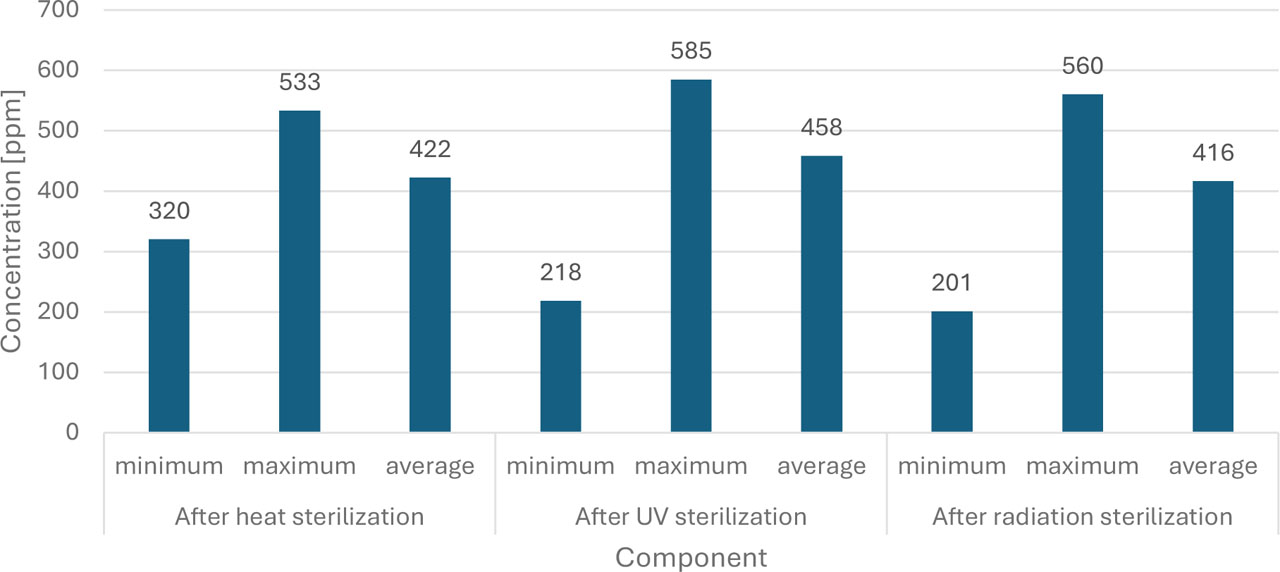
Figure 5.
The minimum, maximum, and average contents of the tested biogas component (H2S)
Source: in-house studies
A review of the literature shows that the average composition of biogas ranges from 40 to 80% methane, 15–60% carbon dioxide, 0.1–1% oxygen, and 0.1–0.5% hydrogen sulfide [Agrahari et al. 2013; Cater et al. 2014; Hasan et al. 2018; Lohani 2020; Nallamothu et al. 2013; Sebola et al. 2014; Salomon et al. 2009]. The average results obtained for the samples after sterilization fall within these ranges.
The results show that the methane production yield from 1 tonne of substrate dry mass is 20.3 m3 for the sample after thermal sterilization, 53.7 m3 for the sample after UV sterilization, and 43.7 m3 for the sample after radiation sterilization, respectively. The methane and biogas yields per fresh substrate mass and dry organic matter are shown in Figure 5.
When converted to electricity from 1 m3 substrates, the following can be produced, respectively: 80,41 kWh for the sample after thermal sterilization, 210,24 kWh for the sample after UV sterilization, and 168,67 kWh for the sample after radiation sterilization, at a cogeneration engine efficiency of 40%.
The yield of methane and biogas per fresh substrate weight and dry organic weight is presented in Figure 6.
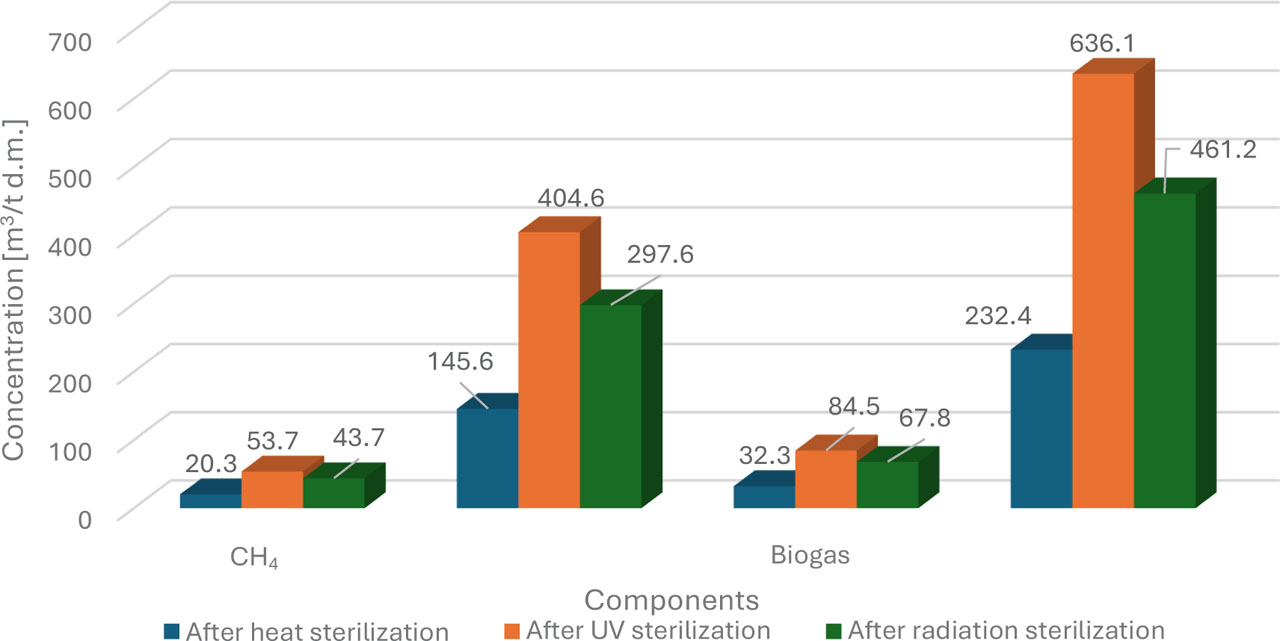
Figure 6.
The methane and biogas yields per fresh substrate mass and dry organic matter
Source: in-house studies
The substrates studied are characterized by a very high concentration of organic compounds in their dry mass, which is readily converted to biogas. This is evidenced by the results and the kinetics of biogas production, which show that the most intensive methane production was recorded during the first three days of the experiment for all samples. The fermentation process was expected, as evidenced by the biogas quality, which ranged from 60% to 65% methane for all samples. The lowest methane production was registered in the sample after the ‘pasteurization’ process. Additionally, on day 8 of the experiment, the methane concentration in this sample decreased to 55%, which may indicate the accumulation of volatile fatty acids and nitrogen compounds in the reactor, contributing to the inhibition of biogas production from the test material. The highest biogas production was observed during the study period from the UV-treated substrate, followed by the radiation-treated sample.
The results obtained fall within the ranges of biogas and methane production efficiency compared to, e.g., municipal biowaste, chicken litter, cow dung, pig manure/slurry, horse manure, fruit waste, and fish waste obtained by various authors [Berglund et al. 2006; Bharathiraja et al. 2018; Kasinath et al. 2021; Weiland, 2010; Jingura et al. 2017].
This demonstrates the utility of the proposed substrates derived from expired waste, including expired meat waste that has been subjected to sterilization, for biogas plants. To date, animal waste has primarily been used to produce biogas, with animal manure or dung added to plant-based waste. There are also biogas plants designed for slaughterhouse waste integrated with pasteurization lines. As demonstrated by the presented basic research, using UV sterilization and operating plants to prepare raw materials for biogas plants based on expired waste are technologically justified.
3. TECHNOLOGY
When designing a system for managing out-of-date animal waste, it is essential to minimise OPEX/CAPEX costs to make the solution economically viable.
Based on a review of available and existing solutions, the following technological layout was proposed for a plant to produce raw materials for biogas production based on expired food products.
3.1. Technological process
In the receiving hall, waste will be directed directly from the truck/wheel loader into a receiving hopper equipped with a hydraulically opening lid. The material from the bunker floor is transported by shaftless screws (switched on and off separately or in an interval arrangement) to a single transverse screw conveyor, which pushes the waste to the rising conveyor. Thanks to the different speeds of the conveyors, the waste is pre-shredded, and the larger packs are shredded. Excess liquid is collected in the conveyor tank and then pumped out. The material is then transported via an ascending conveyor to the separation mill. In the mill, the material is unpacked and crushed to a maximum particle size of. In the mill, the material is unpacked and crushed to a maximum particle size of. The 10 mm material is then discharged into an accumulation tank, from which it is pumped into a storage container. The post-process residue is automatically removed and discharged into a container via an integrated screw press.
3.2. Process equipment
Additionally, in terms of equipment usage, the process must be both repeatable and scalable. Using innovative equipment can delay investment, increase costs, and often lead to implementation problems.
The main technological elements proposed, on which the new production process is based, are not innovative and are commonly used in industry.
3.2.1. Waste receiving hopper with screw conveyors
It features a heavy-duty construction in stainless steel with reinforcing ribs made of profiled steel. The receiving hopper is installed on a concrete structure with the necessary transverse closure plates (waterproof). The hopper is equipped with three shaftless screw conveyors and a transverse screw conveyor. The drive of the transverse screw is fitted with an inverter located in the electric control box. This allows precise adjustment according to the amount of material at the conveyor outlet and the mill throughput.
3.2.2. Conveyor from the receiving hopper to the separation mill
Stainless steel shaftless screw conveyor with screen and integrated excess liquid collection container. Liquid waste is pumped to the separation mill using an immersion pump integrated into the receiving container. The pump is controlled by two built-in level sensors in the container. A watertight conveyor is connected directly to the emptying conveyor of the receiving hopper. The screw drive pushes or pulls the material (as required).
3.2.3. Separation mill
Separation mill for unpacking, separating, and shredding both packaged and unpackaged food, as well as other organic waste. It must have a gear motor, belt drive, and all necessary safety devices to ensure safe operation. Screens made with 12-millimeter perforations allow a maximum of 10 mm substrate grains.
The design of the rotor shaft must ensure the transport of heavy impurities and the suction of the air necessary for the classification of the waste. The rotor and screen shred the unpacked, contamination-free biomass and direct it into the pump tank, which either flows into the accumulation tank or can be pumped out directly. Foreign material (including packaging made of glass, metal, and plastic) is discharged via an emptying chute. Installed in the emptying chute, a simple screw press squeezes the residual liquid out of the foreign material. The liquids from the screw press are returned directly to the separation mill. The addition of liquids is necessary for the optimal functioning of the separation mill (for separation, grinding, and leaching of contaminants). Depending on the dry matter content, the degree of contamination, and the mesh size of the screen, experience shows that approximately. 100–400 liters of liquid (water, service water, separator grease, sludge, etc.) for each tonne of input material.
3.2.4. Steriliser
The radiation method demonstrated good sterilization efficiency, and the UV lamp technique (tube-in-tube type) offers the most significant potential for biogas production. Given this, as well as the economics of the entire project, using more powerful 150 W lamps is worth considering, which can achieve the planned result of reducing the number of microorganisms. According to the study, this type of sterilization provided the most significant degree of polymer breakdown and significantly accelerated and intensified the methane fermentation process. In addition, UV sterilization technology enables the process to run continuously without the need for additional tanks, allowing the plant to operate in a continuous mode, which improves the overall efficiency of the process. It also does not force a unique hall design, entailing significant investment costs.
4. SUBSTRATE PRODUCT FOR BIOGAS PLANTS
A substrate product for biogas plants, based on outdated animal waste, has great application potential in biogas generation and numerous technological advantages.
The possible ranges of the main product parameters to be obtained are summarised in Table 11.
Table 11.
Basic parameters of the substrate product for biogas plants
| Parameters | Range of values |
|---|---|
| Dry matter content | 5–20% |
| Organic dry matter content | 75–90% |
| Biogas yield | 400–600 m3/t d.o.m. |
| Methane content | 60–70% by volume |
| Terms of use | Extended by using sterilization |
The main advantages of the product are from the perspective of its use in biogas plants:
– The product will be used in all methane digestion installations (agricultural biogas plants, biogas plants at sewage treatment plants as a source of additional organic carbon, and waste installations using mixed municipal waste to improve operating parameters).
– High coefficients for avoided CO2 emissions to the environment -> RED II directive, better indicators for biogas and biomethane, e.g., for NDC for refinery plant, etc.
– Thanks to the hygienisation process, the product can be sold to all methane fermentation plants (without this process, only biogas plants with a category three material pasteurization line).
– Thanks to the advanced technological process, the product has a high content of organic substances in dry matter.
– It is possible to regulate the moisture content of the material (assuming 12–15% d.m.) so that it can be easily transported and stored in sealed containers (less odor nuisance).
– Thanks to its pumpable slurry form, it can be supplied to the digesters simply and automatically (less loading work - solid substrates).
– Fewer operational problems with dross on the surface of the tanks and equipment failures (pumps, agitators - by packaging), less inorganic sludge on the bottom, and less electricity to properly mix the tanks. As a result, there are fewer service costs - the equipment wears out less.
– Substrate for use in biogas plants with short retention times: can be used in biogas plants built with small digesters, where there is a high load of dry organic matter per m3 of the reactor.
– The substrate can allow, due to its short decomposition time to biogas, a simple increase in capacity in biogas plants with long and medium retention times without significant capital expenditures (no need to build additional digester tanks) just an additional gas engine and accessories a larger storage tank for the digest (due to the high moisture content of 85–88%).
– Substrate contains organic substances that have good “digestibility”; there are no significant amounts of compounds that are difficult to be broken down by bacteria (e.g., lignins, cellulose, hemicellulose), which is the case with energy crops (e.g., grass silage, corn, etc.); therefore, the d.o.m. The attenuation level is high.
This fact makes it unnecessary to use a system for the separation of the solid fraction from the digestate in the technological process, resulting in lower costs for the construction and operation of the biogas plant itself (no installation: separator, pump, leachate tank, platform for the separator or shed, storage for the solid digestate, subsequent fertilizer “certification” of the additional batch of product).
– The storage of liquid digest and its application are more straightforward and typical than the solid fraction. A biogas plant does not need two systems to apply the digestate.
5. SUMMARY
As the analysis shows, expired food products, including category III animal waste, have a high potential for biogas production. While the technological process is not complicated or expensive, the partial sterilization process must be optimized to ensure optimal results.
Interestingly, such installations do not have to be directly integrated with the biogas plants but can operate independently. Given the organizational management process throughout the life cycle, creating clusters bringing together food producers, stores, and existing biogas plants seems interesting. They could participate in the construction of such plants. On the one hand, producers or stores could lower the cost of disposing of their waste, reduce energy costs, and obtain green certificates. This would also have a positive impact on ESG reporting. Biogas plants would receive high-grade biogas substrate requiring no pretreatment. Thanks to the sterilization process, it could be transported over longer distances. Another important fact is that biogas produced in this way and its further possible transformation is associated with high coefficients for avoided CO2 emissions to the environment (RED II Directive), better rates for biogas and biomethane for the needs of industrial plants (refineries, heavy industry).
It should also be noted that the use of physical sterilization in the preparation of biogas feedstock has a positive effect on the rate of the first phase of methanogenesis - hydrolysis, due to the breakdown of macromolecular polymeric compounds that are often insoluble.
The proposed plant ensures the optimal preparation of suitable feedstock with specific physical and chemical properties. Comminution, homogenization, and sterilization of the final product ensure its direct use in the plant for biogas production.
In addition, it should be emphasized that the selection of suitable substrates for a biogas investment is determined mainly by the cost of obtaining them. The primary factor influencing the economics of the investment is also the cost of transporting the feedstock from the producer to the biogas plant. It is usually assumed that the optimal and profitable investment is within 30 km of the substrate supplier. The quantity and quality of the feedstock must also be sufficient to ensure an efficient biogas production process. Sterilization of the final product in the plant enables it to be transported over long distances, thereby minimizing the risk of spoilage due to rot. The year-round cycle of out-of-date waste in retail chains reduces the threat of irregularity in its supply.
Financial participation in constructing such a network by large-scale retail chains will result in lower waste collection and thermal treatment costs. It may also lower energy consumption costs, and green certification has a positive impact on ESG reporting.
It is assumed that for significant investments, in the order of 1 MW of electrical capacity, the average cost of building a biogas plant is 15 million PLN/MW. With a size of 250 kW, the price per MW rises to approximately 21 million PLN/MW, i.e., a biogas plant of this size costs around 5 million PLN (all prices are given in Polish zloty - PLN).
For a microbiogas plant, the cost per MW is much higher. The cheapest professional solutions for a 40 kW agricultural microbiogas plant mean an investment of around 1,4 million PLN (approximately PLN 35 million per MW), and the payback time is estimated at 7–8 years [Mikrobiogazownia… 2023].
The cost of disposing of a tonne of out-of-date waste is, on average, more than 400 PLN. In the proposed solution for the construction of substrate plants for biogas plants based on out-of-date food waste, mainly meat waste, it is estimated that the cost of construction would be around 30% of the construction of the biogas plant, and the rates for accepting waste are many times lower, depending on the solution applied.
Participating in the cost of construction and operating costs by commercial or wholesale chains will have a positive impact on reducing energy consumption costs, obtaining additional green certification, and minimizing waste disposal costs.
As the above research and analysis demonstrate, establishing a network of substrate plants utilizing outdated animal waste has significant potential for development and offers numerous environmental and economic benefits. A simplified SWOT analysis for this type of solution is presented in Table 12.
Table 12.
SWOT analysis for constructing plants producing substrates for biogas plants based on out-of-date waste, including category III animal waste
| Categories of analysis | Description of the analysis |
|---|---|
| Strengths |
|
| Weaknesses |
|
| Opportunities |
|
| Threats |
|
6. CONCLUDING REMARKS
The purpose of this article is not to conduct further research into the efficiency of biogas production from out-of-date food products. The article presents basic research into the selection of a sterilization method for preparing substrates for biogas plants, while maintaining the highest level of biogas production in the target installations. These substrates are based on expired food waste, including food waste of animal origin (category III).
This work was practical in nature and became the basis for the construction of an industrial plant in Poland. In addition, the paper proposed a coherent system for managing expired food waste, which involves creating clusters and establishing a network of plants that produce substrates for biogas plants.
Creating clusters linking commercial networks, existing biogas plants, new plants producing substrate for biogas plants, and end users (industry) could be a new model for managing category III out-of-date animal waste. This model meets both the requirements of a circular economy, waste management priorities, and energy policy, and is economically viable.
There is no doubt that constructing a network of such plants with year-round access to substrates in cooperation with commercial networks is a more economically viable solution than constructing biogas plants alone.
The basic research on expired waste presented in the article requires further investigation, considering several factors.
The first of these is the diversity of the composition of expired animal waste, e.g., fat content or the presence of bones. Another factor is research into the efficiency of methane fermentation under different conditions, such as mesophilic or psychrophilic fermentation. Another factor is the use of stronger UV lamps for enhanced sterilization process efficiency, which will contribute to the energy optimisation of potential plants. The pH parameter should also be considered. A low substrate pH is beneficial from the perspective of transport logistics and sanitary conditions. Still, a slight adjustment may be necessary in directly applying industrial biogas plants. This may depend on the operating conditions of the final biogas plants.