
1. INTRODUCTION
The increasing population and the acceleration of daily life are driving the economy toward higher-volume, faster-paced food production to meet growing demand. The use of plant protection products (PPPs) in agricultural systems provides substantial benefits by enhancing crop productivity and ensuring effective pest management. Owing to their targeted biocidal properties, PPP significantly mitigates yield losses caused by phytopathogens, insect pests, and invasive weed species [Gleń-Karolczyk et al. 2018]. This contributes to improved food security and economic resilience within agricultural enterprises. Furthermore, PPP application facilitates the optimisation of production inputs by reducing reliance on labour-intensive or biologically based plant protection strategies, thereby streamlining operational efficiency. In addition to the benefits for agriculture [Antonkiewicz, Łabędowicz 2016], the use of plant protection products entails adverse environmental consequences, including contamination of surface and groundwater. Water is essential for maintaining ecosystem stability, as it is the basis for biological processes. In the face of hydrological drought and significant agricultural development, it is crucial to maintain water purity at a level that allows it to be used by living organisms. Therefore, monitoring PPP in aquatic environments remains a key area of research given the critical importance of water quality. Plant protection products used in crop cultivation can enter surface waters, thereby causing pollution [Anagnostopoulou et al. 2022]. The main routes of PPP transport to surface waters are runoff, precipitation, spray drift and drainage [Boonupara et al. 2023; Gabryszewska et al. 2016; Mohammed et al. 2025; Sun et al. 2025]. Adsorption at the air–water interface is a crucial process for aerosol retention and atmospheric transport, as well as accumulation in the atmospheric boundary layer and surface waters [Sherman-Bertinetti et al. 2024; Schaefer et al. 2024]. In water systems, the fate, transport, and toxicity of PPP depend on the transformation processes they undergo, including physical, chemical, and biological changes [Ferreira et al. 2020; Irumva et al. 2025]. Depending on their physical and chemical properties, pesticides may undergo bioaccumulation and biomagnification in the environment, potentially harming the environment and human health [Tongo et al. 2022]. That is why it is crucial to assess the environmental impact of a PPP before it is released to the market. Decision support tools are needed to characterise the spatial and temporal dynamics of agricultural pollution and improve water quality management. The scope of application and registration procedures for plant protection products and active substances are legally regulated at both the European level and within individual Member States. Information on the environmental fate and behaviour of plant protection products is critical, as it provides insight into the type and extent of potential or actual exposure, expressed as the Predicted Environmental Concentration (PEC). Regulation (EC) No. 1107/2009 places strong emphasis on the use of modelling tools to calculate PEC values, which serve as a fundamental basis for assessing the environmental risks associated with plant protection products and their active ingredients.
One of the most critical characteristics of mathematical models used in environmental exposure assessment is their sensitivity, defined as the relationship between changes in input parameters and the resulting output data from simulations [Saltelli et al. 2000]. The parameters introduced into the model depend on both the physicochemical properties of the substance being simulated and variables related to cultivation practices or predefined model settings, which are beyond the model user’s control. Simulation outcomes may vary significantly between different models; therefore, in evaluating the fate and behaviour of a plant protection product and its active substance within various environmental compartments (surface water, groundwater, soil, and air), the selection of an appropriate model and the accurate specification of input parameters play a crucial role. It is also essential to select parameter values that reflect a realistic worst-case scenario, ensuring that predicted environmental concentrations (PECs) are conservative yet plausible.
Models with relatively high sensitivity enable the identification of parameters that require the greatest precision in value selection [Boesten 1991] and that demand the most or least attention during model parameterisation [Dubus, Brown 2002]. At lower tiers of risk assessment, using conservative input values often yields worst-case output that is typically unacceptable and thus has limited applicability. Consequently, risk assessments are conducted using simulations at higher tiers, where more realistic parameter values are assumed, and modelling is performed across multiple combinations of variables within various exposure scenarios.
This study presents a critical review of computational models used to assess plant protection products by calculating Predicted Environmental Concentrations (PECs).
2. METHODOLOGY
A comparative analysis was conducted using a harmonised set of model parameters and environmental scenarios consistent with FOCUS (2015) and OECD guidance. A compilation of available PEC models was conducted by consulting an OECD publication reporting results from a survey of exposure assessment models used in a regulatory context [OECD 2023], as well as the project team’s expertise in pesticide fate and behaviour in the environment. In total, 47 different PEC models were identified and characterised with respect to, e.g., intended uses, included model processes and required substance parameters.
The selection process for models suitable for further analysis encompassed a detailed evaluation across multiple criteria. Initially, the primary function of each model was scrutinised to ascertain its applicability in predicting environmental concentrations. The capability of these tools to calculate concentrations in soil, groundwater or surface water was examined, given their importance in ecological risk assessments. Additionally, models proposed for estimating parameters other than PEC for pesticides were excluded, thereby focusing solely on pertinent pesticide concentration assessments. Models for calculating PEC for soil and groundwater have been identified and are planned for utilisation in further analyses in the coming years within this project. Ultimately, nine models that calculate PECsw were selected for assessment in this report.
3. RESULTS
Accessibility emerged as a significant factor; preference was given to programs readily available for free online download to ensure broad accessibility and user-friendliness. A model is “user-friendly” when its interface or methodology is easy to navigate, comprehend, and use, regardless of users’ level of expertise in the field. This includes intuitive navigation, clear instructions, and accessible resources that facilitate efficient analysis or simulation with minimal obstacles. Moreover, compatibility with Windows operating systems and overall functionality were evaluated to ensure the reliability of selected tools within standard technical environments. Lastly, only models that could be downloaded were retained. Some models initially chosen for this analysis have been replaced by newer models, such as PWC replacing both SWCC and GENEEC2, necessitating an additional layer of analysis.
The models’ adaptability to incorporate and modify chemical parameter values was deemed critical. This attribute is indispensable for customising the analysis to specific chemicals and for accommodating a diverse array of scenarios, including various environmental conditions and regulatory mandates. Concurrently, an assessment was conducted to identify the range of parameters and inputs utilised by the remaining models and their editability, to finalise the models for computation (Table 1).
Table 1.
Comparison of models based on the inputs they utilise
| FOCUS Step 1–2 v.3.2 | FOCUS Step 3 | EXPRESS v.3.2 | GERDA v.3.2 | PWC v. 2.001 | EUSES v. 2.2.0 | SWCC v. 1.106 | EXPOSIT v. 3.02 | EVA v. 3 (rev 2h) | MUST v. 1.0 | EPIC v. 5.0 | PEC CKB | Simple PEC | |
|---|---|---|---|---|---|---|---|---|---|---|---|---|---|
| Molar mass | yes | yes | yes | yes | yes | yes | yes | no | no | yes | yes | no | no |
| Water solubility | yes | yes | yes | yes | yes | yes | yes | yes | yes | no | no | no | no |
| Vapour pressure | no | yes | yes | yes | yes | yes | yes | no | yes | no | no | no | no |
| DT50soil | yes | yes | yes | yes | yes | yes | yes | yes | no | yes, but not possible to edit | no | no | no |
| Koc/Kom | yes | yes | yes | yes | yes | yes | yes | yes | no | yes, but not possible to edit | no | yes | no |
| DT50sediment/water | yes | yes | yes | yes | yes | yes | yes | no | yes | yes, but not possible to edit | no | no | no |
| Freundlich exponent 1/n | no | yes | no | yes | no | no | no | no | no | no | no | no | no |
| Plant uptake factor | no | yes | no | yes | no | no | no | no | no | no | no | no | no |
| Crop type | yes | yes | yes | yes | yes | no | yes | no | yes | no | yes | no | yes |
| Dose | yes | yes | yes | yes | yes | yes | yes | yes | yes | yes | no | yes | yes |
| Application dates | season - Mar–May, Jun–Sept, Oct–Feb | yes | yes | yes | yes | no | yes | yes | no | no | no | no | no |
| Interval | yes | yes | yes | yes | yes | no | yes | yes | yes | no | no | no | no |
| Application method | yes | yes | yes | yes | yes | no | yes | no | no | no | yes | no | no |
This rigorous selection process ensured that the models chosen were not only pertinent and capable of generating the necessary outputs but also accessible, operational, and adaptable to the analysis requirements, thereby enhancing the precision and relevance of Environmental Risk Assessments. During the final selection phase, the MUST program was excluded as its database contained only a handful of chemical substances, with no option to introduce new substances or edit the existing database. Similarly, the EPIC model was also discarded.
Like MUST, it included predefined chemical substances, with the limitation that only the DT50 soil parameter could be modified. Furthermore, it could not edit dosing information.
Consequently, the analysis identified the following programs as meeting all the required criteria for the calculation phase:
– FOCUS STEP 1–2 v.3.2
– FOCUS Step 3
– EXPRESS v.3.2
– GERDA v.3.2
– PWC v. 2.001
– EUSES v. 2.2.0
– EXPOSIT v. 3.02 and EVA v. 3 (rev 2h)
– PEC CKB
– Simple PEC
3.1. Description of selected PEC models
3.1.1. FOCUS Step 1–2 v.3.2
The FOCUS (FOrum for the Coordination of pesticide fate models and their USe) STEP 1–2 model, as outlined by the Surface Water scenarios working group, is engineered for the derivation of PEC values in water and sediment without being specific to any particular climate, crop, topography, or soil type. This model employs two simplified scenarios leveraging a MICROSOFT Visual Basic application, focusing on “worst-case loadings” in Step 1 and “loadings based on sequential application patterns” in Step 2. Both steps are grounded in conservative assumptions and estimates of potential pesticide loadings to surface water through run-off, soil erosion, and/or drainage. This “run-off” loading conceptualises any pesticide entry from the treated field to the adjacent water body. Step 1 consolidates inputs of spray drift, run-off, erosion, and/or drainage as a singular loading, calculating “worst-case” concentrations in water and sediment. Should these concentrations breach safety margins (with Toxicity Exposure Ratios < trigger values), the analysis progresses to Step 2. Here, individual applications are considered, detailing drift to the water body, followed by a runoff/erosion/drainage event four days post-final application. The loss via runoff is influenced by crop interception, the region (Northern or Southern Europe), and the application season (Table 2). Table 2 was elaborated based on ANSES’ (project partner) data.
Table 2.
Comparison of parameters needed in FOCUS Step 1 and Step 2
| Parameter | Step 1 | Step 2 |
|---|---|---|
| Applied rate | ● | ● |
| Number of application | ● | ● |
| Crop type | ● | ● |
| Region and season of application | ● | |
| Crop interception | ● | |
| Koc/Kom | ● | ● |
| DT50 whole system | ● | |
| DT50 water | ● | |
| DT50 sediment | ● | |
| DT50 soil | ● |
A consistent set of assumptions for water body dimensions underpins both steps, reflecting EU risk assessment approaches and ecotoxicity testing requirements. The model assumes a water depth of 30 cm over a 5 cm sediment layer, with specific density and organic carbon content parameters, and serves a water body with one-tenth the area of the contributing field. The surface ratio field/water considered by the model is 10, and the water volume is 300 mL/m2.
Step 1’s methodology involves treating inputs as a loading, with “worst-case” surface water and sediment concentrations computed. The approach for distributing inputs between water and sediment compartments hinges on the route of entry and the compound’s sorption coefficient (Koc) (Figure 1). Figure 1 was elaborated based on ANSES’ (project partner) data.
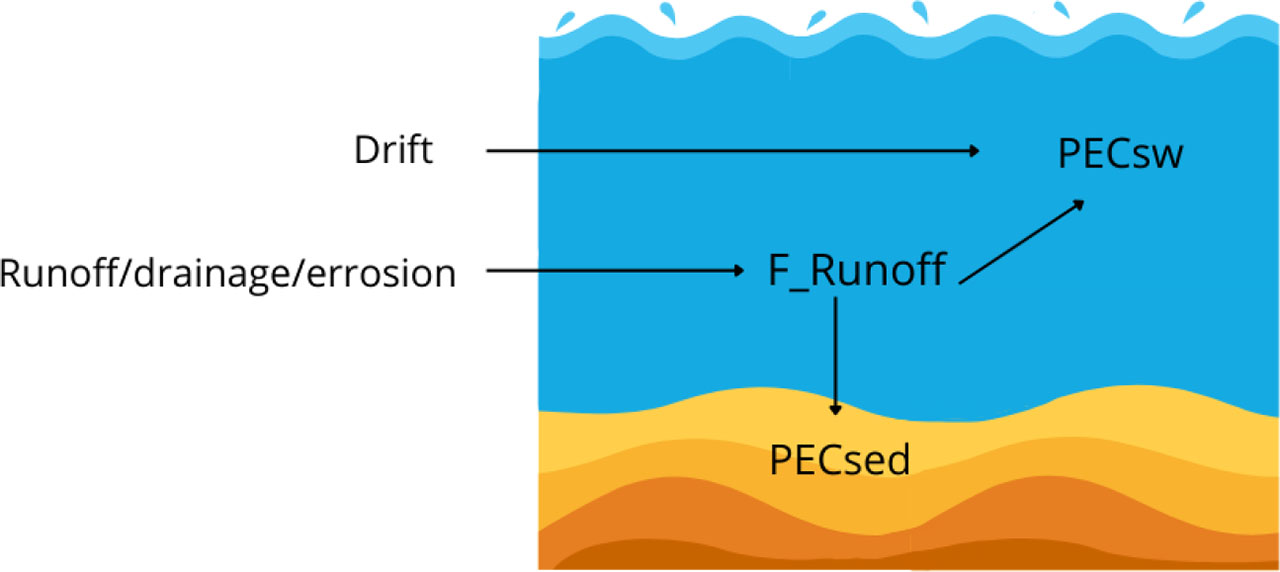
Figure 1.
Model operation scheme for FOCUS Step 1. All entries occur on the same day
In the initial phase, Step 1, the model consolidates inputs from spray drift along with run-off, erosion, and/or drainage into a unified contribution to the adjacent aquatic environment, thus computing the maximum possible concentrations in water.
PECsw - surface water concentration (µg/L); inputrunoff - input via runoff (mg/m2); Frunoff - fraction of compound entering the water phase via runoff (−); inputdrift - input via drift (mg/m2); watdepth - depth of the surface water (cm). Following the initial day, the model accounts for degradation within the water, along with the allocation between the water column, as integral components in determining concentration estimations.
- intfac
Internal factor (−).
Step 2 refines this process, treating inputs as a series of individual loadings and incorporating degradation kinetics. The distribution between water and sediment at loading mirrors Step 1’s methodology, with high Koc compounds being added directly to the sediment (Figure 2). Figure 2 was elaborated based on ANSES’ (project partner) data.
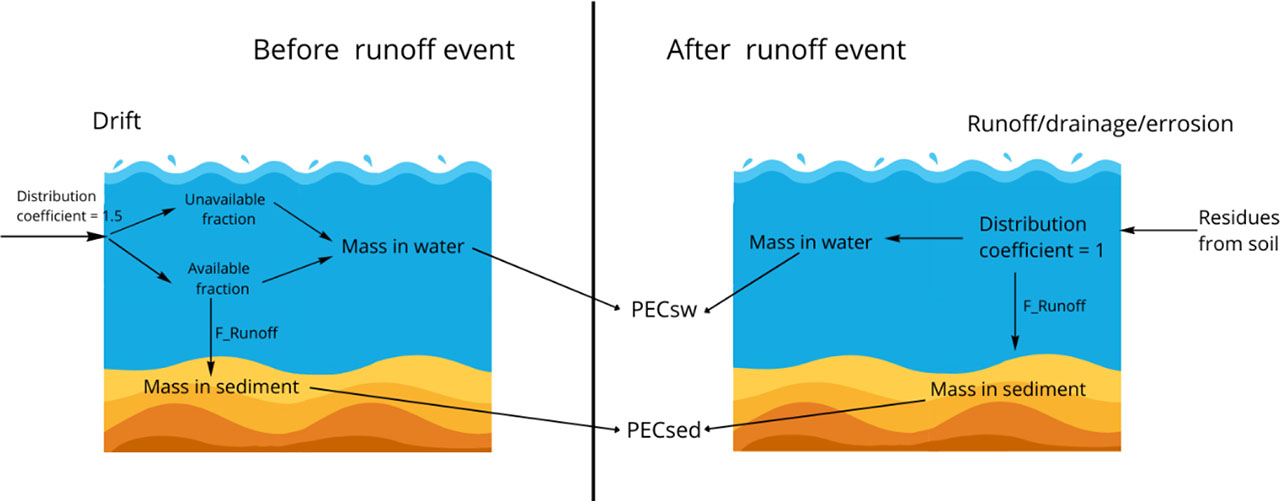
Figure 2.
Model operation scheme for FOCUS Step 2. Loadings based on sequential application patterns
Daily concentrations are calculated from the masses present in the system, before accounting for the distribution between the water and sediment phases.
- PECsw(i)
surface water concentration on day i (µg/L)
- Mass_swint(i)
temporary compound mass in the surface water on day i (mg/m2)
Furthermore, an extended approach in STEPS1–2 addresses the partitioning between water and sediment over subsequent days, recognising that full equilibrium is not immediately established. This nuanced method considers sorption into “available” and “unavailable” compartments (only at Step 2) based on a distribution coefficient, ensuring a realistic simulation of pesticide behaviour in surface water post-application [FOCUS 2001].
The STEP 1–2 model allows for the specification of some physicochemical and environmental fate properties of active substances and their metabolites as inputs. These include:
– Water Solubility,
– Degradation Half-Life (DT50) - the model requires inputs for DT50 in different compartments: soil, water, sediment, and the combined water-sediment system.,
– Sorption Coefficient (Koc).
These parameters are essential for modelling the environmental behaviour of pesticides and are typically derived from laboratory studies and regulatory guidelines. The model allows these parameters to be tailored to the specific substance under assessment, enabling more accurate predictions of environmental concentrations. In addition to substance-specific parameters, the STEP 1–2 model incorporates various crop-related data to simulate realistic agricultural practices and their impact on pesticide fate and transport. These include:
– Crop Type: Users can select from a predefined list of crops, each associated with specific interception rates and growth patterns, reflecting the variability in pesticide exposure due to different agricultural practices.
– Application Rate: This parameter determines the amount of active substance applied per unit area, directly influencing the potential loading to adjacent water bodies.
– Number of Applications and Interval: These inputs simulate the pesticide application regimen, including the frequency and timing of applications throughout the growing season, which are critical for evaluating cumulative exposure and risk.
– Interception: Based on the guidance provided within the model’s documentation, interception rates are selected, reflecting the fraction of the applied substance intercepted by the crop canopy.
The model categorises the agricultural landscape of Europe into northern and southern regions, acknowledging the climatic and agronomic differences that influence pesticide behaviour and exposure. Additionally, it divides the year into three seasons—October to February, March to May, and June to September—to account for seasonal variations in weather conditions and their impact on pesticide fate. By allowing users to input and edit these parameter sets, the STEP 1–2 model facilitates the assessment of pesticide environmental exposure. At Step 1, a 10% runoff value is applied universally, regardless of region or season. At Step 2, the runoff value ranges from 2% to 5%, depending on the specific area and season. The flexibility to adjust substance-specific properties and crop-related data ensures that the model can simulate a wide range of scenarios, from worst-case to more realistic conditions. The STEP 1–2 model’s rigorous methodology and conservative assumptions serve as a harmonised foundation for estimating pesticide concentrations in water and sediment, providing a structured pathway for progressing through the steps of environmental risk assessment for plant protection products.
3.1.2. FOCUS Step 3
FOCUS Step 3 encompasses the following models: SWASH v. 5.3, Drift Calculator, FOCUS PRZM v. 4.3.1, FOCUS MACRO v. 5.5.4, and FOCUS TOXSWA v. 5.5.3. The TOXSWA (TOXic substances in Surface WAters) model is a tool designed to simulate the behaviour and fate of pesticides within surface water bodies, such as ditches, streams, and ponds. It is part of the SWASH (Surface Water Scenario Analysis Shell) software package, which serves as an overarching interface integrating various models and tools required for Step 3 calculations within the FOCUS Surface Water Scenarios framework. TOXSWA operates by processing inputs on pesticide properties, application patterns, methods, and dosages. The core functionality of TOXSWA involves estimating the transport, transformation, and fate of pesticides entering water bodies directly via spray drift or indirectly via drainage, runoff/erosion. These entry routes are initially simulated using the Drift Calculator (incorporated within SWASH) for spray drift and either the MACRO or PRZM model for drainage, runoff/erosion. Subsequently, TOXSWA is used to model pesticide dynamics within water bodies, accounting for processes such as dispersion, sorption to sediments, degradation, and volatilisation.
SWASH plays a critical role in streamlining the workflow by maintaining a central database of pesticide properties and generating the necessary input for TOXSWA, MACRO, and PRZM. It enables the creation of projects that include all Step 3 FOCUS runs required for a particular pesticide-crop combination. The SWASH user interface is linked to a relational database, allowing for access, retrieval, and modification of data. It provides tools for calculating spray drift deposition onto water bodies and generates an overview of all simulations for a specified compound-crop combination through a FOCUS wizard.
The MACRO part of the model is a simulation tool designed to analyse water flow and solute transport in agricultural soils, with particular emphasis on dynamics in unsaturated and saturated zones. This model stands out for its ability to handle complex soil-water interactions, including the formation and dynamics of perched water tables and the flow towards field drainage systems. Its utility is particularly pronounced in evaluating pesticide behaviour and transport in soil, making it an invaluable asset in environmental risk assessment protocols, such as the FOCUS scenarios for groundwater and surface water exposure assessments. Central to MACRO’s approach is the division of soil porosity into two distinct flow systems: macropores and micropores. This dual-domain concept enables MACRO to capture the heterogeneous nature of soil water flow and solute movement more accurately than models that assume a single homogeneous soil matrix. Water flow through micropores is governed by Richards’ equation, which describes unsaturated flow, whereas solute transport follows the convection-dispersion equation. These equations model the slower, more diffusion-driven movement typical of micropores. Conversely, macropore flow, which can be rapid and bypass the soil matrix, is simulated using a simplified capacitance-type approach. This method accounts for the higher fluxes that occur in larger soil voids, such as wormholes or cracks, which are particularly pronounced during heavy rainfall or irrigation events. Exchange processes between the macropore and micropore domains are modelled using approximate, physically based expressions that reflect interactions and mass transfer between these contrasting flow paths. In addition to water flow, MACRO intricately models the fate of pesticides within the soil environment. It employs first-order kinetics to simulate degradation processes in four distinct ‘pools’ or compartments within the soil: the liquid and solid phases of both micro- and macropores. This comprehensive treatment enables detailed simulation of pesticide degradation dynamics, accounting for the specific environmental conditions of each domain. Sorption processes are modelled using an instantaneous sorption equilibrium approach and a Freundlich sorption isotherm, thereby facilitating the evaluation of pesticide partitioning between the soil liquid and solid phases within each pore domain. Within the FOCUS framework, MACRO’s role is to estimate drainage inputs to surface water in six of the ten designated FOCUS surface-water scenarios.
PRZM (Pesticide Root Zone Model) is a one-dimensional model that employs a finite-difference code to simulate a range of hydrological and chemical transport processes, including runoff, erosion, plant uptake, leaching, decay, foliar washoff, and volatilisation. The model accounts for both hydrologic flow and chemical transport, enabling simulation of pesticide advection, dispersion, molecular diffusion, and soil sorption. The model incorporates several advanced features, such as soil temperature effects, volatilisation and vapour-phase transport in soils, irrigation simulation, and a method-of-characteristics algorithm to minimise numerical dispersion. In the context of FOCUS scenarios, PRZM simulates runoff and erosion inputs for aquatic risk assessments in Europe.
TOXSWA (TOXic substances in Surface WAters) is a component of the model designed to elucidate the behaviour of pesticides in edge-of-field water bodies, such as ditches, ponds, and streams. This model is distinguished by its detailed simulation of pesticide concentrations across both water and sediment layers, accounting for horizontal transport in water and for both horizontal and vertical transport in sediment. Transport in the water layer is driven by advection and dispersion, with the addition of diffusion in sediment. TOXSWA’s approach to transformation encompasses hydrolysis, photolysis, and biodegradation, with rates that vary with temperature, providing a realistic depiction of environmental conditions. The model’s sorption process is governed by the Freundlich equation for both suspended solids and sediment. In contrast, pesticides’ movement across the water-sediment interface is modelled through diffusion and advective seepage. TOXSWA’s application is optimised for transient hydrological conditions and pesticide fluxes arising from surface runoff, erosion, drainage, and direct spray drift deposition. The model employs an explicit finite-difference scheme to solve the water-balance and mass-conservation equations, thereby enhancing spatial precision. The TOXSWA software package is integral to the FOCUS Surface Water Scenarios, facilitating pesticide exposure assessments within the EU evaluation process. It operates in conjunction with other models, such as MACRO and PRZM, to calculate pesticide entries via drainage or runoff/erosion, respectively. To facilitate the calculation of PECs, the FOCUS scenarios employ a combination of models: MACRO, PRZM and TOXSWA. These models interact to account for different pathways of contamination into surface water. Depending on the scenario, either MACRO (for drainage scenarios) or PRZM (for runoff scenarios) provides the input file for TOXSWA, which simulates pesticide fate in the adjacent water bodies. An additional component of pesticide loading, spray drift, is also considered, with its contribution integrated into the models via the SWASH graphical user interface (Surface Water Scenarios Help).
The FOCUS models require a comprehensive set of inputs to simulate the behaviour of pesticides across different environmental compartments accurately. Among these inputs, specific parameters are required, whereas others have default values that can be modified to meet specific needs.
Mandatory Inputs for Active Substances:
– Molar Mass
– Saturated Vapour Pressure along with temperature, which was measured at
– Solubility in Water, along with temperature, was measured at
– Kom or Koc (Organic Carbon or Organic Matter to Water Partition Coefficient)
– Freundlich Sorption Exponent
– DT50 for Water, Sediment, and Soil, along with the temperature at which the parameter was measured
– Plant Uptake Factor
FOCUS models come with predefined default values for several parameters. These defaults are based on typical conditions or average values that can be used as a starting point for simulations. However, to tailor model simulations to specific scenarios or to account for the unique properties of a substance, users can modify these default values. This flexibility ensures that the models can be adapted to a wide range of conditions and substances, enhancing their applicability and accuracy in risk assessment. In summary, the FOCUS Step 3 models require detailed input on the physicochemical properties of active substances to accurately simulate their environmental fate. While certain inputs must always be provided by the user, reflecting the specific characteristics of the substance being modelled, others are assigned default values that provide a starting point but can be adjusted to better fit the substance or scenario under study. In addition to precise parameters for active substances, the model requires detailed agricultural data to accurately simulate the environmental fate of pesticides within a specified crop context. These inputs include the crop type, the number of pesticide applications, the interval between applications, and the application rate. Equally critical is the inclusion of the application dates, specifying the day and month of both the initial and final applications, which are pivotal in determining the temporal dynamics of pesticide exposure and degradation. The model requires selecting an application method, offering options including ground spray, granular application, aerial application, soil incorporation, and air blast for tree crops. For a comprehensive risk assessment, the model performs separate calculations for single- and multiple-crop applications.
The FOCUS Surface Water Scenarios are defined by ten realistic worst-case scenarios, identified through expert judgment, to represent the diverse agricultural practices within the EU. These scenarios, designated D1–D6 for drainage and R1–R4 for runoff, represent a cross-section of the environmental and agricultural diversity found across the EU and cover approximately 33% of its agricultural area (FOCUS 2015). Each scenario is characterised by specific soil properties, including annual temperature, rainfall, organic carbon percentage, and topsoil composition, ranging from silty clay in D1 to sandy clay loam in R4. The scenarios also specify the land slope, which affects water flow and pesticide transport, and the associated water bodies, including ditches, streams, and ponds. These environmental parameters are crucial for accurately simulating pesticide fate and transport in agricultural landscapes. The scenarios are designed not to mimic specific fields but to provide a realistic representation of the broad characteristics of EU agriculture. The data for the scenarios originates from specific fields within the EU. The characteristics of water bodies, as defined for use in the TOXSWA model within the FOCUS framework, include ditches, ponds, and streams, each with specific dimensions to standardise scenario analyses. Ditches are designed with a width of 1 meter, a total length of 100 meters, and a distance from the top of the bank to the water of 0.5 meters. This configuration represents typical small water bodies adjacent to agricultural fields, where spray drift or drainage may enter. Ponds have a width of 30 meters, equal to their total length, forming a square water body. The bank’s height above the water level is set at 3.0 meters, indicating a significant depth designed to model static water bodies capable of accumulating runoff, drainage and sediment over time. Streams share a ditch width of 1 meter and a total length of 100 meters, but the distance from the bank to the water surface is 1.0 meters, suggesting a flowing water body with moderate depth. These dimensions provide a consistent basis for simulating the fate of pesticides across different water bodies, ensuring that risk assessments are grounded in realistic yet conservative assumptions about the physical context of pesticide exposure.
3.1.3. PWC v. 2.001
The Pesticide Water Calculator (PWC) integrates the PRZM (Pesticide Root Zone Model) and VVWM (Variable Volume Water Model) to assess pesticide fate and transport in agricultural settings. PRZM simulates pesticide movement through the unsaturated soil zone, accounting for soil properties, weather, and farming practices. VVWM focuses on pesticide fate in surface water bodies, such as ponds and streams, accounting for processes including degradation and sediment interactions. Together, these models provide a comprehensive view of pesticide behaviour in the environment, from application to potential water contamination [Young 2019]. The Pesticide Water Calculator (PWC) model requires input of specific parameters related to the active substance to simulate its behaviour and fate in environmental compartments accurately. These parameters are crucial for understanding the transport, degradation, and persistence of the substance under study. Key parameters required include:
– Sorption Coefficient (Koc/Kd),
– Degradation Half-lives (DT50): in water, sediment, and soil,
– Photolysis and Hydrolysis Half-lives (DT50),
– Foliar Half-life,
– Molecular Weight,
– Solubility and Vapour Pressure,
– Henry’s Law Constant,
– Air Diffusion Coefficient
– Heat of Henry.
PRZM5, a complex model designed to evaluate the impact of agricultural pesticides, integrates hydrology, heat, and solute dynamics within a one-dimensional framework. It employs the NRCS curve number and the Universal Soil Loss Equation for predicting runoff and erosion, ensuring a comprehensive water balance by accounting for precipitation, evapotranspiration, irrigation, and runoff. Inputs like daily weather conditions are essential for its operation. The model’s approach facilitates vertical movement of water and dissolved pesticides, simulating processes such as degradation and volatilisation, using daily time steps for precision.
In PRZM5, crop growth is modelled to increase proportionally from emergence to maturity, with emphasis on canopy coverage and root depth. The maximum values for both are set at crop maturity and remain constant until harvest, at which they reset to zero. This approach accommodates crops with varying canopy behaviour, such as apple trees, where “harvest” refers to leaf fall rather than fruit collection. PRZM5 simulates irrigation through two main types: over-canopy and under-canopy, affecting water and pesticide dynamics differently. Over-canopy irrigation may cause pesticide washoff from plant surfaces, while under-canopy irrigation targets soil directly, avoiding foliar washoff. Irrigation events are automatically managed based on soil moisture deficits and exclude days with precipitation.
The model offers four irrigation options, each adjusting water application based on soil moisture needs, canopy interception, and leaching requirements, with user-defined limits on water application rates to prevent runoff. PRZM5 initiates its precipitation analysis by categorising incoming moisture as either snow or rain based on the ambient temperature. When the air temperature drops below freezing (0°C), precipitation contributes to snowpack formation. Conversely, a temperature above 0°C causes the snowpack to melt. To quantify the melting rate of accumulated snow, PRZM5 uses the degree-day method, linking melt directly to prevailing temperature, in accordance with USDA guidelines established in 2004. This approach ensures a dynamic and temperature-responsive simulation of snow accumulation and dissolution within the model’s environmental parameters. PRZM5 divides precipitation into two categories: water that infiltrates the soil and surface runoff, using the NRCS Curve Number (CN) method. Within this framework, all forms of moisture—be it from rain, irrigation, or snowmelt—are equivalently considered as precipitation. Consequently, the total rainfall calculated for runoff estimations includes these three moisture sources. The daily adjustment of the CN value, essential for runoff estimation, is directly influenced by prevailing soil moisture, ensuring that the model’s runoff predictions accurately reflect changing environmental conditions. Once runoff calculations are completed, PRZM5 allocates any surplus water (i.e., the difference between precipitation/overhead irrigation and runoff) to the crop canopy’s water-holding capacity. While, in practice, canopy interception precedes runoff, the CN method implicitly integrates canopy interception, thereby pre-estimating runoff volumes for specified precipitation events. This approach ensures that the model accounts for the crop canopy’s water-retention capacity in simulating hydrological processes. In the PRZM5 model, evaporation processes are systematically addressed by first applying potential evapotranspiration calculations to the plant canopy and subsequently to the soil, depending on the available moisture content. The model employs the daily pan evaporation data, alongside a pan coefficient, to represent potential evapotranspiration, which mirrors the evaporation potential from well-hydrated natural surfaces. When potential evaporation exceeds the water content within the canopy, the deficit is allocated to soil moisture, in accordance with the principle of priority for surface and available water. This methodology simulates natural plant and soil water interactions, emphasising the proportional distribution of evapotranspiration in accordance with both soil depth and moisture availability [Young, Fry 2020]. In PRZM5, vertical water movement is modelled using a simplified approach termed the “capacity model” or “tipping bucket” methodology. This approach ensures that water movement within any segment of the soil is governed by a principle of continuity. Specifically, the water content at any location within the soil column is initially determined by the water infiltrating from the layer above. Erosion simulation retaining only two options: the Modified Universal Soil Loss Equation (MUSLE) and the Multiple Source Sediment (MUSS).
Time of Concentration: Velocity Method - The concept of Time of Concentration (Tc) represents the duration needed for water to traverse from the most distant point of a watershed to a specified point of interest within that same watershed. This duration is influenced by the watershed’s geometric shape, its topographical features, and the nature of its surface coverage. In calculating Tc, PRZM5 aggregates travel times across segments of the watershed’s flow path. Specifically, PRZM5 distinguishes two primary flow regimes: an initial sheet flow phase covering the first 100 meters, followed by a phase of shallow concentrated flow across the remainder of the watershed’s hydraulic length, typically characterised by unpaved surfaces. This bifurcated approach allows for a nuanced understanding of water movement across varied terrains within the watershed.
Time of Concentration: Watershed Lag Method - The Watershed Lag method, detailed in NEH-4, provides a streamlined approach for evaluating hydrological processes without the complexity of numerous parameters. This method is explicitly tailored to agricultural settings, focusing on broad-scale assessments rather than detailed site-specific analyses. This approach aligns with the needs of agrarian runoff studies, which emphasise general trends rather than precise, location-specific characteristics.
In PRZM5, soil temperature is simulated to account for temperature-dependent processes such as volatilisation and degradation. The model aims to accurately predict daily average temperatures at the soil surface and within or beneath the root zone. It utilises fundamental soil physical and thermal characteristics along with daily climate data from weather stations. PRZM5 determines the soil temperature profile by incorporating various factors such as air temperature, solar radiation, surface reflectivity, wind speed, evaporation rates, moisture content, and soil physical attributes. It calculates daily values for the bottom boundary temperature and soil surface reflectivity by interpolating monthly data, incorporating crop canopy reflectivity and an evaporation adjustment to refine the canopy albedo estimates. PRZM5 incorporates a range of pesticide application methods to accommodate various agricultural practices and to ensure a realistic simulation of pesticide dispersion in the environment. These methods include: Below Crop (Ground Application), Above Crop (Foliar Application), Uniform Below Crop, T-Band Application, @Depth, Increasing to a Depth and Decreasing to a Depth. PRZM5 incorporates an algorithm to anticipate and adjust pesticide application timing in response to forecasted heavy rainfall to prevent potential washoff. This feature assesses upcoming weather conditions and postpones applications ahead of significant rainfall events forecast within a predefined lookahead period. For instance, if a significant rainfall event is expected soon after the planned application date, the model suggests an alternative application date, either before or after the initially scheduled date, to avoid the rainfall. This predictive adjustment continues, scanning both forward and backwards in time from the original date, until an optimal application day is identified within a set window. If no suitable day is found within this window, the model defaults to the original application date, irrespective of forecast weather conditions, to mimic realistic agricultural practices in which applications are unlikely just before heavy storms. The degradation of chemicals in PRZM5 is modelled using a first-order kinetic model, with solutions determined analytically. For foliar washoff of pesticides, the model allocates residues based on the proportion of available pore space in the soil profile, up to a depth of 2 cm. This method involves estimating the pore space in each soil compartment within this depth range and distributing the washed-off pesticide across these compartments in alignment with the available pore space. PRZM5 models changes in soil chemical mass resulting from multiple environmental processes, including runoff, erosion, volatilisation, and degradation. It employs a traditional vertical transport model for solutes, incorporating advection, dispersion, and elimination mechanisms. The elimination mechanisms encompass degradation and extraction via runoff, erosion, and plant absorption. Furthermore, PRZM5 is equipped to handle nonlinear sorption isotherms and dynamic sorption equilibria, thereby enhancing its ability to simulate complex soil-chemical interactions accurately. PRZM5 employs a sophisticated approach to simulate the volatilisation of chemicals, focusing on the vapour-phase movement of pesticides within the soil-plant environment. This simulation accounts for various processes, including the transfer of pesticides from the soil to the air, diffusion of pesticide vapours within the plant canopy, and the exchange of pesticide mass between the foliage and the surrounding air. Additionally, it considers the impact of soil temperature on pesticide volatilisation, providing a comprehensive model for understanding how pesticides may vaporise and move within agricultural settings.
The Pesticide Water Calculator (PWC) model integrates location-specific meteorological data files to simulate environmental conditions that affect pesticide behaviour. These files adhere to a structured format encompassing Month, Day, Year, Precipitation (cm/d), ET0 (cm/d), temperature (°C), wind speed (cm/s), and solar radiation (La/d), providing a comprehensive dataset for accurate simulations. Additionally, the model incorporates predefined scenarios based on the sorption coefficient (Koc) values, categorised into three ranges: below 100, between 100 and 3000, and above 3000. These scenario files are tailored to different crop types, reflecting variations in scenario latitude, hydro factor, irrigation practices, and soil layer characteristics, ensuring the model’s adaptability to diverse agricultural settings.
Meteorological files, essential for modelling the dynamic interplay between climate variables and pesticide fate, are prepared to reflect the unique environmental conditions of different crop systems. By selecting scenario files corresponding to specific Koc intervals, PWC allows for the nuanced simulation of pesticide transport and degradation across various soil types and environmental conditions. The Pesticide Water Calculator (PWC) is designed to estimate Predicted Environmental Concentrations (PECs) for ponds and reservoirs, employing distinctive characteristics for each water-body type to simulate pesticide fate and transport accurately. For ponds, which are generally smaller and shallower, PWC defines a standard scenario with a field area of 100,000 square meters and a water body area of 10,000 square meters. The initial and maximum depths are set at 2 meters, with a length of 356.8 meters, characterising a common agricultural retention pond. In contrast, the reservoir scenario, representing larger water bodies like natural or artificial lakes, specifies a field area of 1,728,000 square meters and a water body area of 52,600 square meters. The depths of reservoirs range from 2.74 meters to a maximum of 600 meters, with a significant length of 600 meters to accommodate the larger-scale water management required for drinking water supply or irrigation. These settings enable PWC to simulate pesticide behaviour in water bodies of varying sizes and hydrological characteristics, providing data for environmental risk assessments (Model PWC, www.epa.gov).
3.1.4. EXPRESS v. 1.03.02
The EXPRESS program, also known as the EXAMS - PRZM Exposure Simulation Shell, is a tool developed to facilitate Tier II assessment of aquatic pesticide exposure. It integrates the Pesticide Root Zone Model (PRZM) with the Exposure Analysis Modelling System (EXAMS) to simulate the movement and fate of chemicals in agricultural settings. EXPRESS enables simulation of multiple crop scenarios in a single run, providing analysis of pesticide behaviour in both soil and aquatic environments. Key features include the ability to run ecological and drinking-water scenarios, simulate parent pesticides and their degradates, and provide graphical and tabular results.
The PRZM and EXAMS models work in tandem to simulate the environmental fate of chemicals, particularly pesticides, within unsaturated soil systems and aquatic ecosystems, respectively. PRZM dynamically models the movement of chemicals through soil, with a focus on the root zone and the immediate subsurface. On the other hand, EXAMS assesses how these chemicals behave in aquatic environments, considering various limnological factors that affect chemical transport and degradation. Outputs from these simulations include annual peak concentrations, average concentrations over varying durations, and upper-percentile concentrations for risk assessment against ecotoxicological and human-health benchmarks. The PRZM-EXAMS runoff modelling scenario delineates the impact of an agricultural field on adjacent aquatic environments to evaluate risks to drinking water and marine life. It integrates the PRZM and VADOFT models to simulate pesticide movement and degradation within the crop root zone and unsaturated soils, accounting for runoff and sediment transport. This approach leverages diverse datasets, including historical weather patterns, to model pesticide behaviour over extended periods, thereby enabling a comprehensive exposure analysis. The process simulates pesticide dynamics, including transport, volatilisation, and degradation.
The EXPRESS model is designed for Tier II aquatic pesticide exposure assessments across various geographical and agronomic conditions. It was developed through collaboration between the U.S. EPA’s Office of Pesticide Programs and Office of Research and Development. EXPRESS facilitates the use of PRZM and EXAMS models, along with meteorological databases for detailed simulation scenarios. While it also supports GENEEC2 and FIRST models, EXPRESS primarily focuses on providing a structured approach to model setup and results interpretation for PRZM and EXAMS, without offering a graphical user interface for the Tier I models [Burns 2006]. Scenarios in EXPRESS are characterised by specific criteria, including the state, crop type, soil properties, meteorological data, and the Major Land Resource Area (MLRA). With approximately 85 standard scenarios currently integrated into EXPRESS, these settings provide a comprehensive basis for assessing aquatic pesticide exposure across diverse geographic and agronomic contexts. Notably, scenarios include additional parentheses with abbreviations to denote the state in which meteorological parameters were studied, for example, OR for Oregon. The EXPRESS program in PRZM requires the user to input specific chemical parameters. These include molecular weight, solubility, Koc/Kd (sorption coefficient), vapour pressure, degradation half-life for both dissolved and sorbed phases, plant uptake factor, foliar half-life, foliar washoff coefficient, air diffusion coefficient, and enthalpy of vaporisation. The EXPRESS program’s Environmental Fate (Efate) Input interface facilitates input of transformation process half-lives, which EXAMS then converts into rate constants. Properties such as solubility, Koc, and vapour pressure are carried over from PRZM Chemical Parameters. For transformation products and metabolites, half-lives are input separately for each chemical, with a limit of three chemicals per simulation. Zero values indicate inactive transformation processes. Hydrolysis simulation requires entering non-zero half-lives at three different pH levels, with EXPRESS allowing up to 10 such entries. Hydrolysis inputs must be consistent across the specified pH values for accurate rate-constant calculations, and metabolic half-lives must account for hydrolysis contributions.
The Pesticide Application Data interface in the model requires inputs such as the total number of pesticide applications, specific application timings, application method, application rate, and depth of incorporation. Users can choose among four application methods: aerial, ground sprayer, airblast, and other equipment. For Tier II assessments, default drift percentages are preset for aerial and ground sprayer applications, specifically for pond and reservoir scenarios, with corresponding efficiency rates. Application dates can be scheduled using absolute calendar dates or relative to key crop growth stages, such as planting or emergence, enabling adaptable scenario configurations across crops. This system ensures accurate application timing aligned with crop phenology, detailed within the scenario files. For Tier I evaluations of pesticide presence in drinking water, the Office of Pesticide Programs (OPP) employs the FIRST model, based on an “Index Reservoir” approach incorporating Per cent Cropped Area factors to reflect specific crop cultivation within watersheds. This model, alongside PCA, integrates into EXPRESS Tier II analyses for comprehensive exposure assessments. The Index Reservoir, exemplified by Shipman City Lake in Illinois, mirrors the characteristics of several central Midwest reservoirs susceptible to pesticide pollution and is intended to represent the 90th percentile of vulnerability for pesticide runoff into surface waters.
3.1.5. GERDA v. beta 28 January 2018
The GERDA (GEobased Runoff, Erosion, and Drainage risk Assessment for Germany) model is still under development and has not been officially released. It is being shared for this project’s purposes and is made available through the courtesy of Fraunhofer-IME and the German Environment Agency (Umweltbundesamt). The GERDA assessment scheme, developed for evaluating surface water exposure from pesticide inputs in Germany, incorporates runoff, erosion, drainage, spray drift, and atmospheric deposition. It uses the PRZM and MACRO models for exposure assessment, selecting soil-climate scenarios statistically to predict environmental concentrations (PECs) between the 83rd to 93rd percentiles. GERDA’s calculations cover approximately 132,000 km2 of agricultural area, using weather data from 1982–2011, with the aim of selecting a percentile-based, statistically reliable scenario. This scheme is encapsulated in the GERDA v.1 software.
The GERDA model uses a percentile-based statistical method to select soil-climate scenarios for exposure evaluation. This process begins with an analysis of the distribution of soil properties and climate elements that are crucial for understanding pesticide runoff, erosion, and drainage losses across all areas where pesticides are applied in Germany, including arable lands and specialised cultures. Soil data are classified according to the Soil Map of Germany 1:1 million (BUEK1000), utilising the 102 FOOTPRINT Soil Types framework to categorise diverse soil properties. Concurrently, climate elements are organised into 12 distinct clusters. Each cluster is then associated with a representative climate station, ensuring thorough and representative sampling of Germany’s diverse climatic conditions. The process involves a detailed simulation approach to assess the environmental exposure of ‘virtual’ plant protection products (PPP) in Germany, utilising the PRZM and MACRO models for predicting edge-of-field losses in both liquid phase and sediment. Here are the basic steps:
– Simulation of Virtual PPP Applications: A total of 360 hypothetical applications of PPPs are created. These applications are defined by tiered combinations of crop characteristics, soil organic carbon-water partition coefficient (Koc), half-life of the pesticide (DT50), and the month of application. These combinations are applied across all soil-climate scenarios in Germany.
– Use of PRZM and MACRO Models: For each of these virtual PPP applications, the models PRZM (to simulate runoff and erosion losses) and MACRO (to simulate drainage losses) are used. These models use 30 years of weather data (1982–2011) to simulate losses at the field edge.
– Generation of Cumulative Distribution Functions (CDFs): The simulations yield 360 CDFs for PRZM and 288 CDFs for MACRO. These CDFs represent the spatiotemporal cumulative distribution of substance losses across Germany, offering a comprehensive overview of potential environmental exposure
– Exposure Assessment for New Substances: When assessing the exposure of a new substance with the GERDA tool, the model selects from these CDFs. Specifically, it selects the soil-climate combinations that correspond to the 80th spatial and 80th temporal percentiles (i.e., the 6th-highest value among 30 annual maxima) of the virtual PPP applications. The selection is based on the similarity of the crop/Koc/DT50/application-month properties of the virtual PPPs to those of the new substance.
The exposure assessment for evaluating the risk of pesticide exposure in surface waters employs a sophisticated modelling approach that integrates multiple models to simulate how pesticides enter and affect aquatic environments. Initially, the process uses selected soil-climate combinations to model pesticide entry into surface waters via runoff & erosion, and drainage, utilising PRZM and MACRO, respectively. This step captures the direct movement of pesticides from agricultural lands into nearby water bodies [Bach et al. 2017]. Beyond these direct pathways, the assessment considers additional routes through which pesticides can reach surface waters. This includes the calculation of pesticide input via spray drift during application and atmospheric transport, modelled using the EVA model. The latter accounts for pesticides that are carried by air currents and eventually deposited into water bodies, highlighting the complex dynamics of pesticide dispersal in the environment.
To quantify the impact of these pesticide inputs, the GERDA model is used to calculate PECs in water (PECsw) and in sediments (PECsed) for typical surface-water scenarios, such as streams and ditches. A 30-year weather time series informs this calculation and follows methodologies aligned with regulatory guidelines, ensuring a comprehensive and realistic assessment. The assessment extracts critical endpoints from these simulations, including PECsw, PECsed, and the Time-Weighted Average Concentrations (TWAC) in both surface water and sediment. The GERDA model simulates the environmental fate of active substances by requiring detailed input parameters describing their physicochemical properties, degradation rates, and interactions with environmental compartments. Key parameters required include:
– Molecular mass (g/mol)
– Water solubility at 20°C (mg/L) with reference temperature (°C)
– Molar enthalpy of dissolution (J/mol)
– DegT50 in sediment/water system (d)
– DegT50 in water (d) with reference temperature (°C)
– DegT50 in sediment (d) with reference temperature (°C)
– DegT50 in soil (d) with reference temperature (°C)
– KOC (L/kg)
– Diffusion coefficient in water (m2/d)
– Diffusion coefficient in air (m2/d)
– Plant uptake factor (−)
– Foliar Washoff coefficient (1/mm)
– Freundlich exponent (−)
– Q10-factor
– Foliar dissipation half-life (d)
– Vapour pressure with reference temperature (°C)
– Molar enthalpy of vaporisation (J/mol)
In the GERDA model, parameterisation of the application scenario is also crucial, requiring the user to specify a range of data regarding the use of the active substance. This includes information on the dosage, number of applications, and the interval between them. Furthermore, the user must define the type of crop, which allows for the consideration of specific conditions and exposure to that plant, as well as the interception rate, reflecting the plant’s ability to retain particles on its surface. The application method and date are other parameters that influence the distribution and availability of the substance in the environment. Users have the option to choose the application date by referring to a relative application window in relation to key crop development stages, such as emergence, maturity, or harvest, or by specifying the month of application.
3.1.6. EXPOSIT v. 3.02 and EVA v. 3 (rev 2h)
The EXPOSIT 3.02 and EVA 3 (rev 2h) models are the designated tools for the national authorisation process of plant protection products in Germany and Switzerland. The model accommodates the selection of active substances with specific, experimentally determined lower elimination factors for bank infiltration, enhancing the model’s adaptability to varied data sets [www.bvl.bund.de]. The EXPOSIT model is designed to simulate the environmental behaviour of active substances in PPP over a standardised application area of 1 hectare. It considers the interval between the application of the substance and the occurrence of a runoff-triggering rain event, set at 3 days (excluding the pre-emptive application of fungicides with a DT50soil of less than 10 days), ensuring that soil degradation between multiple applications is considered. The model incorporates the process of erosion into its calculations by assuming a specific precipitation scenario: continuous rain of 20 mm within 24 hours, including 9 mm classified as heavy rain lasting 15 minutes, occurring once a year, which facilitates the washing away of particle-bound active substances from the application area. For runoff calculations, the model identifies soils with small particle sizes (e.g., loess and clay), soils in proximity to groundwater, and compacted soils as particularly susceptible to runoff, even on flat or nearly flat terrain. In these runoff-prone areas, a constant, location-independent transport of the active substance is assumed as a worst-case scenario. Losses of the active substance are categorised into those occurring via runoff (dissolved phase) and erosion (particle-bound phase). The model leverages the identified relationship between the availability of the active substance in the soil and its Koc value, noting that runoff availability decreases with increasing sorption, resulting in a lower concentration of the active substance in the dissolved phase. EXPOSIT further assumes that, depending on the Koc, a portion of the substance bound to particulates enters water bodies, thereby increasing bioavailability to filter feeders. For substances with a Koc above 50,000, particulate-bound substances are considered non-bioavailable in Germany.
Regarding drainage, EXPOSIT distinguishes between total runoff, which includes active substance losses via drainage for all precipitation events post-application, and peak loads, which only consider heavy rain events of 20 mm. The model also features a water body, represented as a ditch running parallel to the application area, with assumptions made about its dimensions, water flow during precipitation events, and a dilution ratio of 1:2. Specific dimensions and density characterise the sediment within this water body, and in scenarios involving a buffer strip, the model assumes diffuse runoff distribution across a buffer area with permanent and dense vegetation, unaffected by compaction or traffic lanes. This setup presupposes that non-destructive soil preparation is carried out perpendicular to the slope, enhancing the environmental safety assessment of plant protection products by providing a detailed framework for predicting the transport and fate of active substances under various soil and precipitation conditions. The EXPOSIT model operates through an Excel spreadsheet framework, requiring users to input specific information about the active substance in question. Critical parameters such as the soil adsorption coefficient (Koc), the half-life of the substance in soil (DT50 soil), and its water solubility are essential inputs. The model is designed to accommodate scenarios involving either a single application of the PPP or multiple applications. Users must enter the substance’s dosage and interception rate. Based on these inputs, the model calculates the PEC values, providing a detailed assessment of the potential environmental impact of the active substance under study.
The EXPOSIT model yields three primary PEC outcomes: PECini ditch, PEC runoff, and PEC runoff+erosion, each reflecting the environmental impact of an active substance due to different transport mechanisms to water bodies. PEC Runoff quantifies the concentration of the active substance that reaches water bodies via runoff and is considered water-available. However, it posits that the substance embedded in sediment is unavailable to aquatic life, limiting its relevance primarily to scenarios with minimal contact between invertebrates and sediments or particle-bound active substances. This implies that for aquatic invertebrates that do not interact intensively with sediments, PEC runoff values are applicable for assessing exposure risk. PEC Runoff+Erosion represents the total concentration of the active substance entering water bodies via both runoff and erosion. This measure assumes that active substances attached to eroded soil particles are accessible to invertebrates (filter-feeders) unless evidence suggests reduced availability (e.g. for substances with Koc above 50,000) or ecotoxicological activity. It underscores a broader environmental impact, considering both dissolved substances and those bound to particles, providing a comprehensive assessment of exposure risks to aquatic invertebrates.
For drainage scenarios, the result is referred to as PECini ditch, indicating the concentration of the active substance in ditch water following drainage events. This measure is crucial for understanding the potential for environmental exposure through water movement in specific drainage contexts.
The EVA model is a computational tool for estimating the deposition of active substances from plant protection products via drift and volatilisation in non-target areas. This model, named EVA3, calculates PECs and Toxicity Exposure Ratios (TERs) for both adjacent aquatic environments (e.g., water bodies and sediment) and terrestrial ecotones. The calculations are based on established fundamental drift values and empirical models that track deposition following volatilisation. EVA3 allows detailed input on application patterns, supporting up to 12 applications with varying rates, intervals, and drift scenarios. Users can select between different measurement units for application rates and opt between PEC for active concentration (PECact) and time-weighted average concentration (PECtwa) for deposition assessments in water bodies. The model also identifies deposition post-volatilisation scenarios that consider either the single application with the highest rate or the one leading to the highest concentration due to spray drift, helping in defining a “realistic worst case”. User inputs on ecotoxicity and required safety factors further aid in computing TER values for aquatic or terrestrial organisms, thereby highlighting the application conditions required to maintain acceptable risk levels. Additionally, EVA3 includes a separate worksheet for time-resolved deposition values following volatilisation, accessible via a toggle button labelled “vd”. The program operates primarily through Excel, requiring macros to be enabled for certain functionalities. In the EVA model, data entry is structured for user accessibility and calculation accuracy. Input cells are designated in light blue within the program’s interface; users enter essential data, while non-essential fields may remain empty, with default values automatically applied to the calculation processes. In the EVA model, users can input chemical properties such as DT50 water, vapour pressure, and solubility, along with associated temperatures. Additionally, the user can characterise the crop by providing information on the type of cultivation, application rate, number of applications, application intervals, and interception.
To aid in the calculation of sediment-bound PEC (PECsed), specific compound parameters are input on the ‘sed’ worksheet. This sheet captures details that influence the compound’s behaviour in sediment environments. The application rate, drift scenarios, and application intervals are entered on the ‘main’ sheet, with the first value for each parameter being critical and subsequent cells inheriting the previous value if left blank, indicating continuity in application strategy. The EVA model employs a method for calculating pesticide deposition following spray drift, based on the German drift model. The model stratifies volatilisation rates by vapour pressure (VP) at 20 °C, with specific thresholds to categorise compounds as non-volatile, semi-volatile from plant or soil surfaces, or volatile. The vapor pressure categories define the potential for a substance to transition into a gaseous state and are used as trigger values for model calculations: substances with VP less than 10−5 Pa are considered non-volatile; between 10−5 Pa and 10−4 Pa, they are semi-volatile from plant surfaces; between 5 × 10⁻³ Pa and 10−4 Pa, they are semi-volatile from both plant and soil surfaces; and those with VP equal to or greater than 5 × 10⁻³ Pa are classified as volatile. Adjustments within the model account for differences in volatilisation from various surfaces; it posits that volatilisation from plant surfaces is three times higher than from soil surfaces. The model also differentiates between crop types, with volatilisation from high crops such as orchards, vines, and hops deemed twice as high as that from arable crops, which is accounted for by assigning a worst-case interception value.
The dynamics of pesticide residues in non-target areas are modelled using first-order kinetics, with default settings that use total deposition over 24 hours post-application to calculate PEC values. However, for compounds with very short DT50 values (less than 1 day), the model adjusts to account for less deposition during this time frame. For aquatic environments, PEC values are determined for a standardised model of a ditch with set dimensions, specifically one meter in width and 30 centimetres in depth, assuming no water flow. In the EVA model, the risk assessment process is user-driven. Toxicity Exposure Ratios (TER) or the ratios of Predicted Environmental Concentration to Regulatory Acceptable Concentration (PEC/RAC) are computed by incorporating established ecotoxicological effect values and assessment factors, as per the TER criteria. The EVA3 model suggests risk mitigation strategies in line with German risk management protocols.
3.1.7. PEC CKB
The PEC-CKB developed by Boström et al. (2019) is a simple model that estimates PEC values for plant protection products in surface water based on a single equation, briefly defined as follows:
To obtain a dilution factor, the proportion of the catchment area that is annually sprayed f [−] is divided by the duration of the spraying period Ns [weeks] and the weekly runoff factor q [m/week]. The mass introduced is obtained by multiplying the annual application dose D [g/ha] by a generic factor, which represents the proportion of the applied dose that is lost to surface water, Mw[−]. To account for the specific sorption behaviour of the substance, the factor Fw[−] is included. It calculates the dissolved fraction of the substance’s mass using a simple equilibrium adsorption equation
where Zw represents the water depth [m], Zs the thickness of adsorbing sediments [m], γ denotes the bulk density [g/cm3] and foc the organic carbon content [kg/kg]. Koc is the substance-specific partitioning constant between carbon and water [L/kg]. FOCUS assumptions have been used to simplify equation (2): Zw=0.3m, Zs=1mm, γ=0.8 g/cm3 and foc=0.05 kg/kg. Based on the parameter assumptions f=20%, Ns=4 weeks, q=0.001m/week and M=1% from Boström et al., the equation can be simplified toApplication rates for PEC CKB calculations were taken from the proposed scenarios.
3.1.8. Simple PEC model
For the Simple PEC model, application rates were taken from the proposed scenarios. Drift values corresponding to crop type and application number were taken from ESCORT 2 (Table 3, [Candolfi et al. 2001]. It can also be calculated using equations provided by Rautmann et al. [Rautmann et al. 2001].
Table 3.
Basic drift values in the authorisation procedure for plant protection products [Candolfi et al. 2001]
| Distance [m] | Field crops | Fruit crops | Grapevine | Hops | Vegetables/Ornamentals/Small fruit | |||
|---|---|---|---|---|---|---|---|---|
| early | late | early | late | <50 cm | ≥50 cm | |||
| Basic drift values for one application Ground sediment in % of the application rate (90th percentiles) | ||||||||
| 1 | 2,77 | 19,33 | 2,77 | |||||
| 3 | 0,95 | 29,20 | 15,73 | 2,70 | 8,02 | 19,33 | 0,95 | 8,02 |
| 5 | 0,57 | 19,89 | 8,41 | 1,18 | 3,62 | 11,77 | 0,57 | 3,62 |
| 10 | 0,29 | 11,81 | 3,60 | 0,39 | 1,23 | 5,77 | 0,29 | 1,23 |
| 15 | 0,20 | 5,55 | 1,81 | 0,20 | 0,65 | 3,84 | 0,20 | 0,65 |
| 20 | 0,15 | 2,77 | 1,07 | 0,13 | 0,42 | 2,49 | 0,15 | 0,42 |
| 30 | 0,10 | 1,04 | 0,54 | 0,07 | 0,22 | 0,56 | 0,10 | 0,22 |
| 40 | 0,07 | 0,52 | 0,32 | 0,04 | 0,14 | 0,25 | 0,07 | 0,14 |
| 50 | 0,06 | 0,36 | 0,24 | 0,03 | 0,09 | 0,15 | 0,06 | 0,09 |
| 75 | 0,04 | 0,20 | 0,11 | 0,015 | 0,05 | 0,04 | 0,04 | 0,05 |
| 100 | 0,03 | 0,30 | 0,06 | 0,007 | 0,033 | 0,02 | 0,03 | 0,033 |
| 125 | 0,025 | 0,03 | 0,04 | 0,007 | 0,024 | 0,01 | 0,025 | 0,024 |
| 150 | 0,021 | 0,021 | 0,03 | 0,005 | 0,018 | 0,004 | 0,021 | 0,018 |
| 175 | 0,018 | 0,018 | 0,024 | 0,004 | 0,013 | 0,004 | 0,018 | 0,013 |
| 200 | 0,016 | 0,016 | 0,019 | 0,003 | 0,011 | 0,003 | 0,016 | 0,011 |
| 225 | 0,014 | 0,008 | 0,016 | 0,003 | 0,008 | 0,002 | 0,014 | 0,008 |
| 250 | 0,012 | 0,006 | 0,013 | 0,002 | 0,008 | 0,001 | 0,012 | 0,008 |
| Basic drift values for two applications Ground sediment in % of the application rate (82nd percentiles) | ||||||||
| 1 | 2,38 | 17,73 | 2,38 | |||||
| 3 | 0,79 | 25,53 | 12,13 | 2,53 | 7,23 | 17,73 | 0,79 | 7,23 |
| 5 | 0,47 | 16,87 | 6,81 | 1,09 | 3,22 | 9,60 | 0,47 | 3,22 |
| 10 | 0,24 | 9,61 | 3,11 | 0,35 | 1,07 | 4,18 | 0,24 | 1,07 |
| 15 | 0,16 | 5,61 | 1,58 | 0,18 | 0,56 | 2,57 | 0,16 | 0,56 |
| 20 | 0,12 | 2,59 | 0,90 | 0,11 | 0,31 | 1,21 | 0,12 | 0,31 |
| 30 | 0,08 | 0,87 | 0,40 | 0,06 | 0,19 | 0,38 | 0,08 | 0,19 |
| 40 | 0,06 | 0,40 | 0,23 | 0,03 | 0,12 | 0,19 | 0,06 | 0,12 |
| 50 | 0,05 | 0,22 | 0,15 | 0,02 | 0,08 | 0,09 | 0,05 | 0,08 |
| 75 | 0,03 | 0,07 | 0,07 | 0,01 | 0,04 | 0,03 | 0,03 | 0,04 |
| 100 | 0,023 | 0,04 | 0,04 | 0,008 | 0,03 | 0,02 | 0,023 | 0,03 |
| 125 | 0,019 | 0,02 | 0,024 | 0,005 | 0,02 | 0,007 | 0,019 | 0,02 |
| 150 | 0,015 | 0,01 | 0,018 | 0,004 | 0,015 | 0,005 | 0,015 | 0,015 |
| 175 | 0,013 | 0,01 | 0,013 | 0,003 | 0,011 | 0,004 | 0,013 | 0,011 |
| 200 | 0,012 | 0,005 | 0,011 | 0,003 | 0,009 | 0,003 | 0,012 | 0,009 |
| 225 | 0,010 | 0,004 | 0,008 | 0,002 | 0,007 | 0,002 | 0,010 | 0,007 |
| 250 | 0,009 | 0,003 | 0,006 | 0,002 | 0,007 | 0,001 | 0,009 | 0,007 |
3.1.9. EUSES
The European Union System for the Evaluation of Substances (EUSES) is software that helps chemical companies, authorities, and research institutes conduct assessments of the risks posed by chemical substances to the environment. EUSES facilitates the quantitative assessment of the dangers posed by new and existing substances and biocides to man and the environment. Risks to man pertain to consumers, workers and people exposed through the environment. Protection goals in the environment include sewage treatment plant populations of microorganisms, aquatic, terrestrial, and sediment ecosystems, and predator populations. This assessment includes the marine environment. The system can be used to conduct tiered risk assessments of increasing complexity, with corresponding data requirements. Parametrisation used in the EUSES program
Assessment mode: Environmental, regional scale Run mode: interactive, add defaults
For ditch/pond scenario
Defaults – Regional and continental distribution – Areas:
| Area (land+rivers) of regional system | 0.1 | [km2] | S |
| Area fraction of freshwater, region (excl. sea) | 1E-03 | [−] | S |
| Area fraction of natural soil, region (excl. sea) | 0.01 | [−] | S |
| Area fraction of agricultural soil, region (excl. sea) | 0.979 | [−] | S |
| Area fraction of industrial/urban soil, region (excl. sea) | 0.01 | [−] | S |
| Length of regional seawater | 1E-06 | [km] | S |
| Width of regional seawater | 1E-06 | [km] | S |
| Area of regional seawater | 1E-06 | [km2] | S |
| Area (land+rivers+sea) of regional system | 0.1 | [km2] | S |
| Area fraction of freshwater, region (total) | 1E-03 | [−] | O |
| Area fraction of seawater, region (total) | 1E-05 | [−] | O |
| Area fraction of natural soil, region (total) | 0.01 | [−] | O |
| Area fraction of agricultural soil, region (total) | 0.979 | [−] | O |
| Area fraction of industrial/urban soil, region (total) | 0.01 | [−] | O |
For the stream scenario
| Area (land+rivers) of regional system | 0.1 | [km2] | S |
| Area fraction of freshwater, region (excl. sea) | 9E-03 | [−] | S |
| Area fraction of natural soil, region (excl. sea) | 0.01 | [−] | S |
| Area fraction of agricultural soil, region (excl. sea) | 0.971 | [−] | S |
| Area fraction of industrial/urban soil, region (excl. sea) | 0.01 | [−] | S |
| Length of regional seawater | 1E-06 | [km] | S |
| Width of regional seawater | 1E-06 | [km] | S |
| Area of regional seawater | 1E-06 | [km2] | S |
| Area (land+rivers+sea) of regional system | 0.1 | [km2] | S |
| Area fraction of freshwater, region (total) | 1E-03 | [−] | O |
| Area fraction of seawater, region (total) | 1E-05 | [−] | O |
| Area fraction of natural soil, region (total) | 0.01 | [−] | O |
| Area fraction of agricultural soil, region (total) | 0.979 | [−] | O |
| Area fraction of industrial/urban soil, region (total) | 0.01 | [−] | O |
The assumption is that the calculations are done for a 10 ha field with the water body – a ditch/pond or a stream. The surfaces of the waterbodies are calculated according to the dimensions for waterbodies in FOCUS, as presented in the Generic Guidance for FOCUS Surface Water Scenarios, version 1.4, May 2015 [FOCUS 2015].
4. SUMMARY
The review demonstrated that numerous computational tools exist for predicting pesticide concentrations in surface waters; however, their suitability varies considerably depending on the purpose and level of detail of the risk assessment. Among the 47 identified programs, nine models were considered the most relevant and applicable for both regulatory and research use. The models FOCUS Step 1–2, PEC-CKB, and Simple PEC provide rapid first-tier screening, whereas FOCUS Step 3, PWC, and EXPRESS enable more realistic scenario-based analyses. The GERDA model and the EXPOSIT–EVA system are applied within national risk assessment frameworks, while EUSES supports evaluations at the regional scale. Sorption and degradation parameters were identified as key determinants of PEC values, underscoring the importance of accurate parameterisation and transparent documentation of input data. Employing a tiered modelling approach–from conservative screening to realistic scenario simulations– ensures scientific consistency and regulatory compliance in the environmental risk assessment of plant protection products. Selecting the most appropriate model for calculating PEC in surface waters requires further work, including test calculations with selected models.
Notes
[1] Financial disclosure FUNDING SOURCES
This work was carried out in the research project PARC – Partnership for the Assessment of Risks from Chemicals. The work was financially supported by the European Union Programme “Horizon Europe” and Funds from the Ministry of Education and Science: Co-financed international projects.