
1. INTRODUCTION
In Europe, an apparent decline in the population of hares, pheasants and partridges has been observed for over 50 years, which also applies to the vast majority of areas in Poland [Burel, Baudry 1990; Dziedzic et al. 2002; Nasiadka, Dziedzic 2014; Demirbas 2015; Ewald et al. 2020]. Although the downward trend continues in most European countries, the reasons for this state of affairs have not yet been determined. The most frequently mentioned are the intensification of agriculture, and thus the loss of essential habitats; urbanization; water, air and soil pollution; as well as progressive climate change, which also hurts population processes, including reproduction [Panek 1997; Bro et al. 2001; Bro et al. 2005; Stonemason et al. 2013; Albrecht et al. 2016; Ewald et al. 2020]. Another critical factor is the significant increase in predation by foxes, raccoon dogs and birds of prey. Poaching and other hunting pests are also substantial, as are many other less frequently described factors, which, having a comprehensive impact, can significantly influence the dynamics of the numbers of individual species [Tapper et al. 1996; Stonemason et al. 2013; Nasiadka, Dziedzic 2014].
Due to the ongoing decline or stabilization at low levels of small game density for many years, hunters are taking many initiatives to manage their populations, in order to stop and reverse the continuing unfavorable trend. Initially, the priority was to limit hunting and, in many regions of the country, stop hunting by shooting or trapping. At the same time, to meet the described problems, hunters have undertaken many initiatives in active protection to prevent the unfavorable trend of declining numbers. Undoubtedly, the most spectacular challenge in this regard is the reintroduction of small game to areas where the decline in numbers is most noticeable. For many years, pheasants have been introduced into natural habitats, and in recent years, hares and partridges have also been introduced more and more often [Buner et al. 2005; Flis 2018].
The study aimed to assess the activities of hunters in terms of all initiatives undertaken in the field of populating hunting districts with the earliest essential species of small game, thus shaping and protecting biodiversity.
2. MATERIAL AND METHODS
The analysis was based on data from hunting reports regarding the dynamics of the number of hares, pheasants and partridges in areas leased by hunting clubs throughout the country [Panek, Budny 2023; Panek unpublished data 2024]. Leased areas constitute approximately 95% of all places where hunting occurs. An analysis was also made of the hunting acquisition of the described species and the acquisition of game predators contributing to the deepening decline of small game. Data from the last decade were used for the analyses (i.e., hunting seasons 2014/15–2023/24).
Data on the number of game animals come from annual inventories carried out by hunters in spring and constitute the basis for managing individual species during the hunting season. Although there are no accurate inventory methods, and these data may be subject to slight errors, in the long term they indicate specific trends in a given population and thus allow for measures to optimize the management of individual species. In turn, data on the shooting of individual species of small game and game predators come from hunting reports and indicate the level of hunting pressure on individual species, especially predators, to maintain ecological balance in predator-prey relationships [Panek, Budny 2023; Panek unpublished data 2024].
3. RESULTS AND DISCUSSION
Over the last decade, hunters’ interest in taking initiatives to settle hunting districts with small game has decreased (Fig. 1). The level of colonization of hunting grounds with hares dropped very dramatically. Between the periods compared, the decrease amounted to almost 95%. In the case of pheasants, a 76% decrease was recorded, while in the case of partridges, it was 63%. The reintroduction of small animals is one of the most important measures to reduce the declining population trend that has been going on for many years.
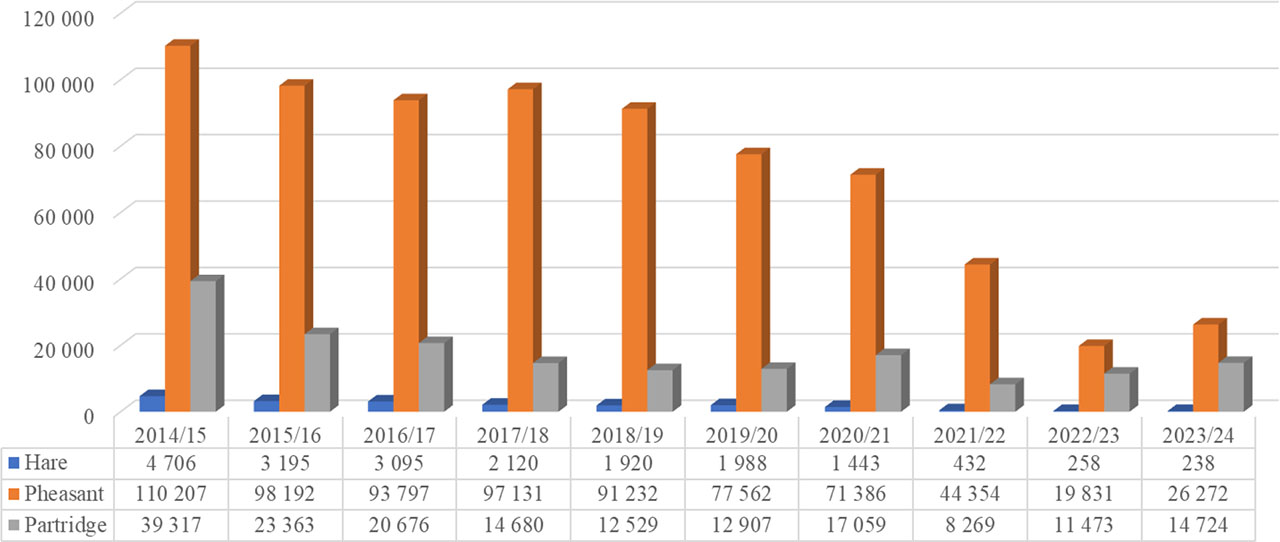
Figure 1.
Population of small game carried out by hunters over the last decade
It is difficult to show a significant decline in hunters’ interest in repopulating small game hunting grounds. However, legal changes regarding invasive alien species should not be ruled out, as these regulations have made introducing pheasants and the subsequent hunting of these animals much more difficult. Also important is the fact that the financial resources of hunting clubs are decreasing: the main reason for this is the poor economic situation on the game market and, above all, the annually increasing liabilities of hunting clubs in connection with the payment of compensation for damage to crops and agricultural produce [Flis 2023a; 2023b; 2023c]. In the case of settlements, it becomes quite problematic to determine the effectiveness of such procedures and their impact on the further functioning of the population. In the case of pheasants, many years of repopulation campaigns have undoubtedly influenced the current numerical status, and thus, the decline in the number of this species is the smallest [Flis 2012; Flis 2018; Kamieniarz 2022].
Data regarding the estimated number of the described species for the last decade indicate that there has been an almost 30% increase in the number of hares. In the case of pheasants, during this period, there was a specific stabilization of the population with an increase in numbers of almost 6%. In turn, in the case of partridges, even though settlements were carried out throughout the entire decade, spring population estimates indicate an over 11% decline in numbers (Fig. 2). This is confirmed by the trend line equations determined for the numbers of individual species. At the same time, it should be noted that many hunting clubs decided to suspend hunting for hares and partridges as part of efforts to save small game. Pheasants are usually harvested in areas where settlements have been carried out, and partridges only where the numbers are satisfactory enough to organize one or two hunts, and the harvest itself is symbolic. According to hunting reporting data, in the 2022/23 hunting season, hares were not hunted at all in 3 hunting districts (Jelenia Góra, Szczecin and Wałbrzych districts), while in another dozen or so districts, the harvest did not exceed 20 individuals per season, and it was in the districts located in the western and northern part of the country. In the same hunting season, partridges were not hunted in 33 (out of 49) hunting districts, and in another 11 districts, the shooting did not exceed 20 birds per season. The highest acquisition through shooting was recorded in the Leszno and Lublin districts, and slightly lower in the Kielce, Piotrków and Radom districts [Panek, Budny 2023].
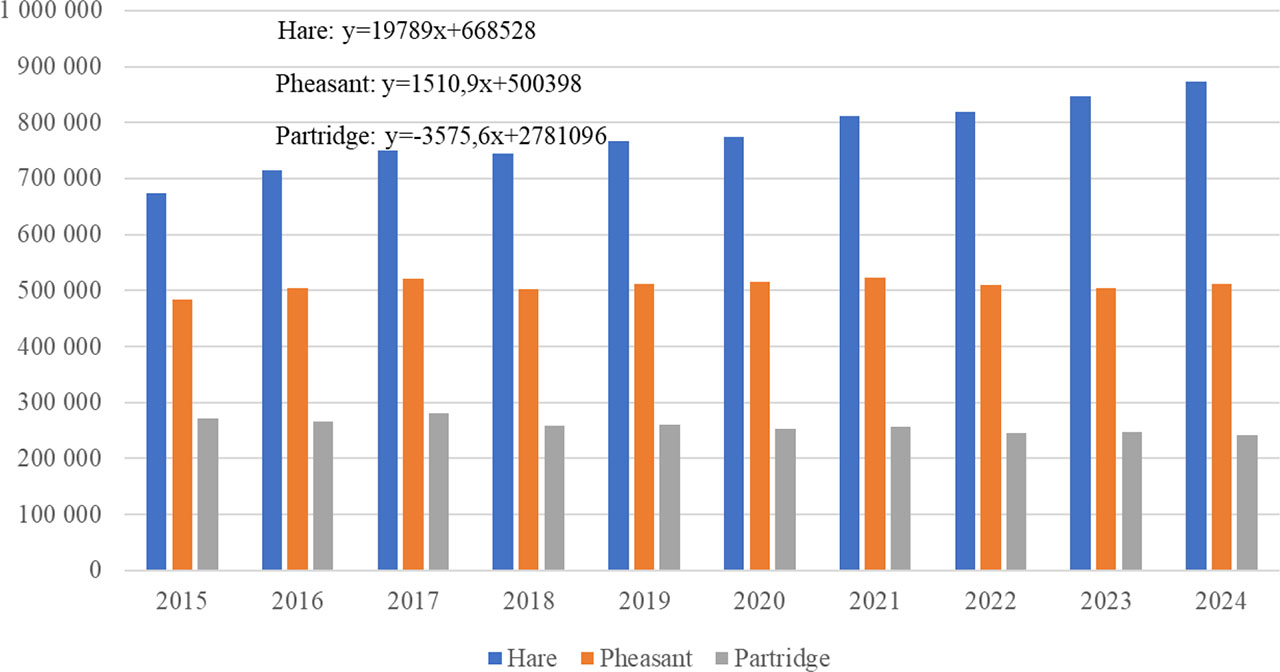
Figure 2.
Dynamics of the number of basic small game species over the last decade
Another quite important issue is the fact that hunters, as part of the protection of biodiversity and even rescue activities, every year carry out activities aimed at intensifying the hunting of game predators (Fig. 3). During the period covered by the assessment, there was an increase in the shooting of foxes, which is confirmed by the value of the trend line equation: y = 2061.2x + 139469. Unfortunately, in the same period, the shooting of raccoon dogs showed a downward trend. Still, since 2022, the raccoon dog has been an invasive alien species. These data may be erroneous due to the lack of harvest recording in the hunting documentation [Reg. Council of Ministers of December 9, 2022]. The intensification of hunting, especially for foxes in small game introduction areas, affects the effectiveness of these treatments because the fox is indicated as the main factor limiting the populations of these species [Panek 2000; Panek 2013; Nasiadka, Dziedzic 2014]. At the turn of the last decade, it was shown in many countries that the most significant adverse impact on small game concerns predation by free-living foxes [Reynolds, Tapper 1995; Panek 2013; Dembiras 2015]. Research conducted in southern England showed that in the diet of foxes, medium-sized mammals – mainly rabbits – accounted for 74% of the diet. In comparison, the share of pheasants accounted for from 34 to 81% of the estimated spring biomass [Baker et al. 2006]. In turn, in Australia, where the fox was introduced artificially, its diet is dominated by mammals (70%) and birds (13%), and there were quite significant differences depending on the habitat [Fleming et al. 2021]. The assessment of the composition of the fox diet based on 66 studies in 17 European countries showed that it changes depending on geographical latitude and human influence. However, the essential components of the diet are still lagomorphs and birds [Soe et al. 2017].
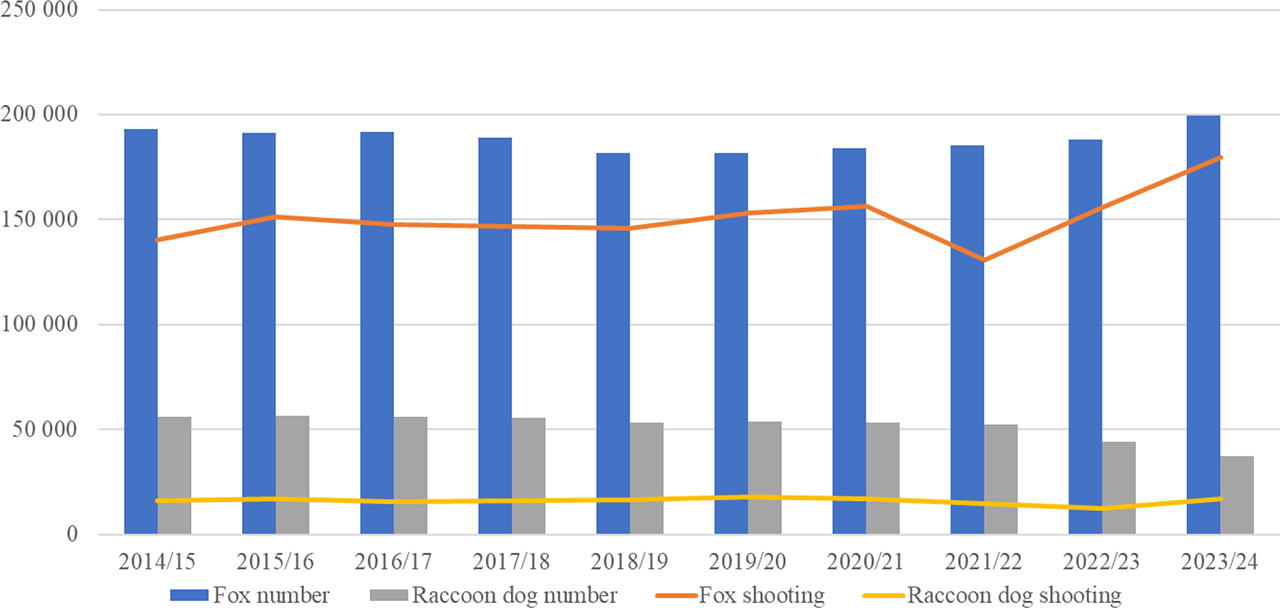
Figure 3.
The number and shooting of foxes and racoon dogs over the last decade
Another quite critical element of hunters’ activities in the field of biodiversity protection is the intensification of shooting the dynamically developing raccoon population (Fig. 4). Although raccoon predation on hares has not been confirmed, given the fact that its diet consists of breeding ground-nesting birds, it may pose a potential threat to pheasants and partridges [Okarma et al. 2012]. Over the last decade, although hunting pressure by shooting this predator has increased by over 1000%, an increasing trend in the population and dispersion to new areas is still observed. Over the last decade, the population has increased almost three times. In turn, in the 2022/23 hunting season, the shooting of at least one raccoon was recorded in 32 districts, while a year earlier, it was in 28 districts, confirming this species’ ongoing expansion towards the east [Panek, Budny 2023].
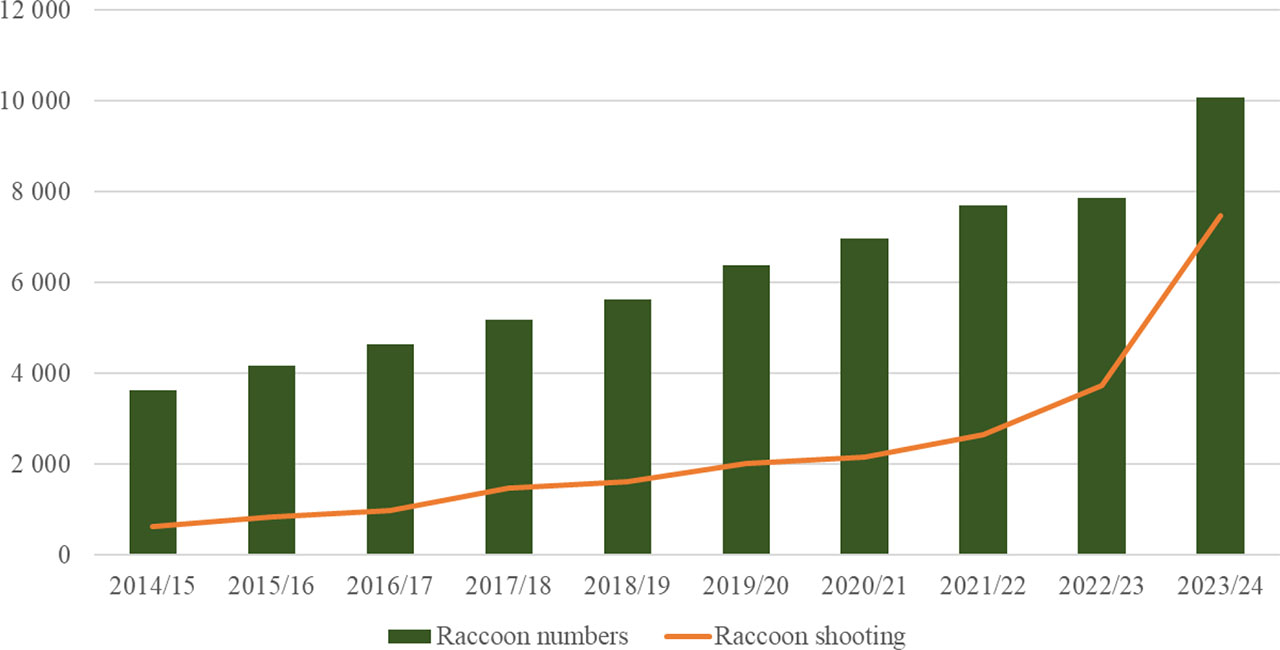
Figure 4.
Number and shooting of raccoons over the last decade
In the case of predation on small game, predators known as synanthropic predators – stray dogs and cats – are becoming increasingly important. Flis and Rataj [2019] reported that the number of stray dogs in Poland was 42,000, and over 90,000 dogs let loose. These authors state that, on average, approximately 33,000 are killed in Poland each year by game animals of various species. These results were also confirmed in other studies from this region [Wierzbowska et al. 2016]. Research conducted in central Poland showed that stray dogs organize themselves in groups to hunt, and their most common prey was deer, followed by hares and birds [Krauze-Gryz, Gryz 2014]. Stray and wandering cats are also a huge threat to local and global biodiversity. This problem has been growing in recent years, and the consequence is a decline in the population of some mammals and birds that become prey to these animals [Kamieniak et al. 2016; Trouwborst et al. 2020]. Research on the cats’ diet indicates these animals’ significant role as predators. Research results from central Poland showed that, on average, farm cats bring home 583 million mammals and 135 million birds, which are eaten mainly by them [Krauze-Gryz, Gryz 2014; Krauze-Gryz et al. 2019].
4. CONCLUSIONS
The analyses indicate that hunters manage small game using sustainable development principles. Annual inventories allow for the detection of long-term trends in population dynamics, which in turn provides for appropriate actions to be taken in protection or sustainable hunting exploitation. It should also be emphasized that in the case of small game, due to the decline of essential species that has been going on for many years, these activities focus on stopping hunting or significantly limiting it and taking initiatives in active protection. Undoubtedly, one of the most important is the annual reintroduction of hares, pheasants and partridges, combined with the intensification of the reduction of game predators that threaten these populations, as well as other mammals and birds. Even though over the last decade, due to economic reasons and legal difficulties in this area, the involvement of hunters in purchasing and stocking small game has decreased significantly, such initiatives are still carried out. It should also be noted that despite legal changes, hunters still intensively fight game predators and those referred to as invasive alien species, which significantly affects the ecological predator-prey relationship, in many cases allowing the latter’s survival. Such activities are entirely within the scope of protecting and shaping biodiversity.