
Table 1.
The results of the repeated measures, analysis of variance. “R1” represents the wastewater treatment effect, and “quarter” refers to the quarter of the year. Significant effects are bolded. Following symbols denote: df – degrees of freedom, F – F-statistic, p – p-value
| Effect | df | F | p | |
|---|---|---|---|---|
| Zn (N = 138) | Intercept | 1 | 948.19 | <0.001 |
| Quarter | 3 | 1.23 | 0.302 | |
| Error | 133 | - | - | |
| R1 | 1 | 7.07 | 0.009 | |
| R1*Quarter | 3 | 4.32 | 0.006 | |
| Error | 133 | - | - | |
| Pb (N = 123) | Intercept | 1 | 708.47 | <0.001 |
| Quarter | 3 | 1.88 | 0.138 | |
| Error | 118 | - | - | |
| R1 | 1 | 2.09 | 0.151 | |
| R1*Quarter | 3 | 0.19 | 0.905 | |
| Error | 118 | - | - | |
| Cd (N = 88) | Intercept | 1 | 411.53 | <0.001 |
| Quarter | 3 | 0.96 | 0.414 | |
| Error | 83 | - | - | |
| R1 | 1 | 2.78 | 0.099 | |
| R1*Quarter | 3 | 1.87 | 0.141 | |
| Error | 83 | - | - | |
| Cu (N = 137) | Intercept | 1 | 969.36 | <0.001 |
| Quarter | 3 | 0.26 | 0.857 | |
| Error | 132 | - | - | |
| R1 | 1 | 14.19 | <0.001 | |
| R1*Quarter | 3 | 0.10 | 0.960 | |
| Error | 132 | - | - | |
| Cr (N = 121) | Intercept | 1 | 707.04 | <0.001 |
| Quarter | 3 | 0.34 | 0.794 | |
| Error | 116 | - | - | |
| R1 | 1 | 1.80 | 0.183 | |
| R1*Quarter | 3 | 2.18 | 0.095 | |
| Error | 116 | - | - | |
| Ni (N = 125) | Intercept | 1 | 635.60 | <0.001 |
| Quarter | 3 | 1.48 | 0.222 | |
| Error | 120 | - | - | |
| R1 | 1 | 17.16 | <0.001 | |
| R1*Quarter | 3 | 0.47 | 0.707 | |
| Error | 120 | - | - | |
| Mn (N = 138) | Intercept | 1 | 1600.64 | <0.001 |
| Quarter | 3 | 0.16 | 0.923 | |
| Error | 133 | - | - | |
| R1 | 1 | 61.15 | <0.001 | |
| R1*Quarter | 3 | 1.28 | 0.285 | |
| Error | 133 | - | - |
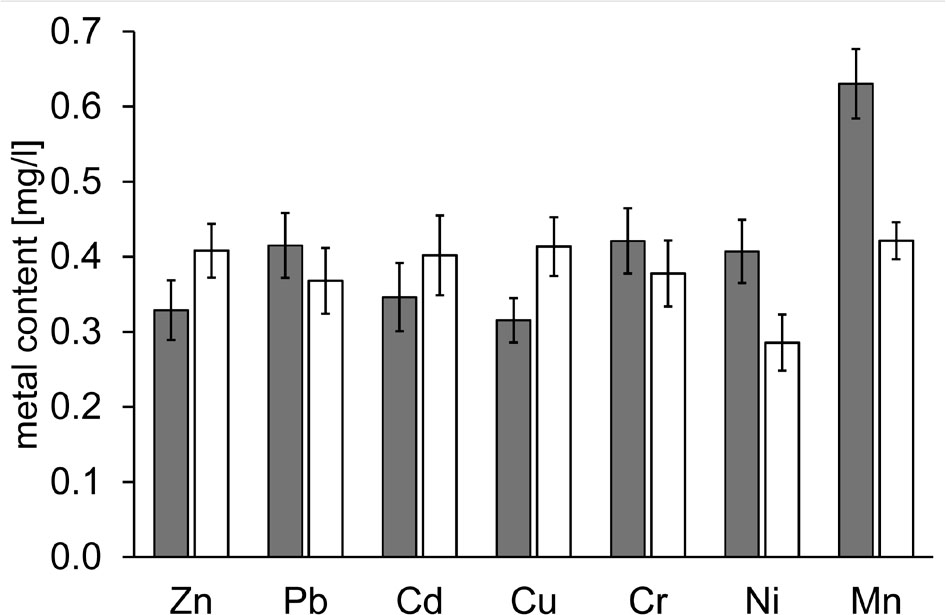
Figure 1.
The heavy metal content in raw and treated wastewater. The means with 95% confidence intervals. Grey bars represent raw wastewater and white bars represent treated wastewater
Table 2.
Compliance with the heavy metal content standard in sewage sludge originating from municipal wastewater treatment. Results of the one-sample t-test relative to a constant reference value – the norm. N denotes sample size. SE denotes Standard error, t indicates t-statistic, and p indicates p-value
| Mean [mg/l] | SE | Reference value [mg/l] | N | t | p | |
|---|---|---|---|---|---|---|
| Zn | 1,148.97 | 42.39 | 2,500 | 70 | 31.87 | <0.001 |
| Pb | 68.86 | 3.90 | 750 | 70 | 174.48 | <0.001 |
| Cd | 4.06 | 1.45 | 20 | 70 | 11.03 | <<.001 |
| Cu | 170.82 | 7.95 | 1,100 | 70 | 104.35 | <0.001 |
| Cr | 81.46 | 11.37 | 500 | 70 | 36.82 | <0.001 |
| Ni | 34.12 | 2.33 | 300 | 70 | 113.89 | <0.001 |
| Hg | 0.98 | 0.06 | 16 | 70 | 261.84 | <0.001 |
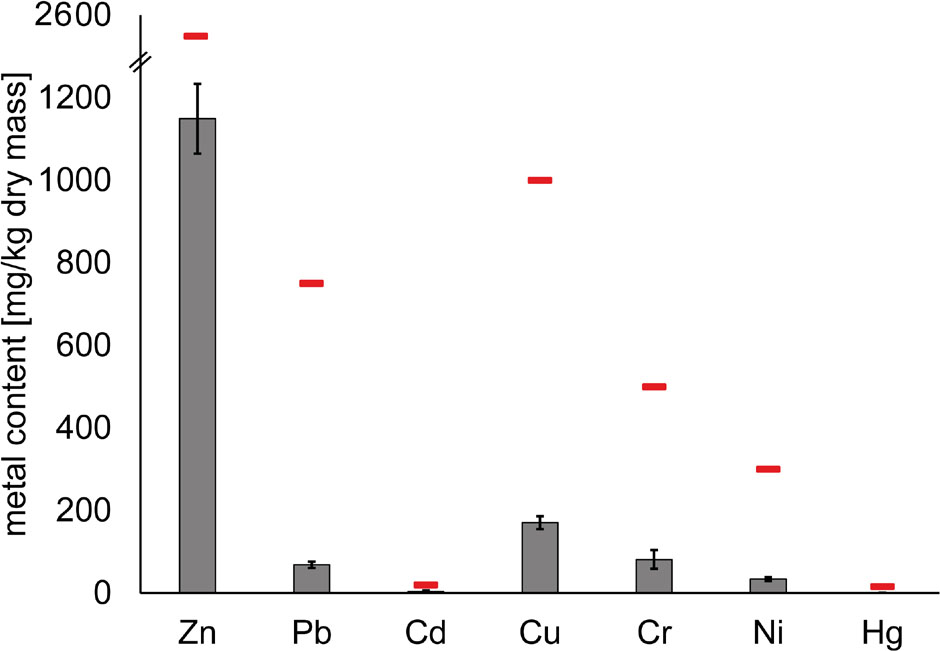
Figure 2.
The heavy metal content in sewage sludge from municipal wastewater treatment. The means with 95% confidence intervals. If the upper limit of the confidence interval is below the value of the standard, it means that the standard is met, if the confidence interval overlaps the value of the standard, it means that the standard is not met, but the metal content is close to the standard, in the situation when the lower limit of the confidence interval is above the value of the standard, it means that the metal content significantly exceeds the standard. The upper bound of the confidence interval falls below the standard (red line), indicating that the metal content in the sludge is statistically significantly lower than the maximum permissible content
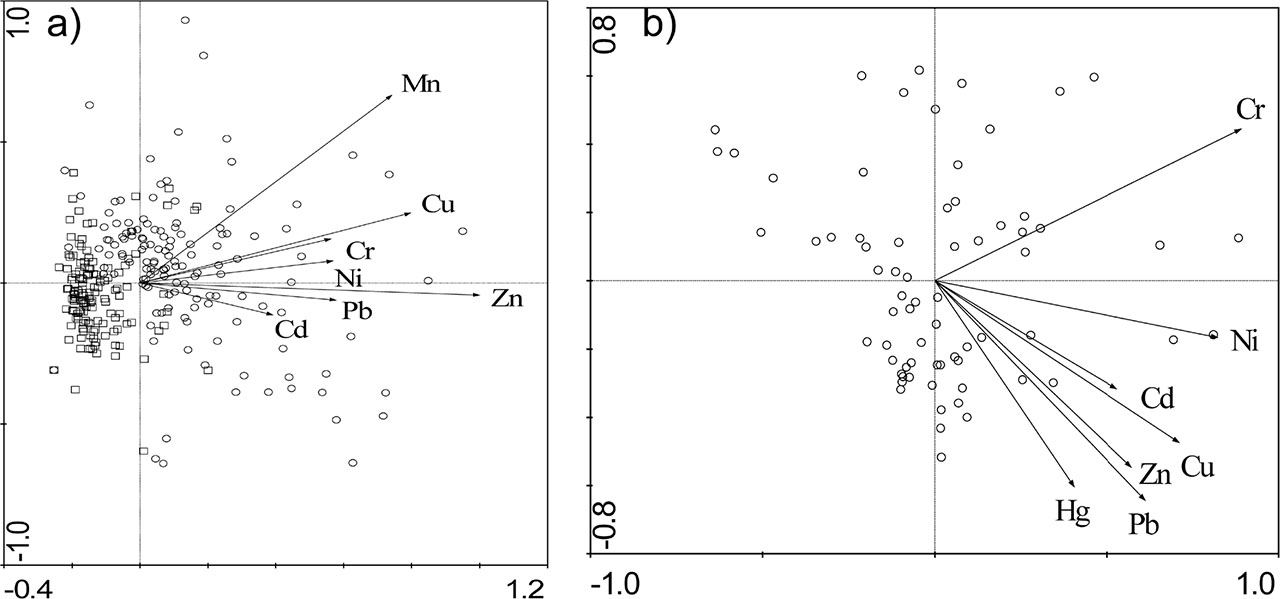
Figure 3.
PCA analysis results. Ordination diagrams showing the first and second ordination axes: (a) for wastewater, (b) sewage sludge. For diagram (a), circles represent raw wastewater and squares represent treated wastewater