
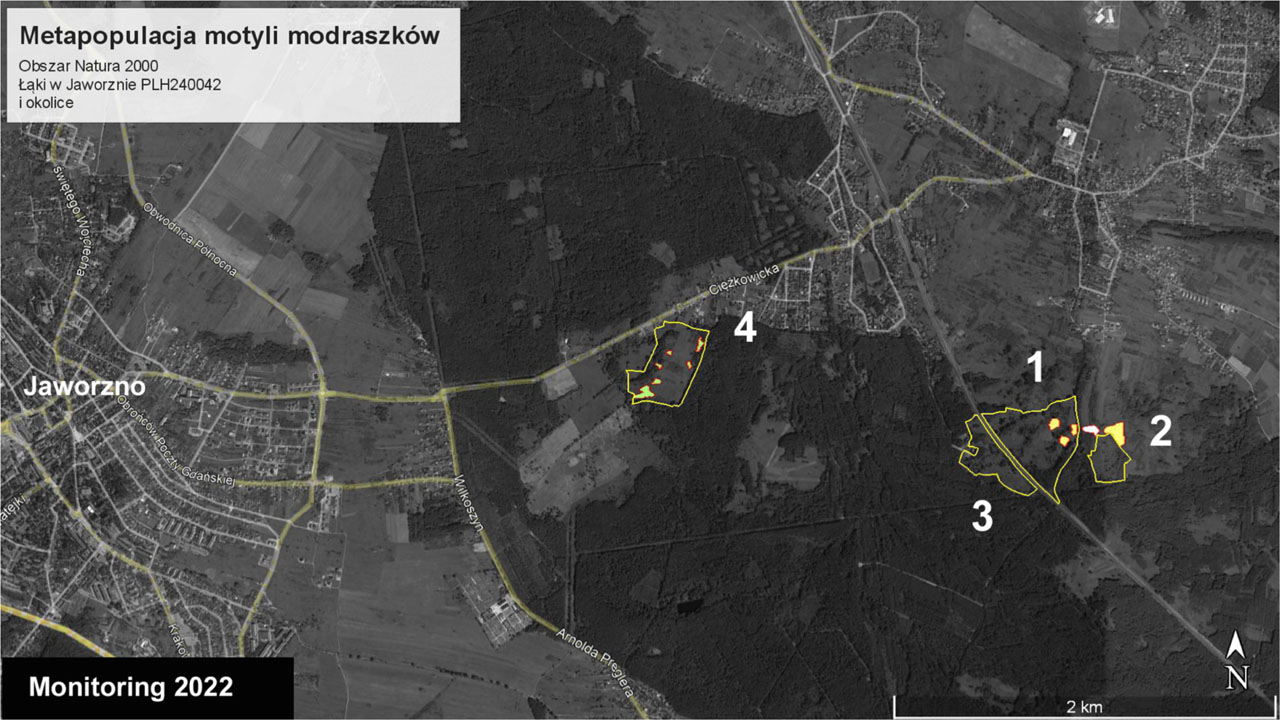
Figure 1.
The location of surveyed habitat patches where the abundance of Ph. nausithous and Ph. teleius populations was studied: (a) Location of patches in individual parts 1–4 of the Natura 2000 site “Łąki w Jaworznie” PLH240042; (b) Complex of patches JA - Jaworzno Górka; (c) Complex of patches JB - Łąki Ciężkowickie.
Table 1.
Population sizes with 95% confidence intervals of Ph. nausithous butterfly in habitat patches within the Natura 2000 site “Łąki w Jaworznie” PLH240042 and its vicinity in the year 2022.
| ID | Patch area [ha] | Sex | N | CI − | CI + | Density [ind*ha−1] |
|---|---|---|---|---|---|---|
| J1A | 0.159 | M | 56 | 39 | 80 | 553 |
| F | 32 | 15 | 67 | |||
| J2A | 0.057 | M | 62 | 34 | 113 | 2193 |
| F | 63 | 35 | 114 | |||
| J3A | 0.062 | M | 24 | 12 | 45 | 871 |
| F | 30 | 18 | 51 | |||
| J4A | 0.109 | M | 31 | 19 | 51 | 532 |
| F | 27 | 15 | 48 | |||
| J5A | 0.413 | M | 208 | 119 | 363 | 918 |
| F | 171 | 84 | 348 | |||
| J6A | 0.072 | M | 41 | 33 | 50 | 1306 |
| F | 53 | 46 | 63 | |||
| J1B | 0.167 | M | 33 | 22 | 49 | 293 |
| F | 16 | 8 | 35 | |||
| J2B | 0.204 | M | 13 | x | x | 123 |
| F | 12 | x | x | |||
| J3B | 0.274 | M | 61 | 23 | 165 | 453 |
| F | 63 | 24 | 166 | |||
| J4B | 0.315 | M | 6 | x | x | 35 |
| F | 5 | x | x | |||
| J5B | 0.815 | M | 57 | 40 | 81 | 141 |
| F | 58 | 41 | 82 |
[i] In cases where it was not possible to estimate the population size, the numbers of captured individuals were italicized. “Density” denotes relative butterfly density (abundance) expressed as number of individuals per 1 ha of area.
Table 2.
Population sizes with 95% confidence intervals of Ph. teleius butterfly in habitat patches within the Natura 2000 site “Łąki w Jaworznie” PLH240042 and its vicinity in the year 2022.
| ID | Patch area [ha] | Sex | N | CI − | CI + | Density [ind*ha−1] |
|---|---|---|---|---|---|---|
| J1A | 0.159 | M | 213 | 133 | 343 | 2547 |
| F | 192 | 113 | 326 | |||
| J2A | 0.057 | M | 114 | 61 | 212 | 3930 |
| F | 110 | 58 | 210 | |||
| J3A | 0.062 | M | 37 | x | x | 1113 |
| F | 32 | x | x | |||
| J4A | 0.109 | M | 130 | 82 | 206 | 1716 |
| F | 57 | 36 | 91 | |||
| J5A | 0.413 | M | 433 | 367 | 510 | 2019 |
| F | 401 | 336 | 479 | |||
| J6A | 0.072 | M | 84 | 64 | 110 | 2375 |
| F | 87 | 67 | 113 | |||
| J1B | 0.167 | M | 134 | 87 | 206 | 1473 |
| F | 112 | 67 | 188 | |||
| J2B | 0.204 | M | 20 | 13 | 29 | 328 |
| F | 47 | 33 | 66 | |||
| J3B | 0.274 | M | 135 | 64 | 282 | 942 |
| F | 123 | 56 | 267 | |||
| J4B | 0.315 | M | 8 | x | x | 76 |
| F | 16 | x | x | |||
| J5B | 0.815 | M | 137 | 91 | 206 | 285 |
| F | 95 | 63 | 143 |
[i] In cases where it was not possible to estimate the population size, the numbers of captured individuals were italicized. “Density” denotes relative butterfly density (abundance) expressed as number of individuals per 1 ha of area.
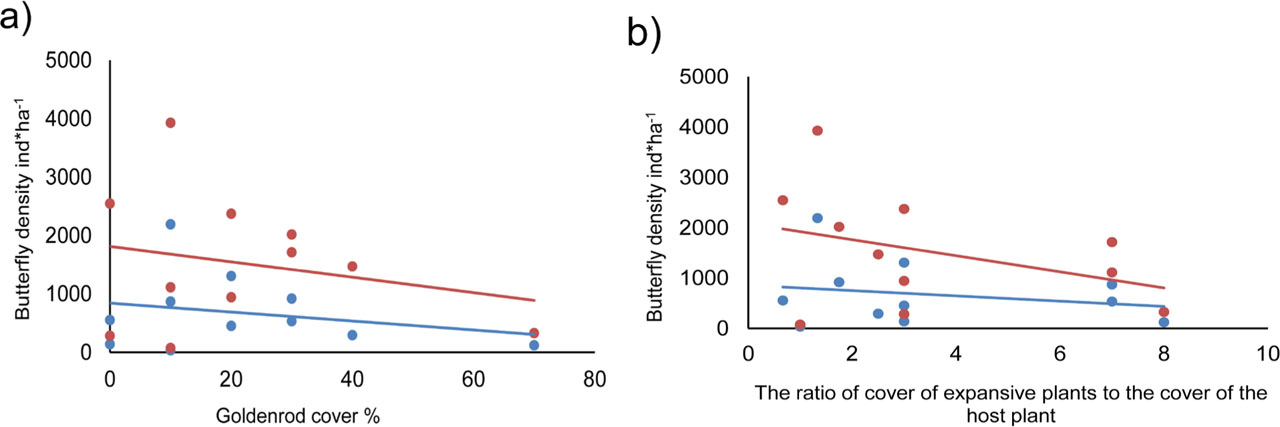
Figure 2.
(a) The relationship between the relative density of butterflies and the coverage of invasive hawkweeds and (b) the ratio of coverage of invasive plants to the coverage of the butterflies’ host plant. Ph. teleius is marked in red, and Ph. nausithous is marked in blue. “Density” denotes relative butterfly density (abundance) expressed as number of individuals per one ha of area.
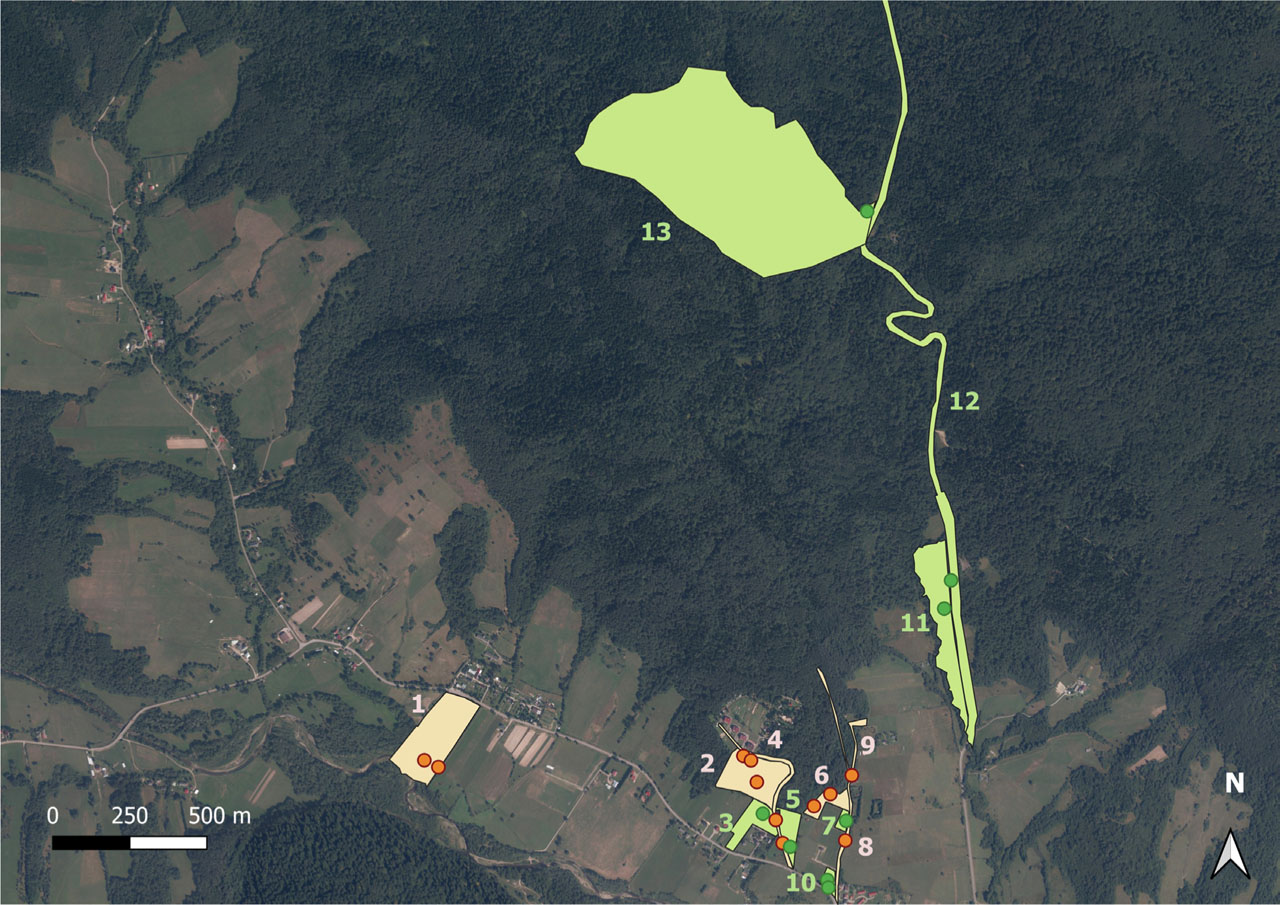
Figure 3.
The location of research sites in Krempna within cadastral parcels. Sites with invasive hogweed are marked in orange, while reference sites are marked in green. Points indicate the locations of transect sections.
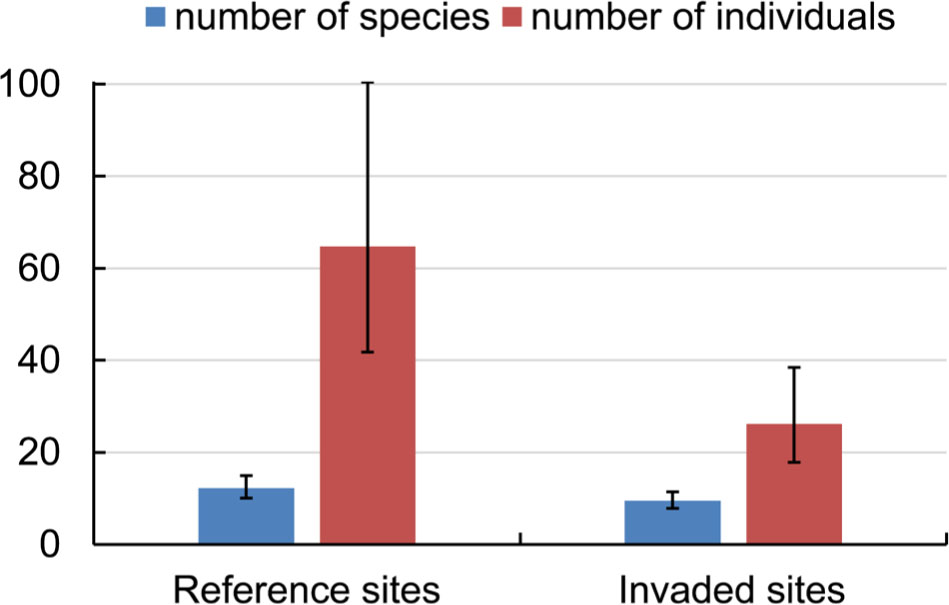
Figure 4.
Mean number of species and mean number of individuals of Heteroptera bugs with a 95% confidence interval at reference sites and sites with invasive hogweed.
Table 3.
Mean difference in Heteroptera bug species assemblages along 50m transect sections between reference sites and sites with invasive hogweed. Species with significantly different mean abundances are highlighted.
| Species | Reference sites | Invaded sites | Cumulative weight | P-value |
|---|---|---|---|---|
| Leptopterna dolabrata (L., 1758) | 22.1 | 6.8 | 0.22 | 0.153 |
| Acetropis longirostris P., 1785 | 16.3 | 1.5 | 0.39 | 0.016 |
| Stenotus binotatus (F., 1794) | 5.0 | 2.7 | 0.48 | 0.85 |
| Aelia acuminata (L., 1758) | 3.1 | 0.6 | 0.54 | 0.04 |
| Stenodema laevigata (L., 1758) | 1.0 | 2.5 | 0.59 | 0.995 |
| Adelphocoris lineolatus (G., 1788) | 3.3 | 0.4 | 0.62 | 0.446 |
| Megaloceroea recticornis (G., 1785) | 0.8 | 0.9 | 0.65 | 0.931 |
| Capsodes gothicus (L., 1758) | 0.5 | 1.1 | 0.67 | 0.993 |
| Notostira erratica (L., 1758) | 0.9 | 1.0 | 0.69 | 0.861 |
| Eysarcoris aeneus (S., 1763) | 0.9 | 1.2 | 0.72 | 0.995 |
| Nabis flavomarginatus S., 1847 | 2.8 | 0.1 | 0.74 | 0.045 |
| Strongylocoris leucocephalus (L., 1758) | 0.8 | 0.1 | 0.76 | 0.003 |
| Adelphocoris seticornis (F., 1775) | 0.9 | 0.2 | 0.77 | 0.024 |
| Capsus ater (L., 1758) | 0.0 | 0.8 | 0.78 | 0.992 |
| Eurygaster maura (L., 1758) | 0.9 | 0.0 | 0.80 | 0.002 |
| Dolycoris baccarum (L., 1758) | 0.4 | 0.5 | 0.81 | 0.994 |
| Orthotylus flavosparsus (S., 1841) | 0.1 | 0.4 | 0.82 | 0.965 |
| Lygus pratensis (L., 1758) | 0.1 | 0.5 | 0.83 | 0.996 |
| Peribalus strictus (F., 1803) | 0.0 | 0.5 | 0.84 | 0.955 |
| Acteropis carinata (H-S., 1841) | 0.4 | 0.2 | 0.85 | 0.608 |
| Horistus orientalis (G., 1790) | 0.3 | 0.5 | 0.86 | 0.994 |
| Coptosoma scutellatum (G., 1785) | 0.5 | 0.0 | 0.87 | 0.01 |
| Nabis rugosus (L., 1758) | 0.3 | 0.5 | 0.88 | 1 |
| Closterotomus fulvomaculatus (De G., 1773) | 0.0 | 0.4 | 0.89 | 0.989 |
| Plagiognathus bipunctatus (R., 1883) | 0.3 | 0.0 | 0.90 | 0.004 |
| Polymerus nigrita (F., 1807) | 0.1 | 0.3 | 0.91 | 0.979 |
| Lygus rugulipennis P., 1911 | 0.1 | 0.2 | 0.91 | 0.945 |
| Lygocoris pabulinus (L., 1761) | 0.3 | 0.1 | 0.92 | 0.569 |
| Coreus marginatus (L., 1758) | 0.0 | 0.3 | 0.93 | 0.986 |
| Heterocordylus genistae (S., 1763) | 0.1 | 0.2 | 0.93 | 0.976 |
| Rubiconia intermedia (W., 1811) | 0.1 | 0.1 | 0.94 | 0.839 |
| Notostira elongate (G., 1785) | 0.3 | 0.0 | 0.94 | 0.01 |
| Globiceps fulvicollis J., 1877 | 0.1 | 0.0 | 0.95 | 0.006 |
| Picromerus bidens (L., 1758) | 0.3 | 0.0 | 0.95 | 0.016 |
| Carpocoris purpureipennis (De G., 1773) | 0.1 | 0.0 | 0.95 | 0.006 |
| Podops inunctus (F., 1775) | 0.1 | 0.0 | 0.96 | 0.016 |
| Adelphocoris reichelii (F., 1836) | 0.1 | 0.0 | 0.96 | 0.016 |
| Nabis limbatus D., 1851 | 0.1 | 0.0 | 0.96 | 0.016 |
| Orthocephalus brevis (P., 1798) | 0.0 | 0.2 | 0.97 | 0.988 |
| Polymerus unifasciatus (F., 1794) | 0.1 | 0.1 | 0.97 | 0.962 |
| Rhopalus parumpunctatus S., 1829 | 0.1 | 0.0 | 0.97 | 0.01 |
| Adelphocoris quadripunctatus (F., 1794) | 0.1 | 0.0 | 0.97 | 0.018 |
| Himacerus boops (S., 1870) | 0.1 | 0.0 | 0.98 | 0.017 |
| Apolygus spinolae (M-D., 1841) | 0.0 | 0.1 | 0.98 | 0.978 |
| Plagiognathus chrysanthemi (W., 1804) | 0.0 | 0.1 | 0.98 | 0.978 |
| Eurygaster testudinaria (G. 1785) | 0.4 | 0.0 | 0.98 | 0.031 |
| Lygus punctatus (Z., 1838) | 0.0 | 0.1 | 0.99 | 0.98 |
| Apolygus lucorum (M-D., 1843) | 0.0 | 0.1 | 0.99 | 0.983 |
| Carpocoris fuscispinus (B., 1850) | 0.0 | 0.1 | 0.99 | 0.988 |
| Pinalitus cervinus (H-S., 1841) | 0.0 | 0.1 | 0.99 | 0.988 |
| Stenodema calcarata (F., 1807) | 0.0 | 0.1 | 0.99 | 0.987 |
| Phylus coryli (L., 1758) | 0.0 | 0.1 | 0.99 | 0.987 |
| Orthops basalis (C., 1853) | 0.0 | 0.1 | 0.99 | 0.987 |
| Teratocoris antennatus (B., 1852) | 0.0 | 0.1 | 1.00 | 0.987 |
| Corizus hyoscyami (L., 1758) | 0.0 | 0.1 | 1.00 | 0.991 |
| Myrmus miriformis (F., 1807) | 0.1 | 0.0 | 1.00 | 0.029 |
| Thyreocoris scarabaeoides (L., 1758) | 0.1 | 0.0 | 1.00 | 0.031 |
| Palomena prasina (L., 1761) | 0.1 | 0.0 | 1.00 | 0.031 |
| Pentatoma rufipes (L., 1758) | 0.1 | 0.0 | 1.00 | 0.031 |