
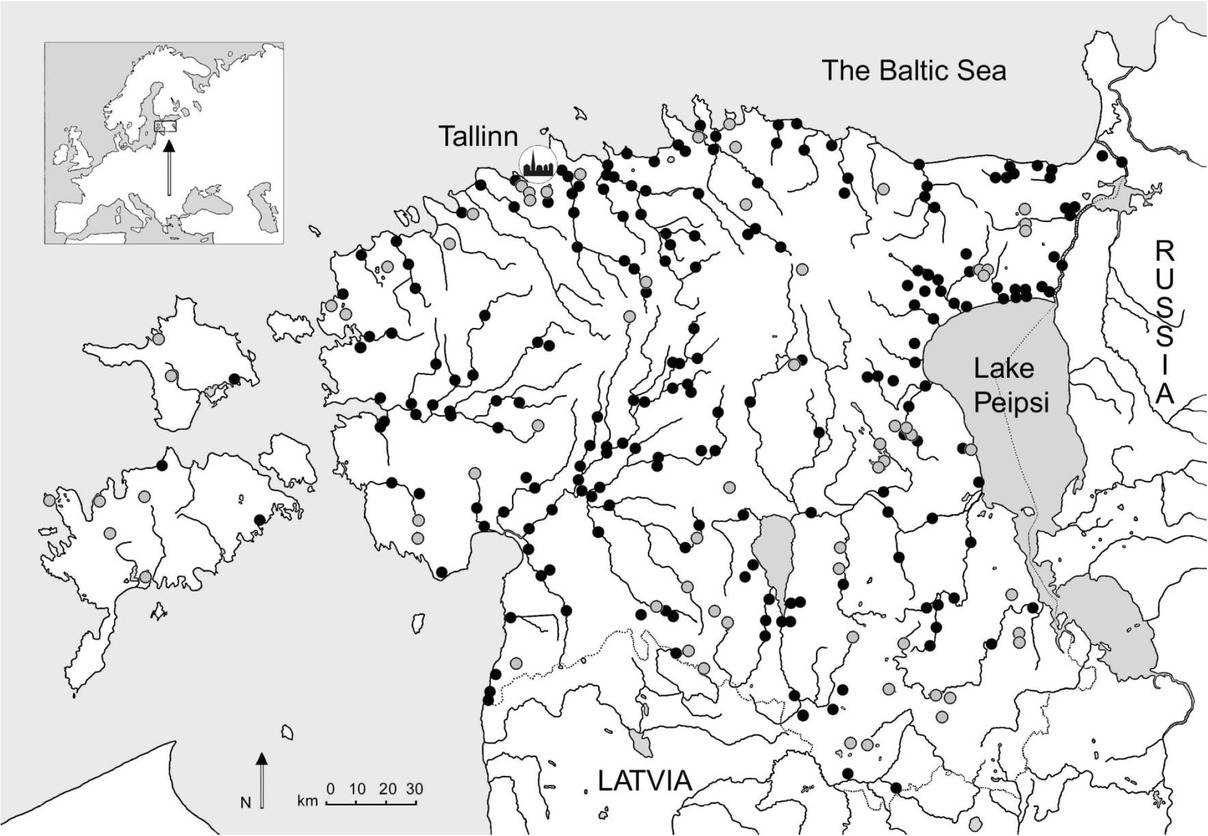
Figure 1
Study area. Black dots – stream sites, grey dots – lake sites
Table 1
The number of macroinvertebrate samples (n) in relation to hydrochemical and hydrophysical stream and lake types (Status classes 2010)
| Type | Water properties | Catchment (km2) area | Alkalinity (mgl−1 HCO3−) | Cond(μS cm−1) | Salinity(mgl−1 Cl−) | Strat | n |
|---|---|---|---|---|---|---|---|
| Streams | |||||||
| I A | Dark water (> 25) | 10−100 | 44 | ||||
| I B | Light water (< 25) | 10−100 | 70 | ||||
| II A | Dark water (> 25) | 100−1000 | 31 | ||||
| II B | Light water (< 25) | 100−1000 | 75 | ||||
| III A | Dark water (> 25) | 1000−10 000 | 1 | ||||
| III B | Light water (< 25) | 1000−10 000 | 19 | ||||
| IV | > 10 000 | 2 | |||||
| Lakes | |||||||
| I | Calcareous | > 240 | > 400 | < 25 | no | 1 | |
| II | Medium water hardness | 80–240 | 165–400 | < 25 | no | 49 | |
| III | Medium water hardness | 80–240 | 165–400 | < 25 | yes | 13 | |
| IV | Soft water, dark (≥ 4) | < 80 | < 165 | < 25 | no | 9 | |
| V | Soft water, light (≤ 4) | < 80 | < 165 | < 25 | no | 19 | |
| VIII | Former lagoons (distance from the sea < 5 km) | > 25 | no | 12 | |||
[i] Water color: streams − CODMn as mg l−1 O (90% of values); lakes – absorption coefficient per m at 400 nm (in IV and V). Cond − conductivity, Strat – stratification
Table 2
Frequency of different dipteran groups and oligochaetes in streams and lakes
| Streams | Lakes | |||
|---|---|---|---|---|
| n | % | n | % | |
| Chironomidae | 241 | 99.6 | 103 | 100 |
| Oligochaeta | 210 | 86.8 | 86 | 83.5 |
| Ceratopogonidae | 108 | 44.6 | 63 | 61.2 |
| Simuliidae | 161 | 66.5 | 0 | 0 |
| Athericidae: Atherix | 92 | 38.0 | 0 | 0 |
| Chaoboridae: Chaoborus | 3 | 1.2 | 14 | 13.6 |
| Culicidae | 8 | 3.3 | 3 | 2.9 |
| Cylindrotomidae: Phalacrocera replicata | 1 | 0.4 | 2 | 1.9 |
| Dixidae | 6 | 2.5 | 6 | 5.8 |
| Dolichopodidae | 4 | 1.7 | 1 | 1.0 |
| Limoniidae: Antocha | 22 | 9.1 | 0 | 0 |
| Limoniidae: Eloeophila | 97 | 40.1 | 1 | 1.0 |
| Limoniidae: Gnophomyia | 1 | 0.4 | 1 | 1.0 |
| Muscidae: Limnophora | 17 | 7.0 | 0 | 0 |
| Pediciidae: Dicranota | 105 | 43.4 | 1 | 1.0 |
| Psychodidae: Pericoma | 21 | 8.7 | 0 | 0 |
| Ptychopteridae: Ptychoptera | 9 | 3.7 | 1 | 1.0 |
| Sciomyzidae | 1 | 0.4 | 0 | 0 |
| Stratiomyiidae | 3 | 1.2 | 1 | 1.0 |
| Syrphidae | 0 | 0 | 1 | 1.0 |
| Tabanidae: Chrysops | 41 | 16.9 | 6 | 5.8 |
| Tipulidae | 29 | 12.0 | 2 | 1.9 |
| Diptera indet. | 106 | 43.8 | 9 | 8.7 |
Table 3
Mean abundance (individuals m−2 ± SE) and contribution of the most abundant dipteran groups and oligochaetes in streams and lakes
| Streams | Lakes | |||
|---|---|---|---|---|
| mean ± SE | % | mean ± SE | % | |
| Chironomidae | 142 ± 35 | 24.2 | 93 ± 11 | 32.6 |
| Oligochaeta | 21 ± 3 | 3.6 | 23 ± 5 | 8.1 |
| Ceratopogonidae | 1.7 ± 0.5 | < 0.1 | 5.3 ± 1.0 | 1.9 |
| Simuliidae | 68 ± 30 | 11.6 | 0 | 0 |
| Atherix | 4.1 ± 1.0 | 0.7 | 0 | 0 |
| Eloeophila | 1.3 ± 0.2 | < 0.1 | < 0.1 | < 0.1 |
| Dicranota | 2.9 ± 0.4 | < 0.1 | < 0.1 | < 0.1 |
Table 4
Significant differences between the abiotic characteristics (> and <, columns 2–4); positive (+) and negative (–) directions of significant relationships between biotic metrics and abiotic factors (columns 5–8)
| Variable | S vs L | S: dark water vs light water | L: hard water vs soft water | S: DistS | All: pH | All: O2 | All: Cond |
|---|---|---|---|---|---|---|---|
| 1 | 2 | 3 | 4 | 5 | 6 | 7 | 8 |
| Chir | <* | ||||||
| Chir% | <*** | ||||||
| Olig | >* | +*** | + ** | +* | |||
| Olig% | +*** | +** | –** | ||||
| Cer | <*** | ||||||
| Cer% | <*** | ||||||
| Sim | --- | --- | –** | ||||
| Sim% | --- | --- | |||||
| DiptR | >*** | <* | –* | +** |
[i] *** – p-value < 0.0001, ** – p-value < 0.01, * – p-value < 0.05. S – streams, L– lakes, All – streams and lakes. Chir − abundance of chironomids, Chir% − percentage of chironomids, Olig − abundance of oligochaetes, Olig% – percentage of oligochaetes, Cer – abundance of ceratopogonids, Cer% – percentage of ceratopogonids, Sim – abundance of simuliids, Sim% – percentage of simuliids, DiptR – richness of dipteran families. DistS – distance from a stream source, O2 – water oxygen content, Cond – water conductivity
Table 5
Significant relationships with model parameter estimates between biotic metrics and water quality factors (where relevant)
| Comparison | Streams | Lakes | |
|---|---|---|---|
| EQRMMQ | Chir | −0.5** | |
| Olig | 0.8*** | −0.7* | |
| Cer | −2.2*** | ||
| Sim | 2.5*** | ||
| Chir% | -0.2** | −0.5*** | |
| Olig% | −0.3** | ||
| Cer% | −0.1* | ||
| DiptR | 3.8*** | ||
| MESH | Olig | 0.18* | 0.6** |
| Cer | −1.1* | ||
| Sim | 2.3* | ||
| Chir% | −0.1* | ||
| Cer% | −0.04*** | ||
| DiptR | 3.8*** | ||
| QWat | Olig | −1.2** | |
| Olig% | −0.1** | ||
| QFish | Olig | 0.2* | |
| Olig% | 0.03** | ||
| QPhybe | DiptR | 0.4* | |
| Olig | −0.3** | ||
| Olig% | −0.06** | ||
| EQRT | Olig | 0.2* | −0.5* |
| Cer | 1.4*** | ||
| Chir% | −0.4*** | ||
| Cer% | 0.03** | −0.1** | |
| DiptR | 1.6*** | ||
| EQREPT | Chir | 6.1*** | ** |
| Olig | 0.5*** | −0.4** | |
| Chir% | −0.1* | ||
| Olig% | −0.1* | ||
| Cer% | −0.05** | ||
| DiptR | 1.7*** | ||
| EQRH’ | Chir | −0.9*** | −0.7*** |
| Olig | 1.3*** | ||
| Sim Chir% | 1.5** −0.3*** | −0.1* | |
| Olig% | 0.07** | ||
| DiptR | 1.6** | ||
| EQRASPT | Olig | −0.8* | −1.8** |
| Olig% | −0.7** | ||
| DiptR | 4.5*** |
[i] *** – p-value < 0.001, ** – p-value < 0.01, * – p-value < 0.05. Metrics: Chir – abundance of chironomids, Chir% − percentage of chironomids, Olig – abundance of oligochaetes, Olig% – percentage of oligochaetes, Cer – abundance of ceratopogonids, Cer% – percentage of ceratopogonids, Sim – abundance of simuliids, percentage of simuliids Sim%, DiptR – richness of dipteran families. Quality factors: EQR – ecological quality ratio, MMQ – macroinvertebrate-based multimetric quality, T – total taxon richness, H’ – Shannon diversity index, ASPT – Average Score Per Taxon, EPT – Ephemeroptera, Plecoptera and Trichoptera taxon richness; MESH – hydromorphological score, QWat – water quality, QFish – fish quality, QPhybe – phytobenthos quality, QPhypl – phytoplankton quality
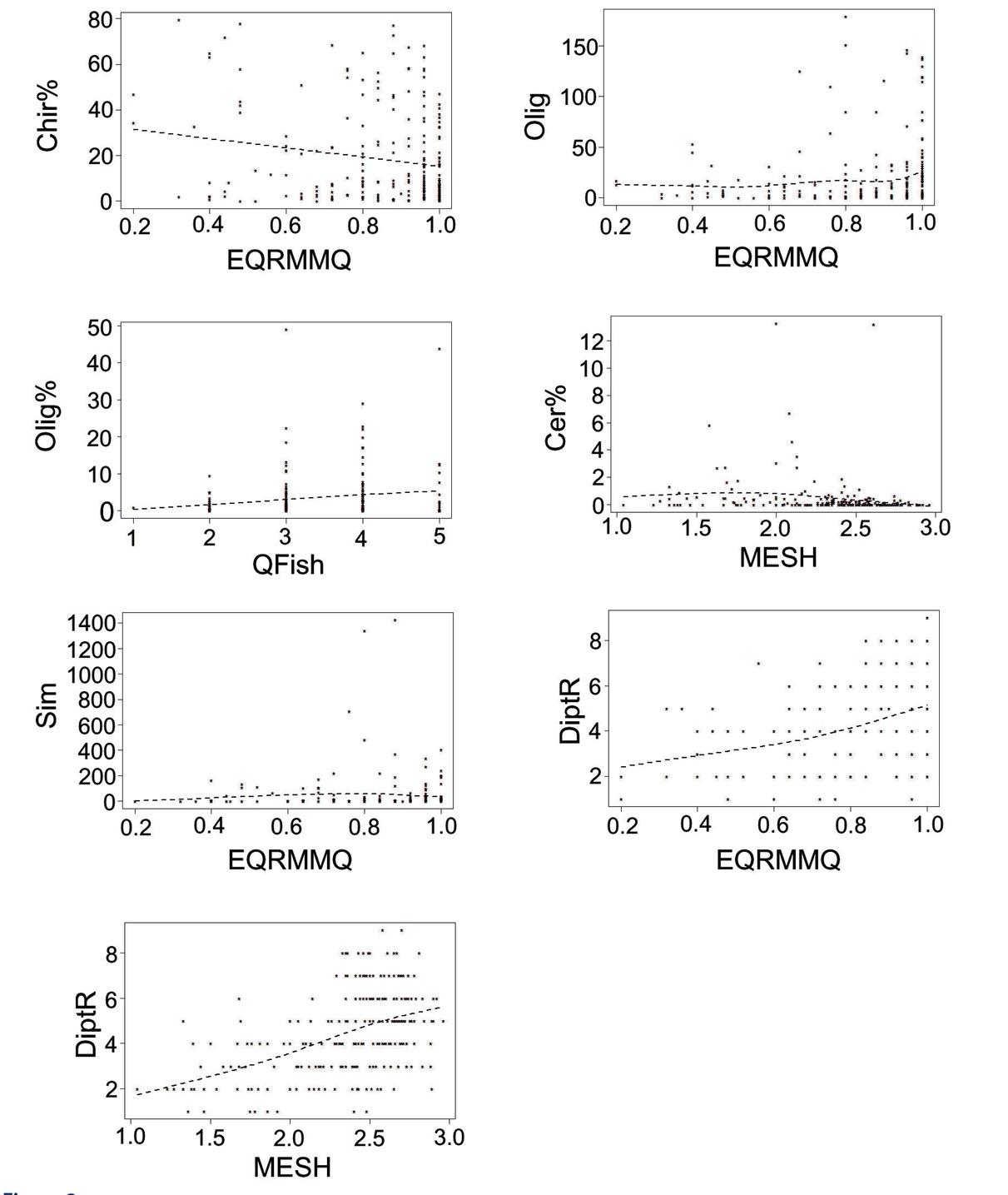
Figure 2
Plots with the most significant relationships between the studied factors and metrics in streams. Chir% – percentage of chironomids, Olig – abundance of oligochaetes, Olig% – percentage of oligochaetes, Cer% – percentage of ceratopogonids, Sim – abundance of simuliids, DiptR – richness of dipteran families. EQRMMQ – ecological quality ratio of macroinvertebrate-based multimetric quality, QFish – fish quality, MESH – hydromorphological score
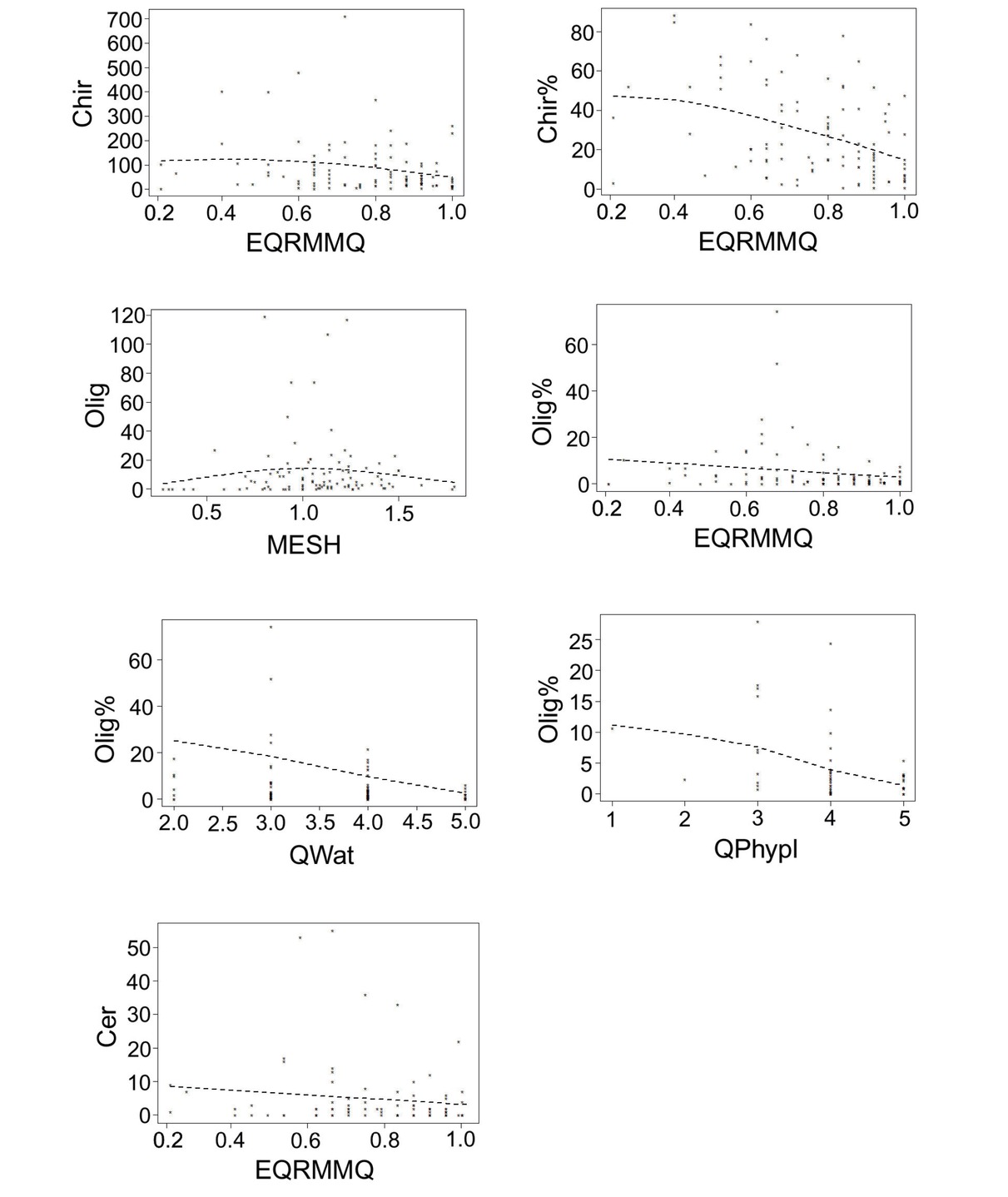
Figure 3
Plots with the most significant relationships between the studied factors and metrics in lakes. Chir – abundance of chironomids, Chir% – percentage of chironomids, Olig – abundance of oligochaetes, Olig% – percentage of oligochaetes, Cer – abundance of ceratopogonids. EQRMMQ – ecological quality ratio of macroinvertebrate-based multimetric quality, QWat – water quality, QPhypl – phytoplankton quality, MESH – hydromorphological score