
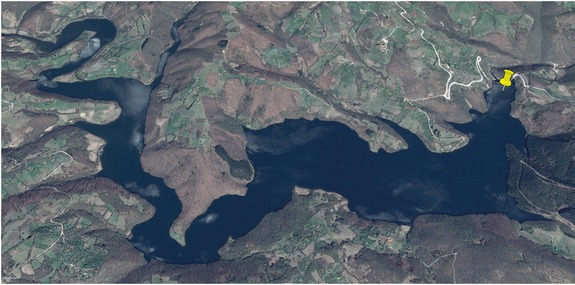
Figure 1
Vrutci reservoir on the Đetinja River (Western Serbia). The yellow marker indicates the sampling location referred to as Vodozahvat
Table 1
Main morphological features of the studied Vrutci reservoir and characteristics of the catchment
| Characteristics of the reservoir | Value | Unit |
|---|---|---|
| Area | 1.92 | km2 |
| Volume | 40.2 × 10⁶ | m3 |
| NPL (Normal Pool Level) | 621.3 | m a.s.l. |
| Max depth | 60 | m |
| Mean depth | 20.9 | m |
| Water retention time | 250 | days |
| Characteristi cs of the catchment | ||
| Area | 160 | km2 |
| Max altitude | 1544 | m a.s.l. |
| Mean altitude | 915 | m a.s.l. |
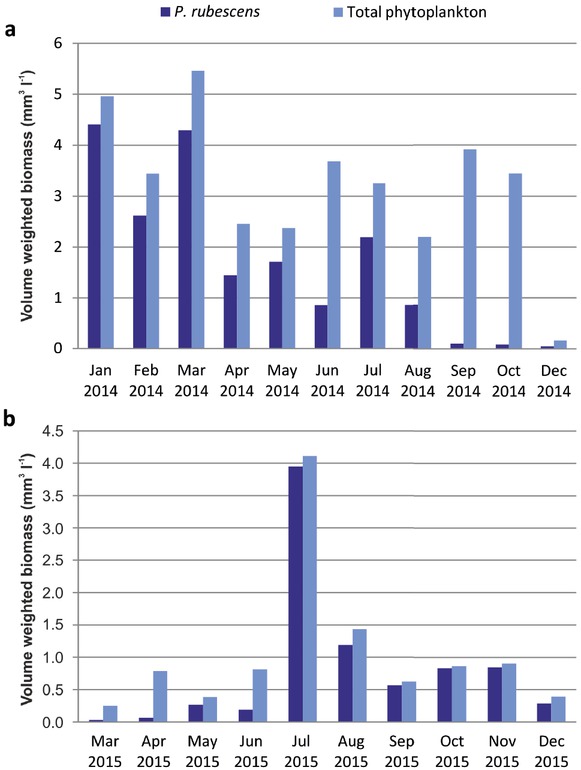
Figure 2
Volume-weighted averages of P. rubescens and total phytoplankton biomass in the Vrutci reservoir: in 2014 (a) and 2015 (b)
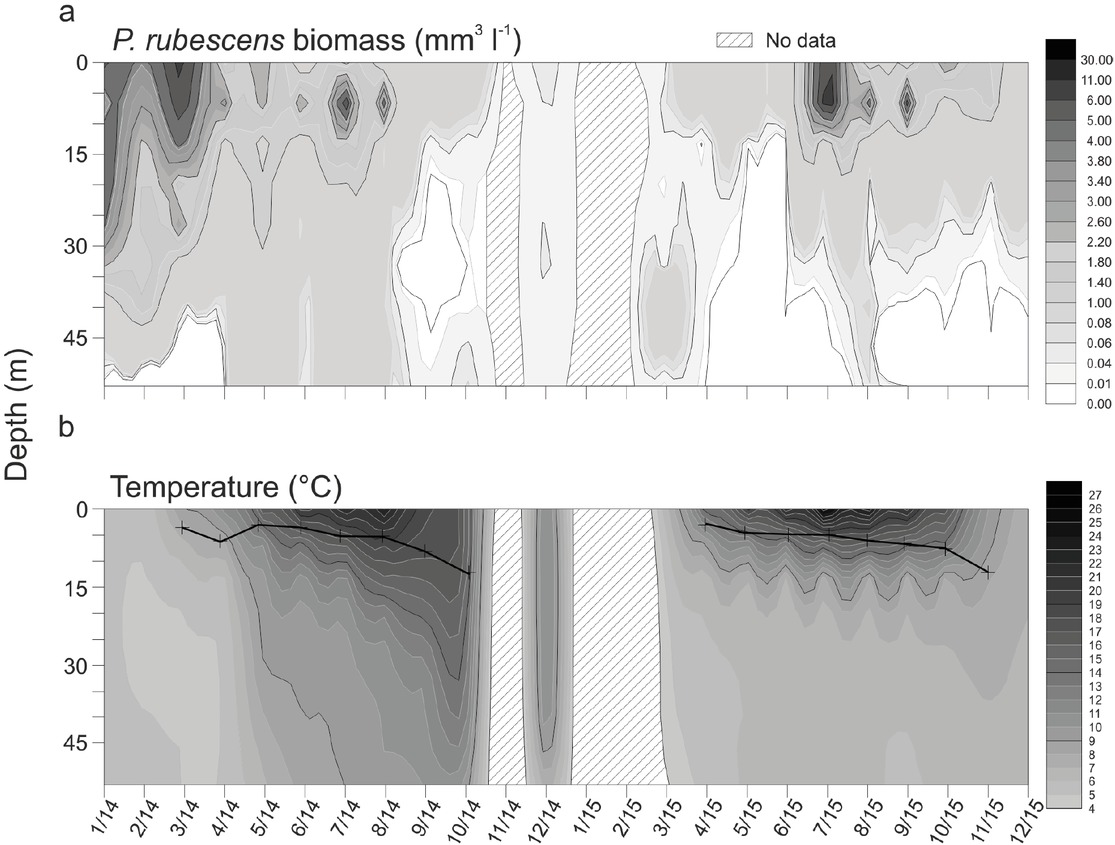
Figure 3
Biomass of P. rubescens (a); water temperature and location of the thermocline (black lines) in the Vrutci reservoir (b)
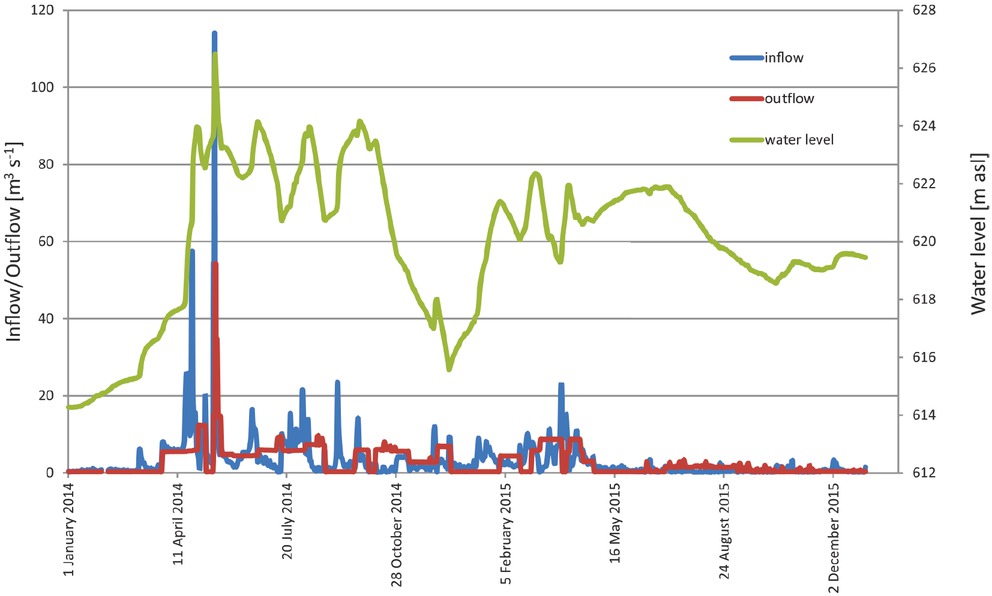
Figure 4
Annual water-level fluctuations in the Vrutci reservoir in 2014 and 2015
Table 2
Mean, minimum and maximum values of hydrological, meteorological, physical and chemical (Chl-a) parameters in 2014
| Hydro- and meteorological parameters | Min. | Mean | Max | ||||||
|---|---|---|---|---|---|---|---|---|---|
| Water flushing (m3 s−1) | −3.71 | 0.86 | 6.79 | ||||||
| Air temp. (°C) | −0.09 | 9.07 | 17.33 | ||||||
| Wind speed (m s−1) | 1.19 | 1.85 | 4.66 | ||||||
| Insolation (h) | 3.34 | 5.35 | 8.91 | ||||||
| Precipitati on (mm) | 1.38 | 7.37 | 12.36 | ||||||
| Physicochemical parameters | |||||||||
| Secchi depth (m) | 1.2 | 1.9 | 2.8 | ||||||
| Epilimnion | Metalimnion | Hypolimnion | |||||||
| Min. | Mean | Max | Min. | Mean | Max | Min. | Mean | Max | |
| Water temp (°C) | 4.9 | 14.5 | 22.7 | 5.2 | 10.7 | 15.9 | 4.9 | 8.5 | 12.5 |
| Conductivity (μS cm−1) | 222.0 | 259.2 | 288.5 | 219.0 | 247.1 | 290.5 | 204.5 | 239.8 | 276.0 |
| pH | 8.2 | 8.7 | 9.2 | 7.8 | 8.2 | 8.5 | 7.7 | 7.8 | 8.2 |
| Chl-a conc. (μg l−1) | 3.1 | 7.2 | 13.9 | 3.7 | 7.4 | 9.9 | 4.5 | 6.1 | 9.8 |
Table 3
Mean, minimum and maximum values of hydrological, meteorological, physical and chemical parameters in 2015
| Hydro- and meteorological parameters | Min. | Mean | Max | ||||||
|---|---|---|---|---|---|---|---|---|---|
| Water flushing (m3 s−1) | −1.10 | 0.15 | 3.38 | ||||||
| Air temp. (°C) | −0.76 | 9.29 | 20.71 | ||||||
| Wind speed (m s−1) | 1.00 | 1.41 | 2.20 | ||||||
| Insolation (h) | 3.94 | 6.61 | 10.89 | ||||||
| Precipitati on (mm) | 1.25 | 5.76 | 9.82 | ||||||
| Physicochemical parameters | |||||||||
| Secchi depth (m) | 1.1 | 2.8 | 4.3 | ||||||
| Epilimnion | Metalimnion | Hypolimnion | |||||||
| Min. | Mean | Max | Min. | Mean | Max | Min. | Mean | Max | |
| Water temp. (°C) | 6.4 | 16.5 | 25.3 | 5.4 | 9.7 | 13.2 | 4.6 | 6.7 | 9.7 |
| Conductivity (μS cm−1) | 145.0 | 267 | 320.5 | 223.2 | 244.4 | 256.5 | 222.6 | 251.5 | 301.0 |
| pH | 8.3 | 8.6 | 9.0 | 7.3 | 8.2 | 9.0 | 7.2 | 7.6 | 8.6 |
| Chl-a conc. (μg l-1) | 3.6 | 4.8 | 6.5 | 3.3 | 11.2 | 32.8 | 2.9 | 3.8 | 5.0 |
| N-NH4 (μg l−1) | 20 | 120 | 400 | 10 | 113 | 276 | 10 | 99 | 198 |
| N-NO2 (μg l−1) | 5 | 6 | 9 | 14 | 35 | 90 | 5 | 14 | 90 |
| N-NO3 (μg l−1) | 50 | 280 | 810 | 200 | 373 | 820 | 340 | 624 | 838 |
| TN (μg l−1) | 450 | 920 | 1430 | 710 | 1101 | 1601 | 784 | 1228 | 1846 |
| ortho-P (μg l−1) | 10 | 20 | 50 | 9 | 17 | 31 | 9 | 9 | 10 |
| TP (μg l−1) | 30 | 120 | 470 | 34 | 135 | 417 | 34 | 156 | 324 |
| TN:TP | 1.6 | 12.9 | 31.2 | 3.0 | 11.5 | 27.4 | 3.4 | 13.4 | 36.2 |
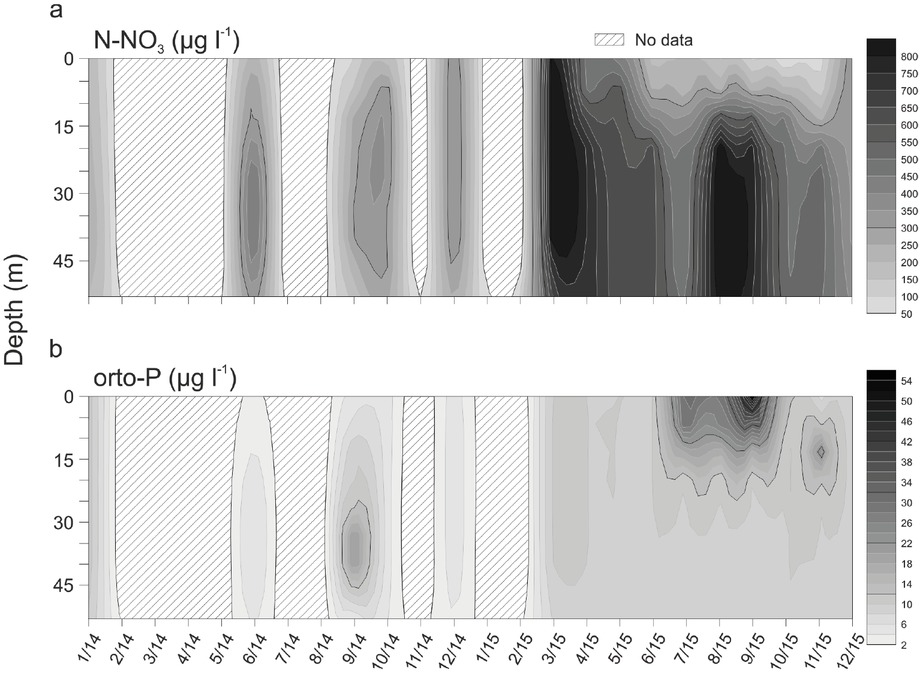
Figure 5
Nutrients in the Vrutci reservoir in 2014 and 2015: N-NO3 concentration (a) and ortho-P concentration (b)
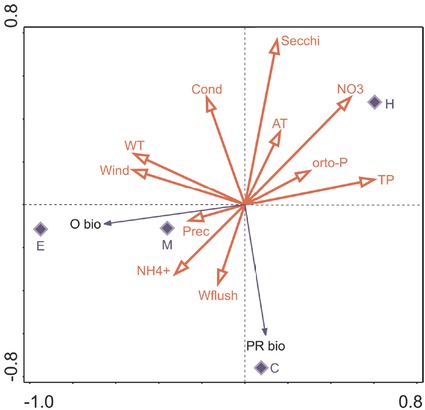
Figure 6
RDA ordination diagram showing the relationships between the biomass of P. rubescens and other phytoplankton taxa as well as hydrological, meteorological, physical and chemical parameters (nutrients). Water mixing layers are used as supplementary variables. The first RDA axis explained 21.90% and the first and second axes together explained 40.80% of the variability in our data, which accounted for the total explained variation in the analysis (F=12.6, p =0.0002).
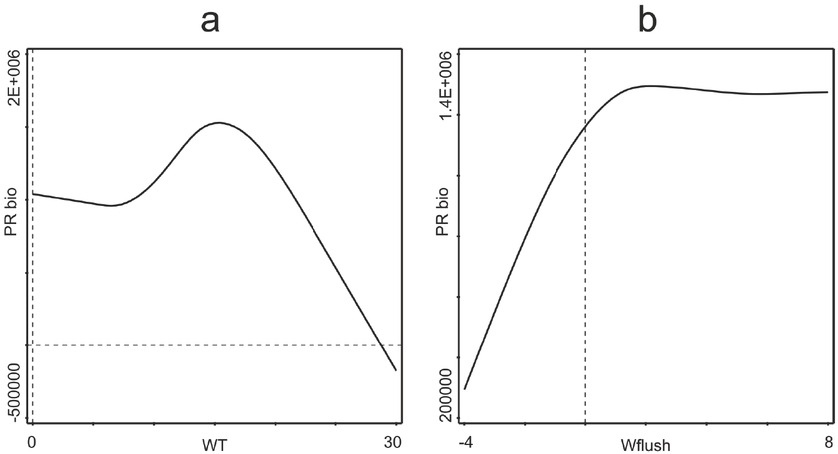
Figure 7
Response curves that include the relationship between P. rubescens biomass and water temperature – WT (a) and water flushing – Wflush (b)
Table 4
Explained variation and significance tests of the variation partitioning that included three groups of variables – conditional (a, b, c) and simple effects (a+d+f+g, b+d+g+e, c+e+f+g) were tested
| Tested fraction | Explained variation (%) | F | p |
|---|---|---|---|
| a | 11.8 | 10.0 | 0.0002 |
| b | 6.2 | 7.1 | 0.0002 |
| c | 9.1 | 7.8 | 0.0002 |
| a + d + f + g | 21.8 | 14.5 | 0.0002 |
| b + d + g + e | 16.2 | 11.3 | 0.0002 |
| c + e + f + g | 18.8 | 12.0 | 0.0002 |
| a + b + c + d + e + f + g | 40.8 | 9.8 | 0.0002 |