
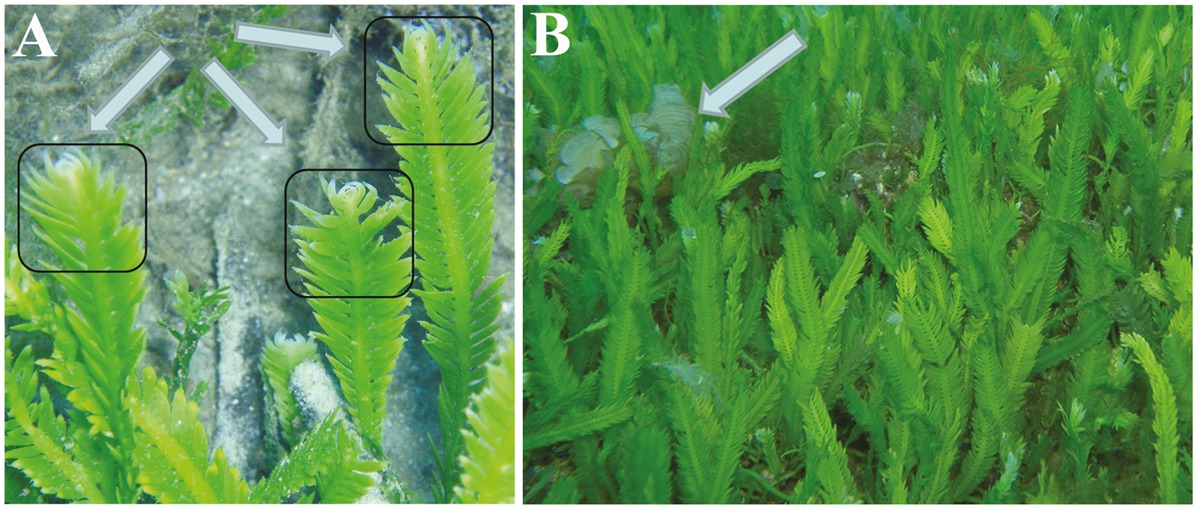
Figure 1
A) Caulerpa taxifolia, the Bay of Stari Grad, the Island of Hvar, 2 cm long cut-off upper part (photo by Tonči Dulčić). B) Padina sp. (arrow) in a dense patch of Caulerpa taxifolia, the Bay of Stari Grad, the Island of Hvar (photo by Tonči Dulčić)
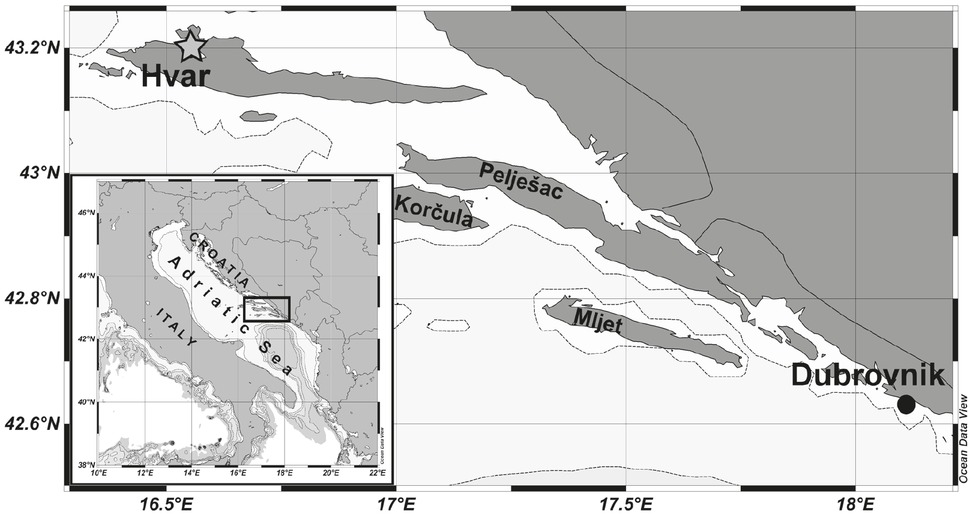
Figure 2
Map of the study site
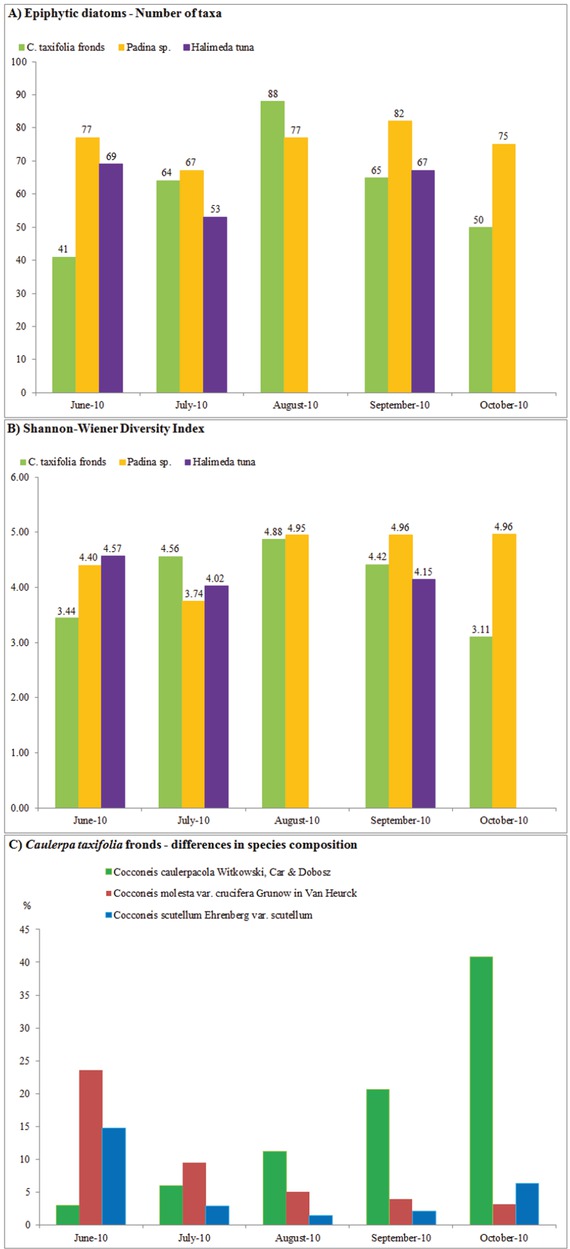
Figure 3
A) The number of epiphytic diatom taxa on Caulerpa taxifolia fronds, Padina sp. and Halimeda tuna from June to October 2010. B) Values of the Shannon– Wiener Diversity Index for epiphytic diatom samples on Caulerpa taxifolia, Padina sp. and Halimeda tuna in summer and autumn 2010 on the Island of Hvar. C) Contribution of individual Cocconeis taxa to the epiphytic diatom community on Caulerpa taxifolia in summer and autumn 2010
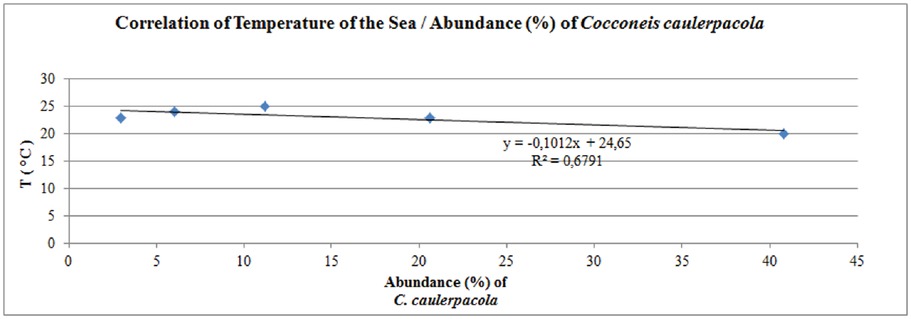
Figure 4
Average abundance of Cocconeis caulerpacola on Caulerpa taxifolia from the Island of Hvar is presented in relation to sea water temperature. N = 5
Table 1
Dominant diatom taxa on upper 2 cm of Caulerpa taxifolia fronds with average relative abundance (Avg. RA) > 1% and frequency of occurrence (Freq.) > 40% in summer and autumn 2010. N = 5
| Caulerpa taxifolia fronds – dominant taxa: | Freq. (%) | Avg. RA (%) |
|---|---|---|
| Amphora helenensis Giffen | 60.00 | 2.05 |
| Ardissonea fulgens (Greville) Grunow | 100.00 | 1.54 |
| Berkeleya scopulorum (Brébisson) Cox | 80.00 | 1.13 |
| Cocconeis caulerpacola Witkowski, Car & Dobosz | 100.00 | 16.31 |
| Cocconeis cf. scutellum Ehrenberg | 80.00 | 6.25 |
| Cocconeis molesta var. crucifera Grunow in Van Heurck | 100.00 | 9.01 |
| Cocconeis scutellum Ehrenberg var. scutellum | 100.00 | 5.47 |
| Hyalosynedra laevigata (Grunow) Williams & Round | 100.00 | 14.44 |
| Licmophora remulus Grunow | 80.00 | 1.88 |
| Mastogloia crucicula (Grunow) Cleve var. crucicula | 100.00 | 2.59 |
| Mastogloia crucicula var. alternans Zanon | 100.00 | 2.02 |
| Mastogloia cuneata (Meister) Simonsen | 80.00 | 1.69 |
| Mastogloia pseudolatecostata Yohn & Gibson | 80.00 | 3.23 |
| Mastogloia spec. (Ico.Diat.Vol.7, Pl. 75 Figs 7-9) | 80.00 | 1.52 |
| Navicula arenaria Donkin var. arenaria | 80.00 | 3.38 |
| Navicula ramosissima (Agardh) Cleve | 60.00 | 1.55 |
| Navicula subagnita Proschkina-Lavrenko | 40.00 | 1.88 |
| Nitzschia angularis W. Smith | 100.00 | 1.37 |
| Nitzschia lanceolata var. minima Grunow | 100.00 | 2.96 |
| Nitzschia panduriformis Gregory var. panduriformis | 100.00 | 2.61 |
| Opephora pacifica (Grunow) Petit | 60.00 | 1.57 |
| Tabularia ktenoides Kuylenstierna | 40.00 | 1.21 |
| Toxarium undulatum Bailey | 100.00 | 1.57 |
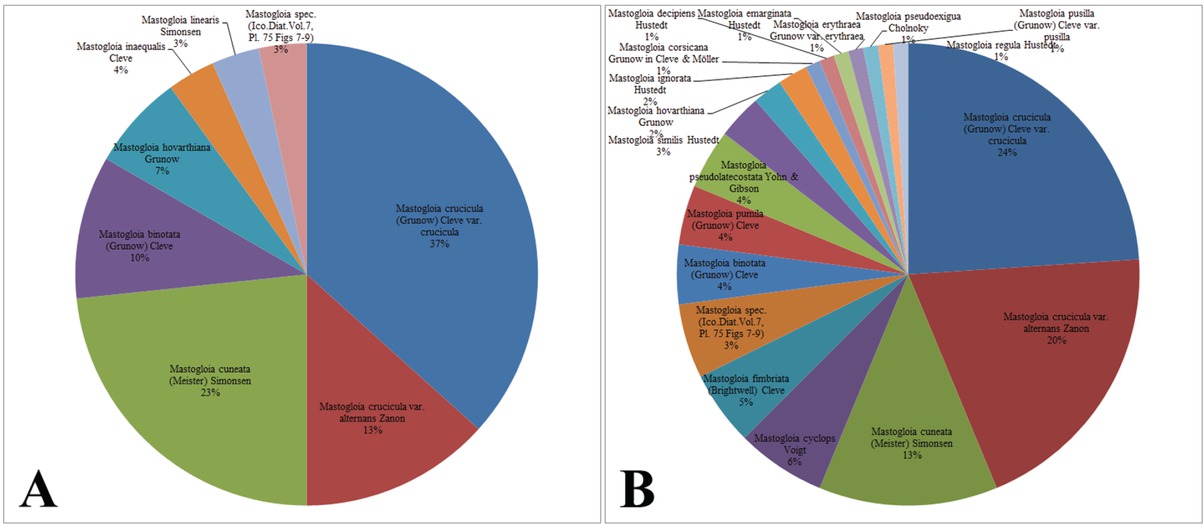
Figure 5
A) Relative percentage contribution of individual Mastogloia taxa on Caulerpa taxifolia fronds in June 2010. B) Relative percentage contribution of individual Mastogloia taxa on Caulerpa taxifolia fronds in July 2010
Table 2
Occurrence of different taxa from the genus Mastogloia on Caulerpa taxifolia fronds from June to October 2010 (“+” indicates the presence and “ ” the absence of a taxon in the sample)
| Mastogloia species: | June 2010 | July 2010 | August 2010 | September 2010 | October 2010 | |
|---|---|---|---|---|---|---|
| Mastogloia baldjikiana Grunow | + | |||||
| Mastogloia binotata (Grunow) Cleve | + | + | + | + | + | |
| Mastogloia borneensis Hustedt | + | + | ||||
| Mastogloia cf. cyclops Voigt | + | |||||
| Mastogloia cf. laminaris Grunow | + | + | ||||
| Mastogloia cf. varians Hustedt | + | |||||
| Mastogloia corsicana Grunow in Cleve & Möller | + | + | + | |||
| Mastogloia crucicula (Grunow) Cleve var. crucicula | + | + | + | + | + | |
| Mastogloia crucicula var. alternans Zanon | + | + | + | + | + | |
| Mastogloia cuneata (Meister) Simonsen | + | + | + | + | ||
| Mastogloia cyclops Voigt | + | + | + | |||
| Mastogloia decipiens Hustedt | + | + | + | |||
| Mastogloia delicatissima Hustedt | + | |||||
| Mastogloia emarginata Hustedt | + | + | + | |||
| Mastogloia erythraea Grunow var. erythraea | + | |||||
| Mastogloia fimbriata (Brightwell) Cleve | + | + | + | |||
| Mastogloia hovarthiana Grunow | + | + | + | + | ||
| Mastogloia ignorata Hustedt | + | + | + | |||
| Mastogloia inaequalis Cleve | + | |||||
| Mastogloia linearis Simonsen | + | |||||
| Mastogloia pisciculus Cleve | + | |||||
| Mastogloia pseudoexigua Cholnoky | + | |||||
| Mastogloia pseudolatecostata Yohn & Gibson | + | + | + | + | ||
| Mastogloia pumila (Grunow) Cleve | + | |||||
| Mastogloia pusilla (Grunow) Cleve var. pusilla | + | + | + | + | ||
| Mastogloia regula Hustedt | + | |||||
| Mastogloia similis Hustedt | + | + | + | |||
| Mastogloia spec. 1 (Ico.Diat.Vol.7, Pl. 75 Fig. 7-9) | + | + | + | + | ||
| Mastogloia spec. 2 (Ico.Diat.Vol.7, Pl. 82 Fig. 13, 14) | + | |||||
| TOTAL : | 8 | 19 | 18 | 17 | 10 | |
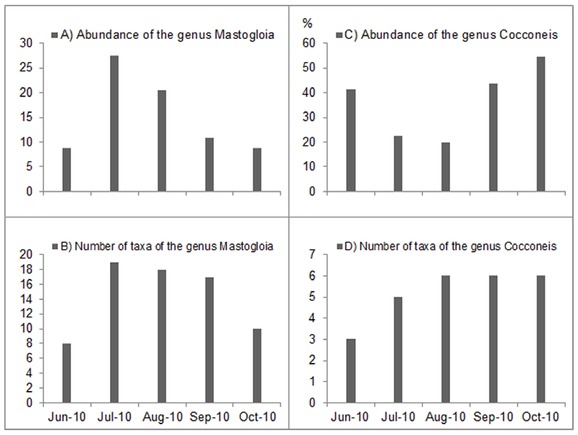
Figure 6
A) Abundance (%) of Mastogloia taxa on Caulerpa taxifolia fronds from June to October 2010. B) The number of Mastogloia taxa on Caulerpa taxifolia fronds. C) Abundance (%) of the genus Cocconeis on Caulerpa taxifolia fronds from June to October 2010. D) The number of Cocconeis taxa on Caulerpa taxifolia fronds
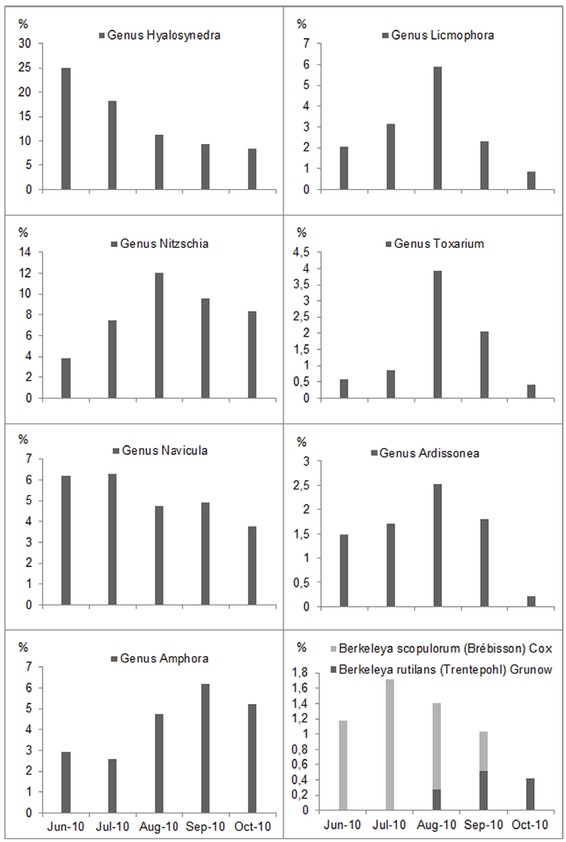
Figure 7
Abundance (%) of the genera Hyalosynedra, Nitzschia, Navicula, Amphora, Licmophora, Toxarium, Ardissonea and Berkeleya taxa on Caulerpa taxifolia fronds from June to October 2010
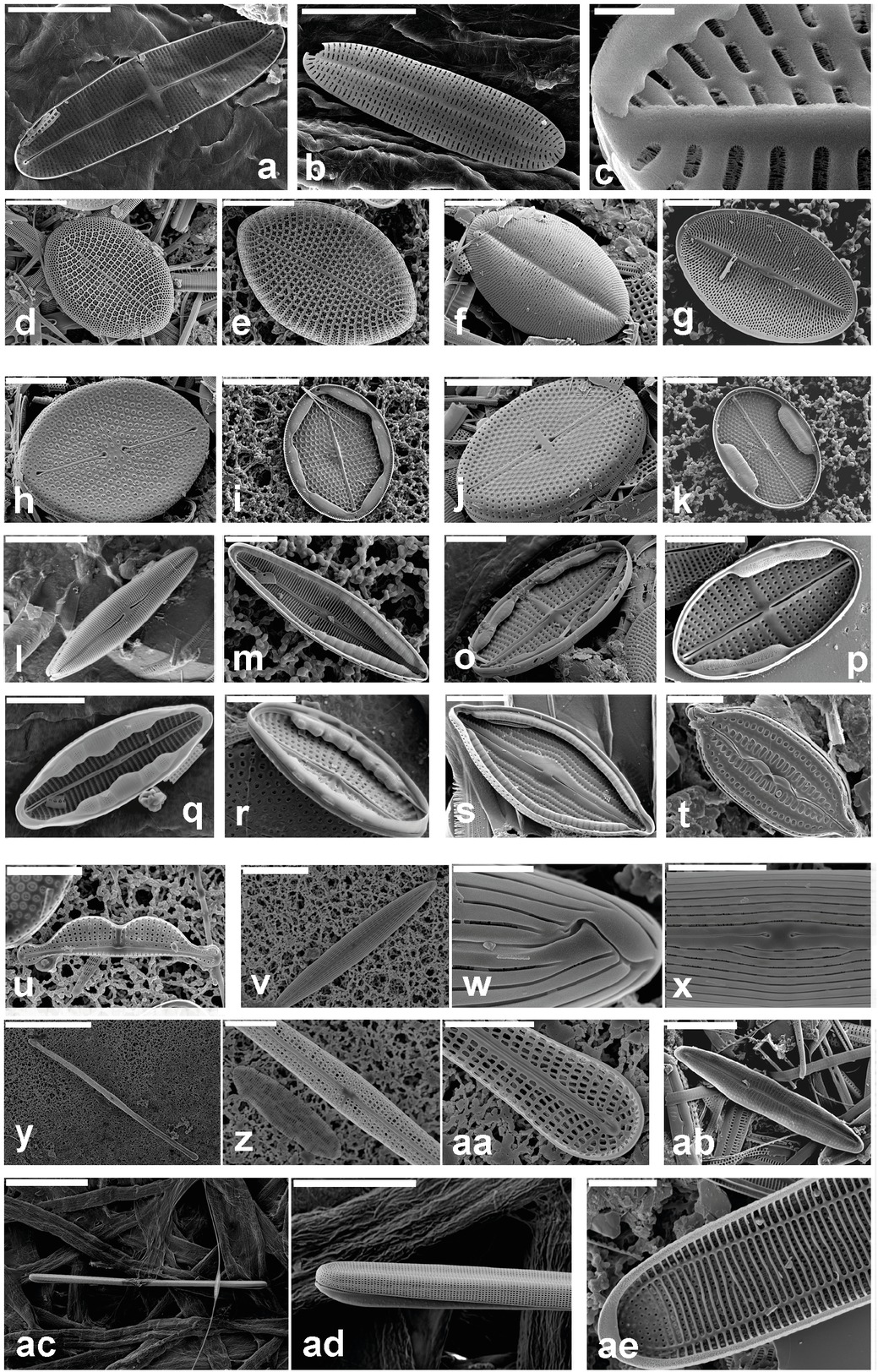
Figure 8
Scanning electron microscope (SEM) micrographs of epiphytic diatoms on the invasive Caulerpa taxifolia and autochthonous Halimeda tuna and Padina sp. macroalgae from the Adriatic Sea. Figs a–c. Cocconeis caulerpacola Witkowski, Car & Dobosz. Figs d, e. Cocconeis scutellum Ehrenberg var. scutellum, sternum valves. Fig. d. External view. Fig. e. Internal view. Figs f, g. Cocconeis molesta var. crucifera Grunow in Van Heurck, Sternum valves. Fig. f. External view; Fig. g. Internal view. Figs h, i. Mastogloia fimbriata (Brightwell) Cleve. Fig. h. External valve view. Fig. i. Internal valve view. Figs j, k. Mastogloia binotata (Grunow) Cleve. Fig. j. External valve view. Fig. k. Internal valve view. Figs l, m. Mastogloia cuneata (Meister) Simonsen. Fig. l. External valve view. Fig. m. Internal valve view. Fig. o. Mastogloia crucicula (Grunow) Cleve var. crucicula; internal view. Fig. p. Mastogloia crucicula var. alternans; internal view. Fig. q. Mastogloia pumila (Grunow) Cleve; internal view. Fig r. Mastogloia ovalis A. Schmidt; internal view. Fig. s. Mastogloia cyclops Voigt; internal valve view. Fig. t. Mastogloia corsicana Grunow in Cleve & Möller; external valve view. Fig. u. Amphora kolbei Aleem; internal view. Figs v, w, x. Navicula subagnita Proshkina-Lavrenko. Figs y, z, aa. Berkeleya scopulorum (Brébisson) Cox; internal views. Fig. ab Berkeleya rutilans (Trentepohl) Grunow; internal view. Figs ac, ad. Ardissonea fulgens (Greville) Grunow (SEM); external views. Fig. ae. Ardissonea crystallina (C.A. Agardh) Grunow; internal view. Scale bars = 100 μm (Fig. ac); 50 μm (Fig. y); 30 μm (Fig. ad); 20 μm (fig. i); 10 μm (Figs d, e, h, j, k, l, s, v); 5 μm (Figs a, b, f, g, m, o, p, q, r, t, u, z, ab, ae); 4 μm (Fig. aa); 3 μm (Fig. x); 1 μm (Fig. w); 500 nm (Fig. c)
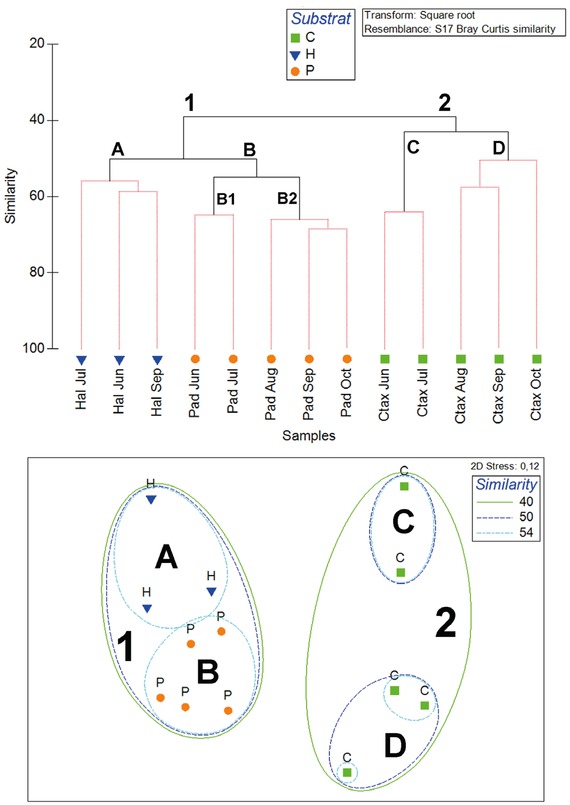
Figure 9
Cluster analysis and multidimensional scaling (MDS) ordination on Bray–Curtis similarity matrices of square root transformed species-abundance data of epiphytic diatom assemblages collected from all three substrates (Caulerpa taxifolia, Halimeda tuna, Padina sp.) during a period of 5 months from June to October 2010 (taxa relative abundance data). All recorded diatom taxa were used in the ordination analysis. Group average similarity values of clusters with significant differences from CLUSTER analysis were superimposed on the MDS plot (SIMPROF; p < 0.05). Top: Cluster analysis. Red lines indicate homogeneous clusters of taxa detected by SIMPROF. Bottom: MDS. Numbers correspond to the same main clusters detected by SIMPROF. Letters A, B, C and D indicate sub-clusters within the main clusters. Symbols Ctax (Caulerpa taxifolia), Hal (Halimeda tuna), Pad (Padina sp.); Jun (June); Jul (July); Aug (August); Sep (September); Oct (October). N(Ctax) = 5; N(Hal) = 3; N(Pad) = 5
Table 3
SIMPER analysis of diatom taxa contributing (% cumulative = 51%) to dissimilarities between invasive C. taxifolia and coexisting autochthonous (Padina sp. + Halimeda tuna) macroalgae
| Taxa | Invasive alga | Autochthonous algae | |||
|---|---|---|---|---|---|
| Av. Abund | Av. Abund | Av. Diss | Contrib% | Cum.% | |
| Cocconeis caulerpacola Witkowski, Car & Dobosz | 16.31 | 0.03 | 8.23 | 11.87 | 11.87 |
| Navicula ramosissima (Agardh) Cleve | 0.93 | 11.45 | 5.30 | 7.64 | 19.51 |
| Hyalosynedra laevigata (Grunow) Williams & Round | 14.44 | 5.75 | 4.36 | 6.29 | 25.80 |
| Nitzschia fusiformis Grunow | 0.33 | 6.85 | 3.31 | 4.77 | 30.57 |
| Cocconeis molesta var. crucifera Grunow in Van Heurck | 9.01 | 3.27 | 3.16 | 4.56 | 35.13 |
| Cocconeis scutellum Ehrenberg var. scutellum | 5.47 | 6.16 | 3.00 | 4.33 | 39.46 |
| Cocconeis cf. scutellum Ehrenberg | 5.00 | 0.00 | 2.53 | 3.65 | 43.11 |
| Nitzschia angularis W. Smith | 1.37 | 4.96 | 1.82 | 2.63 | 45.74 |
| Navicula arenaria Donkin var. arenaria | 2.70 | 0.16 | 1.31 | 1.89 | 47.63 |
| Mastogloia decipiens Hustedt | 0.16 | 2.34 | 1.16 | 1.67 | 49.30 |
| Mastogloia pusilla (Grunow) Cleve var. pusilla | 0.35 | 2.50 | 1.13 | 1.64 | 50.94 |
Table 4
Dominant diatom taxa on Padina sp. with average relative abundance (Avg. RA) > 1% and frequency of occurrence (Freq.) > 20% in summer and autumn 2010. N = 5
| Padina sp. – dominant taxa: | Freq. (%) | Avg. RA (%) |
|---|---|---|
| Amphora helenensis Giffen | 100.00 | 1.54 |
| Ardissonea crystallina (C.A. Agardh) Grunow | 80.00 | 1.34 |
| Auricula sp. 1 | 20.00 | 1.93 |
| Berkeleya rutilans (Trentepohl) Grunow | 100.00 | 2.22 |
| Berkeleya scopulorum (Brébisson) Cox | 100.00 | 1.66 |
| Cocconeis molesta var. crucifera Grunow in Van Heurck | 100.00 | 3.17 |
| Cocconeis scutellum Ehrenberg var. scutellum | 100.00 | 2.12 |
| Cyclophora tenuis Castracane 1878 | 40.00 | 1.12 |
| Hyalosynedra laevigata (Grunow) Williams & Round | 100.00 | 5.20 |
| Mastogloia binotata (Grunow) Cleve | 100.00 | 2.16 |
| Mastogloia corsicana Grunow in Cleve & Möller | 100.00 | 1.05 |
| Mastogloia crucicula (Grunow) Cleve var. crucicula | 100.00 | 1.87 |
| Mastogloia crucicula var. alternans Zanon | 100.00 | 2.30 |
| Mastogloia cuneata (Meister) Simonsen | 100.00 | 3.60 |
| Mastogloia decipiens Hustedt | 80.00 | 4.50 |
| Mastogloia ignorata Hustedt | 100.00 | 3.12 |
| Mastogloia inaequalis Cleve | 60.00 | 1.40 |
| Mastogloia ovalis A. Schmidt | 80.00 | 1.17 |
| Mastogloia pseudolatecostata Yohn & Gibson | 100.00 | 2.09 |
| Mastogloia pusilla (Grunow) Cleve var. pusilla | 100.00 | 3.16 |
| Mastogloia spec. 1 (Ico.Diat.Vol.7, Pl. 75 Figs 7-9) | 100.00 | 1.50 |
| Navicula ramosissima (Agardh) Cleve | 100.00 | 9.71 |
| Nitzschia angularis W. Smith | 100.00 | 3.81 |
| Nitzschia fusiformis Grunow | 100.00 | 10.41 |
| Nitzschia lanceolata var. minima Grunow | 100.00 | 3.14 |
| Nitzschia panduriformis Gregory var. panduriformis | 100.00 | 2.51 |
| Nitzschia scalpelliformis Grunow | 20.00 | 1.47 |
| Opephora pacifica (Grunow) Petit | 100.00 | 1.05 |
| Rhopalodia pacifica Krammer | 100.00 | 2.79 |
| Toxarium undulatum Bailey | 80.00 | 1.06 |
Table 5
SIMPER analysis of diatom taxa contributing (% cumulative = 51%) to dissimilarities between Padina sp. and Halimeda tuna habitats
| Taxa | Padina sp. | Halimeda tuna | |||
|---|---|---|---|---|---|
| Av. Abund | Av. Abund | Av. Diss | Contrib. % | Cum. % | |
| Cocconeis scutellum Ehrenberg var. scutellum | 2.12 | 12.89 | 5.40 | 9.65 | 9.65 |
| Nitzschia fusiformis Grunow | 10.41 | 0.90 | 4.76 | 8.50 | 18.15 |
| Navicula ramosissima (Agardh) Cleve | 9.71 | 14.37 | 2.60 | 4.65 | 22.80 |
| Navicula sp.1 | 0.00 | 4.64 | 2.32 | 4.15 | 26.95 |
| Nitzschia angularis W. Smith | 3.81 | 6.86 | 1.91 | 3.42 | 30.37 |
| Mastogloia decipiens Hustedt | 3.60 | 0.24 | 1.73 | 3.09 | 33.46 |
| Amphora acutiuscula Kützing | 0.70 | 3.72 | 1.51 | 2.70 | 36.17 |
| Mastogloia pusilla (Grunow) Cleve var. pusilla | 3.16 | 1.39 | 1.29 | 2.30 | 38.47 |
| Mastogloia cuneata (Meister) Simonsen | 3.60 | 1.25 | 1.28 | 2.29 | 40.76 |
| Mastogloia ignorata Hustedt | 3.12 | 0.65 | 1.27 | 2.27 | 43.02 |
| Rhopalodia pacifica Krammer | 2.79 | 0.33 | 1.27 | 2.26 | 45.29 |
| Tabularia ktenoides Kuylenstierna | 0.76 | 2.88 | 1.09 | 1.94 | 47.23 |
| Hyalosynedra laevigata (Grunow) Williams & Round | 5.20 | 6.68 | 1.02 | 1.82 | 49.05 |
| Berkeleya rutilans (Trentepohl) Grunow | 2.22 | 0.50 | 1.01 | 1.81 | 50.87 |
Table 6
Dominant diatom taxa on Halimeda tuna with average relative abundance (Avg. RA) > 1% and frequency of occurrence (Freq.) > 33% in summer and autumn 2010. N = 3
| Halimeda tuna - dominant taxa: | Freq. (%) | Avg. RA (%) |
|---|---|---|
| Amphora acutiuscula Kützing | 100.00 | 3.72 |
| Amphora cf. marina Witkowski, Lange-Bertalot & Metzeltin | 100.00 | 2.02 |
| Amphora helenensis Giffen | 100.00 | 1.48 |
| Amphora kolbei Aleem | 66.67 | 1.69 |
| Amphora sp.1 | 33.33 | 1.54 |
| Amphora sp. 2 | 33.33 | 1.10 |
| Ardissonea crystallina (C.A. Agardh) Grunow | 100.00 | 1.18 |
| Bacillaria socialis (Gregory) Ralfs | 33.33 | 1.28 |
| Berkeleya scopulorum (Brébisson) Cox | 33.33 | 2.56 |
| Cocconeis cf. krammeri Lange-Bertalot & Metzeltin | 33.33 | 3.09 |
| Cocconeis costata Gregory var. costata | 66.67 | 1.12 |
| Cocconeis molesta var. crucifera Grunow in Van Heurck | 100.00 | 3.45 |
| Cocconeis scutellum Ehrenberg var. scutellum | 100.00 | 12.89 |
| Cyclophora tenuis Castracane 1878 | 33.33 | 2.31 |
| Diploneis vacillans (A. Schmidt) Cleve var. vacillans | 100.00 | 1.66 |
| Fragilaria investiens (W. Smith) Cleve-Euler | 100.00 | 2.16 |
| Hyalosynedra laevigata (Grunow) Williams & Round | 100.00 | 6.68 |
| Licmophora remulus Grunow | 33.33 | 1.03 |
| Mastogloia crucicula var. alternans Zanon | 100.00 | 2.40 |
| Mastogloia cuneata (Meister) Simonsen | 100.00 | 1.25 |
| Mastogloia pusilla (Grunow) Cleve var. pusilla | 66.67 | 2.09 |
| Navicula ramosissima (Agardh) Cleve | 100.00 | 14.37 |
| Navicula sp.1 | 66.67 | 6.96 |
| Navicula subagnita Proschkina-Lavrenko | 100.00 | 1.81 |
| Nitzschia angularis W. Smith | 100.00 | 6.86 |
| Nitzschia lanceolata var. minima Grunow | 66.67 | 2.99 |
| Nitzschia panduriformis Gregory var. panduriformis | 100.00 | 1.34 |
| Nizschia lanceolata var. minima Grunow | 33.33 | 1.69 |
| Seminavis sp. 1 | 100.00 | 1.12 |
| Tabularia ktenoides Kuylenstierna | 100.00 | 2.88 |
Table 7
Results of the ANOSIM test performed on species and growth form relative abundance data. S– species; GF – growth form
| Substrate (C. taxifolia, Padina sp., H. tuna) | Type of macroalga (invasive/autochthonous) | Months | Season (summer/autumn) | Sea temperature | ||||||
|---|---|---|---|---|---|---|---|---|---|---|
| S | GF | S | GF | S | GF | S | GF | S | GF | |
| p | 0.001 | >0.05 | 0.001 | >0.05 | >0.05 | >0.05 | >0.05 | >0.05 | >0.05 | >0.05 |
| Global R | 0.717 | 0.518 | 0.850 | 0.463 | −0.251 | −0.335 | 0.049 | −0.022 | −0.214 | −0.138 |
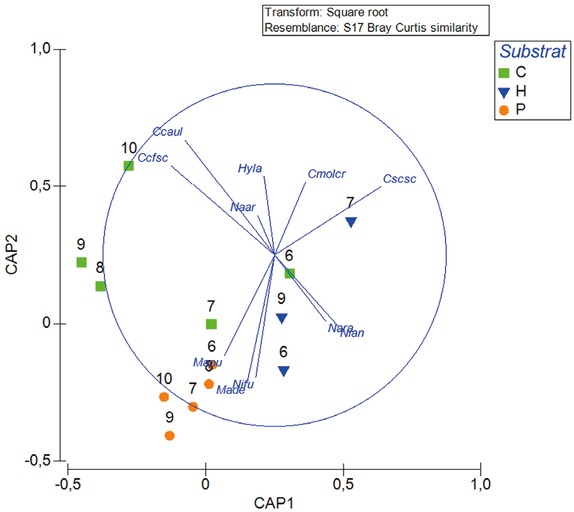
Figure 10
Canonical Analysis of Principal Coordinates (CAP; Primer+PERMANOVA, UK). CAP biplot showing months and vectors of diatom relative abundance (%) data (arrows). The group of 11 diatom taxa, which contribute the most (cumulatively 51%) to the variance between invasive and autochthonous algae, was selected according to SIMPER analysis. Codes for the diatom taxa are as follows:
Ccaul = Cocconeis caulerpacola Witkowski, Car & Dobosz
Ccfsc = Cocconeis cf. scutellum Ehrenberg
Cmolcr = Cocconeis molesta var. crucifera Grunow in Van Heurck
Cscsc = Cocconeis scutellum Ehrenberg var. scutellum
Hyla = Hyalosynedra laevigata (Grunow) Williams & Round
Made = Mastogloia decipiens Hustedt
Mapu = Mastogloia pusilla (Grunow) Cleve var. pusilla
Naar = Navicula arenaria Donkin var. arenaria
Nara = Navicula ramosissima (Agardh) Cleve
Nian = Nitzschia angularis W. Smith
Nifu = Nitzschia fusiformis Grunow