
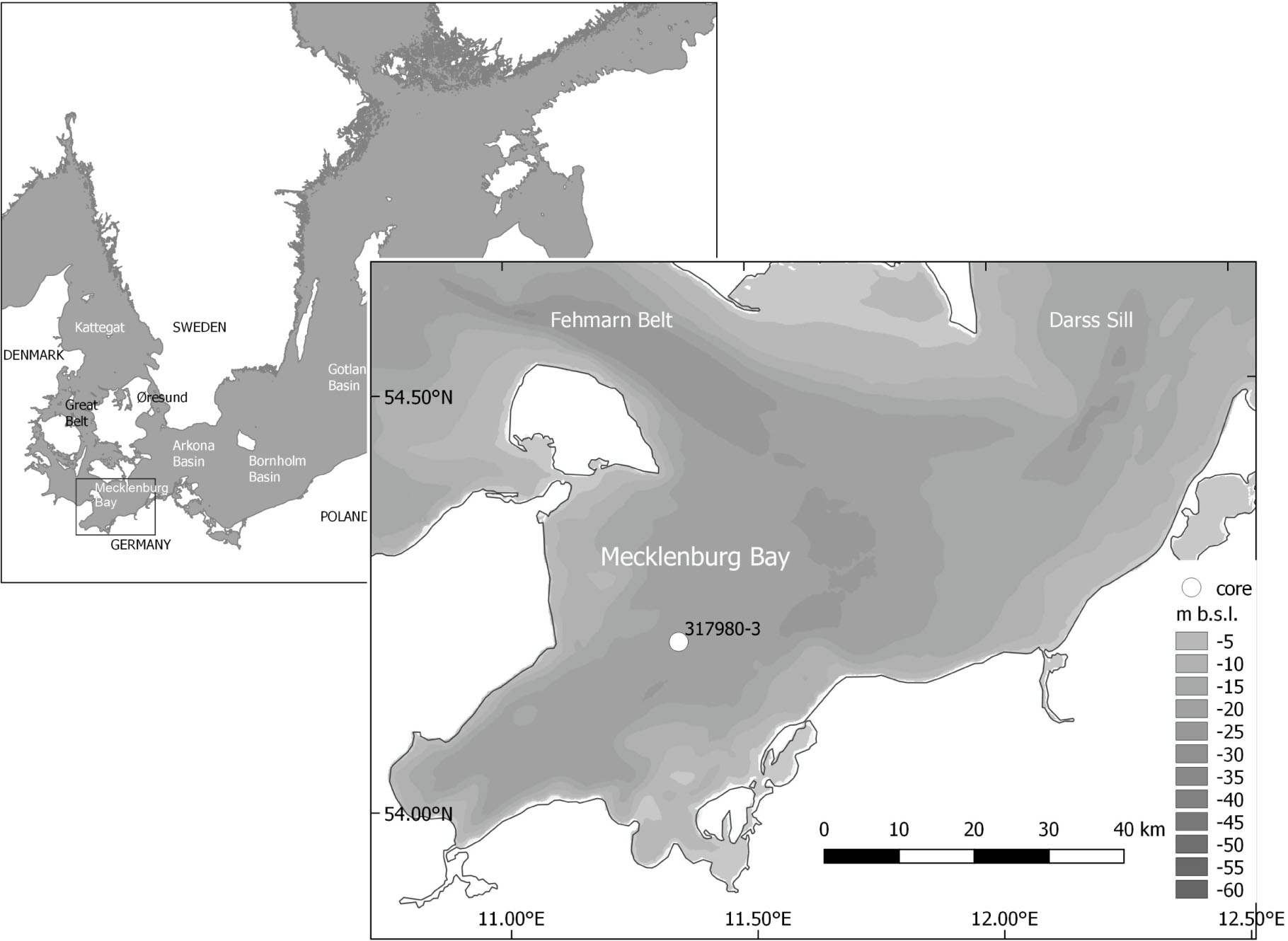
Figure 1
Location of the Core 317980-3 collection site in the Mecklenburg Bay (south-western Baltic Sea)
Table 1
Foraminifera-based stratigraphy of Core 317980-3
| Foraminifera – based unit (F) and age (cal yrs BP) | Core layer (cm) | Assemblage characteristics | Sediment characteristics | Notes and comments |
|---|---|---|---|---|
| F1 +10 700–c. 8100 | 620–540 | No foraminifera | Admixture of fine sand; sulphide micronodules in the deepest layer; abundant fine and coarse plant remains (including seeds and characean oogonia), freshwater mollusc shell fragments | Abundant cladoceran fauna (600–540 cm); occasional shells of limnic ostracods |
| F2 c. 8100–c. 6900 | 540–470 | Foraminifera present; abundance fluctuates, but gradually increases to peak at 475–480 cm, and to decline thereafter; almost 100% domination of the Ammonia group, with a slight admixture of arenaceous forms; C/A ratio strongly in favour of calcareous forms | The lowest layer still with cladoceran fragments; mud with admixture of fine sand; abundant plant remains | Occasional hydrobiid snail shell fragments |
| F3 c. 6900–c. 6300 | 470–410 | Maximum abundance; highest taxon richness; domination of the Ammonia group (occasionally not decalcified), but contribution of arenaceous forms fairly well visible; C/A ratio strongly in favour of calcareous forms | Mud; some plant remains; admixture of fine sand | Occasional brackish-water ostracods and mollusc shell fragments |
| F4 c. 6300–c. 3000 | 410–175 | Abrupt decline in abundance; C/A ratio still in favour of calcareous forms, but agglutinated forms gaining in importance | Mud; occasionally abundant plant remains; admixture of fine sand | Fragments of mollusc shells; occasional valves of fresh- and brackish-water ostracods as well as cladoceran ephippia and carapace fragments |
| F5 c. 3000–present | 175–0 | Fluctuating, generally low abundance (except for one layer with an exceptionally high abundance peak); domination of Eggerelloides scaber; C/A ratio very strongly in favour of agglutinated forms | Plant remains; admixture of fine sand; occasional sulphide micronodules | Mollusc shell fragments (e.g. Cardium), occasionally abundant; valves of fresh- and brackish-water ostracods |
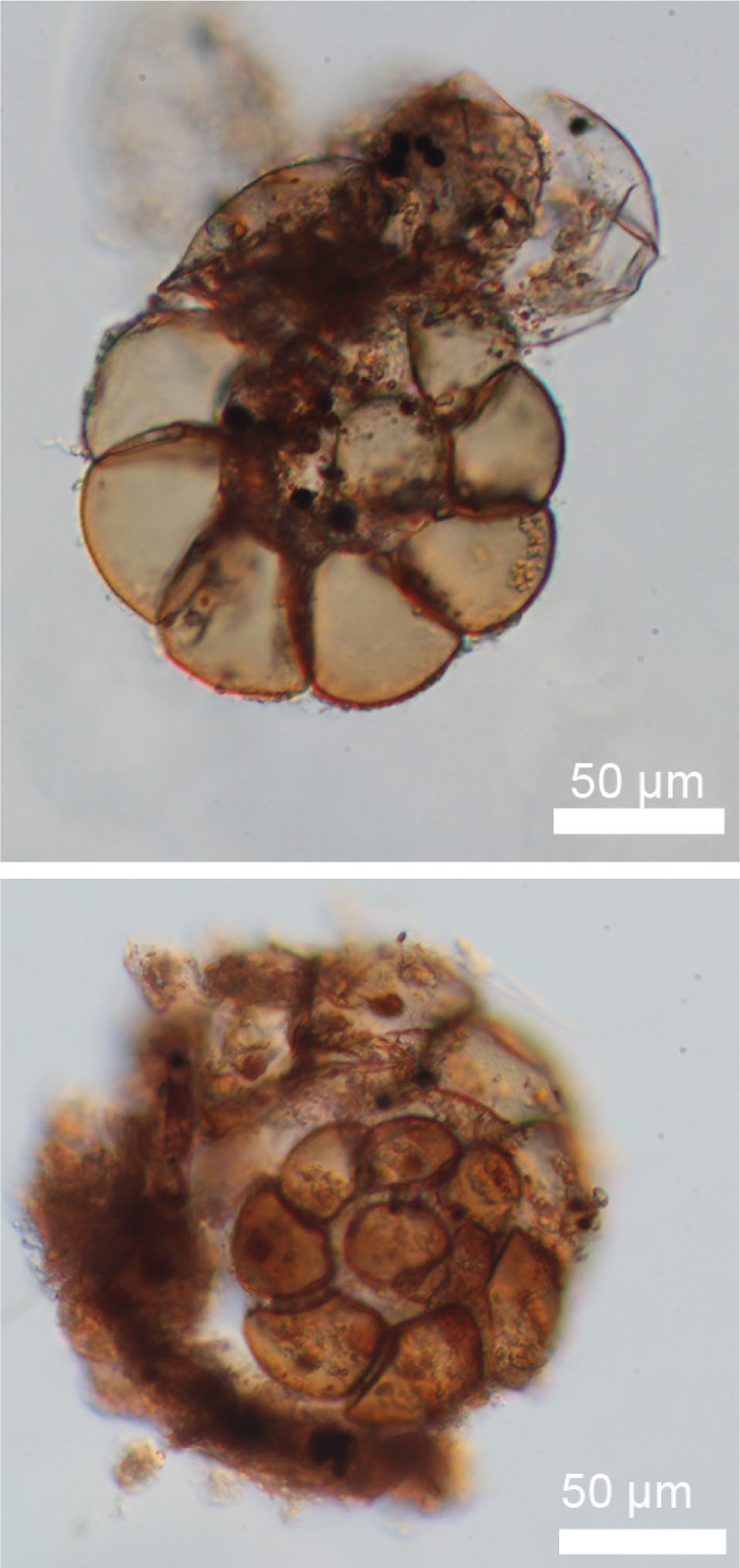
Figure 2
Decalcified tests of Ammonia foraminifera from Core 317980-3
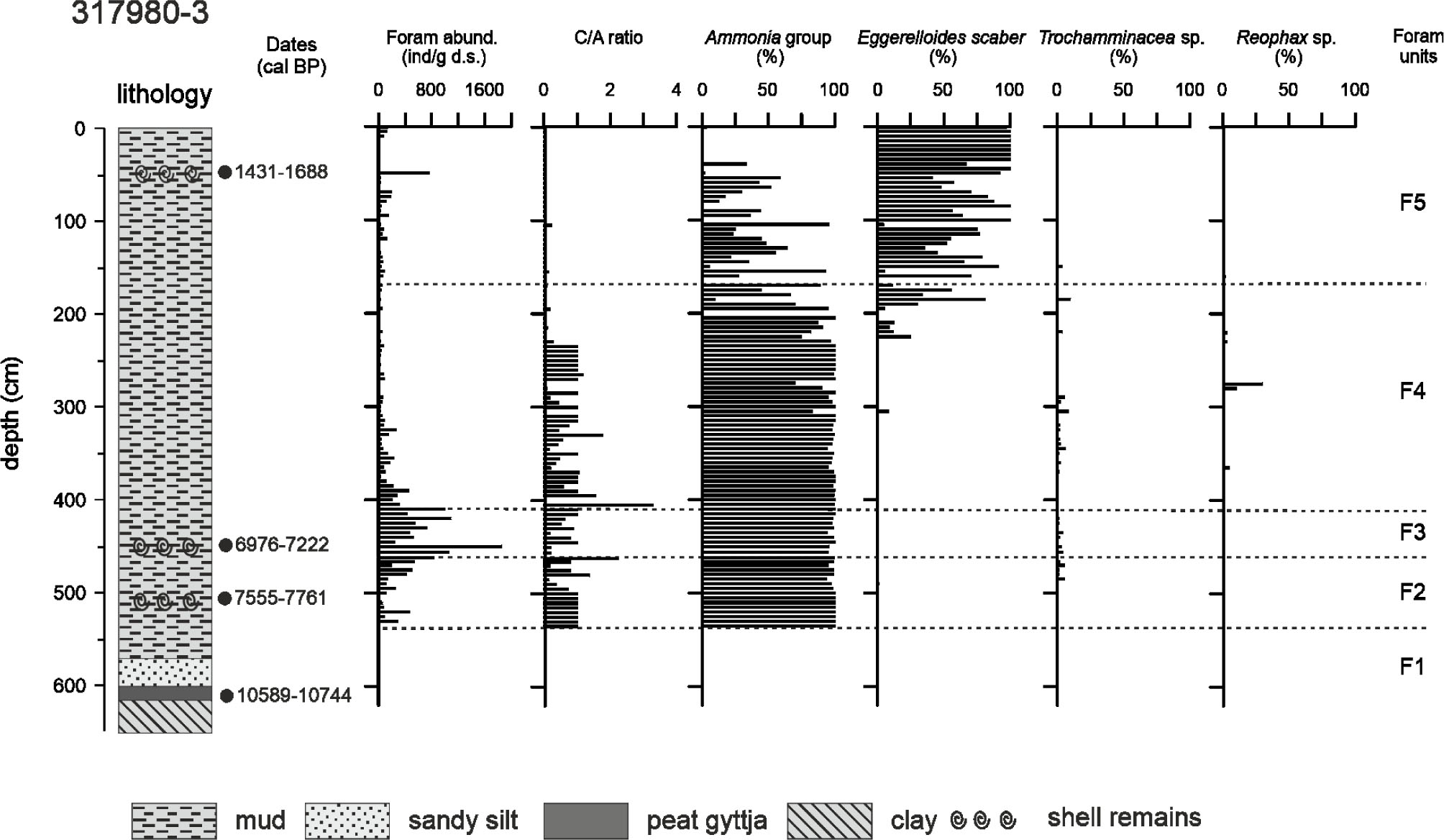
Figure 3
Distribution of dominant foraminiferal assemblages in Core 317980-3 [age–depth model developed from radiocarbon dates after Kostecki et al. (2015) using CALIB 8.1 radiocarbon calibration programme (Stuiver and Reimer 1993) as well as Marine20 and IntCal20 curves (Heaton et al. 2020; Reimer et al. 2020)]; C/A ratio – calcareous to agglutinated foraminifera ratio
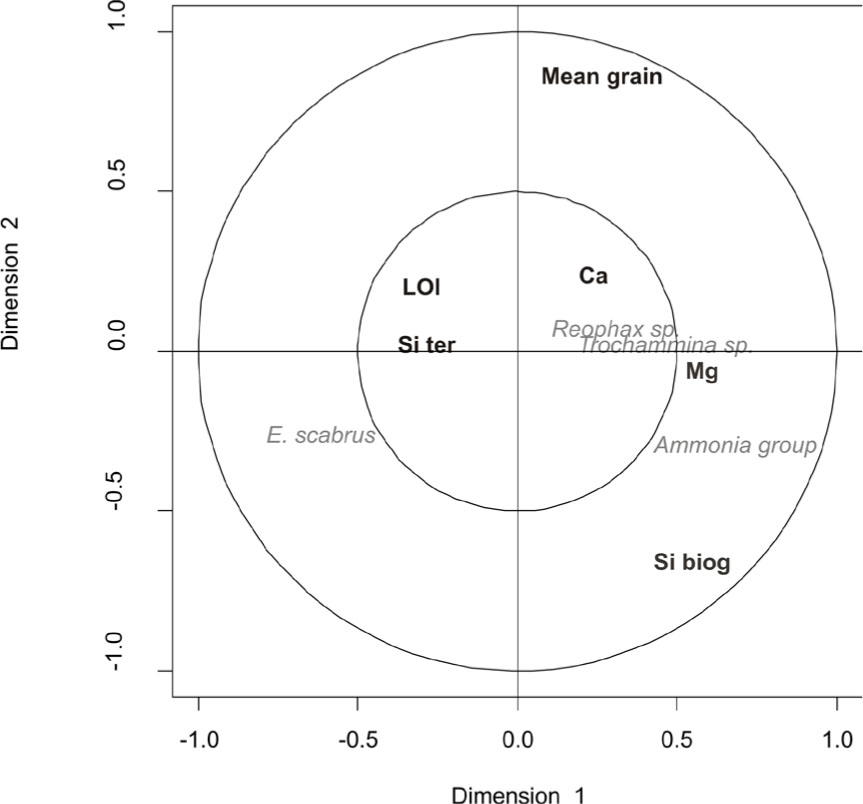
Figure 4
CCA ordination plot for the analysis of foraminifera and biogeochemical variables in Core 317980-3; LOI – loss on ignition; Mean grain – mean grain size; Si ter – terrigenous silica; Mg – magnesium content; Ca – calcium content; Si biog – biogenic silica; geochemical data description published in Kostecki et al. (2015)
Table 2
Results of Canonical Correlation Analysis
| Dimensions | ||||
|---|---|---|---|---|
| 1 | 2 | 3 | 4 | |
| Cumulative percentage of variance explained | 0.82 | 0.92 | 0.96 | 0.99 |
| Environmental parameters | ||||
| Si ter | −0.28 | 0.02 | −0.10 | 0.87 |
| Si biog | 0.56 | −0.66 | −0.20 | −0.41 |
| Mg | 0.58 | −0.01 | 0.01 | −0.56 |
| LOI | −0.30 | 0.21 | −0.05 | −0.91 |
| Ca | 0.23 | 0.25 | −0.21 | 0.05 |
| Mean grain size | 0.20 | 0.87 | −0.08 | 0.34 |
| Foraminifera taxa | ||||
| Ammonia group | 0.77 | −0.61 | −0.18 | −0.02 |
| Eggerelloides scaber | −0.76 | −0.55 | −0.32 | −0.06 |
| Trochamminacea | 0.55 | 0.07 | −0.80 | 0.25 |
| Reophax sp. | 0.33 | 0.05 | −0.65 | −0.69 |
[i] Si ter – terrigenous silica; Si biog – biogenic silica; Mg – magnesium content; LOI – loss on ignition; Ca – calcium content