
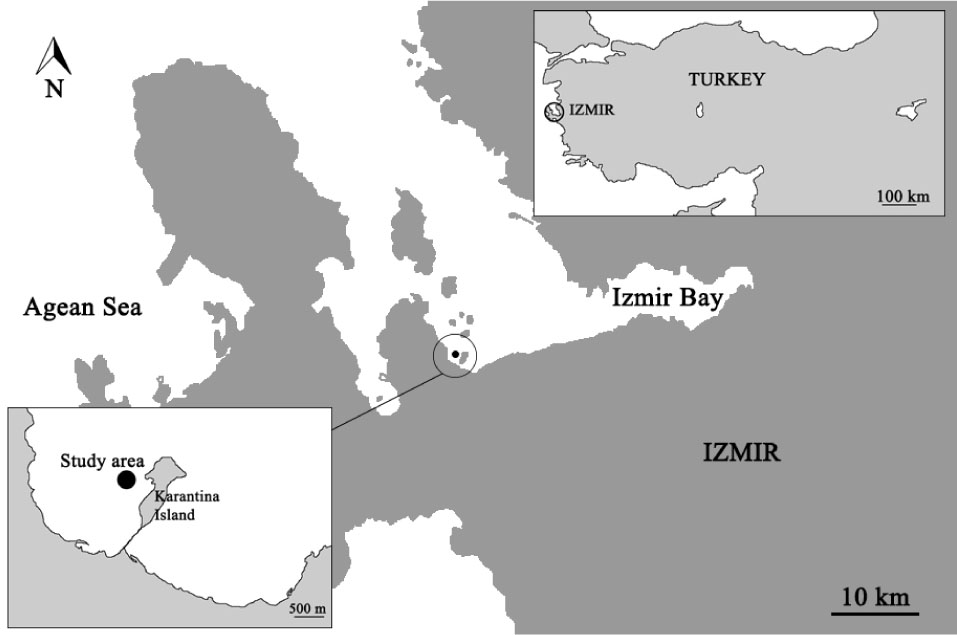
Figure 1
Geographical location of the sampling area (Izmir Bay, Karantina Island, Turkey)
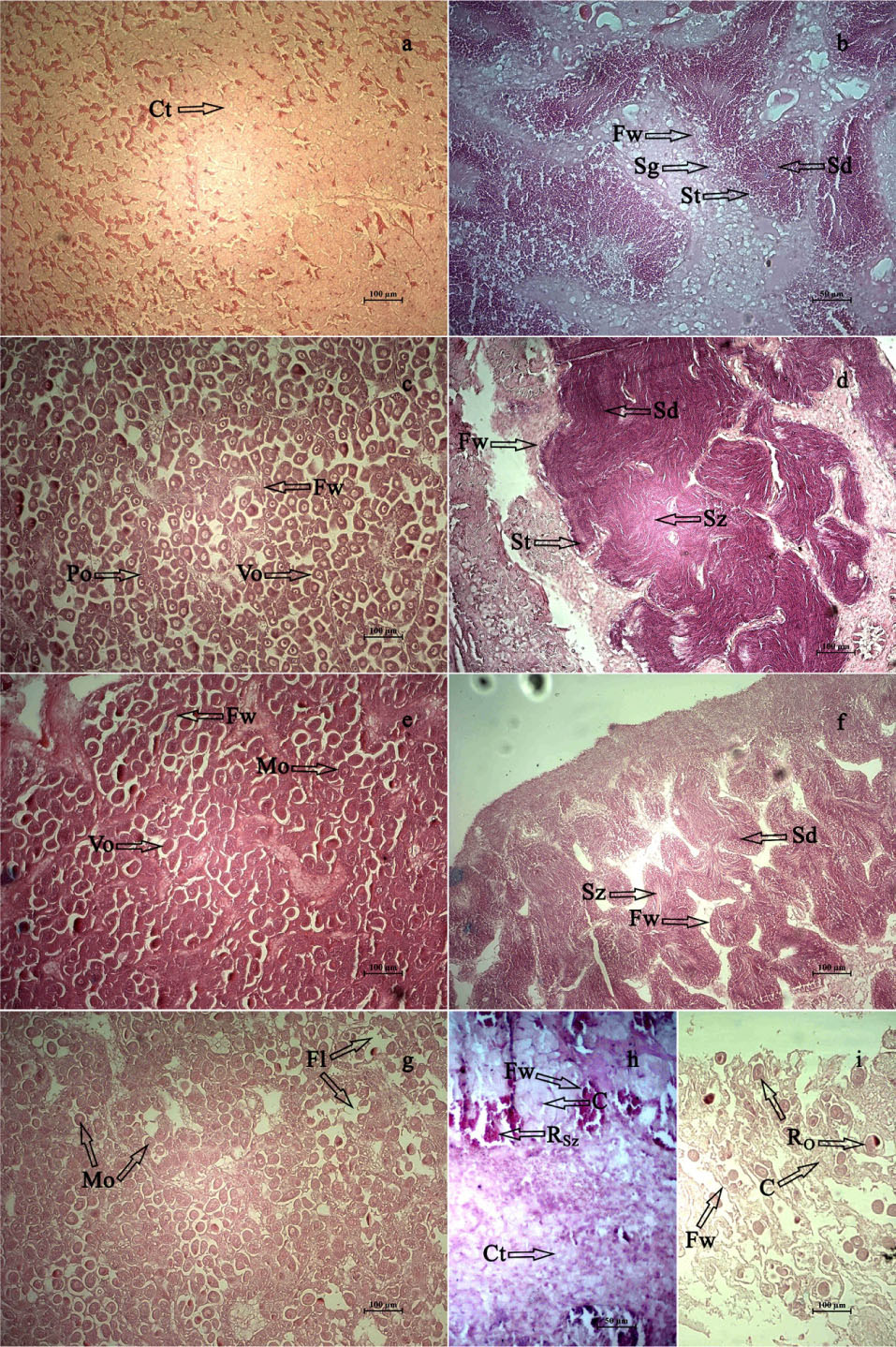
Figure 2
Gonadal stages of Pinctada radiata
a – Stage 0: Inactive; b – Stage 1: Development in male individuals (Fw: Follicular wall, Sd: Spermatid, Sg: Spermatogonia, St: Spermatocyte; c – Stage 1: Development in female individuals (Po: Previtellogenic oocyte, Vo: Vitellogenic oocyte); d – Stage 2: Maturity in male individuals (St: Spermatocyte, Sd: Spermatid, Sz: Spermatozoa, Fw: Follicular wall), e – Stage 2: Maturity in female individuals (Mo: Mature oocyte, Vo: Vitellogenic oocyte, Fw: Follicular wall); f – Stage 3: Spawning in male individuals (Sd: Spermatid, Sz: Spermatozoa, Fw: Follicular wall); g – Stage 3: Spawning in female individuals (Mo: Mature oocyte, Fl: Follicular lumen); h – Stage 4: Spent in males (Fw: Follicular wall, Rsz: Residual spermatozoa, C: Cytolysis, Ct: Connective tissue); i – Stage 4: Spent in females (Fw: Follicular wall, Ro: Residual oogonia, C: Cytolysis)
Table 1
Mean length and total fresh weight of pearl oyster samples used in the study
| Months | Pearl oyster samples | Mean length | Mean weight |
|---|---|---|---|
| Feb. | 30 | 73.99 ± 10.67 | 52.72 ± 23.08 |
| Mar. | 75.42 ± 8.99 | 60.02 ± 19.30 | |
| Apr. | 75.22 ± 9.54 | 61.25 ± 22.23 | |
| May | 72.03 ± 9.28 | 51.85 ± 23.03 | |
| June | 73.42 ± 11.26 | 57.03 ± 29.62 | |
| July | 71.10 ± 9.60 | 54.40 ± 25.43 | |
| Aug. | 72.87 ± 9.71 | 56.33 ± 24.46 | |
| Sept. | 74.57 ± 11.19 | 60.45 ± 29.50 | |
| Oct. | 73.87 ± 6.54 | 53.41 ± 13.59 | |
| Nov. | 75.22 ± 9.54 | 55.60 ± 21.98 | |
| Dec. | 72.52 ± 5.91 | 49.39 ± 13.58 | |
| Jan. | 68.25 ± 6.36 | 41.38 ± 12.37 |
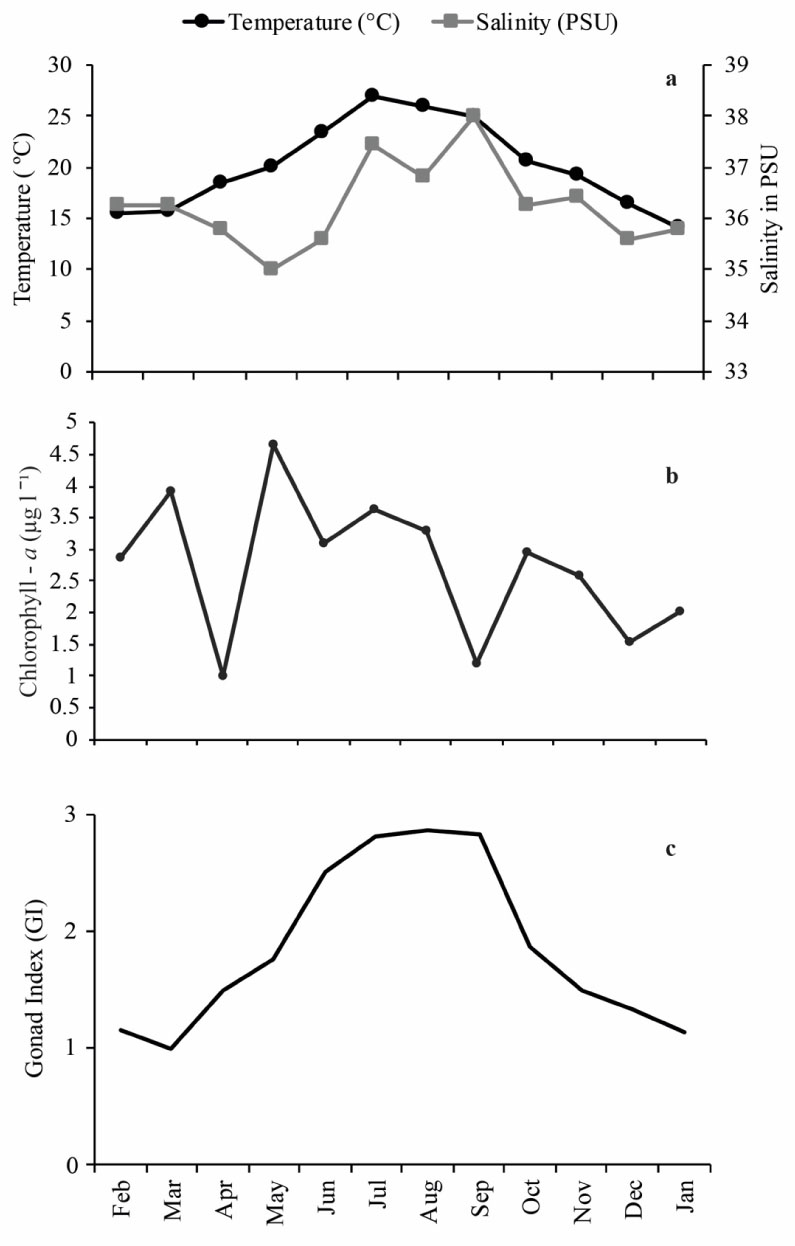
Figure 3
Environmental parameters in the study area: a) temperature and salinity; b) chlorophyll a; c) gonad index from February 2013 to January 2014
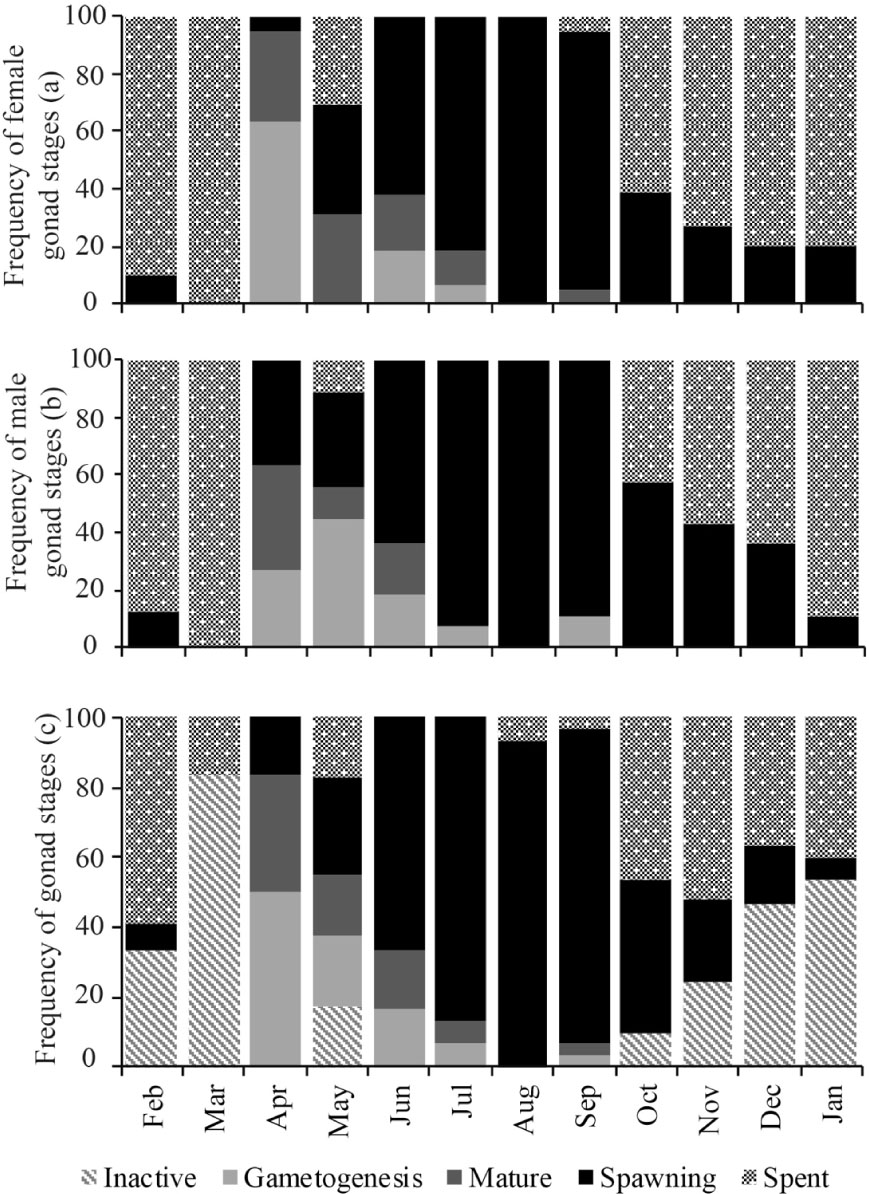
Figure 4
Frequency of gonad development stages in P. radiata in Izmir Bay from February 2013 to January 2014 (a – frequency of female gonad stages, b – frequency of male gonad stages, c – frequency of gonad stages)
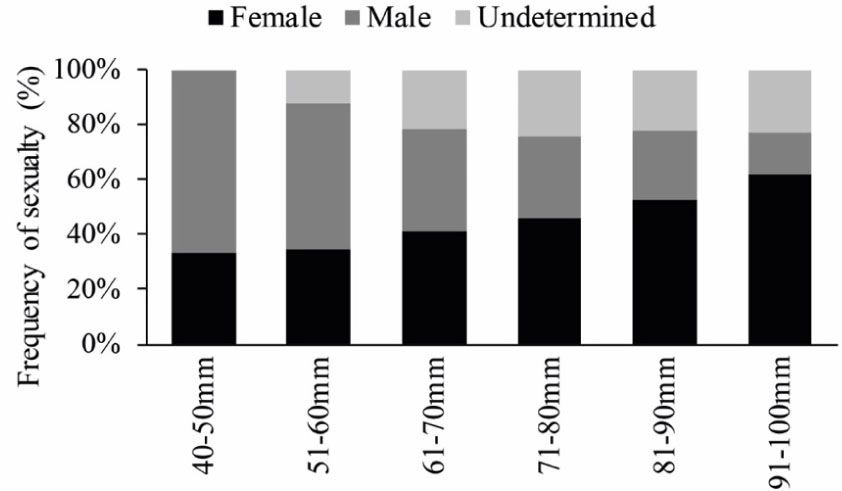
Figure 5
Changes in the sex proportion (%) in P. imbricata radiata in the study area
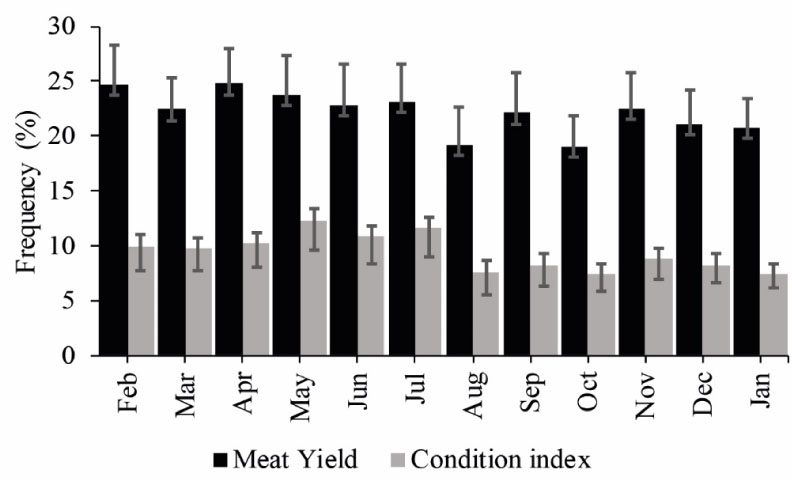
Figure 6
Meat yield (%) and the condition index of pearl oysters in the study area
Table 2
Observations of the reproductive status and temperature range in pearl oysters in different areas
| Study area | Species | Temperature (min.–max °C) | Spawning periods | Spawning peak periods | Authors |
|---|---|---|---|---|---|
| South Korea | P. fucata martensii | 13.5–28.3 | April–August | June–July | Choi & Chang 2003 |
| Tunisia | P.radiata | 12–30 | May–December | July–November | Derbali et al. 2009 |
| Iran | P.radiata | – | February–April | summer | Karami et al. 2014 |
| Tunisia | P.radiata | 12–27 | – | June | Zouari & Zaouali 1994 |
| Columbia | P. imbricata | 24.7–27.5 | December–June and October | January–March and October | Urban 2000 |
| Bahrain | P.radiata | 15–30 | May–December | August–September and November–December | Khamdan 1998 |
| Tunisia | P. radiata | 17–32 | June, September and November | June | Lassoued et al. 2018 |
| Kenya | P. radiata | 26–32 | July, September–February, April–May | July (site2) and October (site1) | Kimani et al. 2006 |
| Australia | P. imbricata | 15–25 | October–April and May–August and April–July (two years) | December–January and March–May | O’Connor and Lowler 2004 |
| Turkey | P. imbricata radiata | 14.2–27 | April–January | June–September | this study |