
Introduction
Cesium-137 (137Cs) is a high-yield fission product of major safety concern in nuclear reactor operations due to its high volatility, long half-life, intense γ-emission, and pronounced solubility in water [1, 2]. Cesium-137 is produced linearly with fuel burnup level due to its same yields from U-235 and fissile plutonium isotopes. Fission products are designed to remain contained within the nuclear fuel system. In the event of a severe accident, cesium could be released from the fuel, carried through the reactor coolant system, and dispersed into the environment, resulting in extensive radiological contamination with the long-term radiation exposure risk [3]. Currently, most codes used to predict source-term release during severe accidents, such as MELCOR, and ASTEC are based on simple diffusion equations without considering the physicochemical behavior of each source-term type [1, 4–8].
The environmental conditions and formation of cesium compounds during a severe accident, significantly influence their physicochemical behavior, i.e., volatility, deposition behavior, and mobility in the environment. In light water reactor (LWR) and fast breeder reactor (FBR), cesium can react with structural materials and their oxide layers. These reactions could produce the formation of stable or metastable compounds [9, 10]. For example, interaction with chromium-rich protective layers produces cesium chromate (primarily Cs2CrO4) [11, 12]. On the other hand, the reaction of cesium with iron-based alloys or corrosion products can produce cesium ferrates such as Cs2FeO4 and CsFeO2 [13–15]. These compounds are formed in significant quantities under certain accident conditions and are therefore directly relevant to fission product transport and source-term modeling [2, 16–18].
An accurate prediction of cesium release, dispersion and deposition in the severe accident codes requires reliable thermodynamic and phase stability data for these compounds [19, 20]. Although Cs2CrO4 has been extensively studied with a number of reported data, including enthalpy of dissolution, thermal expansion, electrical conductivity, enthalpy increase, and heat capacity [12, 21–24], the thermophysical properties of cesium ferrate remain largely unstudied. Existing data for Cs2FeO4 and CsFeO2 are very limited, and some are contradictory [2, 25].
This study addressed these gaps by synthesizing high-purity Cs2CrO4 and Cs2FeO4, and characterizing their phase stability, decomposition pathways, and thermophysical properties using powder X-ray diffraction (XRD), in-situ high temperature XRD, and thermogravimetric–differential scanning calorimetry (TG-DSC). The experimental results were complemented by some first-principles density functional theory (DFT) calculations and quasi-harmonic phonon modeling to obtain the temperature-dependent thermodynamic quantities, e.g., heat capacity, entropy, internal energy, and Helmholtz free energy, from 0 K to 1000 K. By combining the experimental modeling and the DFT, this study yielded a comprehensive dataset for Cs2FeO4 and CsFeO2, along with enhanced data for Cs2CrO4. These data cover input parameters which are important for source term transport modeling in typical nuclear reactor safety assessments, where radiological release and consequence studies are critical [26]. The accuracy of these parameters is highly important to define the design basis accident (DBA) limitation used for radiological emergency and preparedness programs of the respective nuclear reactors [20, 27, 28]).
Methodology
Experimental methods
Synthesis of Cs2CrO4 and Cs2FeO4
The cesium chromate and the cesium ferrate were prepared via a solid-state reaction using high-purity precursors: cesium hydroxide monohydrate (CsOH·H2O, ≥98.0%, Sigma-Aldrich), chromium(III) oxide (Cr2O3, ≥99.9%, Alfa Aesar), and magnetite (Fe3O4, ≥99.9%, Alfa Aesar). The stoichiometric ratios were 4 mol of CsOH·H2O to 1 mol of Cr2O3 and 6 mol of CsOH·H2O to 1 mol of Fe3O4 for Cs2CrO4 and Cs2FeO4, respectively, which were weighed to about 10 g (see Table 1). These precursors were ground using an agate mortar for about 15 minutes to ensure their homogeneity. This powder mixture was uniaxially pressed into 10 mm-diameter pellets at a pressure of 150 MPa. Subsequently, the pellets were placed within an alumina crucible and subjected to heating in an air environment. The temperature was progressively elevated at a rate of approximately 5°C·min−1, commencing from ambient temperature and culminating at 600°C. The temperature was then maintained at 600°C for 6 h. They were then applied to a furnace-cooling to reach the ambient temperature. The reacted pellets were finally grounded becoming fine powders, with grain sizes less than about 45 μm, for the further required characterization.
Powder X-ray diffraction (XRD)
The phase purity and crystal structure were characterized using Rigaku SmartLab diffractometer equipped with Cu-Kα radiation (λ = 1.5406 Å). The data were collected within the 2θ range of 10–80°, with a step size of 0.02° and a counting time of 1 s per step. Some in-situ high-temperatures measurements were performed, when required, using an Anton Paar HTK-2000N heating chamber under the ambient air. The diffraction patterns were then analyzed qualitatively and quantitatively using the embedded Rigaku software package.
Thermogravimetric–differential scanning calorimetry (TG-DSC)
The thermal stability and decomposition behavior were assessed using a Netzsch TG-DSC 449 F3 Jupiter instrument under flowing air with a flow rate of about 50 mL·min−1. Each sample mass was 10 ± 0.1 mg. The temperature was programmed to gradually increase from 25°C to 1200°C at a rate of 10°C·min−1. The platinum crucible was utilized for the analysis, and a baseline correction was performed using an empty crucible run. Data interpretation focused on correlating the mass loss stages with each decomposition event.
Computational methods
Density functional theory (DFT) calculations
All DFT calculations were performed using Quantum Espresso version 7.0, with the Perdew–Burke–Ernzerhof (PBE) generalized gradient approximation (GGA) [29–31]. The PBE function was chosen because the focus of this study is on the equilibrium structures, the phonon spectra, and the quasi-harmonic thermodynamic functions. For ionic and mixed ionic–covalent oxides such as the chromates and the ferrates, PBE generally mitigates the overbinding tendency of the local density approximation (LDA/CAPZ). The approximation typically underestimates the lattice constants and over stiffens the phonons, which can bias the thermodynamic functions becomes too low at a given temperature. Hence, the PBE was expected to yield more accurate lattice parameters, bulk moduli, and vibrational frequencies, which directly influence the calculated heat capacities, entropies, and free energies.
Self-consistency loops were executed with an energy convergence threshold of 1 × 10⁻⁹ Ry. Wavefunction expansions utilized a kinetic-energy cutoff of 25 Ry and a charge-density cutoff of 225 Ry. Pseudopotentials were obtained from the PS library v1.0 in the PAW formalism [32]. K-point sampling used a Γ-centered Monkhorst–Pack lattice and was customized for each structure: orthorhombic Cs2CrO4 and Cs2FeO4: 6 × 6 × 4, and cubic CsFeO2: 8 × 8 × 8. Convergence tests on Cs2CrO4 (chosen as a representative of all phases) confirmed the achievement of total-energy stability and lattice-constant within 1 meV/atom. The initial crystal structures of Cs2CrO4, Cs2FeO4, and CsFeO2 were provided by the Materials Project [33]. These initial crystal structures were relaxed via the trust radius procedure using the Broyden–Fletcher–Goldfarb–Shanno (BFGS) quasi-Newton algorithm, with total energy level differences of less than 10−9 Ry. The initial and optimized crystal lattice parameters before and after optimization are presented in Table 2.
Table 2.
Initial and optimized crystal lattice parameters of Cs2CrO4, Cs2FeO4, and CsFeO2
| Structure | Lattice parameters | |||||||||||
|---|---|---|---|---|---|---|---|---|---|---|---|---|
| Initial structure | Optimized structure | |||||||||||
| a (Å) | b (Å) | c (Å) | α | β | γ | a (Å) | b (Å) | c (Å) | α | β | γ | |
| Cs2CrO4 | 8.45604 | 6.28587 | 11.19674 | 90° | 90° | 90° | 7.88893 | 5.85207 | 10.40019 | 90° | 90° | 90° |
| Cs2FeO4 | 8.41802 | 6.27588 | 11.10394 | 90° | 90° | 90° | 7.80453 | 5.79734 | 10.26532 | 90° | 90° | 90° |
| CsFeO2 | 8.60125 | 8.60125 | 8.60125 | 90° | 90° | 90° | 8.00462 | 8.00462 | 8.00462 | 90° | 90° | 90° |
Phonon and thermodynamic properties
Vibrational properties were computed with Phonopy v2.14.2 under the quasi-harmonic approximation. Force constants were obtained from 3 × 3 × 3 supercells; phonon dispersions and phonon density of states (DOS) used a 4 × 4 × 4 q-point mesh. The same PBE-PAW pseudopotentials and planewave cutoffs as in the DFT step were applied. The thermodynamic outputs (Cv, F, E, S) were calculated within the quasi-harmonic approximation ranging from 0 K (theoretical limit) to 1000 K. The constant-pressure heat capacities (Cp) were derived via the standard relation incorporating molar volume (Vm) bulk modulus (BT), and thermal-expansion coefficients (α) [34].
Results
Phase analysis by X-ray diffraction
The XRD pattern of synthesized Cs2CrO4 indicates a good agreement with the referenced pattern of Inorganic Crystal Structure Database (ICSD) 98-030-0021 (space group Pnma) (see Fig. 1). All peaks are in good agreement with the standard pattern. This confirms a successful synthesis of the singlephase Cs2CrO4 with a high crystallinity. The absence of the secondary phases or unidentified peaks is an important indication on the purity of the synthesized product. Moreover, exposure to humidity for approx. 48 hours did not produce additional peaks or peak shifts, indicating that Cs2CrO4 maintains its crystal integrity under typical environmental conditions.
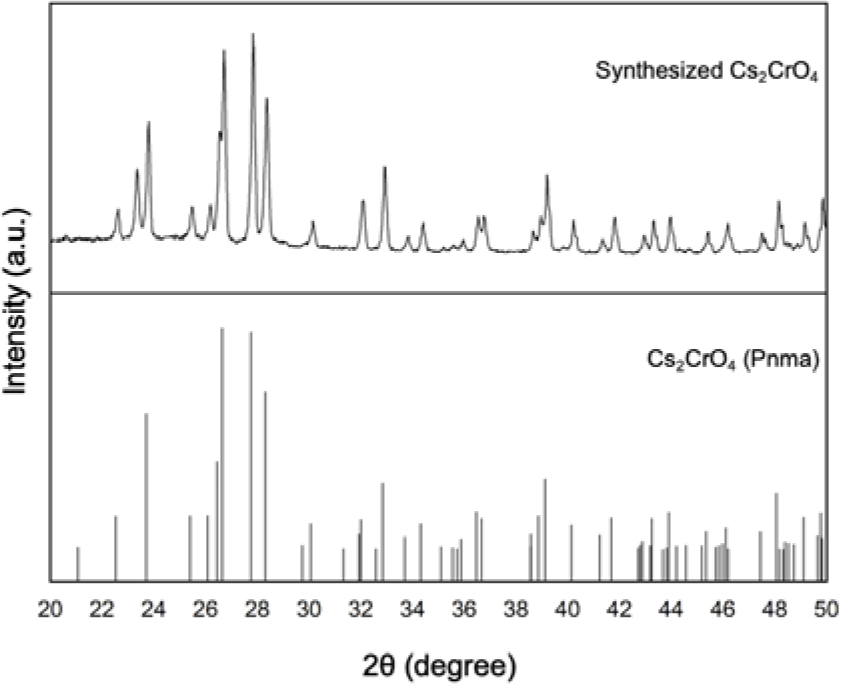
Fig. 1.
XRD pattern of the synthesized Cs2CrO4 compared with ICSD reference (98-030-0021).
In contrast, the freshly prepared Cs2FeO4 powders were highly hygroscopic. This compound readily absorbed moisture, forming Cs2FeO4·nH2O. This caused the XRD measurements, which were at room temperature, to produce an inconsistent pattern with the anhydrous phase. To address this issue, some in-situ high-temperature XRD measurements were performed at 300, 450, 600, 750, 900, and 1050°C using a heater-equipped diffractometer. As shown in Fig. 2, at 300°C, the hydrate diffraction peaks appear simultaneously with the Cs2FeO4 and CsFeO2 diffraction peaks, indicating partial dehydration and phase maturation. At 600°C, the intensity of the peaks associated with Cs2FeO4 decreases, and at 900°C, all peaks associated with Cs2FeO4 disappear, being replaced by a pattern dominated by CsFeO2. At 1050°C, peaks associated with polymorphic Fe2O3 appear. These reveal the thermal decomposition pathway and stability limits of cesium ferrate at elevated temperatures.
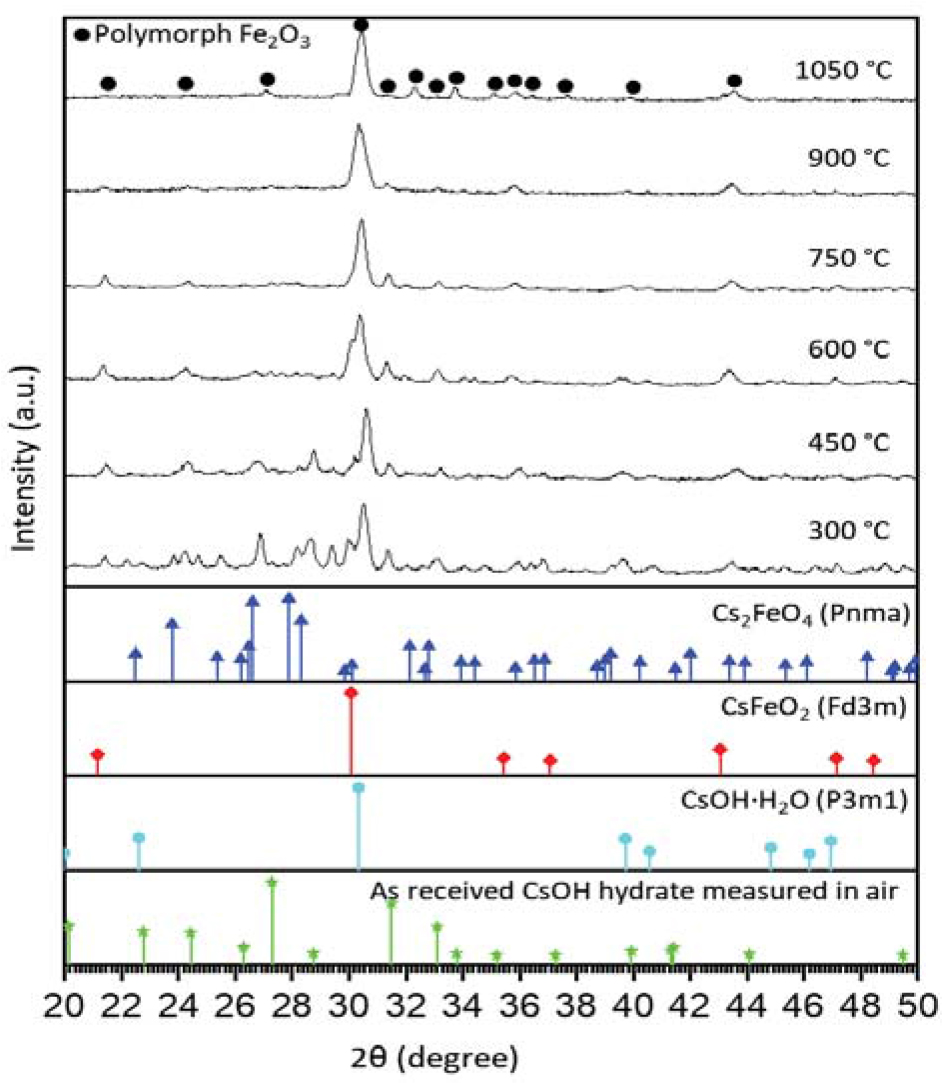
Fig. 2.
In-situ XRD patterns of cesium ferrate at selected temperatures (300–900°C), showing phase evolution.
Rietveld analysis was also performed using initial structural models for Cs2CrO4, Cs2FeO4, and CsFeO2 (Table 3). Both Cs2CrO4 and Cs2FeO4 crystallized in the orthorhombic Pnma space group, while CsFeO2 adopted an orthorhombic Pnca structure. The results show that the Rietveld lattice parameters (Table 4) have some slight deviations from the referenced values due to the thermal effects and experimental conditions. In all the three phases, the lattice parameters increased systematically with the temperature, which is consistent with the thermal expansion [35].
Table 3.
Reference ICSD parameters of Cs2CrO4, Cs2FeO4, and CsFeO2 used for Rietveld refinement
| Structure | Reference (ICSD) | Crystal system | Space group | Initial structure | |||||
|---|---|---|---|---|---|---|---|---|---|
| a (Å) | b (Å) | c (Å) | α | β | γ | ||||
| Cs2CrO4 | 98-030-0021 | Orthorhombic | Pnma | 8.427 | 6.300 | 11.200 | 90° | 90° | 90° |
| Cs2FeO4 | 98-003-3861 | Orthorhombic | Pnma | 8.429 | 6.281 | 11.053 | 90° | 90° | 90° |
| CsFeO2 | 98-042-1171 | Orthorhombic | Pnca | 5.888 | 11.855 | 16.733 | 90° | 90° | 90° |
Table 4.
Rietveld refined lattice parameters of Cs2CrO4, Cs2FeO4, and CsFeO2 at selected temperatures (300-1050°C)
| Structure | Temperature (°C) | Rietveld refined structure | |||||
|---|---|---|---|---|---|---|---|
| a (Å) | b (Å) | c (Å) | α | β | γ | ||
| Cs2CrO4 | 300 | 8.42366 | 6.29645 | 11.15942 | 90° | 90° | 90° |
| Cs2FeO4 | 8.45298 | 6.26310 | 10.94143 | 90° | 90° | 90° | |
| CsFeO2 | 5.88029 | 11.98257 | 16.62691 | 90° | 90° | 90° | |
| Cs2CrO4 | 450 | 8.42984 | 6.29685 | 11.16231 | 90° | 90° | 90° |
| Cs2FeO4 | 8.65481 | 6.24810 | 10.81982 | 90° | 90° | 90° | |
| CsFeO2 | 5.87516 | 11.83784 | 16.57442 | 90° | 90° | 90° | |
| Cs2CrO4 | 600 | 8.42915 | 6.29507 | 11.15966 | 90° | 90° | 90° |
| Cs2FeO4 | 8.36504 | 6.15398 | 11.17351 | 90° | 90° | 90° | |
| CsFeO2 | 5.87482 | 11.92527 | 16.65542 | 90° | 90° | 90° | |
| Cs2CrO4 | 750 | 8.42977 | 6.29284 | 11.14565 | 90° | 90° | 90° |
| Cs2FeO4 | Not detected | ||||||
| CsFeO2 | 5.88306 | 11.89342 | 16.66022 | 90° | 90° | 90° | |
| Cs2CrO4 | 900 | 8.42237 | 6.29867 | 11.18188 | 90° | 90° | 90° |
| Cs2FeO4 | Not detected | ||||||
| CsFeO2 | 5.86574 | 11.89000 | 16.70313 | 90° | 90° | 90° | |
| Cs2CrO4 | 1050 | Not detected (largely evaporated) | |||||
| Cs2FeO4 | Not detected | ||||||
| CsFeO2 | 5.87246 | 11.84662 | 16.63563 | 90° | 90° | 90° | |
Thermal behavior from TG-DSC
Figure 3 shows the TG-DSC profiles for Cs2CrO4 and Cs2FeO4. For Cs2CrO4 (Fig. 3a), an endothermic event occurs at ~354°C, which is also associated with a mass loss of 2.917%. This phenomenon is caused by the release of surface-adsorbed moisture. Cs2CrO4 remains stable up to ~950°C, which is accompanied by a mass loss of 5.99% in the form of an endothermic reaction. This indicates a decomposition and/or an evaporation, as also reported in some works starting that Cs2CrO4 melts at temperatures which are close to 1230 K [22, 36].
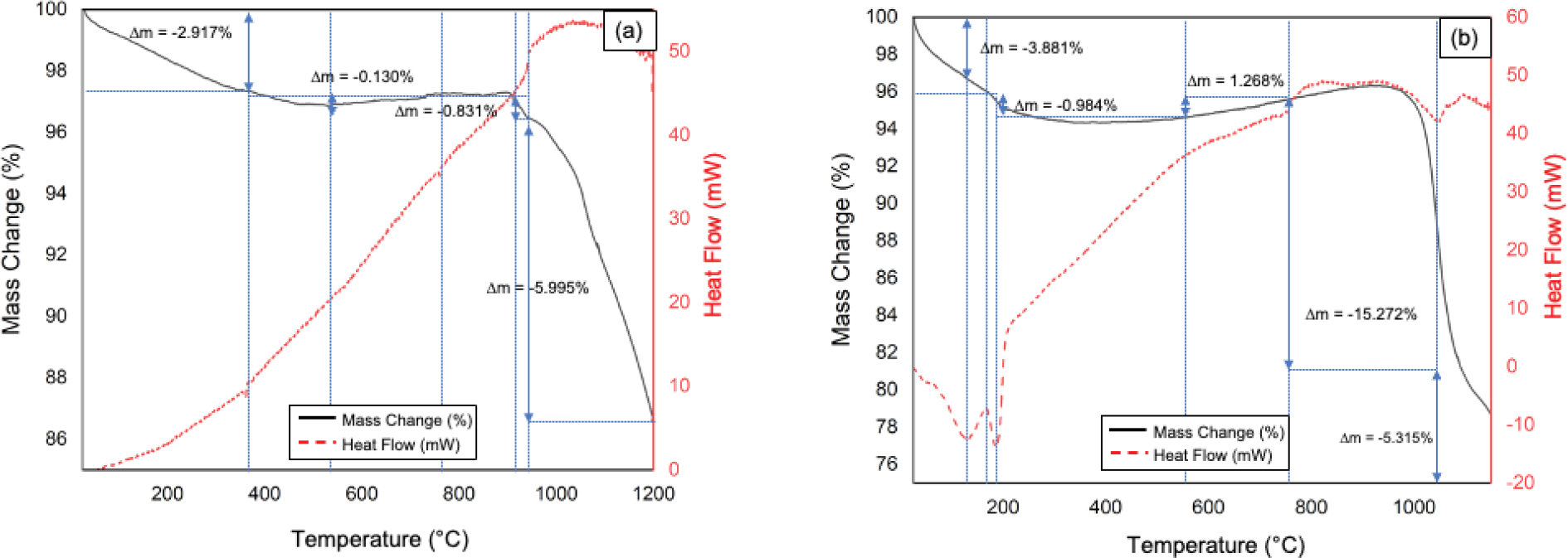
Fig. 3.
TG-DSC curves of (a) cesium chromate, and (b) cesium ferrate, measured from ambient temperature to 1200°C.
Cs2FeO4 exhibits a more complex phenomenon (Fig. 3b). At ~97°C, dehydration, or the release of H2O absorbed by the specimen from the air, was observed. Cs2CrO4 also appears to begin transforming to CsFeO2 starting at ~170°C. This transformation phenomenon can also be confirmed by in-situ XRD data. A small mass gain is observed between 400°C to 800°C. This phenomenon is likely due to oxygen re-adsorption into the ferrate lattice [15]. However, above ~1086°C, a significant mass loss accompanied by an endothermic reaction is observed. This is probably related to the decomposition of CsFeO2 into Fe2O3, accompanied by cesium volatilization. These multistage decompositions align with the phase evolution in Fig. 2 and highlight the thermal instability of cesium ferrates compared to cesium chromates.
First-principles structural and electronic properties
Cs2CrO4 and Cs2FeO4 are isostructural, both crystallize in an orthorhombic Pnma space group. Each unit cell contains 28 atoms, e.g. eight Cs atoms of with four transition-metal (Cr or Fe), and sixteen atoms of O arranged in a network of MO4 tetrahedra. Replacing Cr6+ with the slightly larger Fe6+ ion lengthens the M–O bonds which leads to measurable differences in the a, b, and c lattice parameters, and hence in the unit’s cell volume. In contrast, CsFeO2 adopts a cubic or an orthorhombic Pnca structure with 32 atoms per unit cell, e.g. eight atoms of Cs, eight atoms of Fe, and sixteen atoms of O. A higher content of Fe and a higher three-dimensional connectivity of its framework give a larger unit cell volume of CsFeO2 than either orthorhombic Pnma Cs2CrO4 or Cs2FeO4.
Figure 4 shows charge density distribution of the Cs2CrO4, Cs2FeO4, and CsFeO2 compounds. The distribution reveals that the probability of electrons forming covalent bonds primarily resides between Cr and Fe atoms with O atoms. The bond between Fe and O atoms effectively binds Cs atoms forming CsFeO2 with a crystal structure that is chemically more stable. In the other hand, the electron distribution between Cs and other atoms is weaker, indicating that the bond is naturally ionic.
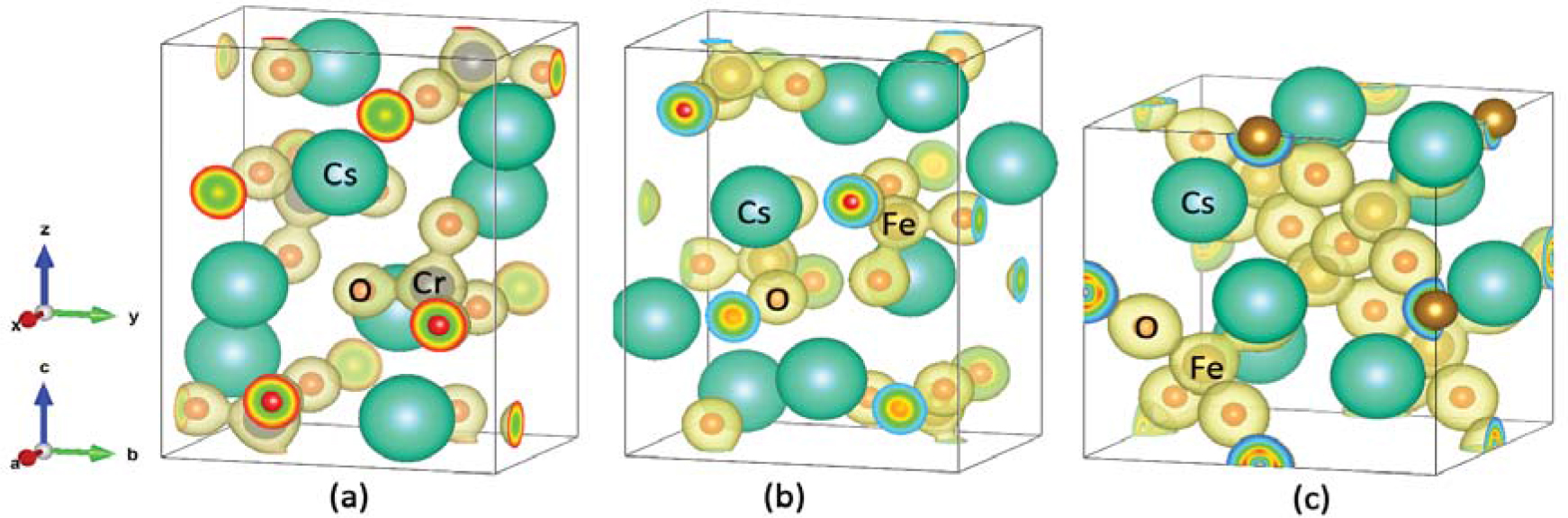
Fig. 4.
Charge density maps of (a) Cs2CrO4, (b) Cs2FeO4, and (c) CsFeO2.
Figure 5 shows the electronic band structure and the DOS of Cs2CrO4, Cs2FeO4, and CsFeO2, providing a detailed quantitative information on the electronic structure characteristics of each compound. The 3.0 eV energy gap between the valence and conduction bands in Fig. 5a indicates that Cs2CrO4 is an insulator. On the contrary, Cs2FeO4 (Fig. 5b) has a much smaller band gap of around 1.2 eV, primarily due to Fe atoms in the 3d state and Cs atoms in the 5p state. This small energy gap allows Cs2FeO4 to exhibit semiconductor behavior. On the other hand, as shown in Fig. 5c, CsFeO2 has a complex electronic structure with overlapping valence and conduction bands, indicating its conductive characteristic. These interesting characteristics of cesium ferrate, which can change its crystal structure and properties, suggest further studies for its deployment in other applications beyond nuclear safety.
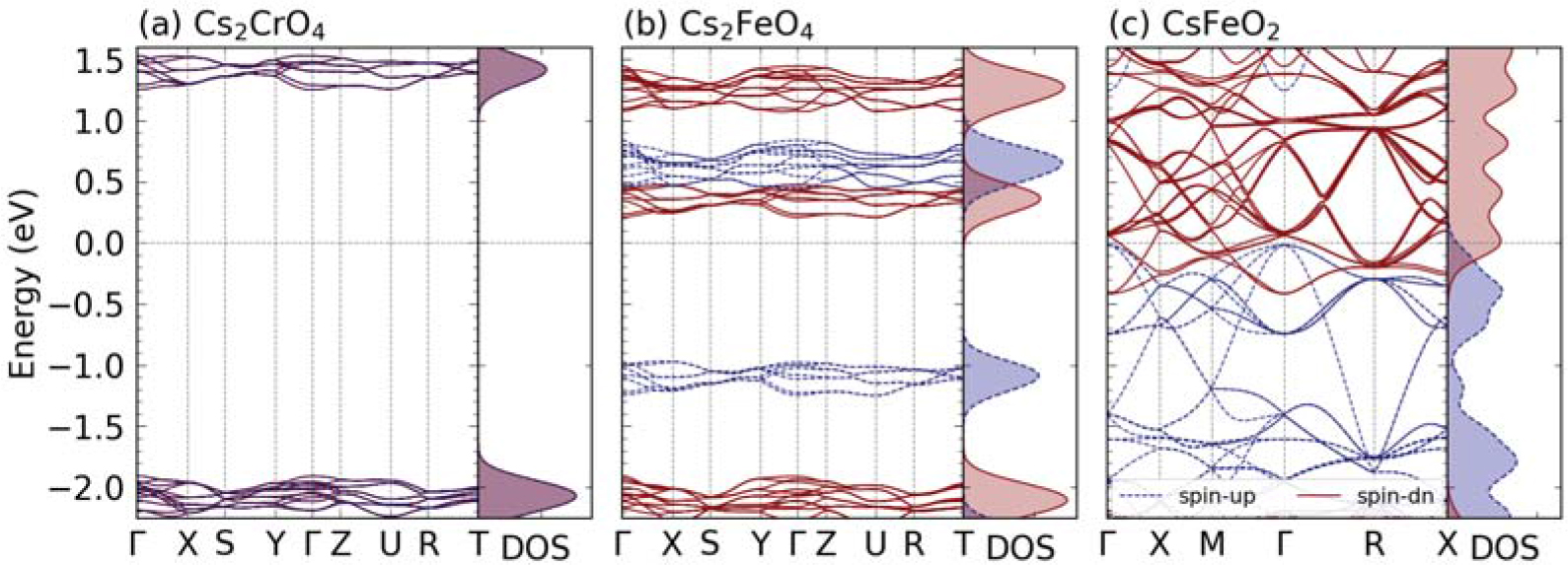
Fig. 5.
Electronic band structures and density of state (DOS) of (a) Cs2CrO4, (b) Cs2FeO4, and (c) CsFeO2.
Phonon dispersion and dynamic stability
The cohesive energies of Cs2CrO4, Cs2FeO4, and CsFeO2 are negative, indicating that these compounds are thermodynamically stable. However, the phonon properties of these three compounds are different as shown in Fig. 6. Cs2CrO4 has no imaginary frequencies in its phonon dispersion curves, which means it is dynamically stable. Meanwhile, Cs2FeO4 and CsFeO2 have several imaginary frequencies in their phonon dispersion curves, which means that they are dynamically unstable. The phonon bands of Cs2CrO4 and Cs2FeO4 can be divided into four groups: one acoustic group and three optical groups. The acoustic group and the first two optical groups overlap up to about 6 THz. The last two optical groups are separated by wide gaps. CsFeO2 has a different phonon band structure, where the acoustic and optical groups are mixed up to 10 THz, and the gaps appear above 10 THz. This suggests that CsFeO2 has a higher thermal conductivity than the other two compounds.
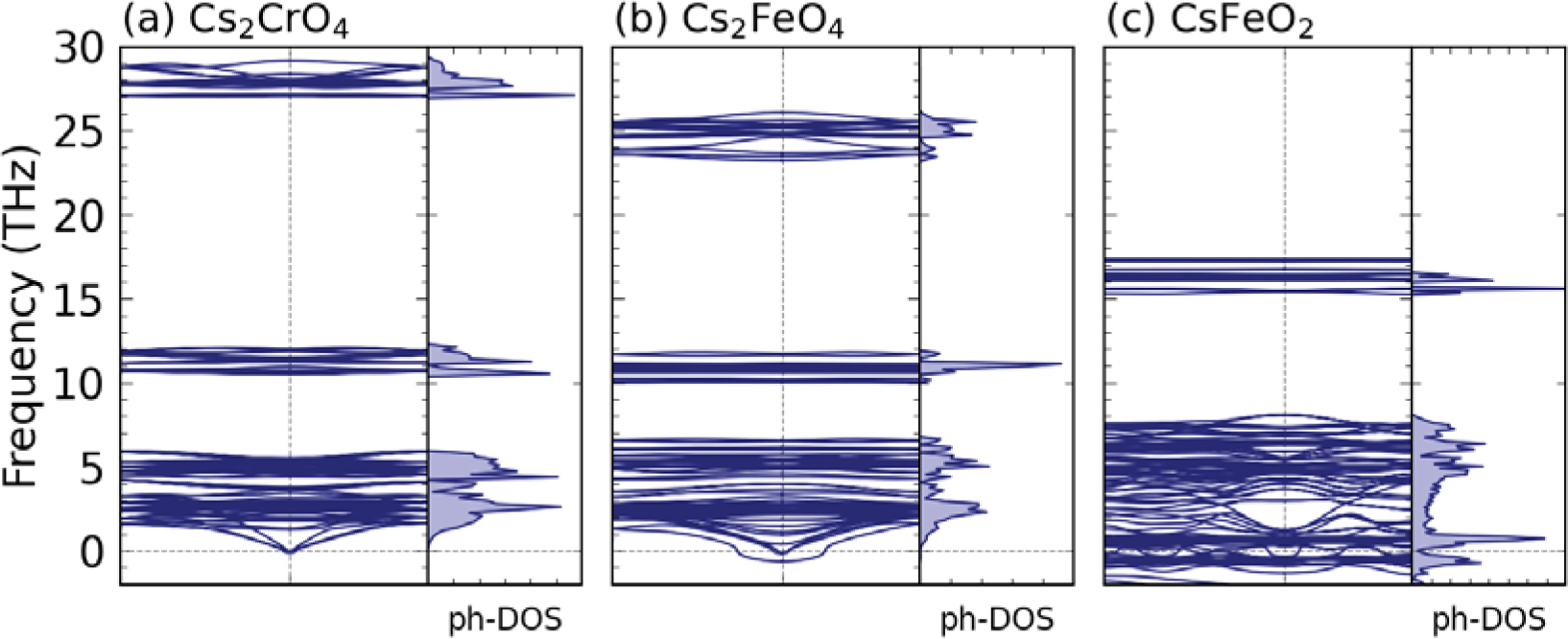
Fig. 6.
Phonon band frequencies and phonon DOS of (a) Cs2CrO4, (b) Cs2FeO4, and (c) CsFeO2.
Heat capacity: Theory vs. experiment
Figure 7 shows the comparison of the constant-pressure heat capacity (Cp) of Cs2CrO4 derived from TG-DSC measurements, DFT calculations, and previous experimental studies [22, 24]. From 300 K up to roughly 750 K, the DFT-predicted Cp closely overlaps both the literature data and our TG-DSC trace, demonstrating that the quasi-harmonic phonon model reliably captures the low- and mid-temperature vibrational contributions. Above about 750 K, however, the DFT curve increasingly underestimates the measured heat capacity, whereas the Cp calculated from TG-DSC data itself shows a marked uptick beyond about 650 K which likely reflects an anharmonic lattice expansion, a defect activation, or the onset of subtle phase fluctuations which is not accounted for in the harmonic approximation. This agreement at lower temperatures and the divergence at higher temperatures highlight the efficacy of DFT methods in predicting Cp in the sub-750 K regime, while underscoring the necessity of experimental validation to capture complex high-temperature phenomena.
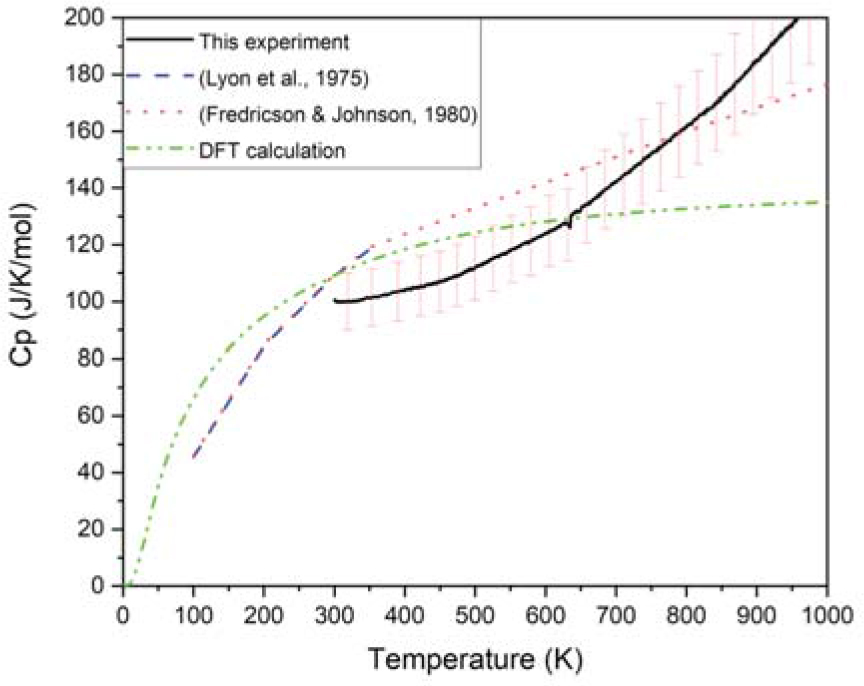
Fig. 7.
Heat capacity at constant pressure (Cp) of Cs2CrO4, obtained from DFT calculations and TG-DSC measurements.
Predicted thermodynamic functions
The experimental results indicate that cesium ferrate has an instability, making its thermal properties became challenging to measure. In contrast, the comparison between the thermal properties of Cs2CrO4 calculated using the first-principal model and the TG-DSC data indicates an acceptable value, particularly in lower temperature regions. Consequently, this method has potencies to address the unknown properties of cesium ferrate.
Figure 8 presents the thermodynamic properties of Cs2CrO4, Cs2FeO4, and CsFeO2 as a function of temperature calculated from 0 K to 1000 K using DFT and quasi-harmonic phonon calculations. Panel ‘a’ shows the calculated Helmholtz free energy, where all compounds exhibit a monotonic decrease with the increasing temperature. These calculation results are consistent with the expected thermodynamic behavior. Cs2CrO4 has the highest free energy at 0 K and decreases steadily. Meanwhile, CsFeO2 and Cs2FeO4 have the same trend compared with Cs2CrO4 but with slightly lower values. This condition reflects the differences in lattice stability and vibrational entropy contributions. Panel ‘b’ depicts the evolution of internal energy. It shows that all compounds show a gradual increase in internal energy as the temperature rises. Cs2FeO4 experiences a more significant increase, indicating stronger phonon excitation and possibly higher density of vibrational modes. Panel ‘c’ shows the entropy trends, with Cs2FeO4 predicted to have the highest entropy value than Cs2CrO4 at temperature below 800 K but becomes lower at higher temperatures. This to the greater configurational and vibrational disorder in Cs2FeO4 with increasing temperature, which also consistent with its more rigid lattice structure. Panel ‘d’ shows a comparison of heat capacity at a constant pressure. This panel shows that Cs2FeO4 has the highest Cp values at elevated temperatures. Meanwhile, Cs2CrO4 and CsFeO2 show higher Cp values at lower temperatures but tend to plateau at higher temperatures.
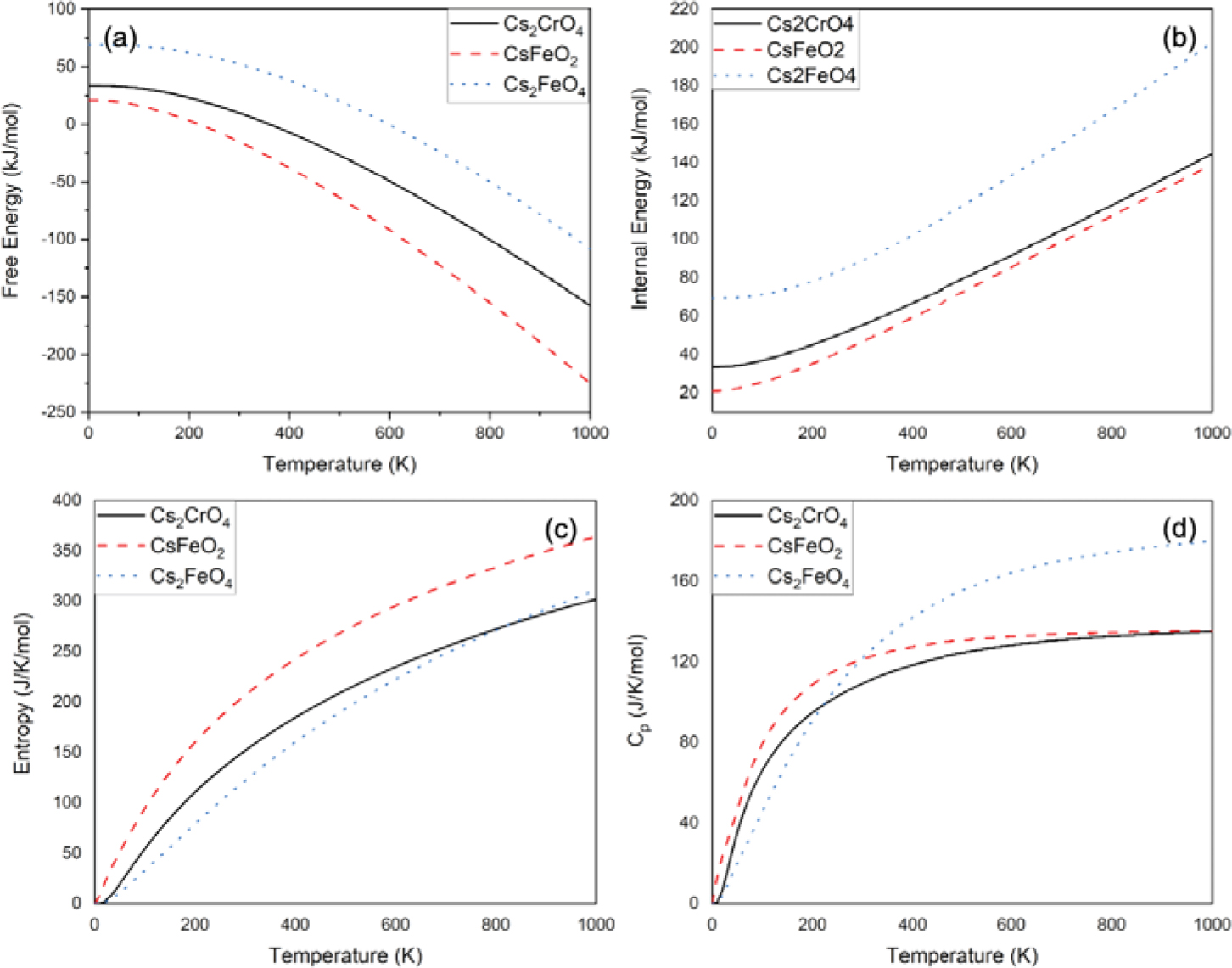
Fig. 8.
Calculation thermodynamic properties of Cs2CrO4, Cs2FeO4, and CsFeO2: (a) Helmholtz free energy, (b) internal energy, (c) entropy, and (d) heat capacity at constant pressure.
Discussion
This study combined experimental measurements and a first-principles modeling to clarify the thermodynamic behavior of Cs2CrO4, Cs2FeO4, and CsFeO2. Powder XRD and in-situ high-temperature scans confirmed that Cs2CrO4 forms a single-phase and ambient-stable orthorhombic structure. Meanwhile, Cs2FeO4 readily hydrated and went to a stepwise transformation initially to CsFeO2 then to Fe2O3 at temperature beyond 900°C. TG-DSC traces mirrored these phase changes, showing a simple two-step decomposition for Cs2CrO4 near 950°C and showing a complex multi-stage profile for Cs2FeO4. The increase in mass over the temperature range of 400°C to 800°C is consistent with the oxygen absorption phenomena, highlight the redox sensitivity of ferrates [36]. This behavior has implications for reactor accident modeling, since oxygen partial pressure in containment atmospheres may influence cesium compound and release timing. The quasi-harmonic phonon calculations accurately reproduce the heat capacity of Cs2CrO4 up to about 750 K but diverge at higher temperatures. Meanwhile, phonon dispersions reveal dynamic instabilities in the ferrate phases.
The Rietveld refinements confirmed the orthorhombic Pnma symmetry of Cs2CrO4 and Cs2FeO4 and the Pnca structure of CsFeO2, with systematic thermal expansion across all phases. These structural relaxations align with the observed decomposition pathways and provide quantitative parameters for thermodynamic modeling. The close agreement between TG-DSC data and quasi-harmonic predictions below 750 K validates the use of first-principles methods for submelting thermodynamic properties. At higher temperatures, divergence arises from anharmonic lattice effects, defect activation, and phase transitions not captured by harmonic models, underscoring the need for experimental validation.
Compared with literature, our results refine and extend existing datasets. Previous studies reported Cs2CrO4 transitions at 1014–1045 K and melting near 1230 K, and Cs2FeO4 decomposition to CsFeO2 near 864 K with further breakdown above 1273 K [15, 22, 36, 37]. Our measurements place Cs2CrO4 decomposition at ~950°C and reveal Cs2FeO4 instability beginning at much lower temperatures, with clear evidence of oxygen uptake prior to decomposition. The combined experimental–theoretical dataset presented here resolves contradictions in ferrate stability and provides the first consistent thermodynamic functions for Cs2FeO4 and CsFeO2.
The unique contribution of this work lies in integrating high-temperature in-situ XRD, TG-DSC, and first-principles phonon modeling to generate a validated dataset for cesium chromate and ferrates. This includes decomposition pathways, phase stability ranges, and temperature-dependent Cp values that can be directly implemented in source term databases such as ECUME and in the severe accident codes (i.e. MELCOR, ASTEC). The identification of dynamic instabilities in ferrate phases provides a mechanistic explanation for their rapid decomposition, while the quantified onset of Cs2CrO4 volatilization defines a critical threshold for cesium release in accident scenarios. Together, these results strengthen the predictive basis for nuclear safety assessments by replacing surrogate or estimated data with experimentally validated, computationally supported values.
Remaining uncertainties include the neglect of anharmonic and electronic entropy contributions in DFT, sample heterogeneity in TG-DSC, and the absence of gas-phase thermodynamics for cesium oxides. Future study should incorporate anharmonic phonon treatments, finite temperature DFT+U, and controlled atmosphere experiments to capture volatilization processes. Such refinements will further enhance the reliability of cesium compound data in reactor accident modeling.
Conclusion
This study established comprehensive physicochemical profiles of Cs2CrO4, Cs2FeO4, and CsFeO2 through combined solid state synthesis, in-situ high-temperature characterization, and first-principles modeling. Cs2CrO4 is confirmed showing a robust orthorhombic phase with a single decomposition step near 950°C, while Cs2FeO4 exhibited hygroscopicity and a multistage decomposition pathway involving transient oxygen uptake, transformation to CsFeO2, and eventual breakdown to Fe2O3. Quasi-harmonic phonon calculations reproduced the heat capacity of Cs2CrO4 up to ~750 K, and phonon dispersions revealed dynamic instabilities in ferrate phases, providing a mechanistic explanation for their instability. Electronic structure analysis further distinguished Cs2CrO4 as insulating, Cs2FeO4 as semiconducting, and CsFeO2 as metallic.
Importantly, these results provide direct insight into the potential behavior of cesium fission products during severe nuclear reactor accidents. The decomposition thresholds define critical release temperatures for cesium species, while the instability of ferrate phases explains their rapid transformation and volatility under accident conditions. The observed oxygen re-adsorption in Cs2FeO4 highlights the sensitivity of cesium compounds to containment atmosphere, with implications for timing and magnitude of source-term release through the multistage decomposition. These data are required to understand the source terms release mechanism. Hence, the results of this study provide an alternative to support the database required by the predictive models such as MELCOR, and ASTEC, which further strengthen the basis for radiological safety assessments.
Remaining uncertainties stem from anharmonic effects, electronic entropy contributions, and gas-phase thermodynamics not captured in the present framework. Addressing these through advanced modeling and experiments with controlled atmospheres will further refine the reliability of cesium compound data. Nevertheless, the dataset reported here represents a significant step toward more realistic and defensible sourceterm modeling in the severe accident scenarios.
Acknowledgments
We would like to express our appreciation for the partial support received from the Research and Innovation Funding Program for Advanced Indonesia (RIIM) from LPDP (Indonesia Endowment Fund for Education Agency) and the support provided by ORTN BRIN Project, HITN (Hasil Inovasi Teknologi Nuklir) 2025–2026. Additionally, we also acknowledge that some data in this study was acquired from research facilities at Nagaoka University of Technology.