
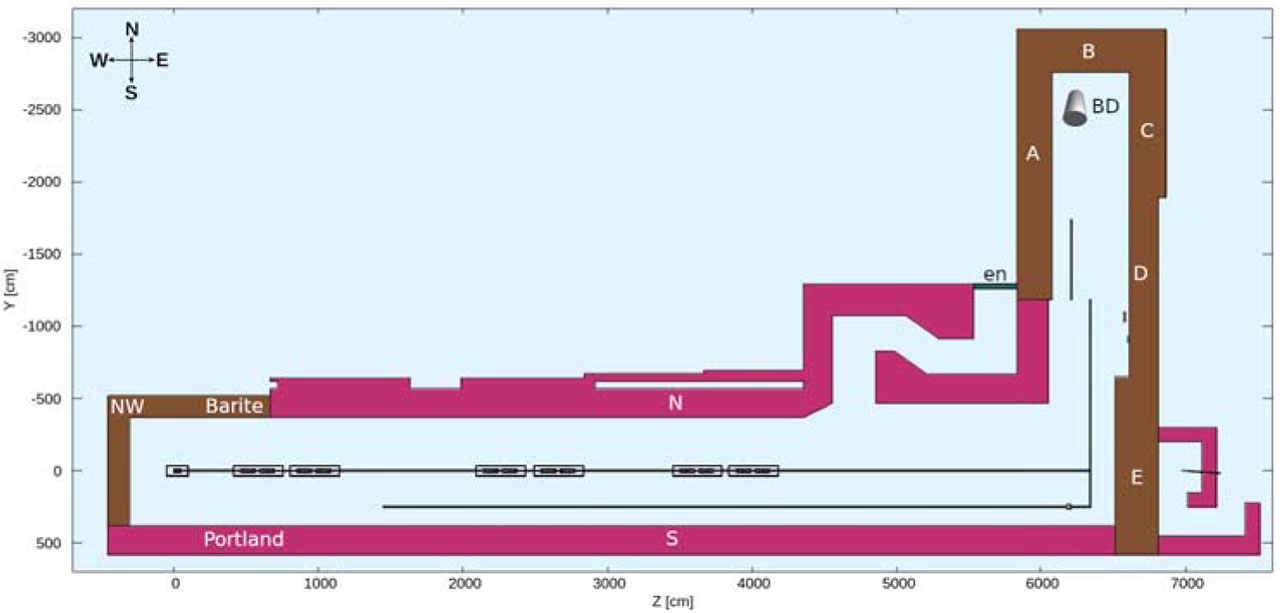
Fig. 1.
The horizontal cross section of the entire bunker for the PolFEL accelerator with the marked location, where the beam dump is positioned below the floor level (BD). A view of the layout for a beam energy of 280 MeV at the beam axis level. There are two less accelerating cryomodules for calculations with 72 MeV and 187 MeV beam energy than with the highest one. One can see the second beam pipe of the THz line, parallel to the beam pipe for VUV line in a distance of 2.5 m to the south. Side walls A, B, C, D, E, and NW are of barite concrete, and the other walls are of Portland concrete.
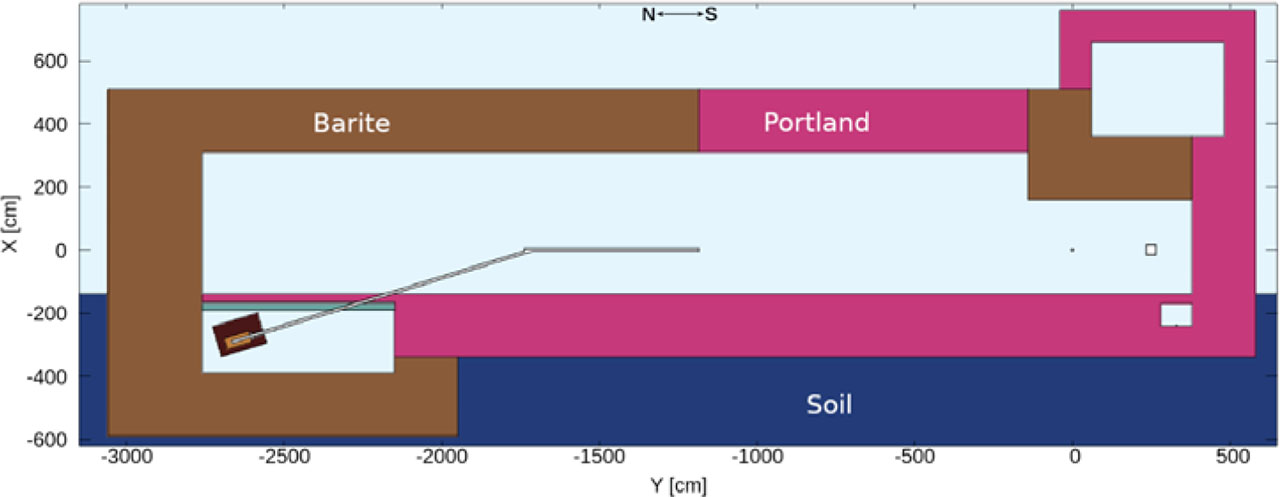
Fig. 2.
Vertical N-S section through the whole bunker branch with the dump room along the beam dump axis. The dump room is covered with three plates, 20-cm polyethylene, 5-cm aluminum, and 25-cm concrete Portland, counting from below. One can see a steel beam pipe with an inner diameter of 7.8 cm and a SS316LN wall thickness of 3 mm, sloping at an angle of 17°, leading to the beam dump. The dump room is shielded from below by a floor with a thickness of 2 m of barite concrete. Additionally, the floor of the bunker branch made of Portland concrete with a thickness of 2 m can be seen, terminating at the ground level. The ceiling of the entire bunker is 2 m thick, regardless of the planned material to be used.
Table 1.
Density and chemical composition of materials used for calculations. Chemical composition in terms of weight
| Density (g/cm3) | Portland concrete | Barite concrete | SS316LN | Soil |
|---|---|---|---|---|
| 2.3 | 3.2 | 7.8 | 2.7 | |
| H (Z = 1) | 2.2% | 0.4% | – | – |
| C (Z = 6) | 0.3% | – | 0.03% | |
| O (Z = 8) | 57.1% | 31.2% | – | 47% |
| Na (Z = 11) | 1.5% | – | – | 3% |
| Mg (Z = 12) | 0.1% | 0.1% | – | 2% |
| Al (Z = 13) | 2.1% | 0.4% | – | 8% |
| Si (Z = 14) | 30.6% | 1.0% | 1.00% | 28% |
| P (Z = 15) | – | – | 0.05% | – |
| S (Z = 16) | – | 10.8% | 0.03% | – |
| K (Z = 19) | 1.1% | – | – | 3% |
| Ca (Z = 20) | 4.3% | 5.0% | – | 4% |
| Cr (Z = 24) | – | – | 18.50% | – |
| Mn (Z = 25) | – | – | 2.00% | – |
| Fe (Z = 26) | 0.7% | 4.8% | 67.14% | 5% |
| Ni (Z = 28) | – | – | 11.25% | – |
| Ba (Z = 56) | – | 46.3% |
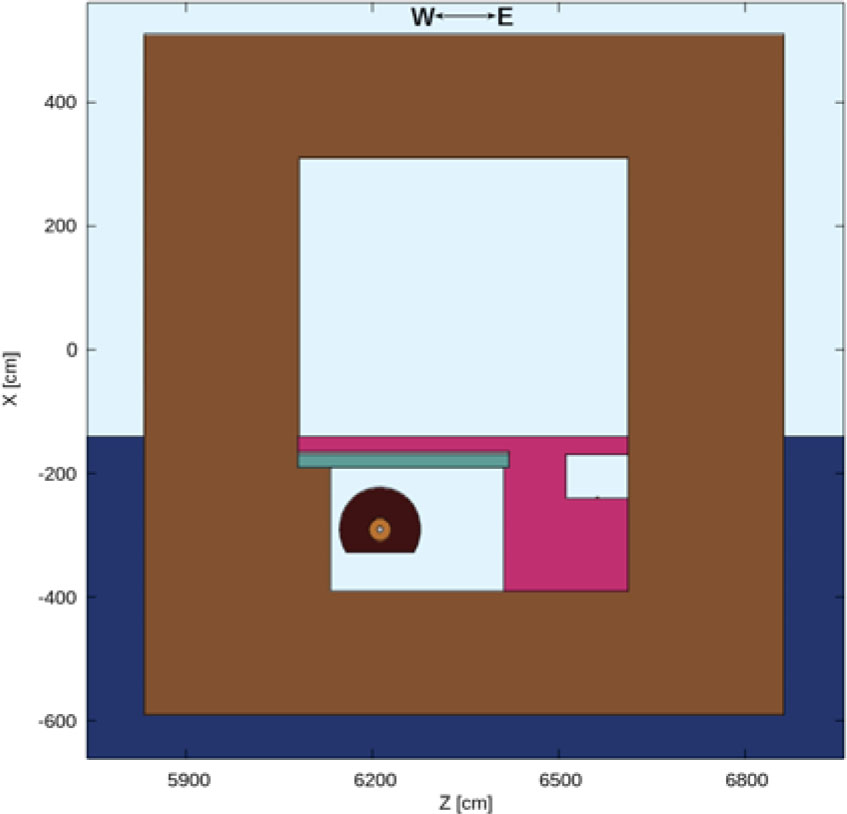
Fig. 3.
Vertical E-W section through the beam dump and the dump room. One can see the side walls and ceiling of the bunker branch made of barite concrete and the level of the ground surface.
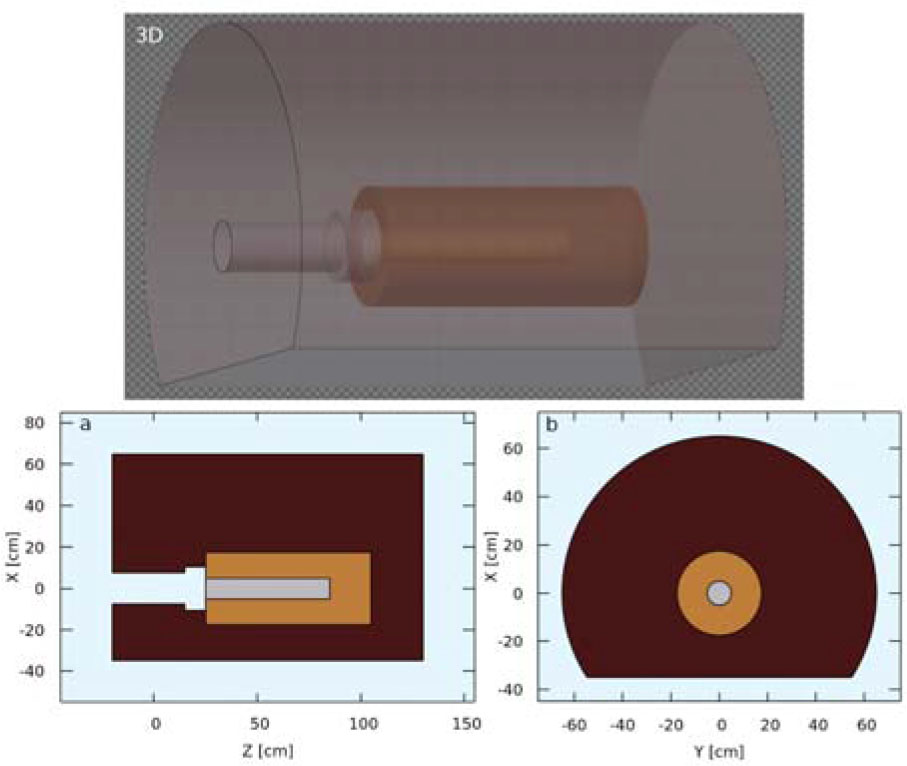
Fig. 4.
Geometry used for Monte Carlo calculations of the radiation transport generated in the beam dump. A cross section parallel to beam axis through the dump (A), a cross section perpendicular to beam axis (B), and 3D view of the beam dump are shown. One can see 10-cm diameter and 60-cm high Al core, surrounded by a 35-cm diameter and 80-cm high copper layer and a 130-cm diameter and 150-cm high SS316LN steel layer.
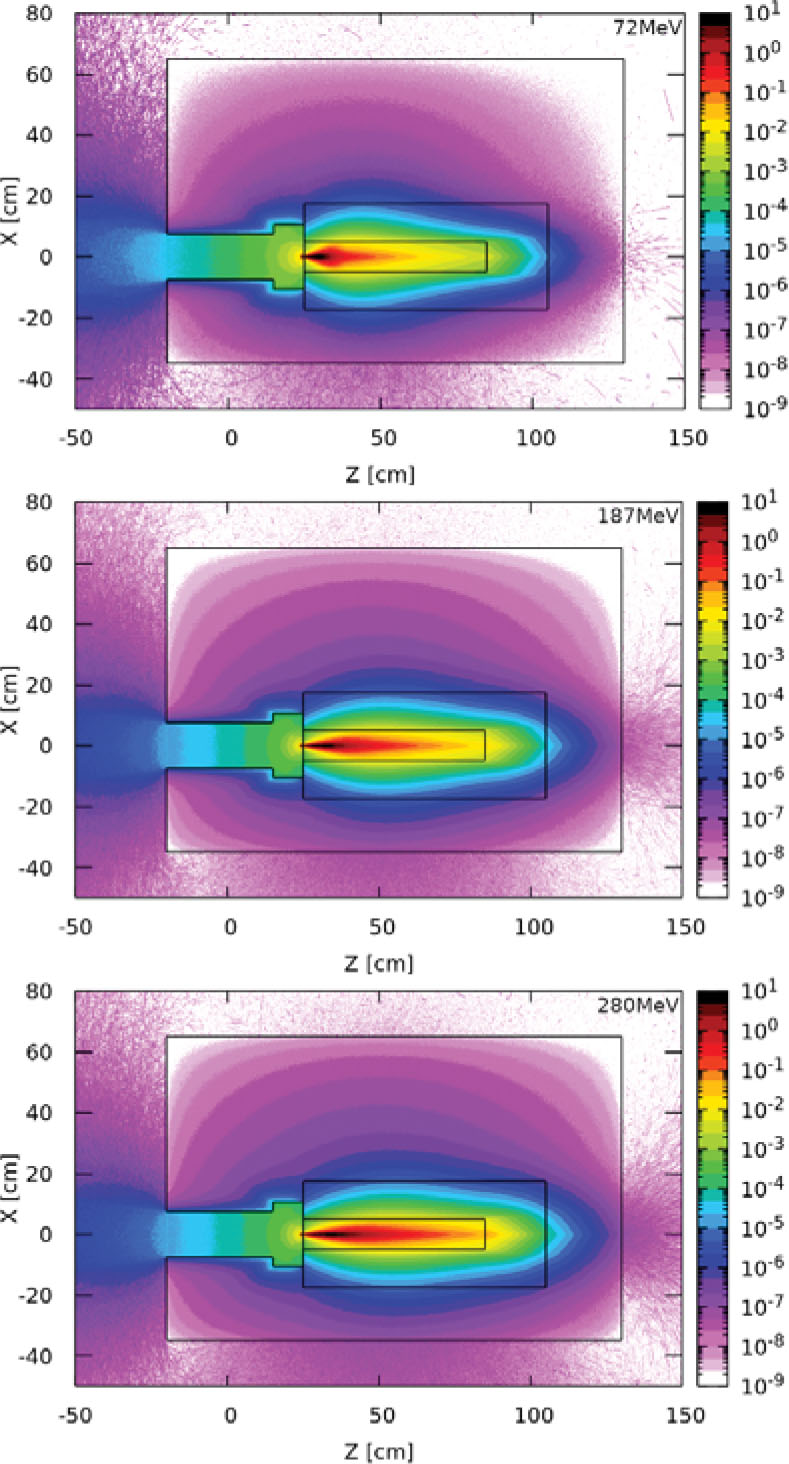
Fig. 5.
The dose rate deposited in the beam dump by beams with energies 72 MeV, 187 MeV, and 280 MeV. The quantities shown in W/g.
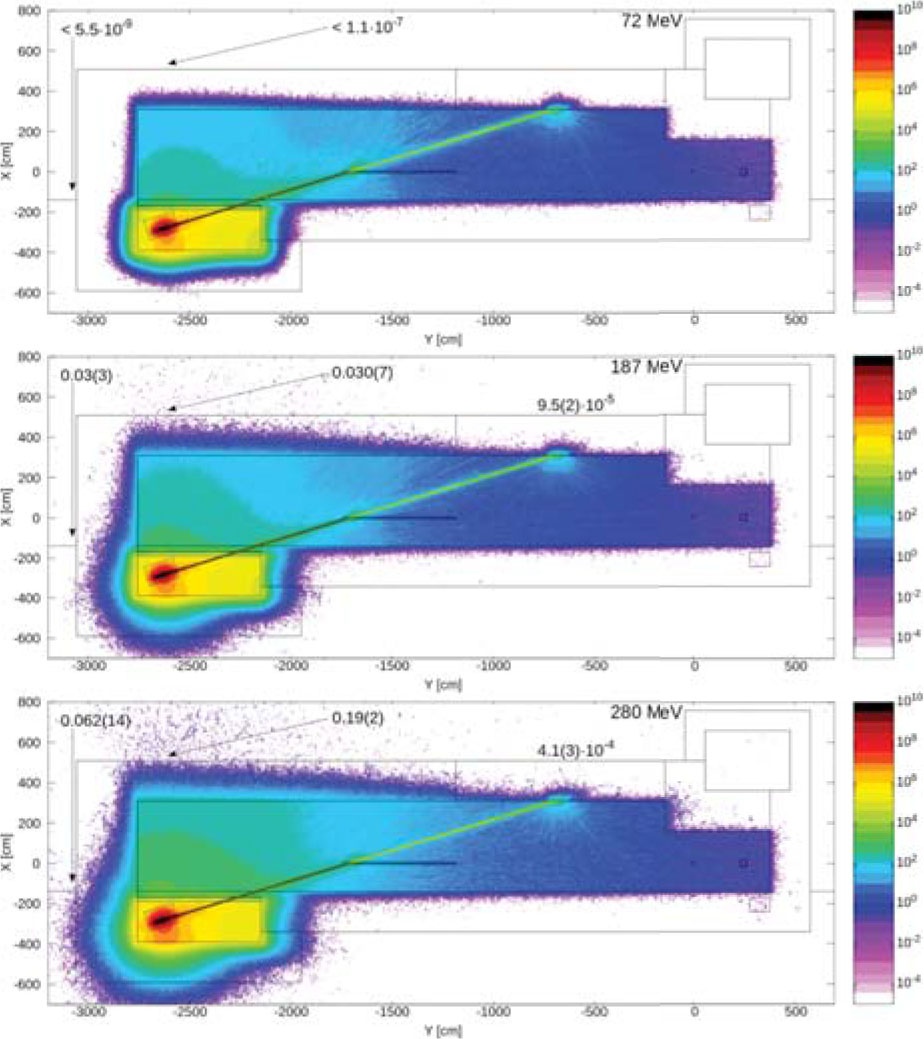
Fig. 6.
Distribution of the radiation dose rate in μSv/h in the vertical plane parallel to the beam axis for the 72-MeV, 187-MeV, and 280-MeV beams.
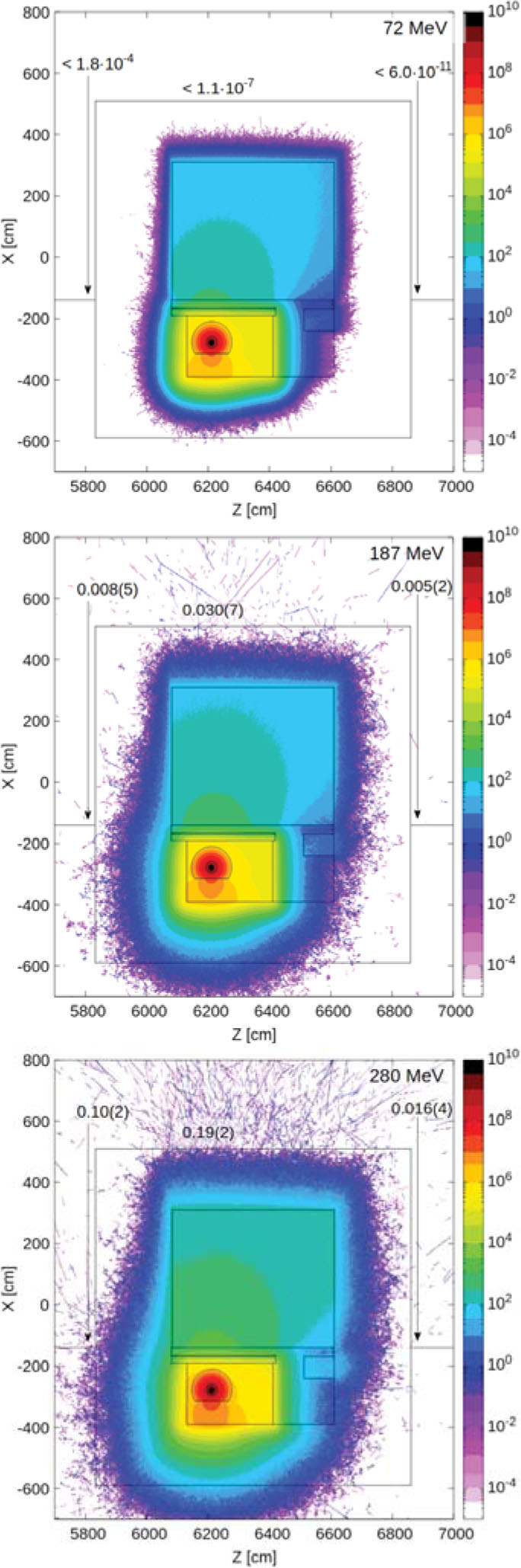
Fig. 7.
Distribution of the radiation dose rate in μSv/h in the vertical plane perpendicular to the beam axis for the 72-MeV, 187-MeV, and 280-MeV beams.
Table 2.
Summary of the radiation leaks outside the bunker branch walls calculated directly for 187 MeV and 280 MeV and estimated on the basis of the dose rate attenuation in the branch walls shown in Fig. 8 for 72 MeV. Radiation leakages through walls D and E are so small that it has not been possible to estimate their magnitude
| Place | 72 MeV | 187 MeV | 280 MeV |
|---|---|---|---|
| Total dose rate (μSv/h) | |||
| A | <1.8 × 10⁻⁴ | 0.008(5) | 0.10(2) |
| B | <5.5 × 10⁻⁹ | 0.030(3) | 0.062(14) |
| C | <6.0 × 10⁻¹¹ | 0.005(2) | 0.016(4) |
| D and E | – | 0.005(2) | 0.019(6) |
| Roof | <1.1 × 10⁻⁷ | 0.030(7) | 0.19(2) |
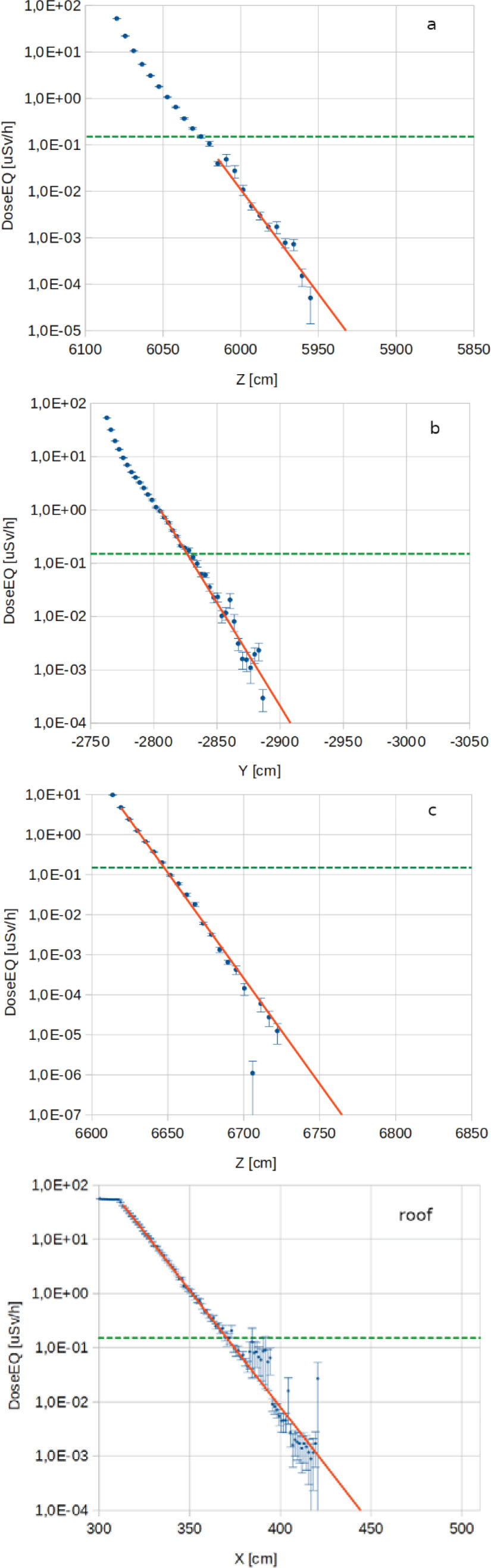
Fig. 8.
Calculated dependence of the radial dose rate depending on the location. Exponential decay of the dose rate was fitted to the data calculated directly from Monte Carlo calculations. The right end of each of the graphs presented here indicates the outer end of the respective shielding wall. Figures (a–c) show the decay of the deposited dose rate in walls A–C, respectively.
Table 3.
Summary of the maximum soil activity averaged in 50 cm × 50 cm × 50 cm cubes directly below the dump room
| Cooling time | 72 MeV | 187 MeV | 280 MeV |
|---|---|---|---|
| Maximum activity from the beam (Bq/cm3) | |||
| 1 min | <8 × 10⁻⁶ | 3.37(15) × 10−3 | 2.98(9) × 10−2 |
| 1 h | <8 × 10⁻⁶ | 1.55(8) × 10−3 | 1.36(5) × 10−2 |
| 1 day | <8 × 10⁻⁷ | 5.3(3) × 10−4 | 4.7(2) × 10−3 |
| 1 week | <8 × 10⁻⁷ | 9.6(19) × 10−5 | 8.5(12) × 10−4 |
| 30 days | <8 × 10⁻⁷ | 6.9(13) × 10−5 | 6.0(8) × 10−4 |
| 1 year | <2 × 10⁻⁷ | 1.1(2) × 10−5 | 9.9(9) × 10−5 |
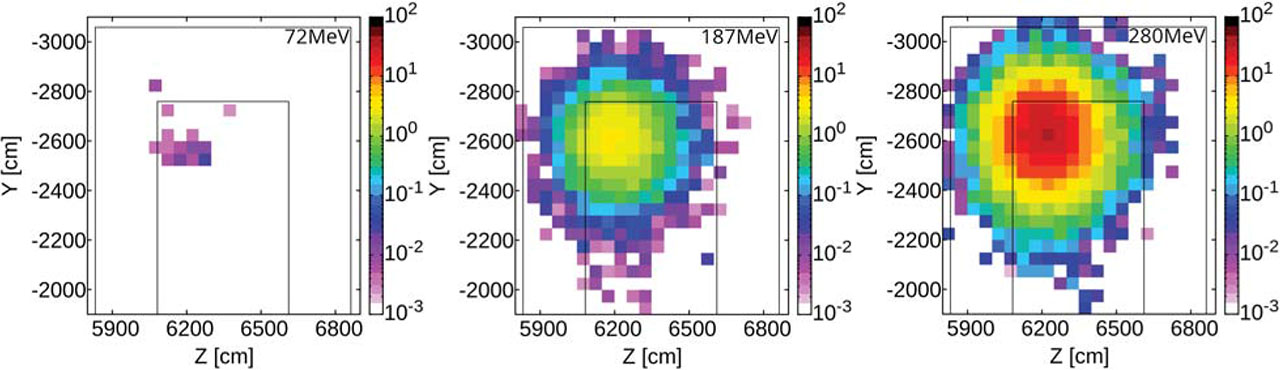
Fig. 9.
The distribution of activation generated in a 50-cm thick soil layer directly below the dump room shown against the walls of the bunker branch. The soil activation levels in Bq/cm3 for electron beams with energies of 72 MeV, 187 MeV, and 280 MeV are shown.
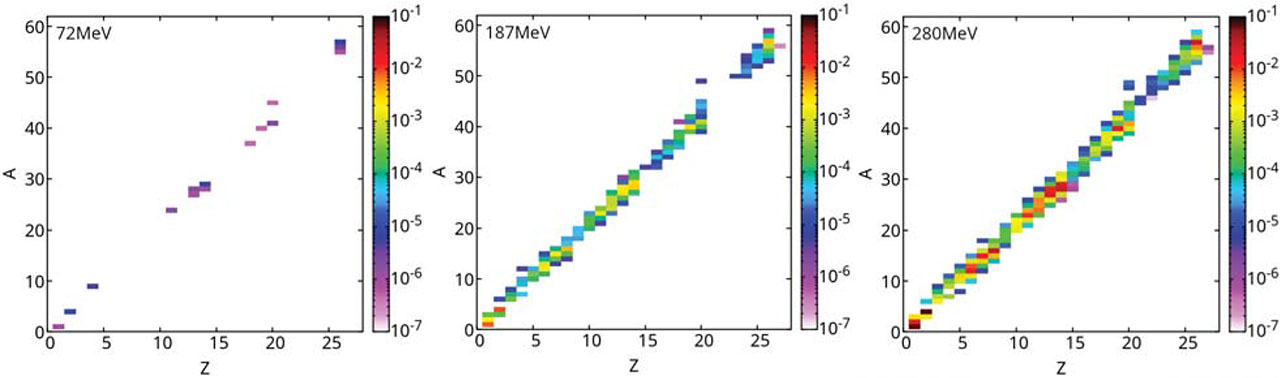
Fig. 10.
The residual nuclei produced on-beam in the soil region directly below the beam dump room for the 72-MeV, 187-MeV, and 280-MeV beams. The data presented in the figures are expressed in nuclei/cm3/s.