
Introduction
High-level wastes (HLW), encompassing spent fuel (SF) and vitrified high-level wastes (VHLW), “are hazardous because they produce fatal radiation doses during short periods of direct exposure” [1].
There is an indication in the literature that these wastes, intended for disposal in geological repositories, will remain a radiological hazard indefinitely. For instance, it is stated that “Even though the hazard potential of spent fuel and some long-lived wastes decreases markedly over time, these wastes can never be said to be intrinsically harmless” and that the long-term safety of these wastes would require discussions that incorporate ethical considerations, as they are related to “our ability and responsibility to protect the environment in the very remote future” [2]. Regarding spent fuel (also known as used fuel in Canada), the Canadian Nuclear Waste Management Organization (NWMO) advises that “While the hazard continues to diminish over time, for practical purposes, used nuclear fuel remains hazardous, essentially indefinitely” [3]. Despite this, there is no detail in the literature regarding the relevant level of the hazard.
Conversely, some studies suggest that the long-term hazard may be minimal. This is because the radioactive content decreases to levels that may eventually be considered “natural levels”. Regarding spent fuel (“used fuel”, in Canadian jargon), NWMO shows that it will take up to 10 million years before the used fuel goes back to the same radioactivity levels as the original ore equivalent (Fig. 1).
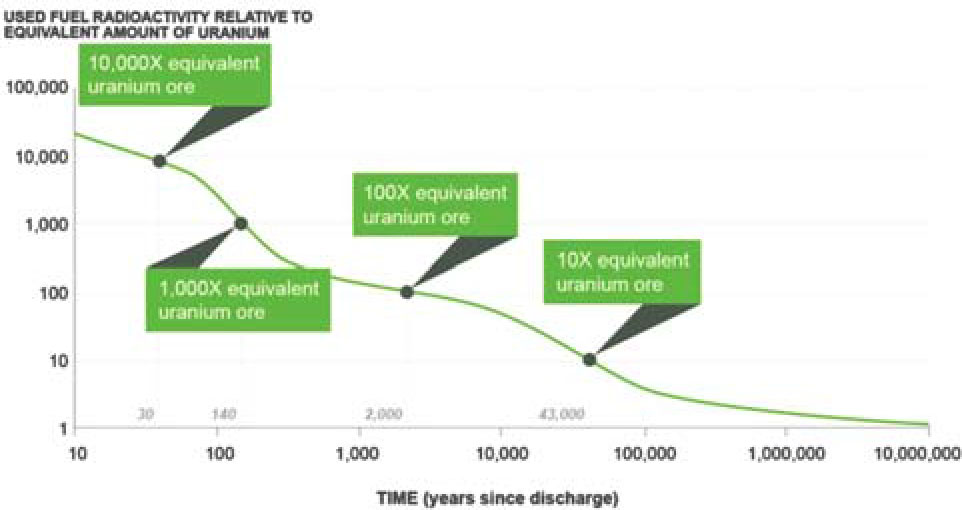
Fig. 1.
Radioactive decay over time of spent CANDU fuel upon discharge from the reactor. It uses natural uranium in comparison and shows that it will take up to 10 million years before the spent fuel goes back to the same overall radioactivity levels as the original ore equivalent. The same chart can be applied qualitatively to any kind of uranium-based SF.
Regarding VHLW, the comparison with natural ore seems even more favorable than SF. Figure 2 indicates that radioactivity levels reach natural levels after about 10 000 years. In all cases, no specific level of the residual hazard is provided.
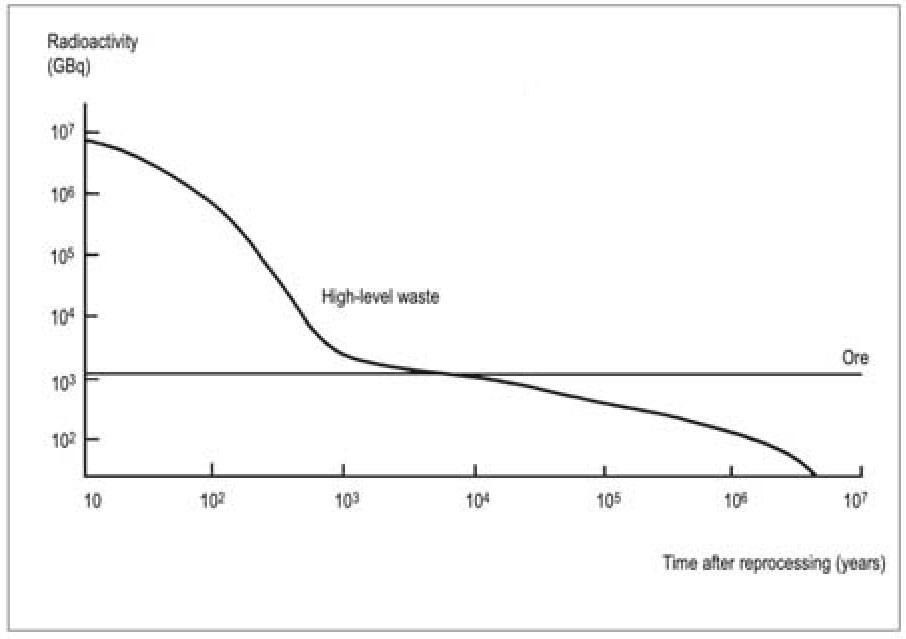
Fig. 2.
Decay of VHLW from reprocessing of 1 ton of spent fuel [4].
As for the timescales typically considered for assessing the hazard, in 1995, when the USA National Research Council issued their guidance for a safety standard for a HLW repository at Yucca Mountain [5], they suggested that “the ultimate restriction on time scale is determined by the long-term stability of the fundamental geologic regime”. In principle, this could be one billion years, if the repository was in a tectonically stable zone. For Yucca Mountain, the Council determined that the relevant “fundamental geologic regime” was one million years. This was a large leap from the previous regulatory standard of 10 000 years. But why to limit the standard only while the site is geologically stable. Is it assumed that the waste would become harmless thereafter? Or that no life would exist afterward?
Since the National Research Council issued their recommendations, many national programs have aligned their quantitative assessments and/or standards to one million years, regardless of site stability considerations. One million years is the official or unofficial quantitative assessments in France and Germany; Sweden and Finland, and other countries.
Geologists are comfortable with the timescale of one million years, for they can assure, fairly confidently, that a thick-enough geological layer will continue to exist and shield the biosphere from the wastes. In the words of the Swiss National Waste Management Organization: “From a geological point of view, a containment period of one million years is a manageable time frame” 1 . Furthermore, except for the NWMO chart above, all radioactive decay charts do suggest a cross over, or activity close to, natural levels by one million years, e.g. Refs. [2, 6]. As a result, timescales beyond one million years are not addressed quantitatively in disposal safety studies. It is also claimed that the accumulating uncertainties would make quantitative predictions unreliable [2]. But why one million and not three, or a larger number of millions? How long would a “manageable time frame” be? In any event, the hazard that comes from direct radiation exposure obeys well-established physical laws of radioactive decay, allowing for reliable quantitative estimations of the intrinsic radiation hazard of HLW at any time. Yet, no such estimations appear to be available for timescales extending beyond one million years.
How radiologically hazardous is HLW at one million years and beyond? May it be contact handled at any time in the future? When would it be possible to stand next to it in an unrestricted area? This paper provides quantitative, scoping answers to these and other related questions. By quantitatively evaluating the dose rates from direct exposure to unshielded SF and VHLW, this study identifies critical new insights, such as the roles of the Np-237 decay chain; the eventual, long-term dominance of the U-238 decay chain; and the interplay of three actinide decay chains, including the significant role of Bi-214. These findings fill a gap in the literature and emphasize the need for more detailed investigations in this area.
Methods and data
Since no data or previous analyses exist regarding the intrinsic radiation hazard of HLW beyond one million years, we extend to later periods the information that is available at one million years and earlier. An important source of information is the French Agency for Radioactive Waste Disposal (ANDRA); notably, the illustrations shown in Figs. 3 and 4; the isotope inventory of the entire French VHLW production slated for disposal; and other data mentioned later in the text.
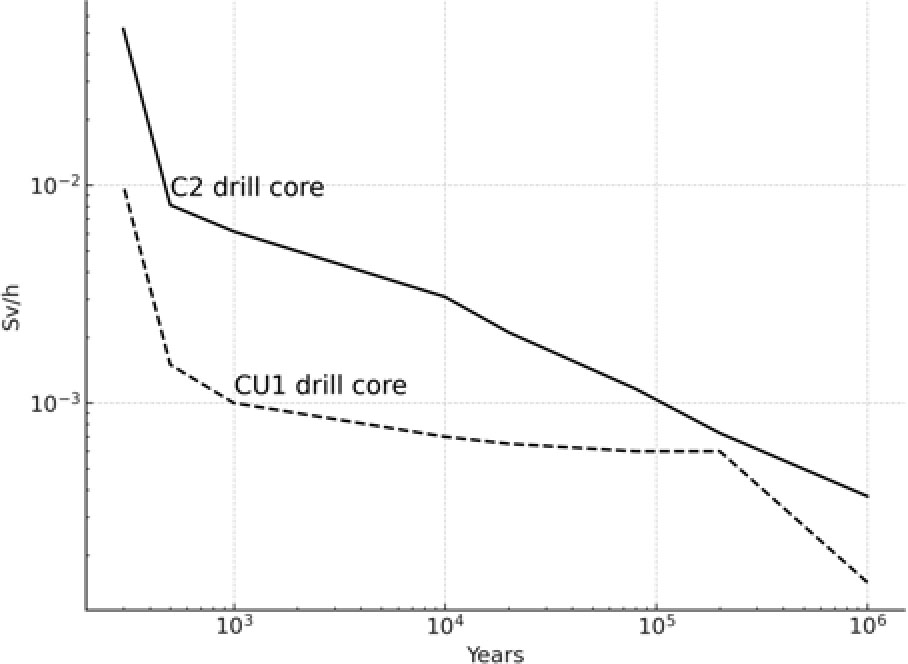
Fig. 3.
Radiological dose rate in Sv/h from two French HLW drill cores. C2 is VHLW; CU1 is SF (p. 25 in Ref. [2] and p. 533 in Ref. [7]).
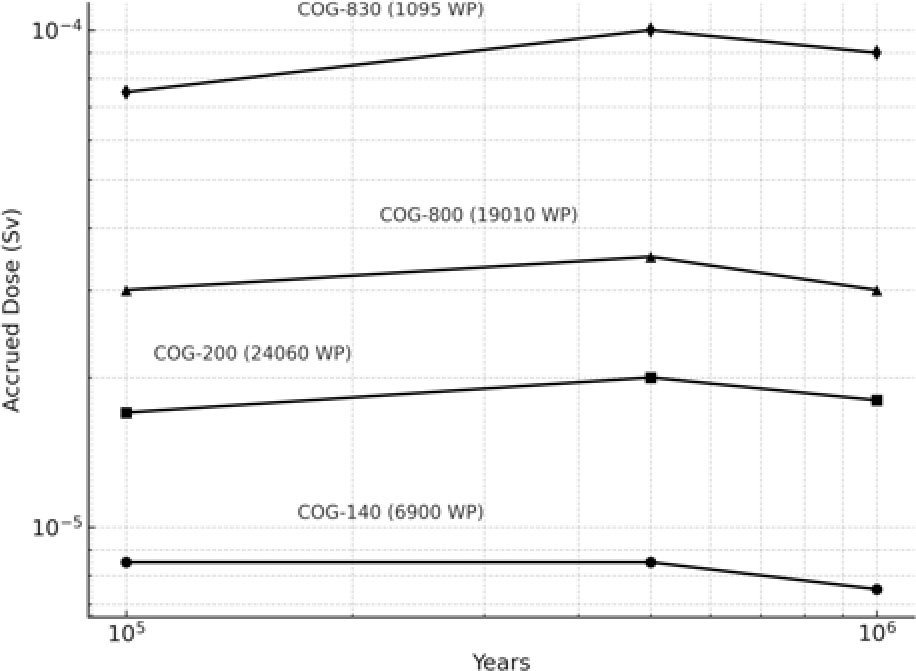
Fig. 4.
Accrued, external dose from drill cores of several kinds of present and future French VHLW after a 10-min exposure, 40 cm from the drill core, and as a function of time [9].
Figures 3 and 4 plot external doses 40 cm away from drill cores of several kinds extracted during potential intrusion episodes into a geological repository. The drill cores capture the nuclear material as one solid piece. No potential residual shielding is counted. We will use the given values of the dose rate at one million years.
In Fig. 3, CU1 is spent UOX fuel, whereas C2 is VHLW. The size of the drill cores is also important for dose. The CU1 drill core consists of 2 cylinders of 21.4 cm height and 10 cm diameter, each laid out on the same longitudinal axis with a gap in-between, and the C2 drill core is a single cylinder of 40 cm height and 10 cm diameter. A previous study [8] provides the isotope inventory of the C2 waste form at production.
C2 is a future glass waste form within a larger family of vitrified waste forms of same size, weight, and aluminum-borosilicate glass formulation in France [7]. These waste forms are designated as COG-X. Figure 4 plots the accumulated dose after 10 min exposure at 40 cm from the drill cores of various COG-X VHLWs. These drill cores are 40-cm long cylinders of 10 cm diameter. At one million years, the reported doses vary approximately between 8 μSv and 100 μSv, which corresponds to the dose rates between 0.05 mSv/h and 0.6 mSv/h. Figure 4 also reports the number of waste containers that are foreseen. Thus, COG-200 (24060 WP) indicates a waste form incorporating a specific waste solution from reprocessing high burn-up UOX and MOX fuels that will require 24 060 waste containers.
Evaluation of hazard
By one million years, all the gamma-emitting fission products that could cause a radiation hazard, including the long-lived Sn-126 (100 000-year half-life), which has Sb-126 as a progeny, will have been decayed. At that point, the gamma dose is dominated by gamma emitters from two actinide chains: the (4n + 2) chain, headed by U-238, and the (4n + 1) chain, headed by Np-237. The small contribution from the (4n + 3) chain, headed by U-235, can be neglected for the purposes of this scoping paper, which is also confirmed by other data later in this text. The (4n + 1) chain is active for up to 20–25 million years, or 10–12 half-lives of Np-237. The (4n + 2) chain is active essentially indefinitely, given the 4.47 billion years half-life of U-238.
It is useful to note that, by one million years, the (4n + 2) chain inventory represents the confluence of two independent decay series: one starting with U-238 and the other with the excess U-234 at reactor discharge. Excess activity ratios of U-234 to U-238, ranging from 14.5 to 33.5, have been measured in actual PWR fuel [10]. The projected global uranium isotope inventory for VHLW disposal in France (p. 431 in [9]) indicates a U-234/U-238 elemental ratio of 14.9 at production, which also accurately represents the ratio in French SF before reprocessing. This elemental ratio increases to 30.1 after 1000 years, reflecting the decay of the Pu-238 inventory (88 years half-life) into U-234. The U-234/U-238 elemental ratio specific to the C2 waste form is 16.4 at production and 33 at 1000 years. As a result, the contribution from the excess U-234 may be significant for up to 2.2 million years – or 10 half-lives of U-234 – and will be accounted for, as needed, in the body of this paper, along with the separate, long-lived contributions from U-238 and Np-237. By one million years, Np-237 and the excess U-234 will be in secular equilibrium with their progeny; U-238 will be at 94% equilibrium, which we approximate as full equilibrium.
For calculation purposes, we note that the radiation dose depends linearly on activity and energy. This fact, along with the condition of secular equilibrium of the three chains, simplifies scaling and extrapolation over time. We also note that the dose data that we will use were obtained with codes capable of dealing with cylindrical geometry and that they refer to situations where the receiver is close to the cylindrical source. For the present scoping calculations, we use cylindrical geometry as well. We shall use the approximation 2r/π for the average path length when performing dose calculations and apply the inverse distance approximation for spatial interpolation [11].
Finally, we measure hazard in terms of compliance with current radiation protection guidelines. We refer to two radiation protection criteria, namely, (a) the annual dose constraint of 0.3 mSv recommended by the International Commission on Radiation Protection (ICRP) for the design of a geological waste disposal facility [12] and (b) the maximum public dose limit of 0.02 mSv in any 1 h, as receivable by a member of the public in an unrestricted area, according to the regulations [13] of the United States Nuclear Regulatory Commission (USNRC). If the USNRC dose limit was exceeded at the surface of the waste, the waste would not be fit for contact handling. We also compare dose rates to current natural levels, notably those in the high, outdoor background-radiation area of Ramsar, Iran, which can reach 0.01 mSv/h.
Radiation hazard at one million years
Referring to Fig. 3, at 40 cm from the drill cores and at one million years, the calculated dose rate is approximately 0.1 mSv/h for SF and around 0.4 mSv/h for VHLW. The ICRP dose constraint would be reached within 3 h for SF and in less than an hour for VHLW. The dose rate 2 cm from the surface would be 20 times higher, reaching 2 mSv/h for SF and 8 mSv/h for VHLW. At one million years, it would take less than a second, in both cases, to reach the USNRC dose limit at contact. Similar conclusions can also be applied to the COG-X drill cores (Fig. 4) encompassing practically the entire French VHLW production.
Therefore, at one million years, relatively small samples of HLW, whether SF or VHLW, cannot be safely contact-handled or left unprotected in an unrestricted area. A fortiori, the same can be applied to full-size waste forms. The NWMO reports a similar finding concerning SF, noting that it could pose a hazard even after one million years. Specifically, “While the external radiation from used fuel declines rapidly over time, it could still be considered significant from a public dose perspective far into the future. Exposure to million-year-old fuel (or unirradiated fuel, for that matter) could potentially reach the public dose limit of 1 mSv/a after approximately 110 hours” [14]. 2
Additionally, we observe that, even though the volumes of the SF and VHLW drill samples of Figs. 3 and 4 are practically identical, French VHLW, with the exception of COG-140, consistently releases higher doses than SF at one million years, and even before in some cases. Figure 2 suggests that reprocessing SF and vitrification of the unwanted waste residues reduce the radioactive hazard of the original SF. We revisit this point in the next section when addressing the hazard beyond one million years.
Radiation hazard beyond one million years
SF
Table 1 presents computed dose rates from German SF over time 3 . The dose rate decreases by half between 1 and 10 million years. It then changes only slightly up to one billion years.
Table 1.
Gamma dose rate (mSv/h) at three distances from a POLLUX-8 cask loaded with 8 UO2 fuel assemblies, neglecting the shielding of the cask
| Decay time (million years) | Next to surface (4 cm) | 40 cm (extrapolated) | 10 m |
|---|---|---|---|
| 1 | 6.56 | 0.697 | 0.0279 |
| 10 | 2.77 | 0.290 | 0.0116 |
| 100 | 2.68 | 0.282 | 0.0113 |
| 1000 | 2.31 | 0.243 | 0.00974 |
Table 2a lists the radionuclides that contribute most to the dose rate. The (4n + 2) series radionuclides are denoted in bold and the (4n + 1) series radionuclides are denoted in italics. Due to secular equilibrium, their relevance aligns to the gamma energy each one delivers once the branching ratios have been taken into account, as reported in Table 2b.
Table 2a.
Main contributors to the gamma dose rate from SF as a function of time 4 in million years for the configuration of Table 1. The (4n + 2) elements are denoted in bold and the (4n + 1) elements are denoted in italics
| 0.1 My | 1 My | 10 My | 100 My | 1000 My |
|---|---|---|---|---|
| Bi-214 | Bi-214 | Bi-214 | Bi-214 | Bi-214 |
| Sb-126m | Pa-233 | Pb-214 | Pb-214 | Pb-214 |
| Pb-214 | Th-229 | Pa-234m | Pa-234m | Pa-234m |
| Pa-233 | Bi-213 | Pa-233 | Bi-210 | Bi-210 |
| Sb-126 | Pb-214 | Th-229 | U-235 | Th-234 |
| Th-229 | Tl-209 | Bi-213 | Ra-223 | |
| Np-237 | Np-237 | Bi-210 | ||
| Bi-213 | Fr-221 | U-235 | ||
| Bi-210 | Ac-225 | Ra-223 | ||
| Tl-209 | Ra-225 | Tl-209 |
Table 2b.
Highest gamma energies in the (4n + 2) and (4n + 1) chains. The weighted averages values are based on the data obtained from Japan Atomic Energy Agency [15,16,17,18]
| Radionuclide | Weighted average gamma energy per emission (keV) |
|---|---|
| Bi-214 | 944.00 |
| Pb-214 | 318.38 |
| Pa-233 | 311.86 |
| Th-229 | 47.96 |
The relative contributions to the dose from each chain are reported in Table 3. The procedure for determining these percentages is explained in Appendix 2. Based on this understanding, we observe that, at any time beyond one million years, there is, for an unshielded pack of eight spent UO2 assemblies, a nearly constant background dose rate of approximately 2.68 mSv/h, coming from the U-238 chain up to 100 million years. Superimposed on this are contributions from the Np-237 chain and the excess U-234 chain, depending on their relative abundance and for as long as they remain active, or about 10 half-lives of each in this case. Over one billion years, the U-238 dose rate decays very little to 2.31 mSv/h due to its 4.47 billion years half-life.
Table 3.
Relative contributions from the three actinide chains to the gamma dose from a block of unshielded eight UO2 fuel assemblies (same assemblies as mentioned in Table 1)
| Decay time (million years) | U-238 chain (%) | Np-237 chain (%) | Excess U-234 chain (%) | Total, surface dose rate (mSv/h) |
|---|---|---|---|---|
| 1 | 41.12 | 32.10 | 26.78 | 6.56 |
| 2 | 62.41 | 35.16 | 2.41 | 4.32 |
| 4 | 77.28 | 22.71 | – | 3.49 |
| 6 | 92.31 | 7.69 | – | 2.92 |
| 8 | 95.73 | 4.27 | – | 2.81 |
| 10 | 96.29 | 3.72 | – | 2.77 |
| 14 | 98.86 | 1.14 | – | 2.72 |
| 20 | 99.83 | 0.17 | – | 2.69 |
| 100 | 100 | – | – | 2.68 |
| 1000 | 100 | – | – | 2.31 |
Table 4 reports the exposure time, in hours, needed to reach the ICRP dose constraint at different distances from the eight unshielded SF assemblies reported in Table 1. Up to one billion years, much less than 1 h is required at contact, approximately 1 h at 40 cm from the cask, and only 31 h at 10 m from the cask. The time needed to receive the USNRC limit dose of 0.02 mSv at contact will also be much less than an hour. SF could not be qualified for being left unguarded or unprotected in an unrestricted area. Additionally, as shown later in this paper, the time to reach the limit dose could be even shorter if a combination of smaller samples is taken vs. one larger sample.
Table 4.
Exposure time in hours for getting the annual ICRP dose constraint of 0.3 mSv as a function of time at three distances from POLLUX-8 cask assemblies, neglecting the shielding of the cask
| Decay time (million years) | Exposure (h) at contact | Exposure (h) at 40 cm | Exposure (h) at 10 m |
|---|---|---|---|
| 1 | 0.046 | 0.430 | 10.8 |
| 10 | 0.108 | 1.034 | 25.9 |
| 100 | 0.112 | 1.064 | 26.6 |
| 1000 | 0.130 | 1.234 | 30.8 |
In practice, Tables 2a and 4 demonstrate that Bi-214 is always the primary contributor to the dose rate because of its high gamma energy and abundance as a member of both the U-238 and the excess U-234 chains. Due to secular equilibrium, a very short-lived radionuclide (19.7 min half-life) is dominant essentially indefinitely.
Let us now consider a smaller quantity, like the CU1 SF drill core shown in Fig. 3. The dose rate 2 cm from its surface can be estimated to be 2 mSv/h at one million years. Notably, 41% of it, or 0.25 mSv/h, arises from U-238. This dose rate is 11 times larger than the USNRC criterion for unrestricted access and contact. A small SF drill core such as CU1 will also be unfit for handling or proximity essentially indefinitely.
Overall, even though the decay rate of SF ultimately coincides with the natural decay rate of U-238, as suggested in Fig. 1, the simple fact of initially concentrating the U-238 into 100% pure UO2 makes it unsafe to contact handle SF or being in its proximity essentially indefinitely. This is also applicable to aged, unirradiated fuel, as it is pure UO2 (see also [14]). As a result, “for practical purposes”, handling SF will always need to be done remotely, such as when re-mining or retrieving it, and uranium ore radioactivity content (Fig. 1) is not a reliable metric for evaluating the radiation hazard of SF over time.
VHLW
Since SF reprocessing is intended to recover uranium, VHLW ends up concentrating the fission products and the Np-237 chain. Based on the isotope inventory of the C2 waste form [8], we can calculate the elemental activity ratios of Np-237 to (U-238 + U-234) as well as the chain activity ratios. Indeed, the initial elemental activity ratios become chain activity ratios by one million years, by virtue of secular equilibrium. These values are reported in Table 5.
Table 5.
Elemental activity ratios (at 10 000 years) and chain activity ratios (at one million years) for French VHLW
| Time (years) | Np-237/(U-234 + U-238) | Np-237/U-238 | U-234/U-238 |
|---|---|---|---|
| 10 000 | 576.73 | 19 220.62 | 32.34 |
| 1 000 000 | 4672.93 | 13 896.10 | 1.97 |
We start with the elemental activity ratio at 10 000 years, because both the U-234 and the Np-237 inventories have been stabilized by then. To obtain these values, we scaled up the initial elemental activity of the C2 waste inventory according to the time-dependent data available for the French global VHLW inventory slated for disposal [9]. Table 5 suggests that, of the three actinide chains discussed earlier, the Np-237 chain will play an overriding role toward the dose rate at one million years. Yet, we still need to evaluate the contributions from all the three chains to estimate the relevant hazard and its duration later in time.
In the absence of the same detailed computations as we have for SF (Table 1), a method has been devised by utilizing (a) the activity ratios presented in Table 5, (b) Fig. 4 for drill cores and Fig. 5 for a full-size waste form, and (c) the procedure explained in Appendix 3.
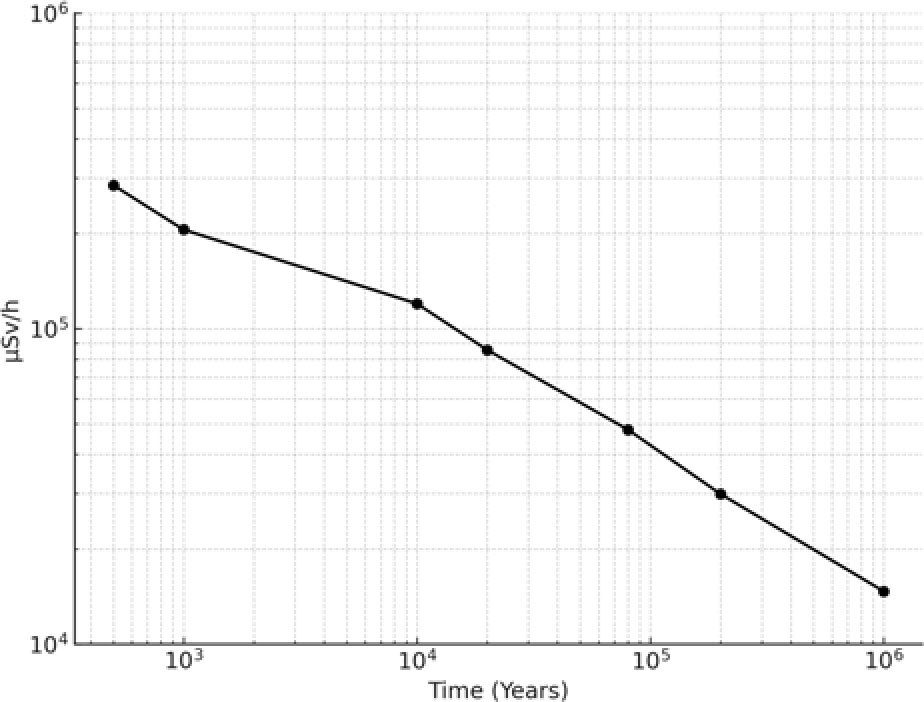
Fig. 5.
The dose rate 2 cm away from the full-size C2 VHLW cylinder as a function of time (source: ANDRA).
Figure 5 plots the dose rate 2 cm away from the full-size C2 VHLW cylinder block (120 cm height and 42 cm diameter). The surface dose rate at one million years is 14.7 mSv/h. From Appendix 3, the dose rate contributions from the Np-237 chain, the excess U-234 and the U-238 chains at one million years are:
As expected, the dose rate from the Np-237 chains dominates the ones from the other chains at one million years. Due to the 2.14 million years half-life, the Np-237 chain will stay significant much longer than the U-234 until it will decay to a fraction of the dose rate from the U-238 chain.
Since the dose rate from the U-238 chain alone is 4.5 times the USNRC dose limit of 0.02 mSv/h, we can conclude that a full-size C2 waste form will be unfit for handling or for proximity to people virtually indefinitely. Concerning other categories of VHLW, their U-238 content will be key.
The total uranium loading of C2 is 636 g, of which 621 g is U-238. COG-200 has similar U-loading [8]. The currently most produced VHLW in France is the Orano-LaHague waste form. Its total uranium content is 2 kg [19]. Accordingly, the U-238 mass in the Orano-LaHague VHLW is approximately 1.962 kg. The resulting long-term U-238 dose rate is expected to be close to 0.28 mSv/h. Other French VHLWs appear to have similar or higher uranium loadings, such as 2 kg-U for COG-140, 14.78 kg-U for COG-800, and 13.6 kg-U for COG-830 [20]. The U-238 dose rates from all these waste forms will exceed the USNRC protection criterion by at least an order of magnitude. Hence, most, if not all, the French VHLW production will require shielding and remote handling essentially indefinitely.
To understand whether a VHLW drill core would still need protection for extended timescales due to the presence of U-238, we apply the procedure of Appendix 3 to the C2 drill core. From Fig. 5, we estimate a surface dose rate of 7.46 mSv/h at 2 cm from its surface and at one million years. We obtain that the U-238 dose rate component is 0.0032 mSv/h and 7.45 mSv/h from Np-237. As a result, it will be unsafe to handle one such drill core or to be in its proximity for approximately 20 million years, until the Np-237 dose rate decays to 0.0168 mSv/h. If the drill core was from the Orano-LaHague waste form, the U-238 dose rate would rise to 0.01 mSv/h, and shielding would be needed to be protected only from the Np-237 chain dose rate for, again, nearly 20 million years.
Overall, we note that, in VHLW, the fission products dominate the dose initially; then, as they decay fast, the Np-237 chain takes over and stays important for approximately 20 million years due to its 2.14 million years half-life and its concentration in the vitrified waste. The heightened concentration of the Np-237 chain is one reason for the high dose rates from VHLW. Another compounding reason is that the glass matrix is much less self-shielding than UO2 due to its much smaller density and atomic number(s). As a result, despite the drill cores (as shown in Fig. 3) have similar volumes, the dose rate from VHLW is higher than from SF. Furthermore, we have seen that eight unshielded SF assemblies generate a smaller dose rate than one full-size VHLW, namely, 6.56 mSv/h vs. 14.7 mSv/h. Past 20 million years, however, the hazard from VHLW will come only from its U-238 content. The latter, however, may still be large enough to generate a dose rate exceeding the proximity protection criterion of the USNRC.
Just as for SF, comparison with uranium ore radioactivity content (Fig. 2) is a misleading metric for evaluating the radiation hazard of VHLW over time.
Smaller vs. larger HLW samples
What if a waste form was fragmented? How would the radiation hazard from larger samples be compared to smaller size samples?
If we compare the dose rate at one million years and 40 cm away from the relatively small sample, CU1, of SF as shown in Fig. 3, with the dose rate 40 cm from the eight unshielded SF assemblies of Table 1, we realize that, at one million years, they are within a factor 7 from one another, 0.1 mSv/h vs. 0.7 mSv/h, respectively, whereas the ratio between their volumes is approximately 1–436. In other words, even if we expect the radionuclide mix and concentration to be similar in the two cases, the dose rate is enhanced in the smaller SF sample. There is significantly less self-shielding within a smaller than a larger volume. Besides, UO2 has high self-shielding characteristics due to its high density and atomic number, and effective travel distances are larger in a larger volume (see also Appendix 1).
As for VHLW, Fig. 5 plots the dose rate 40 cm away from the C2 drill sample (40 cm length and 10 cm diameter) mentioned in Fig. 3 vs. the dose rate 2 cm away from the full-size VHLW cylinder block from which the C2 sample was drilled. To compare the two curves, we need to multiply the drill-sample dose rate by 20 to have its dose rate 2 cm from the surface. We realize that, while the volume of the drill core is 53 times smaller than that of the full waste form, its dose rate is only about 2 times smaller. Once again, while the concentration of the gamma-emitting radionuclides is the same in both cases, there is significantly more self-shielding in the larger cylinder due to its larger thickness.
Overall, smaller volumes of HLW can be comparatively as unsafe as larger volumes, because their smaller matrix is less effective at stopping radiation than their larger counterparts, and the effect is nonlinear (see Appendix 1). An important corollary to this finding is that the sum of doses from the ensemble of smaller parts can be much larger than the dose from the whole waste form. Imagine a ring of 40 cm radius. One could fit 25 C2 drill cores on its circumference. The dose at the center of the ring would be 25 times the dose at 40 cm from each C2 drill core. In this special case, a few parts, which constitute less than half of the whole waste form, deliver approximately 13 times the dose from the intact waste form.
This finding underscores the importance of considering the configuration and distribution of HLW samples when assessing radiation safety. Smaller, distributed samples can create higher localized dose rates compared to a single, larger, intact waste form due to the cumulative effect of radiation from each part.
Comparison to natural background
So far, we have determined hazard in comparison with existing regulatory rules or guidance. The latter accounts for numerous factors of today's practices and living standards and is informed by prudence. Nature follows its own rules, however, and, if possible, it would be useful to determine hazard in comparison with the natural background.
The average, non-ingestion, and non-inhalation radiation component of the total dose rate worldwide is estimated to be up to 0.001 mSv/h [21]. This is at least one order of magnitude smaller than the surface dose rates we have calculated for either SF or VHLW. Besides, if these nuclear materials were broken up into pieces, the doses obtained from a combination of these pieces would be even higher. We conclude that the gamma dose rates in the vicinity of unshielded SF or VHLW or in areas contaminated with their debris would be at least one order of magnitude higher than the average, global gamma background essentially indefinitely.
In some regions of the world, background radiation is significantly more elevated than the global average value, notably around Ramsar in Iran, where the exceptionally high natural background radiation is primarily due to gamma radiation from radium and thorium-rich deposits. Outdoor radiation dose rates in some areas can reach up to 0.01 mSv/h [22].
From Table 1, the dose rate of 0.01 mSv/h will be exceeded 10 m away from the unshielded 8 SF assemblies up to one billion years. That is, at any time, the dose closer to the unshielded SF assemblies will be larger or much larger than 0.01 mSv/h. The dose rates from a combination of fragments of these assemblies could still be larger. We conclude that, for SF, higher dose rates than the currently highest ones around Ramsar would be the norm.
For full-size VHLW, and for the class of French waste forms that we have examined, the surface dose rate due to the U-238 chain is larger than 0.09 mSv/h essentially indefinitely. Farther away from the surface, the dose rate can be lower than 0.01 mSv/h. On the contrary, the dose rate would be larger if these wastes were fragmented. We conclude that, at least for French VHLW, the norm would be that the dose rate would exceed the currently highest Ramsar outdoor dose rate essentially indefinitely.
Information gaps and research needs
The isotopic composition of VHLW
Exploitable, isotopic compositions for individual VHLW waste packages or classes of waste packages either do not exist or are largely unavailable, at least publicly. The French, national nuclear waste packages inventory [19] is insufficient, on its own, to allow estimations of long-term hazard from their waste packages. For instance, for VHLW packages coming from the reprocessing of SF, the national inventory indicates that there is “no long-lived βγ predominant radioelement”. Uranium is listed simply as a “potentially toxic chemical element”. This cannot be right, because, in the very long term, the U-238 chain will become the dominating source of powerful gamma as well as of other radiations. Nor is there mention of Np-237 and its chain, which, we have seen, is a dominating component of VHLW for millions of years. According to an updated data-requirement document by the French Safety Authority [23], the industry may be required to provide the Np-237 data and the isotopic mix of uranium in the future.
Another issue is that VHLW is very heterogeneous, each isotopic composition reflecting a specific waste stream. The US National Waste Technical Review Board explains this in a fact sheet [24]. Similarly, the prospective waste inventory in France details several VHLW formulations [20].
Reliable calculations
Detailed dose calculations from HLW extending beyond one million years need to be performed and made available. In time, there will be a need for benchmarking, i.e., formulating standard-type waste forms and checking each other's codes results. The calculations should account for the self-shielding by the waste forms and the fact that these may be fragmented in some scenarios. LWR SF assemblies are in fact ensembles of tens of thousands of small UO2 pellets, and VHLW glass is brittle. Attention should also be given to the fact that the branching ratio can be applied to the radionuclide abundance and not to its energy. In some cases, the values of the energy levels to be used need to be discussed.
Conclusions
This study presents first-of-a-kind technical analyses that substantiate previous suggestions that high-level nuclear wastes can never be considered intrinsically harmless. By utilizing available data, performing scoping calculations, and comparing these results with current radiation protection guidelines, this paper quantitatively demonstrates that, in the absence of shielding, SF and a large class of VHLW will remain unsafe for contact handling or proximity essentially indefinitely. Smaller VHLW samples may not be approached for millions of years. This paper also demonstrates that the dose rates from unshielded SF and VHLW would exceed the current world-highest outdoor radiation dose rate of 0.01 mSv/h by at least an order of magnitude, and practically indefinitely. Additionally, an ensemble of parts of either SF or VHLW would generate a higher dose than the original, intact waste form. This is relevant because VHLW glass is brittle; the SF assemblies are made up of tens of thousands of ceramic UO2 pellets; and direct exposure scenarios become increasingly likely over extended timescales, including those from natural and manmade events.
The study further reveals that the Np-237 decay chain will dominate the VHLW radiation hazard for approximately 20 million years. After this period, the U-238 decay chain becomes relevant, with Bi-214 playing a dominant role. For SF, Bi-214 is the primary contributor to the dose rate at any time past one million years, although, until 10 million years, the Np-237 chain also provides significant contributions. It also turns out that, on the same volume basis, depending on radioactive content, VHLW may generate more intense doses than SF for millions of years.
Overall, the study identifies critical new insights regarding the intrinsic radiation hazards of SF and VHLW beyond one million years, and it emphasizes the necessity for detailed investigations into these as-yet unexplored timescales. Detailed and benchmarked dose calculations of HLW behavior beyond one million years are missing, and there is an important information gap concerning the isotopic composition of VHLW. Once more detailed studies become available, the timescales for the safety analysis of HLW disposal may find justification on firmer technical bases necessarily complemented by ethical considerations. Similarly, a better-informed choice may be made on which solutions to implement for the back end of the fuel cycle. To this effect, this paper also shows that the common practice of comparing the radioactivity decay of HLW with the radioactive content of uranium ore is not a reliable metric of HLW radiation hazard. What counts is the final concentration of radioactive elements in VHLW and SF, and the radiation doses that each generates on a per volume basis and how long.
Acknowledgments
The topic of how hazardous HLW may be in the very long term came up in recent exchanges with Martin Kunze and Daniel Metlay. With Martin, we were discussing messages to future generations. I take this opportunity to say that my message would be: “If you do not understand this, stay away”. Dan encouraged me to publish my technical analyses. A special thanks goes to Prof. Klaus Fisher-Appelt for providing me with his SF data when we both were working on this topic over 15 years ago. Klaus has kindly permitted that I utilize his data as “personal communication”. I am also grateful to Federico Mompeán for early discussions of this text and Terry Sullivan for his helpful sanity check and technical comments. Finally, I dedicate this paper to the memory of Prof. A. B. Chilton, my teacher of Radiation Protection and Shielding.
Appendices
Appendix 1: Half-value layer and reduced transmission factors
Table A1.1 shows the densities of various materials of interest in this paper along with their half-value layers (HVL). An HVL represents the thickness required to reduce the gamma radiation intensity by half depending on the energy of the gamma rays. Using the NIST XCOM database, we obtained the mass attenuation coefficients for each material at gamma ray energies of 0.3, 0.6, 1, and 1.5 MeV. We converted these into linear attenuation coefficient, μ, from which the HVL was computed through the logarithmic expression: HVL = (ln 2)/μ. In this table, the R7T7 glass is the reference aluminum-borosilicate glass in the French HLW management program [25]. As expected, UO2 has both the highest density and the shortest HVL of the three materials.
Table A1.1.
Density and HVL for various materials depending on the energy of the gamma rays
| Material | Density (g/cm3) | HVL (cm) for 0.3 MeV | HVL (cm) for 0.6 MeV | HVL (cm) for 1.0 MeV | HVL (cm) for 1.5 MeV |
|---|---|---|---|---|---|
| Concrete | 2.3 | 2.08 | 4.02 | 6.69 | 7.70 |
| R7T7 glass | 2.6 | 2.22 | 4.10 | 5.92 | 6.50 |
| UO2 | 10.97 | 0.26 | 0.49 | 0.79 | 1.33 |
We verified that the HVLs vary approximately linearly with energy, E, between 0.2 and 2 MeV. The linear regression formulae are as follows:
Table A1.2 reports reduced transmission factors for 21.5 cm diameter full-size vitrified high-level waste (VHLW) (Fig. 5) and for 5 cm radius drill cores (Fig. 4) and for two energy levels, namely, 0.944 for Bi-214 and 0.312 MeV for Pa-233. These radionuclides are the leading dose-rate contributors in the U-238 and Np-237 chains, respectively. To evaluate the reduced transmission factor, T, we employed the following formula:
where deff = 2r/π and r is the radius of the cylinder. For the same energy, smaller radii result in larger transmission factors, i.e., in higher percentages of radiation passing through the waste form.Appendix 2: Relative contributions to the SF dose rate
Table 3 reports the relative contributions from the three actinide chains U-238, excess U-234, and Np-237 to the gamma dose from the eight unshielded UO2 fuel assemblies as presented in Table 1. To obtain the data shown in Table 3, we had to find the proper equations and their coefficients. To start with, we know that, because of secular equilibrium, each actinide chain will contribute a dose rate, Di, according to the generic decay law:
The decay constants, λi, are those of the parent radionuclides and are easily obtained from their half-lives. We use units of “per million years”.
We know, from Table 1, the total surface dose rates in mSv/h for the eight unshielded SF assemblies. At one billion years, the total dose rate will come from only U-238. We take that number (2.31 mSv/h) and obtain A238. At 10 million years, the total dose rate comes from only Np-237 and U-238. Since we know the total dose rate (2.77 mSv/h) and we can now calculate the U-238 contribution at 10 million years, we can easily obtain A237. Similarly, since we expect the total dose rate (6.76 mSv/h) to come from all the three chains at one million years, we calculate the contributions from U-238 and Np-237 and then easily arrive at A234. Table A2.1 reports the final data.
Table A2.1.
Dose rate computation coefficients for the German spent fuel of Table 1
| Ai (mSv/h) | λi (1/106 years) | |
|---|---|---|
| U-238 | 2.697 | 1.55 × 10⁻⁴ |
| Np-237 | 2.910 | 0.324 |
| U-234 | 29.670 | 2.820 |
Table 3 reports the calculated percentages between one million and one billion years.
Appendix 3: Relative contributions to the C2 waste form dose rate at one million years
The total dose rate, DT, at one million years is the sum of the dose rate, DNp, from the Np-237 chain and from the total uranium (excess U-234 and U-238 chains), DU. As we know, for the C2 waste form, the chain activity ratio of U-234/U-238 at one million years (Table 5), namely, 1.97, we have:
Now we observe the total uranium dose rate is dominated by the gamma energy of Bi-214 (0.944 MeV) and the one from the Np-237 chain is dominated by the gamma energy of Pa-233 (0.312 MeV). These gammas are attenuated differently in the reference aluminum-borosilicate glass (Appendix 1). In cylindrical geometry, with a waste form of radius r = 21 cm, and effective path length, 2r/π, the ratio of the attenuations of Pa-233 to Bi-214 (Table A1.2) is 0.033.
The ratio DNp to DU is equal to the chain activity ratio between Np-237 and the total uranium (4672.93; see Table 5) times the ratio of dominant gamma energies (0.312/0.944), times the ratio of the reduced transmission factors through the 21 cm radius cylinder (0.033; Table A1.2). This results in:
Combining the above relationships and utilizing the total surface dose rate, Dr, of the full VHLW (Fig. 5), which is 14.7 mSv/h, the contributions to the dose rate at one million years are as follows: