1. Introduction
Aggressive tax planning (hereinafter also referred to as “ATP”) became a common term in tax policy discussions and various social debates during the 2010s, and has now taken root in the language used by tax professionals. ATP, however, is not a legal concept – that is, it is not defined in the tax statutes or otherwise in the law. It is also not a concept used in case law.2Therefore, the concept of ATP is arguably not relevant for tax authorities or the courts. The usage of this term is not otherwise established, either, and can refer to slightly different behaviors in different contexts.3
As far as we know, the Organization for Economic Co-operation and Development (OECD) first used the term “aggressive tax planning” (or “aggressive tax planning schemes”) in its public materials in 2006, in the so-called Seoul Declaration, although it did not define the concept in any way in that context.4
In tax literature, however, the concept of ATP had been discussed much earlier than this.5 In 2012, the European Union Commission issued a recommendation regarding aggressive tax planning.6 According to the commission, aggressive tax planning – which can occur especially in cross-border situations – aims to reduce taxes by, for example, using the structural features of the tax system or the differences between different tax systems.7 Though this concept is not embedded in EU law, it has recently been used in a general sense – for example, in the justifications of EU directives8 and in the travaux préparatoires of domestic legislation.9
In these different contexts, various kinds of characterizations of what is meant by ATP have been presented. However, ATP still does not have any precise and established definition – legal or otherwise. This inherent conceptual feature of ATP is also the starting point for the present article. We use the term “aggressive tax planning” (or ATP) pragmatically, to refer primarily to tax planning practiced by multinational entities (MNEs), the prevention of which has been the main objective of the joint project of the OECD and G20 countries known as Base Erosion and Profit Shifting (BEPS).10
The large-scale and ambitious BEPS project has had a significant impact on the existing possibilities of practicing aggressive tax planning. Within the BEPS project, the means generally used in aggressive tax planning were first identified, after which measures (Actions 1–15) were prepared to deal with them, with the help of extensive international cooperation. Since then, the task of the countries involved in the project has been to ensure the necessary implementation of the measures, but the European Union has also taken an active role in this matter.
Given the scope of the BEPS project and the flexibility of its actions, one might assume that ATP has not occurred frequently after the implementation of BEPS. In this article, we will utilize a systematic approach to identify gaps and omissions in the BEPS Project and, based on this analysis, discuss why – despite its ambitious goals – BEPS may not be as comprehensive as one might expect.
As emphasized above, there is no established definition of ATP, and it is not realistically possible to exhaustively define it for purposes of statutory interpretation. Accordingly, the aim of the present article is not to define the concept, but to identify and locate the occurrence of the phenomenon in relation to national tax systems, and especially in relation to the BEPS project. The primary purpose of this article is not to search for, identify or analyze possible means of aggressive tax planning. Rather, it seeks to first systematically examine the reasons why there are still opportunities for aggressive tax planning after the BEPS project, and then to illustrate these situations using examples. The article is tax-legal in its approach, but not strictly, or at least not exclusively, legally dogmatic. In the authors’ view, our approach and analysis can be useful also for tax policy discussions. A systematic approach to examining various types of aggressive tax planning activities will also show more clearly what legislative means are possible for intervening in such undesirable or harmful practices.
The schematic of aggressive tax planning opportunities in the post-BEPS world that we present is general in nature, in that it is suitable for examining the tax systems of many different countries. However, our concrete examples are relatively more focused on the Finnish tax system and how BEPS measures have been implemented in Finland. A detailed examination of all BEPS states, or even all EU member states, is outside the scope of this article.
A framework for a systematic review of aggressive tax planning opportunities is presented in Chapter 3 of the article. Chapter 4 then deals with the identification and positioning of ATP in relation to the BEPS project, both in general and in light of concrete examples. Before those two core chapters, however, it is necessary to examine the relationship between ATP and tax avoidance, as we will in the following Chapter.
2. Aggressive tax planning vs. tax avoidance
2.1. The general and legal-technical definitions of tax avoidance
ATP is often equated with tax avoidance.11 As already stated above, ATP does not have a legal definition, while tax avoidance or preventing it is regulated in the legal order – in general anti-avoidance rules (GAARs). Examples include section 42 of Abgabenordnung12 in Germany; section 2 of lag mot skatteflykt13 in Sweden; and section 28 of the Act on Assessment Procedure (laki verotusmenettelystä)14 in Finland. While some jurisdictions have not necessarily enacted tax avoidance defining GAARs, in these cases, it is not uncommon for a similar anti-abuse doctrine to have been established in the case law.15 In addition, many tax systems also include targeted anti-avoidance rules (TAARs), which grant discretion for tax-avoidance assessment in specific limited situations.16
If one of the concepts (tax avoidance) is included in the legal order, but the other (ATP) is excluded, then how can these concepts be regarded as synonymous or parallel, considering the fact that they refer to a similar kind of activity or behavior?
First of all, it should be noted that in various legal contexts, the general and legal-technical definitions of tax avoidance can be distinguished.17 As a general definition (or rather, a description), tax avoidance refers to tax-minimizing practices that the legislator did not originally anticipate or intend to be accepted. These are actions that could also possibly be evaluated ex post (later), in light of (technical) tax-avoidance norms.
Furthermore, one can use the term “tax avoidance” in a narrower and more precise manner. In the legal-technical context, specifically and retrospectively, an action is considered to be tax avoidance if there is law – or a legal claim asserted by tax authorities – claiming that an action should be considered as such. This might be a statute-based GAAR, a TAAR, or some other similar tax-avoidance norm (e.g., an anti-abuse doctrine developed in the case law).
In the latter legal and technical sense, tax avoidance is an activity that has authoritatively defined ex post, based on the GAAR or the TAAR. Actions that are dealt with on the basis of the GAAR or the TAAR are thus technically defined as tax avoidance, because they meet the characteristics described in the law.18 Meanwhile, actions that are not addressed by these measures fall within the realm of (legally speaking) permitted tax planning.
In international (cross-border) contexts especially, there have been situations involving various activities that would clearly look like tax avoidance from a national point of view in many respects, but where the tax benefit sought is based on interface differences between tax systems that are beyond the reach of national GAARs, or the applications of other national or taxtreaty-based tax-avoidance norms. In such cross-border cases, it is not uncommon to refer to “tax avoidance” in the general sense of the term when there has not been a legal or technical question concerning the issue. As such, it has not been possible to interfere with the tax planning in these cases, even if the actions of a taxpayer have resulted in double non-taxation or another kind of “undertaxation”. The actual result of such forms of tax planning have thus been similar or identical to activity tackled by the GAARs or corresponding norms on the national level. However, the underinclusiveness of these measures creates a fundamental legal-technical difference between national and cross-border tax planning. The term “aggressive tax planning” has often been used to refer specifically to such cross-border activities, which appear to be nearly identical to tax avoidance in the term’s broader conceptual sense.19
2.2. Ex-ante vs. ex-post perspectives
The term “aggressive tax planning” can thus be used loosely, in a similar manner to how “tax avoidance” is used in the general sense. It is also worth noting how these concepts relate to the timeline of actions – tax planning activities, the actions of tax authorities, and court decisions. As stated earlier, the term “aggressive tax planning” can also be used in an ex-ante review to describe actions whose acceptability under tax law is ex post assessed from the perspective of the applicability of the GAAR or other tax avoidance norms, which bring it into either the area of either legitimate tax planning, or of illegitimate tax avoidance.
When a taxpayer at time t carries out business or financial measures that also have, at least partially, fiscal goals, that taxpayer cannot always be sure whether the actions will be treated fiscally in the way that was originally intended. Depending on the point of view, such actions could be described as innovative, creative or aggressive tax planning.
From the standpoint of civil law, these actions are usually considered to be valid transactions. However, their tax-legal significance or acceptability may be examined later. The tax authorities may take into account the fact that a fiscal outcome was reached through aggressive tax behavior that may ultimately be regarded as tax avoidance. There are differences between states in how much power tax authorities have. In some countries – such as Finland – they have direct authority under the GAAR to recharacterize actions as tax avoidance and to make decisions accordingly.20 In some other countries, such as Sweden, there is no such direct right; the tax authorities can only challenge the arrangement and take the case to court.21 In either of these situations, though, a court will ultimately decide the fiscal acceptability of the disputed actions. Most importantly, in all these evaluations, both tax authorities and courts must rely on the law in their actions and decisions.22
The logical use of the terms is linked to whether the level of fiscal acceptability of actions is examined ex ante or ex post. In the ex-ante review, aggressive tax planning and tax avoidance can generally be equated to each other; in advance, there is often no certainty as to whether a tax position will be ultimately accepted. As such, the ex-ante review focuses on the likelihood of a certain action’s acceptance from a tax perspective.23 As further explained in Chapter 2.3, this review may also include various social, economic and policy considerations that cannot be regarded relevant from an ex-post perspective.
Conversely, in an ex-post review, the court deliberates on whether a GAAR or a TAAR is applicable. In this sense, the question concerns judicial assessments and the validity of the action from a tax perspective – that is, tax avoidance in the legal-technical sense. The transaction is deemed either unapproved tax avoidance or as approved tax planning. From a strictly legal point of view, there is no such thing as aggressive tax planning.24 However, if we deviate from the strict legal evaluation, the social evaluation of the matter is not tied to purely legal criteria; regardless of the court’s decision, the company’s stakeholders may still decide the activity is aggressive tax planning.
2.3. Legal vs. social evaluation
As mentioned earlier, there are differences between states regarding the powers of tax authorities. The tax authorities and the courts must always follow the law in their actions and decisions, but broader social evaluation is not tied to legal norms or formal legal processes (which can have harmful consequences for a company’s legal security). This kind of social assessment can be done by any or all of the company’s stakeholders – for example, investors within the ESG framework of responsible investment, the media, or non-governmental organizations – each from their own perspectives.25 Even if an activity is considered to be acceptable tax planning by the courts, stakeholders may still view it as aggressive tax planning.26 As a matter of fact, anyone can conduct such an assessment, since it is not tied to any legal powers or formal criteria.
Therefore, it is important to distinguish three types of assessments. The first is a preliminary assessment of a tax-planning measure or its fiscal outcome, which may take into account economic logic, the internal systematics of the legal tax system, or the equality or horizontal fairness of taxation.27 The second type of assessment concerns legal aspects – that is, assessments and decisions made by courts or other law-enforcement authority. Such assessments are bound by legal norms, the doctrine of legal sources, and other conditions of legal decision making.28 The third type of assessment is when the company’s stakeholders determine taxplanning structures or actions to be aggressive tax planning, regardless of the formal legal approval of the matter. In this case, the assessment can be based on non-legal criteria – for example, taking into account economic or social perspectives.29
Although the court cannot render a judgement concerning ATP, the legislator can either implicitly or explicitly consider whether certain formally accepted actions represent ATP, and address them with, for example, a new special anti-avoidance rule (“SAAR”).30 Though ATP may be hardly mentioned in the statute itself, the concept can be found either directly or indirectly in the travaux préparatoires of the provision. In this way, the legislator can link the concept of ATP to a specific set of characteristics by holding up the case as an example, without defining the concept itself.31 Here, the assessment is legal in the sense that the legislator must weigh many issues when formulating the legislation, such as the impact of EU law, the applicability of GAARs, and the clarity of tax legislation. Accordingly, such legislative and tax policy review approximates a legal assessment of ATP.32
It is worth emphasizing, however, that in these instances the legislator still does not formulate a general definition of ATP. On the contrary, the legislator only describes a certain action or measure and connects it with ATP by removing its tax advantages. In many cases this means enacting a new SAAR or amending an existing SAAR.33 These norms are more specific than GAARs and TAARs, and they do not authorize the tax administrations or courts to determine certain actions as “tax avoidance” or “aggressive tax planning.” Instead, negative tax consequences of a SAAR are applied based on specific, objective criteria set in its wording.34 As such, SAARs can be viewed as legislator’s way of establishing certain actions as ATP.
3. BEPS and aggressive tax planning: the framework
3.1. Base erosion and profit shifting project
The BEPS project can generally be characterized as an extensive “repair package” of the international tax system, specifically aimed at eliminating or reducing the possibilities of ATP in international situations. In the initial report on the project in 2013, the problems of international taxation were described, in part, as follows:
BEPS issues may arise directly from the existence of loopholes, as well as gaps, frictions or mismatches in the interaction of countries’ domestic tax laws. These types of issues generally have not been dealt with by OECD standards or bilateral treaty provisions. There is a need to complement existing standards that are designed to prevent double taxation with instruments that prevent double non-taxation in areas previously not covered by international standards and that address cases of no or low taxation associated with practices that artificially segregate taxable income from the activities that generate it. Moreover, governments must continue to work together to tackle harmful tax practices and aggressive tax planning.35
Indeed, many researchers have referred to ATP specifically as international tax planning that utilizes and ultimately relies on the gaps between different national tax systems, in which the aim is to make use of the differences between these tax systems and the lack of coordination between them.36 Some authors even consider the whole concept as referring solely to international situations.37 In the general tax debate, the focus has especially been on ATP in large MNEs.
Within the national tax system, many undesirable phenomena can be tackled either by introducing new tax-avoidance provisions (especially SAARs or TAARs), or by amending existing tax legislation as necessary. Meanwhile, in cross-border situations, there have been some limitations placed on the application of taxavoidance provisions.38 Amending relevant tax legislation or tax treaties is usually more complicated than introducing new rules. Overall, it can be argued that international situations have not been as well controlled by the national legislatures.
As stated earlier in this article, we do not aim to exhaustively define the concept of ATP. Instead, we aim to identify and locate the occurrence of the phenomenon in relation to the national tax system, and especially in relation to the BEPS project. Accordingly, we take the position that ATP can occur in the tax behavior of MNEs, even after the BEPS project. Consequently, we utilize a systematic approach in assessing in what kind of forms ATP can still occur or for what reasons this can occur. Our approach is general in nature, and suitable for examining the tax systems of different states, but the concrete examples discussed later in Chapter 4 will be more focused on the tax system in Finland and how BEPS measures have been implemented there.
3.2. The systematic approach: classification of different ATP situations
Assuming that we accept the foregoing proposition that the concept of ATP is tied to an ex-ante perspective and can only be defined through legislative and tax policy review of certain taxpayer actions, we can also deduce that ATP can still occur after the BEPS project. This is for a number of reasons. First of all, there are scenarios and activities that have been left out of the BEPS project, which focuses on limiting the tax planning of MNEs; certain specific types of tax subjects fall outside that focus (class 1a in the figure presented below), although some of the BEPS regulatory models may, as a result of their implementation, also apply in themselves to private individuals. However, certain situations or actions might also be included in the main themes of the BEPS project while, for one reason or another, falling outside the scope of the project (class 1b in the figure).
Secondly, taxpayer actions may be of such a type that the BEPS project clearly intends to address the tax benefits obtained through them, but the proposed regulation (or regulatory model) has, for one reason or another, remained “underinclusive” and insufficient in relation to the explicitly stated or assumed goals (class 2 in the figure).
Thirdly, some taxpayer options that have yielded benefits have been the target of interference as part of the BEPS project, but, for one reason or the other, BEPS-inspired regulation has been possible to successfully circumvent (class 3 in the figure).
Fourthly, a given state BEPS regulation model may have the aim of regulating certain taxpayer actions, and be capable of effectively tackling any underlying tax benefits, but suffer from inadequate implementation (class 4 in the figure).
The above situations are represented in the following figure:
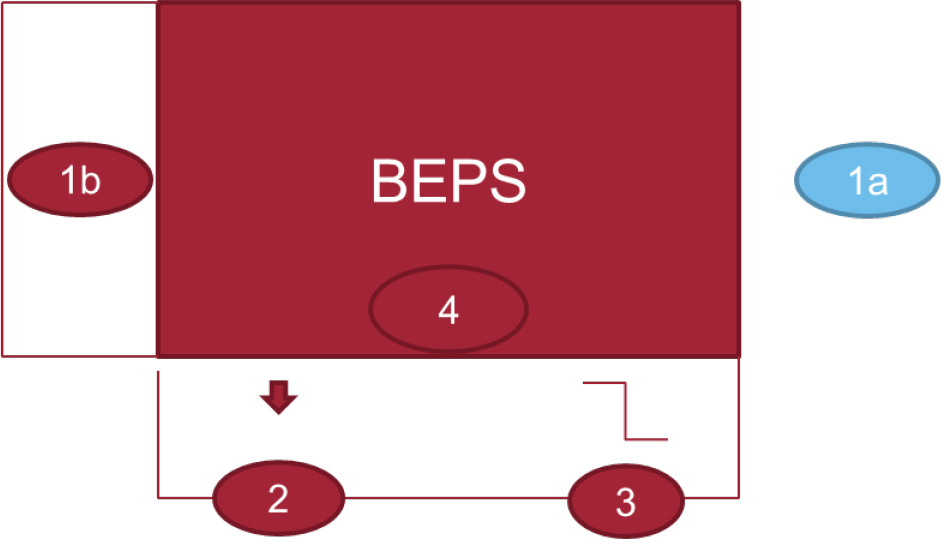
This classification is used as a reference framework for this paper, and it can be relied upon more generally when trying to describe the aggressive “post-BEPS” tax planning opportunities of MNEs. Next, we will discuss each numbered “class” or “region” of the proposed approach in more detail, both generally and using concrete examples. As some concrete examples show, a certain practical phenomenon (or means for ATP) cannot necessarily be placed in a single category, because many phenomena may overlap with two or even more categories.
4. The identification of aggressive tax planning through the proposed framework
4.1. Situations or actions outside the scope of the BEPS project
Classes 1a and 1b in the figure above describe ATP situations or actions that are not relevant to the BEPS project from a thematic perspective or, alternatively, have intentionally been left outside its scope.
From an MNE’s perspective, the BEPS project has focused on tax-planning activities that aim to reduce MNEs’ overall income-tax exposure. Accordingly, the overall income-tax exposure pertaining to, for example, the ownership structure of MNEs has not been the focus of the project. In principle, it might be argued that MNEs also utilize tax planning practices that were not identified during the preparatory phase of the BEPS project. However, given the extent of the BEPS project, it can be argued that the likelihood of such unidentified practices’ existence is insignificant.
Further, it may be argued that class 1a of the proposed framework includes, for example, aggressive tax planning concerning private wealth management carried out, inter alia, through unit-linked insurance products, such as unit-linked life insurance contracts and capitalization bonds.
ATP may also be considered to encompass actions or phenomena that have been intentionally or unintentionally left out of the scope of the recommendations included in the BEPS project. One possible rationale might be the fact that even if certain ATP actions had been properly identified, they were either not prioritized or considered too complicated to address within any of the proposed recommendations.
Indeed, numerous phenomena have been intentionally left outside the scope of the BEPS project. The original intention of the BEPS project was to tackle various inconsistencies between different national tax systems to prevent the corresponding tax planning opportunities utilized by MNEs; as a result, various questions regarding subjects other than corporate income tax were excluded from the project.39 Accordingly, questions regarding the international aspects of transfer taxation, property and wealth taxation, and gift and inheritance taxation are outside the scope of BEPS, even if these areas may bear similarities to items within its scope. It is self-evident that corporate income taxation is not the sole area where the co-existence of numerous national tax systems creates inconsistencies.40
When the BEPS project’s recommendations were published in 2015, concrete proposals regarding the various problems associated with the taxation of the digital economy were left unaddressed.41 The final report explicitly stated that “because the digital economy is increasingly becoming the economy itself, it would be difficult, if not impossible, to ring-fence the digital economy from the rest of the economy for tax purposes.”42 However, the OECD has recently developed concrete solutions to these problems. Hence, various tax complications surrounding the digital economy are now being tackled, albeit with a rather complicated and extensive legislative framework (including OECD Pillar II and global minimum taxation) that affects numerous areas outside the digital economy.
Outside of OECD Pillar II concerning global minimum taxation, however, the BEPS project has not changed the basic underlying principles of the international tax system. As such, the international tax system is fundamentally based on profit-allocation rules arising out of the benefit principle43 and the separate-entity approach,44 both of which still drive international income taxation.45 Because of this, MNEs are still able to utilize differences and inconsistencies in national tax systems through, inter alia, tax planning related to a group entity’s choice of tax residency. For example, the check-the-box rules provided by the U.S. tax legislation are still possible in the taxation of MNEs.46
As such, the BEPS project has also been criticized for neglecting the creation of truly innovative and new means of reform for the international tax framework. The proposed reasons for this lack of innovation vary to some extent. Certain authors believe that it is caused by the unambitious approach of the OECD. Others argue that the opportunistic behavior of taxpayers is the root cause of the ineffectiveness of international tax rules, rather than the changes in the international business environment that especially occurred during the later stages of the project.47
One of the clear limits of the BEPS project is that it did not address – and could not address by any plausible means – the differences in income tax rates used by different countries. As such, MNEs can still effectively gain benefits from the variance in tax rates, especially considering that they are relatively free to choose the tax residence for different group entities for the reasons mentioned above. However, the possibilities of utilizing tax planning opportunities in connection with tax-rate-focused competition have been effectively reduced with the introduction of the rules concerning global minimum taxation.48 One of the clear signs of the significance and extensiveness of these rules is that numerous low-tax countries and jurisdictions have been forced into introducing legislation regarding global minimum taxation.49
It is somewhat surprising that the BEPS project did not focus further on the utilization of crossborder corporate losses, even though this is a particular feature of international corporate taxation and tax planning. In 2011, the OECD had already prepared an extensive report discussing various aggressive tax planning techniques related to the utilization of crossborder corporate losses. The report stated that the differences regarding the restrictions of cross-border loss utilization, and transfer of such losses, amounted to a considerable tax risk for member countries. Because of this, it recommended implementing various legal measures restricting the transfer of corporate losses and double deductions.50
Such rules were not proposed in the recommendations of the BEPS project, except for those regarding the prevention of double deductions of corporate losses using hybrid entities.51 This can be attributed to the fact that most countries had already implemented effective legal remedies regarding the possible misuse of corporate losses prior to the BEPS project – at the latest, after implementing the anti-avoidance rules proposed in the project. As such, the international consensus seems to be that although the BEPS project did not focus on the regulation of cross-border corporate tax loss utilizations and transfers thereof, these behaviors do not pose any meaningful tax risks from the perspective of profit shifting and base erosion under the current circumstances.52
4.2. Proposed regulation has insufficient scope, leaving room for tax planning opportunities
Class 2 in the figure above describes ATP situations or activities that have been the focus of the BEPS project and also are within the scope of its regulatory proposals, but for some reason the regulatory proposal has been insufficient in relation to its ultimate objectives and leaves room for opportunities for aggressive tax planning.
One of the classic challenges of legal regulation concerns the scope of a legal norm.53 This is also a common challenge in the context of preventing various tax avoidance practices. An anti-avoidance norm should not be underinclusive, in order to ensure its effectiveness in relation to the avoidance practices it is intended to counter. However, anti-avoidance regulation should not be overinclusive, either, as this may lead to general ambiguity in the tax law and potentially impede legitimate transactions, thus hampering bona fide business activities.54 Within the context of this framework, it is of special interest whether the BEPS actions are underinclusive in relation to the project’s original goals. Even if a certain situation or action has been covered by the BEPS actions, the OECD may not have been able or inclined to extend these measures to such lengths that any kind of aggressive or other tax planning activity would have been excluded.
In practice, the weaknesses in the BEPS project materialize in two distinct and inherently interconnected ways.
Firstly, none of the four minimum standards included in the 15 action items of the BEPS project concern actual material tax legislation. Instead, all action items concerning the material tax legislation are, by nature, either recommendations or descriptions of best practices.55 This is reflected especially in the implementation of Actions 2–4; concrete measures regarding those items’ implementation have taken off rather slowly outside the European Economic Area (EEA). For instance, according to the progress reports published by the OECD, the majority of the member states in the Inclusive Framework of the BEPS project have yet to implement controlled foreign corporation (CFC) rules based on Action 3 of the project.56
Secondly – and partly as a result of the foregoing – the implementation of the BEPS project’s recommendations and practices concerning substantive tax legislation has not been uniform across different countries. However, since issues related to implementation do not directly fall within the project’s actual scope – which is the theme of this subsection – challenges pertaining to the project’s implementation will be addressed more specifically in Chapter 4.4.
On a more concrete level, addressing the use of so-called “shell companies” can be seen as one of the gaps in the BEPS project. It is uncertain whether the CFC rules recommended in Action 3 can effectively target the use of such entities. This has become particularly evident in the EU, where CFC legislation based on the Anti-Tax Avoidance Directive (ATAD)57 has had a supplement proposed called ATAD 3 (also known as the “Shell Company Directive”)58 that would impose various reporting obligations and tax disadvantages tied to the substance of companies.59 While the CFC regulation in the ATAD largely aligns with Action 3 of the BEPS project, ATAD 3 goes beyond the scope of the BEPS project. In particular, amendments proposed by the European Parliament to the proposed directive reveal that the EU legislator does not consider the current CFC legislation a sufficiently effective means to prevent tax planning through conduit entities and base companies.60 The CFC legislation can thus be considered an example of a regulatory phenomenon that has not been deemed sufficiently effective – at least in the view of the European Parliament and the Commission.61 However, time will tell the extent to which the legislator is willing to go in preventing aggressive tax planning, even if it simultaneously significantly complicates the position of companies established for conducting operative business functions on a legitimate business rationale.62
Furthermore, the interest deduction limitations proposed in Action 4 do not address the fundamental issue of the tax treatment between equity and debt-financed investments, but rather aim solely to restrict the deductibility of interest. Thus, the original purpose of the BEPS project was not to entirely eliminate deduction of interest expenses, but rather to create an environment for businesses where the benefits of profitshifting through debt and related interest expenses would merely be reduced.63 Since the deduction of interest expenses remains possible within the framework of interest deduction limitations, profit shifting can still be conducted to a limited extent. Additionally, mechanisms have been established to allow deductions of interest expenses that were not possible in previous tax years due to interest deduction limitations. Such mechanisms can be leveraged through various means, analogous to certain tax depreciation methods.64
4.3. Proposed regulation can be avoided or circumvented
Even if a specific regulation was implemented within the framework of the BEPS project (preparation of model rules and their implementation), it is possible for it to be avoided or circumvented through certain means. In the figure above, these situations are described by class 3.
Possible reasons for these scenarios are
(i) a certain phenomenon has not been effectively regulated, or
(ii) the regulation of a certain phenomenon has not been intended to be excessively detailed or extensive for other reasons, such as efficiency considerations in taxation, or administrative burden.
For instance, neither the BEPS project nor its actions included any explicit recommendation for a GAAR. Nevertheless, a GAAR aimed at preventing corporate tax avoidance is included in Art. 6 of the ATAD.
However, in the context of the BEPS project, issues or instances of abusive tax behavior have been highlighted, especially in international situations. BEPS Action 6 pertains to the denial of tax treaty benefits in cases of abuse65 and provides minimum standards for preventing tax treaty abuse. Compliance with the minimum standards set forth in Action 6 requires either (1) the addition of explicit language in the tax treaties that the treaty is not intended to create situations of untaxed income or (2) a principal purpose test (PPT) or limitation on benefits (LOB) provision.
Action 6 has been implemented with the multilateral instrument (MLI). The first signing ceremony of the MLI occurred on June 7, 2017, and 68 states were present, including all the Nordic countries. The entry into force of the MLI in different countries has depended on the ratification schedules of individual states.66 Each signatory state of the MLI is required to declare which tax treaties it wants to bring within the scope of the instrument. For the instrument to have an impact on a specific tax treaty, both contracting parties of a bilateral tax treaty must also sign and ratify the instrument. Through the MLI, a kind of tax treaty GAAR, based on the principal purpose of a transaction or arrangement (i.e., PPT provision), has been added to most of the tax treaties concluded by Finland, for example.
As already noted, within the scope of the BEPS project, no explicit recommendation for a GAAR against general tax avoidance was included, apart from addressing the aforementioned instances of tax treaty abuse. However, such a provision is included in Art. 6 ATAD pertaining to prevention of corporate tax avoidance.67 From the perspective of legal decisionmaking, this involves the previously-discussed question of the relationship between a specific rule and a general rule. If there is a specific rule on a certain matter, the assessment and testing of a particular phenomenon should be conducted primarily in relation to the specific norm and not the general rules. This is due to the lex specialis derogat legi generali principle (i.e., a specific norm prevails in case of conflict with a general norm).
Therefore, it is crucial that a specific rule be properly calibrated if the non-applicability of a specific rule prevents the possible secondary application of a general rule concerning tax avoidance. According to the lex specialis principle, the application of specific rules takes precedence over general provisions; thus, norms specifically enacted in anti-tax avoidance rules should be primarily considered. In this way, the legislator has indicated – in the relevant context – where the boundaries between acceptable and unacceptable tax planning lie.68 The immediate downside of this is that the precise definitions or the use of specific threshold values in special anti-avoidance rules simultaneously create new distinctions that can be exploited in aggressive tax planning.
There is currently little jurisprudence or concrete evidence on how Art. 6 ATAD affects the scope of member states’ norms regarding tax avoidance and, consequently, the framework around the prevention of aggressive tax planning. Based on the foregoing, the possibilities of circumventing special anti-avoidance regulations largely depend on how the specific regulatory recommendations within the BEPS project have been implemented, and the tolerance of an individual state or jurisdiction in applying its domestic GAAR. For example, in Finland, regulatory solutions derived from the BEPS project and ATAD have been implemented rather comprehensively, with special anti-avoidance regulations that exceed the minimum standards. Finland has also applied its domestic GAAR quite effectively since the 2010s. Therefore, circumventing the rules within the scope of the BEPS project may be difficult from a Finnish perspective.
As stated earlier, the BEPS project has not established consistent standards or practices regarding the application of GAARs or similar legal principles (outside of abuses of tax treaty benefits). Thus, the BEPS project does not provide answers to how situations falling outside the scope of the action proposals’ special anti-avoidance rules should be assessed – for example, in light of GAARs. In practice, the interplay between GAARs and anti-abuse doctrines on one hand, and precise SAARs on the other, may still lead to significant inconsistencies between different countries and jurisdictions. For example, in Finland, “correcting” the scope of a SAAR through the application of a GAAR has been accepted, and even the simultaneous application of a GAAR and a SAAR has been positively regarded in Finnish case law.69 There are no specific reservations against the interaction between general clauses and SAARs found in the reasoning of the court in the relevant decisions. By contrast, in Germany, the existence of SAARs has effectively prevented the application of a GAAR in several instances, and the possibility of expanding the scope of special anti-avoidance regulation by applying a GAAR has been approached with more reservation.70
Regarding the BEPS project, a potential issue with the interaction between SAARs and general clauses can be exemplified by Action 4, which addresses interest deduction limitations. Action 4 proposes a uniform regulation on interest deduction limitations, without taking a position on the relationship between interest deduction limitations and general clauses. The problematic aspect of this proposal lies in the deductibility of interest expenses per se; when the deductibility of interest is restricted, can the deduction of interest expenses be allowed in all situations within the prescribed thresholds, or can the deductibility of interest expenses be denied entirely by, for example, applying a general clause? The outcome may vary significantly in different countries, leading to distortions between different tax systems.
For example, in Finland, it might be inferred from the provisions on interest deduction limitations that the benefits of profit-shifting would be permissible outside the scope of the limitations, as the interest limitation rules “aim at reducing the possibilities to carry out profit shifting through debt financing”.71 However, the travaux préparatoires explicitly state that in Finnish tax practice, the deductibility of interest expenses related to intra-group transactions has been occasionally denied by applying the GAAR.72 This position has recently been since confirmed in Finnish case law, where a strict line has been drawn between the deductibility of interest expenses generated in intra-group and in third-party transactions.73
According to the authors’ understanding, intragroup interest expenses are deductible certain states – for example in Sweden and Norway. This assumption is based on the CJEU judgment in Lexel,74 the ETFA Court’s judgment in PRA Group Europe,75 and the resulting decisions by the Swedish SAC76 and the Norwegian Court of Appeal (Borgarting lagmannsrett),77 where the deductibility of intra-group interest expenses in a cross-border situation was eventually confirmed. It is worth mentioning that none of the cases addressed the question of applying the GAAR or the prevention-of-abuse principle, as the cases solely concerned rules targeting deductibility of interest expenses in crossborder situations. These targeted rules were considered contrary to the freedom of establishment in both CJEU cases and, as such, could not be applied.
However, recently AG Emiliou concluded in case XBV78 that intra-group loans may be considered artificial if they are principally motivated by tax reasons. The AG proposed for the Court to (partly) overrule the judgment in this sense in Lexel, where the Court had held that intra-group loans cannot be deemed artificial if the terms comply with the arm’s-length principle.79 CJEU ended up following AG Emiliou’s proposition, albeit while being a bit more careful in its approach. Essentially, the Court agreed that intragroup loans complying with the arm’s-length principle may also be considered artificial.80 Even so, the Court emphasized that the tax authorities need to provide prima facie evidence of abuse81 and the denial of interest deductions must be based on sufficiently clear criteria.82
4.4. Implementation of the proposed regulation is either lacking or ineffective and inconsistent
Class 4 in the figure above describes ATP situations or activities that have been the subject of the BEPS project and its legislative proposals. Despite this, there are still opportunities for aggressive tax planning; in one or more countries, the implementation of the proposed regulation is completely lacking, incomplete, ineffective or inconsistent.
As mentioned above, the BEPS project does not include minimum standards for substantive tax legislation, but rather recommendations and best practices to develop national tax legislation. Hence, the legislative content of the BEPS project and the exact scope of the proposed regulation are largely subject to the discretion of domestic legislatures. However, this only applies to those states that have adopted the legislative recommendations contained in the BEPS project. Even for these states, it must be noted that the actual implementation of the legislation may ultimately be quite limited.83
The implementation of the BEPS project has not been consistent, even within the EU, though the BEPS project’s action proposals have been extensively adopted by member states through the implementation of the ATAD.84 While the directive establishes a minimum standard85 for the SAARs included therein, it also provides member states with numerous regulatory alternatives. Member states also have the option of enacting special anti-avoidance regulations that go beyond the minimum standards, as long as the SAARs are compatible with EU primary law. In this way, the ATAD ensures a broadly similar type of regulation across all member states, but does not guarantee that the regulation is precisely identical in content in each member state.86 Within the EU, there are even member states that have implemented SAARs solely to fulfil the formal requirements of the ATAD. In these states, it has been debated whether the application of these rules will be effective in practice.87
The fragmentation of specific anti-avoidance regulation is particularly evident in the case of the CFC legislation included in the ATAD. The ATAD provides member states with two alternative methods for determining CFC income,88 resulting in slightly different approaches to determining CFC income in different member states. There are also significant differences in the exact scope of the rules. Some member states have implemented significantly stricter CFC rules than the minimum standard set by the directive, while others have sought to make the CFC rules as permissive as the minimum standard allows. These differences become apparent when comparing certain details of the CFC rules in, for example, Luxembourg and Finland:
Firstly, according to the Finnish CFC legislation, the formation of a CFC requires a minimum ownership stake of 25% in the foreign entity’s voting rights, capital, or rights to the entity’s profits or proceeds of the entity’s wealth. Instead, Luxembourg’s CFC legislation requires a 50% ownership stake, which, like Finnish legislation, is linked to voting rights, capital, and the foreign entity’s profits. However, first, Luxembourg’s CFC legislation does not include rights linked to the proceeds of the entity’s wealth. Secondly, the condition related to the level of taxation of the foreign entity is lower in Luxembourg, partly due to a lower corporate tax rate.89 Thirdly, Luxembourg’s CFC legislation has more lenient substance requirements compared to Finland and applies to non-EEA countries.90
Additionally, outside the EU and the EEA, there are numerous countries that have not adopted the substance-based tax legislation recommended by the BEPS project. In many jurisdictions, the focus has been solely on implementing the minimum standards of the BEPS project. In many countries, the BEPS project has even posed challenges due to existing tax advantages offered by those country’s domestic tax legislation.91 Traditionally, the anti-avoidance regulation has not been comprehensive in these countries – sometimes, it has been practically non-existent. The BEPS project has not brought significant change to this situation, and as the fundamental principles of international taxation remain unchanged, it is still possible to benefit from the tax advantages offered by these countries. For instance, one of the primary objectives for the United States in relation to the BEPS project was to ensure that the CFC regulation recommended by Action 3 would be universally adopted, but the BEPS project ultimately proved to be a significant disappointment for the United States in this regard.92
5. Concluding remarks
ATP is not a legal concept, nor is it an otherwise established or precisely-defined concept. As such, we have not tried to propose an exhaustive, accurate description of ATP. Instead, it may be more appropriate to study and examine the occurrence of this phenomenon in different contexts, and the underlying incentives or opportunities.
In general, ATP can be examined from ex-ante and ex-post perspectives. However, from a strictly legal standpoint, a certain behavior can be deemed only as either acceptable tax planning, or tax avoidance resulting in the denial of associated tax advantages. This equates to an ex-post perspective emphasizing the actual deliberation taking place in the courts and the possible application of either a GAAR or a TAAR. As such, from a legal ex-post perspective, we can merely address the possibility of tax avoidance.
On the other hand, the ex-ante evaluation is focused on the fact whether tax advantages associated with a certain action are eventually accepted in the future legal praxis. We can also consider various legal-policy, social and economic perspectives in determining whether the associated tax advantage is acceptable. If this ex-ante analysis shows that a certain action is likely to generate a tax advantage – thus making it acceptable from legal standpoint, but unacceptable from policy, social or economic standpoints – the legislator may be inclined to amend the legislation accordingly. In essence, this leads to an amendment of an existing SAAR, or an introduction of a new SAAR.
Above, we have tried to systematize the ATP phenomenon and its occurrence in relation to the BEPS project. Some situations or means of ATP have been left outside the scope of the BEPS project. In some cases, the proposed regulation has insufficient scope, leaving room for tax planning opportunities. In other words, the regulation can be considered underinclusive. Further, in some of the proposed means, even though regulation has been precisely targeted at certain situations, it has been implemented in such a way that its ultimate purpose can be avoided or circumvented. Finally, various ATP methods can rely on the fact that different states have not fully implemented the BEPS recommendations – that is, the implementation of the proposed regulation is lacking, ineffective and/or inconsistent.
The concept of ATP is also often invoked when various legislative solutions are sought. With the help of a systematic approach, it is possible to analyze and define the different forms of ATP that could be addressed through legislation or other legal norms. This approach can also point out which actors have the competence to address a given ATP measure – for example, national legislatures, legislatures at the EU level, or states acting as tax treaty parties. At the same time, however, it is worth remembering that the effects of the measures in the BEPS project have their own timeline. It may not always be reasonable to take regulative steps to the extreme, as the administrative and other effects of regulation on both taxpayers and tax administrations should be considered.
In the end, ambiguous tax law is a particular enabler of ATP. In most cases, legal norms are open to interpretation and thus can be exploited and “bent” to different causes. Income tax law, and generally the entire tax systems of certain states and jurisdictions, can hardly ever be refined to perfection. No matter how precisely tax legislation is developed, it will always include features that can be used for tax planning purposes – sometimes in an inappropriate way.
Overall, the prevention of ATP is a question of a gap between two aspects or aims. On the one hand, what can be reached with legal regulation in a reasonable way, and on the other hand, what would be an ideal situation to reach? A kind of utopian ideal situation could be described as one that would fully achieve the ultimate goals of a good tax system – such as equality and fairness, legal certainty, and efficiency – from the perspectives of many different actors. Unfortunately, tax legislation seems to be complex93 by its very nature and cannot consistently eliminate the gap between the limits of legal regulation and the elements of a perfect tax system.
This gap can, however, also be reduced with nonbinding legal norms, such as practices or norms related to tax responsibility. In this regard, it is especially relevant how MNEs report on their tax issues; this, in turn, is greatly influenced by what a company’s stakeholders (such as ESG investors) expect and require from tax reporting. Looking further into informal measures outside the legal realm may yield a more comprehensive understanding of the complexities and challenges associated with ATP, laying the foundation for future research and policy development regarding this phenomenon.
Notes
[1] The article was written as part of a research project on aggressive tax planning funded by the Finnish Tax Administration and implemented by the University of Turku.
[2] Over the years, however, it has not always been clear whether aggressive tax planning is only a tax policy, or also a legal concept. See Dourado (2015, 42).
[3] For example, in accounting, the term “tax avoidance” has been used in describing “broadly as anything that reduces the firm’s cash effective tax rate over a long time,” reflecting “both tax reductions that are squarely in compliance with the law as well as those that result from gray-area interpretations.” See e.g., Dyreng, Hanlon and Maydew (2008, 62).
[4] OECD (2006, 4). Later on, OECD tried to define the concept of ATP more precisely in its 2008 Study into the Role of Tax Intermediaries. See OECD (2008, 87).
[5] In legal literature, among the first to address the topic of aggressive tax planning are Randall W. Roth in 1983 in his article “New Penalty Provisions and Their Effect on Aggressive Tax Planning” (1983), Kari S. Tikka in in his article “The principle of legality in the application of tax law” (1998), and David M. Schizer in in his article “Sticks and Snakes: Derivatives and Curtailing Aggressive Tax Planning” (2000). For a review of earlier literature on the use of the ATP concept, see Kaunisto (2022, 31–32).
[6] 2012/772/EU: Commission Recommendation of 6 December 2012 on aggressive tax planning (OJ L 338 12.12.2012, p. 41.
[7] In several situations, ATP has been made enabled by harmful tax competition between states. See here, for example, Knuutinen (2014, 218–224) and Dourado (2020, 392).
[8] See Council Directive (EU) 2016/1164 of 12 July 2016, laying down rules against tax avoidance practices that directly affect the functioning of the internal market (ATAD), recital, para. 3: “It is necessary to lay down rules in order to strengthen the average level of protection against aggressive tax planning in the internal market.” This terminological choice is open to criticism, as in many other parts of the directive, including the main headline, it is referred to as fighting tax avoidance. See also Council Directive (EU) 2018/822 of 25 May 2018, amending Directive 2011/16/EU regarding mandatory automatic exchange of information in the field of taxation in relation to reportable cross-border arrangements (DAC6), where the concept of ATP is referred to several times.
[9] In Finland, e.g., see Government Proposal 16/2018 pp. 284 and 287 and Government Proposal 150/2018, pp. 5, 10 and 29.
[10] See and cf. directive on administrative cooperation in the field of taxation (Council Directive (EU) 2018/822 of 25 May 2018 amending Directive 2011/16/EU as regards mandatory automatic exchange of information in the field of taxation in relation to reportable cross-border arrangements (OJ L 139 05.06.2018, p. 1)), where the concept of aggressive tax planning is not defined, but described with the help of “characteristics of the arrangement.” In the recital (para. 9), it is stated: “Aggressive tax-planning arrangements have evolved over the years to become increasingly more complex and are always subject to constant modifications and adjustments as a reaction to defensive countermeasures by the tax authorities. Taking this into consideration, it would be more effective to endeavour to capture potentially aggressive tax-planning arrangements through the compiling of a list of the features and elements of transactions that present a strong indication of tax avoidance or abuse rather than to define the concept of aggressive tax planning.”
[11] Even the OECD also appears to largely equate the concepts of ATP and tax avoidance with each other; see e.g. Kuźniacki (2023, p. 9–12). See also Hultqvist (2017, 674) ja Knuutinen (2020a, 38).
[13] Lag mot skatteflykt (2011:1372), section 2.
[15] See e.g. Korving and Wisman (2021, 935) regarding the fraus legis doctrine in the Netherlands.
[16] See Itälä and Knuutinen (2023, 853).
[17] See Hultqvist (1995 383–384); Rosander (2007 13–15) and Knuutinen (2020a, 31–34).
[18] See also Rosander (2007, 14): “Den metod som används mot skatteflykt återspeglas i en teknisk definition. De transaktioner som framgångsrikt kan angripas med metoden är per teknisk definition skatteflykt” [“The anti-tax avoidance methodology is reflected in a technical definition. The transactions that can be successfully tackled by the methodology are, by technical definition, tax avoidance.”]
[19] See Pistone (2017, 99): “[…] aggressive tax planning is a phenomenon that requires two jurisdictions, since it derives tax advantages from the external inconsistency between two or more tax systems and the exploitations of the potential cross-border disparities that may arise in such a context.”
[21] See lag mot skatteflykt, Section 4.
[22] Furthermore, after this, the legislator can (either on the basis of the decision made or otherwise) assess whether there is a reason for legislative actions to intervene in similar actions in the future.
[23] See Field (2017, 271).
[24] However, the court may indirectly refer to such a phenomenon, or to a similar one, in the reasoning of its decision. This happened, for example, in the Finnish Supreme Administrative Court decision KHO 2008:6 in Finland. The Supreme Administrative Court rejected the applicability of a GAAR based on “the current state of the legislation” and, thus, seemed to point out the fact that the law may need to be amended.
[25] See also OECD (2013b, 8): “[… ] citizens have become more sensitive to tax fairness issues.”
[26] See e.g., Burgers and Mosquera Valderrama (2017, 773–775).
[27] It is worth noting that the internal logic of a legal tax system does not necessarily always operate in accordance with economic logic; the internal logic of a tax system is based on the legal-formal features of the tax system itself. See generally, e.g., Thuronyi (1990) and Prebble (1994).
[28] In the United Kingdom, such an assessment can be carried out by a special authorized GAAR panel.
[30] The history of adjusting interest deduction limitations serves as an example of this. See Itälä and Knuutinen (2023, 855–858).
[31] See e.g., ATAD preamble, para. 3, stating that “[i]t is necessary to lay down rules in order to strengthen the average level of protection against aggressive tax planning in the internal market.” In the authors’ view, this indicates that the SAARs governed by ATAD are considered to be various forms of aggressive tax planning.
[32] It is worth emphasizing that the notion of ATP may be also discussed in parliamentary debates, which may eventually lead to an enactment of a SAAR. However, these debates do not necessarily aim to define ATP. The ATP is rather used as an incentive for new regulations targeting specific tax-efficient measures. See, e.g., Verbatim report of proceedings CRE 07.06.2016– 2 regarding the report on the proposal for a Council directive laying down rules against tax avoidance practices that directly affect the functioning of the internal market [COM(2016)0026– C8-0031/2016–2016/0011(CNS)] - Committee on Economic and Monetary Affairs. 07.06.2016 – Strasbourg.
[33] SAARs can be located anywhere income tax legislation based on the nature of the phenomenon they are intended to target. As such, SAARs may be found, inter alia, in General Tax Acts, Corporate Income Tax Acts and Personal Income Tax Acts.
[34] See, in more detail, Itälä and Knuutinen (2023, 852–853).
[35] See OECD (2013b, 13).
[36] See Piantavigna (2017, 479): “In particular, MNEs adopt such strategies, without circumventing the tax regulatory regimes of their own countries, but operating in the legal vacuum existing between sovereign states and utilizing planning paradigms, which are the result of treaty models, transfer pricing guidelines and domestic laws developed in a non-integrated legal environment.”
[37] See e.g., Pistone (2017, 99).
[38] In particular, over the years, the primary law of the EU and the tax treaties concluded by states have limited the international application of the GAARs to some extent.
[39] See OECD (2013a, 3, para. 5): “Base erosion and profit shifting (BEPS) relates chiefly to instances where the interaction of different tax rules results in tax planning that may be used by multinational enterprises (MNEs) to artificially shift profits out of the countries where they are earned, resulting in very low taxes or even double non-taxation. These practices, if left unchecked, undermine the fairness and integrity of our tax systems. They fundamentally distort competition, because businesses that engage in cross-border BEPS strategies gain a competitive advantage compared with enterprises that operate mostly at the domestic level. Fair, transparent and efficient tax systems are not only key pillars for sound public finances, they also provide a sustainable framework for dynamic economies.”
[40] See e.g., Finnish Supreme Administrative Court decision KHO 2021:120 concerning the acquisition cost of an inheritance received by a Finnish tax resident legatee. The individual in question had received shares in a listed company as inheritance from a deceased U.S. tax resident. The shares had not been subject to inheritance taxation in the United States, and the legatee had not filed an inheritance tax return therein. The inheritance was not taxed in Finland either, due to the inheritance tax treaty concluded between Finland and United States. As such, the underlying legal question was whether any acquisition costs could be allocated to the inheritance in Finnish income taxation; Sec. 47.1 of the Finnish Income Tax Act (1535/1992, tuloverolaki (TVL)) stipulates that the acquisition cost of an asset received as inheritance shall be deemed the inheritance tax value of the asset (i.e. the fair value of the inheritance at the date of death of the deceased person).The Supreme Administrative Court held that the inheritance-tax value of the shares was the acquisition cost of the inheritance, even though the assets were not subject to inheritance taxation in either country. Taking into account that the rationale behind Sec. 47.1 of the Finnish Income Tax Act (1535/1992, tuloverolaki, TVL)) is to prevent double taxation of inheritances, this decision can be seen as reflecting the inconsistencies between the Finnish and U.S. inheritance taxation. See, in more detail, Nykänen (2021).
[41] See OECD (2015a).
[43] According to the benefits principle, the residence country has the primary taxing rights to passive income, and the source country has the primary taxing rights to active income. The benefits principle originates from the work conducted by the League of Nations during the 1920s, when it was trying to solve problems arising out of the fragmentation of the connection between value generation and actual taxing rights. To this end, see e.g., Avi-Yonah (2007, 11), OECD (2014, 36–38) and Jaakkola, Ylönen and Saari (2023, 15), where the benefits principle is referred to as the “membership principle.”
[44] “Separate-entity approach” refers to the independent tax liability of each separate legal entity. The opposite of separate entity-based taxation is a group approach, where the income tax liability of a single legal entity is determined by other legal entities subject to tax. See in more detail e.g., Hey and Schnither (2022,18).
[45] See e.g., Avi-Yonah and Xu (2017, 6–8) who criticize the reliance on traditional solutions, especially the rejection of reverse benefits-principle and single unitary approach. However, Offermanns and Baldewsing (2015, 89-91) argue that the recommendations regarding interest limitation rules deviate too far from the separate-entity approach and the arm’s-length principle. See also Kingma (2020, 398), who takes the position that in the end, the BEPS project’s principle of value creation was left rather ambiguous, even though it was originally one of the most fundamental inspirations behind the project. Because of this, the benefits principle has retained its primary magnitude in international taxation.
[46] Check-the-box rules enable the taxpayer to choose whether the entity is deemed a transparent entity or independent tax subject for the purposes of U.S. income taxation. See, in more detail, e.g., Agresta (2017, 574–579, 586–591). Some authors have argued that it is unlikely that the BEPS project could effectively address tax planning opportunities arising out of the check-the-box regulation. To this end, see e.g., Picciotto et al. (2017, 21) and Agresta (2017, 601–602).
[47] To this end, see Escribano (2017, 250–252).
[48] See OECD (2021, 4).
[49] Such countries or jurisdictions include Singapore, Liechtenstein, Guernsey, Jersey, Isle of Man and Switzerland. In addition, the United Arab Emirates has announced the introduction of a corporate income tax rate of nine percent, which can be seen as a turning point in global tax competition unto itself. See KPMG (2024).
[50] See OECD (2011, 77–79).
[51] See OECD (2011, 57) and OECD (2015b, 53). It is worth mentioning that transactions involving a transfer of losses were included in recommendation 12 regarding mandatory disclosure rules. See OECD (2015d, 48).
[52] See Matteotti (2023, 69–72).
[53] See Ehrlich and Posner (1974, s. 268) regarding legal regulation in general; in practice, the scope of legal norms is often either underinclusive or overinclusive. The problem of underinclusion may be solved by introducing standards in connection with a norm, while the problem of overinclusion may be tackled by providing the authorities with more room for discretion.
[54] See Tikka (1972, s. 13): According to Tikka, when a tax norm is intended to cover anything other than strictly economic phenomena, it is often difficult to find facts related to a particular phenomenon. The result is that when these facts arise, the said phenomenon also arises, and when such a phenomenon arises, the same facts arise simultaneously.
[55] See Christians and Shay (2017, 34–36). The minimum standards were action 5 regarding harmful tax practices, action 6 regarding prevention of tax treaty abuse, action 13 regarding country-by-country reporting, and action 14 regarding more effective cross-border dispute resolution mechanisms.
[56] See OECD (2020, 12). According to the report, 49 out of the 122 inspected countries had implemented CFC regulation. Eleven of these countries had not included any requirements regarding substantial economic activity in their CFC regulation. It is worth noting that, to the knowledge of the authors, the implementation of BEPS Actions 2–4 has not been inspected following the aforementioned progress report (July 2019 – July 2020).
[58] Proposal for a Council Directive laying down rules to prevent the misuse of shell entities for tax purposes and amending Directive 2011/16/EU.
[59] For a more detailed description of the proposed regulation, see, inter alia, Veikkola (2023, 4–9).
[60] See draft European Parliament legislative resolution on the proposal for a Council directive laying down rules to prevent the misuse of shell entities for tax purposes and amending Directive 2011/16/EU (COM (2021) 0565–C9-0041/2022– 2021/0434(CNS)), proposed amendment regarding the addition of a new para. 1b to the recital: “The lack of an international instrument on the misuse of shell entities for tax purposes creates a significant loophole in the global efforts to combat tax fraud and evasion and aggressive tax planning. In addition, it creates an uneven playing field among businesses. The absence of such an instrument confirms the importance of the legal standards laid down in this Directive. It is essential to guarantee that the obligations provided for in this Directive are proportionate and effective from a taxation point of view, preserving the competitiveness of Union undertakings.”
[61] It is worth a mention that the Finnish Grey Economy Information Unit has also concluded that the various substance-and industry-based exceptions to the Finnish CFC regulation are problematic. See Tokola and Martikainen (2021, 78).
[62] At the time of writing, the amendments proposed by European Parliament in the aforementioned resolution on 17th January 2023 are still under consideration by the Commission.
[63] See VM (2017, 33).
[64] See Itälä and Knuutinen (2023, 856, footnote 38).
[65] See OECD 2015c.
[66] For example, in Finland, the Act on the Multilateral Instrument on Measure to Prevent Base Erosion and Profit Shifting in Tax Treaties (Veropohjan rapautumisen ja voitonsiirron estämiseksi verosopimuksiin toteuttavista toimenpiteistä tehdystä monenvälisestä yleissopimuksesta annettu laki (231/2019)) entered into force on 1 June, 2019.
[67] See Kaunisto (2022) for a general description of the effects of Art. 6 ATAD on the Finnish tax system. See also Itälä and Knuutinen (2023, 866–869).
[68] The question of the relationship between special antiavoidance rules and GAARs seems to have been practically significant in Germany, where the GAAR (§42 Abgabeordnung) has been amended on several occasions in recent years to address this issue. See e.g., Knuutinen (2009, 334).
[69] Regarding the expansion of special anti-avoidance rules, see, for example, Finnish Supreme Administrative Court decision KHO 2018:40, Itälä (2023, 505–506) and Knuutinen (2020a, 96–99). Concerning the simultaneous application of special anti-avoidance rules and general clauses, see, inter alia, KHO 2014:66, Itälä (2023, 508–509) and Knuutinen (2020a, 120–122). It should be noted that in the decision KHO 2014:66, two general clauses were practically applied simultaneously (GAAR of Sec. 28 VML generally applicable in income taxation and the targeted anti-avoidance rule of Sec. 52h of the Business Income Tax Act (360/1968, laki elinkeinotulon verottamisesta, EVL), limited to situations set forth in Sec. 52–52g of the same Act). It is also noteworthy that in Finland, the legislator typically explicitly states that a special anti-avoidance rule is not intended to limit the scope of the GAAR. See, for example, Government Proposal 146/2012, p. 18, regarding the relationship between interest deduction limitations and the GAAR.
[70] See Kraft (2018, 348–349), pointing out that the Federal Tax Administration (headed by the German Ministry of Finance) and the Federal Tax Court have been on opposite lines in this matter. See also Knuutinen (2020b, 37–39) and Knuutinen (2021, 1142–1144). Compare with Reimer (2017, 380–381) who states that the GAAR may be applied in two distinct scenarios. Firstly, it may be applicable if the SAAR targets a different arrangement from the one under inspection. Secondly, the GAAR may be applicable if the arrangement is intended to circumvent the SAAR itself.
[71] See e.g., VM (2017, 33).
[73] See Finnish Supreme Administrative Court decisions KHO 2021:178 and KHO 2021:179. In the former case, the deductibility of interest expenses was denied by applying the GAAR. The case concerned interest expenses that were generated in intragroup transactions related to restructuring of target company ownership after the share purchase. It is worth noting that at the time of the tax years concerned, Finland did not have any interest-limitation rules in force. In the latter case, restricting the deductibility of interest expenses related to a share purchase was not accepted solely by applying the GAAR. The Court emphasized the fact that the share purchase was concluded between unrelated parties, and in such cases, the GAAR could be applied only under extraordinary circumstances.
[75] Case E-3/21, PRA Group Europe AS and the Norwegian Government, represented by the Tax Administration.
[77] See Borgarting lagmannsrett 30.8.2023 23-034315ASD-BORG/02 and International Tax Review (2023). It is worth noting that, to the authors’ understanding, the case has been appealed to the Norwegian Supreme Administrative Court (Høyesterett).
[83] One viable explanation for this could be that many countries have somewhat conflicting goals in terms of implementing the proposed BEPS rules, as they want to simultaneously protect their domestic tax base from foreign multinational entities and prevent their own resident multinationals from eroding the tax base of foreign countries. See Arnold (2019, p. 204).
[84] See, inter alia, Halehner and Pantazatou (2022, 8).
[86] It is worth a mention that in the legal literature, the GAAR included in Art. 6 ATAD has been considered as both a minimum and maximum standard that the member states should implement per se. To this end, see Perdelwitz (2018, subsection 15.4.2). Regardless, there are still notable differences between the domestic GAARs and principles concerning their application in different member states.
[87] This has been stated, for example, concerning the CFC regulation. See Krever (2020, 14).
[89] Luxembourg applies a corporate tax rate of 17 % to entities whose annual taxable income exceeds 200,000 euros.
[90] See Pantazatou (2022, 61–63) regarding the CFC legislation in Luxembourg. See also Rust (2020, 197), according to whom the applicability of the so-called substance exception to foreign entities residing outside the EEA leads to ineffective CFC legislation.
[91] See, for example, Schusterreiter (2017, 484–488) regarding Liechtenstein; Hui Lim (2017, 667–669) regarding Singapore; Burkhalter (2018, 749–750) regarding Switzerland; and Anderson et al. (2017, 815–816) regarding the United Arab Emirates.
[92] See Brauner (2017, 856).
[93] As Prebble and Shanske (2022, 283) point out, the reason for the complexity can be found, inter alia, in promoting various social and economic objectives that obscure the policy and structure of tax laws. Complexity, in turn, is one of the main enablers of ATP. To this end, see, e.g., Pistone et al. (2019, 20).