

Introduction
In the years following the 2015 European border crisis, we have seen the far-right movement 1 in Sweden – much like elsewhere in the world – evolve from a fragmented and often internally antagonistic constellation of groups into an increasingly interconnected network of formal and informal actors. This solidification of a networked social movement has been undergirded and facilitated in part by an expanding online ecosystem connecting mainstream social media with fringe platforms and the extensive web of alternative far-right news media, which in Sweden has managed to create a considerable hyper-partisan counterpublic around issues related to immigration, Islam, and anti-feminism (Ihlebæk & Nygaard, 2021; Mayerhöffer et al., 2024). These developments in Sweden dovetail with international tendencies and patterns identified in studies from a wide range of national contexts testifying to the rise of an increasingly digitally connected and (domestically and transnationally) networked far-right across Europe and the US (Benkler et al., 2018; Heft et al., 2021; Kaiser et al., 2020; Rauchfleisch & Kaiser, 2020; von Nordheim et al., 2023). A particularly noteworthy development in recent years’ transformation of far-right activism is the integration of social media influencers into the broader network of more formal activist groups and alternative media, where they play a key role in not only spreading and mainstreaming far-right ideology but also blurring the boundaries between mainstream conservatism and more violent forms of far-right extremism (Farrell-Molloy & Leidig, 2025; Lewis, 2020; Munger & Phillips, 2022; Rothut et al., 2024; Smith et al., 2025).
Drawing on empirical data from the Swedish-speaking sphere of far-right actors on YouTube, our ambition is to understand how different types of political actors across the landscape of extra-parliamentarian far-right politics in Sweden – including formal groups and organisations, hyper-partisan alternative news media, 2 and social media influencers – come together online through a series of connective media practices. Together, these actors form what Lewis (2020) has termed an alternative influence network (AIN) that extends beyond those explicitly involved in far-right activism and reactionary politics in the country to include a diffuse array of political convictions and grievances piggybacking on different online genres, communication strategies, and platform-specific logics. The result is a much less neatly defined ideological landscape where the boundaries between political commentary, lifestyle content, consumer culture, and entertainment are increasingly blurred.
If the refugee crisis of 2015 marked a moment of growth for far-right activism in Sweden and elsewhere, both on the streets and online, the Covid-19 pandemic marks another period of rapid transformation and hybridisation of actors, practices, and ideas involved in online extremism (Demuru, 2022; Hemmila & Perliger, 2025; Petersen & Johansen, 2025). In the wake of social restrictions and economic instability, and the mistrust in public institutions that followed, the far-right forged new alliances and narrative convergences across ideological lines (Askanius et al., 2025; Tuters & Willaert, 2022). With constraints on mobility and restrictions on public gatherings during the pandemic, digital activism and a strong social media presence became increasingly important for activists, including those on the reactionary right (Fominaya, 2024). The study is set within this particular time frame and political context, exploring the period around the global Covid-19 pandemic from April 2020 to March 2022. We capture a distinct moment and momentum of resurgence and diversification of far-right activism during a period that reshaped the contours of reactionary politics in ways that continue to shape the political landscape today. As such, the study provides a snapshot of the pandemic era: a time marked by rapid shifts and new forms of cross-pollination in the discursive and organisational alliances of the far-right worldwide. In Sweden, far-right actors, including activists from the neo-Nazi Nordic Resistance Movement, were visible in the protests emerging around the so-called Freedom Movement opposing public health restrictions and vaccination recommendations (Fröjd et al., 2022), echoing similar tendencies of convergence between Covid-19 protests groups and the far-right elsewhere in the world (Baker, 2022; Bar-On & Molas, 2021; Curley et al., 2022; Davies et al., 2021). Further, during this period, far-right extremist narratives and conspiracy theories increasingly merged with broader expressions of public discontent over government overreach and perceived betrayal (Askanius et al., 2025; Sarnecki et al., 2023).
Against this backdrop, we ask:
How does the extra-parliamentarian far-right in Sweden connect across influencers, groups and organisations, and alternative news media on YouTube?
How do far-right actors in this network combine activist tactics and influencer techniques, and how does this fusion drive the hybridisation of online extremism on social media?
In a first analytical step, drawing on the results of a network analysis, we show how actors across categories are connected by an interlocking series of connective practices including guest appearances on each other’s YouTube channels as well as a variety of referencing and hyperlinking practices. We then engage in a qualitative case study examining the influencer practices of actors across the network to provide an in-depth examination of how online business strategies and self-branding tactics are interspersed with political propaganda techniques. Finally, the results are discussed in relation to recent debates in the field of online extremism and its increasing integration with influencer cultures. For these purposes, we draw on an analytical framework for understanding contemporary forms of online extremism on social media proposed by Petersen and Johansen (2025), who emphasised the importance of hybridisation as a process that takes place at the levels of actors, practices, and content. With these concepts informing our research design, we aim to capture these intersecting processes of strategic connectivity, alongside more general development towards convergence and hybridisation currently transforming the increasingly dynamic movement in Sweden, and along with it the nature and boundaries of what is, and is not, considered far-right extremism.
Understanding social media influencers in the changing landscape of far-right politics
In her seminal study of the rise of political influencer networks on YouTube in the time following the first election of Donald Trump, Lewis (2018, 2020) mapped how influencers drove the platform’s remarkable growth as a hub for far-right discourse and community-building, marked by a surge in collaborations and cross-channel appearances that defied traditional ideological divides. Lewis (2018: 5) described these political influencers as content creators “repurposing influencer marketing techniques to impart ideological ideas to their audiences”. They employ microcelebrity practices in content co-creation and cross-promotion to foster a sense of community and ideological cohesion among followers across the right-wing ecosystem. Microcelebrity practices work as “a self-presentation technique in which people view themselves as a public persona to be consumed by others, use strategic intimacy to appeal to followers, and regard their audience as fans” (Marwick, 2015: 333). Influencers grow their audiences by positioning themselves as central nodes around which networks of other likeminded actors emerge. On YouTube, one of the most powerful methods for expanding a network involves featuring or referencing other influencers. Manuals offering advice on building influence on the platform frequently highlight collaboration as a key strategy, offering recommendations in how to guest host, make guest appearances, and participate in collabs. Through these connective practices, and aided by the platforms recommendation system, far-right actors have in recent years embedded themselves in an elaborate network of prominent online voices consisting of “an assortment of scholars, media pundits, and internet celebrities who use YouTube to promote a range of political positions, from mainstream versions of libertarianism and nationalist conservatism, all the way to overt white nationalism” (Lewis, 2018: 3).
The AIN thus creates a zone of ideological proximity where mainstream and far-right discourses increasingly intersect. More moderate actors share platforms and audiences with openly extremist actors, making distinctions across the increasingly porous mainstream–extreme continuum difficult. This convergence is further reinforced through a blending of genres across politics, culture, and entertainment: White supremacist talking points, racist tropes, and conspiracies are trafficked into seemingly innocuous forms of cultural content or talk show-like entertainment programmes (Ma, 2021). To better understand this convergence at the level of content, Knüpfer and colleagues (2023) built on Lewis’s actor-centred study to map the topics addressed in videos circulating within the network. Their analysis shows a gradual convergence over time toward more overtly political and right-wing content, even among channels that initially appeared to focus primarily on more innocuous “cultural” content concerned with gaming, music, movies, tech reviews, or lifestyle advice and consumer products. In her qualitative study of AIN fans and followers, Ma (2023: 217) shifted the focus from the networking features and content of the videos to the demand side of the network, exploring how and why people come to follow these channels. She found viewers’ engagement with AIN channels to be motivated by a deep distrust in mainstream media and political institutions and to be informed by an “epistemic individualism” shared by an international community of viewers who described longstanding fan relationships with reactionary YouTubers that have developed over time, and that were sparked or strengthened by major disruptive events such as Brexit, the first election of Donald Trump, or the onset of the Covid-19 pandemic.
This study has been conducted in an explicit echo of Lewis’s (2018) original study and we aim to shed light on the growing importance of social media influencers, and YouTubers specifically, in reshaping the entangled domains of alternative media and far-right politics in Sweden. We examine the implications of this development for the circulation and hybridisation of online extremism across actors, practices, and content and “the distinct role of social media as both technology and culture in transforming the nature of extremist expression” (Petersen & Johansen, 2025: 1).
Data and methods
We draw on a mixed-methods approach combining social network analysis of YouTube channels and a qualitative case study of actors in the network, their engagement-driven influencer tactics, and profit-oriented content production. Social network analysis is based on the premise that social phenomena can be modelled as systems composed of entities (nodes) and the relationships that link them (Wasserman & Faust, 1994). This method has been applied to various social phenomena, such as criminological questions ranging from youth street gangs and terrorist networks to corporate economic crime (Morselli, 2014; Sarnecki, 2001). Offering a structured, bird’s-eye view of relationships, social network analysis illuminates how actors are interconnected within the network. As it allows us to identify central nodes, clusters, and patterns of influence, this computational approach is particularly valuable for studying digital activism and political movements, where visibility, reach, and interconnectedness play critical roles.
The sampling began with a purposeful sample of 25 preselected YouTube channels including far-right groups (5), far-right influencers (14), and hyper-partisan alternative news media (6). The strategic selection of channels was informed by an exhaustive review of far-right actor mappings published by government and state authorities, nongovernmental organisations, and expert scholars in the five years prior to commencing the study. 3 With this initial population of actors known to be part of the far-right movement as our starting point, we then expanded our sample to include additional actors and channels that were featured and/or promoted by them. We used this snowball approach during the first phases of analytical coding until we reached data saturation and network connections became less dense. The final sample includes 52 channels (9 groups and organisations, 32 influencers, and 11 hyper-partisan alternative news media), comprising a total of 8,531 videos posted over a two-year period (April 2020–March 2022) during the Covid-19 pandemic. The channels had follower counts ranging from 200 to over 222,000. Channels with as little as 200 followers were still included, as these figures do not necessarily reflect actual followership or influence. As pointed out by Smith and colleagues (2025), a growing body of scholarship suggests that understanding political influencers irrespective of the size of their following is imperative, as even low-follower accounts have proven impactful in their role as digital thought leaders and micro-influencers (see, e.g., Starbird et al., 2023). Further, several of the included channels had previously been taken down by YouTube for breaching terms and conditions, only to be relaunched under new accounts without regaining their original subscriber base. This also means that some of the largest Swedish far-right actors who were deplatformed during the pandemic are not represented in this sample.
For feasibility, we analysed content from three selected months distributed over the two-year period: April 2020 (the first full month of the pandemic) and January 2021 and January 2022 (the first months of their respective years). This yielded a sample of 1,512 videos that were still available at the time of data collection in 2022, which we manually coded for connectivity and networking practices:
Guest appearances (actors appearing on other actors’ YouTube channels).
Linking practices (links within a video’s description; clickable and non-clickable in-video links). To gain insights into how connections were established within videos, we watched in full all videos published during the third week of each selected month (n = 347) and coded for an additional mode of connectivity.
In-video references which involved examining how AIN actors platform other actors/channels by directing attention to their content.
Network properties were computed and visualised using Gephi.
However, social network analysis alone cannot fully explain the nuances behind these connections. For these purposes, we relied on close reading of a selected sample of videos. As Lindgren (2020) has suggested, integrating computational methods and qualitative analysis of digital activism allows researchers to move beyond surface-level structures of the network and examine the tactics, narratives, and self-presentation strategies shaping these network formations. This combination of distant and close reading, and Big and Thick Data, provides a more comprehensive understanding of how these actors operate on YouTube and combine various strategies to connect, reach new audiences, and boost engagement on the platform and beyond.
Limitations
Our data suggests a significant increase in content with each consecutive year (e.g., a 1,060% increase in the number of videos between 2020 and 2022). However, these numbers are not necessarily indicative of an increase in activity within the AIN. Rather, the study cannot provide a complete picture of the content’s scope, especially during 2020 and 2021. Since YouTube actively removes content that breaks terms and conditions, especially content containing false or misleading information related to the Covid-19 pandemic, we cannot map content originally published within the time frame that viewers might have been exposed to, but that was later removed. Our qualitative observations indicate the existence of such content. During the two-month period of data collection in July–August 2022, we saw several videos and accounts that were part of our sample get removed, either by YouTube or the channel hosts. In many cases when accounts were removed, new accounts were created by the same actors, which meant that the followship numbers we captured do not accurately represent actual interest in these accounts. Additionally, several hyperlinks in our sample were broken, limiting or preventing assessment of their content.
Further, the data collection period may exclude actors who were active in 2020 and 2021 but were no longer on the platform, and observed activity differences in this period may partly reflect that the analysed calendar months differed (April vs. January).
Finally, due to extensive labour and resources required for qualitative data analysis of a sample of this size, it was only possible to analyse a total of three months’ worth of video content. As a result, while our findings provide valuable insights into the studied period, they do not capture the full scope of the Swedish AIN beyond this timeframe.
Ethical considerations
The study has been vetted by the Swedish National Ethics Board (No. 2022-02700-01). No informed consent has been obtained from the owners of the channels subject to study in this research, as this would have compromised the study’s aims. The actors included in the sample are explicitly creating public-facing content and building themselves into public figures on social media. While we have chosen not to include their names and channel details, we have used screenshots and data exerpts to illustrate patterns and key points. While these have been anonymised, they may still be identifiable to those familiar with the landscape of far-right activism in Sweden.
Mapping the Swedish AIN through connective practices on YouTube
The results of the network analysis demonstrate that the Swedish AIN is interconnected through a series of connective digital practices afforded by YouTube. In the following, we account for how the AIN is formed through three overlapping forms of connectivity: guest appearances, hyperlinking, and in-video mentions. The vast majority of the analysed videos (over 90%) referred to another actor in the network of channels in the sample (be it an organisation, alternative media, or influencer) in at least one of these ways. This indicates substantial efforts to connect with other channels and suggests that AIN actors largely consider each other collaborators rather than competitors. Beyond strengthening internal ties, these practices also function as adaptive responses to YouTube’s content moderation policies.
Guest appearances
The first and most direct way of connecting the different nodes in the network is through guest appearances, which were widespread across these channels. Figure 1 visualises these collaborations as a directed network, where each link goes from the guest to the host. In this network layout, node size indicates the number of guests an actor has invited to their own channel, with larger nodes serving as key exposure hubs within the network. Edge thickness represents the frequency of collaboration between actors, with thicker connections denoting repeated appearances. Where two actors invite one another, this reciprocity is shown as two separate directed, weighted edges.
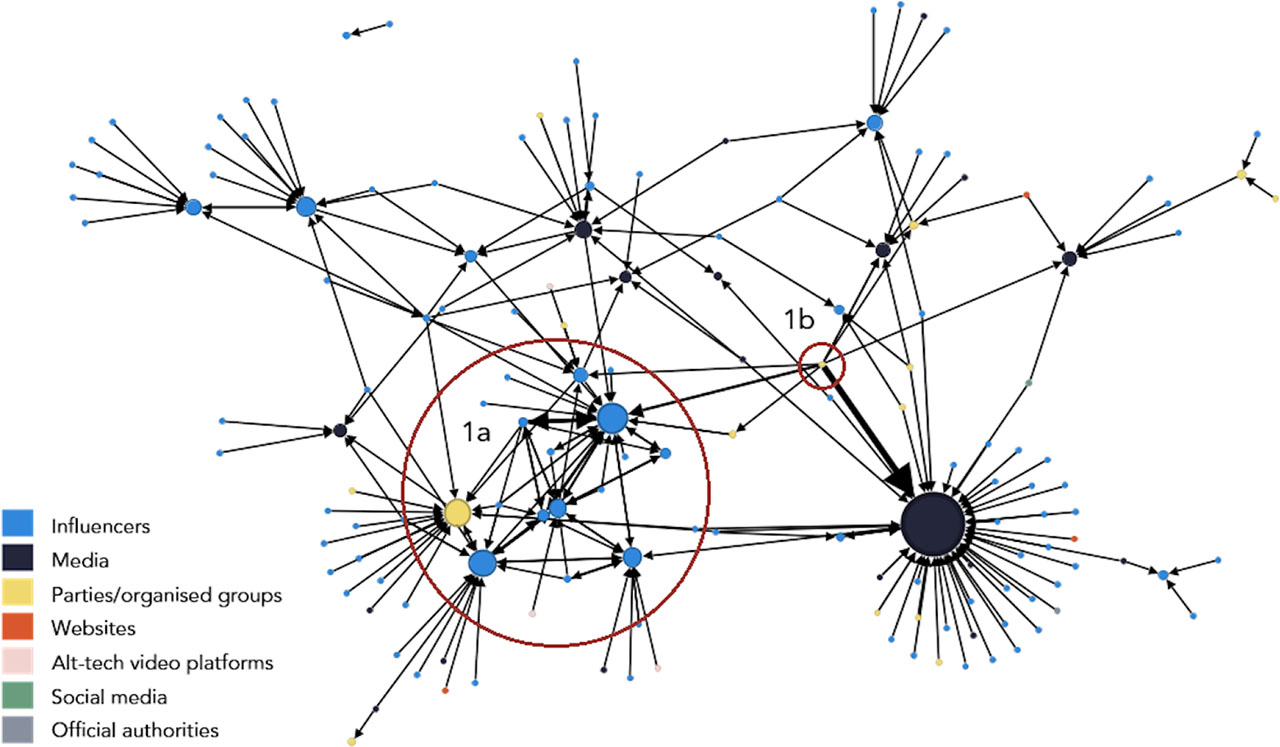
Figure 1
Network of guest appearances
Comments: 151 nodes and 228 directed links.
Layout: Forced (Yufan Hu Proportional), used to highlight clusters of collaborators.
Node size = in-degree (number of actors that have appeared on this channel).
Edge weight = frequency of appearances for each guest–host pairing.
Edge direction A → B = A is a guest on B’s channel.
Colour = actor type.
Most of the 480 guest appearance cases featured two actors engaging in a one-on-one conversation, but there were also cases of multiple actors coming together for roundtable-like discussions. The largest hub in the network is an alternative media channel that regularly hosts guests from across the far-right spectrum. Smaller yellow nodes represent organised political groups or parties that occasionally join these exchanges, usually as invited guests rather than hosts. This asymmetry in guest distribution across actor types reflects different role expectations within the ecosystem. The node that most frequently appears as guest is a political party node in the centre-right of the network (labelled 1b in Figure 1).
The guest appearances network demonstrates frequent collaborations between far-right actors and single-issue activists, as well as groups that are not overtly political. Rather than a single tightly woven community, the number of star-like configurations in Figure 1 shows a series of small, semi-independent circles gathered around particular hosts, suggesting that many influencers appear to cultivate their own pool of recurring guests who are loosely connected to one another, while a handful of central figures act as bridges linking these clusters. Several of these bridging actors are long-standing anti-immigration activists who, during the pandemic, became important links between the far-right and the emerging so-called Freedom Movement. This movement, much like in other parts of Europe, developed in response to the pandemic, bringing together right-wing extremists, spiritual communities, alternative health advocates, and proponents of various anti-lockdown, anti-vaccine, and conspiracy theories (Sarnecki et al., 2023). There were clear ties between far-right actors (from the original sample) and pandemic-related figures involved in the Freedom Movement in Sweden (channels now discontinued), as well as with adjacent international actors connected to pandemic protests and conspiracism, notably in Germany, the US, and the UK. This reflects a more general development in global far-right politics, which is increasingly “marked by its opportunistic pragmatism, seeing movements which hold seemingly contradictory ideologies share a bed for the sake of achieving common goals” (Davey & Ebner, 2017: 2). Guest appearances also served as a means for deplatformed actors to maintain visibility, acting as bridges between extreme and more mainstream actors in which the networking between actors directs audiences to extremist content and ideas. Actors who lost their channels due to content violations continue to reach audiences by appearing as guests on active channels, circumventing platform restrictions. For these actors, guest appearances offer a way to inform audiences where they can be found on alternative, less regulated platforms. Some of the more mainstream actors were also willing to share the mic with representatives from organisations or networks that, up until recently, were considered too extreme to be associated with, including actors from the white supremacist milieu and former members of the neo-Nazi group Nordic Resistance Movement.
In addition to guest appearances, an adjacent form of collaboration revealed by the analysis involved joint live-streaming events in which multiple actors came together, merging their follower bases in concrete ways. In the period around the pandemic, we saw several examples of this practice being picked up in the Swedish context.
While our network analysis showed that Swedish AIN is generally characterised by decentralised and fluid connections, certain clusters exhibit a higher degree of coordination. A particularly notable case was a group of smaller channels hosted by amateurish but aspiring political influencers that strategically “teamed up” to widen reach and create synergies during the pandemic. This cluster of channels, concentrating 7.3 per cent of the nodes and 19.7 per cent of the links, appears in the lower-left of the network map (labelled 1a in Figure 1). The coordinated activity of this community, self-identifying under the name “The Swedish Tube Family”, differs markedly from the otherwise fluid and loosely connected pattern of the network. Together, the Tube Family formed a tight-knit subnetwork within the larger AIN, largely defined by mutual guest appearances, cross-promotion, and shared content strategies. Individually, these accounts were too small in terms of followers and/or views to attract scrutiny around pandemic-related disinformation; but collectively, they accounted for over half (55.6%) of the content in our sample. Closely connected to one another, they also maintained looser ties to other influencers and to parties and organised groups such as Alternativ för Sverige, Medborgerlig Samling, and Det Fria Sverige, extending their influence across the wider network.
Within this cluster, one “Party/organised group” node stands out as an exception to the usual behavioural pattern of actors in this category. It invites guests, participates in cross-channel collaborations, and acts as a local hub within the Tube Family. This node represents a pandemic-era actor associated with the so-called Freedom Movement, which we categorised as a party/organised group due to its organisational ambitions. Unlike traditional party actors in the network, who predominantly appeared as invited guests and rarely hosted, this channel strategically adopted influencer-like practices. Its atypical position in the network reflects the hybrid nature of pandemic-related mobilisation, where organised groups blended the communicative styles of influencers, alternative media, and political actors. This also illustrates how the Tube Family subnetwork enabled emergent organised formations to seamlessly integrate and experiment with influencer-style visibility tactics.
Fostering relationships with more established channels with a larger number of followers was crucial to the Tube Family. More central actors within the AIN were frequently mentioned and endorsed by the group, often referred to as “honorary members” and introduced as “part of the family” whenever they appeared as guests on Tube Family members’ channels. This strategy served a dual purpose: It enhanced the group’s legitimacy through association with established far-right figures, while simultaneously cultivating an inclusive, community-oriented culture that encouraged engagement from other influencers. Although Tube Family members presented a united front on broad ideological issues, they also highlighted their individual identities and areas of expertise, encouraging cross-following among their respective audiences.
We were interested in the Swedish YouTube sphere specifically, but it became clear that it is closely intertwined with international far-right actors, particularly in the US. We identified several internationally prominent far-right personalities who were hosted as guests by Swedish channels, underscoring the transnational dimension of this network. These observations mirror findings from Lewis (2018), who identified cross-national collaborations as a key feature of the AIN in the US. Further, several of the larger Swedish AIN actors run channels in English, targeting international audiences. This indicates that the Swedish far-right continues its effort to reach international audiences and alliances, not least by rallying around and fuelling prevailing narratives on the global far-right of Sweden in decline and crisis; a country collapsed under the weight of immigration and multiculturalism (Brock & Askanius, 2023; Åkerlund, 2023).
Hyperlinking practices
Secondly, we mined for hyperlinking practices, which were by far the most common connective practice. We logged 6,172 hyperlinks, the majority of which led to alternative hyper-partisan news sources, advertisers, and other social media platforms (see Figure 2). Owing to its size, this network is visualised using an alternative circle-packing layout to foreground which actors are being linked to. In this layout, nodes are grouped (“packed”) by category, and within each group the most frequently linked-to nodes (those with the highest in-degree) are positioned closer to the centre of the pack, making them more visually prominent. The hyperlink network captures the outward-facing dimension of the Swedish AIN. It reveals a web of alternative news media, alt-tech video, and marketing platforms, forming a communication ecology that extends beyond YouTube and links ideological production, monetisation, and hyper-partisan news infrastructures within a single sphere of attention.
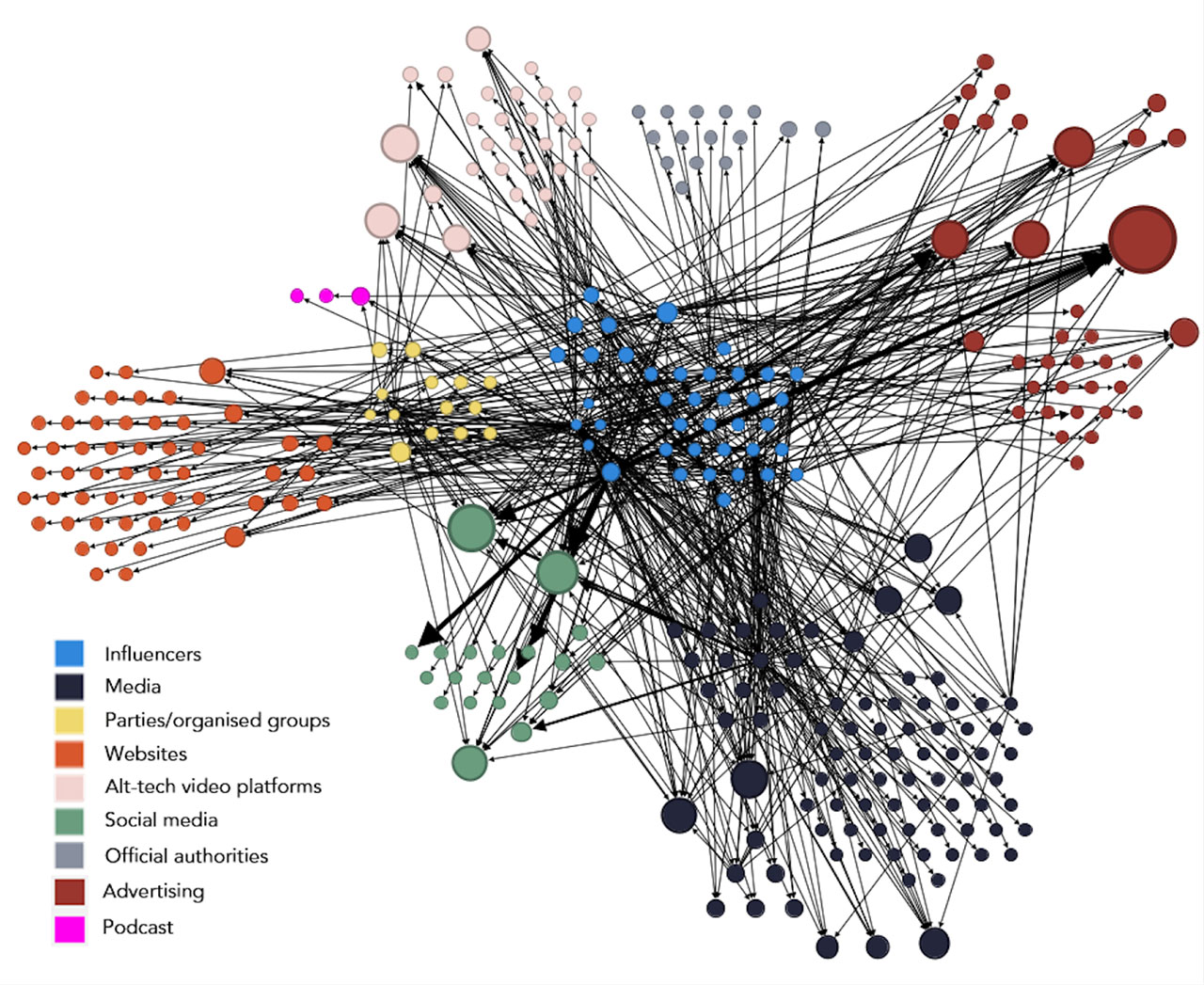
Figure 2
Network of hyperlinks
Comments: 294 nodes and 557 directed links.
Layout: Circle-pack, used to highlight targets of hyperlinking.
Node size = in-degree (number of actors linking to this node).
Edge weight = number of links for each source-target pairing.
Edge direction A → B = A links to B.
Colour = actor type.
The considerable attention directed at alternative news media positions these as central nodes within the ecosystem of far-right discourse on the platform. A significant share of this content featured misinformation, crisis narratives, and conspiracy theories about Covid-19. Influencers strategically linked to or cited alternative media channels to bolster the legitimacy of their claims while simultaneously displacing authorship and the burden of proof. In turn, outlets such as Riks, FriaTider, and Samnytt elevated individual AIN actors by inviting them into the “newsroom” as political commentators or “alternative experts” to offer correctives to mainstream science or information from public health authorities (see Figure 1). This reciprocal relationship demonstrates how influencers and alternative media mutually reinforce credibility and expand shared audiences through these connective practices.
At the height of the pandemic, YouTube tightened its content moderation policies, particularly in an effort to curb health disinformation related to Covid-19 – which the actors were acutely aware of. Many AIN videos and channels were removed, prompting Swedish AIN actors to adapt their hyperlinking practices. Instead of placing links in video descriptions, where they risk detection and removal, they instead began displaying URLs directly on-screen, allowing them to continue directing audiences to external platforms that challenge or “correct” official authorities.
In-video mentions
Mentioning other actors in videos is another key connectivity tactic. The network of in-video mentions (see Figure 3) is similar in size but denser than the network of guest appearances (see Figure 1), with links concentrated around a core group of frequently mentioned actors. 30.8 per cent of the mentioned actors were influencers, followed by media (23.1%) and alt-tech video platforms (9.6%). The most frequently mentioned actor was the Sweden Democrats (SD), a far-right political party and currently Sweden’s second-largest party in parliament. Actors in the AIN described SD as both a potential vehicle for institutional influence and an ambiguous ally that was ideologically close enough to merit support, yet also criticised by some actors for perceived compromises or insufficient radicalism.
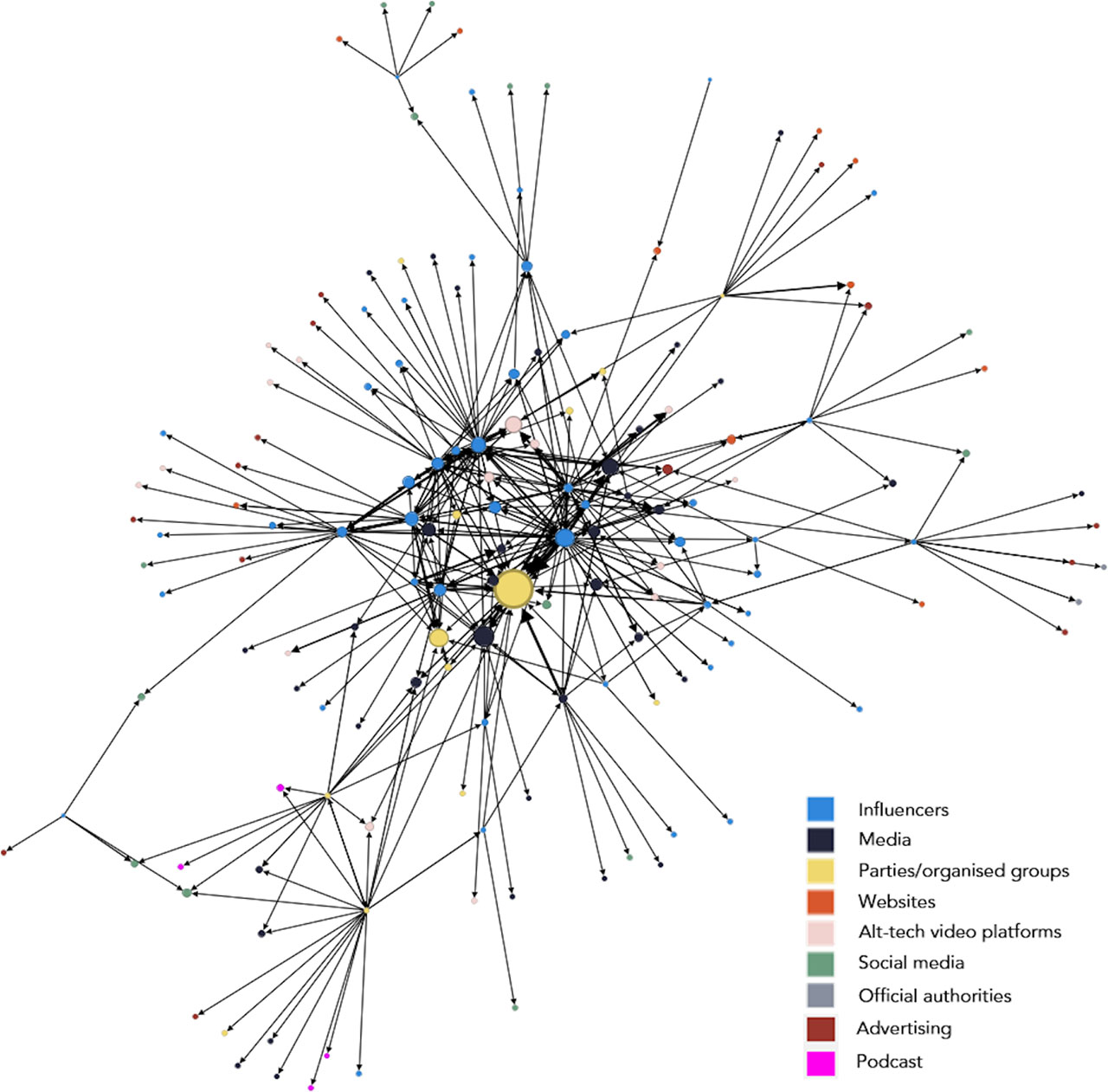
Figure 3
Network of in-video mentions
Comments: 156 nodes and 334 directed links.
Layout: Forced (Yufan Hu Proportional)
Node size = in-degree (number of actors mentioning this node).
Edge weight = number of times the source mentions the target.
Edge direction A → B = A mentions B.
Colour = actor type.
The visual structure of this network, with many visible star-like formations, reveals that mentions are overwhelmingly unidirectional. Only 17 pairs of nodes exhibit mutual mentions out of 334 total ties. Hence, many actors mention a small set of central figures or organisations, but those central actors rarely mention back.
A less common but relevant form of connectivity not initially coded for involves embedding other actors’ videos within one’s own (52 occurrences), often accompanied by commentary or endorsement for the featured channel. These replay practices serve reputation validation: Smaller channels invoke larger, more established figures to borrow credibility, while prominent actors use shoutouts to reaffirm alliances and signal belonging within a broader movement. Many references also direct audiences to alternative media sources and less moderated alt-tech platforms (Donovan et al., 2019). Through these cues, influencers facilitate audience mobility across the far-right media ecosystem and guide followers from YouTube to a broader range of like-minded content creators elsewhere.
The systematic practices of in-video mentions constitute a hybridised form of communication blending elements of endorsement, networking, and content curation. They extend each channel’s narrative reach by incorporating actors from diverse domains, including politics, entertainment, and conspiracism. In doing so, extreme narratives and conspiracy tropes become intertwined with more familiar elements from popular culture or mainstream punditry, broadening their appeal and making them more palatable to wider audiences.
Political activism meets brand influencer tactics: The hybridisation of online extremism
In the following, we provide a qualitative analysis of the inner workings of the influencer tactics employed by AIN actors, detailing how they intersperse marketing strategies and personal branding with political messaging to monetise content and build audience engagement and community around issues such as anti-immigration, mistrust of government and public institutions, vaccine scepticism, culture wars, “gender ideology”, and a broader distrust and contempt for democratic institutions and representatives. We draw on what Lewis (2018) has termed “micro-celebrity” and “influencer practices” to refer to a set of styles and techniques closely resembling those of commercial brand influencers. While brand influencers primarily promote products and cultivate a personal brand for commercial gain, political influencers adopt similar strategies to advance ideological agendas. In our data, these modes of engagement often merge: Some adapt journalist-style presentational techniques, while others take on the role of political agitators throwing brand marketing strategies and lingo into the mix, producing a hybrid form of communication that is simultaneously engaging, persuasive, and profit-driven.
Collaboration, self-branding, and influencer techniques across hybrid genres
While ultimately promoting far-right agendas, AIN influencers use microcelebrity techniques designed for mainstream appeal, crafting messages to resonate with diverse audiences.
Key strategies combined to cultivate authenticity and intimate parasocial relationships with their followers include brand consistency (obtained through strategic authenticity, visual coherence, and regular, standardised content production) and community-building techniques.
AIN influencers draw on a repertoire of well-established techniques to attract followers and sustain engagement across a range of formats, including traditional “news” broadcasting, vlogging, and candid behind-the-scenes footage often interspersed with commercial breaks and sponsorship announcements. Some videos mimic conventional news segments, complete with formal introductions and agendas in semi-professional studio settings. Others adopt a more personal vlogging style, with hosts addressing the camera directly in a confessional, conversational tone characteristic of this digital vernacular. A third genre feature, seemingly unedited “raw” content, captures influencers in everyday and unspectacular settings going about their daily business while offering political commentary on current or historical events. One of the larger accounts, for instance, alternated between longer, professionally edited vlogs and unedited phone recordings during daily walks. Fluctuating between these different formats allows AIN influencers to blend registers of authenticity and authority: Mimicking the polished style of mainstream journalism lends legitimacy, while the casual aesthetics of vlogging and livestreaming cultivate a sense of community.
These hybrid genres highlight how AIN actors construct and sustain their online personas. Much like mainstream lifestyle or brand influencers, they strive for “strategic authenticity” (Gaden & Dumitrica, 2014) – a deliberate performance of openness and relatability to build trust and attract followers. One influencer in the sample openly reflected on his aesthetic choices: “I have promised my followers to never edit my videos. I want them to see me, connect with me, to my message, and not to a cut and edited version of it”. Such reflexive awareness suggests that authenticity functions as a strategic and calculated performance rather than a spontaneous expression, signalling the influencer’s recognition of and active negotiation with their role. Authenticity is similarly reinforced through audience engagement. Many influencers use signature greetings or recurring phrases, often carrying political connotations, that become hallmarks of their content and persona. It is also common for them to address followers using group labels such as “Sweden friends”, “fellow nationals”, or “Tube family” adapted from celebrity and fan culture to foster a sense of community and collective identity (Tarvin, 2021). These consistent language cues are integral to microcelebrity practices cultivating a display of networked intimacy, making viewers feel part of an exclusive and entrusted inner circle (Leidig, 2023). An additional example of how such networked intimacy is forged involves inviting audiences into the planning and production of content. During joint livestreams, hosts discuss content strategies and delegate topic responsibilities to one another. These on-air discussions about behind-the-scenes “editorial decisions” blur the line between hosts as public personas and private selves.
The importance of AIN actors “staying on brand” and maintaining a consistent identity is clear. Most organised groups and alternative media channels on the platform feature consistent graphic profiles with stylised thumbnails, uniform fonts and colours, and, when applicable, a party, organisation, or media logo or watermark in their videos (see Figure 4). This cohesive branding signals both the video’s origin and often also its ideological affiliation to viewers. Even independent influencers unaffiliated with any formal alternative media organisations or political groups adopt such practices to present themselves as professional content creators. Beyond enhancing brand recognition, these professional cues convey a sense of investment in production quality, thereby reinforcing perceptions of credibility and authority. Consistent posting and livestreaming schedules, along with recurring programme formats, such as daily vlogs reviewing current affairs, further reinforce professionalism, credibility, and authority.
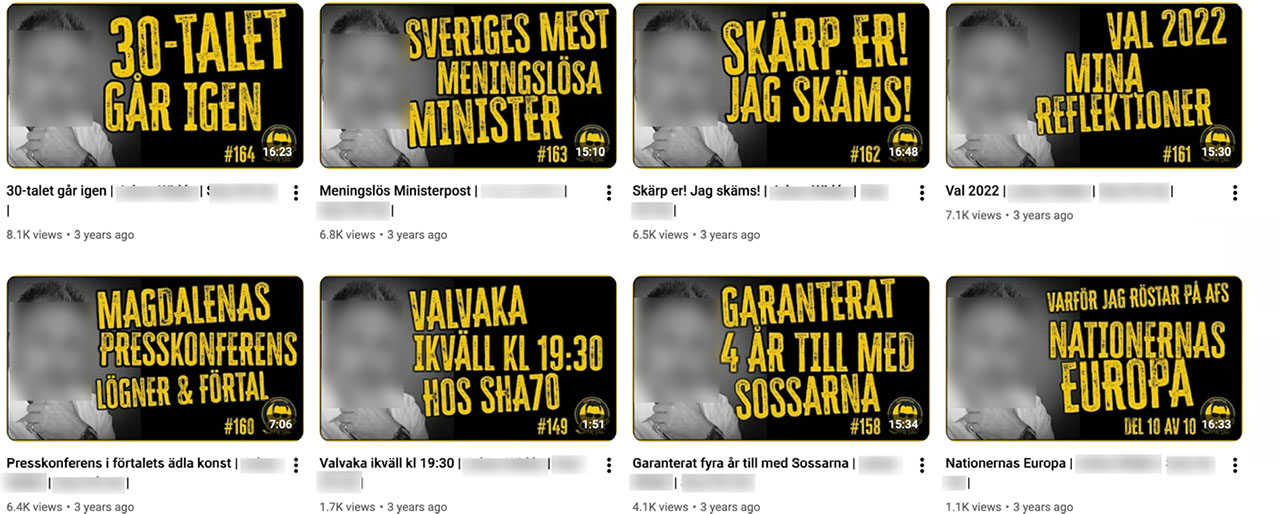
Figure 4
Influencer using standardised thumbnails with a consistent graphic profile
Further, AIN actors frequently encouraged viewers to engage with them in the comment sections or follow them on other social media platforms – efforts aimed at both broadening and tightening the network. They also regularly appeared in other creators’ livestreams, not only as collaborators but as viewers, where they engaged in live chats and invited viewers to visit their channels. They commented on fellow AIN creators’ videos to show support, promote their own channels, and foster a sense of community. These practices sustain dialogue between influencers and their audiences, reinforcing network cohesion and amplifying collective visibility.
Activist tactics to “game the system”
AIN actors developed various tactics to navigate YouTube’s content policies and avoid deplatforming, particularly during the pandemic and amid the platform’s efforts to curb health- and vaccine-related misinformation. One common strategy to evade algorithmic detection involves hyperlinking practices (see Figure 2), whereby links are embedded directly within videos rather than pasted into detectable metadata. Potentially sensitive terms are also deliberately altered to prevent automated flagging, either through intentional misspellings, obscuring letters, or substituting words with symbols. Other times, actors used euphemisms and coded language, using arbitrary, innocuous words such as kanelbulle [cinnamon bun] and spolarvätska [washer fluid] to refer to vaccines.
When posting explicitly extremist or conspiratorial content prohibited on YouTube, some AIN actors nonetheless used the platform as a gateway by posting so-called “phantom videos”: short clips announcing new content released elsewhere, directing audiences to less-regulated platforms such as Swebbtube, Rumble, Odysee, or BitChute (categorised as Alt-Tech video platforms in Figures 1–3). Beyond circumventing YouTube’s policies, this practice actively encourages digital migration, training followers to seek out content on fringe channels and driving traffic to them. In doing so, YouTube’s content moderation regime created a surface appearance of legitimacy while still affording indirect access to more extreme material through links, coded language, and in-video recommendations to other channels.
These creative tactics to “game the system” demonstrate AIN influencers’ ingenuity in maintaining a YouTube presence despite the platform’s content moderation policies at the time, rather than being deterred by them. In fact, deplatforming and strict content moderation policies often play into their hands, reinforcing narratives of censorship and claims of being silenced by an oppressive establishment or “woke” elites. Many AIN creators reframed the risk of content removal or channel takedowns as evidence of political bias and perceived suppression by powerful institutions, generating sympathy from followers and amplifying ideas of persecution and victimhood.
Commercial tactics and efforts to monetise content
YouTube is not only effective as a space for connecting activists and ideas; it is also a potentially lucrative arena. Monetisation lies at the core of AIN influencers’ operations on the platform, many of whom seek to establish stable income streams from far-right advocacy and peddling conspiracy theories. Influencers skilfully combine business strategies with political communication techniques, aligning themselves with the market logics of the platform’s attention economy to self-brand as microcelebrities and cultivate audience engagement. Commercial practices commonly include sponsorships, donation drives, affiliate marketing, and merchandise sales. One key monetisation strategy is sponsored content, where influencers receive payments to promote products or events. This includes advertisements for commercial products embedded in videos, as well as compensated promotion of ideologically aligned products and events, such as books, political conferences, and demonstrations. As with other influencers on the platform, political or otherwise, AIN actors are required to disclose sponsorships. A significant share of the videos subjected to close reading contained paid marketing, often, but not always, labelled as “sponsored” or marked with in-video “paid promotion” tags. The structural centrality of advertising is also evident in the hyperlink network (see Figure 2), where the largest node represents an advertiser sponsoring many AIN members.
Direct donations constitute another significant revenue stream. Appeals for financial support are frequent, ranging from subtle on-screen banners to explicit and repeated requests during broadcasts. Payment details are typically provided in video descriptions, often with clickable links to streamline seamless donations. The most common donation method is the Swedish app Swish, followed by PayPal and bank transfers. Some channels also accept cryptocurrencies, such as Bitcoin, offering donors full anonymity.
The livestreaming format is also potentially profitable, owing to YouTube’s Super Chat feature, which enables viewers to donate money in real time while interacting with the content creator. During live sessions, creators can directly solicit donations through engagement with their follower communities. In several livestreams, we observed donations arriving continuously as presenters spoke, with viewers paying to have their questions or comments read aloud or featured on screen.
Merchandise sales constitute yet another revenue stream, particularly for influencers with affiliations to political parties or groups such as Alternativ för Sverige or Det Fria Sverige that offer a range of merchandise such as branded clothes, caps, and other attire with logos, slogans, and emblems (see Askanius & Ulver, 2024). A prominent example of an influencer with his own product series is a full-time fitness and masculinity influencer who runs a long-standing nutrition and gymwear brand. Alongside selling personal training programmes and self-improvement coaching, he uses his platform to offer metapolitical commentary on domestic and global politics. This hybrid model, characteristic of far-right masculinity influencers, allows him to attract broader audiences – such as users initially drawn to fitness content, who are then incidentally exposed to the far-right narratives embedded in his political messaging (Farrell-Molley & Leidig, 2025). Such influencers serve as important vectors for the circulation of far-right ideas, as they subtly weave extremist narratives into ostensibly apolitical lifestyle content, rendering these ideas more palatable to audiences unfamiliar with far-right discourse and activism.
Lastly, community-building efforts also serve a monetisation function. The consistent greetings and collective labels used to address followers, direct audience engagement, and scheduled, recurrent livestreams all foster audience loyalty, increasing the likelihood of sustained financial support. Some AIN creators further monetise their most dedicated followers by offering exclusive, paywalled content through platforms such as Patreon.
Concluding discussion: Professionalisation and hybridisation of online extremism
Unlike the refugee crisis of 2015, which primarily saw a surge in far-right activism around nativist and xenophobic concerns, the pandemic expanded the reach and repertoire of far-right actors, their talking points, and narratives. By exploiting fears over the loss of individual freedoms and rights, social and economic precarity, and mistrust in public institutions and the scientific community, these actors expanded their influence beyond their traditional base to include new groups and followers associated with the Freedom Movement. These shifts have fundamentally reshaped the landscape of far-right extremism in Sweden, creating a more interconnected and transnational movement equipped with more sophisticated and efficient tools for influence in social media and beyond. As a result, the movement has become harder to pin down and neatly pigeonhole within conventional distinctions between extreme and far-right, democratic and anti-democratic iterations of far-right ideology.
While our sampling began with known actors in the Swedish far-right scene, the network analysis shows that the Swedish AIN broadened its reach during the pandemic, branching out in ideologically diverse directions. Notably, far-right politics in Sweden appear to be attracting an increasing number of content creators seeking to cultivate a personal image and online brand centred on politically divisive material. The ideas and conspiratorial narratives promoted by these actors during the pandemic range from anti-immigration and anti-Muslim sentiments to vaccine scepticism, the perceived dangers and existential threats of “woke gender ideology”, and a broader distrust of government, public authorities, and democratic institutions, which are portrayed as treacherous and complicit in Sweden’s perceived decline. While these ideas are certainly not new to far-right agendas, they converged and evolved in novel ways during the pandemic. As such, this network, afforded by YouTube, serves as a bridge linking mainstream or ostensibly moderate voices on the reactionary right to more radical and extremist ideologies, facilitating the flow of ideas, conspiratorial narratives, and grievances that contribute to the spread and mainstreaming of far-right discourse.
Our study provides insights into two parallel processes emblematic of contemporary trends in digital activism on the far-right: the professionalisation of media practices and the hybridisation of extremist discourse. First, the ability to connect across ideological and organisational divides and mobilise around a shared agenda that we see playing out on YouTube reflects a broader professionalisation strategy and concerted efforts to mainstream far-right ideology in Sweden (Åkerlund, 2022). At the same time, the commercialisation of far-right activism enabled by social media platforms underscores the professionalisation in key ways: The adaptation of marketing techniques, sponsorships, fundraising schemes, and merchandise and digital content sales serve both as revenue streams and as means of ideological dissemination, suggesting a shift from decentralised, grassroots movements toward more structured, businesses-like, or quasi-political organisations (Askanius & Ulver, 2024; Miller-Idriss, 2018).
Second, the connective practices and influencer tactics engaged by actors across the Swedish AIN reflect a process of hybridisation of extremism in digital spaces. This process is usefully understood to unfold across three overlapping levels in term of the who (actors), how (practices), and what (content/narratives) of contemporary forms of online extremism (Petersen & Johansen, 2025). At the level of actors involved, we identified cross-ideological convergences that blur established boundaries and merge ideological narratives. The convergence between “pandemic actors” in the Freedom Movement and organised far-right actors such as the neo-Nazi Nordic Resistance Movement during the pandemic protests is a case in point. The mixing of microcelebrity self-branding techniques with more conventional far-right advocacy exemplifies this process at the level of practices. At the level of content, far-right narratives merged pandemic-related protests with deep-rooted anti-establishment ideas, capitalising on public concerns about rights and freedoms and a mistrust in public authorities and democratic institutions. Conspiracy narratives reframed core beliefs about a “deep state” betraying the people, asserting that governments were enforcing population control or, in the more extreme Great Reset conspiracy, committing genocide against their own citizens. In Sweden, these hybrid narratives fed into anti-establishment sentiment, amplifying fears of state overreach and deception by global elites. Together, these dynamics make for a hybridisation of strategies, where traditional propaganda techniques merge with influencer tactics, political agendas intersect, and conspiratorial narratives coalesce.
With its combination of an algorithmic recommendation system that privileges provocative and conflict-driven content and its monetisation opportunities, YouTube functions as a key space for these political actors, even when content is mirrored across multiple platforms. Users may first encounter certain fringe ideas in this mainstream, algorithmically driven environment, before being funnelled toward more fringe and explicitly extremist spaces. As such, YouTube acts as a gateway to far-right ideas, drawing in new audiences by offering a more “sanitised” version of politically charged or extremist content.
As Petersen and Johansen (2025) have noted, the continuous hybridisation of extremism is not only a matter of content hybridity, but also of technologies, practices, and modes of engagement and incentivisation, all intricately linked to online platforms. The fusion of influencer techniques with traditional far-right political advocacy among groups and actors with varying degrees of ideological explicitness and commitment examined in this study reflects broader patterns of hybridisation in online extremism. By utilising the performative, personality-driven strategies of social media influencers, these actors are able to craft content that is emotionally engaging and relatable, while simultaneously embedding polarising narratives, conspiratorial thinking, and calls to hostility or violence towards perceived enemies and out-groups. This hybridity not only blurs the line between mainstream and extremist content, but also complicates efforts to categorise, monitor, and prevent the spread of online extremism. As such, it exemplifies a new type of online extremism characterised by an “amalgamation of disparate beliefs” and actors that increasingly challenge conventional categories in Prevention of Violent Extremism (PVE) and the legal frameworks surrounding hate speech and extremism (Gartenstein-Ross et al., 2025: 1343). In this landscape, what constitutes extremist discourse and the boundaries around what is considered dehumanising, stigmatising, or violent is increasingly fluid and contested.
Acknowledgements
This research was funded by the Swedish Research Council [Vetenskapsrådet] (grant nr 2023-00611) and the Swedish Civil Contingencies Agency [Myndigheten för samhällsskydd och beredskap] (grant nr 2019-13780).