

Introduction
Nordic media and communications markets have been relatively competitive in terms of revenue generation, digital development, and audience attention and trust compared with other regions in the world (e.g., Newman et al., 2025). However, revenue development only tells part of the story. While revenue growth signals sector viability, concentration also tends to follow growth in media markets (George, 2007), causing concern for the conditions of media diversity and democratic pluralism (Trappel & Meier, 2022). Nevertheless, comprehensive concentration measures of media and communication markets in the Nordic region are largely missing on which to make assessments about the amassment of power in the communication industries. Moreover, debates about media concentration tend to overlook the fact that media industries operate within the Internet ecosystem, growing increasingly dependent on the discovery and distribution services provided by the Big Tech companies dominating search, social media, and infrastructure provision (Nechushtai, 2018). Not only are earnings in the Internet sectors much higher than in the traditional media sectors – only part of which is generated at the cost of media advertising revenue – concentration is also significantly stronger. As Internet power concentrates towards large global players (notably Amazon, Alphabet, Meta, and Microsoft), the question becomes what concentration measures can really tell us about the health and viability of our media systems in the global network media economy.
Media concentration has largely been treated as a question of power in the political economy of communication (Hardy, 2014), assumed to influence democracy, culture, and welfare distribution in society (McChesney, 2013; Mosco, 2009). Concentration within media markets has been viewed as an expression of how such power can be wielded. Concentration has therefore been an important question because the media have been assumed to be powerful (Sjøvaag, 2014). As a consequence, media tend to get blamed for many problems in society (Noam, 2016), and ownership concentration becomes an object of scrutiny. The number of owners on a market is of concern here because ownership denotes how much strategic intent there is to provide different media content to users. In theory, the more suppliers, the higher degree of competition, where media producers try to attract audiences by differentiating content (Hollifield, 2006; Perloff & Salop, 1985). As concentration can be cost-effective due to efficiency gains, it can lead some companies to assume dominant or monopoly positions, thus decreasing intent to differentiate content. At the same time, there is evidence that even highly concentrated markets may at times produce various forms of high-quality content. This is particularly the case when consolidated companies invest the returns generated by economies of scale into content production (e.g., Garz & Ots, 2025). Hence, this attention to concentration, Jin and Winseck (2011) have noted, tends to overlook the complexity and uncertainty of media markets and industries. Our research therefore departs from Baker’s (2006) assertion that pluralistic ownership is a process value – that given multiple diverse senders on a market, the possibility for diverse news and information can be fulfilled. However, our research also acknowledges the economic trajectory of media industries given the digital economy. As traditional media’s power is subsumed by the platform ecology, we need new frameworks to understand what media concentration is in the wider communication ecology, how to address issues of power in a networked world, and how to protect the pluralistic values of the media welfare state through policy intervention.
In this article, we present the first comprehensive and comparative measures of revenue and concentration developments in the telecom, content media, and Internet industries in the Nordics, covering Denmark, Finland, Norway, and Sweden in 2018–2022. The data has been collected and analysed as part of a larger international effort at mapping media concentration across the world, through the Global Media and Internet Concentration (GMIC) project, funded by the Canadian Social Science and Humanities Research Council (Grönlund, 2025; Henten, 2024; Ohlsson & Lindberg, 2026; Sjøvaag, 2025). Based on a common codebook and shared methodology (Winseck, 2024), the scope of the project focuses on market developments in the different service segments of communications and the media, and the concentration and revenue trends that can be observed. The rationale for comparing Denmark, Finland, Norway, and Sweden lies with their unique media systems properties (Syvertsen et al., 2014), largely sharing welfare state regulatory frameworks, comparative media structures, economic affluence, and societal trust levels (Jakobsson et al., 2024). At the same time, the countries are also different (Ala-Fossi, 2021; Schrøder et al., 2020), providing insight as to what the varying revenue and concentration trends in the media and communications industries in the Nordics can tell us about the viability of communication industries across this region in the context of the wider network media economy. To that end, our research questions are the following:
RQ1. How concentrated are the telecom, content media, and Internet sectors in the Nordics?
RQ2. How are the industries performing, comparatively, in terms of revenue?
RQ3. How do we evaluate market concentration in the media industries within the wider network media economy, and what insight does this provide to theories of market concentration in the political economy of the media?
Concentration and revenue in media markets
Concentration in the media and communications sectors has been of interest to scholars because of the assumption that ownership carries certain motivations that revolve around financial gain, ideological aims, or ideal goals to improve society (Ohlsson, 2012), any of which can impact democracy. In content-producing media sectors, market concentration creates concern around the issues of pluralism and representation. Too much power in the hands of a few actors can limit the range of opinions that audiences are exposed to (e.g., McQuail, 1992; Napoli, 1999). Moreover, a lack of diverse narratives or representations can make people feel as though politics, culture, or the economy do not concern them, leading to feelings of disenfranchisement, polarisation, and fragmentation (Jeffres et al., 2000). The problem of media concentration is thus that when fewer providers control more of the landscape, it can limit content diversity, leading to incomplete consumer information, which limits citizens’ ability to make assessments about how governments are performing. However, the potential impact of concentration also hinges on larger media systems dynamics (Jakobsson et al., 2024), whereby ideological, economic, or technological capture can influence how pluralism is influenced by concentration (Nechushtai, 2018), particularly in a small-state context (Puppis, 2009).
Revenue is an expression of firm performance on a market. In the media industries, revenue generation has traditionally been based on a two-sided market where earnings are gained from sales to audiences, either direct sales or through subscriptions, and advertising revenue (Noam, 2019). As platform economics shifted market realities to strip content media of much of its platform and network effects, substitute platforms provided primarily by Meta and Alphabet have moved in to assume dominant shares of advertising revenue and audience attention (Van Alstyne et al., 2016). As most media in the world are commercial entities, they need to generate revenue. Hence, revenue is an expression of the ability of media businesses to plan, compete, and innovate in an increasingly competitive landscape. In the network media economy, content-producing media become more and more reliant on Internet technologies as channels of distribution, not only for discovery on social media platforms (Nielsen & Ganter, 2022), but also backbone technologies such as fibre cables, content delivery networks, and data centres, which are essential for the distribution and management of media signals (Sjøvaag et al., 2025). The term “network media economy” is used here to denote the highest level of aggregation within the vast system of industries, technologies, and practices involved in the production, distribution, and consumption of content across both traditional channels, such as print and broadcasting, and interconnected digital networks, encompassing platforms as well as the underlying infrastructure (Winseck, 2024). This increasing dependency on the companies operating in the platform economy occurs alongside the displacement that content media experience in audience attention, whereby traditional media products now compete with myriad other digital products – including streaming, podcasts, gaming, and social media – for users’ time and money.
The network media economy framework investigates these markets together, analysing where there is growth, stagnation, and decline in revenue to understand how the forces of concentration and centralisation work across the media, telecom, and Internet sectors (Winseck, 2024). As the political economy of communication is concerned with power, with particular attention to actors and resources, it is essential to the analysis of media industries concentration that we also include the actors that own the distribution infrastructure on which content media rely, and the resources they wield (e.g., Kristensen & Hartley, 2023; Nielsen & Ganter, 2022; Sjøvaag et al., 2025). Hence, as the networked platform economy of the Internet submerges media industries under its infrastructure, we must begin to account for the fact that media are not as powerful as they once were. The network media economy thus denotes a shift in power, whereby the revenue and concentration of the access, network, and Internet sectors on which the media rely should be taken into account when we evaluate the concentration of communication markets to understand the impact of communication systems on democracy, culture, and civic life.
Media concentration in the Nordics
Media and Internet concentration has received sporadic empirical attention in the research literature in later years, to a large extent because revenue data are difficult to access. Often, this requires a concerted effort of collaboration spanning years of work, exemplified by the GMIC project (Winseck, 2024), of which this article is a result, and its precursor, Noam’s (2016) Who Owns the World’s Media? In the European context, the Centre for Media Pluralism and Media Freedom produces concentration measures of European media markets (Top4 measurement, where the top 4 firms controlling more than 70% of the market denotes high concentration), finding that all countries covered in their Media Pluralism Monitor (MPM, 2024) are at medium to high risk in terms of media ownership concentration. Noam’s (2016) study, covering 29 countries, puts overall concentration (CR4 measurement, where concentration is set at top 4 firm market share above 50%) at 79 per cent for platform media and 40 per cent for content markets. Studies as well as discussions about media concentration furthermore tend to conclude that market concentration is increasing and that markets will continue to grow more concentrated in the future (e.g., Trappel, 2024; Winseck, 2019).
Media ownership in the Nordics is largely national. Public subsidy schemes, universal public service broadcasting, a history of subscription, and strong state intervention (Jakobsson et al., 2024) have put incumbents in relatively strong positions in the digital transition (Sjøvaag et al., 2019), leaving Nordic content media in comparatively good condition in terms of revenue generation (Olsen et al., 2024). Ownership concentration has been an enduring trend in most content markets, particularly in the newspaper sector (Nygren et al., 2018), but also in the television (Ohlsson & Sjøvaag, 2019) and telecom markets (Flensburg & Lai, 2024). Furthermore, there is a growing tendency towards cross-border consolidation (Sjøvaag, 2022). Major Nordic media and communications firms tend to operate across the region, including Bonnier and Schibsted in the newspaper sector, Viaplay in the television markets, Egmont and Aller in publishing, and Telia and Telenor on the telecom side (Lindberg, 2023). This reality is largely a result of increasing pressures on audience and advertising markets from global competition (e.g., Krebs et al., 2021), whereby more than half of advertising revenue in the Nordics are estimated to go to global actors (Lindberg, 2023), primarily Meta and Alphabet.
Researching revenue and concentration developments in the Nordics thus presents an opportunity to analyse trends given a relatively comfortable position, compared with other countries and regions in the world. While the industry narrative (e.g., Salamon, 2025) has focused on maximising the image of a “revenue crisis” for content media, arguing in favour of concentration to protect national markets, open questions remain as to the impact of the Internet ecology on media industry revenues (Winseck, 2017). Furthermore, public support schemes have come under increasing pressure in recent years (Sjøvaag & Ohlsson, 2024), challenging policy frameworks at a time when countries find it increasingly hard to regulate media markets in the global, platform context.
The Nordic context
Denmark, Finland, Norway, and Sweden comprise a region in Northern Europe covering approximately 25 million inhabitants. The Nordic countries are characterised as media welfare states (Jakobsson et al., 2024; Syvertsen et al., 2014), part of the northern cluster (Brüggemann et al., 2014) of the democratic corporatist media system (Hallin & Mancini, 2004), meaning high state involvement in the media sectors, regulation through arm’s-length distance, high media independence, and strong public service media that enjoy comparatively high levels of audience trust and use (Newman et al., 2025). Media ownership is not regulated specifically but falls under the purview of the general competition authority and is subject to competition law. All of the Nordic countries have duopolistic broadcasting structures reflecting mixed systems with state-owned and -funded public service media alongside commercial broadcasting, comparatively distributed press structures subsidised by press support (except Finland), high media use, and high media household expenditure (Schrøder et al., 2020). All countries are affluent societies with high GDPs, and they all score high on the World Press Freedom Index (Reporters Without Borders, n.d.) and the Digital Economy and Society Index (European Commission, n.d.). Among the four, Denmark, Finland, and Sweden are EU members, while Norway is subject to EU law through membership in the European Economic Area.
Data and method
Concentration measures have been calculated across four sectors. Telecom infrastructure covers access technology and includes traditional telephony (wireline), mobile broadband (wireless), Internet service providers, and multichannel video distribution (cable television, satellite, fibre, and digital terrestrial television). Content producing media includes broadcasting (television and radio), pay-TV and online video services, digital games, music services, newspapers, and books, as well as online advertising. The third sector maps core Internet services, and includes app distribution, search engines, browsers and operating systems, and social media platforms. The fourth sector covers the technical backbones of the Internet including content delivery networks, international submarine cables, data centres, and cloud providers. The backbones category must be said to be exploratory in this context, given the scarce access to data from these sectors, a primary reason for which is their global reach and private, commercial nature. Overall, however, this segmentation is useful because it distinguishes between access technologies (provided by telecoms), production sectors (content media), content distribution and discovery technologies (Internet applications), and data transportation layers (backbone services), illustrating the dependencies that traditional media face in the network media economy. While the category of content-producing media is heterogeneous, their revenue models are based largely on user spending, competing for the limited attention of audiences, the aggregation of which reflects the increasingly global nature of competition in the media markets. As these markets become more algorithmically driven (Seipp et al., 2023) – challenging the relevance of supply side analyses to exposure diversity (Joris et al., 2020), authorities cannot regulate consumption – they can only direct pluralism measures towards supply side structures by regulating ownership and concentration.
Our research is based on publicly available and mostly free statistics. Where no such statistics exist, we have in some cases made estimations, largely based on market reports (see the Appendix). We have focused on the period 2018–2022 not only because this is the timeframe set by the GMIC project but also because this is the period where platform economics have come to fruition (Sjøvaag, 2022). Data have been assembled by the authors in individual country teams, collected sector by sector based on revenue data where available and other market data, such as number of subscriptions, amounting to an exhaustive account of the data accessible on Nordic markets, comprising several thousand data points. Overall, concentration monitoring of this kind is made difficult because the sources of data are highly varied, sometimes sporadic, and often hidden behind paid services. This reflects an unsatisfactory state of available statistics in this field, particularly regarding revenues and market shares. A strong recommendation would be that such official statistics be developed.
Measurements
We assess the level of concentration based on the Herfindahl-Hirschman Index (HHI) and the CR4 index. As the measures illustrate slightly different things, we use both to enable assessments of firm domination as well as firm concentration in the different sectors. CR4 represents the combined market share (i.e., adding together the market shares) of the four largest firms on a market. A CR4 figure above 50 per cent is generally considered a sign of a concentrated market, whereas ratios below 40 per cent are considered competitive. The benefit of including CR4 as well as HHI is that the aggregation of the CR4 distribution does not account for the distribution of shares within it, which can vary greatly. A CR4 of 60 per cent may cover different market situations: It may indicate that four companies each have 15 per cent of the market; it may also mean, for instance, that one company has 50 per cent and the three other largest companies have only 10 per cent together. A key advantage of the HHI measurement is that it not only considers the distribution of market shares across firms but also accounts for the total number of firms in an industry. In an HHI, the market shares of each company on a given market are squared, and the squared numbers are added. The HHI ranges from near 0 in a perfectly competitive market to 10,000 in a monopoly, or 100 per cent market share. US (2023) and EU (2004) merger guidelines operate with slightly different concentration thresholds (see Table 1). HHI measurements should thus be subject to interpretation given the size of the market under investigation. Trappel and Meier (2022) have set values below 1,500 as an indication of low concentration in the European context, whereas values above 2,500 indicate very high concentration. In other contexts, such as the Nordic newspaper markets where there are numerous newspapers despite concentration, Lehtisaari and colleagues (2024) have argued that HHI values above 2,000 should be considered highly concentrated.
Table 1
HHI concentration measures in the EU and the US
| Concentration degree | European Commission | US Department of Justice |
|---|---|---|
| Low | 0 – 1,000 | 0 – 1,000 |
| Moderate | 1,000 – 2,000 | 1,000 – 1,800 |
| High | 2,000 – 10,000 | 1,800 – 10,000 |
Beyond these concentration measures, revenue is used to make comparisons across time and across sectors, to track developments, and to compare between countries. Revenue here is defined as total receipts, meaning all income generated from its funding model (Picard, 1989).
Results
In this section, we present the revenue and concentration measures of the telecom and Internet access sectors in the Nordics, the content-producing media sectors, core Internet applications, and backbone infrastructure services.
Telecom and Internet access
Network provision covers traditional telecommunications services including wireless communication, Internet service provision, and multichannel video distribution. Convergence between Internet service provision, broadband, and television services makes it difficult, in the Nordic markets, to make clear differentiations between these sectors, particularly as broadband and television access are often sold together. Wireless communication here consists of mobile and voice data combined and includes roaming data for Internet communication. Internet service provision refers to licenced carriage of broadband and fibre Internet connection. Multichannel video distribution constitutes television access technologies including satellite, cable, Internet protocol television, and digital terrestrial television. Wireline, which constitutes traditional circuit-switched voice communication and packet-based Internet communication based on copper cables, is in the process of being discontinued in the Nordics.
Revenue
The overall market value of services offered by the telecommunications sector in the Nordics amounted to 17.9 billion euros in 2022. Revenue growth in the telecom sector is steady except in traditional telephony, reflecting the discontinuation of copper cables across the region. Wireless (mobile) is the highest grossing sector in all four countries. Mobile also grows faster than other sectors in Denmark, Finland, and Norway, reflecting the active switch to 5G among Nordic telecom operators. In Sweden, mobile growth has stagnated, one reason for which may be slower build-out in the time period covered. Internet service provision revenue displays steady growth in all markets except in Finland, where revenue was declining slightly since 2018, but showed signs of recovering in 2022. Finland has also shown steady revenue developments in the multichannel video distribution markets, whereas revenue growth has slowed in this market in Denmark, Norway, and Sweden since 2020, evidence of the rise of streaming in viewing habits since the Covid-19 pandemic.
The substantial revenue generation of the wireless (mobile) sector largely reflects the fact that this is licensed infrastructure, creating high barriers to entry through government allocated frequency spectrum shaping these markets. This creates high revenues, but also high concentration. All four markets are dominated by three or four carriers, with a myriad of smaller providers offering mobile subscriptions on top of these networks. Denmark and Sweden have four licence-holders each (TDC, Telia, Telenor, and 3 (H3G) in Denmark and Telia, Tele2, Telenor, and Hi3G in Sweden), and Finland and Norway have three each (Elisa, Telia, and DNA in Finland and Telenor, Telia, and Altibox in Norway). CR4 measures as well as HHI scores reveal that the markets are significantly to highly concentrated across all sub-sectors. CR4 scores show that all the markets are concentrated above 50 per cent. Denmark is the least concentrated at around 60 per cent for the overall sector, while Finland is the most concentrated, approaching 100 per cent. Norway and Sweden’s telecom markets are concentrated at around 80 per cent. This suggests a tightly controlled Finnish telecom space with more room for competitors in the Scandinavian cluster, with Denmark in particular reflecting diverging regulatory regimes across the Nordics.
The incumbents are strong in all four markets, constituting TDC in Denmark, Elisa in Finland, Telenor in Norway, and Telia in Sweden. Among these actors, Telia is present in all four markets, while Telenor is present in all markets except in Denmark, making them dominant players across the region. Incumbents are also dominant in their home markets, TDC, Elisa, Telenor, and Telia taking major shares of access markets in Denmark (40.5%), Finland (37%), Norway (43.5%), and Sweden (34%), respectively. The fact that these telecom markets are dominated by domestically owned companies is furthermore evidence of strong public policies regarding telecommunications, and partial state ownership in the case of Telenor (53.97%) and Telia (41.1%).
Table 2
Revenue for the telecom sector, 2022 (million EUR)
| Denmark | Finland | Norway | Sweden | |
|---|---|---|---|---|
| Wireline | 2,222.8 | n/aa | 48.3 | 218.9 |
| Wireless | 220.8 | 2,127 | 1,615.0 | 2,817.8 |
| Internet service provision | 1,631.7 | 944 | 1,358.8 | 1,387.0 |
| Multichannel video distribution | 1,133.3 | 48 | 1,032.2 | 888.6 |
| Total | 6,106.5 | 3,119 | 4,054.4 | 5,312.3 |
Concentration levels
Looking at CR4 scores, multichannel video distribution is highly concentrated across the Nordic countries. In Denmark and Sweden, concentration levels reach around 90 per cent, while in Finland they approach 100 per cent. Norway stands out as somewhat less concentrated, at approximately 80 per cent. The wireless sector shows a similar pattern. Concentration is close to 100 per cent in Finland, around 90 per cent in Denmark, and approximately 80 per cent in Sweden. In Norway, however, CR4 levels declined from nearly 100 per cent in 2021 to about 80 per cent in 2022. This shift was largely the result of Altibox’s acquisition of Ice, which expanded Altibox’s presence in the mobile market and, in turn, reduced overall concentration by redistributing market shares. In the Internet service provision market, Denmark again exhibits lower levels of concentration, somewhat above 60 per cent, compared with Sweden and Norway, where levels exceed 80 per cent. Finland remains the most concentrated, with levels close to 100 per cent. Hence, whereas the Finnish market shows consistent signs of consolidation across access market segments, diverging levels in the Danish case suggests differentiating regulatory attention can impact concentration. The case of Altibox in Norway furthermore illustrates the counter-intuitive point that a decrease in vendors can also decrease concentration.
These concentration scores are supported by HHI measures. Finland is the most concentrated, with all sectors measuring well above 2,500, indicating high concentration levels. Here, wireless is Finland’s most concentrated market, measured at above 3,000. Multichannel video distribution is Denmark’s and Sweden’s most concentrated sector, at above 3,000 in both countries, while in Norway, this is the least concentrated sector, scoring below 2,000. This is reflective of the number of players in the market, where Denmark is dominated by only three operators (YouSee [TDC], Norlys, and Allente). Internet service provision is moving towards more moderate competition levels, observable in Norway, with the rise of more “other” providers. Overall, Denmark is the least concentrated market, while Finland is highly concentrated across sectors. Internet service provision is the only market showing signs of moving towards moderate (but still challenged) competition levels. HHI thus reveals meaningful variations across the markets, illustrating how regulatory frameworks can shape competitive conditions.
Table 3
Nordic concentration measures (CR4 and HHI) of telecom sectors, 2022
| Measure | Denmark | Finland | Norway | Sweden | ||||
|---|---|---|---|---|---|---|---|---|
| CR4 | HHI | CR4 | HHI | CR4 | HHI | CR4 | HHI | |
| Wireline | 67.2 | 1,958 | n/a | n/a | 97.1 | 2,541 | 84.9 | 4,487 |
| Wireless | 90.0 | 2,300 | 99.0 | 3,314 | 84.1a | 2,554 | 80.0 | 2,575 |
| Internet service provision | 65.6 | 1,270 | 96.0 | 2,662 | 86.6 | 2,337 | 78.2 | 1,946 |
| Multichannel | 94.1 | 3,775 | 99.0 | 2,811 | 79.6 | 1,991 | 89.7 | 3,078 |
Telecom and Internet services in the Nordics are relatively stable sectors in terms of the actors and services present in these markets. Market shares and revenue generation show steady growth except in multichannel video distribution, challenged by streaming services, but can otherwise be affected by mergers and acquisitions, as well as the emergence of new providers, mostly in the mobile and video distribution sectors. Technology shifts are, however, likely to impact the sector in the coming years, as wireline is switched off across the region and more of the electromagnetic frequency spectrum is allocated towards mobile and 5G. Low-orbit satellite broadband provision is also signalling a shift in Internet service provision towards potentially higher competition, as new operators like Starlink enter these markets.
Content media
While revenue data for the Internet access and telecom sectors are accessible through official statistics in the Nordic region, this generally does not apply to the same extent for traditional content-producing media. Ad hoc government reports do provide some basis for analysis, but there is little systematic reporting of revenues, particularly for newspapers. There are also vast differences in terms of sector data availability across the four countries covered here. Hence, there is a limit to what we can compare, and there is a limit to what we can project, as historical data is often missing (see the Appendix).
Revenue
What we observe from the Nordic content markets is that, in general, advertising-based media and digital markets report the highest revenues. Online video and digital games have seen an increase in earnings, particularly since the Covid-19 pandemic, when users shifted their media consumption habits towards more at-home consumption. Here, the Finnish gaming market is particularly strong, exhibiting three times the income of the Finnish newspaper sector, evidence of the success of home-grown companies like Supercell and Rovio. Public service broadcasters report steady increases in state support in Norway and Sweden, while Danish and Finnish public service broadcasters have seen stagnant government funding. Print media display continuous decline both in the newspaper and magazine sectors, due in large part to a loss of advertising revenue and competition from social media platforms. Despite this, newspaper revenue in the Nordics must be said to be resilient compared with other markets, particularly in Sweden. Per capita spending for content media is highest in Finland (1,190 euros), followed by Norway (1,053 euros), with Denmark (814 euros) and Sweden (556 euros) at the lower end.
Table 4
Revenue for content media sectors, 2022 (million EUR)
| Denmark | Finland | Norway | Sweden | |
|---|---|---|---|---|
| Commercial television broadcasting | n/ab | 255 | 874.4 | 1,369.8 |
| Public service broadcasting | 439.7 | 290 | 594.3 | 540.5 |
| Commercial broadcast radio | 171.6 | 71 | 58.6 | 134.2 |
| Public service broadcast radio | n/ac | 97 | n/ad | 293.3 |
| Pay-TV programming services | 707.0 | 185 | 1,029.7 | 888.0 |
| Online video services | 716.1 | 330 | 489.3 | 843 |
| Film exhibition | – | 104 | 122.7 | 191.9 |
| Digital games | 385.6 | 2,900 | 83.1 | 107 |
| Music services | 1,311.6 | 805 | 629.2 | 961 |
| Newspapers | 757.4 | 856 | 653.4 | 1,350.1 |
| Online news media | n/aa | n/aa | 557.0 | n/aa |
| Magazines | 230.6 | 325 | – | 442.2 |
| Books | – | 326 | 591.1 | 574.8 |
| Total | 4,719.5 | 6,544 | 5,682.5 | 7,701 |
Comments: Currency conversions conducted with Claude Sonnet 4, based on average conversion rates for 2022. All figures reflect domestic market revenues, except where this distinction was difficult, for example, the Finnish gaming market. Magazine revenues include trade press revenues in Denmark and Finland, while this is mostly excluded from the Swedish figures. Music services include traditional and online revenue.
Revenue generation for traditional content producing media has nevertheless been affected by the shift in advertising expenditure towards online and digital platforms (see Table 5). Internet advertising revenues have seen a five-year growth rate (in local currencies) of 15 per cent across the Nordic region, with Denmark displaying the strongest growth at 15.6 per cent. Alphabet and Meta take the majority of this revenue across the countries, reaching approximately two thirds of online advertising in Finland (approx. 460 million euros in 2022). In Norway, an estimated 58 per cent (900 million euros in 2021) of market share goes to these two companies, and in Denmark, Google has roughly 50 per cent (raising 750 million euros in advertising revenue in 2023) of the advertising market. Concentration measures for online advertising show that the market is growing more concentrated.
Table 5
Internet advertising revenues, 2018–2022 (million EUR).
| 2018 | 2019 | 2020 | 2021 | 2022 | |
|---|---|---|---|---|---|
| Denmark | 943.5 | 1,079.4 | 1,086.7 | 1,475.5 | 1,687.8 |
| Finland | 421 | 460 | 528 | 637 | 700 |
| Norway | 1,491.3 | 1,661.4 | 1,596.1 | 1,949.0 | 2,357.7 |
| Sweden | 2,053.4 | 2,378.8 | 2,675.2 | 3,354.4 | 3,354.3 |
| Total | 4,909.2 | 5,579.6 | 5,886.0 | 7,415.9 | 8,099.8 |
[i] Comments: Currency conversions conducted with Claude Sonnet 4, based on average conversion rates for 2022. Danish, Norwegian, and Swedish data originate from the same source, IRM, while Finnish data is extracted from the Finnish Advertising Council and Kantar Media, which could explain the discrepancy in numbers.
Advertising expenditure displays notable recovery after the Covid-19 pandemic; however, it is difficult to know exactly how big the market shares of Meta and Alphabet are in these markets, as these figures are largely estimates.
Concentration
Concentration measures reflect the fact that Nordic media markets have strong incumbents, particularly the broadcasters, and that there is limited competition in most markets. Hence, most markets are oligopolistic with a few dominant players and high barriers to entry. Established markets are more concentrated than emerging markets. For instance, online video services are less concentrated than traditional television. Denmark is most concentrated overall, while Sweden displays more variation with some highly concentrated markets and other markets that are more competitive.
Table 6
Concentration measures (CR4 and HHI) for content media sectors, 2022
| Denmark | Finland | Norway | Sweden | |||||
|---|---|---|---|---|---|---|---|---|
| CR4 | HHI | CR4 | HHI | CR4 | HHI | CR4 | HHI | |
| Commercial television broadcasting | n/aa | n/aa | 93.7 | 2,991 | 100 | – | 99.9 | 2,998 |
| Public service broadcasting | 100 | 7,407 | 100 | 10,000 | 100 | 5,246 | 100 | 8,585 |
| Commercial broadcast radio | 98 | 4,579 | 77.6 | 3,586 | – | – | 97.5 | 4,061 |
| Public service broadcast radio | – | – | 100 | 10,000 | – | – | 100 | 10,000 |
| Pay-TV programming services | 97 | 5,899 | 54.9 | 2,408 | 86.3 | 2,415 | 89.7 | 3,092 |
| Online video services | 83 | 2,047 | 60.7 | 1,563 | 76.1 | 1,635 | 73.8 | 1,957 |
| Film exhibition | – | – | 83.7 | 5,056 | – | – | 88.6 | 4,632 |
| Traditional music | 12.5 | 50 | – | – | – | – | – | – |
| Online music | 82 | 3,132 | – | – | – | – | – | – |
| Games | – | – | 80.6 | 3,269 | – | – | 44.9 | 2,100 |
| Newspapers | 75.8 | 1,872 | 59.4 | 2,216 | – | 2,958 | 81.8 | 2,602 |
| Magazines | 89 | 3,091 | – | – | – | – | 52.6 | 929 |
| Online news media | – | – | – | – | – | – | – | – |
| Books | – | – | 64.8 | 1,689 | – | – | 49.4 | 883 |
Source: The Norwegian Media Authority; The Norwegian Telecommunications Authority; European Audiovisual Observatory; The Swedish Agency for the Media; The Swedish Post and Telecommunications Authority; The Finnish Advertising Council; Kantar Media; Statistics Finland; TNS Gallup; News Media Finland; Neogames, Danish Ministry of Culture; Rambøll; PwC; Statista; MediaWatch; annual reports; government reports; trade press reports
Not all of these markets are comparable, as data is missing for many sectors. However, we can observe that public service broadcasting and commercial television (in Denmark, this is included in the Pay-TV category) are equally concentrated across the Nordics, reflective of active Nordic policies to preserve mixed broadcasting systems. Otherwise, newspaper markets are moderately competitive in Denmark and Finland, while they are concentrated in Norway and Sweden, indicative of the consolidation taking place in the Norwegian and Swedish newspaper sectors. Across the region, ownership restructuring has concentrated ownership in fewer hands. While CR4 figures for the newspaper sectors are generally high, HHI calculations also indicate that there are a relatively large number of smaller providers in these markets. The traditional geographical boundaries of newspaper chains have somewhat blurred over the past few decades; however, the largest newspaper companies still maintain their original regional “home markets” and, in some cases, dominate or have a presence in other regions. These newspaper chains have effectively divided geographically distinct markets among themselves, thereby creating monopolistic regional markets (Hellman, 2022; Sjøvaag, 2022). Overall, Nordic content markets are dominated by strong incumbents, with lower concentration in emerging sectors, like online video, that have yet to undergo the consolidation that characterises established media sectors.
Core Internet applications
This sector covers app distribution, mobile and desk operating systems (OS), search engines, and social media platforms. Revenue data for these sectors are not possible to locate for individual countries, however, there are some estimates of their market shares (by usage), provided by the market insight platforms Statcounter and Statista. We report the figures we have found for the Nordic markets, as they provide context as to what concentration entails within the wider networked communications ecology. While we refrain from estimating the revenues generated by these sectors in the Nordic markets, they are likely to be substantial (see the Appendix).
We find that operating systems are duopolistic across the Nordic region, with Microsoft leading the desktop market in competition with Apple, while the mobile OS market is divided between Apple and Alphabet. For instance, Microsoft Windows dominates desktop OS at 79 per cent in Finland and 73 per cent in Norway. Apple’s OS X is a distant second at 16 per cent in Norway and 11 per cent in Finland, and slightly stronger in Sweden at 21 per cent. On mobile, Alphabet’s Android leads the Finnish market at 64 per cent, with Apple’s iOS at 25 per cent, while in Norway, iOS leads at 62 per cent, with Android at 38 per cent. iOS also leads the Danish and Swedish markets at 75 and 55 per cent, respectively. OS markets are highly concentrated across the Nordics, with CR4 scores approaching or at 100 per cent, with HHI figures in the 5,000 range.
The search engine market is dominated by Google on all platforms, constituting a monopoly on search. Google holds a 97 per cent market share across all platforms in Norway, 94 per cent in Finland, 98 per cent in Sweden, and 90 per cent for Denmark. CR4 scores for search engines are at 100 per cent, with HHI scores well above 9,000. As for browser use, this market is slightly more diverse. On desktop, Chrome is the dominant application (70% in Denmark, 69% in Finland, 57% in Norway, and 63% in Sweden). On mobile, Chrome is dominant in Finland, while Safari leads in Denmark, Norway, and Sweden. CR4 scores for desktop browsers is above 90 per cent across the four countries, while HHI scores are around 4,000. The only observable difference between the Nordic markets here is Finland’s preference for Android over iOS, perhaps indicative of the legacy of Nokia in the Finnish communication landscape, but otherwise, concentration measures are reflective of the scale economics, network effects, and platform lock-in that characterise the global Internet ecology.
Meta is the dominant actor in social media services across platforms, with Facebook leading and Instagram as a distant second. Facebook has about two-thirds market share in Sweden and Norway, but only about half the market in Finland, and less than half of the market in Denmark. There are no specific figures for app distribution, but the Nordics are likely to follow the global trend, where Apple’s App Store and Alphabet’s Google Play Store dominate the market. Hence, Internet application markets show consistently high market concentration, with several sectors even showing signs of increasing concentration. Search is monopolistic, while OS is duopolistic. Social media is dominated by one major player (Meta), with several smaller platforms having market shares around 10–15 per cent.
Table 7
Concentration measures (CR4 and HHI) for core Internet sectors, 2022
| Denmark | Finland | Norway | Sweden | |||||
|---|---|---|---|---|---|---|---|---|
| CR4 | HHI | CR4 | HHI | CR4 | HHI | CR4 | HHI | |
| Social media | 94.4 | 3,271 | 90.9 | 3,419 | 95 | 4,878 | 93.2 | 4,878 |
| Search engine mobile | 99.5 | 9,650 | 99.6 | 9,566 | 100 | 9,644 | 99.7 | 9,644 |
| Search engine desktop | 99.6 | 8,183 | 99.2 | 7,824 | 100 | 9,431 | 99.6 | 9,431 |
| Mobile OS | 100 | 5,361 | 99.3 | 5,278 | 100 | 5,245 | 100 | 5,009 |
| Desktop OS | 99.6 | 5,213 | 98.9 | 5,926 | 100 | 5,595 | 98.8 | 4,966 |
| Browser mobile | 98.7 | 4,760 | 97.8 | 4,360 | 99 | 4,492 | 98.3 | 4,165 |
| Browser desktop | 96.7 | 5,137 | 96.1 | 4,646 | 97 | 3,906 | 96.2 | 4,414 |
Backbone sectors
This sector covers Internet backbone services including content delivery networks, international submarine cables, and data centres. Revenue and market share data for these industries are largely unavailable given the foreign ownership of many of these services. We have, however, managed to generate a few estimates based on official reports and revenue reported from national companies (see the Appendix).
A Norwegian government report (KDD, 2021) estimates revenue generated for the data centre sector in Norway to be approximately 13 million euros per year for an average data centre. In 2022, the market was estimated at 1,410 million euros in Sweden (Research and Markets, 2024), while in Finland, the total revenue for the data centre markets is estimated to be 1.52 billion euros. For the submarine cable sector, there are a few Norwegian cable companies reporting revenue such as Eviny Digital, Kysttele, and Tampnet, with Eviny and Tampnet reporting revenue between 25–35 million euros in 2024. As for the cloud services market, this is dominated by Microsoft, Amazon Web Services, and Google Cloud (Sjøvaag et al., 2025). Statista reports revenue in the cloud market in Norway in 2022 to be 3.29 billion euros, while annual growth is reported to be 30 per cent (WIK, 2023). And finally, for content delivery networks, the global market value is reported to be 19.93 billion euros in 2023, with the European market valued at 6.19 billion euros in 2024.
Market share approximations are not possible for this sector, due to a lack of data. While most of these revenue figures are estimations, they are high-value markets that are, based on the limited data available, seemingly relatively diverse in terms of vendors, except the cloud market, where there is high concentration. Within the network media economy, these sectors are crucial carriers of data and Internet traffic, on which content media rely. Moreover, there is generally a lack of national alternatives, particularly in the content delivery network and cloud markets, posing questions as to the resilience of Nordic communication infrastructures within the global networked ecology.
Discussion
As our analysis shows, the “content is king” era is long gone. The most valuable network communication sectors in the Nordics deal in material assets and physical infrastructure. Telecoms are the highest earners in the overall network economy, with wireless (mobile) and Internet service provision constituting the strongest markets in this sector. Global technology platforms that operate across the stack, such as Google, also generate significant revenue in these markets. Exactly how much is hard to tell. While the largest companies in the Nordics (in terms of revenue) constitute legacy media and communications companies such as Sanoma Oyj, TDC, and Telenor in top positions, we do not really know what revenue Microsoft, Amazon, or Google generate from their data centre, software, and application products in the Nordics.
Despite the strength of these infrastructure markets, legacy media companies still generate significant revenue. Certain markets that are dependent on advertising revenue – such as newspapers, video distribution, and magazine publishing – are declining, but other sectors show remarkable resilience, particularly cinema, book publishing, radio, and television, evidence of the enduring popularity of established content formats. Finland’s digital games sector stands out as an innovation-driven, export-oriented success story, as does the Swedish music-streaming platform Spotify, underscoring the global competitiveness of certain areas within the network media economy, and also the fact that small countries can be competitive on these global markets.
The fact that the market for search engines is a virtual monopoly, dominated by Google, should cause some concern at a democratic level, as this gateway to information shapes knowledge production in society. As search becomes embedded with artificial intelligence, this is likely to shape revenue generation in content markets further, influencing use patterns by reducing direct traffic to websites, impacting brand visibility. Otherwise, duopolistic and oligopolistic markets like telecom, television, and book publishing demonstrate the kind of scale needed to achieve sustainable business models in small national markets like those in the Nordics (e.g., Puppis, 2009). This is also a likely reason why we see more cross-border ownership across the region (Sjøvaag, 2022), where companies try to maximise economies of scale within “likeminded” ecosystems to counter competition from global actors. With the kind of regulation that is present in the Nordics (Jakobsson et al., 2024; Syvertsen et al., 2014), it is, however, possible for smaller companies to survive, contributing to diversifying markets, offering a choice for people in terms of what mobile operator, publisher, newspaper, or game designer they use. As of yet, backbone markets seem to be less concentrated than telecom and core Internet markets, evidence of the extent to which these are still emerging sectors. With a lack of regulation to shape these markets going forward, however, they are likely to further concentrate (Trappel & Meier, 2022; Winseck, 2019). While the implications of concentration are embedded in Nordic regulation of access and content markets, aimed at ensuring consumer choice and democratic pluralism, such safeguards are not applied to the backbone or core Internet service markets.
Among the four countries examined here, Finland’s media and communications ecology is the most concentrated, while the Danish is the most diverse. Norway and Sweden’s ecologies resemble each other the most in terms of revenue and concentration. This suggests that there are sector specific dynamics playing out in these national markets, influencing the level of competition within each sector. This is likely related both to how national sectors are regulated as well as the relative position of incumbents within specific markets. Global providers in content markets, particularly streaming, are moving in to capture more of audiences’ attention and spending, while Internet use is captured in total by global technology companies. Nevertheless, national content still generates revenue in these markets, most also growing revenue from year to year, evidence of the enduring popularity of national and local content among Nordic audiences.
Conclusions
To answer the research questions outlined in the introduction, the telecom, content, and Internet sectors in the Nordics are highly concentrated. Comparatively, telecom is the strongest sector in terms of revenue generation, but content media still experience revenue growth in most sectors except for newspapers and digital television. Within the wider network media economy, content media are relatively competitive. While each sector is dominated by one or two major players, the sectors often enable multiple smaller venders to operate, evidence of the strength of incumbent actors and the role of regulation in ensuring a diversity of senders on each market. Licenced infrastructure such as public service media and telecom is highly concentrated, reflecting the value of scarce resources within the communications industries. The extreme concentration in core Internet services is, however, a testament to the pervasive role that Big Tech has assumed in the communications ecology, and the global scale at which Nordic content media now operate.
If concentration measures are to be actionable politically, our measurements should constitute a good foundation for policymakers to assume regulatory action against these players in the network media economy, both at the national level and within the EU context. On the other hand, the concentration measures presented here also show that national protection policies, for example, for the telecom sector or for public service media, tend to produce high concentration. Policymakers thus face a challenge in mobilising concentration measures and setting benchmarks. Perhaps this is why we have not seen uses of concentration measures of Nordic media and communications markets in political oversight, as they would challenge incumbent-protecting policies that are grounded in welfare state provisions to provide citizens with public goods, such as universal broadband access and public service media. In the political economy of communication, concentration is primarily viewed as detrimental for democracy (McChesney, 2013; McQuail, 1992; Mosco, 2009). In small-state contexts like the Nordics, however, concentration is a necessary protection mechanism – a natural outcome of enabling viable commercial markets to survive global competition. Two consequences follow from this consideration, where the first would be to adjust concentration indices to account for national protection of communication industries, and the other would be to conduct regional concentration measures to account for cross-border ownership, subject to further research.
Media concentration is thus not a clear-cut affair (Jin & Winseck, 2011). As our analysis shows, Nordic media welfare state provisions have allowed many legacy media and communications operators to survive and even thrive in the shift to a global platform economy. Their regulations and remits that emphasise universal service aim to preserve their public good characteristics, working for the benefit of citizens. We thus argue that theories of concentration need to account more thoroughly for context-specific market dynamics, particularly the rationales behind regulation of the media and communications industries. As the network media economy expands the political economy of communication, we furthermore suggest that this framework can enable more comprehensive investigations into the core and backbone sectors of the Internet, monitoring how they develop in terms of concentration given their public good characteristics. The analytical implications of using established concentration measures like HHI and CR4 should furthermore be considered in light of how mechanisms of technology capture (Nechushtai, 2018) play out along media systems properties where network media economics prevail. We urge policymakers to assume strong positions against concentration in core Internet sectors, to recognise the vital role of telecom in media provision, and to provide the appropriate framework on which to evaluate further concentration developments by mandating companies in these sectors to provide revenue and market share data to relevant authorities.
Limitations
There are clear limitations to the research presented here, the most significant one being a lack of data, particularly longitudinal data, on which to make assessments of revenue and concentration developments in the media and Internet sectors in the Nordic region. Alongside this, relevant data on non-traditional content creators, such as influencers, is lacking. The revenues of these actors are not included nor estimated in this study. To that end, we acknowledge that our data is riddled with holes, some of which we have filled with estimations based on market reports and trade press news coverage. We nevertheless believe that certain estimations, such as market share and revenue by the large, global technology companies dominating core and backbone Internet services, are warranted, as they provide at least a certain yardstick from which to understand concentration tendencies and the distribution of revenue within the wider network media economy. Furthermore, there is weakness in the time-period covered by this research, covering only five years from 2018 to 2022, which leaves out evaluations of long-term trends, as well as estimations of the real effects of the Covid-19 pandemic. While the four countries analysed here are relatively comparative in terms of media, telecom, and Internet industry structures, there are also differences in their regulatory and historical particularities, not least access to data, which should be considered in evaluating these concentration measures. Future research should therefore expand the empirical foundation on which revenue and concentration trends are considered in the Nordic context, attempting to patch up holes in the data that we were unable to fill.
Acknowledgements
This research is supported by the Canadian Social Science and Humanities Research Council (Grant number 311801) and the Research Council of Norway (Grant number 314257). The research has been coordinated by Nordicom and conducted with the help of Luise Salte, Anders Henten, and Ulrika Facht. Thanks also go out to Dwayne Winseck as leader of the Global Media and Internet Concentration Project, under which this study is conducted.
Appendices
Appendix
The GMIC project seeks to capture a broader segment of the media market than is typically encompassed in comparable research endeavours. This ambition introduces several challenges related to the availability of reliable sources, data access, and cross-national comparability. To mitigate these challenges as far as possible, all authors have relied on a shared handbook, User Manual: A Guide and Glossary of Market/Sector Definitions, with the aim of achieving the highest possible degree of consistency in data management.
This Appendix outlines the categorisation of the media market employed in the article, the degree of cross-Nordic comparability of the resulting indicators, and the principal source types underpinning each category.
Structural framework of the media market
The article adopts the media-market taxonomy agreed upon by all participating countries in the GMIC project. This classification is fundamentally derived from a closely related effort led by Eli Noam between 2009 and 2016, which culminated, among other outputs, in Who Owns the World’s Media? Media Concentration and Ownership around the World (Noam, 2016). The GMIC project can in several respects be considered an iteration of that earlier initiative and, where feasible, adheres to its structural framework to facilitate longitudinal and cross-national comparison. Several of the countries involved in the present project also participated in the earlier one.
At its core, the taxonomy seeks to group together business activities that are as comparable as possible across contexts. Accordingly, sectors such as broadcast television and newspapers have been placed within the category “Digital & Traditional Audiovisual & Publishing Media”, while Internet advertising and search engines have been classified under “Core Internet Applications & Sectors”. In total, the framework comprises three defined groups, in addition to the previously mentioned “Telecom & Infrastructure”, and a residual “Other” category (see Figure A1).
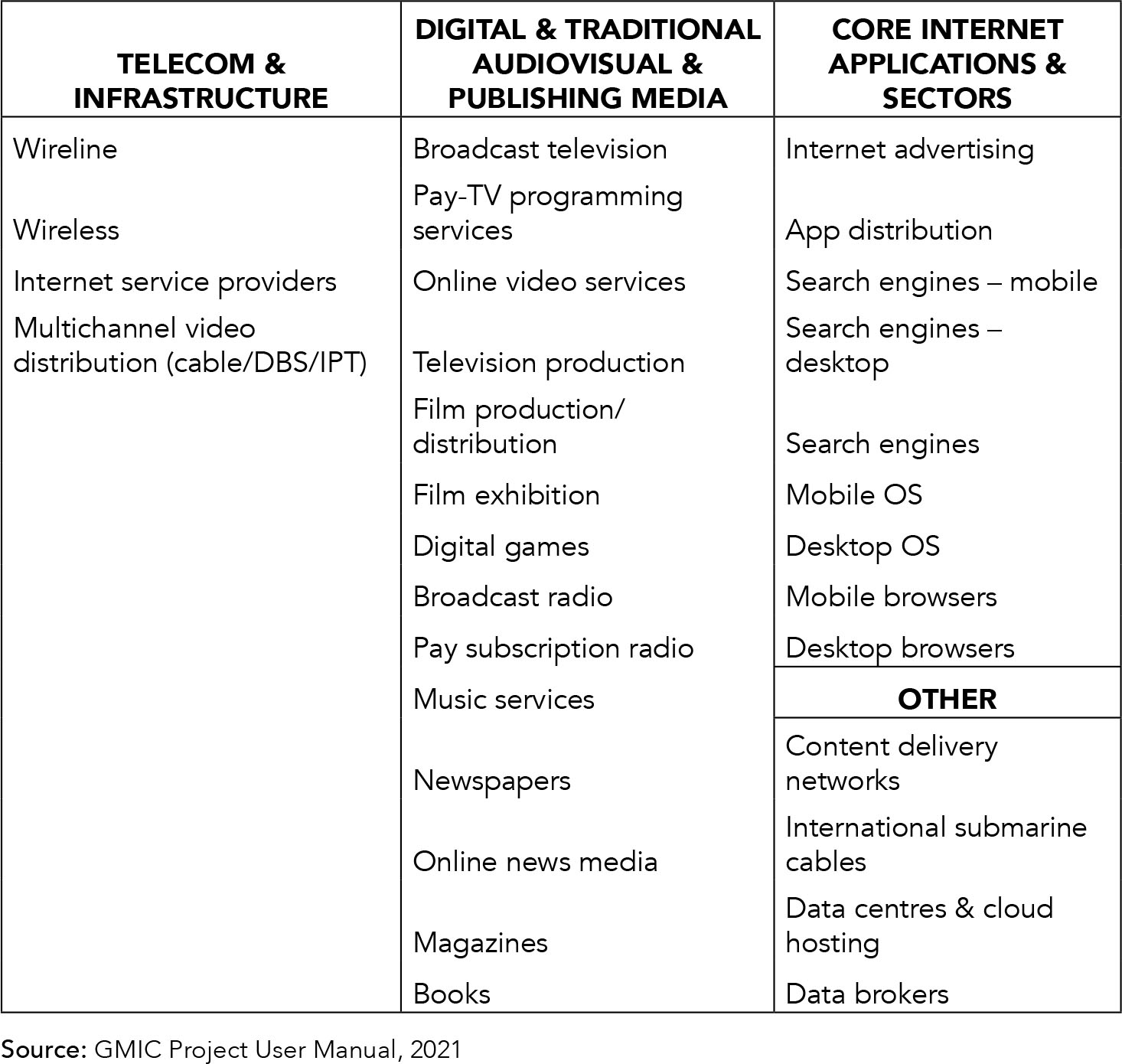
Figure A1
The telecoms, media, and Internet sectors covered by the GMIC Project
When the project – particularly its earlier iteration – was initiated, the segmentation broadly reflected prevailing distinctions in ownership and production across different parts of the media industry in a broad sense. As digitalisation has advanced, maintaining such clear boundaries has become increasingly difficult (not least because this development has progressed at different speeds across countries and across markets). Nevertheless, to preserve the possibility of longitudinal comparison as far as feasible, the core structure has been retained.
Cross-country comparative possibilities
Although the Nordic media markets resemble one another in many respects, including in terms of supply structures and ownership patterns, significant differences remain. The following section provides a schematic overview of the extent to which comparisons across countries are feasible – whether strongly or more limited – for the various sectors and national markets (see Table A1). The level of comparability has been classified as robust, moderately robust, or tentative. For detailed discussions of specific outcomes, reference is made to the main body of the article.
Table A1
Cross-country and cross-sector comparison level
| Category | Level of comparability across the Nordics | Dominating type of sources |
|---|---|---|
| Wireline | Robust | Official data |
| Wireless | Robust | Official data |
| Internet service provision | Robust | Official data |
| Multichannel video distribution | Robust | Official data |
| Broadcast television | Tentative | Annual reports, tax reviews, and market data |
| Pay-TV programming services | Tentative | Market data |
| Online video services | Tentative | Market data |
| Film exhibition | Tentative | Market data |
| Digital games | Tentative | Market data |
| Broadcast radio | Robust | Annual reports, official reports, and market data |
| Music services | Tentative | Market data |
| Newspapers | Moderately robust | Annual reports, official reports, and market data |
| Magazines | Tentative | Annual reports and market data |
| Books | Moderately robust | Annual reports and market data |
| Internet advertising | Tentative | Market data and estimations |
| App distribution | Tentative | Market estimations |
| Search engines – mobile | Tentative | Market estimations |
| Search engines – desktop | Tentative | Market estimations |
| Search engines | Tentative | Market estimations |
| Social media platforms | Tentative | Market estimations |
| Mobile OS | Tentative | Market estimations |
| Desktop OS | Tentative | Market estimations |
| Mobile browsers | Tentative | Market estimations |
| Desktop browsers | Tentative | Market estimations |
| Mergers & acquisitions | Robust | Annual reports, market data |
Estimation strategies
One of the major challenges faced by the project, as noted in the main article, concerns the availability and reliability of data sources. Wherever possible, we have relied on official statistics, official reports, and corporate financial statements. However, in many instances, such robust sources were either unavailable or did not provide the necessary level of detail. In these cases, various forms of estimation were employed. The specific estimations and inferential strategies adopted differed across countries, reflecting national variations in data availability. Information obtainable in one Nordic country was sometimes entirely absent in another. Consequently, estimation procedures were adapted to the conditions and constraints of each national context. The overarching principle guiding these procedures was to remain as closely aligned with official data or the accepted industry currency in question as possible.
For sectors regarding telecommunication and infrastructure, scientific studies and government sources served as the primary basis for estimation, supplemented by industry reports where needed. For advertising investments and their distribution, estimates were derived from domestic data providers, industry reports (e.g., from IAB Europe), and companies’ annual reports. In certain categories – advertising being a key example – a top-line market figure was often available. In such cases, this figure was allocated across active firms in proportion to their respective revenues. In other cases, no aggregate figure existed; here, the total was estimated based on the combined revenues of firms operating within the relevant sector. When financial data has been unavailable, the estimates have instead been based on market shares measured in terms of consumption.