

Introduction
Sustainable development (SD) has been a hot topic for several decades. For the last decade or so, professional journalism’s role as the “fourth estate” and its self-imposed democratic responsibility for enlightening the public about current affairs has been increasingly connected to SD as well as the 17 sustainable development goals (SDGs) from the UN Agenda 2030 (Minodora, 2021). In other words, the role of professional journalism is normatively promoting the following: no poverty; zero hunger; good health and well-being; quality education; gender equality; clear water and sanitation; affordable and clear energy; decent work and economic growth; industry innovation and infrastructure; reduced inequality; sustainable cities and communities; responsible consumption and production; climate action; life below water; life on land; peace, justice, and strong institutions, and partnerships for the goals. To a great extent, the role of media in highlighting and potentially contributing to solutions to these SDGs has evolved around the concept of sustainable journalism (Jamil, 2020; Vukić, 2018).
In this context, an interesting observation is the multifaceted development of how sustainable journalism is applied in research and thus its different meanings. To begin with, throughout the economic crisis of legacy news media, the concept has been used to label the search for economic resilience through business model innovation (Harlow, 2018; Moro & Aikat, 2010; Posetti, 2018; Santos-Silva, 2021). Rather than the survival of the planet or any explicit contributions to a societal development in line with the SDGs, here, “sustainability” primarily refers to the economic persistence of news organisations and sustenance of established journalistic practices (Franklin, 2014; Pantic, 2022; Price, 2020; Requedo-Alemán & Lugo-Ocando, 2014). An important aspect here is the effects of social media news consumption and citizens’ decreasing willingness to pay for professional news content (Goyanes et al., 2023), which puts the future of professional journalism and its role as a fourth estate at risk.
Sustainable journalism is also associated with post-truth challenges in society (Uluşan & Özejder, 2024) or society’s media monitoring infrastructures (Ots et al., 2024). Such infrastructure is built upon the collection and production of data about media’s impact on society and experts’ ability to use these data to predict future consequences. Another emerging research niche is sustainable journalism education (Larrondo Ureta et al., 2021; UNESCO, 2013; Vukić, 2018), characterised by initiatives to provide media workers with courses in holistic understandings of society (Vukić, 2018). One of the main conclusions drawn from recent studies is the prevalence of a “weak sustainable transition” – that there is a need for more systematic and profound updating of universities’ journalism curricula to become more sustainability-oriented (Appiah-Adjei, 2025: 2784).
Furthermore, instead of focusing on particular topics (business models, education, media monitoring, etc.), some contributions are instead devoted to different regions of the world. One example is Addjin-Tettey and colleagues (2021), who have examined how media workers in sub-Saharan African countries connect sustainable journalism to particular democratic challenges. Another study that concentrates on the Global South is provided by Abdulateef Elega and colleagues (2024), who have confirmed the prevalence of journalism practice addressing the SDGs in Africa’s two leading digital journalism platforms: Ushahidi and EcoNai +. Further, Booker and colleagues (2024) have proposed a sustainability model for journalism education and training, which emphasises the need to avoid Western-centric perspectives on sustainable journalism and instead include perspectives of the Global South. Finally, some studies focus on the lexical use of sustainable/sustainability in the news, and what media de facto mean when using these terms (which could be very varying) (Fischer et al., 2017).
The pros and cons of “broad” understandings of sustainable journalism
The above presentation of different types of contributions could be considered a positive development and a sign of sustainable journalism gradually becoming a distinct research subject within journalism studies. The heterogeneous understandings of sustainability might be seen as a natural semiotic development of a concept – that is, the popularity and relevance of it will by necessity lead to different types of uses and understandings of what sustainability “is”, be it business model robustness, counter-Western perspectives, or education in democratic values. As sustainable journalism might include many different things, there are also definitions of it that seek to include many things simultaneously, such as the Swedish Media Institute Fojo’s (2022: 5) definition, in which sustainable journalism is understood as “an independent journalism that not only safeguards and promotes democracy, but which is an enabler of a sustainable society”. The apparent advantage of such a broad perspective is that it manages to embrace all 17 SDGs and more besides (see Barkemeyer et al., 2017). The potential downside of this, however, is that the concept might seem diluted, representing too many things simultaneously, much like the concept of sustainable development itself. In turn, this could make it difficult to clarify how it differs from other forms of journalism, which are also relevant for SD (see Table 1). Here, we may consider constructive journalism (e.g., Atanasova, 2019; Bro, 2019; van Antwerpen et al., 2023), peace journalism (e.g., Galtung & Fischer, 2013; Lynch & McGoldrick, 2014), development journalism (e.g., Banda, 2007; Imran, 2024), and solutions journalism (e.g., Steinke, 2022).
Table 1
Existing alternatives to sustainable journalism
| Concept | Basic definition/understanding | Relevant for SD and SDGs |
|---|---|---|
| Constructive journalism | To avoid only negative news and instead contribute to more constructive understandings of society (Bro, 2019: 506) | Journalism that emphasises how SDGs could be constructively handled and solved (in contrast to negative news) |
| Solutions journalism | Journalism that focuses on solutions rather than problems and negative information (thereby avoiding media fatigue) | Journalism might help to clarify ongoing or future solutions to the SDGs |
| Peace journalism | Journalism that seeks to prevent further war/conflicts between parties and even contribute to solutions (Lynch & McGoldrick, 2014) | Journalism which is primarily connected to SDG16 (peace, justice, and strong institutions) but might also be deemed fundamental for all SDGs (no peace, no sustainability) |
| Development journalism | Journalism that both constructively and critically covers governments’ development and actions in countries (often connected to developing countries) (Banda, 2007) | Journalism that highlights and covers governments’ efforts to handle and “solve” SDGs in domestic contexts |
Hence, when concepts manage to engage and include many different phenomena (water, climate, education, war and conflict, etc.) or ideals (democracy, independent media, etc.), it does indicate the concept’s scientific relevance, but the point here is that there are several other journalism concepts that provide specialised forms of media knowledge for each of the aforementioned SDGs (peace journalism on war and conflicts, and so forth). Therefore, as a complement to existing studies that seek to crystallise the particular relevance of the concept of sustainable journalism, the purpose of this article is to theoretically elaborate the potential foundations of the concept (i.e., thereby a sustainable journalism redux). This is done by connecting sustainable journalism with important cornerstones of the sustainability concept (see Cohen, 2021; Brundtland, 1987/2022; Elliot, 2013; Mensah, 2019; Walker, 2017). We elaborate it as a tangible practice of organising – that is, framing – society, primarily deduced from Brundtland’s (1987/2022) report, Our Common Future: Report of the 1987 World Commission on Environment and Development, for the United Nations, but also taking into account the criticism that has been directed against it, namely the rather one-sided focus on environmental sustainability and uncritical understanding of the existing economic system. We argue that such a theoretical operation could facilitate empirical explorations of sustainable journalism of the deductive kind, where the understanding of the concept is theoretically pre-defined or pre-given, rather than, for example, through inductive inferences where observations of organic, unforeseen, or emerging ways of understanding and using this concept are the centre of attention. Hence, the use of sustainability in studies of business models in the media sector, for example, is primarily a result of the increasing use of this term (sustainability) in this sector, rather than some clear connection to some elements in the Brundtland report or some other authoritative UN sources. However, the dynamic between, on the one hand, ideas about the concept’s potential “origin”, and on the other, its expanding prevalence and use in more and more social contexts and sectors, should be further analytically highlighted. Our “cornerstones” of sustainable journalism suggested below could further stimulate the ongoing discussion of how sustainability should be understood in the media context and researched in relation to other forms of journalism (see Table 1).
In order to fulfil our purpose, we first highlight framing theory below. By means of its basic understanding of the relationship between language and social reality, we explain how framing practices in the media, endowed with a sustainable outlook on society, might pave the way for “sustainable journalism”. In the next step, we exemplify three proposed media frames, more precisely three-pillar, time-reflexive, and cross-border framing, and how they originate from influential SD literature. Then, we focus attention on how this mode of understanding sustainable journalism will have certain consequences for its ability to operate in the overall attention economy of mainstream media logic, which requires easily digested information rather than complex sustainability frames of society, emanating from SD literature. In the concluding section, we discuss how our proposed cornerstones of sustainable journalism can play an important role, not only in research, but also at media organisations that, as with many other branches in society, aspire to become entirely sustainable (Picha Edwardsson, 2015).
Sustainable journalism: Its framing practices and outlook on society
Goffman (1974) theorised the concept of framing as an interpretative framework for attaching meaning to events, processes, and phenomena. In his view, frames function as organising principles that structure experience and guide interpretation. They are often implicit and always socially embedded, drawing on shared cultural meanings that make sense of otherwise fragmented strips of activity (Goffman, 1974). Conceptually, frames answer implicit questions such as What is happening? and Why does it matter? – providing coherence while reflecting the normative and cultural expectations of a community.
A frame should thus be considered an “implicit organizing idea” (Gamson, 1992: 3) generated through language use, where the selection and arrangement of symbols foreground certain interpretations and background others (Gamson & Modigliani, 1987). Salience is achieved “by placement or repetition, or by associating [information] with culturally familiar symbols” (Entman, 1993: 53). Turning information into a frame necessarily involves omission – diverting attention away from some aspects of reality in favour of others – through textual and visual choices that make particular elements salient (Entman, 1993). Entman’s (1993: 52) widely cited definition captures this process:
To frame is to select some aspects of a perceived reality and make them more salient in a communicating text, in such a way as to promote a particular problem definition, causal interpretation, moral evaluation, and/or treatment recommendation for the item described.
In professional settings – including journalism – as well as in everyday language use, framing is not optional: It is constitutive of meaning-making. Reality is always mediated through epistemology – the only concern is which frames are being (re)shaped in news discourse and how those frames “organise” society (Lakoff, 2010). The latter is of paramount importance. Frames operate across topics, texts, and visuals, providing “a central organizing idea or story line that provides meaning to an unfolding strip of events, weaving a connection among them” (Gamson & Modigliani, 1987: 143). Reese (2007: 151) underscored this point: “if [researchers] cannot show how the frame does more ‘organizing’ and ‘structuring’ work, I prefer they not use the label”. Accordingly, frames function at different levels of abstraction:
Generic frames – broad interpretive structures that recur across multiple issues and contexts, such as responsibility and morality (Semetko & Valkenburg, 2000).
Issue-specific frames – tailored to particular topics and reflecting an issue’s distinctive discursive features, such as “scientific uncertainty” in climate coverage (Pan & Kosicki, 1993).
Generic frames usually do not give us much information about normative dimensions (whether the frame propagates a worldview, interests, desire, and so forth), which is, however, easier to observe at the level of issue-specific frames. These complementary layers frequently co-occur within the same media text as hybrid frames (Brüggemann & D’Angelo, 2018), which are central to sustainable journalism given its integrative orientation toward sustainability. The very concept of hybrid frames has developed as a consequence of attempts to “defragment” news framing studies, that is, to manage the (too) far-gone diversity of ways of defining and exploring frames in the news (Brüggemann & D’Angelo, 2018; de Vreese, 2012). Rather than considering these two frames as two distinct ways of framing analysis, or even as opposing schools, the idea is to demonstrate how they complement each other in holistic fashion.
The three hybrid media frames proposed below – the three-pillar, time-reflexive, and cross-border frames – operationalise the framing process of sustainable development at an overarching level (see Table 2). They make sustainable journalism both empirically identifiable and codable within news texts, while also providing a practical framework for journalistic application. We partly disagree with Brüggemann and D’Angelo’s (2018: 91) characterisation of hybrid frames as merely “complementary layers”. In journalistic practice, translating sustainable development into concrete and meaningful information requires a dynamic interplay between generic and issue-specific frames (Berglez, 2025).
When it comes to sustainability discourse in the media, analysed as frames, Nambiar (2014: 106) has explored the latter in terms of how media embed environmental issues in different social and political categories such as “change/changing paradigm”, “exemplary practice”, and “activism”. Atanasova (2019) and Guenther and colleagues (2022) analysed sustainability in the news media in terms of innovation and solution-oriented frames, while Ghosh and Boykoff (2018) examined, with a focus on climate change, how sustainability discourse in the news could pave the way for locally generated frames in different parts of the world. What these contributions share is that they either inductively examine the types of frames on which news media tend to construct sustainability, or they approach sustainability from a particular topical angle (e.g., innovation, activism). By contrast, the approach we advocate for and develop below focuses on how sustainable development is fundamentally conceptualised in seminal literature, and on how the media might translate these conceptualisations into basic frames. This translation requires the hybrid perspective on frames discussed above, in which foundational understandings of sustainable development serve as generic frames (see Table 2) that ideally merge with, or become anchored in, specific issues within news reporting.
It is important to note that the production of frames that involves sustainability and/or SD might, as is the case with frames in general, be more or less invisible to their creators (editors, journalists, etc.). This is because they are a product of deeply rooted and habitual newsroom practices, also involving the selection of news (Galtung & Ruge, 1965; Schultz, 2007; Harcup & O’Neill, 2017) and use of digital strategies for assuring clicks and shares. However, media frames are not an entirely unconscious process. Media workers can also be reflexive about their own work and therefore also change and develop their framing practices in various directions. This includes the professional cultivation of frames which are in tandem with ideas about sustainable development.
The sustainable outlook
In this respect, the (hybrid) framing practices of sustainable journalism need to rely on a sustainable outlook on society. Essentially, to apply such an outlook means to normatively promote rather than to repress the SDGs. For example, this is achieved by highlighting that famine should be eliminated in the world, or that climate change should be handled as quickly as possible by all the world’s countries. However, when it comes to how to manage these challenges, SD is also a concept of deliberation and disagreement (Bennett, 2021). The most obvious conflict is between ecomodernists, who emphasise the potential of new technology and innovation, and proponents of de-growth thinking, who instead propose a radical transformation of existing society and market capitalism. Due to the SD term’s common associations with a market economic logic, some de-growth proponents even choose to desert it. Other conflicts concern the achievement of particular SDGs, such as the disagreement on whether energy supply should primarily be solved through nuclear energy or renewables.
The SD paradigm is thus not consensual. As a consequence, the sustainable outlook on society involves a few deeper, fundamental frames for explaining society, which embrace contrasting and even conflicting engagements with SD.
The three-pillar, time-reflexivity, and cross-border frames of sustainable journalism
More precisely, we suggest that the sustainable outlook primarily gives rise to three ways of framing society in journalism. We do not claim that these are the only or final ones, although we argue that they are essential for the understanding of sustainable journalism, and thereby are associated with cornerstone status, as they connect in different ways to important aspects of how SD is basically understood in seminal literature. Thus, in this context, the three frames have been developed through deductive reasoning: Given that A (a concept, idea, model, etc.) is an important historical and intellectual dimension of SD, a journalistic version, in terms of a particular frame, could be formulated in accordance with B. Consequently, below we present the way in which the frames have been operationalised from central SD literature (see Table 2).
Table 2
Three frames of sustainable journalism
| Frame | Practice | Background | Empirical questions |
|---|---|---|---|
| Three-pillar | Interrelating economic, environmental, and social sustainability | Brundtland report (1987/2022), “donut-boundary perspective” (Raworth, 2012, 2017), and planetary boundaries thinking (Randers et al., 2019) | To what extent and in what ways does journalism interlink economic, environmental, and social dimensions when covering an event or problem? |
| Time-reflexive | Oscillating between past, present, and future perspectives | Brundtland report (1987/2022) | To what extent and in what ways does journalism oscillate between the past, present, and future when covering an event or problem? |
| Cross-border | Highlighting global–national–local relations | Brundtland report (1987/2022) | To what extent and in what ways does journalism include relations between the global, national, and the local when covering an event or problem? |
We suggest that empirical identifications of these three frames in media reporting, below exemplified through news coverage in established media such as Le Monde, Los Angeles Times, and Al Jazeera, could be guided by the questions presented in Table 2. The more journalism addresses these three questions in its coverage, the more sustainable the media reporting becomes. This means that, ultimately, all three frames are prevalent in a singular coverage. Below, we first exemplify each of these three frames separately, which is then followed by examples of intersecting cases. The frames presented could be analytically applied to news content that explicitly mentions SD and/or SDGs or to news that covers events, issues, problems, and so on, that in one way or another is interpreted as being relevant for SD and SDGs.
Three-pillar framing
Brundtland’s (1987/2022) report for the United Nations, Our Common Future: Report of the 1987 World Commission on Environment and Development, paved the way for an increasing focus on how the future of the planet requires solutions in which economic, ecological, and social challenges are increasingly interconnected – hence a three-pillar mode of thinking. The three fundaments of sustainability cannot therefore be treated in isolation, but their interdependent nature must be acknowledged in public discourse. Often, they cause internal conflicts known as “wicked problems” (Lönngren & van Poeck, 2021): Environmental stress can increase poverty, but policy aimed at reducing poverty could increase stress on the planetary boundaries, to mention one example.
The original three-pillar model does not, however, fully succeed in conveying the interdependent nature and the internal hierarchy of the sustainability dimensions. Therefore, quite a few attempts to more adequately illustrate this have been made over the years. Arguably, Kate Raworth’s example is one of the most successful. According to her model, which is visualised as a “donut”, a sustainable economy creates “safe and just space for humanity” (Raworth, 2012) in between the social foundation and the environmental ceiling. For social sustainability (the foundation), a sustainable economy works in the service of human necessities such as food, water, health, equality, and education. However, both social and economic development are determined by and confined below the environmental ceiling of the planetary boundaries (Randers et al., 2019), that is, it is the ecological carrying capacity that defines what is possible to achieve socially and economically.
This frame qualifies as a hybrid (Brüggemann & D’Angelo, 2018) because it necessarily combines a generic dimension– that is, the interrelations among environmental, social, and economic aspects – while anchoring it in something concrete and issue-specific (Moscovici, 2001: 158), for example, a community’s challenge in managing water resources.
Mainstream media’s event-centred and time-pressing working routines usually make it difficult for journalists to include the contextual frameworks and processual perspectives that the combining of environmental, social, and economic aspects of sustainability require (Fink & Schudson, 2014). But even though a three-pillar frame is primarily repressed in everyday news, illustrative examples do exist, where three or at least two of the sustainability dimensions are addressed and interrelated. One example is found in The Guardian (2022, March 9), where a leading climate scientist in Ukraine is interviewed, simultaneously commenting on the recent IPCC report and the Russian invasion of Ukraine:
“This is a fossil fuel war”: Ukraine’s top climate scientist [S. Krakovska] speaks out (headline)
Both the invasion and IPCC report crystallized for Krakovska the human, economic and geopolitical catastrophe of fossil fuels. About half of the world’s population is now acutely vulnerable to disasters stemming from the burning of fossil fuels, the IPCC report found, while Russia’s military might is underpinned by wealth garnered from the country’s vast oil and gas reserves. (para. 6)
In a few sentences, (lack of) environmental sustainability (acute climate change); (lack of) social sustainability (the devastating effects of fossil fuels on humanity); and a devastating form of economic sustainability model (Russia’s economy including a war based on oil and gas reserves) are mentioned and collectively problematised. In another example, from the Los Angeles Times (2022, July 8), issues of environmental, social, and economic sustainability come together in relation to the water issue in the western US:
California is finally reducing water use, but it’s not enough amide severe drought (headline)
On June 10, the water board required all urban water suppliers to implement Level 2 of their emergency drought restrictions. It also took the step of banning the irrigation of “nonfunctional grass,” or grass that is purely decorative, at businesses and in common areas of subdivisions and property controlled by homeowner associations. Newsom’s [CA.Gov] office on Friday said the recent gains were “a positive trend in response to the governor’s latest actions and local measures” but reiterated that the results were far below the desired 15%. “Individuals and California businesses need to step up,” said Erin Mellon, a spokesperson for the governor. (paras. 13–15)
In a quite apparent way, the journalist manages to interlock an environmental issue (droughts causing water scarcity) with social dimensions (the responsibility of individuals) and economic aspects (“California businesses need to step up”). In contrast, an unsustainable way of framing this event would be, for example, to frame the water restrictions merely as a problem with negative consequences for business while repressing other values.
Time-reflexive framing
This frame is connected to the most well-cited and contested (Cohen, 2021: 14) phrase in the Brundtland report (1987/2022: 37), namely:
Sustainable development is development that meets the needs of the present without compromising the ability of future generations to meet their own needs.
The temporal dimension of the sentence is central, that is, the relation between the past, present, and future. To begin with, individuals’, institutions’, and entire societies’ actions and decisions (or lack of such) in the past one or many decades ago have consequences for the present and our current ability to handle the SDGs. Our present efforts are thus very much determined by the past. In the same sense, what individuals, institutions, and societies “do” (or do not do) in present times has future consequences for humanity and the entire planet. Therefore, short-term needs in the present (e.g., “Lower prices on gas now!”) always need to be set against future needs (e.g., lower prices might cause increasing emissions and negatively affect future generations).
Sustainable journalism is thus about “time-reflexive framing”, that is, oscillating between the past, present, and future, in media reporting. If there is too much emphasis on one of these three temporal dimensions, journalism risks becoming unsustainable. For instance, war reporting that is entirely stuck in the historical past by reproducing old conflicts between “us” and “them”, stereotypes and prejudices about the Other (Lynch & McGoldrick, 2014), is highly problematic. Journalism which instead reifies the present – that is, with what happens here and now (live events, crises in the present, etc.) – is also unsustainable. This is due to its inability to provide a proper context (Fink & Schudson, 2014) about why the present event occurs in the first place or potential future consequences. Finally, journalism, which fetishises the future, either in a positive sense (e.g., new technology will save the planet) or in a dystopic sense (e.g., there is no hope for civilisation due to irreversible climate change) will not be able to provide the “bigger picture”.
What makes the frame hybrid is the implementation of the generic organisational perspective (time-reflexivity) in the overall framing of a specific issue, that is, in the coverage of a particular problem or challenge. In the example below, which focuses on the topic of biological diversity, media combine the past (baseline for understanding present conditions), present (actual state of condition and identification of lack of actions), and future (negative scenario for year 2030 if nothing happens, but also in terms of a more hope-oriented scenario: If A is done now, B might be achieved), as illustrated by CNN (2022, June 3):
More than 40% of Earth’s land surface must be conserved to stop the biodiversity crisis, report warns (headline)
Almost half of the Earth’s land surface must be protected to stop the biodiversity crisis, according to a new report published Friday in the journal Science. The research found some 64 million square kilometers (24.7 million square miles) – 44% of the Earth’s land – needs “conservation attention” to prevent major biodiversity losses. “We must act fast, our models show that over 1.3 million square kilometers of this important land – an area larger than South Africa – is likely to have its habitat cleared for human uses by 2030, which would be devastating for wildlife,” lead author Dr James R. Allan from the University of Amsterdam said in a news release. (paras. 1–3)
In another example from Dagens Nyheter (2022, March 19), the focus is on collective preparedness for potential (small-scale) nuclear wars.
“We need to think about the idea that nuclear weapons could be used” [translated] (headline)
It is a November day in Nynäshamn [city in Sweden]. People are moving around in the area the way the usually do. Suddenly, without warning, a nuclear charge detonates. Its power is 100 kilotons, almost seven times stronger than the atomic bomb dropped on Hiroshima in 1945 [future scenario; translated]. (para. 1)
“If we start imagining that it could happen, we have come quite far in our preparedness,” says Erik Johansson from the Swedish Armed Forces [translated]. (para. 17)
In the news article, the journalist focuses on the historical perspective, that is, how the technology developed in the 1930s and 1940s and on events such as Hiroshima in 1945, the present situation, as well as future scenarios for humankind and the entire planet. Hence, an unsustainable form of journalism would be to present nuclear wars as merely a historical phenomenon that is no longer so relevant; as a new risk without a past; or, to cover it as a distant future threat.
This way of framing news also exemplifies potential conflicts about what normative content the frames of sustainable journalism should be filled with. It is thus possible to argue that sustainable journalism is instead about critically examining the ideological effects of discourses such as “collective preparedness” (Furedi, 2006). Is the coverage presented above not intending to make people accept something that is not sustainable, namely nuclear weapons?
Cross-border framing
In classic SD thinking, cross-border interdependencies are of pivotal importance (Brundtland, 1987/2022). Decisions, actions, and processes in one part of the world affect living conditions on the other side of the planet, and vice versa, not least across the Global North and Global South (Cohen, 2021: 7–8). The necessary transition from “one Earth to one World” is clearly emphasised by the Brundtland report (1987/2022: 12):
Until recently, the planet was a large world in which human activities and their effects were neatly compartmentalized within nations, within sectors (energy, agriculture, trade), and within broad areas of concern (environment, economics, social). These compartments have begun to dissolve. This applies in particular to the various global “crises” that have seized public concern, particularly over the past decade.
When translated into sustainable journalism practice, this becomes cross-border framing. The hybrid nature of this frame lies in its integration of a broad interpretative structure (cross-border relations) in the framing of a specific, concrete problem or challenge. It thus concerns media’s ability to endow covered events and problems ideally with local, domestic, and global perspectives simultaneously and to explain their relations (Cottle, 2009; Hellmueller & Berglez, 2022; Rothenberger et al., 2023), or at least combining two of these perspectives. In the following example, Al Jazeera (2022, June 11) framed the Ukraine war by actively connecting the events in Ukraine with a potential hunger crisis on the African continent:
Could Ukraine war prompt another hunger crisis in Africa? (headline)
African Union says disruption of Ukraine grain exports risks ‘catastrophic scenario’ of food shortages and price rises. Today, 346 million Africans, more than a quarter of the continent’s people, are suffering from hunger because of conflict, drought and poverty. Now a war, thousands of kilometres away, is threatening to worsen Africa’s food insecurity crisis. Grain supplies are disrupted and the prices of staples and fuel are skyrocketing. The chair of the African Union and Senegal’s President Macky Sall warns that there is the risk of a “catastrophic scenario” of food shortages and has urged Russia and the West to help ease the situation. (paras. 1–4)
Here, the cross-border frame consists of the combination of nation-states (Ukraine, Senegal, Russia), transnational organisations (African Union), and particular parts of the world (the West), testifying to a coverage that spatially stretches over several continents.
Although the SDGs are often supposed to be handled by nation-states separately and are endowed with local solutions, an important aspect of this framing practice is to highlight cross-border initiatives. In the example below from Le Monde (2022, May 11), which involves several SDGs simultaneously, though primarily “life below water” and the need for partnerships, the media highlight the protection of seas as a cross-border responsibility:
Fishermen on the northern French coast call for a ban on a ‘devastating’ technique (headline)
French fishermen from Boulogne teamed together with their English counterparts to ask for a moratorium on demersal seine fishing. (preamble)
Fishermen the from UK and France, supported by the NGOs Greenpeace, Bloom and Pleine Mer, are uniting behind a joint call for governments to properly protect the oceans. (image caption)
On the Quai Gambetta in Boulogne-sur-Mer, fishermen and environmental activists waited for the return of the Merlin. Laetitia Bisiaux, a spokesperson for Bloom, an NGO committed to defending oceans, said of this unprecedented union: “There have been many tensions between French and English fishermen following Brexit, or on scallops, but on demersal seine fishing, they are coming together.” (para. 2)
Hence, it would be less sustainable for journalism to present this action as either a British or French initiative, that is, to frame it in accordance with a traditional “national container” rationale with no cross-national dimensions (Beck, 2005: 111–112).
Which frame is the most important?
Despite the fact that all three frames are important for the achievement of sustainable journalism, some might stress their asymmetric relations and propose that some of the frames are more fundamental than others. For example, those very inspired by Raworth’s (2012) famous donut-boundary model might state that without the three-pillar frame – that is, without combining the social, economic, and environmental sides of sustainability – there would not be much sustainable journalism. To this it can be added that the environmental pillar is always the most important one. However, it can also be argued that the three-pillar frame is incomplete without the time reflexivity and cross-border frames. This is based upon the reasoning that sustainability thinking is essentially about balancing the past, present and future, and thinking beyond national horizons. For example, media coverage highlighting an innovation that promises smart solutions for both environment, society, and the economy (three-pillar framing) becomes less sustainability oriented if it excludes the potential future negative side-effects (time-reflexivity) or avoids mentioning its foreign consequences (cross-border frame).
Three levels of sustainable journalism practice (incomplete, basic, and advanced) and how to understand the practice in relation to media’s need to attract audiences/users
When combined, the three presented frames pave the way for defining sustainable journalism as the holistic practice of covering environmental, social, and economic relations through time–space reflexivity. The first part of the sentence refers to the three-pillar frame, while the remaining part captures the time-reflexivity and spatial cross-border frames. The optimal fulfilment of sustainable journalism thus occurs when several hybrid frames “work together” in reporting. This would mean that, here, hybrid frames do not only involve the complementary relation between generic framing and issue-specific framing, but also a possible hybridisation of the different hybrid frames (see Figure 1). The more of such “double hybridisation”, the stronger the sustainability discourse in the news.
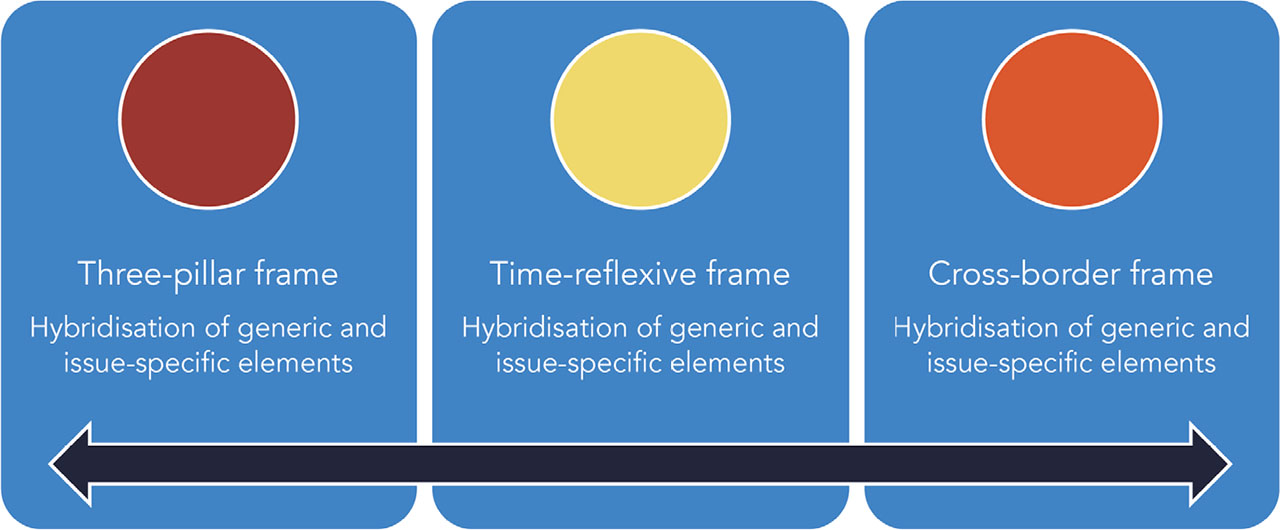
Figure 1
How hybridisation also potentially develops across different hybrid frames (i.e., double hybridisation)
In this respect, the Ukraine-war-in-a-global-context example of cross-border framing from Al Jazeera also includes some three-pillar discourse by presenting social and economic consequences of the war (i.e., at least two out of three pillars). The news example of time-reflexivity framing from Dagens Nyheter about potential nuclear war threats also includes environmental and social sustainability perspectives, thereby connecting to the three-pillar framing practice. Finally, compared with the Los Angeles Times story about the Californian drought crisis, The Guardian’s three-pillar frame in the news about the climate effects of the Ukraine war is a stronger case of sustainable journalism. This is due to The Guardian’s inclusion of cross-border framing, while the Los Angeles Times coverage is rather regionally framed.
As combinations of the three (hybrid) frames is preferred practice, sustainable journalism may be classified as incomplete, basic, or advanced. “Incompleteness” thus occurs when media cover an event or problem in accordance with only one frame. Combining two frames could be understood as a sufficient but still basic form of sustainable journalism performance. The competence of combining all three frames in coverage is likely to be rarer, representing an advanced form of journalism (see Table 3). Assumedly, the more frames that are combined, the bigger the challenges for media producers to deliver “sellable” news to broader groups of media users. This is because the frames are fairly “science-oriented” and thereby potentially in conflict with so-called media logic (Altheide, 2013).
This way of understanding sustainable journalism receives support from Barkemeyer and colleagues (2017), who have categorised different sustainability topics as either informative or noise-oriented, meaning that the latter category (noise) is easier to generate attention to due to its spectacular character (e.g., sudden extreme weather). As a hypothesis, then, mainstream media primarily tend to produce news with only one frame, while the combining of two is more restricted to elite media in which users actively pay subscriptions for quality journalism. Three frames combined ought to be found almost exclusively in media outlets specialised in SD challenges, for instance, environment, energy, or water. However, this is an empirical question that needs to be answered through further research. From a normative point of view, the desired development should be that ever more advanced forms of sustainable journalism practices reach mainstream media audiences and users, and thus citizens in general.
In conclusion: The importance of a “common thread” in media organisations
An increasing number of organisations, including media houses, promote themselves as sustainable (Picha Edwardsson, 2015). They do this by assuring gender equality among the employees, preventing discrimination at the workplace, or by reducing their CO2 emissions by using eco-friendly material or through sustainable travelling, to note a few examples. Such efforts are then documented and distributed by means of annual reports. Below is an example provided by the Nordic media house Bonnier, the owner of the newspapers Dagens Nyheter, Expressen, and Dagens Industri, approximately 40 local newspapers, and more than 20 branch media outlets in several countries (see Table 4).
Table 4
Sustainability declaration of Bonnier News, 2024
| Freedom of expression and protecting free speech are at the heart of Bonnier News’ operations and the single most important focus area in the company’s sustainability strategy. The war in Ukraine these past years has set the agenda for a large proportion of newspaper reporting, along with the ever-more-important climate coverage. |
| Bonnier News’ sustainability strategy is based on four focus areas, each connected to the UN’s 17 Sustainable Development Goals. Within the framework of these focus areas, a number of initiatives are underway in many different parts of the business. |
| Bonnier News’ core values and identity are built around freedom of expression and empowering free speech. They act as defenders of independent journalism and their businesses contribute to an inclusive society where more people can participate. |
| Business ethics – sustainability integrated into the business. Bonnier News strives for sustainable profitability that over the long term ensures the publication of independent journalism. |
| Equality and inclusion – the responsibility of the entire organization. Focus on creating an open atmosphere at the workplace, with equality, diversity and inclusion as key factors for success. |
| Environment – to gradually reduce the carbon footprint. Bonnier News’ direct climate impact is limited and varies, considering the breadth of operations. Based on what is relevant to each business, efforts should be made to reduce the direct impact in the value chain. (Bonnier, n.d.: Bonnier News) |
To avoid inconsistency, it is essential for Bonnier and many other media houses worldwide to fulfil these basic values, not only at the organisational level, for example, in terms of their corporate social responsibility, employment practices, or purchase policies, but in media coverage as well. We therefore argue here that sustainable journalism is a key component. There is no such thing as a sustainable media organisation without sustainable journalism. But the inverse condition is also true: Sustainable journalism can only become credible if it operates in media organisations that are sustainable in other respects as well. Ideally, media organisations such as Bonnier would act in accordance with the basic principles of sustainability as demonstrated above from a framing perspective. Hence, rather than separating “business ethics”, equity and inclusion”, and “environment” (see Table 4), they would also seek to integrate and interconnect them.
Avoiding developing more and better sustainable journalism might be a risk for media organisations. The challenges of the SDGs (climate, biological diversity, water, energy, etc.) and the challenges for journalism (need for new business models and generations of users/consumers; the competition from social media platforms, etc.) have a mutual relationship (Booker et al., 2024). The world needs a partially new kind of journalism to meet and understand the global sustainability challenges, while professional journalism and media houses need to “use” these planetary crisis situations to renew or update themselves, and thereby avoid becoming residual and outdated as a fourth estate (Berglez & Gearing, 2018). For media and journalism scholars, we contend that assessing how – and to what extent – media organisations actually accomplish this is best pursued through approaches such as the one outlined in this article – that is, by examining how they succeed in combining generic dimensions of sustainable development thinking with issue-specific news coverage (i.e., the use of hybrid frames). However, in this regard, our contribution should primarily be understood as a conceptual article that proposes a potential framework for empirical analysis. The substantial empirical work, we argue, still lies ahead.
Acknowledgements
This article was funded by the European Union’s Horizon 2020 research and innovation programme under Grant Agreement No. 101004811.
We would like to thank Nordicom Review’s editor, Professor Magnus Fredriksson, for insightful comments and suggestions in the final process, which very much helped to improve the theoretical contribution of this article.