

Introduction: The Nordic news media landscapes are special
When I read the executive summary of this year’s Digital News Report from the Reuters Institute for the Study of Journalism (Newman et al., 2025), I encountered a bleak picture of the global news and information landscape. The bleakness has to do especially with the rise of social and video networks for news, news users deserting traditional news brands, the decline of trust in mainstream news media, the rise of misinformation, the worrying increase in news avoidance, unwillingness to pay for news, and so on.
I don’t want to belittle the alarming signals coming from around the globe due to increasingly powerful communication infrastructures and commercially driven tech platforms; however, I want to say that these challenges are not playing out uniformly globally.
If we consider the news landscapes in the Nordic countries, the dire portrait and the implied predictions about worse to come don’t provide the true picture.1 It is precisely data produced by the Digital News Report project which enable me to say that until now at least, the Nordic media cultures are an island with a less ominous news and media environment.2
Indeed, based on data from the Digital News Report 2025 (Newman et al., 2025), this is what we find:
Nordic news audiences are loyal to the news titles coming from the public service media and the publicistic commercial media, comprising both established newspapers and new, born-online news providers. Only a third of Nordic news audiences go to social media platforms for news.
The weekly reach of public service media and publicistic media is close to 80 per cent.
All Nordic countries are on the top-10 of news-trusting countries. Between half and two thirds of the people trust the news in general, and less than 20 per cent distrust the news.
Less than a third avoid the news “often” or “sometimes”. Only 5–7 per cent avoid the news “often”.
Two Nordic countries (Norway, 42%; Sweden, 31%) are world-leading in paying for news. Denmark and Finland are closer to the European average, with approximately 20 per cent paying for news.
In a global comparison, these figures are “good”. Thus, it appears that the Nordic news cultures are more sustainable in terms of democracy-strengthening audience practices than almost anywhere else in the world.
The Nordic media welfare state
The unique characteristics of media in the Nordic countries are acknowledged in media systems theory. Hallin and Mancini’s (2004) seminal analysis of supranational media systems categorised the Nordic countries in the democratic corporatist media system, but allocated them collectively to a special role within this sub-system, as a media system that is strong in cultivating democratic prerequisites in its citizens.
Subsequent developments in media systems analysis have made clear that the Nordic media cultures are, indeed, in a league of their own. For instance, Michael Brüggemann and colleagues (2014: 1056) empirically tested Hallin and Mancini’s model and identified a separate Nordic cluster, with Norway as its prototype. A few years later, Laia Castro, with a team including Nordic colleagues Jesper Strömbäck, David Hopmann, and Toril Aalberg, extended the work of James Curran, Anker Brink Lund, Shanto Iyengar, and Inka Salovaara-Moring (2009) and concluded that the news media repertoires in the Nordic media system result in higher levels of democratically relevant knowledge among citizens (Castro et al., 2022). They traced this finding especially to the fact that “the use of public service broadcasting for news is positively associated with knowledge of hard news” (Castro et al., 2022: 832).
Against the background of these findings, it is relevant to ask: Why are the Nordic media systems – or in the singular, the Nordic media system – so special? The short answer, which I’ll expand a bit on, is that the Nordic countries are “media welfare states” (or “media welfare societies”) – a concept coined in the seminal book by Syvertsen, Enli, Mjøs, and Moe (2014; see also Jakobsson et al., 2024a, b).
The overall idea of the media welfare state is that the media systems of the Nordic welfare states have developed parallel to the sociopolitical (i.e., social democratic) characteristics of these countries. Despite the undeniable internal differences between the countries, Syvertsen and her colleagues (2014) argue that the organisation of media and communication in all Nordic countries rests on a combination of four pillars:
Universally available communication systems
Institutionalised editorial freedom
Extensive cultural policy for media (press subsidies)
Consensus-driven policymaking among stakeholders
Syvertsen and colleagues’ key argument is that the media are themselves “a welfare state system” (p. 11), also historically because the party press and the broadcasting institutions were “crucial vehicles to achieve the aims of the welfare state” (p. 11). The media provided shared narratives and became the social glue that held the societies together, and they are therefore a constitutive player in the welfare society-building process (p. 13).
The Media Welfare State has been extremely influential since its publication – in fact, it is hard to find any academic work about Nordic media affairs that doesn’t cite, discuss, and critique it. The authors themselves bring a critical perspective, asking if this is really a correct portrait of the state of affairs, or a romanticised picture (p. 7). They ask whether the neoliberal turn, with its partial privatisation of previously public goods (health, education), and the evolution of the competition state, has also affected the media systems (p. 8). Their verdict is that “outright neoliberalism did not take hold” (p. 9). Instead, they claim that the four pillars have been successful in protecting the Nordic media systems from various challenges into the digital age, where “overall principles and user patterns are to a large degree maintained and fortified” (p. 20).
Today, more than ten years later, it is necessary to raise the question of whether the four pillars are still able to withstand the pressures from the increasingly pervasive tech platforms. Has it been possible to uphold the values of the Nordic media system despite the fact that Big Tech companies don’t want to cooperate with national governments or national media providers (or the EU, for that matter)? On the contrary, some of them have been taking a growing share of the revenue streams that used to support national news and entertainment production, while other giants in the age of AI violate the content property rights of news organisations in order to train their revolutionising tools. More about this later.
An audience perspective on the Nordic news media system
Together with my colleagues Mark Blach-Ørsten and Mads Kæmsgaard Eberholst, I have been developing an audience perspective on the Nordic news media system over the last few years. To be more precise, we have explored whether Nordic news audiences appear to navigate the news landscape in such a way as to develop and maintain the democratic prerequisites that are fundamental to building an informed citizenry and, by implication, democratic media welfare states. We have developed this perspective in two articles (Schrøder et al., 2020, 2024).
Syvertsen and colleagues included a chapter about media access and use, which focuses on the notion of fragmentation of social groups. The chapter points at a development towards a more diverse use of media, which affects all social groups. But although they found some fragmentation caused by age differences, they stressed that there is not a fundamental digital divide in the Nordic countries, and that “the old and young do not live on different planets media-wise” (Syvertsen et al., 2014: 42). An important reason for this is, according to the authors, the strong position of public service media,
Whenever the authors support their argument with statistical data about audiences, they admonish the reader that most of their data is insufficient in several ways: Sometimes the data doesn’t include all the Nordic countries, sometimes the data is not updated, and sometimes the research designs and materials are not identical (Syvertsen et al., 2014: 25).
Since I, Blach-Ørsten, and Kæmsgaard Eberholst use Reuters Institute data from the four Nordic countries, our analyses don’t suffer from these shortcomings: We ask the same battery of questions on the same dates to consistent samples of respondents. So, the data are eminently comparable. This advantage remains when we use the Reuters Institute’s dataset to compare the Nordics with other countries, in our case primarily the US and the UK.
Together with my colleagues (Schrøder et al., 2020), I have asked the research question: Is there a Nordic news media system when seen from an audience perspective? We deployed a descriptive comparative methodology that operationalised four key indicators of audience practice: primary sources of news, pathways to online news, willingness to pay for digital journalism, and levels of trust in news media.
While there are internal national differences, we have shown that Nordic countries collectively exhibit distinctive news consumption behaviours that set them apart from other European media systems, particularly the Central and Southern systems identified in previous typologies. For instance, the green bars in Figure 1 show that Nordic audiences use television news less than the other countries’ audiences, and the grey bars show that the Nordics use the websites and apps of newspapers a good deal more.
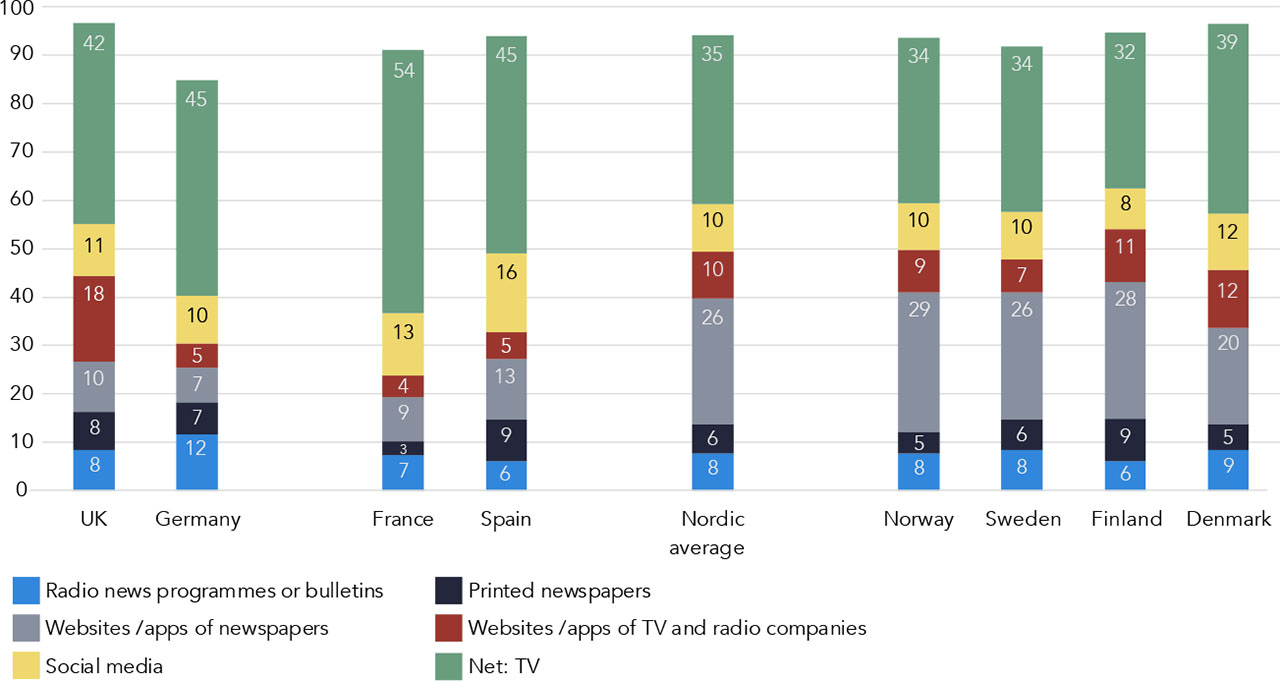
Figure 1
Main source of news 2019
Source: Newman et al., 2019, as cited in Schrøder et al., 2020
Moving on to the 2024 study, we were a bit more normative in that we addressed the negatively loaded concepts of “fragmentation” and “polarisation” and explored to what extent they characterise Nordic news media cultures. Again, we drew on comparable survey data from the Reuters Institute study – this time using them for a longitudinal analysis of Nordic trends in news consumption between 2016 and 2022, and for comparing the findings from the Nordics with those from the UK and the US. As in the previous study, we calculated an aggregated Nordic average to compare with the other countries, and two age groups were compared: young people (18–24 years old) and older people (55+). The use of a Nordic average does not mean that we’ve ignored national differences. We have tried to balance generalisation across the Nordics with attentiveness to outliers in several domains, especially paying for news and greater reliance on alternative media in Sweden.
Our findings on fragmentation, very briefly, are that while some age-based differences persist, the overall level of fragmentation has not increased over time. And more importantly, both young and old continue to rely on quality news sources, which should mitigate civic concerns.
Having found relatively low levels of fragmentation in the Nordics, we have gone one step further and advocated a non-alarmist stance towards the notion of audience fragmentation. In fact, there is nothing wrong with fragmentation in itself – it does not automatically lead to echo chambers or a democratic deficit. We argue that the civic quality of the content people encounter is more important than whether different societal groups, defined by age or class, duplicate their use of specific news outlets.
On polarisation, the brand-level analysis shows that Nordic user patterns cluster near the political centre, reflecting low media polarisation compared with the UK and especially the US. Richard Fletcher at the Reuters Institute has developed a way of graphically representing polarisation with media bubbles, which we’re very fond of (see Figures 2 & 3). In the UK (Figure 2), apart from the big BBC bubble on the zero line to the left, most British news brands have clear political inclinations at the top (rightwing) or the bottom (leftwing) of the figure.
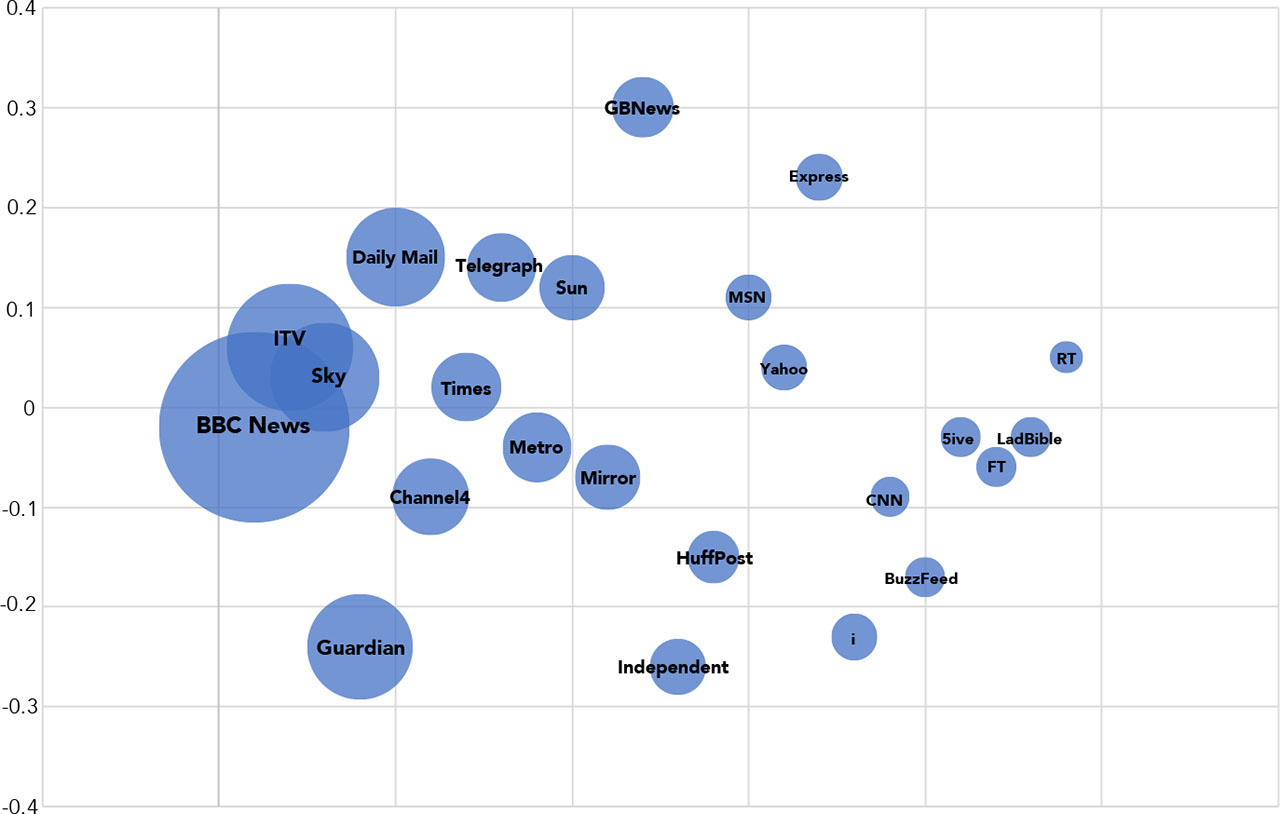
Figure 2
Polarisation of media in the UK, compound of brand scores across off-and online news media
Source: Newman et al., 2022, as cited in Schrøder et al., 2024
The picture for the Nordics (Figure 3), is very different: Located on the zero-line of polarisation, there are four big bubbles representing the national public service media institutions. In addition to these, there are a few smaller bubbles, or brands: rightwing at the top, leftwing at the bottom.
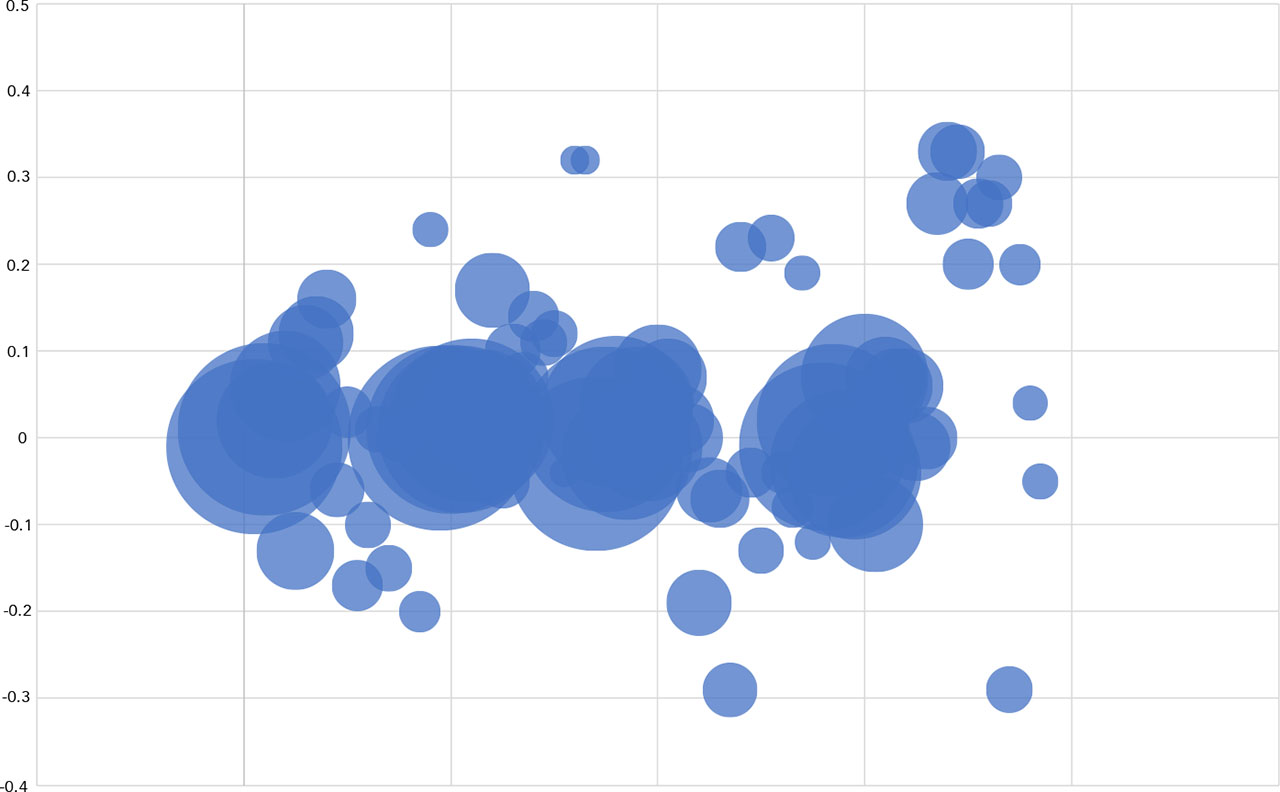
Figure 3
Polarisation of media in the Nordics, compound of brand scores across off- and online news media
Source: Newman et al., 2022, as cited in Schrøder et al., 2024
We have concluded that despite concerns about digital fragmentation and ideological echo chambers, Nordic news audiences continue to engage with broadly shared, high-quality news sources. These patterns support the ongoing viability of the media welfare state model from an audience perspective. Compared with the UK and US, Nordic media ecosystems appear more resilient, offering a compelling case for the continued value of public service and publicistic journalism in democratic societies.
In the future, there is a need to update this analysis, considering how Nordic information-seeking habits are being affected by the increasing use of AI in news production, how Nordic audiences handle the information pollution created by misinformation and fake news, and how the emergence of so-called “newsfluencers” especially impacts young people’s information sources. These topics have been built into the Reuters Institute’s questionnaire in recent years.
I now turn to my second topic: the current role of the Nordic news media when it comes to climate change and sustainability. I look mainly at the audience experience of the media’s performance on climate change, asking: Are the Nordic news media doing a good or a bad job of informing the citizens about climate change, climate crisis, and so on – and are they helping us imagine livable futures?
Climate journalism: Less is more
The first thing to say when evaluating the Nordic news media’s performance in relation to climate change is that they have a very difficult task: Today, the news media have to navigate a terrain in which truth and falsehood are often difficult to tell apart.
In June this year, a report by the International Panel on the Information Environment (Elbeyi, et al., 2025), chaired by Danish media scholar Klaus Bruhn Jensen, found, as reported in The Guardian, that “climate action was being obstructed and delayed by false and misleading information stemming from fossil fuel companies, rightwing politicians and some nation states” (Carrington, 2025: para. 2). In the report, social media were mentioned as the main culprits of spreading misinformation. So, this polluted information environment is the premise when evaluating how well the news media perform on the matter.
I now leave my home turf and enter the – for me – vast and foreign territory of climate media research. Before going into specific aspects of climate news journalism, let me reveal the – perhaps not so surprising – conclusion, which is that there is room for improvement! Even in the Nordic media welfare states, climate journalism does not fully succeed in engaging people for the climate cause.
Ideally, an evaluation of news media performance should adopt a holistic lens and consider the newsroom production of climate journalism; the agendas set and the frames adopted in the news content; and the audiences’ sense-making and impact. Not surprisingly, perhaps, to those of you who know my work over the years, I choose to focus on the audience dimension. And I’ll briefly touch the other dimensions by drawing on a few select sources – not least Line Weldingh’s (2024) doctoral dissertation from last year, which labels climate journalism “the media’s problem child”.
What I have learned here is that climate journalism is challenging because it doesn’t really fit into what Peter Berglez (2011) (among others) has called the “news media logic” – that is, the professional normative ideals and commercial rules that govern the production of news:
Climate change is a long-term process, but the temporal structure of journalistic production causes climate journalism to focus on dramatic events rather than complex processes.
Journalism’s preference for elite sources results in climate change being (mis)represented as something that’s mainly handled in the circles of politicians and businesspeople.
In spite of its high relevance and urgency, climate change generally has little news value: It doesn’t sell, and therefore doesn’t comply well with the commercial imperatives of the news industry.
Climate problems are often discursively framed in such a way that the responsibility to act lies with individuals rather than societal institutions (Appelgren & Jönsson, 2021).
But as I said, I want to focus on the news audience and ask: How do Nordic populations perceive and make sense of climate news? Does climate news manage to engage people for the climate cause?
The takeaways from the Reuters Institute surveys are that the Nordic news media are not overly successful in creating interest in climate change news, especially in relation to users who identify themselves as rightwing: In fact, many of those who avoid news do so because there’s too much climate news. To some extent, young people are seeking climate information from more personalised sources, and young people are to a greater extent than older people frustrated that media don’t abandon neutrality and take a clear stand on climate change.
Moving on to some mainly Nordic studies of how Nordic people use and make sense of climate change news (Ejaz et al., 2025; Eskjær & Horsbøll, 2023; Høegh-Krohn et al., 2025; Jensen, 2017; Kunelius & Roosvall, 2021; Moe et al., 2023, 2025; Willig et al., 2022), it is striking that they arrive at fairly similar conclusions. For instance, Jensen (2017: 452) found that “respondents found it difficult to articulate firm or stable positions on the problem and any solutions, recognizing feelings of impotence as well as inclinations either to avoid the topic or to blame others”.
Eight years later, Høegh-Krohn and colleagues (2025) found that many people experience climate change as an intangible news topic; news audiences are left confused and despondent in their encounter with climate journalism, and feeling overwhelmed and emotionally drained, many actively avoid climate-related news. Many participants find climate change ambiguous, as it blurs into related terms like “pollution” and “environment”.
What can Nordic news media do about this disheartening feedback? To answer this question, I take my point of departure in the fact that climate journalism is something that many people avoid. But why is this the case?
I suggest that one of the reasons may be that climate journalism as a whole is perceived as an overwhelming public campaign with strong normative pressure. So, while people are on the whole sympathetic to the green cause (according to recent Eurobarometer findings, no less than 85% across the EU believe that fighting the climate crisis should be given high priority), they nevertheless feel pressured by the sheer amount and ubiquity of climate news, in which they experience an implicit moralising, pointed finger.
Bringing in a campaign perspective on climate news, I lean on a study by Almlund and colleagues (2020) about audience perceptions of public communication campaigns. This and other studies show that even when people are positively disposed towards public campaigns, they nevertheless resent the element of preaching, and authorities interfering with the way they lead their lives. According to Bødker (2025), people in general do not lack knowledge about climate change – the problem is not that we’re facing a “knowledge deficit situation”.
To be clear, I’m not saying that the individual green news story is experienced as a campaign. The campaign effect is something that derives from the aggregate coverage of climate change, and its underlying premise is that if you’re not leading a green life, you’re a bad global citizen.
I know very well that climate communication scholars are saying that we should not “moralise” about green behaviours, but “normalise” them. But it’s very difficult to normalise without moralising. So, maybe it would be good to downsize the current amount of climate news – following the dictum that “less is more”?
Most of you will probably disagree, and say “the more, the better” – that whether they like it or not, people must be constantly pushed towards a more sustainable way of life. I advocate for less climate news, knowing very well that it won’t happen: Realistically, there is no chance that competitive news media will reduce the daily flood of news, in the area of climate news or in any other area. But maybe they should! As Moe and his colleagues (2025: 14–15) put it: In its current amount and form, “climate news stops making sense […]. Mechanisms of psychological distancing and expressions of low efficacy thereby become potential shields from despair, making it easier to go on with everyday life as normal”.
So, I suggest that “less is more”, or “less is better” – and that climate awareness and incentives to embrace climate engagement may benefit from a less massive load of climate coverage. Maybe less green journalism would actually be more effective – maybe reducing overload could,
increase impact: If climate stories were more selective, they might stand out more and feel less like background noise. This could help audiences absorb and reflect on the information rather than tune it out.
avoid moral fatigue: Constant exposure to stories that frame climate change as a moral failing can backfire. People may feel judged or powerless, which can lead to disengagement. A lighter touch – or a shift toward solutions-focused journalism – might foster more constructive responses.
make room for relevance: Research has found that people are most interested in climate stories that intersect with local news and weather. Less frequent but more personally relevant coverage could deepen engagement.
When I say this, I don’t really believe that it is my job to tell climate journalists how to do their job. But I suggest that a smaller volume of climate news should be accompanied by changes in the tone, form, and content of climate journalism – a different climate news rhetoric.
There are already many initiatives in the news industry aimed at giving a stronger role to climate journalism, for instance, a report from the European Broadcasting Union (2023) titled Climate Journalism that Works. There is also the worldwide Oxford Climate Journalism Network (reutersinstitute.politics.ox.ac.uk/oxford-climate-journalism-network), in which 800 climate journalists share innovative – perhaps more constructive and solution-oriented – ways to engage audiences.
Other solutions may be found outside of the news media sphere, in the universe of social and video platforms: Eskjær (2021) has pointed to the potential residing in individual opinion-leaders and influencers (sometimes called “greenfluencers”) who communicate directly with their followers. The greenfluencers combine factual information with emotional engagement – and have greater appeal, in particular amongst younger audiences, through what he has called “affective identification mechanisms” (Eskjær, 2021: 643).
Similarly, Lundtofte and Hagensen (2024) have suggested that the mainstream media should learn from the short, playful climate videos published on Instagram and TikTok, which use humor to get users to reflect on ways to be green.
Moving towards a conclusion
Despite the many qualities of the Nordic news media, which I extolled in the first part of the article, looking specifically at the news media’s ability to get the green message across to the audiences, there is room for improvement. Thus, if we want to go forward as Nordic media welfare societies, we need to find sustainable solutions to the climate challenges the world faces, and we have to do this through collective deliberative public fora that bring together societal actors from various levels and spheres: state and public authorities, businesses and organisations from the digital technology sector, civil society organisations, research institutions, as well as interested individual citizens.
Among all these actors, the mainstream media are still pivotal as providers of information and as vehicles of public debate. Therefore, we should ask to what extent the Nordic media system and its mainstream media are still operating as media welfare states capable of organising such debates. Are the four pillars still standing, increasing the likelihood of enlightened democratic deliberation in the Nordic societies?
One key challenge is, evidently, that control over digital infrastructures is increasingly in the hands of a few global companies, which means that key forms of media regulation can no longer be accomplished on the national level. We therefore have to ask, with Marko Ala-Fossi, if the media welfare state is “an image in the rearview-mirror” (Ala-Fossi, 2020) or whether it remains a reality on the road that lies ahead of us.
Marko Ala-Fossi has been one of the sustained critical voices in this debate. He has both discussed whether the Nordic media model as such still holds explanatory value and has particularly argued that Finland no longer fits into the model.
On the first matter, he has claimed that the Nordic media markets have been losing their “distinguishability”, that none of the four countries today lives up to all four pillars, and that the media welfare state model only has “a partial match with reality” (Ala-Fossi, 2020: 14).
On the second, he has argued that Finland has increasingly deviated from the model due to unique geopolitical, economic, and political factors. Today, Finland only lives up to pillar 2 (editorial freedom), but not pillar 1, because it has privatised key communication infrastructures; nor pillar 3, because it has abolished all press subsidies; nor pillar 4, because the government has regulated with a strong bias in favor of the mobile tech industry. So, maybe Finland has left the Nordic media welfare state model while Denmark, Norway, and Sweden still adhere to the key criteria?
This question is illuminated in a study by Grönvall and Karppinen (2025), who examined how public service media have been discursively framed in national policy debates across the Nordic countries over a ten-year period (2013–2022), again in relation to the four pillars. Long story short: Finland again stands out as the most deviant from the media welfare state model. Norway, in contrast, has the best fit with the pillars, with Denmark and Sweden in between, living up at least partially to the four pillars.
I thought that for fun I’d ask the AI platform CoPilot what this looks like. This is how CoPilot represents the situation graphically…
Figure 4 shows at a glance how Norway upholds all four pillars (green icons), while Finland diverges significantly, particularly on cultural and stakeholder engagement (red icons). Sweden and Denmark sit somewhere in between (with a mix of yellow and green icons).
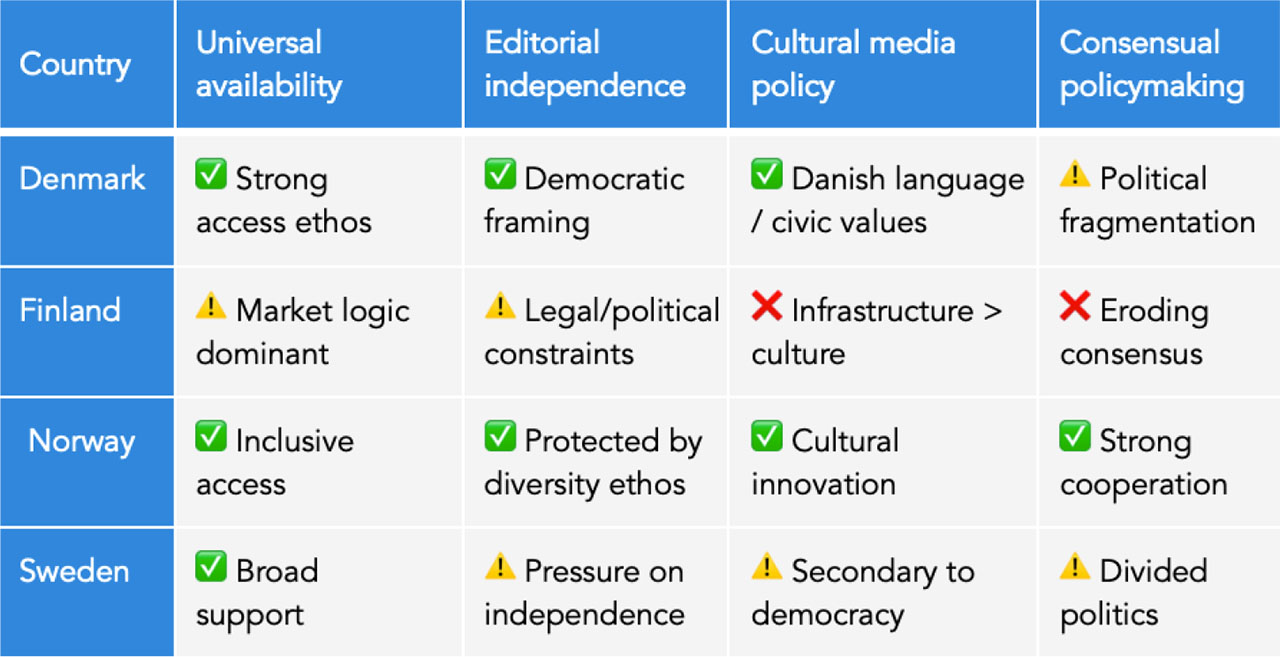
Figure 4
How CoPilot represents Nordic media policy discourses 2013–2022
Source: based on findings presented in Grönvall & Karppinen, 2025
My third and last take on the status of the Nordic media welfare state comes from a chapter by Flensburg and Lai (2024). The chapter offers a detailed analysis of the media conditions of the Nordic societies in the age of Big Tech, in the form of an analytical discussion of Syvertsen and colleagues’ (2014) work and their claim that Nordic media welfare states build on four pillars that ensure the maintenance of a media environment that creates favourable conditions for democratic enlightenment.
Flensburg and Lai (2024: 179) argued that “the Internet’s evolution into a critical societal infrastructure has reconfigured the material conditions for communication and led to the emergence of a wide range of new media and communication platforms”, which operate outside of the traditional control and media support structures of the media welfare state. Their analysis comprises, first, an analytical description of the four layers of Internet infrastructure:
access networks: highspeed broadband connections available to users
backbone infrastructures: submarine cables and Internet exchange points
interfaces: websites and mobile apps
data flows: digital data collection and distribution
After delineating how these four infrastructural layers are owned and controlled in the Nordic countries, Flensburg and Lai related them systematically to the four pillars of the media welfare state, finding that all four pillars, but some more than others, are being undermined by the new Internet infrastructure.
With respect to pillar 1 (universality of access and media as public goods), they found that although the global tech companies function as important gatekeepers, the Nordic media welfare states to a large extent hold to the requirements of this pillar: “Through public digitalisation strategies, the four welfare states […] have played key roles in ensuring equal access in non-profitable areas and stimulating the availability of publicly available digital services” (Flensburg & Lai, 2024: 193).
Regarding pillar 2 (freedom from editorial interference and self-regulation of the industry/market), on the one hand, the pillar holds, as Internet platforms have made “individual Internet users independent from former editorial gatekeepers” (Flensburg & Lai, 2024: 194). However, it has also led to massive amounts of misinformation and hate speech. On diminished self-regulation, Flensburg and Lai mentioned the many examples of clashes between Nordic media and American tech giants over content values.
With respect to pillar 3 (content obligations and support schemes), the Nordic model continues to have impact: Public service media must live up to content requirements like non-partisan information and cultural diversity, and subsidies for news organisations serve to maintain diversity in the news market.
Finally, on pillar 4 (consensual solutions), within the national media markets in the Nordics there is still a high degree of collaborative solutions between private and public operators, but international tech giants defy consensual regulation and strongly oppose attempts to involve them in regulation of competition and copyright affairs.
In their conclusion, Flensburg and Lai all but dismissed the insights of classic media systems analysis and found the Nordic media welfare state to be in bad health. But, as I read their detailed analysis, they also acknowledged that – until now at least – the classic media welfare state has not completely disappeared: This is because the political and institutional heritage of the Nordic countries ensure that some key characteristics of the media welfare state remain even under new infrastructural conditions.
Conclusion
Flensburg and Lai’s (2024: 196) conclusion is negative for the notion of an existing media welfare state; in their words, “the media welfare state is more of a theoretical ideal than an empirical reality”. I would, however, say that comparisons with countries beyond the Nordics should make us realise that the Nordic states are still, to some extent, ensuring that they follow the four pillars to the best of their ability under the new globalising infrastructural conditions.
As I have tried to demonstrate in my brief reading of their analysis, the negative conclusion is not entirely borne out by their analysis. In my reading, the media welfare state is still to some extent an empirical reality, although it faces serious challenges from the global order of the Internet. Their conclusion is thus, in my view, more pessimistic – and less nuanced – than their analysis warrants.
Looking around the world, Nordic mainstream news media are probably “the least bad” providers of high-quality journalism for public discussion of climate change and other challenges facing the world today. But they will increasingly be supplemented by “a personality-driven alternative media sector” (Newman et al., 2025: 13) populated by both “journalistic influencers” and other kinds of influencers, including greenfluencers.
There will be many challenges for the maintenance of a deliberative public sphere, as there are powerful players influencing the formation of Nordic media agendas and news frames. Furthermore, we’re facing the infrastructural power of Big Tech platforms and their depletion of revenues that formerly flowed to the national news media. There are also the potentially ominous effects of AI, the consequences of digital surveillance, the political attempts to curb the activities of the public service media, etcetera, etcetera.
Nevertheless, in my crystal ball, the Nordic news institution, with its backbone of public service media that exist alongside quality, publicistic private media, and a citizenry that is less fragmented, less polarised, and more well-informed than anywhere else in the world, ensures that we’re better off in the Nordic countries than most other regions of the world, and we have reason to be confident in our ability to collectively develop sustainable and livable futures.