

TABLE 1
Norwegian parties represented in parliament, 2021
| Party | Votes (%) | Mandates (change) | In gov’t before election | Ideological position/bloc | Social media platforms used in the campaign | Party leader | Categorised as pop ulist (according to PopuList) |
|---|---|---|---|---|---|---|---|
| Labour Party [Arbeiderpartiet] | 26.3 | 48 (−1) | No | Social Democratic/Red–Green | All | Jonas Gahr Støre | No |
| Conservative Party [Høyre] | 20.4 | 36 (−9) | Yes | Conservative-Liberal/Blue | All (Twitter only by party leader) | Erna Solberg | No |
| Centre Party [Senter-partiet] | 13.5 | 28 (+9) | No | Rural/Red–Green | Facebook and Instagram (Instagram only by party) | Trygve Slagsvold Vedum | No |
| Progress Party [Freskritts-partiet] | 11.6 | 21 (−6) | No | Populist, Rightwing/Blue | Facebook and Instagram | Sylvi Listhaug | Yes |
| Socialist Left Party [Sosialistisk venstre-parti] | 7.6 | 13 (+2) | No | Socialist/Red | All | Audun Lysbakken | No |
| Red Party [Rødt] | 4.7 | 8 (+7) | No | Socialist/Red | All | Bjørnar Moxnes | No |
| Liberal Party [Venstre] | 4.6 | 8 (0) | No | Non-Socialist/Liberal/Blue | All | Guri Melby | No |
| Christian People’s Party [Kristelig Folkeparti] | 3.8 | 3 (−5) | Yes | Non-Socialist/Christian/Blue | Facebook and Instagram | Kjell Ingolf Ropstad | No |
| Green Party [Miljø-partiet de Grønne] | 3.9 | 3 (+2) | No | Green | All | Une Bastholm | No |
| Patient Focus [Pasientfokus] | 0.2 | 1 (+1) | No | One issue movement, regional | Facebook (only used by party) | Irene Ojala | Not categorised |
[i] Source: Valgdirektoratet, 2021; Rooduijn et al., 2019
TABLE 2
Presence of populist communication across platforms (per cent)
| People-centrism | 3.1 | 1.9 | 0.2 |
| Anti-elitism | 9.3 | 6.8 | 4.3 |
| Exclusion of out-groups | 2.9 | 1.4 | 0.4 |
[i] Comments: n = 2,518 posts.
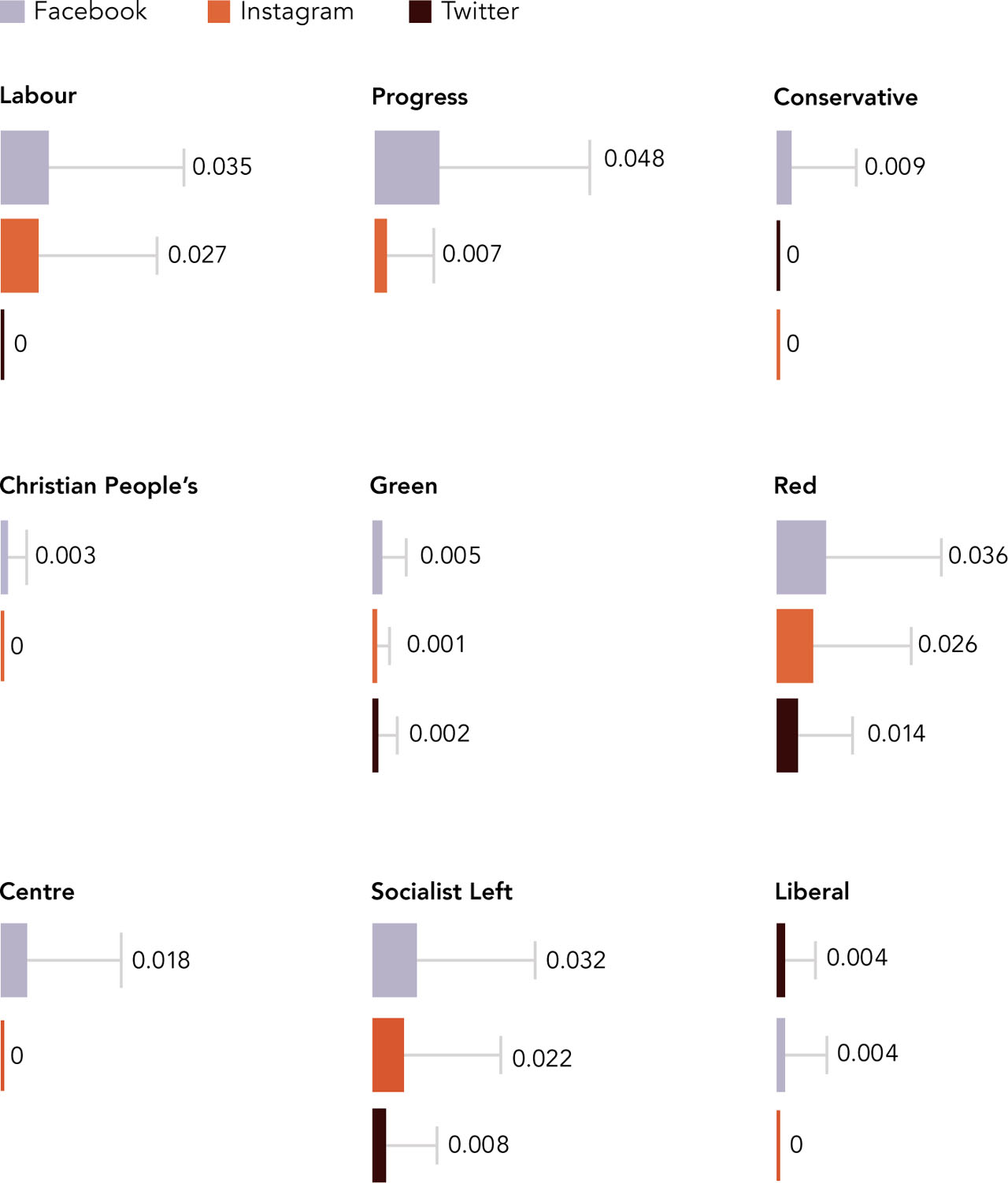
FIGURE 1
Additive populist communication index across platforms, by party (mean)
Comments: n = 2,518 posts.
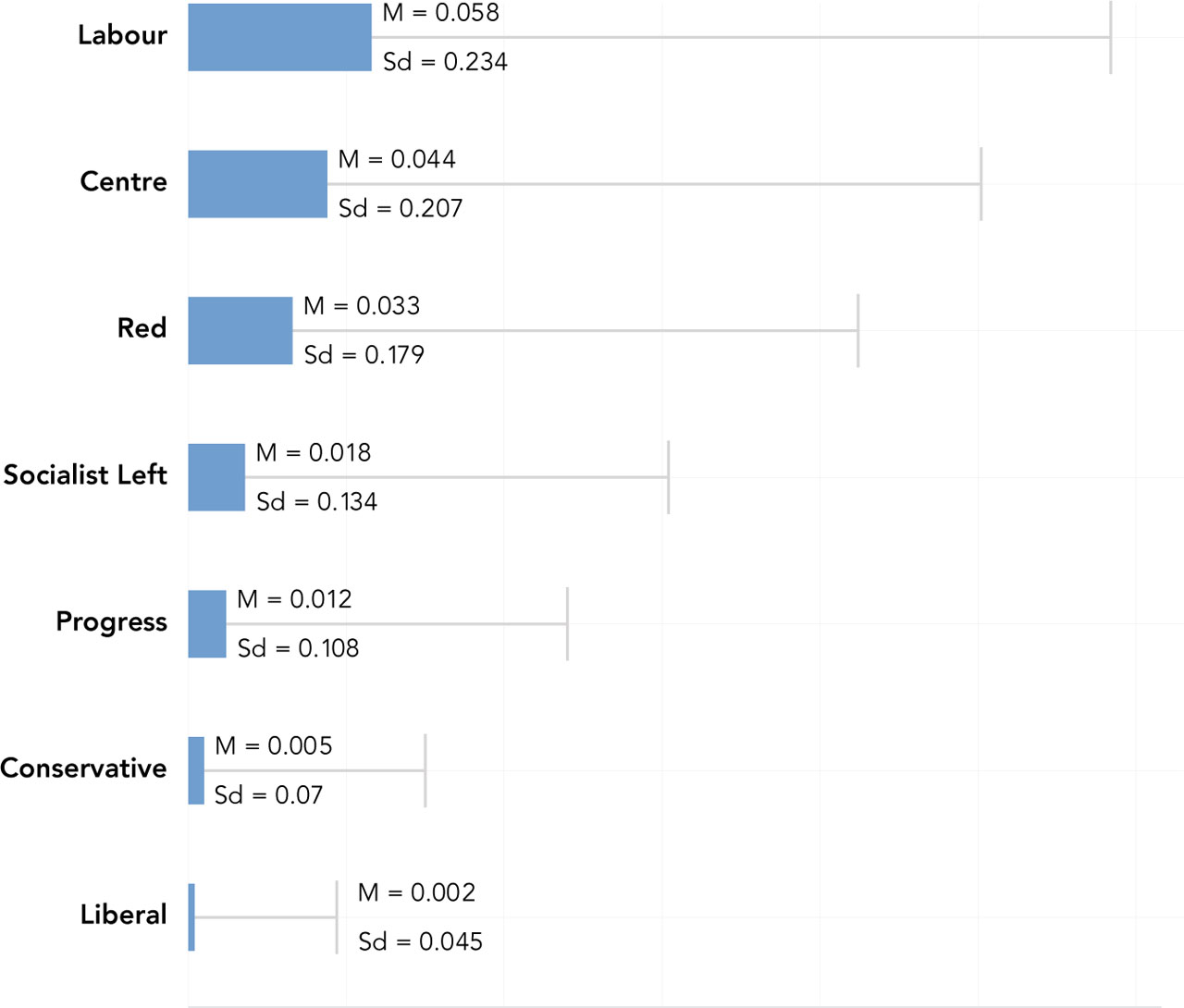
FIGURE 2
Use of people-centrism per post for all platforms, by party (mean and standard deviation)
Comments: n = 2,518 posts.
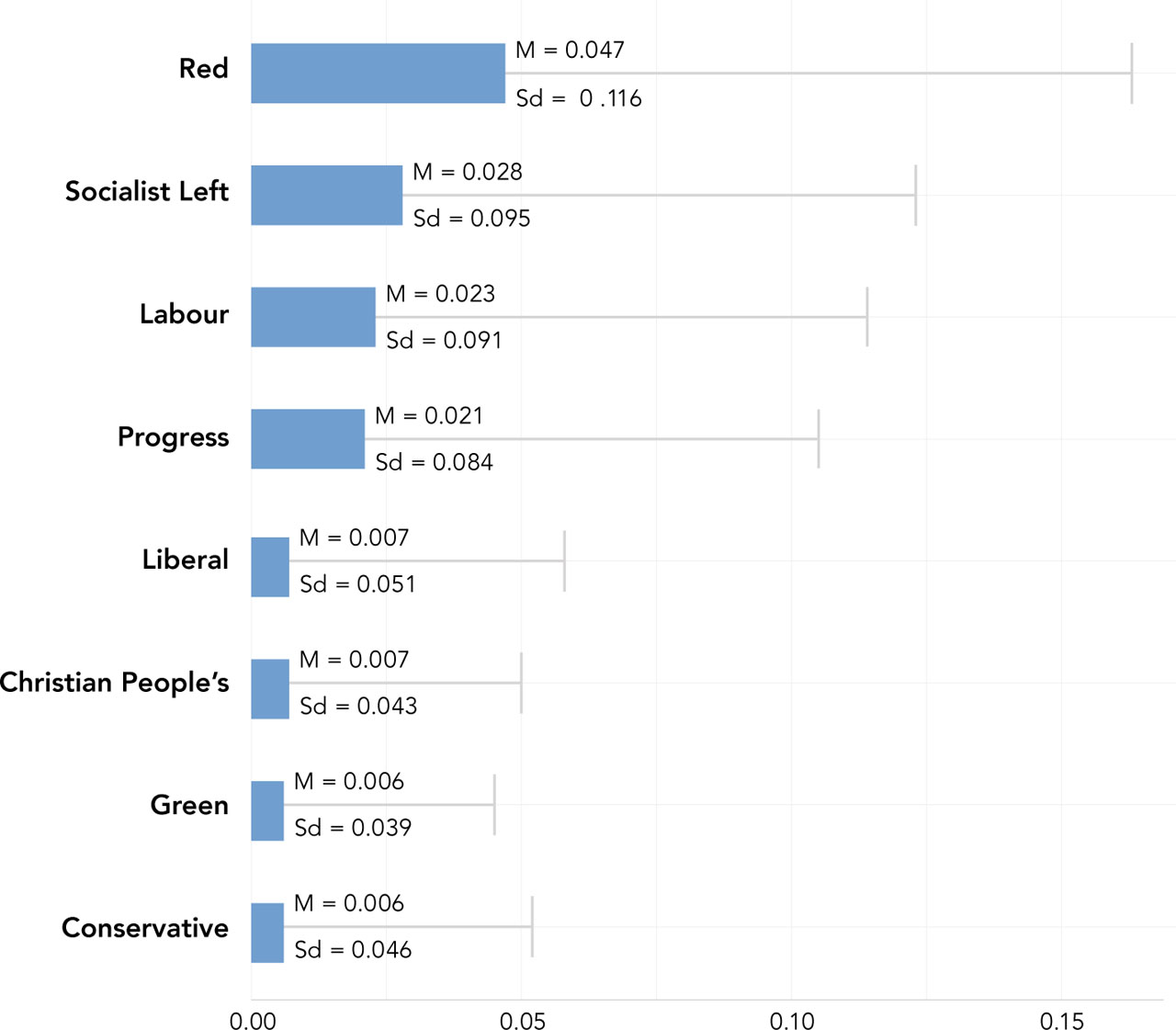
FIGURE 3
Use of anti-elitism per post for all platforms, by party (mean and standard deviation)
Comments: n = 2,518 posts.
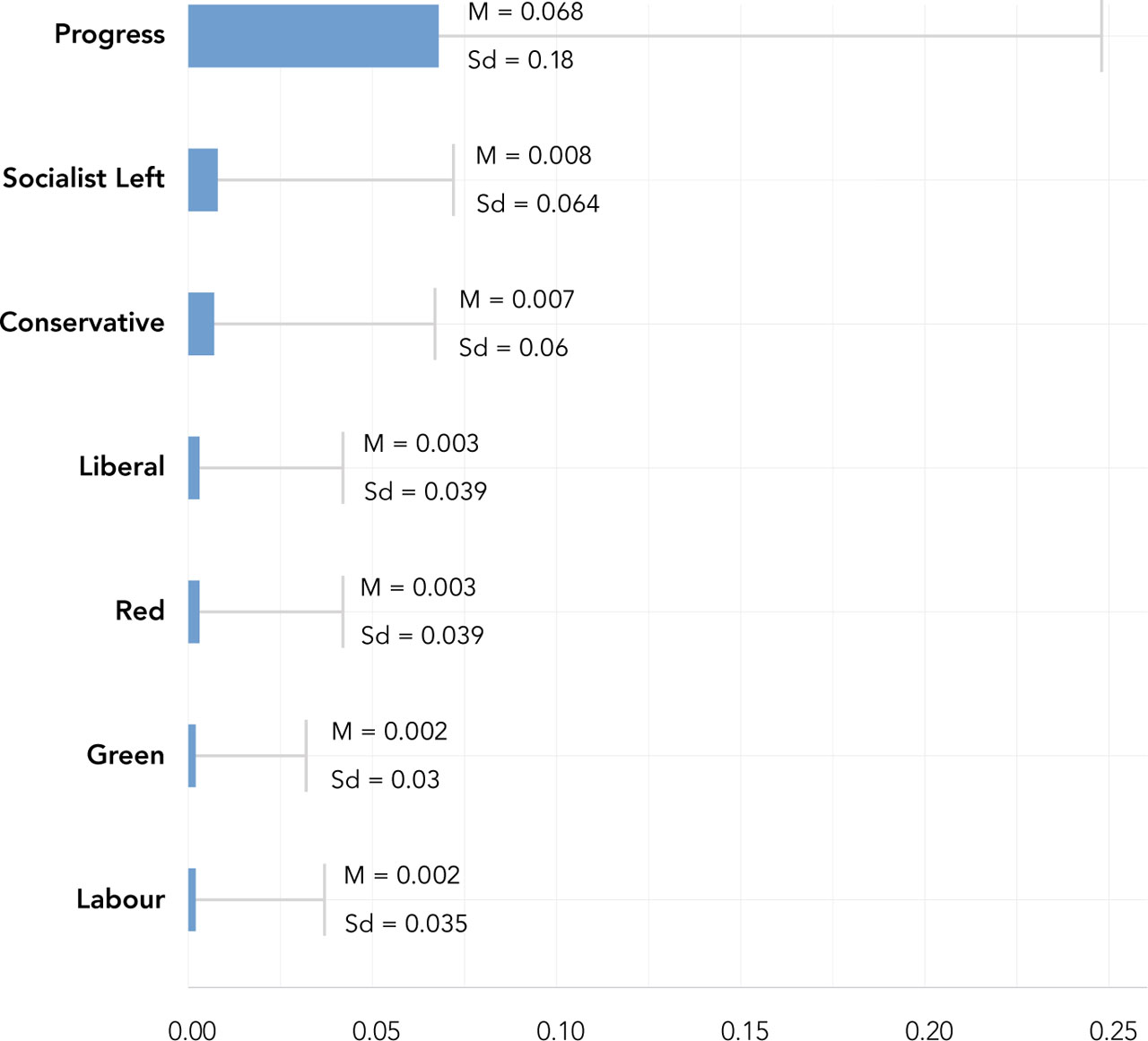
FIGURE 4
Use of exclusion of out-groups per post for all platforms, by party (mean and standard deviation)
Comments: n = 2,518 posts.
TABLE A1
Overview of the sample
| Party | Facebook (n) | Instagram (n) | Twitter (n) | All platforms (n) | Share of all posts from party (%) | |
|---|---|---|---|---|---|---|
| Labour | Party | 97 | 36 | 28 | 161 | 78 |
| Jonas Gahr Støre | 35 | 7 | 4 | 46 | 22 | |
| Total | 132 | 43 | 32 | 207 | 100 | |
| Conservative | Party | 109 | 20 | – | 129 | 63 |
| Erna Solberg | 37 | 18 | 21 | 76 | 37 | |
| Total | 146 | 38 | 21 | 205 | 100 | |
| Centre | Party | 38 | 11 | – | 49 | 72 |
| Trygve Slagsvold Vedum | 19 | – | – | 19 | 28 | |
| Total | 57 | 11 | – | 68 | 100 | |
| Progress | Party | 62 | 17 | – | 79 | 47 |
| Sylvi Listhaug | 47 | 43 | – | 90 | 53 | |
| Total | 109 | 60 | – | 169 | 100 | |
| Socialist Left | Party | 74 | 79 | 101 | 254 | 47 |
| Audun Lysbakken | 60 | 99 | 132 | 291 | 53 | |
| Total | 134 | 178 | 233 | 545 | 100 | |
| Red | Party | 123 | 78 | 84 | 285 | 59 |
| Bjørnar Moxnes | 108 | 50 | 42 | 200 | 41 | |
| Total | 231 | 128 | 126 | 485 | 100 | |
| Liberal | Party | 55 | 28 | 309 | 392 | 80 |
| Guri Melby | 45 | 15 | 38 | 98 | 20 | |
| Total | 100 | 43 | 347 | 490 | 100 | |
| Christian People’s | Party | 39 | 9 | – | 48 | 71 |
| Kjell Ingolf Ropstad | 13 | 7 | – | 20 | 29 | |
| Total) | 52 | 16 | – | 68 | 100 | |
| Green | Party | 49 | 42 | 143 | 234 | 83 |
| Une Bastholm | 20 | 17 | 10 | 47 | 17 | |
| Total | 69 | 59 | 153 | 281 | 100 | |
| All parties & politicians | All parties | 725 | 320 | 665 | 1710 | 66 |
| All politicians | 384 | 256 | 247 | 887 | 34 | |
| Total | 1,030 | 576 | 912 | 2,518a | 100 |
a 5 of the posts we originally collected had been deleted by the account owners prior to our coding. The deleted posts are not included in Table A1.
TABLE A2
Reliability coefficients
| Variable | Brennan’s & Prediger’s kappa | Agreement (%) | |
|---|---|---|---|
| People-centrism | 1: References to the people | .838 | 92 |
| Anti-elitism | 2.1: Blaming the elite (from any sector) | .781 | 89 |
| 2.2: Questioning the elite’s legitimacy to take decisions | .924 | 96 | |
| 2.3: Calling for resistance against the elite and their ideas and direct popular decisions | .914 | 96 | |
| 2.4: Accusing the elite of betraying the people or acting against the people’s interest | .962 | 98 | |
| Exclusion of outgroups | 3.1: Ethnic or cultural “others” | .99 | 100 |
| 3.2: Political “others” (holding allegedly minority opinions) | .905 | 95 |
| Category | Description | Code |
|---|---|---|
| criticism1 |
| 0/1 |
| criticism2 |
| 0/1 |
| criticism3 |
| 0/1 |
| criticism4 |
| 0/1 |
| Category | Description | Code |
|---|---|---|
| people |
| 0/1 |