

Introduction
Football fandom has become increasingly politicised in recent years (Doidge et al., 2020), not least via an increased focus on sportswashing. 1 This relatively new term describes the purchasing of sports interests in the service of improving public perceptions of nations, businesses, governments, and individuals, particularly those with poor human rights records or a poor public image. In this article, we explore sportswashing through social media and legacy media responses to the Saudi Arabian State takeover of Newcastle United Football Club. We do so as scholarly researchers and as Newcastle United fans. 2 In particular, we explore mediated uses of the past and nostalgia in the context of legitimating and delegitimating sportswashing.
On 7 October 2021, a consortium led by the Saudi Public Investment Fund (PIF) completed a takeover of Newcastle United Football Club (NUFC). While welcomed by many Newcastle fans, this was the focus of criticism from organisations such as Amnesty International. PIF, as the investment arm of the Saudi state, is chaired by the Crown Prince of Saudi Arabia, Mohammed bin Salman. bin Salman has been accused of increasing the repression of critics and overseeing human rights abuses. These include a 2019 mass execution of prisoners, the violent closing down of women’s rights reform protests, and complicity in the murder of journalist Jamal Khashoggi in 2018 (Freedom House 2021; Qiblawi, 2019).
Some activists, journalists, and human rights organisations have questioned the willingness of NUFC supporters to welcome this ownership. We explore supporter and media responses to this takeover, with a focus on Twitter (now X) 3 and legacy news media content in the year following the takeover. Through giving attention to discourses of nostalgia and of sportswashing, we examine the means through which sports ownership can be both legitimated and delegitimated in the football media landscape. We develop understandings of how sportswashing operates, explore the complicity of the past and nostalgia therein, and offer insight into political mobilisations in the context of sport.
We explore our approach to the concept of sportswashing through a critical engagement with emerging definitions of the term. We consider nostalgia, and the linked role of emotion and memory, as a component of the construction of belonging and identity through sport, particularly in relation to football fandom. Through an analysis of responses to the takeover as gathered from Twitter, we explore the different frames of reference that emerge in the discourse of nostalgia towards the past of the football club and responses to the potential sportswashing associated with a state takeover of Newcastle United. Through these responses, we interrogate the potential for nostalgia to serve the legitimation and delegitimation of sportswashing. The article expands on sportswashing studies by bringing this term into engagement with memory, nostalgia, and media analysis.
Background
PIF’s interest in purchasing Newcastle United emerged in April 2020, with immediate opposition raised on human rights grounds. Amnesty International encouraged Newcastle fans to oppose the takeover, while Adam Crafton, journalist with The Athletic, detailed the violence and fear faced by LGBTQIA+ communities in Saudi Arabia (Crafton, 2022). Additionally, the wife of the murdered journalist Jamal Khashoggi spoke out against the deal (Taylor, 2020). While it has been suggested that accusations of sportswashing treat Gulf states with a negative exceptionalism (Crossley & Woolf, 2024), the human rights abuses raised are accurately represented. Concurrently, a protest was raised by Qatar-based broadcaster beIN Sports. beIN claimed that their coverage of Premier League matches was being broadcast illegally in Saudi Arabia under the name beoutQ. On 6 October 2021, Saudi Arabia lifted their ban on beIN sports broadcasts and, a day later, the Newcastle United takeover was completed.
Thousands of Newcastle fans gathered at St James’ Park, the club’s home ground, to celebrate the takeover. The event seemed to trigger emotions of hope among most fans, with visible opposition largely confined to the activities of the NUFC Fans Against Sportswashing group. This hope could be seen as part of an act of “motivated ignorance” among fans (Jones et al., 2024). NUFC fans’ hopes, however, have subsequently been realised in results on the pitch. The 2022–2023 season included a first cup final in 24 years, and a qualification for the subsequent season’s Champions League, with a first cup title since 1969 following in the 2024–2025 season.
This positivity exists alongside continued reminders of the source of funding for this success. Newcastle United is now a small part of PIF’s heavy investment in global sport. In this context, investment in a football club – a prospect that brings significant levels of attention and requires considerable investment – is reflective of a broader public strategy. It is here, perhaps, that sportswashing becomes a pertinent term.
Sportswashing and its (de)legitimation via memory and nostalgia
Sportswashing as an emergent field of study
Sportswashing is a relatively new term, first used in an article relating to a sporting event in the UK in 2015 (Skey, 2023). It is also a term drawing increasing academic engagement (Davis et al., 2023; Fruh et al., 2023; Ganji, 2023; Grix et al., 2025; Kazakov, 2025; Kearns et al., 2024). This includes a broadening of focus from large international sporting spectacles such as the Olympic Games (Boykoff, 2022) to longer-term investment projects such as the state purchase of sporting teams (e.g., Kearns et al., 2024; Crossley & Woolf, 2024; Jones et al., 2024).
While a lack of consensus remains regarding the definition of sportswashing (Grix et al., 2025) and a focus on definitions can obscure the complexities of the subject (Kazakov, 2025), in this article, we generally adopt Skey’s approach. This suggests that sportswashing is focused on “acts of consociation rather than deception. It is designed to build positive associations with a state/country rather than simply conceal” and is concerned with “state actors who work with, or alongside, national or supra-national sporting organizations” (Skey, 2023: 760). The focus on consociation tackles a critique that viewing acts such as the PIF purchase of Newcastle United through the sportswashing lens can lack nuance (Crossley & Woolf, 2024; Chadwick, 2022). Skey, additionally, recognised that sportswashing is a “pejorative term” that seeks to critique nation-state involvement in sport while often being entirely focused on state actors outside the West. As Jonathan Wilson’s history of the Football World Cup makes clear, football has long been used to embellish the global image of nation states (Wilson, 2025), recognising the deep historical roots of these forms of political uses of sport.
An increased attention on human rights abuses in Saudi Arabia at the time of the Newcastle takeover would suggest that viewing these actions as a means of concealment would be flawed. However, we do see evidence of political motivation for the purchase of sports teams that exceeds a diversification of the Saudi Arabian economic interests (Ettinger, 2023). The release of Newcastle United kits with a striking resemblance to the Saudi national football team shirts, the hosting of Newcastle United friendly matches in Saudi Arabia, and Saudi Arabian national team matches in Newcastle suggest acts of consociation. Considering acts of consociation, and our later exploration of (de)legitimation of sportswashing, allows us to respond to calls for a greater appreciation of the role of different forms of media environments in understanding the political power of sports (Kazakov, 2025). In doing so, we work to bring a nascent field of sportswashing studies into further dialogue with those of memory studies, nostalgia studies, and media studies.
Nostalgia, memory, and sports
Scholars have regularly studied the interfaces between sport, memory, and nostalgia (Healey, 1991; Slowikowski, 1991; Snyder, 1991) with respect to mostly national, but also local, sporting events and teams, often foregrounding the role of these interfaces in processes of identity construction (Brabazon, 2006; Hunt, 2019; Sindbæk Andersen, 2013). More recently, there have been signs of a renewed and amplified interest in the connections between these fields (Nosal et al., 2024).
Against the background of these developments, we are less concerned with memory and nostalgia as “ends” than as “means” (Merrill & Rigney, 2024). Our main focus is not what is being nostalgically remembered in social media and legacy media, but rather when and how it is remembered and with what consequences. Rigney (2026: 230) has additionally distinguished between nostalgic uses of the past, seeking the “return of a lost Eden” and uses of the past as a “resource for building a world different from both the past and the present”. Smith and Campbell (2017: 612), however, supported a view of nostalgia as an affective practice that neither infers a particular form of political action nor requires a focus on loss. Rather, nostalgia can be hopeful and future oriented. When we focus on references to specific past moments in the history of Newcastle United, we see practices akin to the progressive nostalgia outlined by Smith and Campbell. That is, we see evidence of both a “sense of loss tempered with overt pride” and the construction of a “communal belonging” at a time of significant change (Smith & Campbell, 2017: 617). Nostalgia, here, is a space where legitimacy, through the past, can be asserted or denied through the construction of a “collective mythology” (Boym, 2007: 8) built on the evocation of both positive and negative emotions of loss, longing, and imagined futures.
Our efforts resonate with research agendas that seek to understand the political use of the past, memory, and nostalgia in terms of state actions and grassroots activist counter measures (see Menke, 2025; Numerato & Svoboda, 2022). To do this, and centring on digitally mediated forms of nostalgia (Niemeyer, 2014), we draw conceptually on Kearns and colleagues’ (2024) discussion of the legitimation of sportswashing.
(De)legitimation and nostalgia
Legitimation can be understood as a “linguistic process, wherein legitimacy is affirmed and continually reaffirmed through everyday discursive interactions” (Kearns et al., 2024: 484). Applying Van Leeuwen’s (2007) four categories of legitimation: authorisation (legitimacy derived from authority); moral evaluation (legitimacy derived from presumed common moral values); rationalisation (legitimacy derived from supposedly logical arguments); and mythopoesis (legitimacy derived from narrative illustration), Kearns and colleagues (2024: 481) have shown how Manchester City fans became complicit in sportswashing by employing “a range of legitimation discursive tactics” shaped by the club’s history.
We adapt this approach to the fields of memory and nostalgia studies by examining how remembering a club’s past can serve to lend legitimacy to new ownership, otherwise accused of sportswashing. We emphasise the mnemonic and nostalgic tendencies that can inform or reinforce many, if not all, of Van Leeuwen’s (2007) categories of legitimation. In terms of authorisation, legitimacy utilises the authority of tradition that is connected to how things are remembered as always having existed and thus not requiring justification or elaboration. We can conceive, then, of the authority of a connection to a nostalgic past, evoked through reference to collective experiences and memories. Moral evaluation, meanwhile, relies on evaluation, abstraction, and comparison, but overall, on reference to shared value systems which can again hinge on what is remembered as “normal”. Rationalisation, too, can depend on mnemonic and nostalgic schemes because explanation often relies on what has happened in similar scenarios earlier on. But it is perhaps mythopoesis and the use of moral and cautionary tales where memory and nostalgia have the clearest influence, given the importance of narrative within practices of remembering and remembrance.
Our conceptualisation of nostalgic (de)legitimation is distinct from Kearns and colleagues’, however, rather than considering delegitimation solely in terms of inverted discursive strategies turned outwards towards critics, nostalgic delegitimation also relates to how the hopeful past can be used as a buttress against owners seeking approval within a sportswashing project. This accounts for scenarios where nostalgia and memory are used not only to aid sportswashing but also to resist it as a form of activist memory work (see Merrill et al., 2020). We further respond to an acknowledged gap in the literature (see Jones et al., 2024; Kearns et al., 2024), focusing on the impact of sportswashing on specific, local audiences. While fan groups are never homogeneous, we approach Newcastle United fans, including ourselves, as not unavoidably vulnerable to sportswashing but also as actual and potential critics for whom the past might serve as a means of resistance.
Material and methods
While others have explored fan reactions to the new ownership of Manchester City and Newcastle United using online fan forums (Kearns et al., 2024; Jones et al., 2024), Twitter is the starting point for our analysis of the nostalgic (de) legitimation of sportswashing. More specifically, we focused on #NUFC, the most commonly used Newcastle United hashtag. Used heavily but not exclusively by Newcastle United fans, #NUFC differs from dedicated fan forums as it is more likely to facilitate discussions and debates that extend beyond specific fan groups, reaching other fans and actors such as activists and journalists. For this reason, it offers analytical opportunities that differ from online fan forums. While recognising that the #NUFC hashtag represents a limited cross-section of fans, our decision to study Twitter reflects the significant role that it and other social media platforms play in the digital mediation of memory and nostalgia, including in relation to past sporting events (Malanski et al., 2022).
We used the twarc2 command line and Python library (see twarc, n.d.) to collect 3,377,175 tweets (original tweets and retweets) containing #NUFC. These tweets spanned 450 days (12 August 2021–4 November 2022), including both the official confirmation of the takeover on 7 October 2021 and the first anniversary of the takeover. From this larger sample, two subsamples of tweets were then extracted.
The first subsample included tweets containing at least one of a set of words focused on the period of the club’s history between 1992 and 2004, the most recent (pre-takeover) periods of near-success for the club, and a period that is in living memory for most Newcastle fans. 4 During this period, the team was managed by four managers: Kevin Keegan, Kenny Dalglish, Ruud Gullit, and Bobby Robson. Highlights of this period included two consecutive runners-up finishes in the Premier League under Keegan in 1995/1996 and 1996/1997, 1998 and 1999 FA Cup final defeats under Dalglish and Gullit, and consecutive qualifications for Champions League football in 2002/2003 and 2003/2004 under Robson. This subsample consisted of 15,561 tweets. Our choice of these pasts reflects the way these moments have been used by Newcastle United and the supporters of the club. For example, the supporter group Wor Flags have regularly referenced Keegan, Robson, and kits from the 1990s in their pre-match “tifo” displays. The club has also recently produced a series of away shirts that reflect kit designs from these periods. Such references to these pasts hold the potential to express a nostalgic desire to revisit a more hopeful past (Boym, 2007). In our analysis, we identify instances where these same pasts are referenced as a means of either expressing the return of past hopes through a form of restorative nostalgia (Kaya, 2023), or a counter-argument that signals the further loss of connection to this hopeful past, and the potential activist use of this counter-argument as a form of progressive nostalgia (Smith & Campbell, 2017).
The second subsample included tweets containing at least one of a set of words taken to indicate the discussion of the club’s new Saudi Arabian ownership in relation to sportswashing. 5 These discussions often focused on Saudi Arabia’s human rights abuses, the repression of LGBTQIA+ people, the murder of Jamal Khashoggi, and Saudi Arabian involvement in the Yemeni Civil War. These discussions also regularly mentioned Mohammed bin Salman. This subsample consisted of 43,464 tweets.
We plotted the frequency of the tweets associated with these two subsamples across the sample period in order to gain insight into the general relationship of nostalgic and sportswashing discussions within #NUFC and how these shifted over time. We then used the temporal analysis of the nostalgic and sportswashing discussions to bring the social media content into conversation with legacy media.
For this purpose, we used LexisNexis to search newspaper content for the same 450-day sample period (12 August 2021–4 November 2022). We used “Newcastle United” as an initial sampling filter in much the same way as we used #NUFC on Twitter, returning over 32,494 total articles. Sifting this dataset meant combining “Newcastle United” individually with each of the other search terms used for Twitter. To give some indication of the sorts of datasets generated via this method, “Newcastle United” and “Saudi” returned 3,034 articles (9% of the total sample) while “Newcastle United” and “Sportswashing” returned 333 articles (1% of the total sample). “Newcastle United” and “Keegan” returned 609 articles, while “Newcastle United”, “Keegan”, and “Saudi” in combination returned 179 results (29% of the “Newcastle United” and “Keegan” sample). These datasets were then manually reviewed with focus placed on those articles where discussions of sportswashing intersected with references to the club’s past most explicitly, drawing out examples in the analysis where legacy media language reflects discourse from the Twitter data.
In the analysis below, we draw on specific tweets and newspaper articles, drawn from national broadsheets in the UK (e.g., The Guardian, The Times, and The Telegraph) and local media in the Newcastle and North East England region (e.g., Newcastle Evening Chronicle and Shields Gazette). Ultimately, our analysis centred on identifying and interpreting how nostalgia and memory were discursively mobilised in selected tweets and newspaper articles to legitimise or delegitimise claims that the Newcastle United takeover represented a sportswashing project for the Saudi state, in line with Van Leeuwen’s (2007) framework.
For ethical reasons, in the analysis below, any reproduced tweets have been paraphrased to prevent the the identification of their original authors (Markham, 2012).
Analysis I: The relationship of nostalgic and sportswashing-related activity on Twitter
In setting the context for the explicit interaction between nostalgia and sportswashing in media discourse, we explore the degree to which discussions of both sportswashing and nostalgia occupy the same discursive spaces. This includes examining the timeline of the two subsamples of tweets (see Figure 1). Immediately following the takeover, there was a concurrent increase in tweets in both nostalgia-related and sportswashing-related tweets. This means that #NUFC users at this time, when perhaps their opinions of the takeover were not fully formed, would have been more likely to be consuming nostalgic and sportswashing content alongside each other within the discursive space of the hashtag. It also suggests that news of the takeover coincided with the nostalgic reminiscence of the club’s past (near) glories. Exemplifying this, the two #NUFC tweets below were posted within an hour of one another on the day of the takeover:
Think: Excitement about the Takeover. Think more: Concern about Saudi Arabia’s human rights abuses. Think too much: Will PIF reduce the match day drinks costs down #NUFC
For those too young to have witnessed King Kev or Sir Bobby Robson, prepare for take-off. HOWAY THE LADS #NUFC #nufctakover
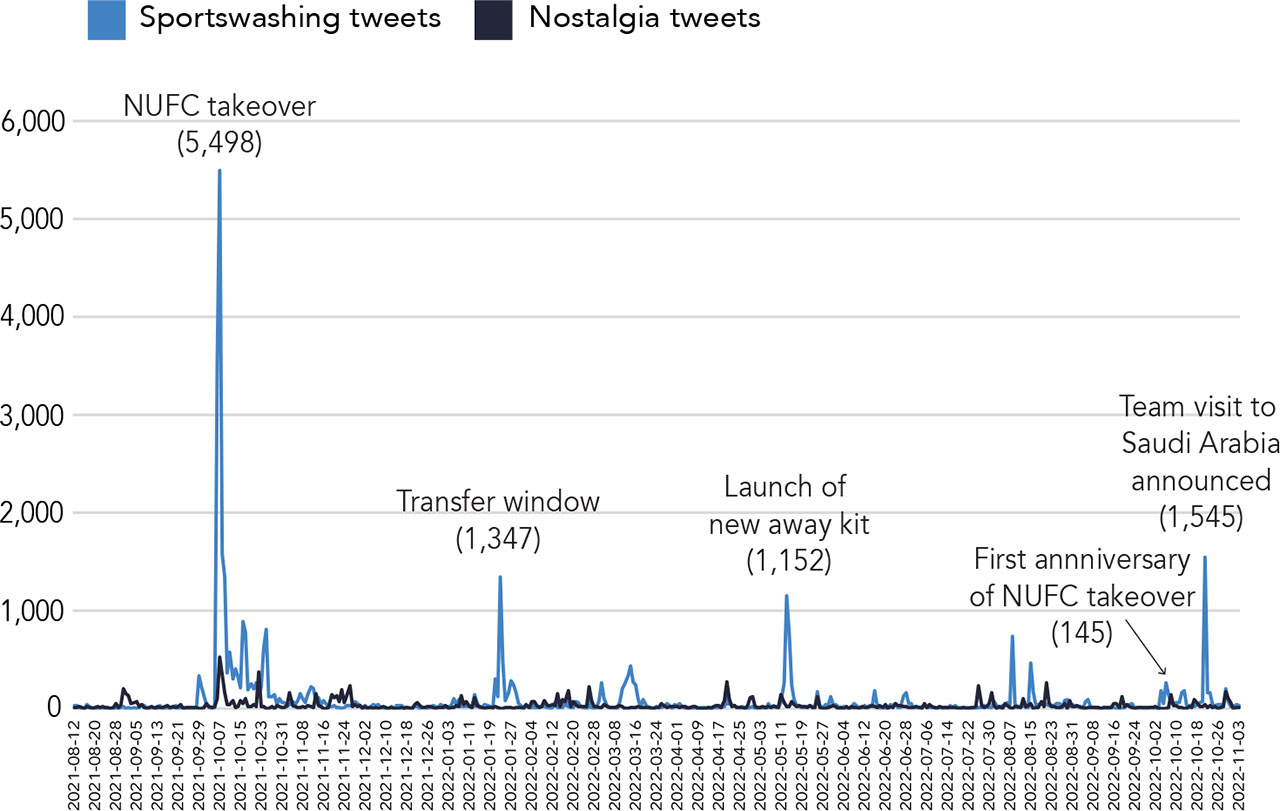
Figure 1
Frequency of “sportswashing” and “nostalgia” tweets across the sample period
While neither Keegan nor Robson won a trophy with Newcastle, a reference to them positively framed a hopeful past. Younger fans who did not experience this past were told to expect great things, suggesting a restorative nostalgia (Boym, 2001) that hopes for a repeat of these mythologised pasts instead of reflecting critically on a future under the new ownership through the lens of this past. Concurrently, others turned attention to the funding behind this new sense of hope. The temporal alignment of these two categories of tweets was, however, an exception rather than the rule. From about a month after the takeover, nostalgic tweets started to outnumber those related to sportswashing for a time. Subsequent spikes in both types of tweets rarely aligned. The few tweets that were both explicitly nostalgic and sportswashing-related were also predominantly restricted to the time immediately following the takeover.
This lack of later alignment between nostalgia and sportswashing discussions, as well as the general diminishment of the latter’s peaks, can be interpreted as reflecting the growing acceptance of the ownership among the online #NUFC community. While the explicit acknowledgment and critique of the club’s new owners became, in comparison, less pronounced and restricted to certain moments, nostalgic renderings of what the new ownership might mean for the club’s footballing standards (and therefore the restoration of past hopes) remained relatively consistent. This, in turn, suggests how nostalgia might legitimate sportswashing through distraction.
This separation in the two types of tweets also reflects the reactive nature of social media content, where spikes occur in response to specific events, such as key results in the football season, or occasions where the Saudi state is the focus of increased attention in traditional media. This is seen in the decrease in the intensity of the sportswashing peaks in the run-up to occasions such as the anniversary of the takeover. The takeover’s anniversary is a moment where we might have expected a significant increase in attention on the ownership. However, at least within Twitter’s discursive environment, this only emerged to a limited degree and was overshadowed by the discussion generated two weeks later following the announcement that the team would visit Saudi Arabia. Earlier peaks in discussions of sportswashing are also event related. Peaks align with the January 2022 transfer window, when there was investment in the team’s playing squad, and the May 2022 launch of a new away kit bearing a striking resemblance to the Saudi National Football Team kit. 6 Although spikes in sportswashing-related tweets are present, it is clear that the attention given to the topic decreased significantly over time, from soon after the takeover. Although this might not reflect explicit acts of nostalgic legitimation, it may represent a tacit legitimation through apathy or lack of interest in an issue that has become an old story, exacerbated by nostalgic distractions.
In our LexisNexis search results, specific peaks in attention are less discernible. However, trends emerged in the timing of the use of particular terminology. For example, the 3,034 articles mentioning both “Newcastle United” and “Saudi” include results from across the timeframe of the search. Articles discussing both “Newcastle United” and “Sportswashing” (333 total), however, commence at the point of the takeover’s completion: 7 October 2021. These articles also show a difference in intent. Articles from the period prior to the takeover referenced the takeover in the context of pre-season plans and previews; for example, The Daily Telegraph pre-season guide referenced the prospect of a Saudi Arabia-led takeover (Dean et al., 2021), and interviews with then manager Steve Bruce placed the lack of transfer activity in the context of stalled plans for the sale of the club (Wilson, 2021). References to sportswashing after the takeover, conversely, were led primarily by political and human rights organisations, such as Amnesty International. This is illustrated by headlines from The Independent – “Amnesty: Saudi-led Newcastle takeover a ‘bitter blow for human rights defenders’” (Press Association Sports Staff, 2021) – and the Evening Chronicle – “Back our human rights fight as well as your club; Amnesty’s Message to United Fans” (Graham, 2021).
What emerges from both the Twitter and legacy media samples is that despite sharing a particular discursive space (i.e., #NUFC on Twitter, or Newcastle United related sports reporting), and despite overall coming together to influence views of the takeover, occasions where explicitly nostalgic discourse came into direct contact with those relating to sportswashing at the level of individual tweets and articles was limited. However, as we highlight below, in those tweets and articles where nostalgia and sportswashing discourse explicitly interacted, we do find evidence of the nostalgic (de)legitimation of sportswashing.
Analysis II: Nostalgia for and against sportswashing
In this section, we focus on the 26 tweets in which at least one term each related to nostalgia or sportswashing appeared. These tweets arguably most clearly illustrate how nostalgia can be mobilised as a means of legitimating or delegitimating sportswashing in social media discourse, as linked to similar discourses in legacy media. While relatively limited in an empirical sense, these tweets reflect the type of discussions that were taking place on match days, in closed WhatsApp groups with fellow supporters, or across social media, as experienced by both of us as Newcastle supporters.
Nostalgic legitimation
Within the 26 tweets, nostalgic legitimation was more common than delegitimation. References to Newcastle United’s past provided a means to legitimate the new ownership and delegitimate its critics. In some instances, the legitimation was more broadly focused on the authorisation of past knowledge; for example, in response to the new green-and-white away kit that closely resembled that of the Saudi national football team:
Like the top. I recall #NUFC having green away kits in the past. No one mentioned the Saudis with the 88/90, 90/93, 97/98, 05/06 season kits.
Here, the legitimacy of historic knowledge did not call on a nostalgic moment but rather as founded on detailed knowledge of the club’s past. Drawing an analogy with these pasts was used to rationalise decisions made in the present. This is evidence of a form of mnemonic legitimation (Van Leeuwen, 2007) through the authority of expertise and tradition. If we accept the role of shared pasts and memories as a feature of constructed belonging (Guibernau i Berdún, 2013), then we can acknowledge that references to specific pasts and figures can give an argument additional authority. While the issue of the colour of an away shirt and the discussion surrounding it on Twitter might seem banal, the above tweet reveals how the past can be adopted, intentionally or not, as a means of legitimation. This is reflected in instances where nostalgia was directly called upon.
Certain tweets evoke the nostalgic feeling associated with key figures from the club’s past, including former player and manager Kevin Keegan (referred to by Newcastle fans as “King Kev”):
King Kev is my hero. He inspired me to support Newcastle back in the mid-90s. If he is happy with the Saudi ownership, who cares what other pundits and trolls think? #NUFC
Kevin Keegan has given limited comment on the new ownership, although he did eventually say that Newcastle had “hit the jackpot”, an assessment that is hard to disagree with on purely financial terms. Our interest, however, is in the role that reference to these seemingly glorified pasts plays in legitimising the new ownership. The author of this tweet shares something in common with both of us: Keegan inspired our support of the club. The tweet reflects a form of restorative nostalgia (Boym, 2001; Kaya, 2023). The feeling of being inspired to support the club in that era evokes a lost, positive past, nodding towards the potential for the new ownership to bring these positive pasts back. Reference to Keegan gave the author the authority of 30 years of support for the club, while also drawing on the authority of Keegan himself to allude to a restoration of past glories. The tweet placed Keegan as an authority figure who speaks for Newcastle fans when “pundits and trolls” do not. This authorisation allows for concerns regarding sportswashing to be put aside.
Such dismissing of concerns regarding sportswashing is also reflected in prominent legacy media output. In a match report for The Daily Telegraph in October 2022, Luke Edwards (2022) described the positive atmosphere in Newcastle city centre following a 5–1 defeat of Brentford as,
a celebration of a manager, Eddie Howe, who has captured the zeitgeist of what this football club means, what they need to succeed and what needs to be done to get there. […] this feels like the start of something rather than a climax. It reminded those of us who are old enough of Newcastle under Keegan in the early- to mid-1990s and the renaissance that followed under the expertise of Robson at the turn of the century. […] Thoughts about sportswashing and human rights in a distant Middle East kingdom, at least for a moment, can be parked.
Edwards’s piece offered legitimation through both nostalgic authorisation and through rationalisation (Van Leeuwen, 2007). Nostalgic authorisation was given through reference to the excitement on the pitch and in the city, and the memory it evokes for the near success of Kevin Keegan and Bobby Robson. In noting that the contemporary positive feeling represents “the start of something rather than a climax”, Edwards directly suggested that the feelings associated with Robson and Keegan can be reclaimed under the current ownership. The excitement being felt indicates that the new ownership can restore past (near) successes, rationalising fans’ support for that ownership in the process and, again, reflecting the role of a restorative nostalgia in the legitimation of sportswashing.
Nostalgic delegitimation
While pockets of opposition to the Saudi ownership exist within the Newcastle United support – particularly the NUFC Fans Against Sportswashing group – the continued high attendance at matches and demand for tickets suggest a widespread acceptance of the ownership. However, critique of the ownership is visible in our Twitter data, and equally reflected in the position taken by some legacy media journalists. This content includes references to the same historical moments as those used to legitimate sportswashing. Take the following tweet:
Remember back in the Keegan era, Newcastle were everyone’s second favourite team. As long as there are dictators in charge of our club, they stain the #NUFC name. This should be an issue that unites all fans. Who would want a violent dictatorship taking ownership of their team?
The request to remember Newcastle United under Keegan calls back to an era where the club was referred to as “the entertainers”, in reference to their attacking football. Delegitimation, as with the processes of legitimation described above, utilises a combination of authorisation through nostalgia and rationalisation. Where above we saw indications of a restorative form of nostalgia, here we find a reflective nostalgia that calls for a “critical re-evaluation” and desire for an “active changing of the present” (Kaya, 2023: 321). The past feeling of being “everyone’s second favourite team” cannot be regained while the PIF ownership is in place. The author showed an understanding of the club’s history and, as above, drew on Keegan’s status to add authority to their argument. This was combined with a rationalisation of the impacts of sportswashing – that the owners’ presence will “stain” the club for as long as they are involved – to reflect on a sense of loss.
In the tweet above, the close connection to Newcastle United was used to give an extended request to other football fans, who should be “united on this issue”. Delegitimation of sportswashing, then, becomes a macro-concern, where content focused on legitimating sportswashing was predominantly directed locally, towards the in-group of Newcastle United supporters. The tweet hints towards the extended public of the NUFC hashtag, including journalists and other football fans. This reflects the use of references to the same past within legacy media. Writing for The Times, Owen Slot used the story of an individual fan’s memories of these same past moments to frame a discussion regarding the takeover. The fan in question referenced his joy at “momentous occasions”, such as Kevin Keegan being unveiled as manager in the early 1990s, linking it directly to the hope then being provided to fans by the takeover. Again, we see these pasts referenced as a means of indicating a hope that the feelings associated with a “better time” can be restored (Boym, 2007). This story of memory and connection to the club was then used in Slot’s article to critique the role of fans in legitimating sportswashing:
What do these fans think of this strange marriage of Geordie and Saudi? They are jumping for joy, aren’t they? It’s not that they are in denial, but when they discuss the new member of the family, they will finish a sentence about their great future together with appended caveats like “despite the human rights ...”
Football has thus given us an extraordinary lexicon where you can now somehow say: “They might have a ban on homosexuality, but they’re going to help us win the league”. Or: “They might have murdered that journalist and sawn his limbs into small pieces but, look, we’re finally going to get a new striker”.
The fact is that Newcastle will now be a genuinely happier place. (Slot, 2021)
Supporters’ dismissive attitude towards the new ownership was framed as reflective of a hypocrisy present in modern football support. Serious human rights issues were dismissed in favour of the hope of success being brought back to the club. In opening the article with a fan’s perspective, Slot gave authority to his argument through demonstrating an understanding of the club’s history and its role in the city. This is reflected, too, in his assertion that Newcastle would “be a genuinely happier place”. While the joy described by the fan referenced by Slot alludes to the affective dimension of nostalgia, Slot’s conclusion also tied this to a future-oriented feeling. As fans, however, we are asked to consider this sense of nostalgia and hope in combination with the documented human rights abuses conducted by the Saudi state. Are those feelings, experienced before, worth putting ahead of combating human rights abuses?
References to supporters’ attitude towards the takeover also emerged in more assertive, aggressive calls for fan action on Twitter:
Would Robson manage a team in a Saudi kit? Would Robson work for these owners? The Saudis have chosen an uninformed set of fans to sportswash, and it’s going smoothly. #NUFC
“Sir Bobby” refers here to Bobby Robson, Newcastle manager from 1999–2004, a period of relative success. Like Keegan, Robson took the club close to titles but never succeeded in winning a trophy. However, his place in Newcastle folklore is furthered by being a locally born Newcastle United supporter himself and is often discussed in relation to a nostalgia for the emotions of football. This is encapsulated by perhaps his most famous quote:
What is a club in any case? Not the buildings or the directors or the people who are paid to represent it. It’s not the television contracts, get-out clauses, marketing departments or executive boxes. It’s the noise, the passion, the feeling of belonging, the pride in your city. It’s a small boy clambering up stadium steps for the very first time, gripping his father’s hand, gawping at that hallowed stretch of turf beneath him and, without being able to do anything about it, falling in love. (Robson, 2008: 185)
In the tweet further above, asking whether Robson would “manage a team in a Saudi kit”, Robson’s understanding of what a club is was placed in opposition to the launch of the kit. The past was referenced to both create the sense of legitimacy of authority, while again, a positive past was placed as being at risk. Robson’s conception of the role of a football club is threatened by the PIF ownership. This tweet came with a combativeness in referencing an uninformed set of fans – perhaps a fanbase showing a “motivated ignorance” (Jones et al., 2024: 105–106). The legitimacy of some fans’ opinions and actions was placed in opposition to those of others. But what constitutes an uneducated fanbase? Those who do not have the correct memory of what Robson would have done? In February 2023, Robson’s family was actively involved in producing an in-ground commemoration for his achievements on what would have been his ninetieth birthday. His “What is a club in any case?” quote was held aloft on banners produced by Wor Flags, with a member of the group reading the quote before kick-off. Robson’s memory, with the support of his surviving family, was placed at the core of a significant day for the club under its new ownership.
In each of these examples, it is a nostalgic reference to specific pasts that seek to give authority to an argument that not only delegitimates sportswashing but also calls for concrete actions as a result of this delegitimation. Additionally, this content was predominantly targeted to a wider, national audience, in comparison to the locally focused content seen to legitimate sportswashing. This suggests a more openly activist element to content that seeks to delegitimise sportswashing and state ownership of football clubs. Authors place themselves as not only concerned with the fortunes of Newcastle United, but also with the future of football. The overall lack of focus on sportswashing with regard to Newcastle’s latest success, however, suggests that this form of activism is proving ineffective. We conclude this article by considering the implications of the Newcastle United case for the potential use of nostalgia and the past in future instances of sports-based activism.
Conclusion: What role for activist nostalgia?
For Rigney (2026: 230), the potential for activist memory stems from an acknowledgement that the past is “full of unfinished business and unrealized possibilities”. In our analysis of media spaces where the nostalgia and sportswashing discourses overlap, we see the potential for an activist use of nostalgia where the reflection on a once-hopeful past can operate in combination with the desire to build progressive futures. This is most clearly the case where a focus on present-day injustices (in our case, the human rights abuses linked to the new owners of Newcastle United) threatens the potential renewal of hope, as it is nostalgically ascribed to the club’s mythologised past.
This more activist use of nostalgia emerges prominently at the point of the Saudi takeover of Newcastle United, but then it dissipates through the course of the period of our dataset. Thereafter, the nostalgia and sportswashing discourse rapidly separate, suggesting two concurrent but potentially mutually ignored areas of discourse. The more activist discourse, seeking to delegitimate sportswashing, is not directly engaging those fans who continue to focus on supporting their club and preferring to legitimate, or simply ignore, accusations of sportswashing. Both, however, recognise the nostalgic potential of referencing the past, alluding to a future reclamation of those positive experiences.
This separation of discourse has implications for the future activist use of nostalgia in the delegitimation of sportswashing. Firstly, it suggests the need for activists to be organised and active at the early stages of action they wish to speak against, in a period when debate will reach into spaces beyond activist circles. This is a particular challenge for groups such as NUFC Fans Against Sportswashing, who may see the impact of their activism limited, as a football-supporting public and national media have largely moved on from detailed discussions of the Saudi ownership. Secondly, the increasing separation of these discourses alludes to the difficulty in challenging the hope for success provided by sportswashing projects on equal terms, where the positive past being enrolled in the delegitimation of sportswashing is one focused on the manner of near success, rather than success itself. For fans of clubs who may fear similar changes in ownership in their own futures, this suggests the need for organised opposition to be prepared, and perhaps nostalgically armed, well in advance of any takeover.
In the four years since the takeover, Newcastle fans have witnessed Champions League football, top-6 league finishes, two cup finals, and a first cup win in decades. For many, including us authors, this is the first trophy win of their lifetimes. This is creating a future nostalgic past, focused on moments of sporting joy. The club chairman, the chair of the PIF and a close ally of Mohammed bin Salman, celebrated this cup win on the pitch at Wembley Stadium with players and coaching staff. As he raised the trophy towards supporters in the stands, it was a reminder of the reality of the ownership of the club and the source of the funds that have delivered sporting success. In moments like this, sportswashing projects become normalised, as these owners become part of a new moment in sporting history – a moment that will play a part in fans’ future recollections of past success.