

iStock, Pict Rider
Sustainability isn't just an environmental issue, but also a societal one. Crises, like the recent Iran War with surging energy prices, always carry the risk of social disruptions and further destabilization of democracies. It is therefore crucial that institutions address resource shortages and economic tensions stemming from sharply rising prices to sustain the standard of living in democratic societies. In times of acute crisis, whether economic downturns, pandemics or climate emergencies, governments and organizations frequently call on citizens to “take responsibility” themselves. Consumers are encouraged and often expected to rapidly change their behavior, accept sacrifices, and actively contribute to recovery efforts. Yet appeals to individual responsibility frequently fall short.
Our research in Ireland during the Great Recession from 2008 to 2013 shows that people are more likely to accept responsibility when it is framed as a collective effort embedded in community values and social norms rather than as an individual obligation. For managers and policymakers, the implications are significant. Crisis management strategies that activate communities can mobilize people more effectively than those that focus solely on individual responsibility.
Why individual responsibility often fails in crisis communication
Many crisis management strategies rely on messages that emphasize personal responsibility. Consumers are urged to reduce spending, change consumption habits, conserve resources or support economic recovery. While such appeals may appear logical, they can trigger resistance when people believe forces beyond their control caused the crisis. In these situations, calls for individual sacrifice can feel misplaced, particularly when people perceive that systemic failures by governments, financial institutions, or corporations triggered the crisis. This disconnect between responsibility and perceived causality can undermine the legitimacy of crisis communication efforts. Our analysis identifies three common barriers to individual responsibilization.
Perceived unfairness
People may perceive calls for personal responsibility as unfair and may reject them if they believe powerful institutions or elites caused the crisis. When individuals feel they are being asked to solve problems created by others, they may question the moral legitimacy of the request and disengage from proposed solutions. Such perceptions can quickly erode trust in both policymakers and the institutions attempting to manage the crisis.
Limited capability
Crises often diminish or eliminate important resources available to citizens. Economic hardship can make it difficult, if not impossible, for individuals to act as responsible economic actors. Job losses, reduced incomes and rising living costs can significantly constrain people's ability to change consumption patterns or make long-term responsible choices. Even well-intentioned people may simply lack the financial or emotional capacity to act as policymakers expect.
Lack of support structures
In times of crisis, markets and government support programs are often reduced or may even break down. When markets or public institutions do not provide practical support, individuals struggle to translate responsibility into action. In such situations, communities can step in to fill the gap.
„Calls for individual sacrifice can feel misplaced, particularly when people perceive that systemic failures by governments, financial institutions, or corporations triggered the crisis.“
BOX 1
What the Irish crisis revealed
Following the global financial crisis of 2007/2008, Ireland implemented strict austerity policies to stabilize its economy. Citizens faced high unemployment, increased taxes, wage cuts and reduced public services. Despite the severity of these measures, Ireland experienced relatively limited social unrest compared with other European countries. To understand why, we analyzed consumer interviews, political discourses, media coverage and market data from this period. Two distinct “crisis narratives” emerged.
The first emphasized individual responsibility, encouraging citizens to make personal sacrifices to restore economic stability and long-term prosperity. The second framed the crisis as a shared community challenge. It invoked the cultural concept of meitheal, pronounced meh-hell, an ancient Irish tradition in which neighbors work together to overcome hardship. This concept draws on a long-standing rural practice in which communities pooled labor and resources to help families during demanding periods such as harvests or building projects. By invoking this tradition, the crisis response was framed not as an individual burden but as a familiar form of collective resilience deeply rooted in Irish culture.
This communal framing of the crisis and its solutions proved more effective in helping people accept responsibility and adapt their behaviors. Importantly, communities became crucial support systems that encouraged and enabled individuals to cope with hardship and participate in recovery efforts. Local networks provided both practical assistance and a sense of solidarity that made difficult behavioral adjustments socially acceptable, emotionally manageable, and economically feasible.
In this way, communities acted as an important bridge between abstract policy goals and the everyday realities citizens faced.
Communities as engines of crisis adaptation
During Ireland's recession, communities played a critical role in enabling people to cope with economic hardship and assume responsibility for the country's fiscal recovery. As formal institutions struggled to respond quickly to rapidly changing economic conditions, local communities often became the most immediate and accessible support structures available to citizens. These grassroots responses helped translate abstract calls for responsibility into concrete everyday practices.
Our research identified four mechanisms through which communities enabled citizens to navigate the crisis.
Social scaffolding
Local communities provide emotional and psychological support that helps individuals navigate crises. Shared hardship reduces stigma and normalizes behavioral changes, such as reduced spending or simpler lifestyles. When difficult adjustments become collective experiences, individuals are more willing to accept them. In Ireland, communities created a shared narrative of “we are in this together.” This shared narrative reduced feelings of personal failure associated with financial hardship and reframed economic struggles as a collective national experience. As a result, behavioral adjustments that might otherwise feel humiliating or isolating became socially accepted and even morally valued.
Informal resource exchange
Beyond destigmatization and emotional support, communities can function as informal systems for sharing resources during crises. Examples observed during the recession included the informal exchange of goods and services, the sharing of childcare or housing and community-based services, such as free haircuts. In this way, communities can temporarily compensate for the failure of functioning markets or public support systems.
Civic engagement and collective action
In Ireland, the financial crisis also triggered a surge in civic participation. During the recession, many people became involved in volunteering, community organizations, neighborhood initiatives and local charities. These activities strengthened social bonds and reinforced a sense of shared responsibility. For many individuals, participation provided a renewed sense of purpose and agency at a time when economic circumstances felt largely outside their control. This form of civic engagement also reinforced communal norms that encouraged cooperation and mutual support.
Community entrepreneurship
Finally, communities frequently develop innovative responses to economic challenges. Examples of such entrepreneurial activity included local exchange systems, skill-sharing networks, community marketplaces and cooperative initiatives. These grassroots efforts enabled communities to generate economic resilience even when traditional markets were struggling. Such initiatives often emerge organically from local needs and rely on trust, reciprocity and shared identity among community members. In doing so, they create alternative economic structures that help communities adapt and recover more quickly.
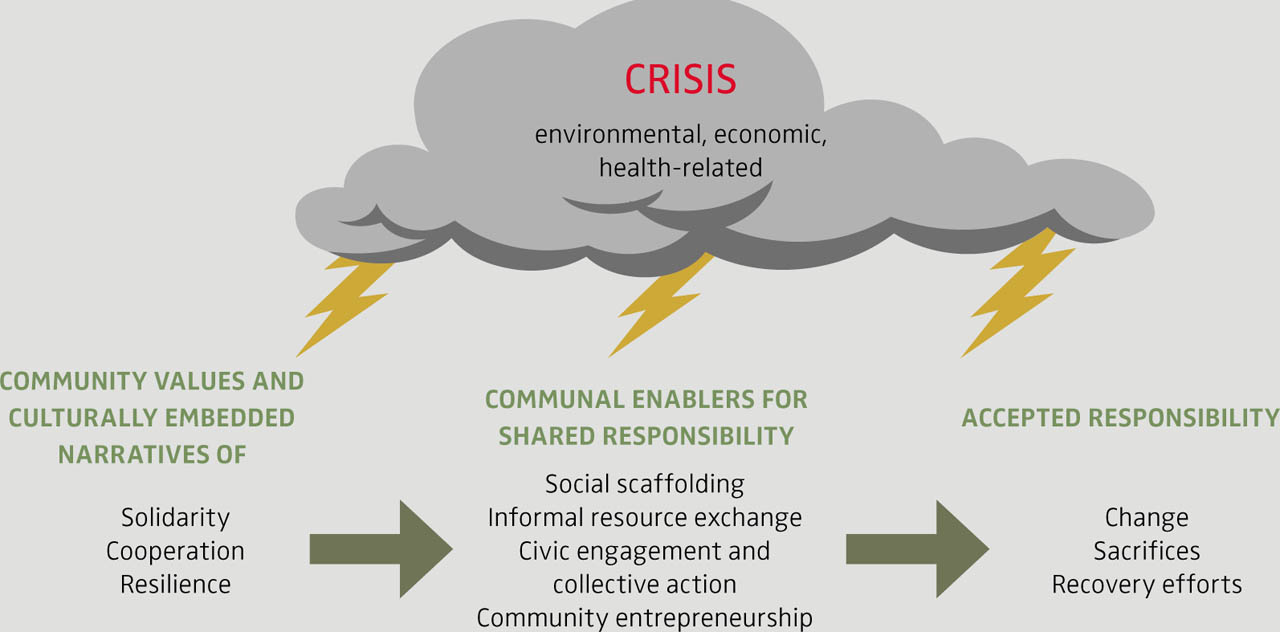
FIGURE 1
Mechanisms for creating shared responsibility for handling collective crises
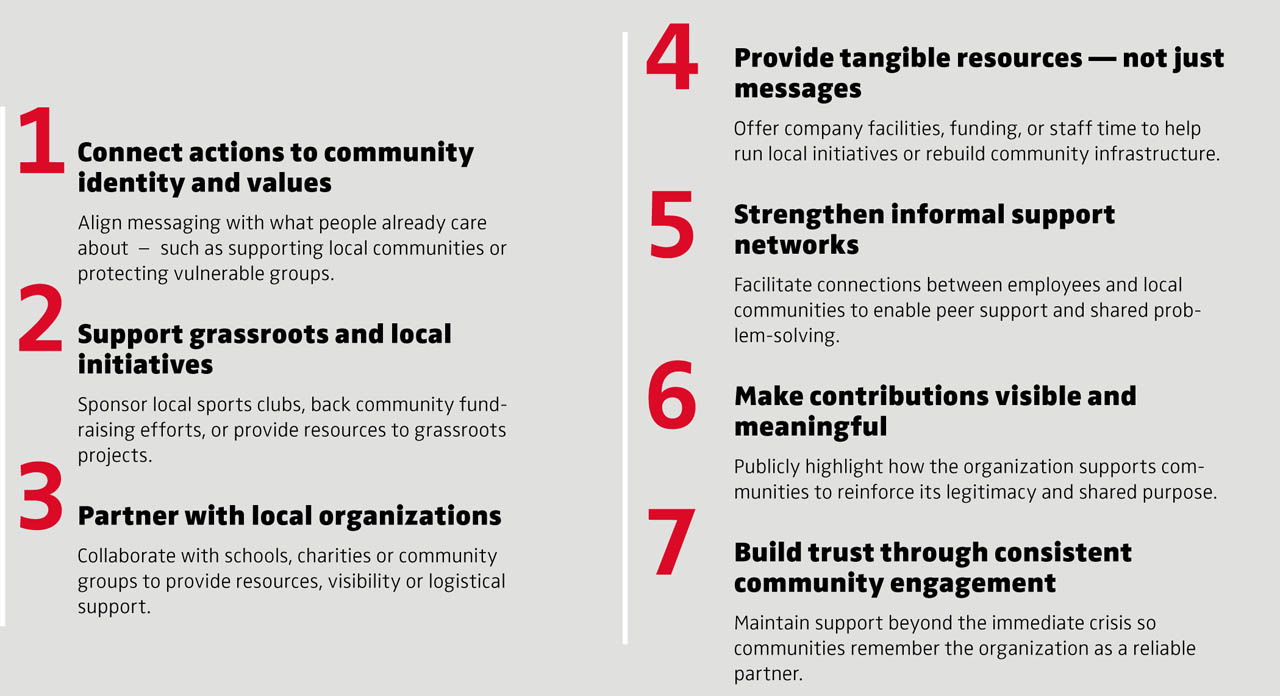
FIGURE 2
How businesses can support collective action to combat a crisis
Activating communities during crisis: What managers can do
Organizations cannot manufacture communities overnight, but they can actively support and strengthen already existing ones. In Ireland, we observed numerous examples of businesses supporting local communities and grassroots initiatives. Retailers and brands sponsored local sports clubs, supported community fundraising initiatives and partnered with local organizations to provide resources and visibility for grassroots projects. These efforts strengthened local ties while positioning businesses as supportive partners during a period of national hardship.
Several principles can help leaders mobilize collective responsibility during crises. Messages that emphasize shared responsibility and collective action are more likely to resonate with people, particularly when they are rooted in community identity and shared values. Crisis communication becomes significantly more powerful when it draws on culturally embedded values or traditions. In Ireland, the concept of meitheal provided a culturally resonant symbol of collective action. By tapping into this familiar cultural narrative, organizations were able to frame behavioral change as part of a broader national effort rather than as an isolated individual obligation. This cultural resonance helped make calls for sacrifice feel both meaningful and legitimate.
Other societies possess similar narratives of solidarity, cooperation or resilience that can serve as powerful mobilizing frames. Examples include traditions of mutual aid, neighborhood solidarity movements, or national narratives of collective perseverance that often emerge during periods of hardship. Identifying and activating these narratives allows organizations to connect crisis messaging with deeply rooted social values.
Beyond symbolic gestures, businesses can also strengthen communities as informal support systems during crises. Local businesses can reinforce these networks by supporting local initiatives, facilitating events, partnering with local institutions such as schools or helping to rebuild critical infrastructure. Such actions not only support communities but also strengthen brand trust, which often persists long after the crisis has passed. Businesses that visibly contribute to community resilience frequently develop stronger emotional connections with consumers, who remember which organizations supported them during difficult times. These trust-based relationships can translate into long-term brand loyalty and stronger reputational capital.
„Organizations cannot manufacture communities overnight, but they can actively support and strengthen already existing ones.“

get tyimages, Mike Harrington
Importantly, our research also shows that consumers' priorities and values shifted in the aftermath of the crisis. Economic hardship prompted many individuals to reassess their lifestyles and consumption habits, placing greater emphasis on social relationships and community belonging. These value shifts created new opportunities for brands that aligned themselves with community-oriented ideals. For many people, the crisis served as a stark reminder of what mattered most: family, friends and local communities. International businesses, such as Lidl and Kellogg's successfully aligned their brand messages with these shifts in sociocultural values and, by actively supporting local initiatives, formed strong and enduring bonds with Irish consumers.
Recognizing the limits of community support
Our findings also show that communities can become overburdened if adequate economic support and infrastructure are not provided quickly. While communities can significantly enhance resilience during periods of acute crisis, they cannot fully replace institutional support. When governments withdraw too much assistance or when economic hardship becomes prolonged, community networks may struggle to sustain the increasing demands placed upon them. Effective crisis management, therefore, requires collaboration between institutions, markets, and communities rather than relying on any single actor.
The future of crisis management
The world is entering an era of interconnected crises ranging from financial instability and climate change to pandemics and geopolitical conflict. Addressing these challenges will increasingly require collective behavioral change from citizens and consumers. To sustain the quality of life in free societies, mobilizing individuals through appeals to personal responsibility alone will often prove insufficient. Instead, crisis strategies should also focus on activating communities, strengthening social networks and fostering shared responsibility. In times of uncertainty, people rarely act alone. They act more effectively together.