
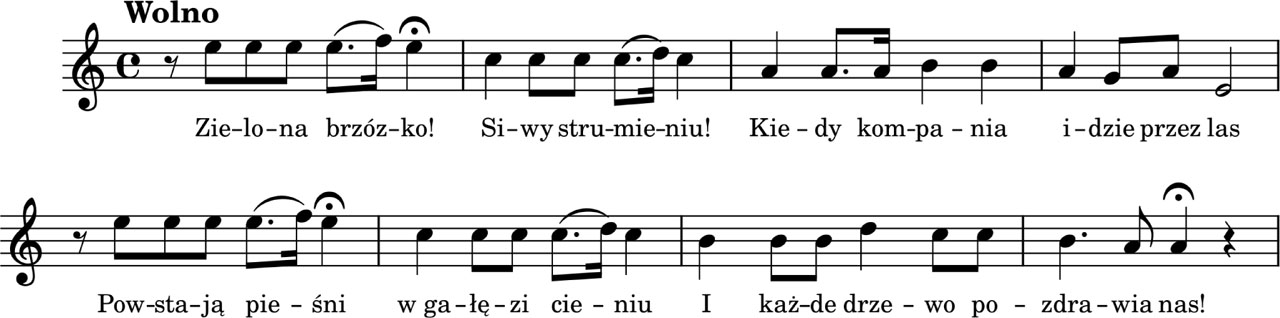
Example 1
Tadeusz Szeligowski, ‘Zielona brzózko’ for voice and piano, Warsaw, Czytelnik, 1949, measures 1–8, stanza one, melody only. English translation: ‘Green birch tree! Gray stream! When the company walks through the forest, songs emerge in the shade of the branches and every tree greets us!’
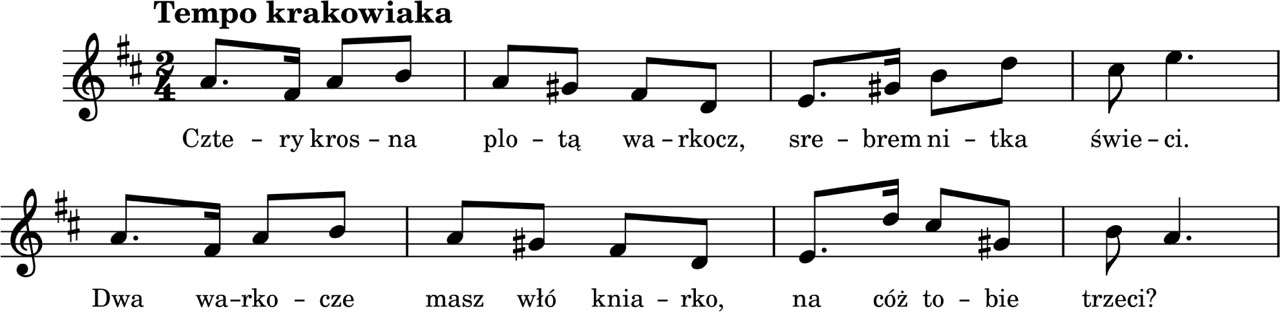
Example 2
Edward Olearczyk, ‘Warkocz’ for voice and piano, Kraków, Polskie Wydawnictwo Muzyczne, 1951, measures 6–12, stanza one, melody only. English translation: ‘Four looms are making a braid, the thread shines with silver. Textile worker, you have two braids, what do you need a third one for?’
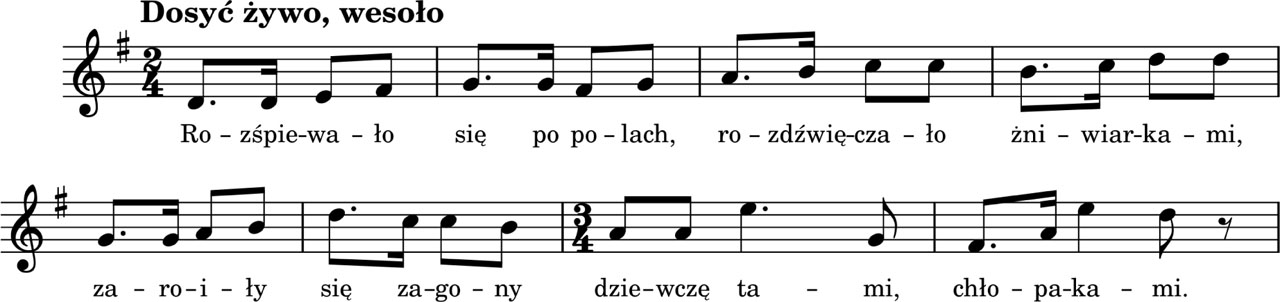
Example 3
Alfred Gradstein, ‘ZMP pomaga wsi’ for voice and piano, Kraków, Polskie Wydawnictwo Muzyczne, 1951, measures 5–12, stanza one, melody only. English translation: ‘Singing started in the fields, which resounded with reapers. The fields swarmed with girls and boys.’
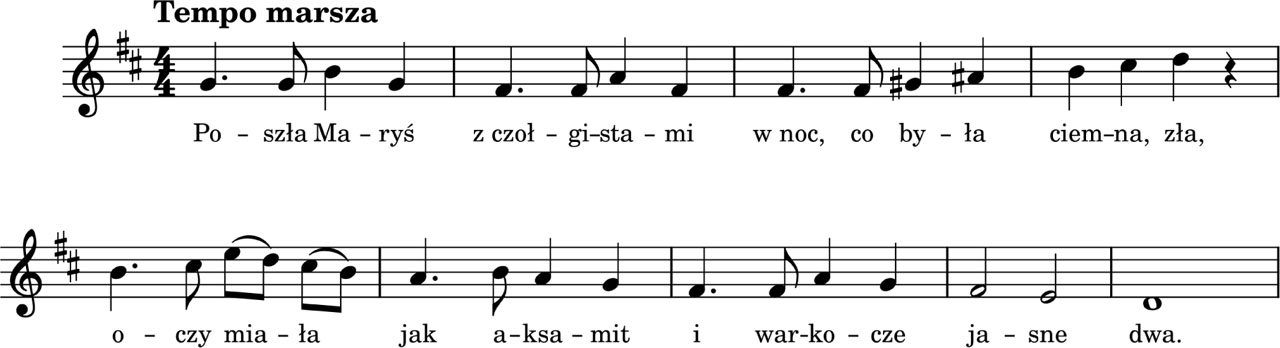
Example 4
Alfred Gradstein, ‘Czołgiści’ for voice and piano, Warsaw, Wydawnictwo Ministerstwa Obrony Narodowej, 1951, measures 13–21, stanza one, melody only. English translation: ‘Mary went with the tank men at night, which was dark and evil. She had eyes like velvet and two shining braids.’
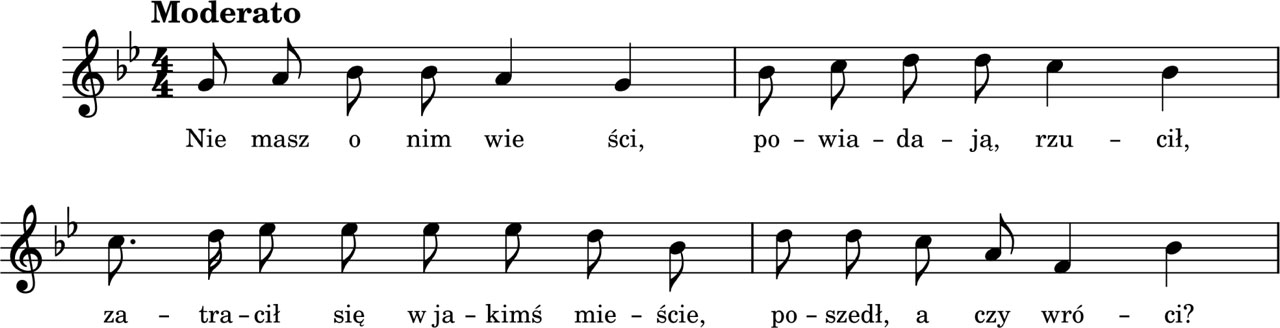
Example 5
Jan Ekier, ‘ Na zielonych bukach’ for voice and piano, Kraków, Polskie Wydawnictwo Muzyczne, 1951, stanza two, measures 2–5, melody only. English translation: ‘You have no news about him, they say he walked out. They say he lost himself in some town. He went, but will he return?’
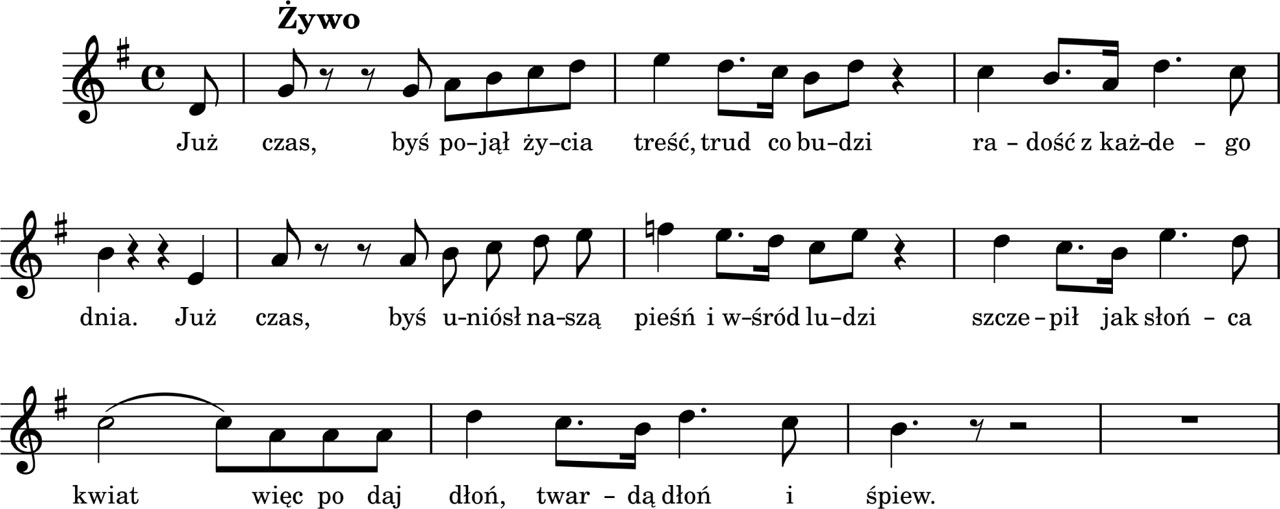
Example 6
Władysław Szpilman, ‘Pieśń pokoju’ for voice and piano, Warsaw: Czytelnik, 1951, stanza two, measures 1–11, melody only. English translation: ‘It is time for you to understand the content of life, the toil that inspires joy from every day. It is time for you to lift our song among people, to graft it like the flower of the sun. So lend us a hand, a sturdy hand, and sing.’
| Composer | Poet | English Title | Polish Title | Publication (if known) |
|---|---|---|---|---|
| Czesław Aniołkiewicz | Roman Sadowski | ‘Hanys and Barbarka’ | ‘Hanys i Barburka’ | |
| Jan Ekier | Tadeusz Kubiak | ‘On Green Birch Trees’ | ‘Na zielonych bukach’ | PWM, 1951 |
| Stanisława Gajdeczka | Ludwik Jerzy Kern | ‘Night Flight’ | ‘Nocny lot’ | PWM, 1955 |
| Stanisława Gajdeczka | Adam Włodek | ‘Onward, Soldiers of Freedom’ | ‘Naprzód żołnierze wolności’ | PWM, 1951 |
| Alfred Gradstein | Tadeusz Kubiak | ‘Along the Green Bridge’ | ‘Po zielonym moście’ | |
| Alfred Gradstein | Jacek Bocheński (?) | ‘Boys from the Polish Youth Union’ | ‘Chłopcy z ZMP’ | |
| Alfred Gradstein | Konstanty Ildefons Gałczyński | ‘Konstanty Rokossowski’ | ‘Konstanty Rokossowski’ | |
| Alfred Gradstein | Zbigniew Stolarek | ‘Our Land’ | ‘Nasza ziemia’ | PWM, 1951 |
| Alfred Gradstein | Helena Kołaczkowska | ‘The Polish Youth Union Helps Villagers’ | ‘ZMP pomaga wsi’ | PWM, 1951 |
| Alfred Gradstein | Jerzy Jurandot | ‘Polish Youth Union Song’ | ‘Pieśń ZMP’ | PWM, 1951 |
| Alfred Gradstein | Włodzimierz Słobodnik | ‘Song about Warsaw’ | ‘Piosenka o Warszawie’ | PWM, 1951 |
| Alfred Gradstein | Leopold Lewin | ‘Song of the Work Leaders’ | ‘Pieśń przodników pracy’ | PWM, 1951 |
| Alfred Gradstein | Tadeusz Kubiak | ‘The Tank Men’ | ‘Czołgiści’ | Wydawnictwo Ministerstwa Obrony Narodowej, 1951 |
| Tadeusz (?) Hesse | Roman Sadowski | ‘Song about the Vistula’ | ‘Pieśń o Wiśle’ | |
| Andrzej Klon | Leopold Lewin | ‘Boys from the Tatra Foothills’ | ‘Chłopcy z popod Tatr’ | |
| Andrzej Klon | Jacek Bocheński | ‘Comrades Sang’ | ‘Zaśpiewali towarzysze’ | |
| Andrzej Klon | Witold Wirpsza | ‘Sailors’ Song’ | ‘Piosenka marynarska’ | |
| Władysław Markiewicz | Roman Sadowski | ‘In Muranów’ | ‘Na Muranowie’ | |
| Edward Olearczyk | Krzysztof Gruszczyński | ‘The Braid’ | ‘Warkocz’ | PWM, 1951 |
| Edward Olearczyk | Józef Prutkowski | ‘Geography Lesson: A Song about the Vistula’ | ‘Lekcja geografii piosenka o Wiśle’ | |
| Edward Olearczyk | Józef Prutkowski | ‘Song about Stalin’ | ‘Pieśń o Stalinie’ | |
| Edward Olearczyk | Mirosław Łebkowski | ‘Why Such a Change’ | ‘Skąd taka zmiana’ | PWM, 1951 |
| Witold Rudziński | Tadeusz Kubiak | ‘Along the Green Bridge’ | ‘Po zielonym moście’ | PWM, 1951 |
| Henryk Swolkień | unknown | ‘About a Bricklayer in Love with Warsaw’ | ‘O murarzu zakochanym w Warszawie’ | |
| Henryk Swolkień | Roman Sadowski | ‘At the Start’ | ‘Na start’ | |
| Henryk Swolkień | Robert Stiller | ‘Heart of the General’ | ‘Serce generała’ | Książka i Wiedza, 1952 |
| Henryk Swolkień | Tadeusz Kubiak | ‘Song about Warsaw’ | ‘Piosenka o Warszawie’ [‘Warszawie’ is crossed out in the manuscript] | |
| Henryk Swolkień | Roman Sadowski | ‘The Textile Worker’ | ‘Włókniarka’ | PWM, 1951 |
| Henryk Swolkień | Zbigniew Przyrowski | ‘We Will Build a New Poland’ | ‘Zbudujemy nową Polskę’ | Czytelnik, 1950 |
| Władysław Szpilman | Kazimierz Winkler-Augustowski | ‘Fighting and Working People’ | ‘Ludzie walki i pracy’ | Czytelnik, 1950 |
| Władysław Szpilman | Roman Sadowski | ‘March of the Youth’ | ‘Marsz młodzieży’ | Książka i Wiedza, 1952 |
| Władysław Szpilman | Roman Sadowski | ‘Song of Peace’ | ‘Pieśń pokoju’ | Czytelnik, 1951 |
| Władysław Szpilman | unknown | ‘Waltz’ | ‘Walc’ | |
| Władysław Walentynowicz | Stanisława Fleszarowa-Muskat | ‘From Elblag to Szczecin’ | ‘Od Elbląga do Szczecina’ | |
| Władysław Walentynowicz | Edward Fiszer | ‘Our Native Baltic’ | ‘Ojczysty nasz Bałtyk’ | |
| Władysław Walentynowicz | Konstanty Ildefons Gałczyński | ‘Song about Stalin’ | ‘Pieśń o Stalinie’ |