
INTRODUCTION
Opera seria or eighteenth-century dramma per musica has repeatedly fallen victim to critique on account of its apparent lack of formal closedness. When held against the model of (post-)Romantic opera, the (seemingly) coherent and inextricable constructions of which are revered as ‘works’ and ‘repertoire’, opera seria indeed cuts a ramshackle figure. Rarely revived or printed in its own day, the genre relies on open structures with exchangeable components (arias, recitatives, scenes and scene complexes, situations, types and topics, etc.) that can be excerpted at will and moved from libretto to libretto, score to score, stage to stage. No matter how hard modern scholars and music promoters have tried to uphold the integrity of a garland of opere serie by ‘master composers’,1 out of a genuine passion or on commercial grounds, it is foremost on detachable and permutable ‘interaction rituals’ and ‘scripts for rhetorical exchange’ that the genre’s reputation has to rest.2 The everlasting vogue for favourite songs testifies to this idea, as does the dearth of full, critically edited scores. Not altogether unjustly, pianist and musicologist Charles Rosen opined that, ‘[i]f we limit, perhaps unwisely, the meaning of “form” to a way of integrating details within a larger conception, then opera seria is not a form at all: it is only a method of construction. The total form was never made to live; the sub-forms are sometimes very much alive indeed.’3
All the more inherently modular is the multiple-author ‘method of construction’ of the pasticcio. Although the pasticcio can be aligned with contemporary concepts of montage and collage,4 its thoroughly pejorative connotations make it somewhat of a bête noire among music-theatrical phenomena. Starting with Johann Joachim Quantz’ characterisation of a ‘kind of disposition’ (Art von Einrichtung) by which ‘arias by diverse masters are patched together’,5 the pasticcio carries an inevitable ring of unoriginality and tinkering with it. And so does the related verb pasticciare, which signifies ‘doing something without order and method, usually due to inability, lack of precision, ease, or carelessness’, and ‘accumulating [things] without order or distinction’.6 But pastiching is also connoted with creative interventions that affect the original substance – ‘placing one’s hands in a substance to manipulate it, stir it, mix it, shake it’.7 A certain playfulness and learning opportunities would characterise the act of pastiching – ‘getting involved in manual activities to learn or to play with them’.8 Could pastiching be associated with the ludic activities from which culture at large would have emerged?9
In this modest essay, I will explain how pastiching indeed provides twenty-first-century artist-researchers with a playful, creative tool to come to grips with the music-dramatic syntax of opera seria. Using the case of two one-act pasticci I assembled for students of the Royal Conservatoire of Brussels, Ifigenia and Ipermestra, I will explain how issues of layout and construction (Quantz’s Einrichtung) can be investigated and resolved in ways that sometimes respect, and sometimes override eighteenth-century convention.
CONTEXT
In 2004, the period-instrument conductor Paul Dombrecht informed me that the Royal Conservatoire of Brussels would make funding available for projects in the then relatively young field of artistic research in music. Artistic research can be most easily defined as research that is carried out through making music, rather than research about making music, as traditional musicology does. By conducting an original investigation in and through musical objects and its concomitant creative processes, artistic research can expand knowledge in ways that connect scholarly theory with artistic practice, intellectual with embodied knowledge, or thinking with doing. ‘Characteristic of artistic research,’ Henk Borgdorff argued,
is that art practice (the works of art, the artistic actions, the creative processes) is not just the motivating factor and the subject matter of research, but that this artistic practice – the practice of creating and performing in the atelier or studio – is central to the research process itself. Methodologically speaking, the creative process forms the pathway (or part of it) through which new insights, understandings and products come into being.10
Although I was pursuing traditional doctoral work in musicology at the time of being asked to join Dombrecht, I responded positively to the challenge as it offered opportunities to combine historical scholarship with my background in composition. I offered the Conservatoire the following plan: Why not perform an opera seria, go ‘historically informed’ all the way, from the pit to the stage, and pin our attention on Graeco-Roman mythology, for the simple reason that the representation of that kind of subject matter was the subject of my doctoral research?11 The artistic project would provide an artistic showcase for the repertoire I was exploring in my dissertation but could rarely see or hear for myself. A couple of sobering meetings and proposals later, it was decided that we would not be mounting a complete score. Though it is possible for young students to handle a three-act opera with staging and all, as past endeavours have shown,12 there was no budget for such a forbiddingly expensive venture. Rehearsing three acts in their entirety also seemed too much of a stretch, given the lack of visual enticements in our case; a hundred minutes seemed more realistic. Cutting a seria score gave us heartache, however.
The proposition of assembling new pasticci arose from my work in electronic music, and more particularly from the many seamless ‘sets’ I played in the late 1990s and early 2000s using loop-based sequences. In the temporary and unstable nature of their composed linearity, these ‘playlists’ appeared to me as modern analogues of the eighteenth-century pasticcio. In this respect, the pasticheur assumes the role of a deejay, arranging a seamless meta-composition out of existing materials. The examples of Jean-Louis Martinoty’s Pasticcio (1985) and Jean-Claude Malgoire’s Montezuma (1992) convinced me of the possibility of stitching together heterogeneous pieces into thematically coherent flows with dramatic developments that appeal to modern ears without embarrassing Aristotle and the poetics on which opera seria rests.13
Although the resulting ‘cut & paste’ operas served as credentials for artistic research in music, the budget granted to produce them was minimal – a four-figure amount, with which we could barely hire a stage director and choreographer, Sigrid T’Hooft, for a fifteen-day masterclass in period gesture, rent costumes, have someone do the make-up, print posters, flyers and libretti, obtain help in the transcription of scores, and buy food and drinks for our student musicians.14 Prosaic though all of this might sound, I think most pasticci in the past and present came about on a continuum between artistic utopia and economic reality.
Since singers did not audition until after our score was compiled, rather than before, as was customary in the eighteenth century, we could afford ourselves some modern liberties that our historical predecessors did not have.15 In timbral and dramatic terms, we did not have to cater to a pre-determined cast, consisting of, say, four sopranos, one alto, and one tenor, with one singer enacting the Princess and another the old King. Nevertheless, typecasting did occur to some extent due to the codified nature of opera seria and the pedagogical motivations of the project; you want to give students equal opportunities, by letting them shine in one pasticcio and assigning them a more subordinate role in the other. We did not transpose fragments, although that practice was commonplace in the Settecento, nor did we have to deal with complete, ready-made libretti imposing metric restrictions on our musical selections, which were guided primarily by the music-dramatic potential of each fragment and its appropriateness with respect to the envisioned dramatic-harmonic context. After perusing scores in Brussels, Vienna, and Naples, two mythical plots presented themselves to us: Iphigenia in Aulis and the Danaids.
PASTICHING MYTHS
The story of Iphigenia in Aulis is well known. An oracle tells King Agamemnon that the Greek ships cannot leave for Troy (to rescue Helen) until Artemis/Diana has been appeased by the sacrifice of Agamemnon’s daughter, Iphigenia. Agamemnon has offended the goddess by accidentally killing one of the deer sacred to her. Despite opposition from Iphigenia’s mother Clytemnestra and her fiancé, Achilles, the young virgin surrenders to the Greek cause. While Euripides installed a deus ex machina at the end of his Iphigenia in Aulis (Athens, 408–406 BC) to refrain from murder, and Jean Racine had Eriphyle stand in for Iphigenia (in Iphigénie, Versailles, 1674), I chose to restore the story’s archaic funesto fine without spilling any blood on the stage, as that would have violated classicist decorum.16 In our version, Iphigenia bids farewell to her family in a finale reminiscent of Pietro Metastasio’s Attilio Regolo (1740).17
In Ipermestra, the relational cards between father and daughter are laid out differently. Having dreamt that his sons-in-law will murder him, the King of Argos, Danaus, asks his fifty daughters, the so-called Danaids (also Danaïdes), to stab their bridegrooms (and cousins) to death on the night of the wedding. One princess, Hypermnestra, faces the characteristic dilemma between virtù and amore: should she follow her father’s order and carry out the homicide or save her fiancé, Lynceus? After bravely defending her father’s raison d’état, Danaus agrees to the marriage and abdicates in favour of his daughter.
We derived the lion’s share of our pasticcio Ipermestra from two settings of Metastasio’s libretto by Johann Adolf Hasse: the princeps for Vienna (1744) and the version for Hubertusburg (1751; see Table 1).18 Our interest in the first version was aroused by (Belgian) national curiosity, since it had been composed for the wedding of Charles of Lorraine, ruler over the Southern Netherlands, to Archduchess Maria Anna of Habsburg.19 But it was the sheer dramatic power of Hasse’s 1744 score that won us over. Hasse’s bass part for Danao seemed particularly worth reviving, extending over two and a half octaves – a feat that became a critical risk when our projected bass had to be replaced last-minute…
Table 1
Music-dramatic contents of Ipermestra
| No. | Entity | Composer / Librettist | Source | Dramatic content | Musical characteristics | Framing tonalities |
|---|---|---|---|---|---|---|
| 1 | Sinfonia | Vinci / Metastasio | Didone abbandonata (1726) | Allegro, 4/4 – Largo, 3/4 – Allegro, 6/8 | F major – D minor – F major | |
| 2a | Recitative ‘Vadasi al genitor: dal labbro mio’ (Ipermestra, Danao) | Hasse / Metastasio | Ipermestra (1751) | On the very day of her marriage, Hypermnestra learns from her father, King Danaus, that she must kill her fiancé. An oracular spell leads the King to believe that he will be killed by his sons-in-law. | G major ~ F major | |
| 2b | Recitative ‘Misera, che ascoltai! Son io? Son desta?’ (Ipermestra, Linceo) | Hasse / Metastasio | Ipermestra (1744) | Touched by these words, Hypermnestra is left alone. At that very moment, the future groom appears, unaware of anything and declaring his love for her. | Un poco lento – Adagio, 4/4 | G minor ~ F major (V) |
| 3 | Aria ‘Ah non parlar d’amore’ (Ipermestra) | ibid. | ibid. | Hypermnestra will not hear of love. | [senza tempo], 4/4 | F major |
| 4a | Recitative ‘Ah Signor, siam perduti’ (Adrasto, Danao) | Hasse / Metastasio | Ipermestra (1751) | Adrastus tells Danaus that Hypermnestra has revealed her fate to Lynceus. | G minor ~ C major | |
| 4b | Accompagnato ‘Come vivrai, s’ei muore?’ (Ipermestra, Danao) | Hasse / Metastasio | Ipermestra (1744) | The princess tries to persuade her father to withdraw from the nefarious plan, but Danaus remains stubborn and forbids his daughter to deal with the prince any longer. | [senza tempo] – Un poco lento, 4/4 | G minor ~ E major |
| 5 | Aria ‘Non hai cor per un’ impresa’ (Danao) | ibid. | ibid. | Danaus saddles Hypermnestra with guilt. | Allegrissimo, 4/4 | B minor / D major |
| 6 | Recitative ‘Ebbi la vita in dono’ (Ipermestra) | Hasse / Metastasio | Ipermestra (1751) | Hypermnestra is faced with the gruesome dilemma: either she obeys her father and kills Lynceus, or she chooses her betrothed and lets her father die. | G major ~ C major | |
| 7 | Aria ‘Ombra diletta’ (Ipermestra) | Conti / Metastasio | L’Issipile (1732) | Hypermnestra invokes the ghost of her soon-to-be dead father. | Largo, 4/4 | F minor |
| 8 | Recitative ‘Olà, custodi’ (Ipermestra, Danao) | Hasse / Metastasio | Ipermestra (1751) | Hardly has Hypermnestra moved but one foot when her father is back with a group of guards to capture Lynceus. | A major ~ A-flat major | |
| 9 | Aria ‘Or del tuo ben la sorte’ (Danao) | Hasse / Metastasio | Ipermestra (1744) | Andante, 3/4 | C minor | |
| 10 | Recitative ‘Ah qual tumulto!’ (Ipermestra, Danao, Linceo, Plistene) | Hasse / Metastasio | Ipermestra (1751) | Against all odds, Lynaeus and Pleisthenes appear armed, overpowering Danaus, who is protected by his daughter. Moved by his daughter’s generosity, Danaus pardons her and Lynceus, and abdicates. | E-flat major ~ G major | |
| 11 | Aria col coro ‘Se un core annodi’ (Linceo, tutti) | Caldara / Metastasio | Achille in Sciro (1736) | Lynceus and the other characters sing about Cupid’s power. | Allegro, 3/8 | G major |
The highlights of Hasse’s Ipermestra served as a dramatic framework preceded by the overture to another Metastasian opera: Leonardo Vinci’s Didone abbandonata (Rome, 1726), in which oboes were substituted for trumpets in order to save on instrumental resources.20 From L’Issipile (Vienna, 1732), the last opera by Francesco Bartolomeo Conti and princeps of Metastasio’s libretto of that name, we chose Eurinome’s contrapuntal lament ‘Ombra diletta’ (Act II, Scene 1), all the parts of which are notated in C clefs (an expression of Conti’s sophisticated ambitions?) in the manuscript we consulted in Vienna.21 However, we opted to end this act and the whole evening on a positive note with the aria col coro ‘Se un core annodi’ (Act II, Scene 7) from Antonio Caldara’s – more pleasant – wedding opera for Maria Theresia, Achille in Sciro (Vienna, 1736).22
While Ipermestra can be perceived as an abridged Hasse opera peppered with Metastasiana from the 1720s and 30s, Ifigenìa constitutes a more contrived, ‘trans-stylistic’ pasticcio (Table 2). Alessandro Scarlatti’s serenata Endimione e Cintia (Rome, 1705) furnished its overture and opening scene (‘Sento un’ aura che dolce respira’), both of which are in the key of D minor and in the Corellian concerto grosso idiom.23 By substituting ‘Agamennone’ for ‘Endimione’, a nocturnal, pastoral, and supernatural prologue came into being in which Diana contemplates the dormant Greek King, rather than the Arcadian shepherd. The goddess’ role in the new context did not need to be separately justified, as it is her grudge towards Agamemnon that sets the whole action in motion.
Table 2
Music-dramatic contents of Ifigenia
| No. | Entity | Composer / Librettist | Source | Dramatic content | Musical characteristics | Framing tonalities |
|---|---|---|---|---|---|---|
| 1 | Sinfonia | A. Scarlatti / Anonymous | Endimione e Cintia (1705) | Allegro, 4/4 – Largo e sostenuto, 4/4 – [Andante], 3/8 | D minor | |
| 2 | Aria ‘Sento un’ aura che dolce respira’ (Diana) | ibid. | ibid. | Diana beholds the landscape of Aulis and catches a glimpse of sleeping Agamemnon. | Largo e piano – Allegro non presto – Largo e piano, 4/4 | D minor |
| 3 | Recitative ‘Ma più soffrir non posso’ (Diana) | ibid. | ibid. | Frustrated because of the King’s peacefulness and her inner turmoil, Diana awakens Agamemnon. | B-flat major ~A minor (V) | |
| 4a | Accompagnato ‘Alta Diva, che sei Cintia nel cielo’ (Agamennone, Oracolo I & II) | C. H. Graun / Frederick II, Villati | Ifigenia in Aulide (1748) | Agamemnon jolts awake. He recalls the situation in which he and his men have found themselves: the Greek ships have been detained in Aulis on their way to Troy. He implores Diana to bring new wind to their sails. | [senza tempo], 4/4 | D major ~ C minor (V) |
| 4b | Arietta ‘Qual oracol tremendo’ (Agamennone) | ibid. | ibid. | Out of nowhere, an oracular voice resounds, making Diana’s will known: Agamemnon must sacrifice his daughter Iphigenia for having provoked her wrath. | Allegro, 4/4 | C minor ~ F minor |
| 5 | Recitative ‘Signor di questa vita’ (Clitennestra, Agamennone, Ifigenia) | ibid. | ibid. | Clytemnestra appears with Iphigenia. Neither of the two is aware that anything is wrong, but the King has a hard time hiding his unease, especially when Iphigenia comes up with a ‘good idea’: to make a sacrifice. | B minor ~ F major | |
| 6 | Aria ‘Di questo core’ (Agamennone) | Caldara / Zeno | Ifigenia in Aulide (1718) | Non tanto presto, 2/4 | B-flat major | |
| 7 | Recitative ‘Misera me!’ (Ifigenia) | Jommelli / Anonymous | L’Ifigenìa (1751) | Perturbed by her father’s sad mood, Iphigenia has a dark premonition. | C major ~ A minor | |
| 8 | Aria ‘Ritrovo in quei detti’ (Ifigenia) | Conti / Metastasio | L’Issipile (1732) | [senza tempo], 3/4 | A minor | |
| 9 | Recitative ‘Il crudo uffizio’ (Ulisse, Clitennestra) | Caldara / Zeno | Ifigenia in Aulide (1718) | Odysseus arrives and reveals the oracle’s message, which tears Clytemnestra apart. | A minor ~ F major | |
| 10 | Aria ‘Prendi quel ferro’ (Clitennestra) | Leo / Salvi | Andromaca (1742) | Risoluto, 4/4 / Largo, 3/8 | B-flat major / minor | |
| 11a | Recitativo ‘È questo il loco del mio supplizio?’ (Oreste) | Jommelli / Verazi | Ifigenia in Tauride (1771) | Iphigenia’s brother Orestes appears on the stage. The news of the sacrifice has so upset him that he has become delusional and offers himself as a sacrifice. | B-flat major | |
| 11b | Scena ‘Per pietà’ (Oreste) | ibid. | ibid. | Andantino, 6/8 | B-flat major | |
| 11c | Accompagnato ‘Grazie ai numi, parti’ (Oreste) | ibid. | ibid. | [senza tempo] – Larghetto – Andante – Allegro – Un poco andante – Con spirito, 4/4 | C major ~ G minor | |
| 11d | Aria ‘Tardi rimorsi / Odo il suon’ (Oreste) | ibid. | ibid. | Allegro, 4/4 / Andantino, 6/8 | G minor ~ E-flat major (V) | |
| 11e | Accompagnato ‘Ah madre!’ (Oreste) | ibid. | ibid. | Con spirito, 4/4 | C minor ~ G minor (V) | |
| 11f | Aria ‘Tardi rimorsi’ (Oreste) | ibid. | ibid. | Tempo di prima [Allegro], 4/4 | G minor | |
| 12a | Marcia | Jommelli / Anonymous | L’Ifigenìa (1751) | A mournful procession appears. Iphigenia is wearing sacrificial robes. | Larghetto, 2/2 | E-flat major |
| 12b | Accompagnato ‘Ahi padre…’ (Ifigenia) | ibid. | ibid. | Iphigenia resigns herself to her fate and, as befits a Greek princess, faces death with her head held high. Achilles appears and embraces his beloved one last time. | Larghetto – Andante – Larghetto – Allegro (alternated three times) – Con spirito, 4/4 | E-flat major ~ B-flat major |
| 12c | Aria ‘Pria, che nell’ore estreme’ (Ifigenia) | ibid. | ibid. | Iphigenia’s grand farewell. | Larghetto, 4/4 | E-flat major |
For Agamemnon’s awakening, the King’s contact with Diana, and the reception of the oracle – a supernatural episode few drammi have staged – Paul Dombrecht and I discovered a unique accompagnato in Carl Heinrich Graun and Leopoldo de Villati’s Ifigenia in Aulide (Berlin, 1748), in which the oracle responds to the King’s inquiries with a tenor and bass in octave unison (a feature that reminded me of the mysterious chorale ‘Der, welcher wandert diese Strasse voll Beschwerden’ of the Zwey schwarz geharnischte Männer in Wolfgang Amadeus Mozart’s Zauberflöte, Vienna, 1791, Act II, Scene 28). That a twenty-five bar arioso in agitato style followed upon its heels only convinced us to premiere this piece.24 The ensuing confrontation between Agamemnon, Iphigenia and Clytemnestra was represented in a simple recitative from Act I, Scene 11 of Antonio Caldara’s Ifigenia in Aulide (Vienna, 1718), the maiden setting of Apostolo Zeno’s dramma.25 The eighty-bar dialogue struck me as worthy of integral scenic treatment on account of its rhetorical gestures and harmonic trajectory, which leads from B minor to F major. The aria that follows in Caldara’s score, Agamemnon’s incisive ‘Di questo core’, was also retained because it brought the King’s inner conflict to the fore through marked rhythms and unison violins. Agamemnon accuses his wife and daughter of not understanding his sadness, the true reasons for which he cannot reveal – so how can they understand?26 To reflect Iphigenia’s emotional turmoil upon hearing her father’s ominous but veiled words, I took seven bars of simple recitative from Niccolò Jommelli’s L’Ifigénìa (Rome, 1751), Act II, Scene 5,27 followed by ‘Ritrova in quei detti’, another contrapuntally rich aria from Conti’s Issipile (sung by Toante in Act I, Scene 8). Apart from the correspondence between the acts, the latter lyrical number seemed particularly suited to our dramatic situation because of its allusions to ‘lost calm’ (calma smarrita) in Agamemnon’s cryptic utterances.28
Occasionally we ventured an experiment on the harmonic level, more particularly between the concluding and opening tonalities of certain numbers (see Tables 1 & 2). The last three entities, for instance, have rather smooth harmonic transitions, from B flat major at the end of the Caldara aria to C major at the start of the Jommelli recitative, with A minor binding the tail of the latter to the Conti aria. The three passages are further held together by the motif of ‘telling and not telling’ – the Baroque interplay between reality and semblance, ostentation and dissimulation (dissimulazione).29 By contrast, the subsequent scene, in which a representative of the Greek army, Ulysses, informs Clytemnestra of Iphigenia’s fate in a recitative (from Act III, Scene 11 of Caldara’s Ifigenia in Aulide), is deliberately disruptive dramatically and harmonically.30 Shocking in its conciseness, the recitative in question spurs the Queen to vent an explosive combination of anger and grief, serving as a foreboding of Clytemnestra’s hatred towards Agamemnon.31 For this pivotal moment, we unearthed the aria ‘Prendi quel ferro’ from Leonardo Leo’s Andromaca (Naples, 1742), a score that the composer himself must have ranked among his best, judging from his portrait preserved at the Conservatorio di Musica San Pietro a Majella, Naples.32 In the original context (Act I, Scene 9), Andromache screams at Pyrrhus to kill her infant Astyanax at once, only to erupt into remorseful tears, and then again give way to her anger.33 Leo portrayed the emotional duality in such blunt contrasts, juxtaposing two ‘pathos formulas’, that representing a believable Clytemnestra was a matter of putting our twenty-year-old soprano in a black dress (Figure 1) and changing the word figlio into figlia (Music example).34 The rough passage from the Risoluto to Largo sections of ‘Prendi quel ferro’, as well as between the aria’s absent opening ritornello and the preceding recitative, added a welcome acceleration to the plot.
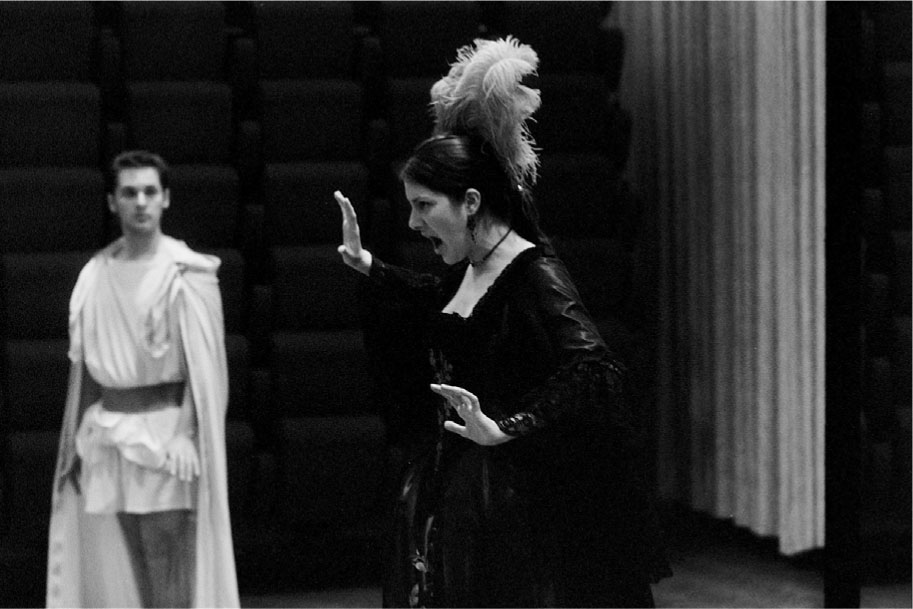
Figure 1
Soetkin Elbers (Clitennestra) rehearsing Leo’s ‘Prendi quel ferro, o barbaro’ while Geoffrey Degives (Ulisse) is watching her. Photograph by Matthias Schellens
To delay the finale and heighten the sense of tension, an interlude was inserted in the guise of an unusually extensive scena (‘E’ questo il loco del mio supplizio? … Tardi rimorsi atroci’; Act I, Scene 5) from Niccolò Jommelli’s Ifigenia in Tauride (Naples, 1771), the opera that is said to have flopped so mercilessly that it caused the composer to suffer a stroke.35 In this episode, which does not have a place in the Iphigenia in Aulis but flashes forward to Iphigenia’s adventures in Tauris, Iphigenia’s brother Orestes is having hallucinations after killing his mother Clytemnestra. His remorse for the assassination was translated in our pasticcio into remorse over Iphigenia’s imminent fate. The sense of displacement, the quirky string of short arias and declamatory accompagnati typical of such a madness-cum-ombra scene, the highlights of Jommelli’s late style, and the presence of obbligato oboe and horn parts evoking the sound of horror, all made the choice of this interlude obvious.
Our apotheosis was all the more built on Jommellian foundations, and more precisely on the composer’s L’Ifigenìa for Rome, 1751, the autograph of which furnished three useful items: a lugubre sinfonia in the ombra key of E-flat major, accompanying Iphigenia’s sacrificial procession (Act III, Scene 8);36 a heroic accompagnato culminating in a Mannheim crescendo;37 and ‘Pria che nell’ore estreme’ (Act III, Scene 4), the aria with which Iphigenia’s stand-in Erifile bids farewell to the world, but which we entrusted to Iphigenia. All of this material produced a one-act opera that was both musically and dramatically varied, giving our young singers a chance to excel and highlighting various aspects of the Iphigenia myth.
CONCLUSION
In his introduction to Machinic Assemblages of Desire (2021), the final instalment in a trilogy of volumes on the relationship between Gilles Deleuze’s philosophies and artistic research, Paulo de Assis states that,
in the field of artistic research … the artist-researcher [on the one hand] scrutinises the materiality and the connectors of her or his objects of practice (as a symptomatologist), while, on the other, he or she invents new relations, interactions, and transversal paths between them. With the concept of assemblage … new modes of thinking and apprehending art objects emerge: not unitarian monuments, but heterogeneously constituted multiplicities; not primarily meaning-oriented realisations, but stimulating[,] non-signifying ruptures; not extensive measurements of quantities (mapping), but intensive explorations of qualities (cartography); not the search for an ‘essence’ of the artwork, but an adventurous exploration of its manifold and heteroclite constitutive parts and flows.38
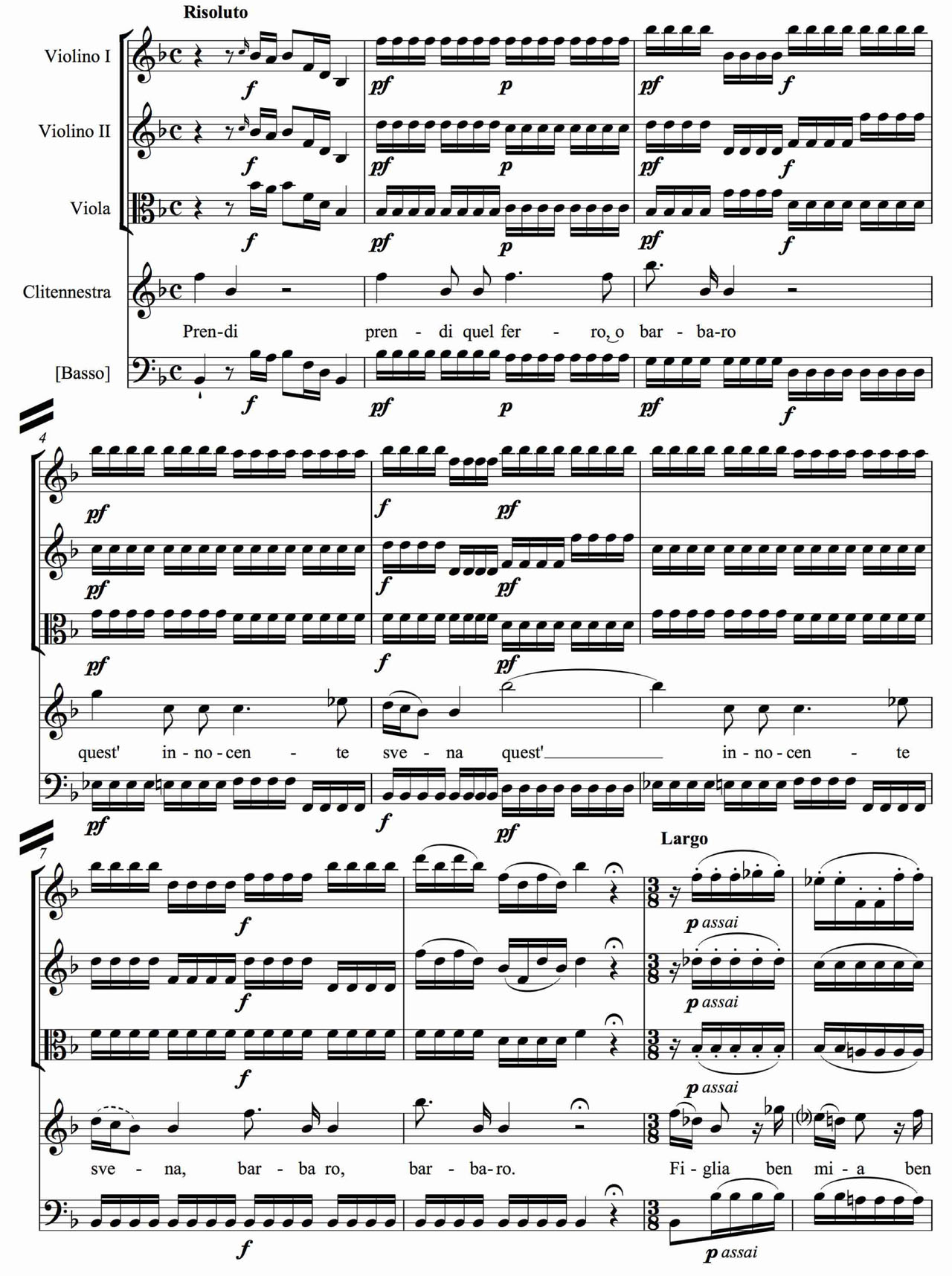
Musical Example 1
Leonardo Leo / Antonio Salvi Andromaca (Naples, 1742), ‘Prendi quel ferro’, bars 1–10
Advertised in 2006 as apologies for artistic or practice-based research,39 Ifigenia and Ipermestra answer to the Deleuzian concept of assemblage in that their constituent parts were arranged to create new constellations: meta-compositional propositions that challenge, if not collapse, the chimerical entities – the ‘works’, ‘canons’, ‘repertoires’, ‘composers’ intentions’, and so on – of Romantic historicism.
Pastiching furthermore offered a method of reconfiguring networks of agents or ‘voices’, as eighteenth-century impresarios would have done to satisfy their stakeholders: ‘producers’, such as the Royal Conservatoire of Brussels, which hoped to see a prestigious project implemented on a shoestring budget, versus artist-scholars, who wanted to showcase the music-dramatic power of opera seria; ‘performers’, such as our young singers and period instrumentalists, who gladly used an educational project as a springboard for their careers; and ‘receivers’, such as today’s spectators, whose attention and listening regimes might be more attuned to Lisztian recitals and black-box theatres than to the idiosyncrasies of Baroque music theatre.40 By gluing together rarely heard fragments from various scores by different authors, according to both Quantz’s definition of pasticcio and modern notions of pasticciare (see above), Ifigenia and Ipermestra allowed us to harmonise these agents and their strategies in useful dialogues, which do not necessarily have to upset historical textures (as Regietheater does).
Myths with a rich Nachleben can provide modern assemblers or pasticheurs with intertextual playgrounds open to both modern and old codes, on both the horizontal (linear, temporal, dramatic, narrative) and vertical (harmonic or synchronic) levels. Great care was in our case taken to ensure a fluent liaison des scènes (scenic connections), with characters emerging and exiting as in classicist dramma per musica.41 The plots respected notions of vraisemblance and bienséance, while our scores had tonalities and cadences succeed one another in as grammatically correct a manner as possible. Finally, Sigrid T’Hooft’s gestural contributions, the costumes, and make-up served to clarify rather than obscure the actions and pathos. In sum, Ifigenia and Ipermestra did involve a high degree of historically informed praxis, as originally envisioned.
At the same time, we chose not to pursue a contextualist historicism by attempting to emulate a specific type of pasticcio from the eighteenth century, seeking to compose it the way composer or impresario X would have done it. Instead, we made a journey through time and space, with our first act beginning, so to speak, in the Arcadian Academy of Rome, in 1705, and ending with late Jommellian melodramma from 1771. This rich palette offered pedagogical advantages, as our singers and instrumentalists worked their way through a broader anthology of highlights – exceptional, not necessarily conventional, if not atypical pieces, selected from a modern perspective. For the young artist-scholar that I was at the time, pastiching Ifigenia and Ipermestra offered a unique avenue to cultivate Baroque artistry, and to build a trompe l’oreille out of ready-made materials. It would be therefore unwise to declare the Ifigenia/Ipermestra as ‘vintage pasticcio’, and also miss the opportunity to reconsider the praxis of pastiching, not so much as the artifact of a deviant past, but rather as a productive method for artistic research.
Bruno Forment is principal investigator at Orpheus Instituut (Ghent, B), where he leads the Resounding Libraries research cluster centred around the private library of Ton Koopman. He has taught at Vrije Universiteit Brussel, KU Leuven, and the Royal Conservatoires of Brussels and Ghent. He is the author and editor of four books (most recently Droomlanders: Vergeten tovenaars van het geschilderde toneeldecor, Davidsfonds, 2021) and of dozens of articles and reviews on opera, historically informed performance, and stage design. He has programmed and directed the Baroque orchestra Il Fondamento, coordinated the Classical Music department at the Royal Conservatoire of Ghent, and carried out research projects at the Conservatoire of Antwerp and CEMPER. He set up several professional music (theatre) productions and discovered Europe’s largest collection of historical stage sets.