
Table 1
Arias in L’abbandono di Armida (Venice 1729), their performers and sources
| Scene | Incipit | Sung by | Borrowed from |
|---|---|---|---|
| I,1 | Pastori cantate | coro | ? |
| I,1 | La fortuna è un pronto ardir | Tancredi / Nicolini | Text originally from Il trionfo della Fedeltà (1708) by A. Scarlatti, previously also sung by Nicolini |
| I,2 | Che dolce foco in petto | Armida / Fachinelli | B. Marcello, Arianna |
| I,3 | Fin che per te mi palpita | Erminia / Negri | Porpora, Ezio |
| I, 4 | Un certo non sò che | Rinaldo / Broschi | Leo, Catone in Utica? |
| I,5 | Se dalle stelle tu non sei guida | Ubaldo / Gizzi | Didone abbandonata, Porpora? owing to Gizzi’s participation |
| I,6 | Se d’ira armato vuoi cimentarmi | Clorinda / Giorgi | Leo, Catone in Utica; extended in comparison with the original. |
| I,8 | Sò che pietà non hai | Rinaldo / Broschi | Leo, Catone in Utica |
| II,2 | Quando saprai chi sono | Tancredi / Nicolini | Didone abbandonata, Porpora? |
| II, 3 | Quel vapor che in valle impura | Rinaldo / Broschi | Porpora, Semiramide |
| II,4 | Bei labbri ch’Amore | Ubaldo / Gizzi | Vinci, Farnace15– its text resembles that of Metastasio’s later cantata |
| II,6 | Nave altera che in mezzo all’onde | Clorinda / Giorgi | Vinci, Gismondo re di Polonia |
| II,7 | Che quell Cor quell Ciglio altera | Erminia / Negri | Porpora, Semiramide |
| II,9 | Ma gia scoperti | Armida / Fachinelli | Marcello, Arianna |
| II,10 | Cerva in bosco se l’impiaga | Rinaldo / Broschi | Leo, Catone in Utica |
| II,11 | Solo nel vero | coro | ? |
15 In Vinci’s Farnace (Rome 1724) this aria opens with the words Bei labri, but the further structure of the text is different. Nevertheless, it is possible that Vinci’s music was adopted to suit the new words. The pasticcio text of this aria is, however, most similar to the later text of Metastasio’s cantata, La Gelosia, music for which was notably written in 1746 by Porpora.
| Che dolce foco in petto | What sweet fire in my breast |
| Oltre l’usato io sento | Different from what I used to feel, |
| Che in vece di tormento, | Which instead of torment |
| Gioja mi dà e diletto, | Offers me joy and delight |
| E mi consola. | And it consoles me. |
| E se di nuovo ardore | And as I feel this new ardour |
| Sento quest’alma piena, | Fill my soul |
| Desio, ma senza pena, | I desire, but without pain |
| Amo, ma dal mio core | And I love, but from my heart |
| Il duol s’invola. | The pain flies away. |
| Fin che per te mi palpita | For as long as my heart beats |
| Timido in petto il cor, | Shily for you in my chest, |
| Accendersi d’amor | This soul is unable |
| Non sà quest’alma. | To be inflamed by love. |
| Nell’amorosa face | In love’s radiance |
| Qual pace | What peace |
| Ho da sperar | Can I hope for |
| Se comincio ad amar | If I begin to love |
| Priva di calma. | Deprived of peace. |
| Sò che pietà non hai, | I know you have no pity |
| E pur ti deggio amar: | But must love you all the same: |
| Dove apprendesti mai | Where did you learn |
| L’arte d’innamorar | This art of arousing passions |
| Quando m’offendi? | With which you insult me? |
| Se compatir non sai, | If you can’t show compassion |
| Se amor non vive in te, | And there’s no love in you, |
| Perche crudel perche | Why, cruel one, o why, |
| Così m’accendi? | You inflame this passion in me? |
| Quel vapor che in valle impura | The fog that has in the impure valley |
| S’inalzò da ignobil Fonte | Risen from that ignoble source |
| Gli Astri oscura | And hides the stars from view, |
| Adombra il Monte, | Conceals the mountain |
| Sì colora in facia al Sol. | And is coloured on the side of the Sun. |
| Ma disciolto a poco a poco | But dissolved, bit by bit? |
| O dell’aure è scherzo è gioco, | It now becomes a plaything of the winds |
| O ritorna in grembo al Suol. | And now returns into the womb of the earth. |
| Quel… | The… |
| Nave altera che in mezzo all’onde | The proud ship in the midst of the ocean, |
| Nell’orror di note oscura | In the terror of a dark night, |
| Agitata è da due venti | Playing between two hurricanes, |
| Ferma stà e non sà | Remains constant even when it knows not |
| Qual di lor la spinga al porto. | Which of the two winds will bring it to harbour. |
| Così l’alma che si confonde | Just so, the soul is caught up in thought |
| Fra due stimoli possenti | When it is torn between two mighty forces |
| Pensa fra sè – qual è Qual che giova al suo Conforto. | Which of the shall bring it to salvation.21 |
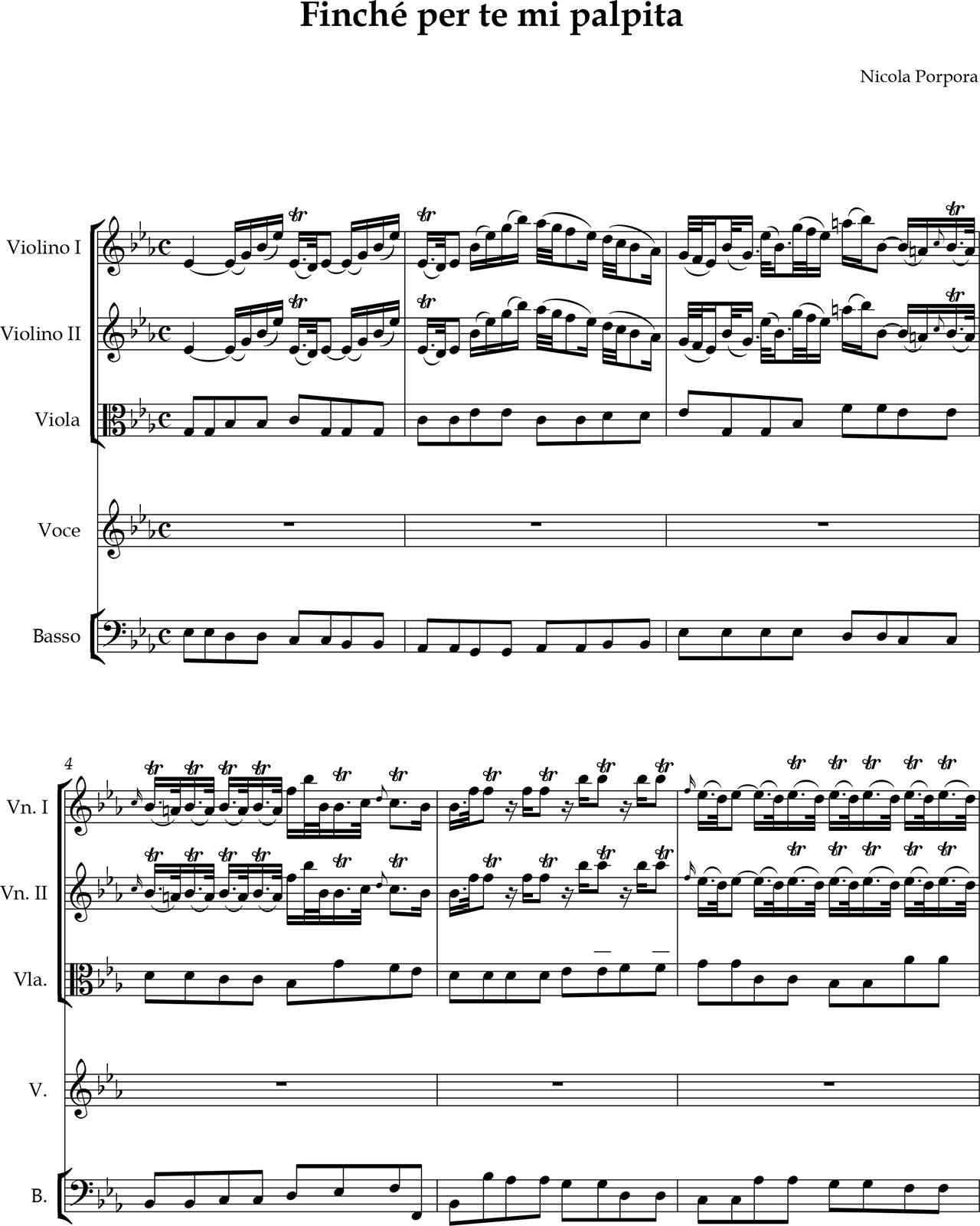
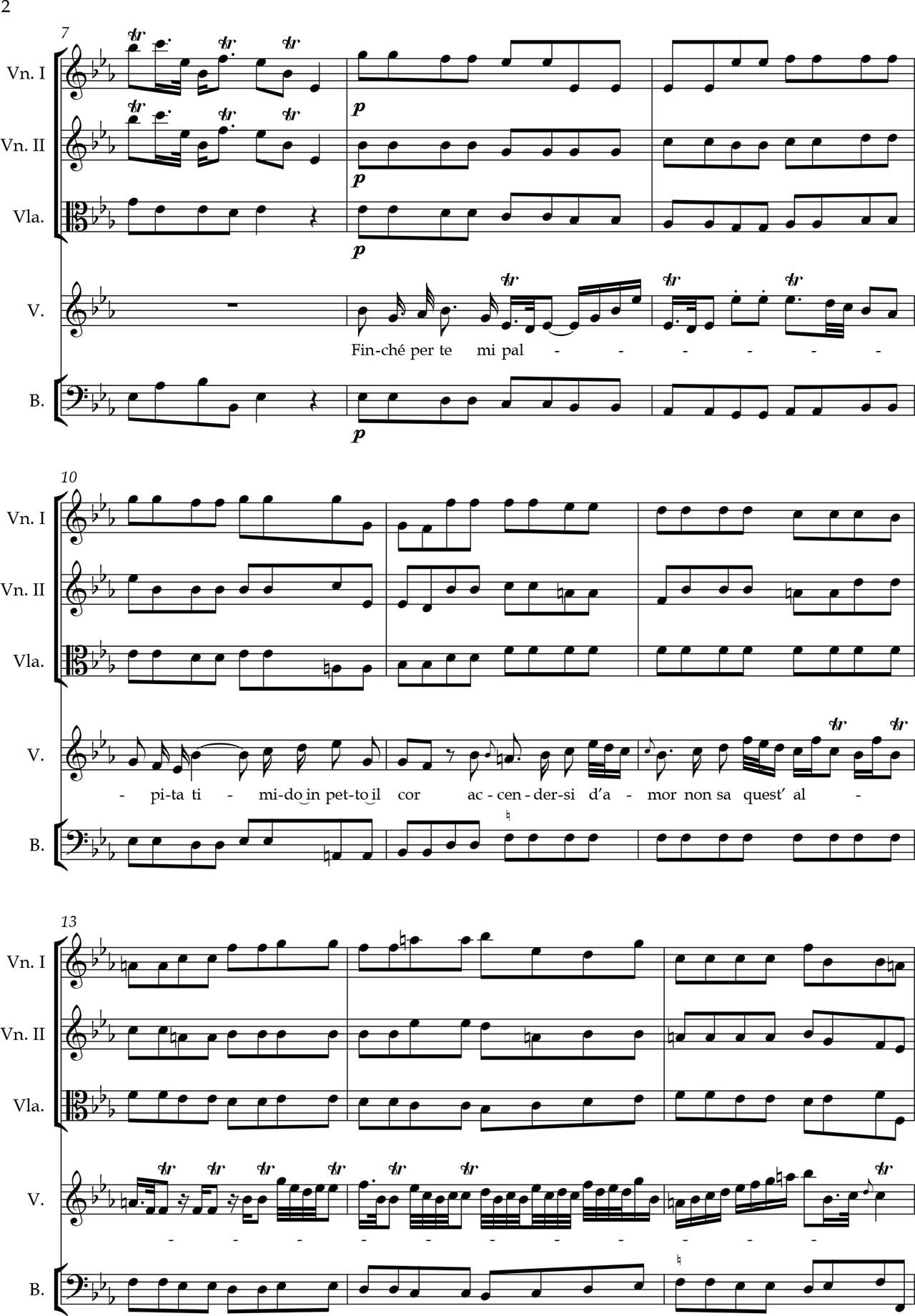
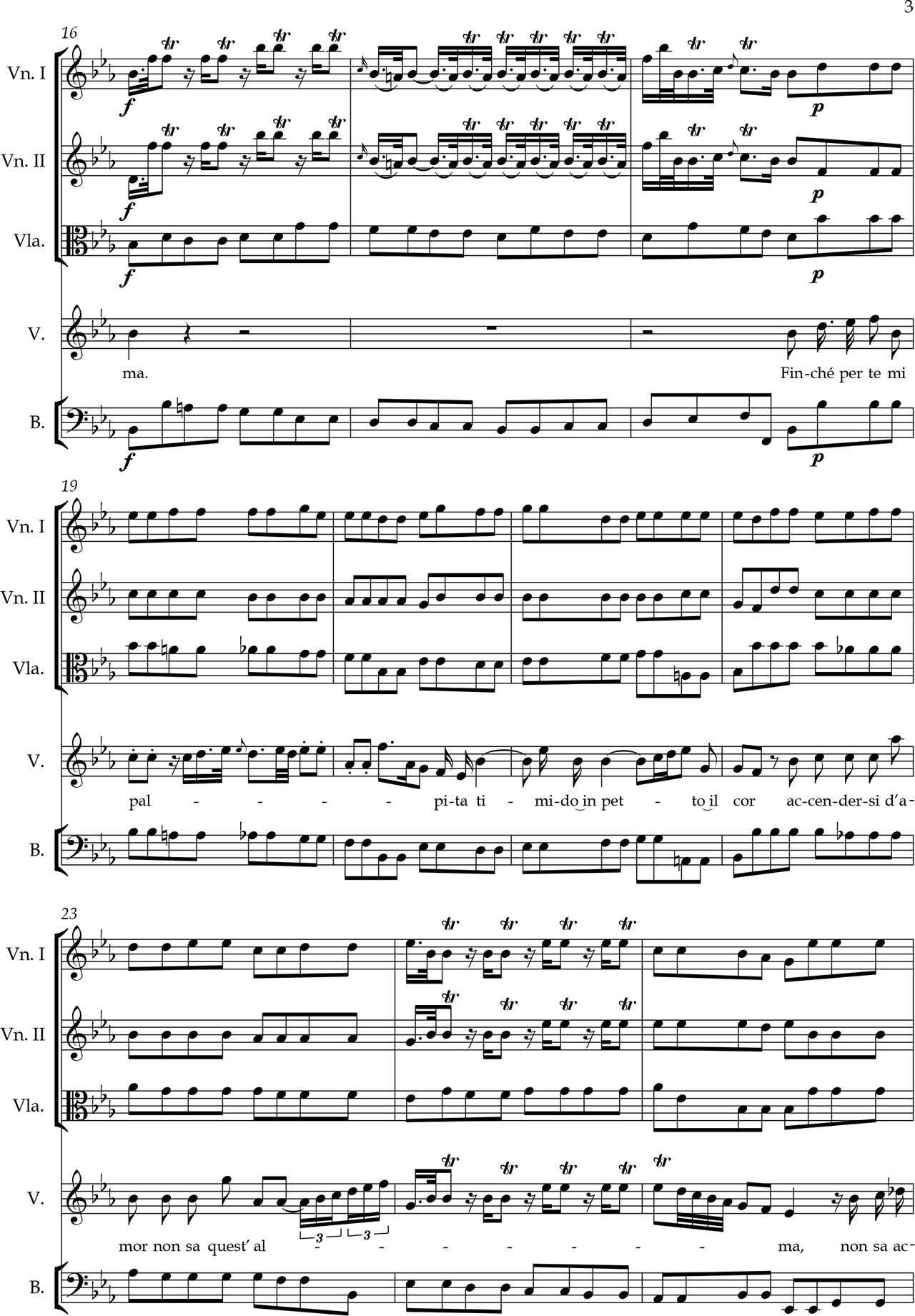
Musical example 1
Nicola Porpora, Fin che per te mi palpita, initial ritornello and section A of ‘trill aria’
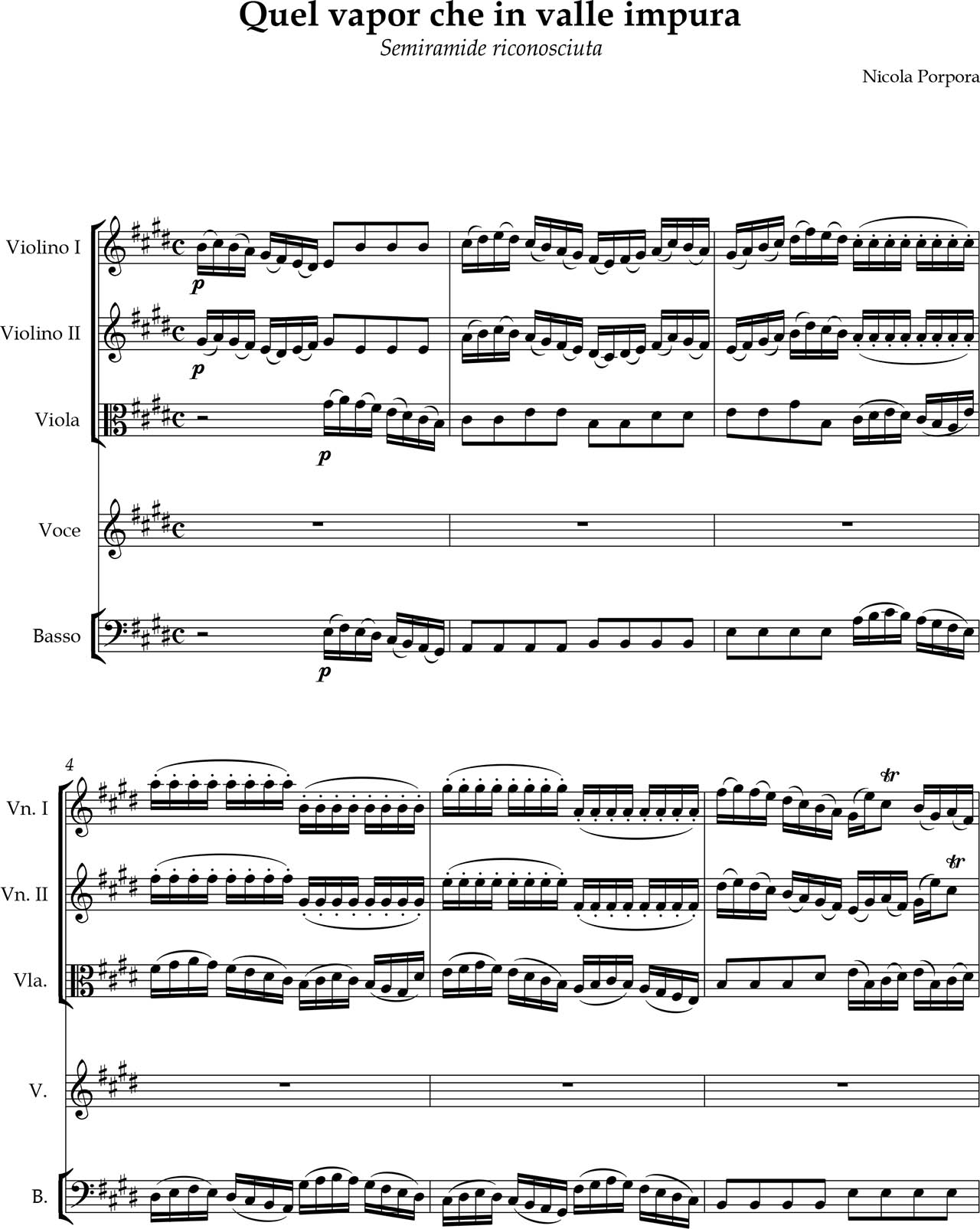
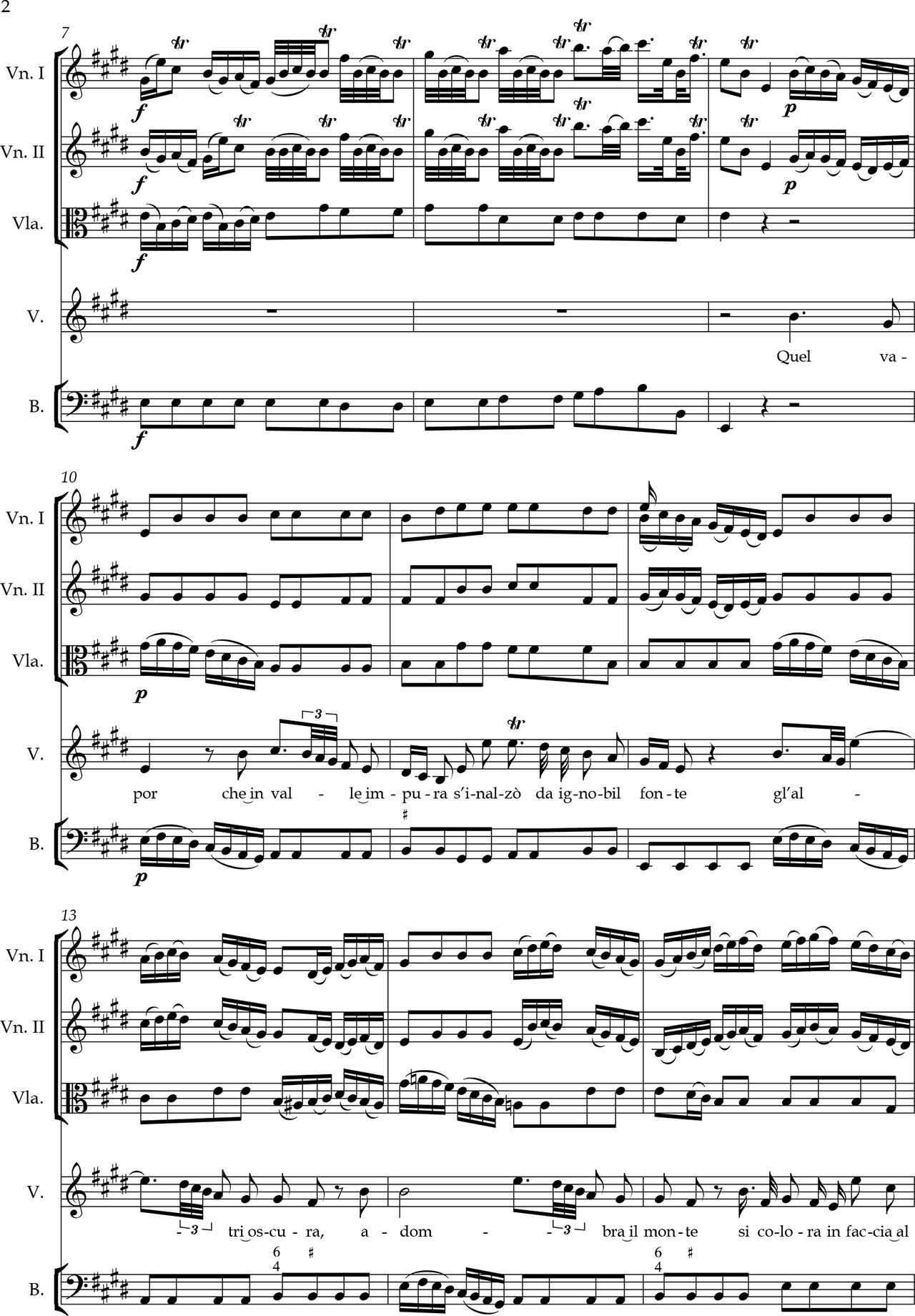
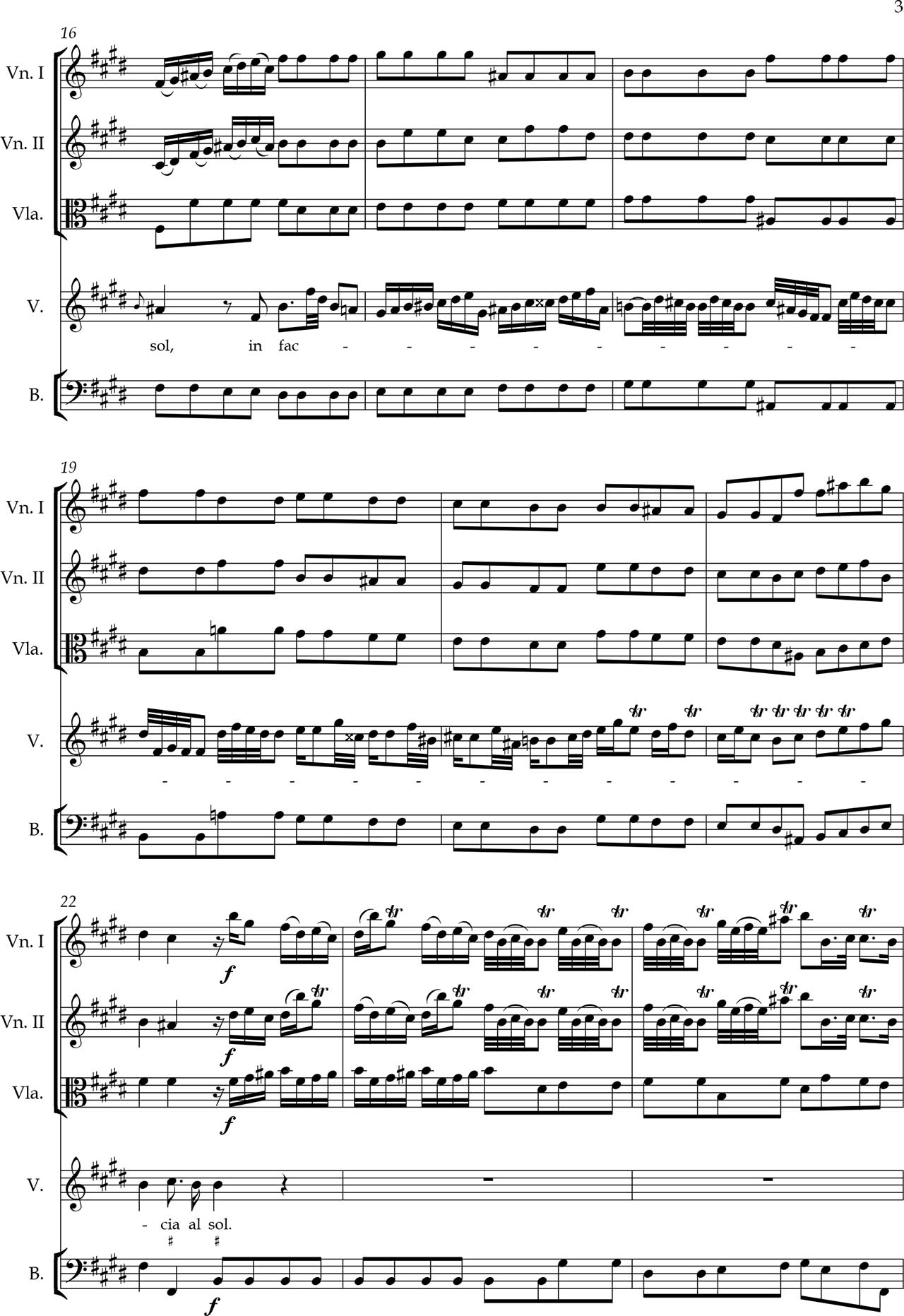
Musical example 2
Nicola Porpora, Quel vapor che in valle impura, initial ritornello and section A of the aria