
This now forgotten 18th-century composer attracted my interest several years ago, when I discovered that he was employed at the court of Hieronim Florian Radziwiłł1, one of the most controversial magnates of the Polish-Lithuanian Commonwealth in the Saxon period. Torti's works, gradually unearthed in ever more remote corners of Europe, prove that he was both competent and acclaimed as a composer. The recent discovery of his previously unknown compositions – two trio sonatas and a cantata – provides an opportunity to take another look at his output.
Very little is known about Giuseppe Torti's life. He was associated with Milan (his surname was frequently coupled with the epithet Milanese2), and may have received his music education in that city. With his wife Teresa, a popular singer, he travelled widely in Europe in search of employment and income. Undoubtedly the longest of his journeys took him to Lithuania, to the Radziwiłł estates in Slutsk and Biała (Podlaska). We owe the existing information concerning Torti's life and work (covering the years 1752–1780) mainly to the artistic engagements of his wife. The earliest records of Giuseppe's activity need to be related to Teresa's performances in Genoa in 1752. The couple then set out for the northeast. In 1753 Teresa sang in Vicenza, for the carnival of 1754 – in Graz, and in 1755 both artists were active in Vienna, where they stayed until the spring (April) of 1756. We should note at this point that Torti's only surviving aria (Attenda il core dal caro bene), found in a Viennese collection3 among works by Italian artists (B. Gallupi, A. Mazzoni, G. Ferrandini) is dated 1755 in the source. The choice of the capital of the Habsburg Empire, of which the Duchy of Milan was a part nearly throughout the 18th century (1706–1797), as one of the destinations of the Tortis’ artistic tour, seems an obvious choice. Apparently, however, their stay in that city did not work out exactly as they had hoped. They most likely intended to obtain engagements at the court of Empress Maria Theresa, but failed, as we can glean from the surviving sources. They therefore sought other employment and signed with the court of Hieronim Florian Radziwiłł. The contract was concluded on 1st April 1756. Having reached Biała and Slutsk, the couple spent three years at the prince's estates in accordance with the terms of agreement, and in the autumn of 1759 were already back in Milan, as we learn from Joseph Kohaut, one of Radziwiłł's former musicians, who mentions visiting the Torti couple in that city late in that year or at the beginning of 17604. While their artistic itinerary on the way from Milan to Lithuania can be reconstructed almost in full, their route back to Italy is not easy to map out. Torti's works found in the collections of Benedictine monasteries in the Alps (Lambach and Engelberg) might suggest that they stopped over in those regions. The couple left Milan again in 1762 (or a bit earlier) and travelled to the south of Italy, were they worked in Palermo for at least two years. In 1762 Teresa is known to have sung Berenice in Il Vologeso5 at the Teatro Santa Cecilia, and in the following year the azione drammatica Tancredi in Tessalonica was staged with Torti's music for the birthday of Ferdinand I, the future King of the Two Sicilies (1751–1825), at his palace6. The couple did not remain in Sicily for long. For 1765, we have records of Teresa's performances in Florence in the north, and in the subsequent years in Padua, Alessandria, and Venice. As late as 1780, she sang Ismene in a Venetian production of L’Antigono. The later life of the couple (assuming that Giuseppe was still well in 1780 and accompanied his wife) is unknown.
Table 1
Works by G. Torti kept at the Badische Landesbibliothek in Karlsruhe
| No. | Work | D-KA | Attribution | Concordances | Attribution |
|---|---|---|---|---|---|
| 1. | Concerto in G Major fl, vl (2), vla, b, GroF826 | Mus. Hs. 953 | G. Torti | – | |
| 2. | Trio in C Major, GroT 3943-C | Mus. Hs. 954 | G. Torti | – | |
| 3. | Trio in G Major, GroT3944-G | Mus. Hs. 955 | G. Torti | – | |
| 4. | Trio in D Major, GroT3991-D | Mus. Hs. 1128 | none | GB-Eu, Mus. c. D 52–54/19 | G. Torti |
| 5. | Trio in G Major, GroT3833-G | Mus. Hs. 129 | B. Federici | CH-Bu, kr IV 353 S-SK, 234a | G. Torti B. Galuppi |
The list of Giuseppe Torti's currently known works comprises instrumental pieces, cantatas, an aria, as well as one opera libretto. We also know of at least two lost operas. Instrumental music forms the largest group. With one exception, it was written for transverse flute. There are six flute trio sonatas and three concertos (one for oboe) 7. Torti's trios, scored for two flutes and basso, have primarily been preserved in the music collection of the Badische Landesbibliothek in Karlsruhe, which includes four of the six now known trio sonatas by this composer: the Trios in C Major (GroT8 3943-C) and in G Major (GroT3944-G)9, not found in any other sources, as well as the unattributed and incompletely preserved Trio in D Major (GroT3991-D)10 and the Trio in G Major (GroT3833-G)11, for which we have two other sources. The Karlsruhe collection also contains Giuseppe Torti's Concerto in G Major for flute, two violins, viola and b.c. (GroF826)12.
The presence of compositions by Torti in the Karlsruhe collection justifies the question whether Giuseppe or his wife were in any way connected with the music ensemble of Charles Frederick, Margrave and later Grand Duke of Baden (1728–1811). In the mid-18th century, music life flourished in the Grand Duchy of Baden thanks to the musical passions of the margrave (who was a great lover of flute music and played this instrument well himself), as well as those of his wife13, coupled with Johann Melchior Molter's (1696–1765) effective management of the 45-piece orchestra. However, the surviving lists of artists associated with that ruler do not list either Teresa or Giuseppe among the court musicians. Besides, in the Tortis’ known calendar of artistic tours from the 1750s to the 1770s there is hardly any space left for a stay in Karlsruhe. On the other hand, we know that the programmes of the numerous instrumental music concerts held in that city featured, apart from works by the Kapellmeister J.M. Molter (which dominated the repertoire), also music imported from Milan, including compositions by Giovanni Battista Sammartini, with whom the margrave corresponded in person14. It is therefore most likely that the works of Giuseppe Torti and such other Milanese composers as Giovanni Battista Lampugnani, Baldassare Federici, and Andrea Bernasconi were purchased for the needs of the Baden court's music ensemble. Molter's inventory of the courtly music collection, made in 1755, lists Torti in only one place, in the section for Concerti e Quarti concertanti next to the incipit of the Concerto in G Major (GroF826)15. This proves that the concerto, Torti's only work recorded and released so far16, had been composed before 1755. The inventory does not list any of his four trio sonatas, which means that they reached Karlsruhe at a later date.
Torti's surviving flute trios consist of three movements (fast-slow-fast)17. The first and last of them represent a binary form with repeated segments, where the material of segment B draws on A. Torti's sonatas must have enjoyed some popularity in their own time, since most of them (four) survive in more than one source. Trio Sonata in G Major (GroT 3833-G) can be found in three sources, only one of which (kept at Basel University Library) attributes this piece to Torti. In the copy from Karlsruhe, it was ascribed to another Milanese composer, Baldassare Federici, and in the Stockholm collection – to Baldassare Galuppi18. The copies in these various manuscripts only differ in minor details of articulation, rhythm, and ornamentation, without any major modifications. What is notable is that the part of the second flute in the central movement of the Trio exceeds that instrument's range, reaching B3 and C4. This is the variant we find in S-SK, 234a (where the performing forces listed are two violins and b.c.) and in CH-Bu, kr IV 353 (Ms. 312), whereas in the copy from Karlsruhe the passages in question were notated an octave higher, which makes a performance of the work by two flutes possible19. 18th-century works for a solo instrument (violin or flute) were frequently conceived in such a way that they could be executed on either of them depending on the instruments’ availability and on local preference. The copy from Basel evidently contains a minor error, most likely made by a careless copyist.
Two of Torti's trio sonatas survive in John Reid's music collection in Edinburgh20. These are: Trio in D Major (GroT3991-D21), also known from Karlsruhe, and a Trio in G Major. Reid, a Scottish general and music lover, played the flute in concerts in London and Edinburgh. He also tried his hand at composition (writing marches dedicated to the various British army troops, as well as minuets, solo sonatas for flute or violin with b.c., all of them published in London in 1756–178123). He endowed a chair of music at the University of Edinburgh, which laid the foundations for its present-day Faculty of Music. Trio in D Major (GroT3991-D), which is part of Reid's collection, is also found as an anonymous piece in an incomplete copy (already mentioned above) kept in Karlsruhe (only the title page remains of the basso part). These two copies are nearly identical, with only one modification in the 2nd movement, where the key was changed from D minor (in the Edinburgh source) to B minor (in the copy from Karlsruhe), which means that the whole was notated a third lower.
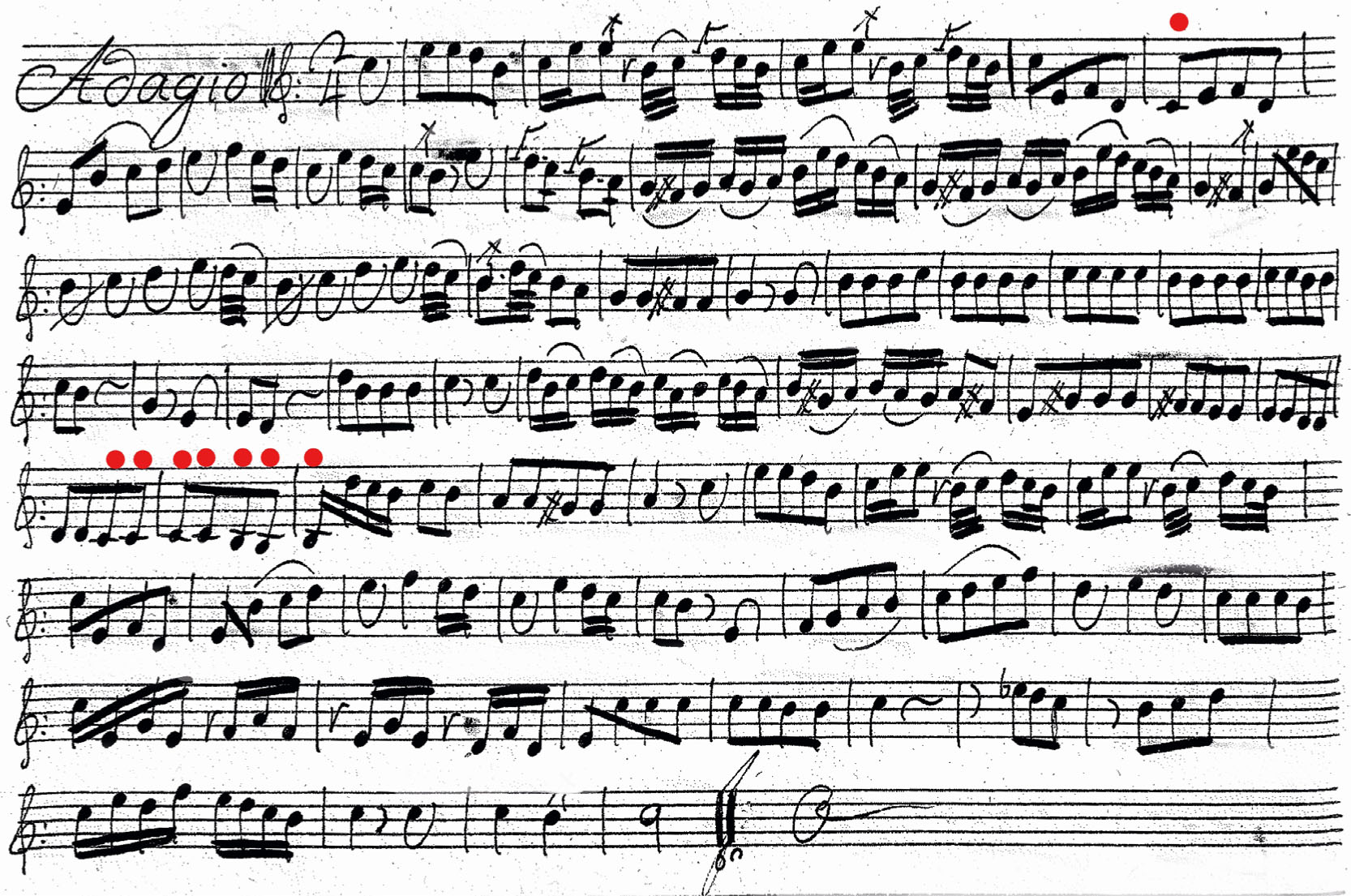
Music Example 1a
Giuseppe Torti, Trio in G Major, GroT3833-G, Adagio, Fl II part, CH-Bu, kr IV 353 (Ms. 312), fol. 922
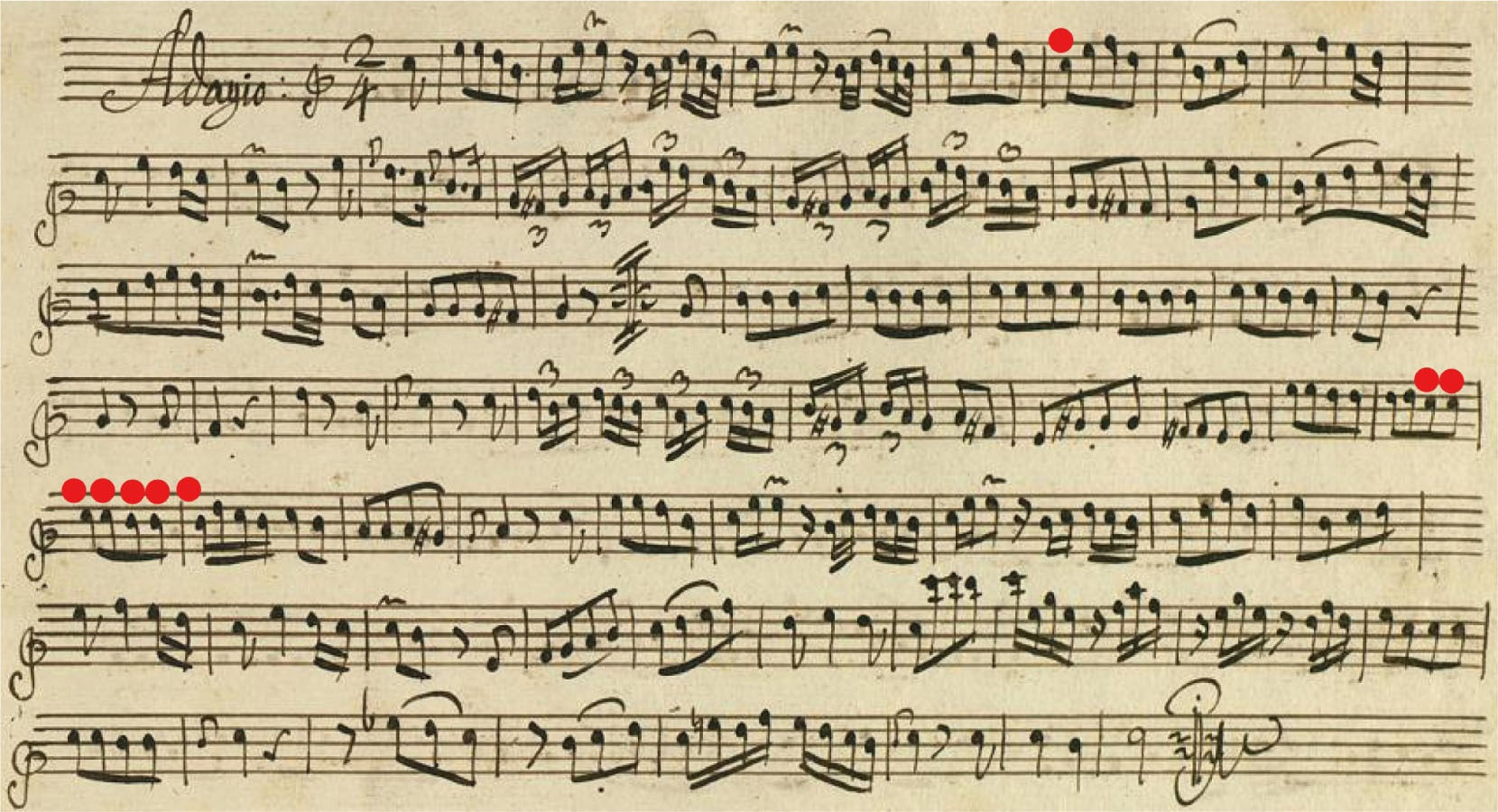
Music Example 1b
Giuseppe Torti, Trio in G Major, GroT3833-G, attributed in the source to B. Federici, Adagio, Fl II part, D-KA Mus. Hs. 129, fol. 9
Table 2
Trios by G. Torti kept at Edinburgh University Library
| No. | Work | GB-Eu | Attribution | Concordances | Attribution |
|---|---|---|---|---|---|
| 1. | Trio in D Major, GroT3991-D | Mus. c. D 52–54/19 | G. Torti | D-KA, Mus. Hs. 1128 | none |
| 2. | Trio in G Major | Mus. c. D 52–54/20 | G. Torti | I-Mdemicheli, MSS. Mus 116; F-AG, 277 (1–2) | none; G.B. Sammartini |
Reid's collection24, comprising nearly 50 flute trio sonatas by, among others, Quantz, Jomelli, Sammartini, Campioni, and numerous unattributed ones, includes also Torti's Trio in G Major25, dated 1755 in this source, and bearing the note: “per uso Del Sigre Cavaliere Davers”. This may refer to one of the two brothers, Sir Robert Davers (1735–1763), 5th Baronet of Rushbrook, or the younger Charles (1737–1806). We know that Robert remained in the British Isles till the spring of 1756, when he set out for the continent, heading for Italy. The inscription on the title page therefore refers most likely to the then 18-year-old Charles Davers, who, having graduated from Trinity College, Cambridge in 1755, embarked on his foreign travels. We know nothing about his itinerary, but it may be hypothesised that late in 1775 Torti and Davers's paths crossed, probably in Vienna or thereabouts. Torti's Trio in G Major (and his other trio, in D Major) may have become part of the collection of John Reid, a music-lover and flutist well-known on the Isles, at some later date (impossible to define precisely), when it was either presented to him by, or purchased from Davers.
Of the Trio in G Major dedicated to Charles Davers, previously omitted from flute music catalogues except for the Edinburgh copy, one (unattributed) part-book also survives in the Biblioteca privata Jorxe De Micheli in Milan26. Besides, another copy of this piece can be found in the Archives Départementales de Lot-et-Garonne in Agen27 (as a duetto for two violins by Giovanni Battista Sammartini). The melodic and rhythmic material of Torti's flute parts is identical with that of Sammartini's Duetto and with the 1st violin part in the Milanese source28, except for the central movement of the latter, which in Torti's version is a Largo in G major, quite different from that found in the Agen and Milan versions (Adagio in E minor). Since we have no other sources at our disposal, we cannot unequivocally decide whether the attribution to Sammartini (in F-AG) is erroneous, and the Duetto is actually a piece by Torti later rearranged as a trio, or whether perhaps the former composition was indeed written by Sammartini and used by Torti as the basis for his own piece, in which he supplemented the b.c. and added a new middle movement. Torti was associated with Milan and may, as we suggested above, have received his music education in that city. He belonged to a generation of musicians who could be Maestro Sammartini's pupils. The Trio in G Major is, however, a conventional mid-18th-century setting, and does not demonstrate distinctive stylistic qualities which might justify a decisive attribution to either Samartini29 or Torti.
Two other pieces may be identified, albeit tentatively, as flute trio sonatas by Torti. The first is another Trio in G Major, kept at S-Sk30 (as an unattributed piece) and at S-L31 (as a work by Andrea Bernasconi, 1706–1784). Bernasconi, as he informs us himself (in the libretti of his early operas), was associated with Milan (specifically, in 1737 and 1743–1753). He was, however, first and foremost an opera composer, and exhibited little interest in instrumental music32. The said trio is the only known example of this genre in his oeuvre. In his catalogue, Barry Brook33 attributed this work to one ‘Giuseppe Tarti’, dating it to 1763. It is tripartite, similarly as Torti's Trio in G Major (GroT3944-G), which likewise ends with a minuet.
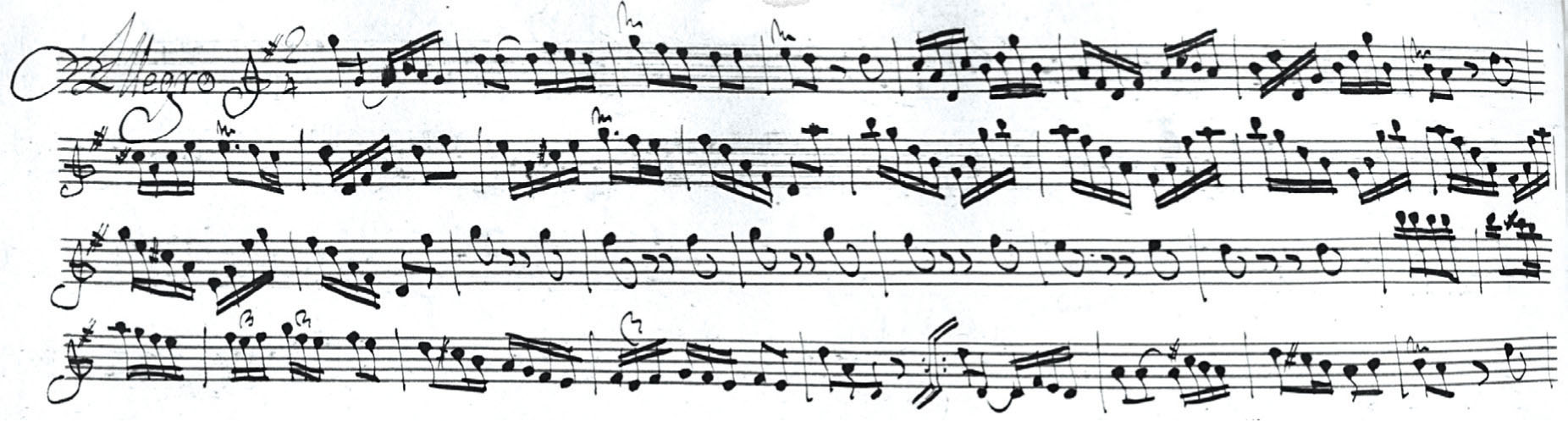
Music Example 2a
Giuseppe Torti, Trio in G Major, mov. I, Allegretto, Fl I part, GB-Eu, Mus. c. D 52–54/20
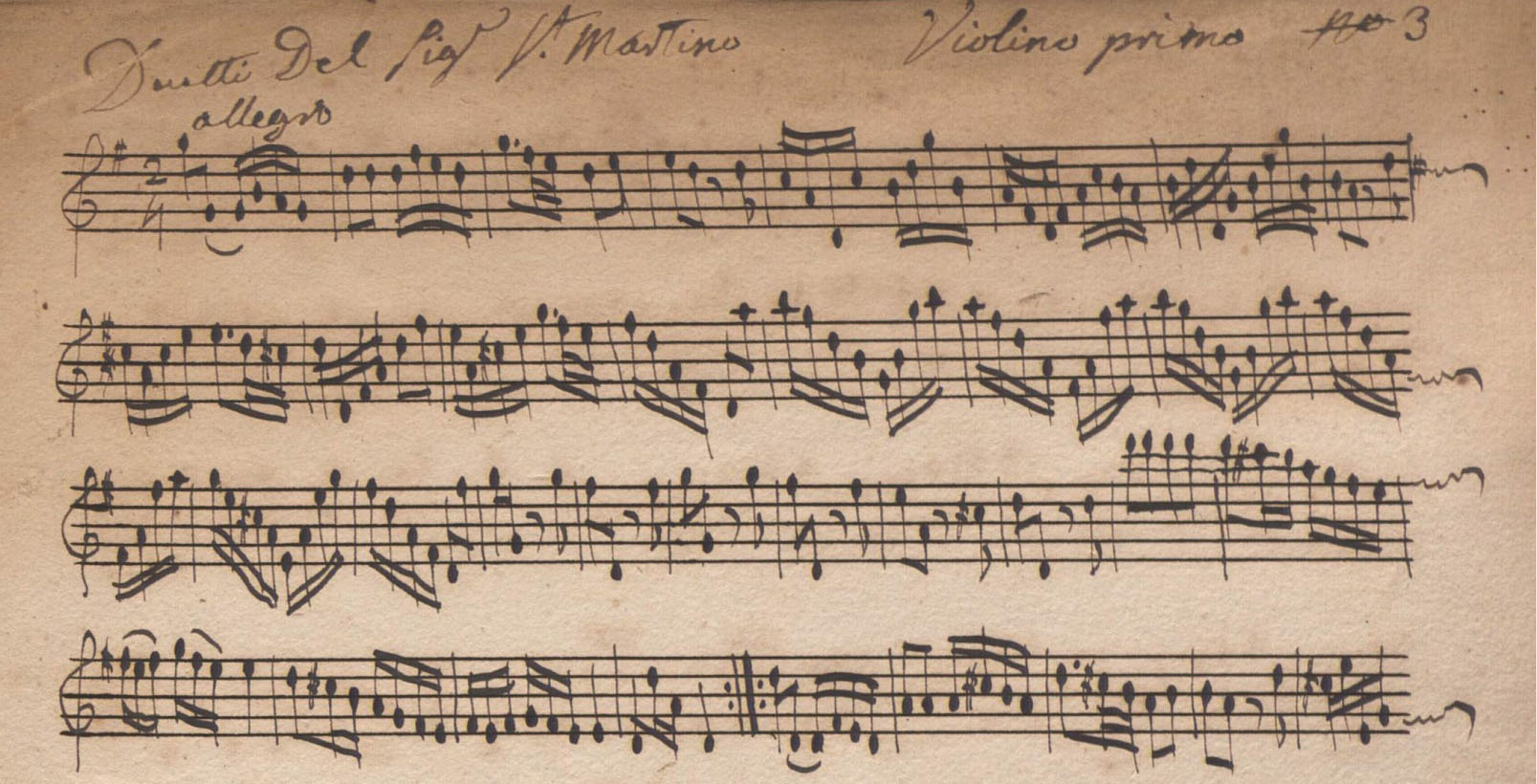
Music Example 2b
Giovanni Battista Sammartini, Duetto in G Major, mov. I, Allegro, vl I part, F-AG, 277 (1–2)
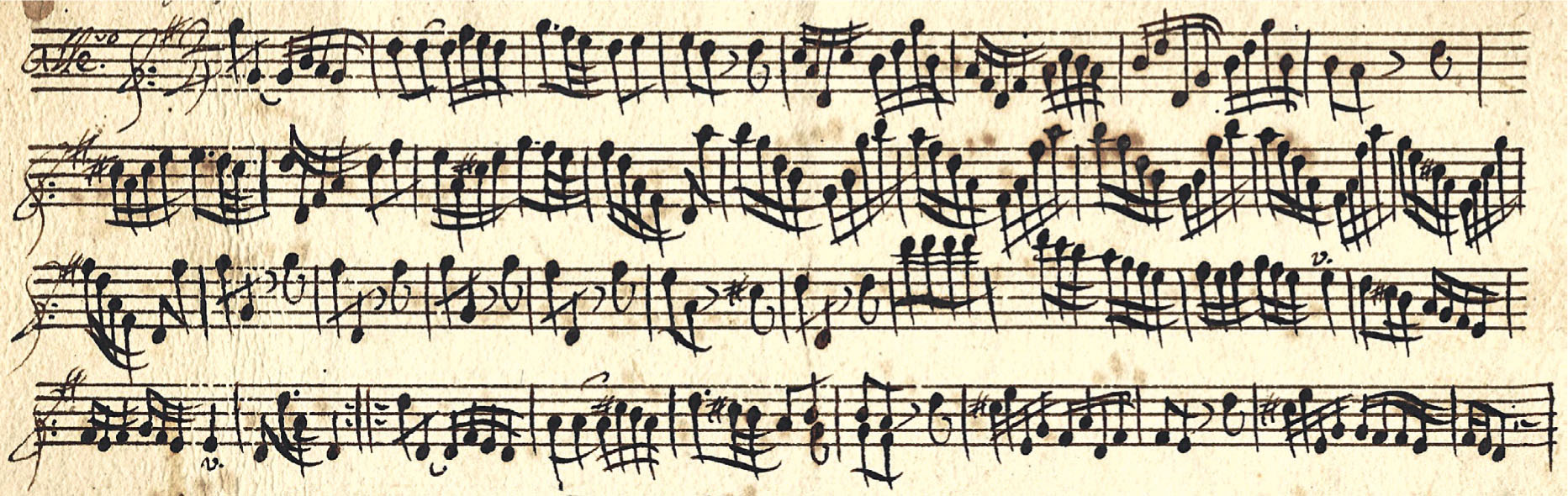
Music Example 2c
Anonymous, Duetto in G Major, mov. I, Allegro, vl I part, I-Mdemicheli, MSS. Mus 116
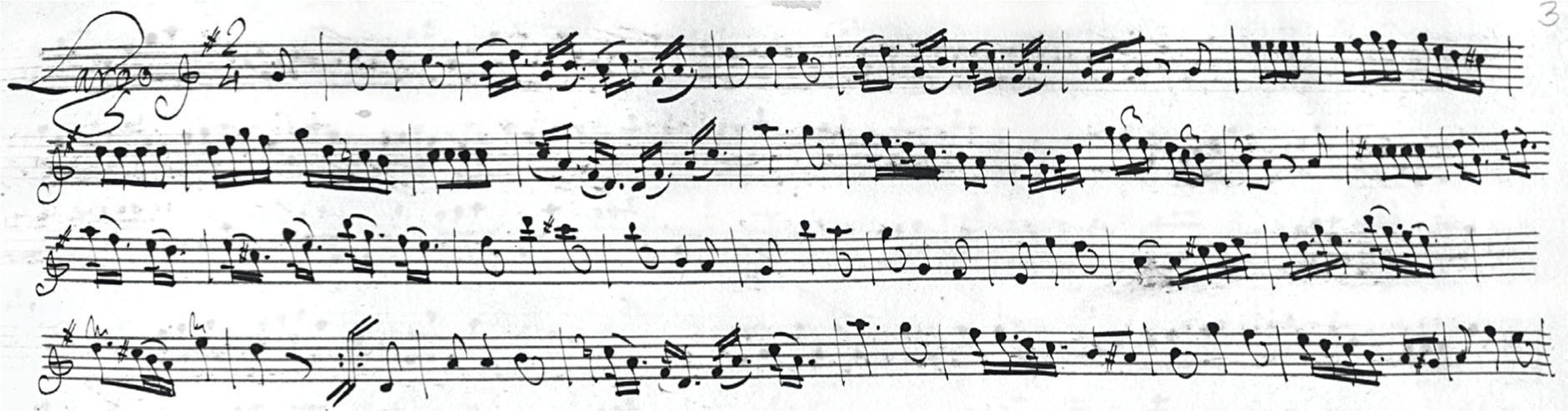
Music Example 3a
Giuseppe Torti, Trio in G Major, mov. II, Largo, Fl I part, GB-Eu, Mus. c. D 52–54/20
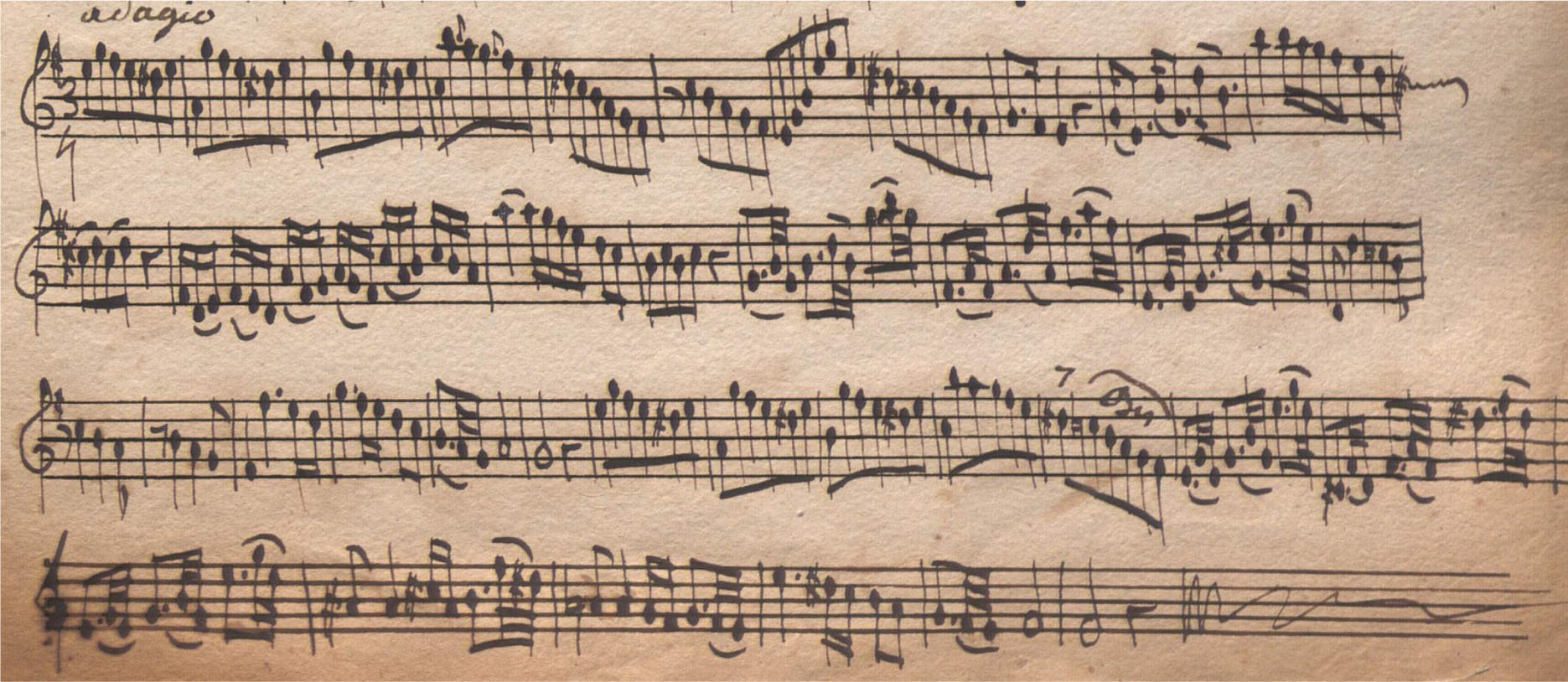
Music Example 3b
Giovanni Battista Sammartini, Duetto G-dur, mov. II, Adagio, vl I part, F-AG, 277 (1–2)
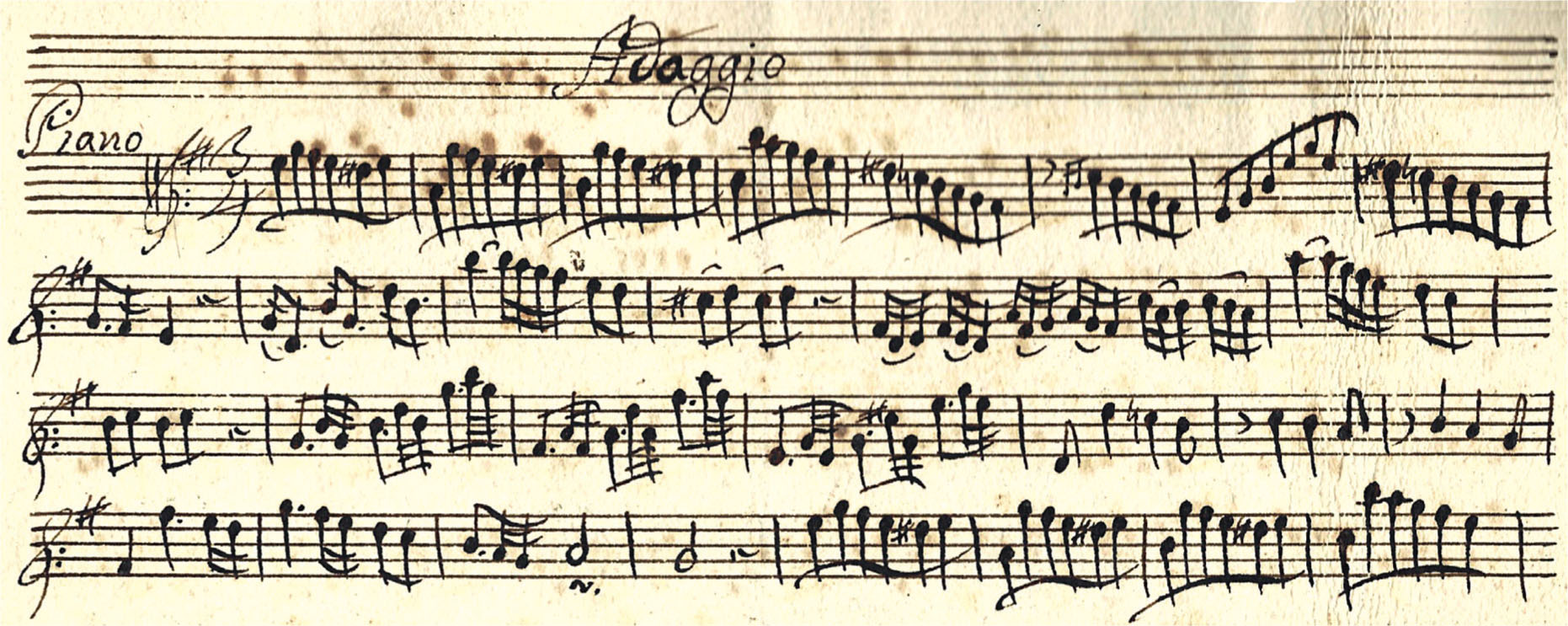
Music Example 3c
Anonymous, Duetto G-dur, mov. II, Adagio, vl I part, I-Mdemicheli, MSS. Mus 116
Torti's known vocal-instrumental output comprises, apart from the above-mentioned aria, also two Latin sacred cantatas, Armata sum in campo34, based on variants of the same text, with minor differences in musical settings. Both follow the same overall four-part design, with two da capo arias separated by a recitativo accompagnato and ending with an Alleluia (Halleluiah). The whole is preceded by a sinfonia and interspersed with instrumental ritornelli. The cantatas differ in the key and performing forces. The setting now kept in Lambach, in A major, is scored for bass voice, two violins, viola, b.c., and two horns, whereas the other version is in C major, and more modestly scored (a soprano, two violins, viola, and b.c.35)
Notably, the cantatas are part of the music collections of two sister monasteries of the Benedictines, in Lambach and Engelberg, both boasting long musical traditions36 and, in the case of Lambach, an exceptionally large library of 18th-century music sources, which reflects the position of this monastery as a major cultural centre in that period. The manuscripts are undated, but if we assume that they were incorporated into these collections in the context of the Torti couple's journey back from Lithuania, then the Lambach version for solo bass would be chronologically earlier than the Engelberg soprano cantata, thus reflecting the musicians’ itinerary. It is also possible that one or both of these works had been composed earlier, specifically with Teresa Torti in mind as the soloist, or for the excellent bass Tadeus Butz, who worked at the Radziwiłł court37 and took part in performances of Torti's operas.
In either case, both cantatas were most likely composed before 1760, before Torti returned to his native Italy from his long journeys. The solo vocal part is conceived in a way which may suggest that it was originally meant for a low voice, since the melody features numerous progressions consisting of broken triads, leaps, and repeated notes. Both solo parts abound in extensive melismata, comprising as many as almost 90 notes in the first aria (Armata sum in campo) and in the final Alleluia (Halleluiah)38. The vocal ambitus is up to one and a half octaves in both versions (between C4 and A5 for the soprano, A2 to E4 for the bass). In both, the composer mainly exploits the top register of the respective voice ranges39.
Table 3
Comparison of form and scoring in the two versions of the cantata Armata sum in campo, found in Lambach (A-LA, 1906) and Engelberg (CH-EN, mus A 683)
| No. | A-LA, 1906 | CH-EN, mus A 683 | ||
|---|---|---|---|---|
| Sequence of movements [whole cantata = 364 measures] | Scored for: | Sequence of movements [whole cantata = 397 measures] | Scored for: | |
| sinfonia (20 ms) | vl (2), vla, b, cor (2) | sinfonia (26 ms) | vl (2), vla, b | |
| 1. | Aria da capo: Armata sum in campo, A major, 4/4, no tempo indication (119 ms) | B, vl (2), vla, b, cor (2) | Aria da capo: Armata sum in campo, C major, C, Vivace assai (129 ms) | S, vl (2), vla, b |
| instrumental ritornello (12 ms) | vl (2), vla, b, cor (2) | instrumental ritornello (13 ms) | vl (2), vla, b | |
| 2. | Recit[ativ]o: Venite infidelarum abissi G major, 4/4 (12 ms) | B, vl (2), b | Recitativo: Venite invidae larvae B-flat major, C (12 ms) | S, vl (2), b |
| sinfonia (21 ms) | vl (2), vla, b | sinfonia (23 ms) | vl (2), vla, b | |
| 3. | Aria da capo: Non confido in mundo infido, D major, CI, Sostenuto e piano (90 ms) | B, vl (2), vla, b | Aria da capo: Non confido Mundo F major, CI, Sostenuto (94 ms) | S, vl (2), vla, b |
| instrumental ritornello (15 ms) | vl (2), vla, b | instrumental ritornello (17 ms) | vl (2), vla, b | |
| 4. | Alleluia A major, C (75 ms) | B, vl (2), vla, b, cor (2) | Alleluia C major, C (83 ms) | S, vl (2), vla, b |
Torti's instrumental works have relatively frequently been confused in the manuscripts (as demonstrated above) with pieces by his contemporaries, but, notably, with just one exception they were always attributed to composers who had close links to Milan; that single non-Milanese artist came from the not-very-remote Venice. Such erroneous attributions should be viewed as related, on the one hand, to Milan's leading position in instrumental music practice and development, and on the other – to Giuseppe Torti's not very distinctive style.
In the case of foreign artists active in the Polish-Lithuanian Commonwealth, of much importance to researchers is the question which of their works were composed and performed specifically in that country. Concerning Torti, we know (from indirect sources) that two of his operas were staged (in 1756 and 1757) at Hieronim F. Radziwiłł's theatre40. These and most likely other works which he composed as part of his contract signed with the Prince's representatives are now lost41. With a high degree of probability, we may assume that his other music, written before entering the prince's service, was also performed in Lithuania. We know of at least three such works: Concerto in G Major (GroF826, comp. before 1755) and two pieces dated to 1755: Trio in G Major dedicated to Charles Davers, and the aria Attenda il core dal caro bene. One or both versions of the cantata Armata sum in campo may also have been composed in Lithuania, but this is only one possible hypothesis.
A notable aspect of Torti's preserved output are the numerous arrangements of his works, which prove that his music was constantly in circulation, adapted and rewritten for the needs of a given place, in accordance with the audience's tastes. This indirectly confirms that his oeuvre earned considerable acclaim among the audiences. The geographic distribution of his compositions in European music centres is impressive indeed, from Edinburgh to Slutsk (nearly 3,000 km) and from Stockholm to Palermo (more than 3,000 km). This wide distribution results from Torti's long journeys, but also testifies to the fact that his music did enjoy some popularity, including in places such as Scotland and Sweden, which he probably never visited in person.
Torti's known oeuvre is only a fraction of his once undoubtedly large output of compositions. Hopefully, thanks among others to the recently intense process of digitalising music collections, which are being entered into electronic catalogues, some of his other works, or at least new copies of the previously discovered compositions, may soon be unearthed.
Irena Bieńkowska: She completed her M.A. (1994) and Ph.D. (1998) studies at the Institute of Musicology of the University of Warsaw (IMuzUW). Her doctoral dissertation, Muzyka Giovanniego Battisty Coccioli [The Music of Giovanni Battista Cocciola], on the basis of which she obtained her Ph.D. in 1999, was published as: Giovanni Battista Cocciola. Dzieła zebrane w opracowaniu Ireny Bieńkowskiej [Giovanni Battista Cocciola. Collected Works, Edited by Irena Bieńkowska], Warszawa, BelStudio, 2004. Since 2000 she has been a faculty member at the Polish Music History Unit (now the Chair of Music History) of the IMuzUW. She obtained her postdoctoral (habilitation) degree on the basis of the book Muzyka na dworze księcia Hieronima Floriana Radziwiłła [Music at the Court of Prince Hieronim Florian Radziwiłł] (Warszawa, Wydawnictwa Uniwersytetu Warszawskiego, 2013). In 2003–2007 she was the Director for Student Affairs at the IMuzUW.
Her research interests focus on the musical culture of the Polish-Lithuanian Commonwealth in the 17th and 18th centuries, with particular emphasis on aristocratic patronage. Her other field of academic activity is music editing. She has prepared for publication more than 40 works by musicians associated with the courts of Polish magnates and church dignitaries. She is the scientific editor of the Musica Revelata series, dedicated to critical editions of music repertoires. Since 2020 she has also been the head of the nationwide research project Słownik muzyków Rzeczpospolitej XVIII wieku [A Dictionary of Musicians in the Polish-Lithuanian Commonwealth in the 18th Century], financed by the Minister of Science and Higher Education as part of ‘The National Programme for the Development of Humanities’.