
Table 1.
Basic properties of crude oil used in this study
| Samples | Viscosity (mPa·s) | Acid value (mg KOH/g) | Saturate, aromatic, resin, and asphaltene (SARA) composition (%) | Moisture content (%) | ||||
|---|---|---|---|---|---|---|---|---|
| 25◦C | 50◦C | Saturate | Aromatic | Resin | Asphaltene | |||
| 1# | 52212 | 6862 | 2.27 | 34.07 | 35.20 | 27.63 | 3.10 | 10 |
| 2# | 21494 | 2458 | 0.43 | 39.08 | 32.47 | 23.31 | 5.14 | 21 |
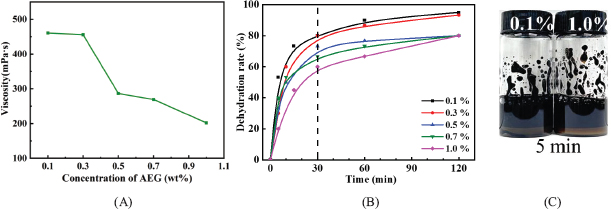
Fig. 1.
Effect of AEG concentration on viscosity (A) and stability (B) of acidic crude oil, and the appearance of 1# crude oil emulsion prepared with AEG concentrations of 0.1% and 1.0% after standing for 5 min (C)
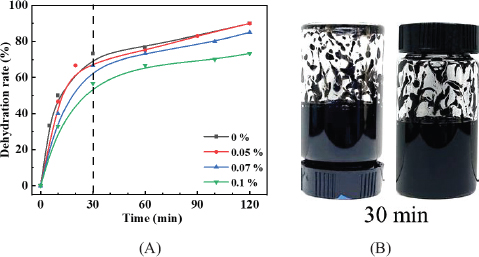
Fig. 2.
Effect of S1O2 concentration on stability of acidic crude oil 1# (A); the appearance of 2# ordinary crude oil emulsion after standing for 30 min (B) Notes: In panel (B), the 2# ordinary crude oil emulsion showed good stability and no obvious creaming phenomenon after standing for 30 min
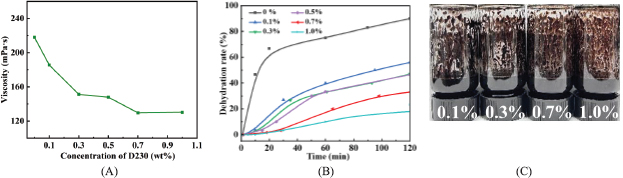
Fig. 3.
Effect of D230 concentration on viscosity (A) and stability (B) of acidic crude oil emulsion, and appearance of viscosity reducing agent emulsion crude oil emulsion prepared by polyetheramine with different concentration (C)
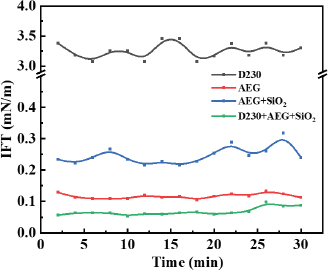
Fig. 4.
Interfacial tension (IFT) between different components and acidic crude oil emulsions
Table 2.
Influence of SiO2 nanoparticles on viscosity of acidic crude oil emulsion
| Nanoparticles type | Diameter (nm) | Surface wettability (water contact angle) | Viscosity (mPa·s) |
|---|---|---|---|
| A200 | 12 | 18.2◦ | 135.9 |
| MZ32090 | 30 | 30.5◦ | 134.7 |
| R974 | 12 | 117.2◦ | – |
| R805 | 12 | 131.3◦ | – |
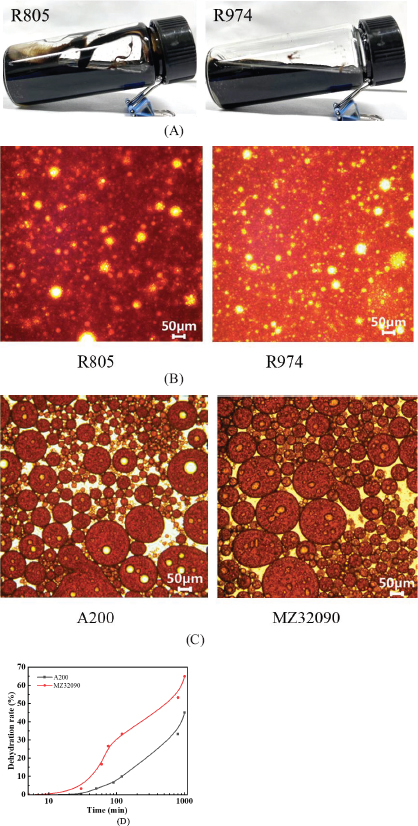
Fig. 5.
Effect of of SiO2 nanoparticles hydrophobicity and size on emulsion stability of acidic crude oil Notes: (A) Hydrophobic SiO2 nanoparticles R805 and R974, exhibited ineffective to emulsify acidic crude oil; (B) Microscopic images of hydrophobic SiO2 nanoparticle R805 and R974 failed to emulsify crude oil; (C) Microscopic images of hydrophilic SiO2 nanoparticle A200 and MZ32090 emulsified crude oil; (D) dehydration rate of hydrophilic SiO2 nanoparticles A200 and MZ32090 emulsified crude oil. A lower dehydration rate indidated a higher stability
Table 3.
Effect of alkali type on viscosity of acidic crude oil emulsion
| Types of alkali | pH of viscosity reducer | Viscosity emulsion (mPa·s) |
|---|---|---|
| D400 | 10.82 | 109.6 |
| D230 | 10.89 | 129.6 |
| NaOH | 12.62 | 133.7 |
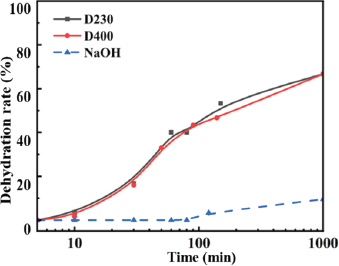
Fig. 6.
Influence of different alkali type on stability of acidic crude oil emulsion
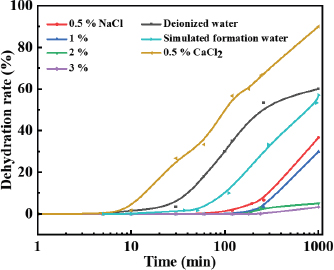
Fig. 7.
Effect of salinity on emulsion stability of acidic crude oil
Table 4.
Effect of salinity on viscosity of acidic crude oil emulsion
| Total salinity (mg/L) | Deionized water | NaCl | CaCl2 | Simulated formation water | ||||
|---|---|---|---|---|---|---|---|---|
| NA | 5000 | 10000 | 20000 | 30000 | 50000 | 5000 | 5722 | |
| Viscosity (mPa·s) | 123 | 281 | 221 | 153 | 223 | – | 114 | 128 |
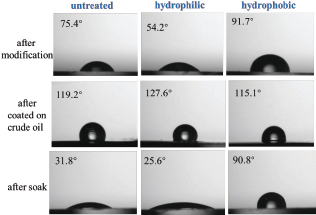
Fig. 8.
Measurement of contact angles of quartz with different wettability
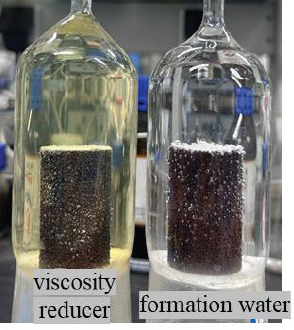
Fig. 9.
Core imbibition simulation experiment artificial immersed at 50◦C for 15 days