
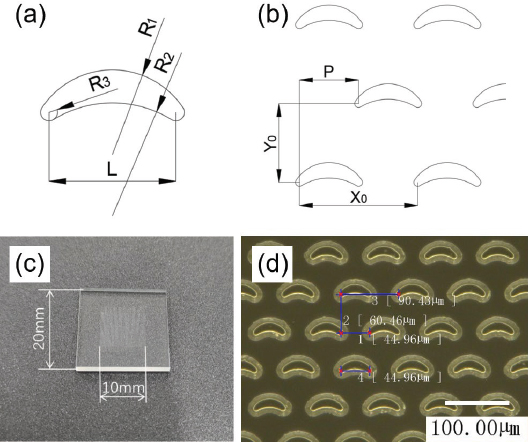
Fig. 1.
Bionic crescent-shaped microstructure mold: (a) parameters of microstructure characteristics on the mold surface; (b) parameters of the crescent-shaped microstructure array on the mold surface; (c) physical mold; and (d) the physical surface structure of the mold
Table 1.
Parameters of the fabricated molds
| Mold | P | L | R1 | R2 | R3 | X0 | Y0 |
|---|---|---|---|---|---|---|---|
| type | (μ m) | (μ m) | (μ m) | (μ m) | (μ m) | (μ m) | (μ m) |
| Mold 1 | 0 | 45 | 30 | 36 | 4 | 90 | 60 |
| Mold 2 | 30 | ||||||
| Mold 3 | 45 |
Table 2.
Materials for LSI
| Functionality | Constraint layer | Ablative layer | Soft film | Workpiece |
|---|---|---|---|---|
| Material | PMMA | Aluminum foil | Polyurethane | Copper foil |
| Thickness | 3 mm | 20 μm | 100 μm | 10 μm |
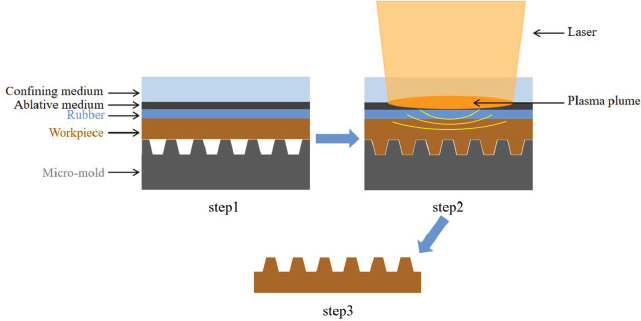
Fig. 2.
Principle diagram of LSI
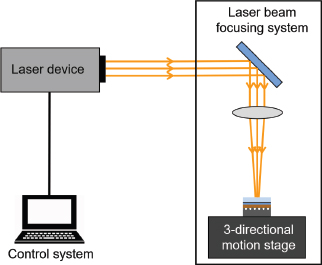
Fig. 3.
LSI experimental system
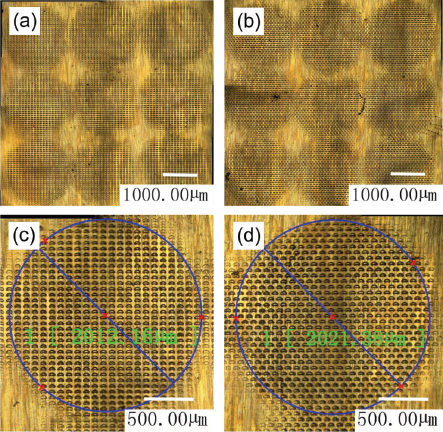
Fig. 4.
Two-dimensional morphologies of the microstructures for two different offset distances (P): (a) P = 0 μm; (b) P = 45 μm; (c) P = 0 μm, measurement results of a single spot imprint diameter; (d) P = 45 μm, measurement results of a single spot imprint diameter
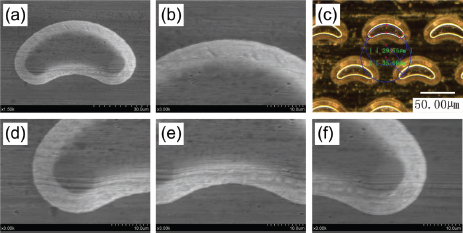
Fig. 5.
Surface crescent-shaped microstructure of the workpiece: (a) SEM morphology of a single crescent-shaped microstructure; (b) magnification of the crescent-shaped outer arc forming region; (c) the size measurement of a single crescent-shaped microstructure; (d) magnification of the crescent-shaped left corner forming region; (e) magnification of the crescent-shaped inner arc forming region; (f) magnification of the crescent-shaped right corner forming region
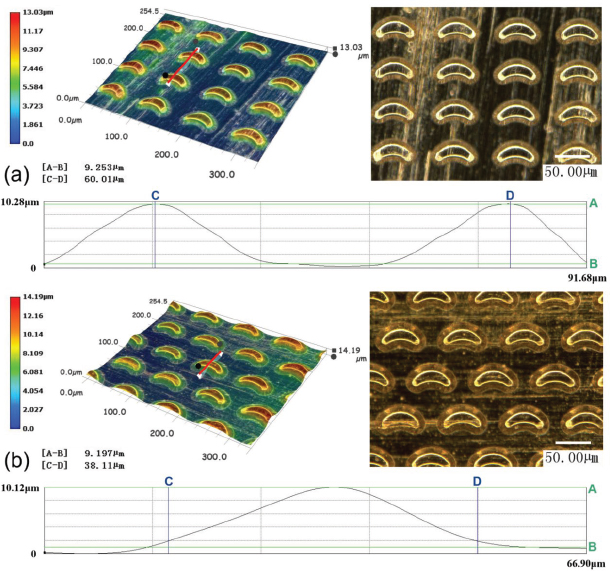
Fig. 6.
Three-dimensional morphologies of the workpiece surface for two different offset distances (P). (a) P = 0 μm; (b) P = 45 μm
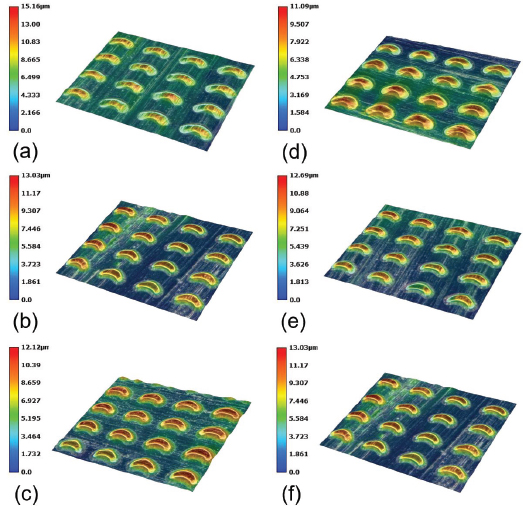
Fig. 7.
Three-dimensional morphologies of the workpiece surface fabricated by different LSI parameters: (a) LSE 835 mJ, 3 shocks; (b) LSE 1020 mJ, impact 3 shocks; (c) LSE 1200 mJ, 3 shocks; (d) LSE 1020 mJ, 1 shock; (e) LSE 1020 mJ, 2 shocks; (f) LSE 1020 mJ, 3 shocks
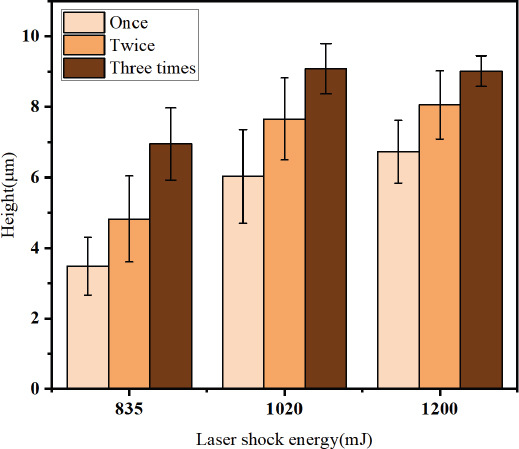
Fig. 8.
Influence of LSI processing parameters on the forming height of crescent-shaped microstructures on the workpiece surface
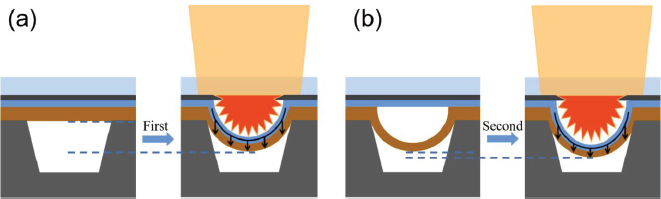
Fig. 9.
Schematic diagram of dynamic changes of the workpiece and soft film imprinted by multiple LSIs. (a) the first LSI; (b) the second LSI
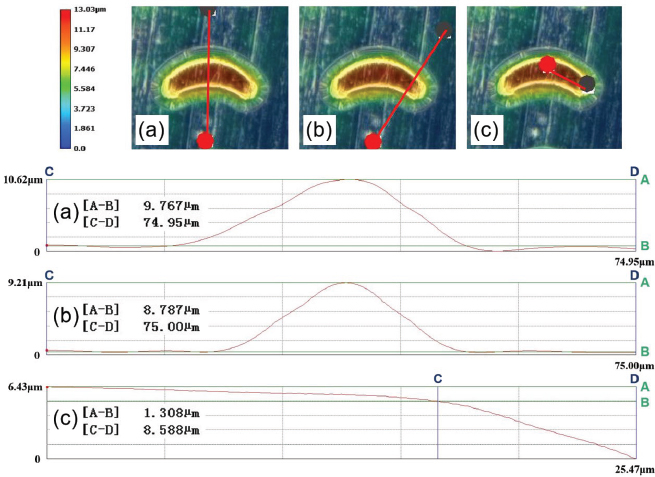
Fig. 10.
Heights of crescent-shaped microstructures at different positions: (a) center of symmetry; (b) near the right rounded corner; (c) localized inner cross section; (d) contour line at position (a); (e) contour line at position (b); (f) contour line at position (c)
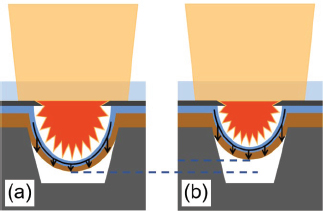
Fig. 11.
Schematic diagram of the effect of different width molds on forming depth: (a) wide mold; (b) narrow mold
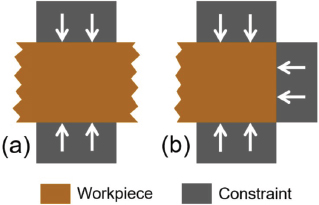
Fig. 12.
Two different constraint cases: (a) two directions; (b) three directions
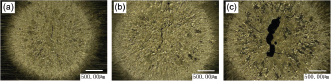
Fig. 13.
Comparison of ablated layers processed with diverse LSI parameters: (a) LSE 835 mJ, 3 shocks; (b) LSE 1020 mJ, 3 shocks; (c) LSE 1200 mJ, 3 shocks
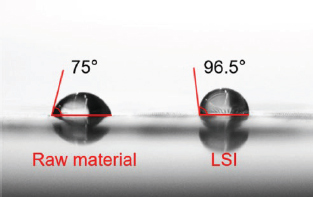
Fig. 14.
Contact angle diagram on the surface of the workpiece. Contact angle on the surface of raw material (left), contact angle on the surface of crescent-shaped microstructure (right)
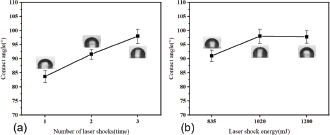
Fig. 15.
Effect of different LSI processing parameters on the contact angle: (a) effect of the number of laser shocks on the contact angle; (b) effect of LSE on the contact angle
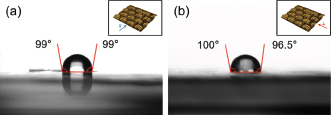
Fig. 16.
Contact angle diagram of water droplets on the workpiece surface in two directions: (a) parallel (//) direction; (b) perpendicular (⊥) direction
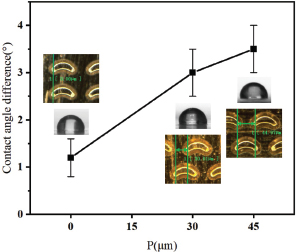
Fig. 17.
Influence of the offset distance (P) of the alignment of crescent-shaped microstructure features on the contact angle difference of water droplets on their surfaces
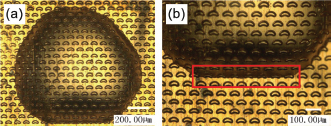
Fig. 18.
Residual droplet morphology on crescent-shaped, microstructured workpiece surface: (a) Droplet overall solid-liquid contact line; (b) solid-liquid contact line of droplet on the surface of workpiece on the bottom of the arc
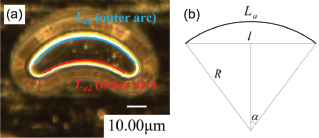
Fig. 19.
Modeling of solid–liquid contact lines of crescent-shaped microstructures: (a) location of some solid–liquid contact lines of crescent-shaped microstructures; (b) mathematical modeling of solid–liquid contact lines of crescent-shaped microstructures
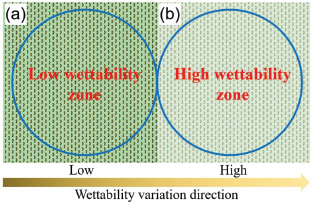
Fig. 20.
Schematic diagram of the wettability gradient surface of the crescent-shaped microstructure: (a) low wettability zone; (b) high wettability zone
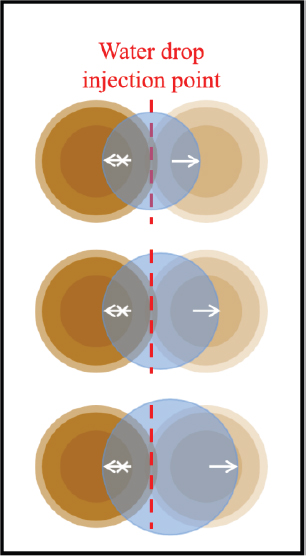
Fig. 21.
Schematic diagram of the theory of directional spreading of liquid droplet
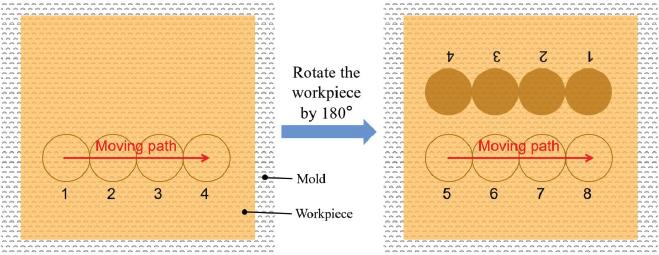
Fig. 22.
Schematic diagram of the method of fabricating type-I flow channel by LSI
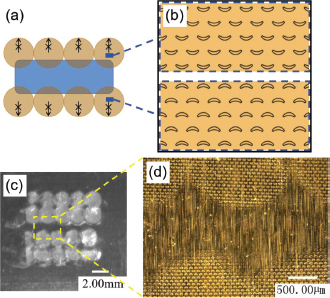
Fig. 23.
Type-1 flow channel composed of crescent-shaped microstructure arrays: (a) schematic diagram of the principle of type-I flow channel; (b) a partially magnified image of the microstructured zone; (c) fabricated type-I flow channel morphology; (d) local morphology of type-I flow channel
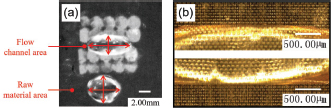
Fig. 24.
Water droplet spreading mode on the surface of the type-I flow channel: (a) comparison of water droplet morphology in the flow channel and raw material areas; (b) morphology of water droplets on both sides of the microstructure area inside the flow channel area
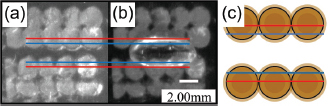
Fig. 25.
Diagram of water droplet movement position within the flow channel: (a) flow channel without water droplets; (b) flow channel after water droplet injection; (c) schematic diagram of water droplet spreading position within the flow channel