
Table 1.
Chemical composition of steel used in experimental studies
| C | Si | Mn | Fe | Pmax | Smax |
|---|---|---|---|---|---|
| 0.419 | 0.254 | 0.751 | 98 | 0.040 | 0.050 |
Table 2.
Electrodeposition conditions
| Parameter | Amount |
|---|---|
| Current density | 200 mA/cm2 |
| Ultrasonic mixing | 5 min |
| Temperature | 40°C |
| Mixing speed | 100 rpm |
| pH | 2.5 |
Table 3.
Bath components
| Bath solution | Amount | Function |
|---|---|---|
| NiSO4.7H2O (nickel sulphate) | 50 g/l | Ni2+ source |
| NiCl2.6H2O (nickel chloride) | 45 g/l | Ni2+ source |
| CrCl3. 6H2O (chromium chloride) | 75 g/l | Cr3+ source |
| H3BO3 (boric acid) | 50 g/l | Blocking agent |
| C6H8O7 (citric acid) | 70 g/l | Blocking agent |
| Na3C6H5O7.2H2O (sodium citrate dihydrate) | 105 g/l | Complexing agent |
| C7H4NNaO3S • 2H2O (sodium saccharin) | 0, 0.5, 1, 2 g/l | Additive material |
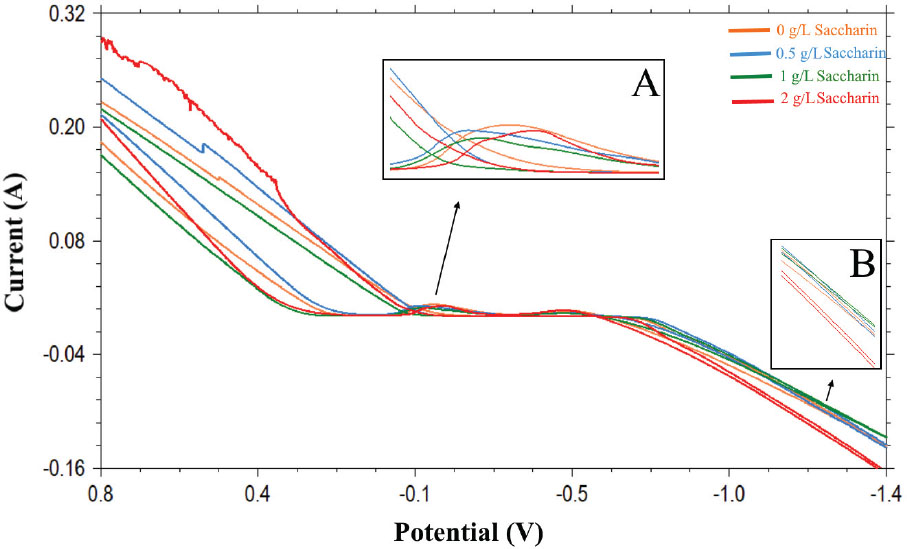
Fig. 1.
Alternating voltammetry curves obtained from baths
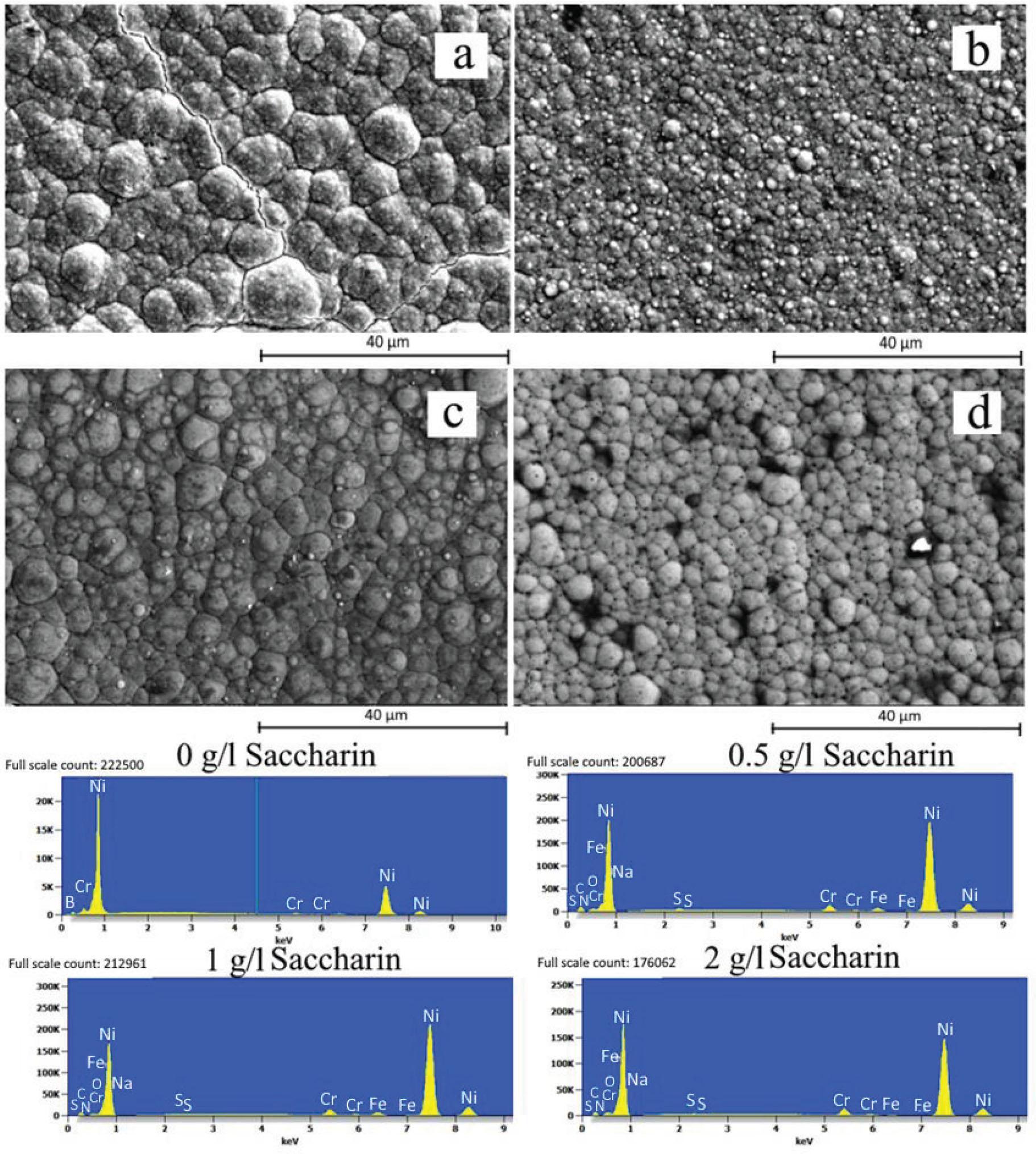
Fig. 2.
SEM images and EDS analysis a) 0 g/l saccharin, b) 0.5 g/l saccharin, c) 1 g/l saccharin, d) 2 g/l saccharin
Table 4.
Chemical composition of coatings according to EDS analysis (wt. %)
| C | N | O | Na | S | Cr | Ni | |
|---|---|---|---|---|---|---|---|
| 0 g/l Saccharin | 0.00 | 0.00 | 0.00 | 0.00 | 0.00 | 1.18 | 98.82 |
| 0.5 g/l Saccharin | 7.83 | 2.27 | 1.77 | 0.17 | 0.17 | 2.53 | 85.27 |
| 1 g/l Saccharin | 8.64 | 2.37 | 0.00 | 0.13 | 0.19 | 2.84 | 85.83 |
| 2 g/l Saccharin | 7.87 | 1.85 | 0.29 | 0.19 | 0.22 | 3.38 | 86.21 |
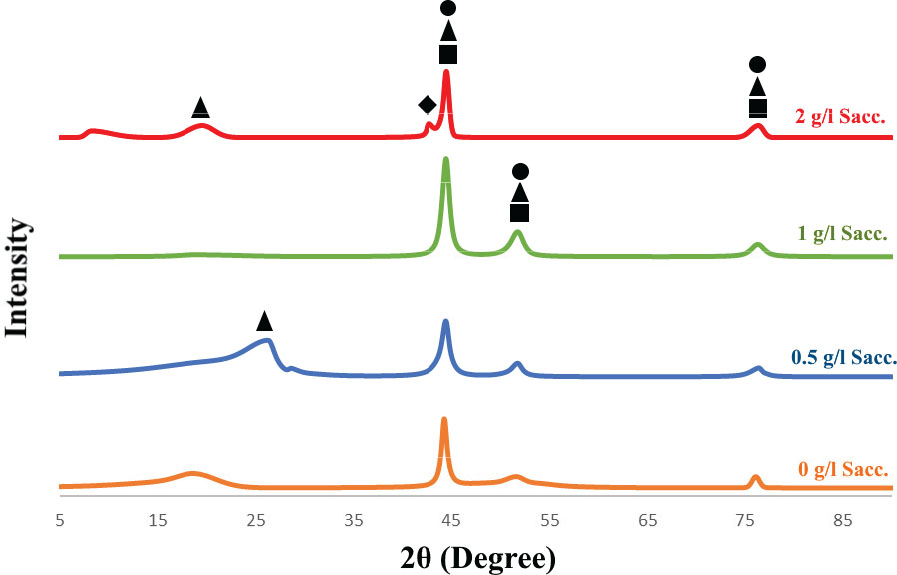
Fig. 3.
X-ray diffraction patterns of coatings
Table 5.
Angle values and DB card numbers
| Chemical formula | 2-theta (deg) | Phase name | DB card number | Chemical formula | 2-theta (deg) | Phase name | DB card number | ||
|---|---|---|---|---|---|---|---|---|---|
| 18.7 | 100 | 44.4 | 111 | ||||||
| 26.3 | 110 | 01-089-2392 | ■ | Ni | 51.8 | 200 | 00-004-0850 | ||
| ▲ | Cr | 44.4 | 210 | 01-077-7591 | 76.3 | 220 | |||
| 51.7 | 200 | 44.4 | 111 | ||||||
| 76.3 | 220 | • | (Cr2Ni23)0.16 | 51.8 | 200 | 01-077-7616 | |||
| ♦ | Cr7Ni3 | 42.6 | 410 | 00-051-0637 | 76.3 | 220 |
Table 6.
Parameters obtained from XRD models
| Sample | 2 (Degree) | Full width at half maximum (FWHM) | Grain size (D) (nm) |
|---|---|---|---|
| 0 g/l Saccharin | 44.28 | 0.650 | 32.42 |
| 0.5 g/l Saccharin | 44.44 | 0.960 | 21.87 |
| 1 g/l Saccharin | 44.46 | 0.875 | 23.99 |
| 2 g/l Saccharin | 44.47 | 0.644 | 32.58 |
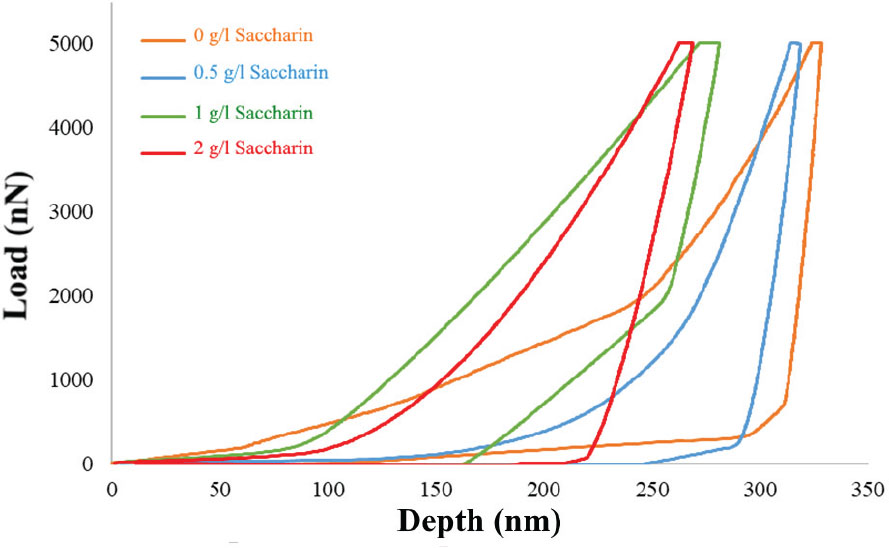
Fig. 4.
Nanoindentation load-displacement curves
Table 7.
Elastic modulus, hardness and residual stress values
| hc (nm) | Pmax (μN) | S (μN/nm) | A (nm2) | Hmax (nm) | Er (GPa) | H (GPa) | Residual Stress (Gpa) | |
|---|---|---|---|---|---|---|---|---|
| 0 g/l Sacc. | 317 | 5006 | 326 | 2842233 | 329 | 171.58 | 1.76 | 0.51 |
| 0.5 g/l Sacc. | 304 | 5005 | 257 | 2632610 | 319 | 140.58 | 1.90 | 0.24 |
| 1 g/l Sacc. | 250 | 5007 | 99 | 1819289 | 281 | 65.17 | 2.75 | −0.95 |
| 2 g/l Sacc. | 242 | 5008 | 136 | 1706650 | 269 | 92.11 | 2.93 | −0.71 |
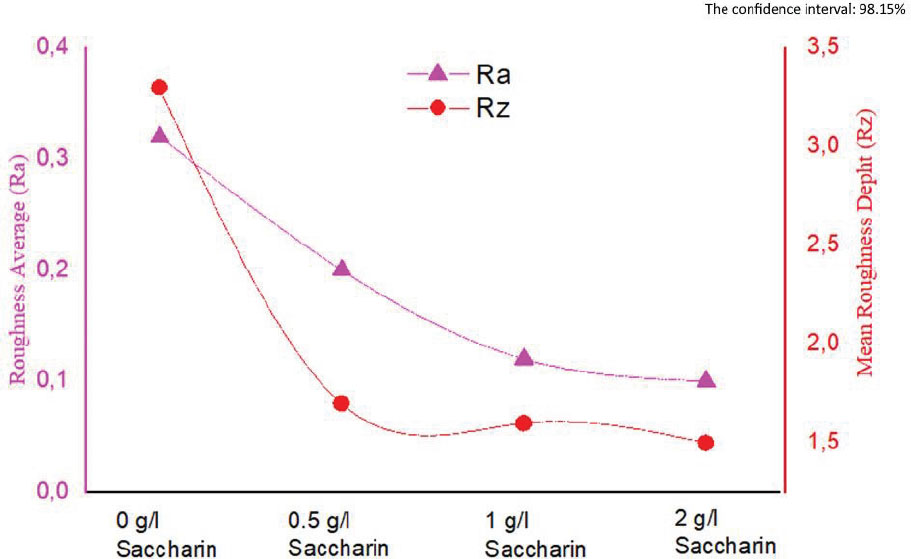
Fig. 5.
Effect of saccharin addition on the surface roughness of Ni-Cr coatings
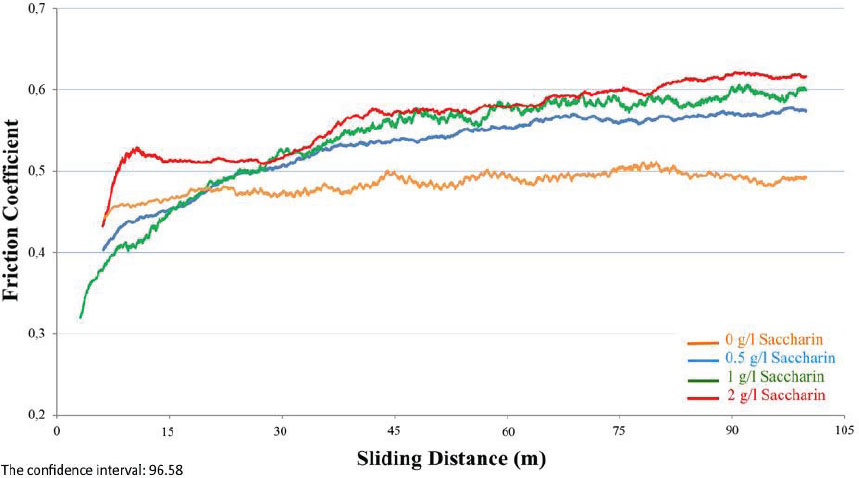
Fig. 6.
Friction coefficient of coatings
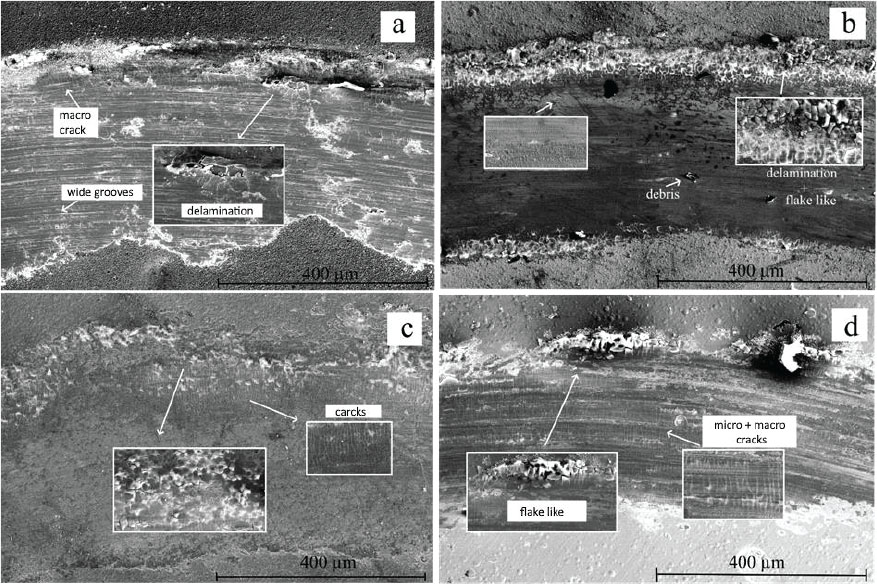
Fig. 7.
Worn surface morphology: (a) 0 g/l saccharin, (b) 0.5 g/l saccharin, (c) 1 g/l saccharin, (d) 2 g/l saccharin
Table 8.
Wear rate, wear volume loss and average COF values
| Sample Name | Wear rate (mm3/Nm) (10−6) | Volume loss (mm3) (103) | Coefficient of Friction (COF) |
|---|---|---|---|
| 0 g/l saccharin | 11.24 | 5.620 | 0.483 |
| 0.5 g/l saccharin | 5.91 | 2.953 | 0.528 |
| 1 g/l saccharin | 4.93 | 3.002 | 0.535 |
| 2 g/l saccharin | 3.75 | 1.875 | 0.563 |
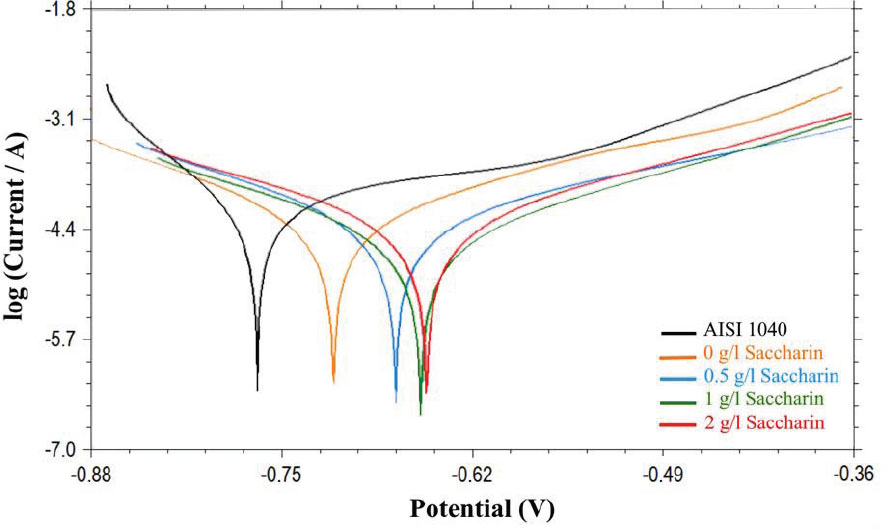
Fig. 8.
Tafel curves of coatings and substrate
Table 9.
Corrosion data determined using the Tafel extrapolation method
| ECorr (mV) | Icorr (μ A/cm2) | Corrosion rate (mm/year) | |
|---|---|---|---|
| AISI 1040 | −770 | 91.73 | 1.08 |
| 0 g/l Saccharin | −719 | 65.18 | 0.77 |
| 0.5 g/l Saccharin | −678 | 58.26 | 0.68 |
| 1 g/l Saccharin | −662 | 38.18 | 0.44 |
| 2 g/l Saccharin | −658 | 56.53 | 0.66 |
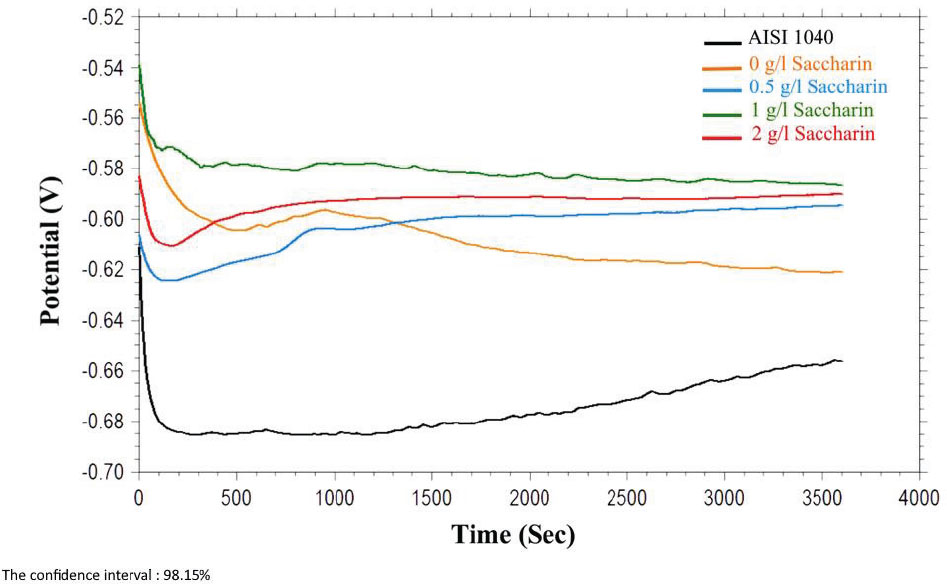
Fig. 9.
Open circuit potential curves of Ni-Cr alloy coatings and substrate
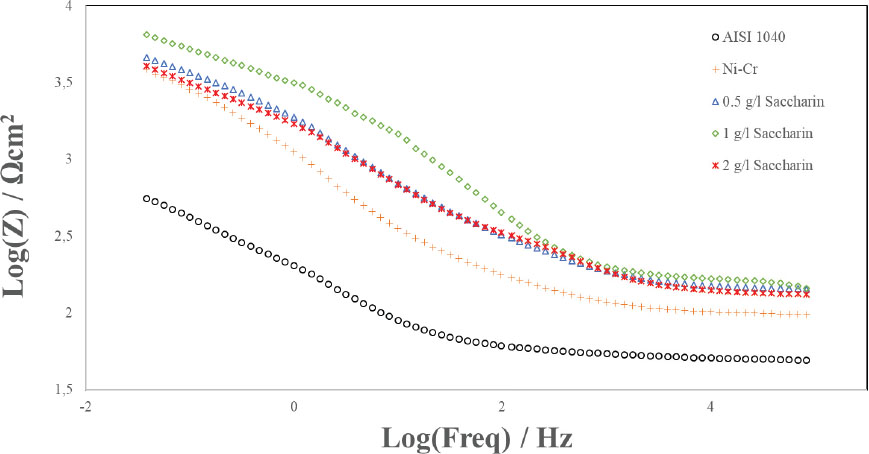
Fig. 10.
(a) Nyquist diagrams, (b) impedance modulus plots, (c) bode diagrams, (d) equivalent circuit diagram