
Table 1.
Reference strains used to determine the antimicrobial activity
| Bacterial strain | ATCC | Gram/Respiration | Associated with |
|---|---|---|---|
| Porphyromonas gingivalis | 33277 | −/anaerobic | Periodontitis |
| Streptococcus mutans | 25175 | +/facultative anaerobic | Dental caries |
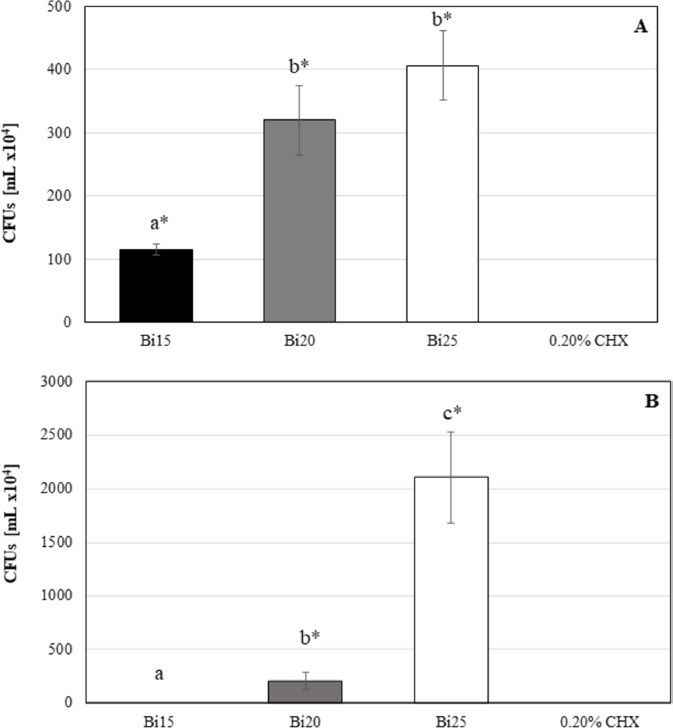
Fig. 1.
(A) Evaluation of the antibacterial effect of the experimental cements: Bi15, Bi20, and Bi25, on S. mutans. Positive control: 0.20% chlorhexidine (ANOVA p < 0.05; post hoc Tukey test p < 0.01). 0.20% CHX was significant against all experimental groups (ANOVA p < 0.01; post hoc Dunnett test p < 0.05). Lowercase letters are used to compare means; means sharing a superscript letter are not significantly different, n = 3. (B) Evaluation of the antimicrobial effect of the experimental cements: Bi15, Bi20, and Bi25 on P. gingivalis. Positive control: 0.20% chlorhexidine solution. (ANOVA p < 0.01; post hoc Tukey test p < 0.05). 0.20% CHX was significant against the experimental groups Bi20 and Bi25 (ANOVA p < 0.05; post hoc Dunnett test p < 0.05). Lowercase letters are used to compare means; means sharing a superscript letter are not significantly different, n = 3
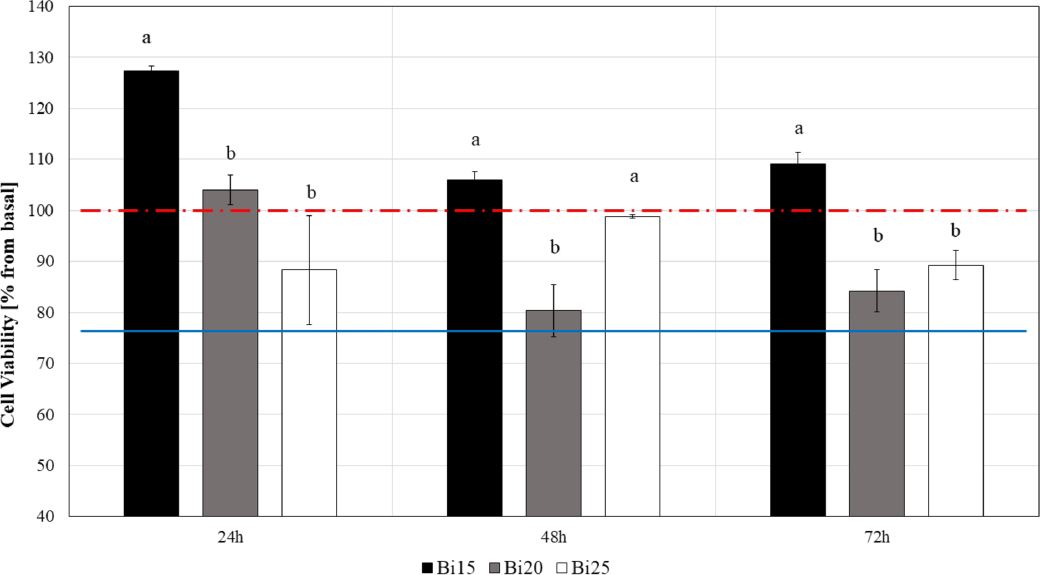
Fig. 2.
Effect of bismuth on cell viability of Bi15, Bi20, and Bi25 cements. L929 cells were seeded in 96-well plates (2.5 × 10³ cells/well) and treated with different percentages of bismuth followed by MTT assay for 24, 48, and 72 h. The red horizontal dotted line represents the basal group as 100%, and a blue continuous line represents the threshold for a cytotoxicity level of 75% of cell viability compared to the basal group (negative control). Each bar represents mean ± SD calculated from three independent experiments. ANOVA p < 0.01; post hoc Tukey test p < 0.05, lowercase letters are used to compare means; means sharing a superscript letter are not significantly different, n = 3
Table 2.
pH means of the Bi15, Bi20, and Bi25 cements
| 1 h | 3 h | 24 h | 48 h | 72 h | 7 d | |
|---|---|---|---|---|---|---|
| Bi15 | 10.28 (0.25)a | 10.68 (0.15)a | 11.16 (0.21)a | 10.94 (0.48)a | 10.78 (0.70)a | 9.98 (1.08) a |
| Bi20 | 10.49 (0.12)a | 10.87 (0.10)a | 11.32 (0.16)a | 11.33 (0.22)a,b | 11.07 (0.53)a | 10.11 (0.92) a |
| Bi25 | 10.49 (0.13)a | 10.88 (0.06)a | 11.37 (0.12)a | 11.47 (0.18)b | 11.35 (0.35)a | 10.96 (0.88) a |
| p | 0.309 | 0.061 | 0.119 | 0.043 | 0.237 | 0.181 |
1a Mean and standard deviation (in parentheses). Lowercase letters are used to compare means in the same column; means sharing a superscript letter are not significantly different. Any statistically significant difference is observed in pH over all time periods (Kruskall Wallis test p > 0.05), n = 5 for each group
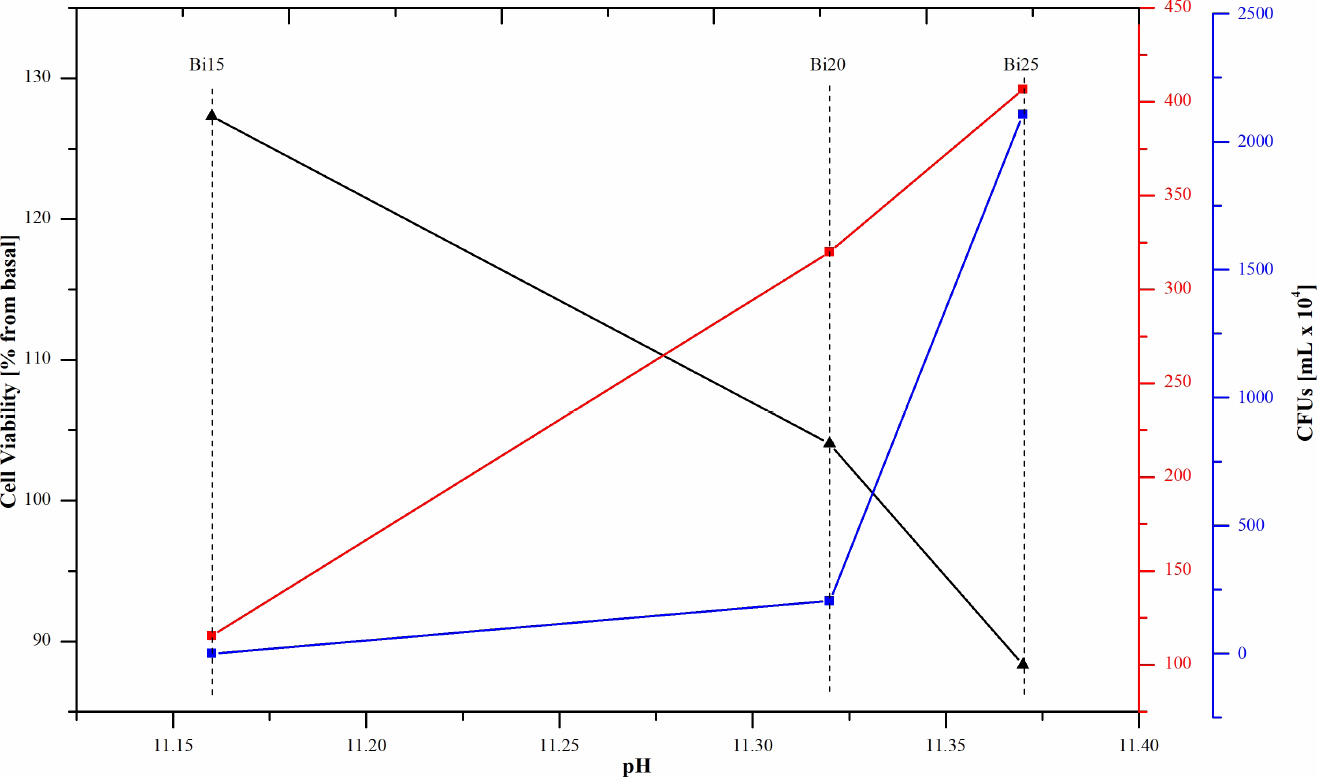
Fig. 3.
Effect of pH on the antibacterial activity and cell viability at 24 h. Black line: Cell viability, L929 cells. Red line: Antibacterial activity on S. mutans. Blue line: Antibacterial activity on P. gingivalis
Table 3.
Means and standard deviation (in parenthesis) of solubility, setting time, and film thickness of Bi15, Bi20, and Bi25
| Solubility (%) | Setting time (min) | Film thickness (mm) | |
|---|---|---|---|
| Bi15 | -2.70 (0.41)a | 5:19 (1:41)a | 0.01238 (0.00027)a |
| Bi20 | 0.24 (0.81)b | 4:59 (1:26)a | 0.01229 (0.00023)a |
| Bi25 | -0.27 (0.82)b | 4:41 (1:31)a | 0.01230 (0.00043)a |
| ISO 6876 requirements | < 3% | No more than 110% of the manufacturer’s specifications. | < 0.05 mm |
1 Lowercase letters are used to compare means in the same column; means sharing a superscript letter are not significantly different. No significant differences were found in setting time (ANOVA p = 0.401) or film thickness (ANOVA p = 0.972); n =10 for each group and test.
Solubility at 24 h show statistically significant differences between Bi15 and Bi20 and Bi15 and Bi25 (ANOVA p < 0.05, post hoc Tukey test p < 0.05), negative signs indicate solubility
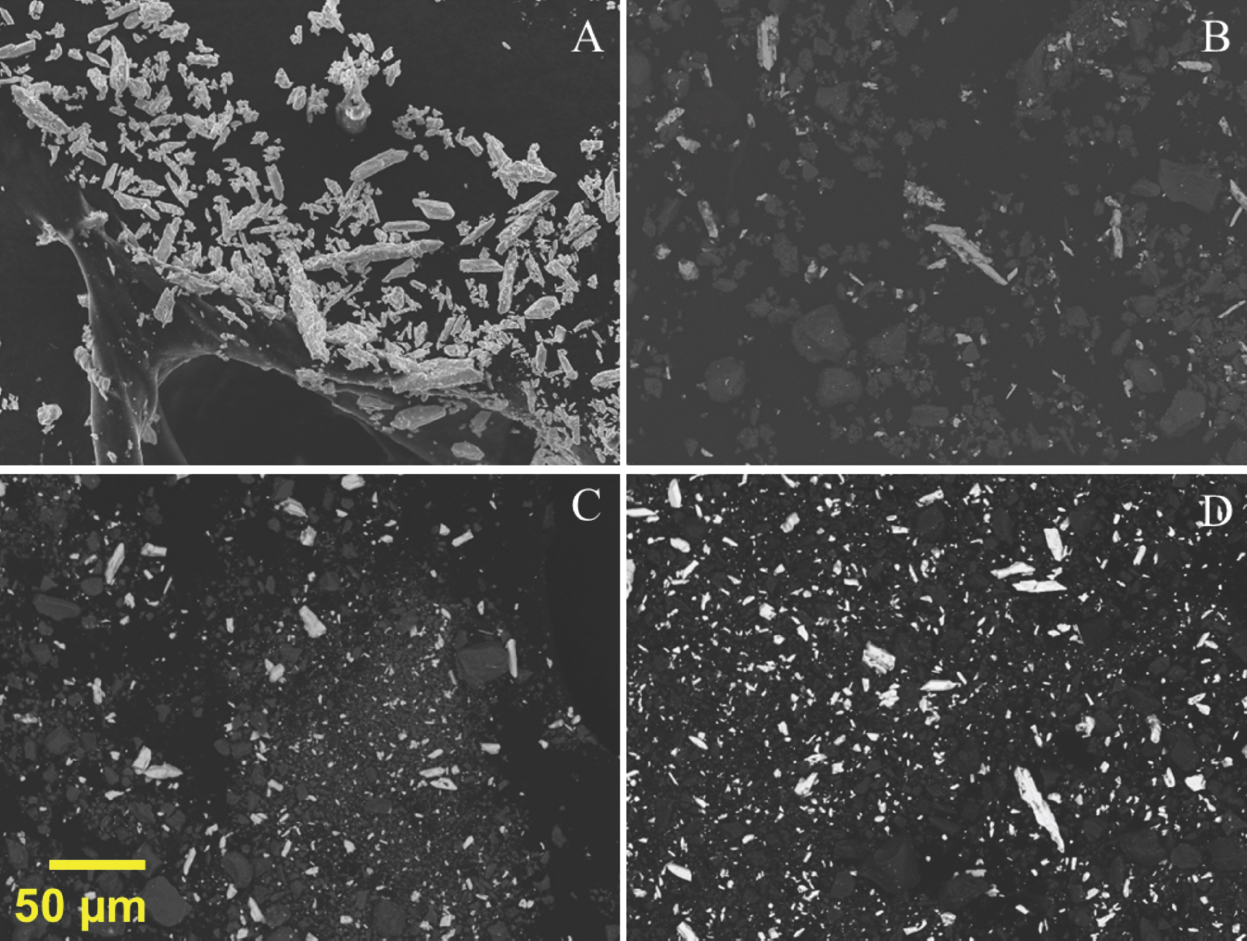
Fig. 4.
Micrographs of bismuth trioxide and the unhydrated cement sample. A. Bismuth trioxide; B, Bi15; C, Bi20; and D-Bi25. Yellow bar = 50μm, 350 × magnification
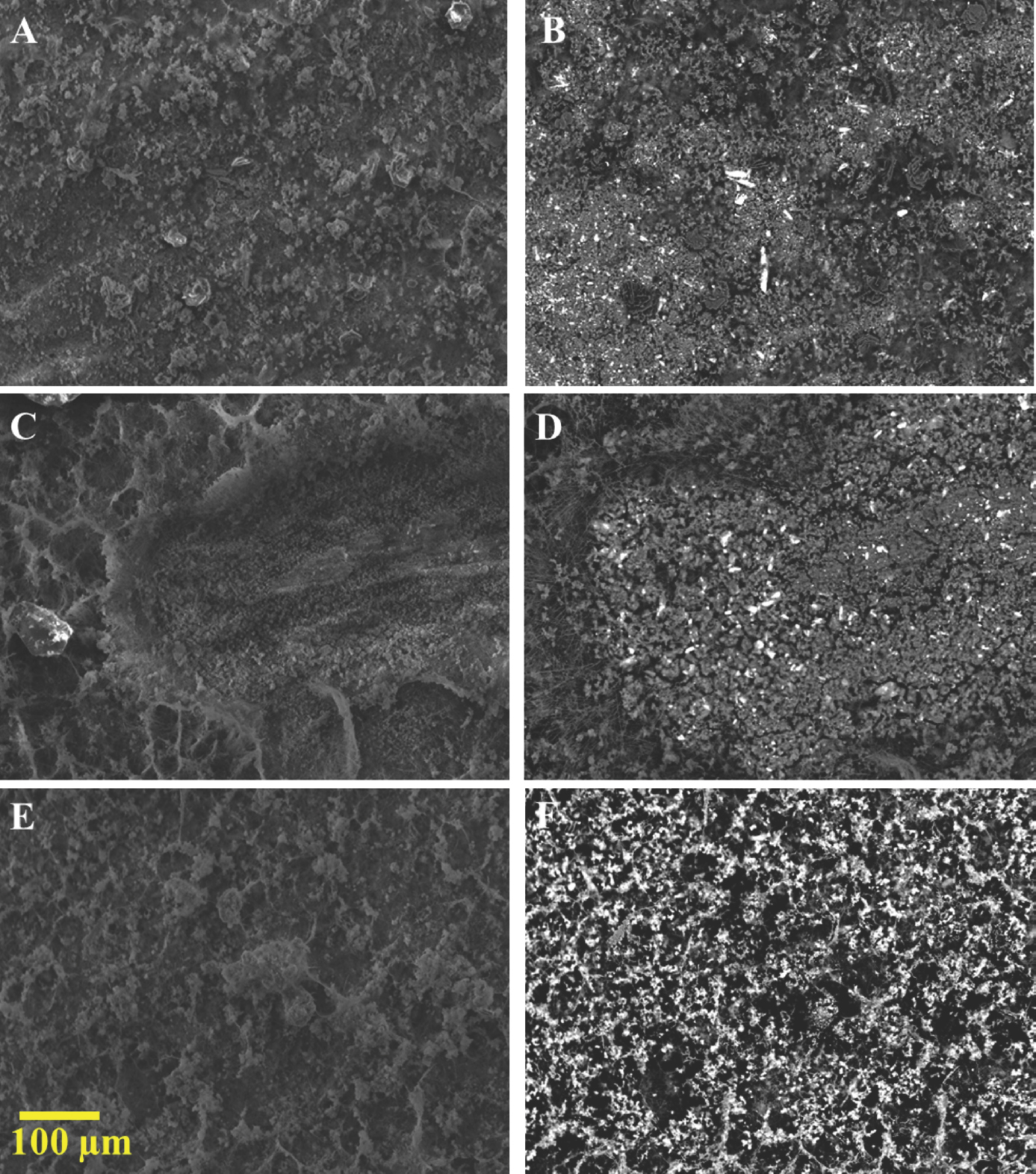
Fig. 5.
Surface micrographs of the hydrated cement sample. The long white particles corresponding to bismuth trioxide are not well incorporated into the cement. Left columns (A, C, E) are micrographs with secondary electrons. The right columns (B, D, F) are backscattering electron images. A–B: Bi15, C–D: Bi20, and E–F: Bi25. Yellow scale bar = 100 μm, 200 × magnification