
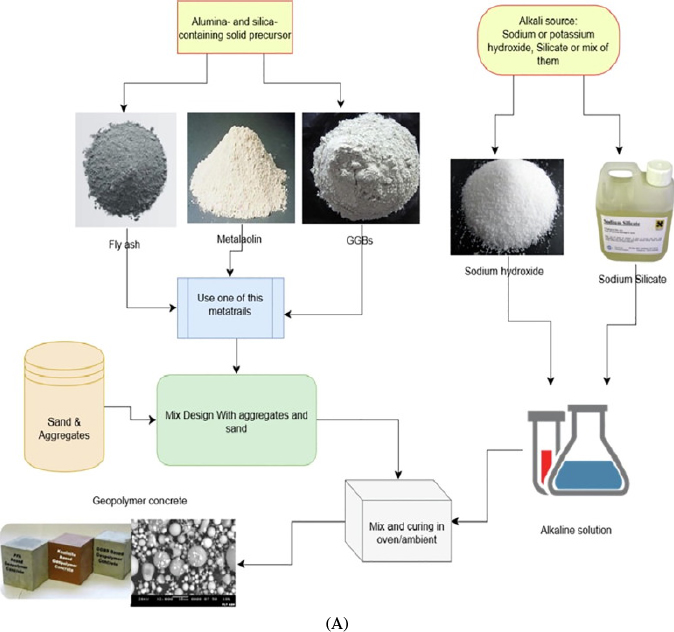
Fig. 1.
(A): Raw ingredients used for the development of geopolymer concrete [41]
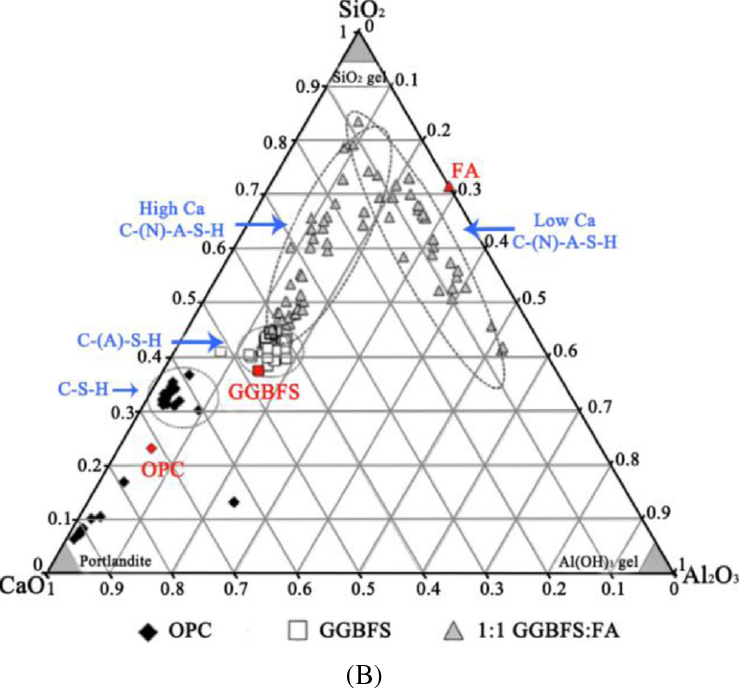
Fig. 1.
(B): Composition of binder gel of Portland cement and geopolymer [42]
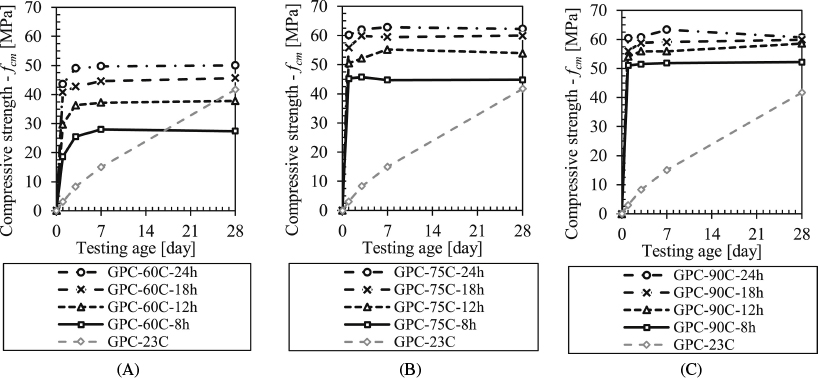
Fig. 2.
Compressive strength of room temperature and thermally cured specimens [45]
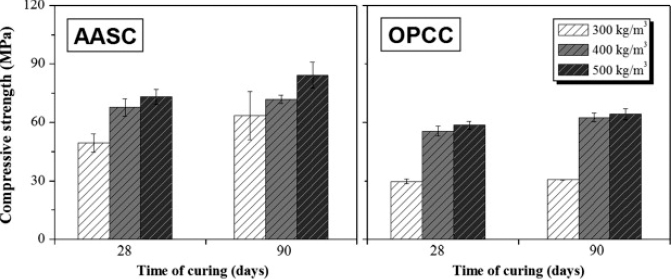
Fig. 3.
Compressive strength of alkali silicate-activated concrete (left) and conventional concrete (right) [50]
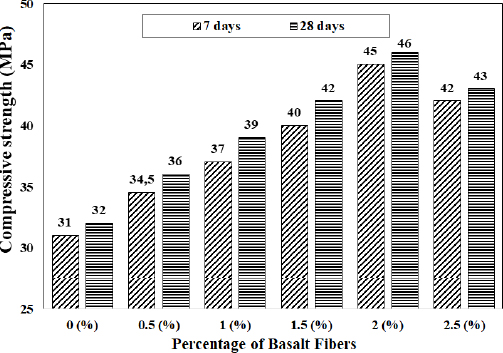
Fig. 4.
Compressive strength of geopolymer concrete with basalt fibers [51]
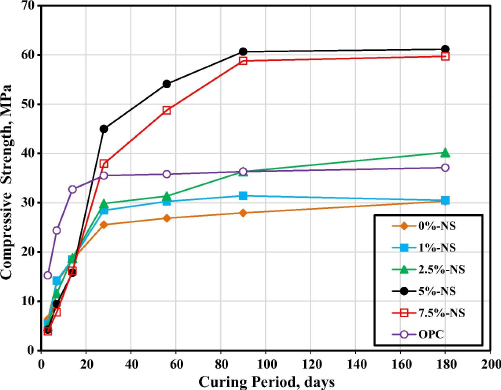
Fig. 5.
Influence of the amount of Nano-silica on the specimen’s compressive strength [54]
Table 1.
Comparison and discussion based on freeze and thaw of FA-based GPC
| Authors | Binding Material | Alkaline solution | Curing situation | Properties assessed | Result |
|---|---|---|---|---|---|
| Sun et al. [58] | Class F FA | Sodium silicate and sodium hydroxide | Curing of samples at 75 °C for 12 hours | Freezing and thawing resistance of FA-based GP mortar and OPC mortar | FA-based GP mortar has incredible resistance to freezing and thawing than Portland cement mortar |
| Temujin et al. [60] | Class F FA | Sodium silicate and sodium hydroxide | Curing was done at a temperature of 75 °C for 20 hours | Impact of calcium proportion on the behavior of FA-based GPC in freezing and thawing surroundings | FA-based GPC made with a high amount of calcium FA had less resistance against freezing and thawing |
| Zerzouri et al. [61] | Class F FA | Sodium silicate and sodium hydroxide | Curing at 65 – 85 °C 4 to 10 hours | Resistance to freezing and thawing of FA-based GP mortar | FA-based GP mortar has incredible resistance to freezing and thawing |
| Zhao et al. [62] | Class F FA | Sodium silicate and sodium hydroxide | 1, 7, 14, and 28 days curing at ambient temperature, 50 and 80 degrees | Impact of curing situations on durability against freezing and thawing of FA-based GPC | Enhancement in curing time and temperature can raise the development of geopolymer gel, which can enhance the structure of pores and further optimize the freezing and thawing resistance of GPC. |
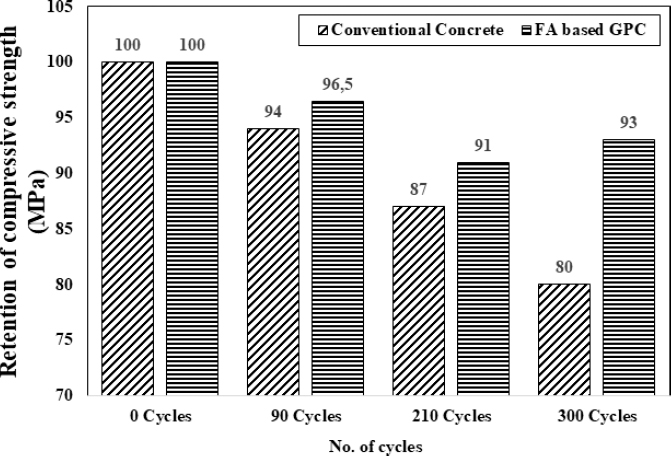
Fig. 6.
Influence of different cycles of freezing and thawing on compressive strength of conventional concrete and FA-based GPC [58]
Table 2.
Comparison and discussion based on acid resistance of FA-based GPC
| Authors | Binding Material | Alkaline solution | Type of acid | Curing situation | Properties assessed | Result |
|---|---|---|---|---|---|---|
| Mehta et al. [71] | Class F FA | Sodium silicate and sodium hydroxide | 5% sulfuric acid | Curing at a high temperature of 600 °Cin the oven for 1 day | Impact of sodium hydroxide on acid resistance of FA-based GPC | FA-based GPC made with a high concentration of sodium hydroxide had more resistance against acid |
| Lakhssassi et al. [61] | Class F FA | Sodium silicate and sodium hydroxide | 3% sulfuric acid | Curing at 75 °C for 1 day | Sulfuric acid resistance ofFA-based GPC and Portland cement concrete | Subsequently, ping in sulfuric acid |
| Bakharev et al. [61] | Class F FA | Sodium silicate, sodium hydroxide, and potassium hydroxide | Acetic acid | Curing for 1 day at ambient temperature, then sustained at 95 °C for 1 day | Impact of alkaline solution on resistance of acid of FA-based GPC | Specimen made with sodium hydroxide had more resistance to acid. The inclusion of potassium hydroxide instigated a reduction in durability. |
| Ariffin et al. [67] | Class F FA | Sodium silicate and sodium hydroxide | 3% sulfuric acid | Curing at a temperature of 28 °C for 4 weeks | Resistance of GPC and Portland cement concrete against sulfuric acid | The sulfuric acid attack on FA-based GPC was excellent than the reference sample because of the stable firm microstructure of GPC |
| Wallah et al. [72] | Class F FA | Sodium silicate and sodium hydroxide | 2% sulfuric acid | Curing was done at 65 °C for 1 day | Resistance of FA-based GPC against the acid test | FA-based GPC has incredible resistance against acid attack |
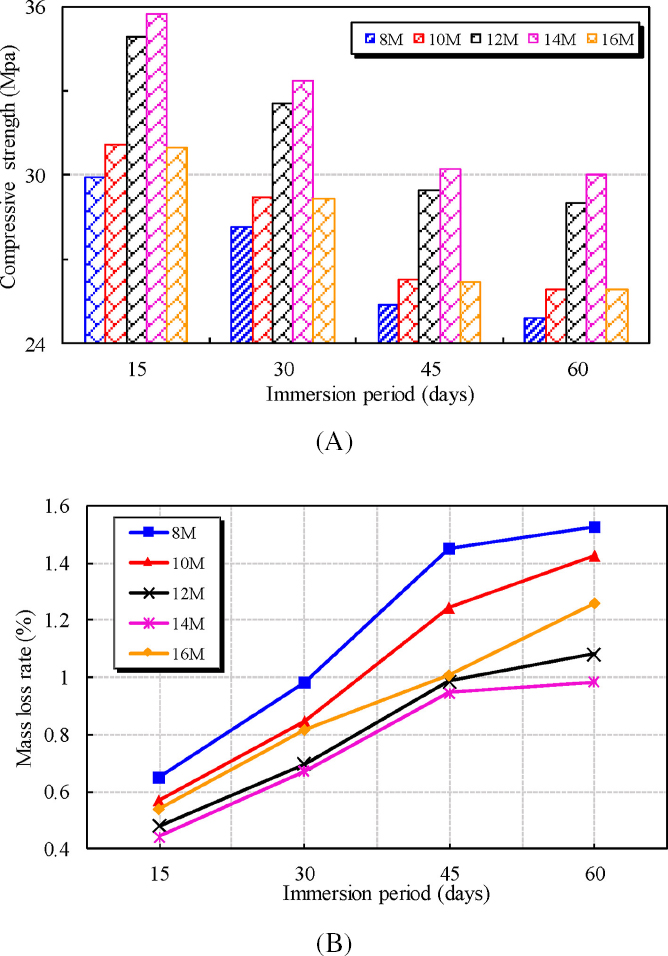
Fig. 7.
(A) Compressive strength (B) rate of loss in mass of FA-based GPC due to acid attack [69]
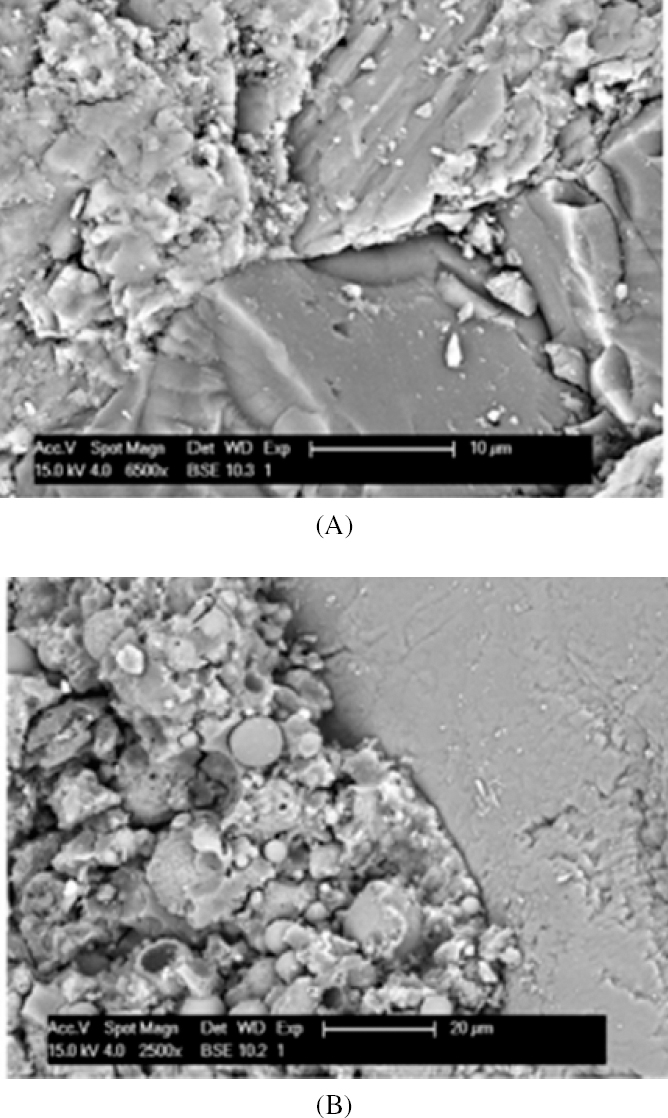
Fig. 8.
Change in Interfacial Transition Zone of geopolymer concrete (A) before and (B) after the acid test [70]
Table 3.
Comparison and discussion of study based on chloride resistance of FA-based GPC
| Authors | Binding Material | Alkaline solution | Curing situation | Properties assessed | Results |
|---|---|---|---|---|---|
| Yang et al. [78] | Class F FA and slag | Sodium silicate and sodium hydroxide | Curing was carried out at ambient condition | Influence of slag on the chloride resistance of FA-based GPC | Slag can assist in refining pore structure and thus decrease the sorptivity and avert the infiltration of chlorides into sample |
| Abdullah et al. [79] | Class F FA | Sodium silicate and sodium hydroxide | Curing was performed at ambient conditions for 1 day and then heat curing at 80 °C | The chloride resistance of FA-based GPC was assessed. | FA-based GPC had excellent resistance to chloride as compared to conventional concrete. |
| Kupwade-Patil et al. [76] | Class F FA | Sodium silicate and sodium hydroxide | Temperature curing at 80 °C for 3 days | Impact of Class F FA on chloride resistance of GPC and a reference concrete | GPC with class F FA had superior performance against chlorides than Portland cement concrete |
| Noushini et al. [45] | Class F FA | Sodium silicate and sodium hydroxide | Curing at 60, 75, and 90 °C | Influence of curing situation on transport attributes, diffusion of chlorides, and binding of chlorides | Raise in the temperature of curing can decrease the coefficient of chlorides ion in FA-based GPC, Low Ca FA-based GPC had no capacity for binding chlorides. |
| Kannapiran et al. [80] | Class F FA | Sodium silicate and sodium hydroxide | Samples were cured at 75 °C for 1 day | Resistance of chlorides for FA-based GPC | FA-based GPC had good resistance against chloride infiltration than reference concrete. |
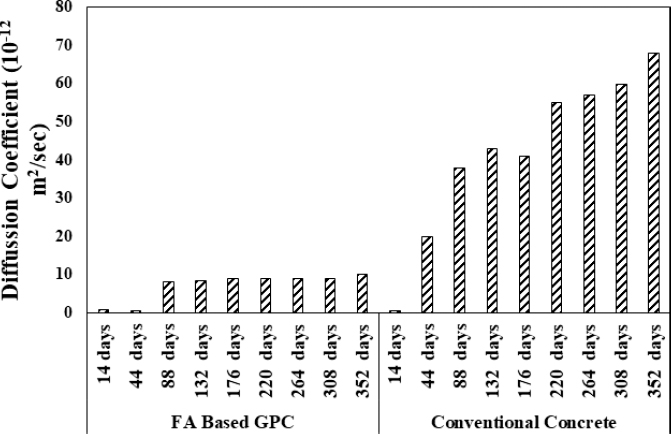
Fig. 9.
Mean Coefficient of chloride diffusion for FA-based GPC and conventional concrete [69]
Table 4.
Comparison and discussion based on sulfate resistance of FA-based GPC
| Authors | Binding Material | Alkaline solution | Sulfate solution | Properties assessed | Results |
|---|---|---|---|---|---|
| Elyamany et al. [85] | Class F FA | Sodium hydroxide | 10% magnesium sulfate | Impacts of curing situation and alkaline solution on resistance of sulfates of FA-based GPC | Raising heat for curing causes a reduction in water absorption and the ratio of voids and improved resistance against magnesium sulfates. |
| Long et al. [86] | Class F FA | Sodium silicate and Sodium hydroxide | 5% magnesium sulfate | Resistance against corrosion and related procedure of FA-based GPC and conventional concrete in an identical solution of sulfate | FA-based GPC had excellent resistance against magnesium sulfate compared to reference concrete due to its firm polymer alumino-silicate structure. |
| Bhutta et al. [83] | Class F FA | Sodium silicate and Sodium hydroxide | 5% Sodium sulfate | Resistance of sulfate on FA-based GPC and a reference concrete | FA-based GPC had incredible conduct in 5% Sodium sulfate than Portland cement concrete because of its firm polymer alumino-silicate structure. |
| Ismail et al. [87] | Class F FA | Sodium silicate | 5% Sodium sulfate and 5% magnesium sulfate | Impact of various sorts of sulfates on resistance against sulfate and corrosion attack of FA-based GPC | The existence of magnesium ions caused the de-calcification of the gel phase of rich calcium existing in FA-based GPC, which led to wear and tear of the binder. Magnesium sulfate could have harmful impacts on the sample. |
| Bakharev et al. [88] | Class F FA | Sodium silicate and Sodium hydroxide | 5% Sodium sulfate and 5% magnesium sulfate | The durability of FA-based GPC in chemicals of Sodium sulfate and magnesium sulfate | The extent of corrosion in FA-based GPC is higher in magnesium sulfate than in sodium sulfate. |
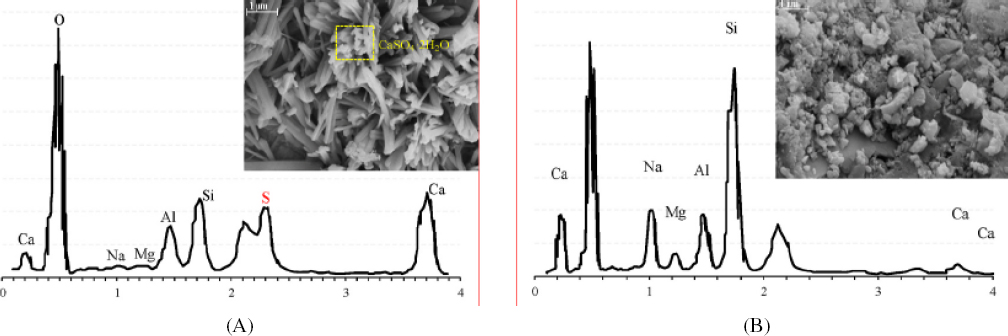
Fig. 10.
EDX analysis and SEM micrograph (A) conventional concrete, (B) FA-based GPC dipped in 5% solution of sodium sulfate [83]
Table 5.
Comparison and discussion on carbonation resistance of FA-based GPC
| Authors | Binding Material | Alkaline solution | Carbonation situation | Properties assessed | Results |
|---|---|---|---|---|---|
| Khan et al. [92] | Class F FA | Sodium silicate and sodium hydroxide | Quickened temperature for carbonation 23°C, humidity 50%, and 1% concentration of carbon dioxide | Impact of concentration of carbon dioxide on carbonation mechanism of GPC | Test outcome depicts that the rate of carbonation and depth of GPC raises considerably with raise in the concentration of carbon dioxide |
| Badar et al. [93] | Class F FA | Sodium silicate and sodium hydroxide | Quickened temperature for carbonation 24°C, humidity 65%, and 5% concentration of carbon dioxide | Impact of the amount of calcium on resistance against carbonation of FA-based GPC | Quickened carbonation tempted the reduction in pH, decrease in strength, and raise in permeability of FA-based GPC. |
| Bernal et al. [94] | Class F FA | Sodium silicate and sodium hydroxide | Quickened temperature for carbonation 23°C, humidity 65%, and 1% to 5% concentration of carbon dioxide | The variations in gel structure of FA-based GPC through the quickened carbonation mechanism. | The gel of sodium-aluminate-silicate-hydrate mainly was not changed. At the same time, the gel of calcium-aluminate-silicate-hydrate gets de-calcified to develop a firm pore structure. |
| Pasupathy et al. [95] | Class F FA and GBFS | Sodium silicate and sodium hydroxide | Natural carbonation | Impact of the proportion of slag on resistance against carbonation of FA-based GPC | The inclusion of GBFS could decrease the permeability and pore diameter of GPC, which can reduce the rate of diffusion of carbon dioxide and optimize the resistance against carbonation of GPC. |
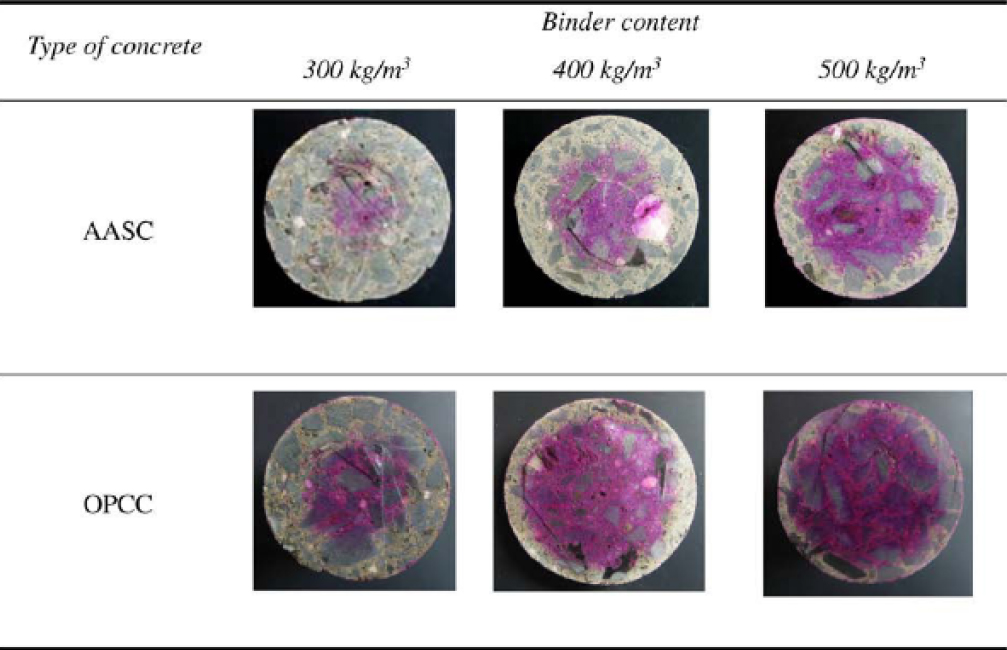
Fig. 11.
Carbonation changes for geopolymer concrete and conventional concrete [50]
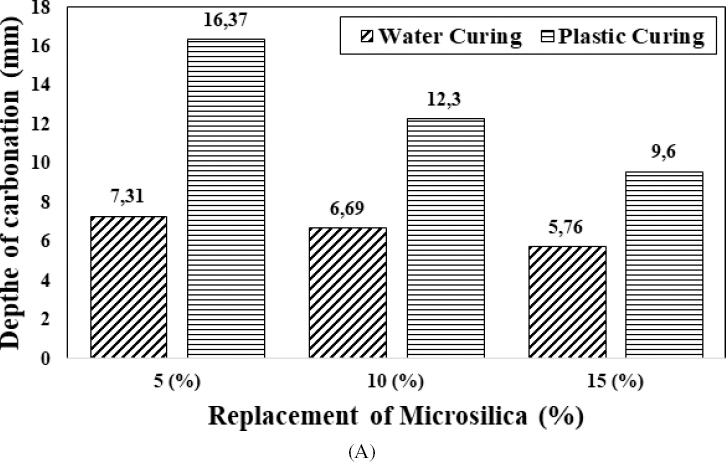
Fig. 12.
(A): Depth of carbonation of geopolymer concrete after 28 days [93]
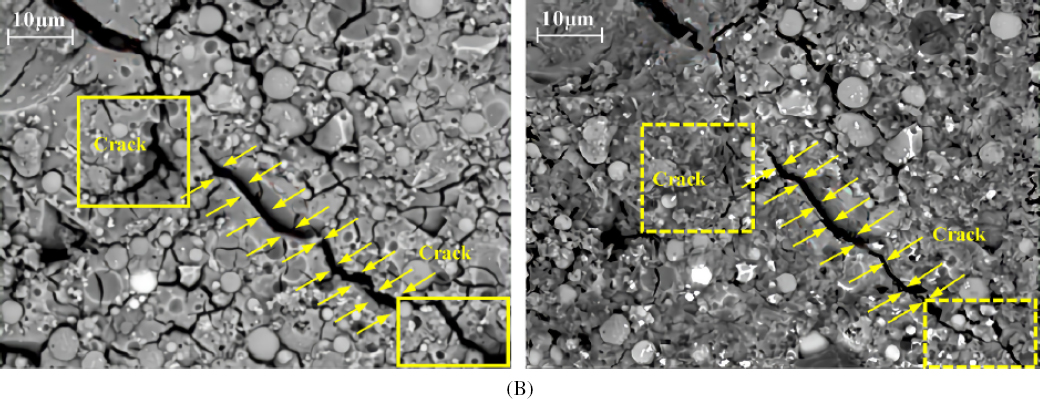
Fig. 12.
(B): Change in the microstructure of FA-based GPC before and after carbonation [90]
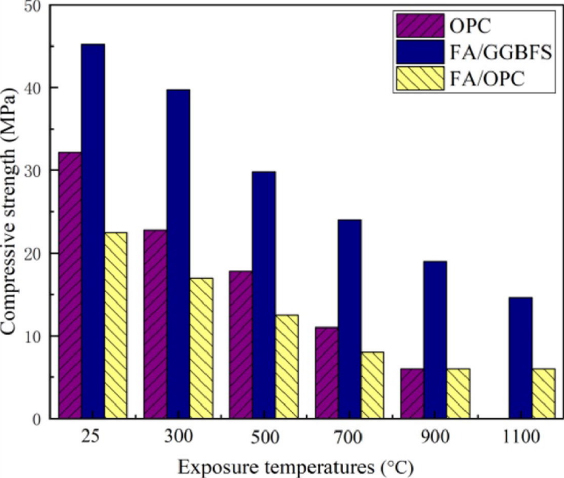
Fig. 13.
Compressive strength of samples after heating at different temperatures [91]
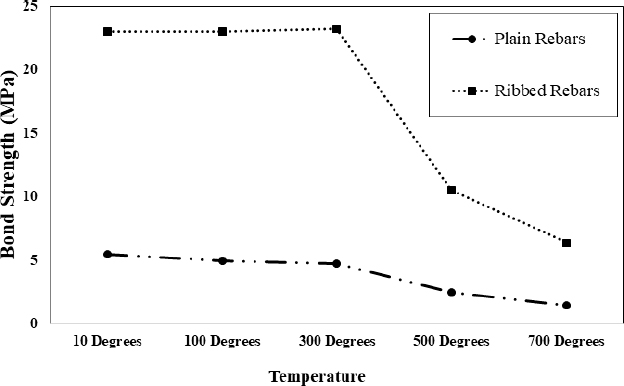
Fig. 14.
Bonding strength of FA-based geopolymer concrete with plain and ribbed rebars under different temperatures [102]
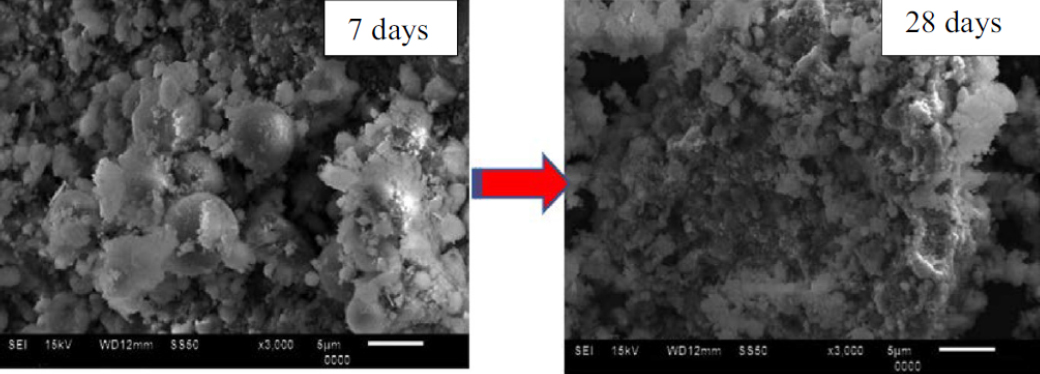
Fig. 15.
Change in the microstructure of FA-based GPC with time [107]
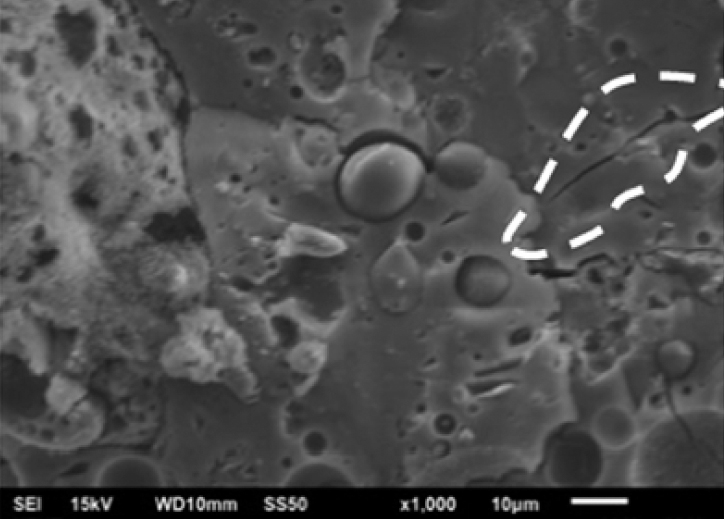
Fig. 16.
Micro-cracks in the microstructure of GPC cured in outside surroundings for 6 months [108]
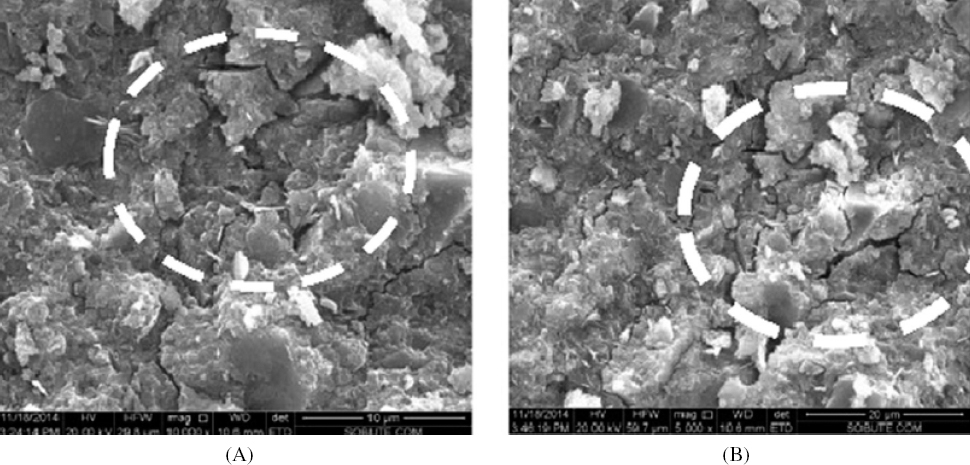
Fig. 17.
Infiltration of chlorides in FA-based GPC at higher content of water (A) 10000 magnification, (B) 5000 magnifications [109]