
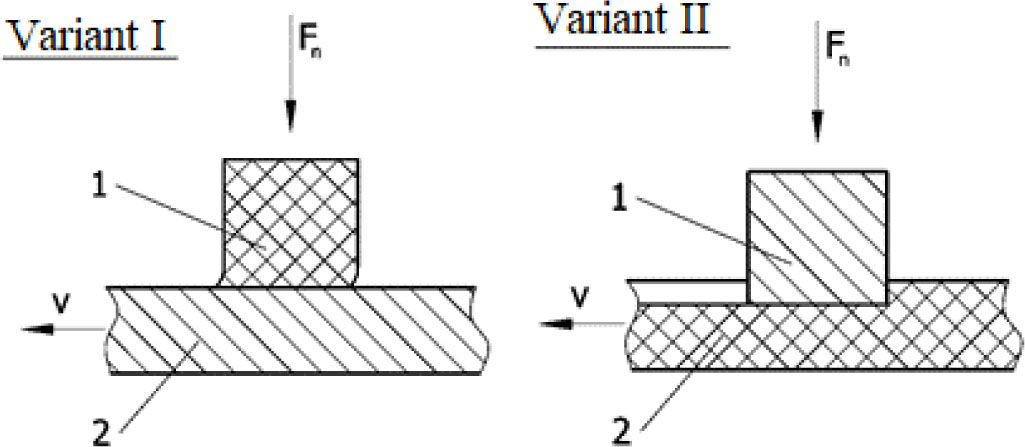
Fig. 1
Variants of sliding pairs for materials characterised by different deformability [15]: variant I (normal sliding pair) – (1) polymer sample, (2) steel counter body; variant II (reversed sliding pair) – (1) steel sample, (2) polymer counter body
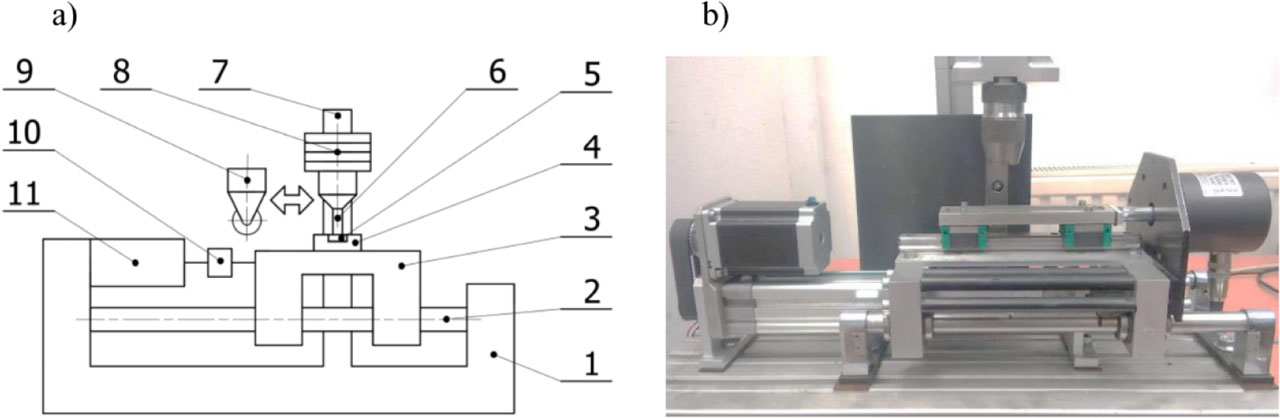
Fig. 2
Test stand for tribological investigations at reciprocating motion: (A) schematic, (B) photo of the test stand
Table 1
Mechanical parameters of polymers selected for tests [18]
| Density [g/cm3] | E-modulus [MPa] | Glass transition temperature [°C] | Melting point [°C] | Softening point [°C] | |
|---|---|---|---|---|---|
| PE-UHMW | 0.93 | 730 | −100 | 135 | 80 |
| POM | 1.41 | 2400 | −240 to 180 | 167 | 150 |
| PTFE | 2.6 | 750 | −97 | 327 | - |
[i] PE-UHMW, polyethylene with an ultrahigh molecular weight; POM, polyoxymethylene; PTFE, polytetrafluoroethylene
Table 2
The static friction coefficient of tested steel-polymer friction pairs as a function of unit pressure p. Reversed sliding pairs
| 0.5 | 1.0 | 2.0 | |
|---|---|---|---|
| PE-UHMW | 0.12 ± 0.001 | 0.11 ± 0.001 | 0.11 ± 0.001 |
| POM | 0.16 ± 0.002 | 0.14 ± 0.002 | 0.12 ± 0.002 |
| PTFE | 0.09 ± 0.002 | 0.08 ± 0.001 | 0.06 ± 0.001 |
[i] PE-UHMW, Polyethylene with an ultrahigh molecular weight; POM, polyoxymethylene; PTFE, polytetrafluoroethylene
Table 3
The static friction coefficient of tested polymer–steel friction pairs as a function of unit pressure p. Normal sliding pairs
| 0.5 | 1.0 | 2.0 | |
|---|---|---|---|
| PE-UHMW | 0.10 ± 0.002 | 0.09 ± 0.001 | 0.08 ± 0.001 |
| POM | 0.09 ± 0.001 | 0.08 ± 0.001 | 0.07 ± 0.001 |
| PTFE | 0.05 ± 0.001 | 0.06 ± 0.001 | 0.05 ± 0.001 |
[i] PE-UHMW, Polyethylene with an ultrahigh molecular weight; POM, polyoxymethylene; PTFE, polytetrafluoroethylene
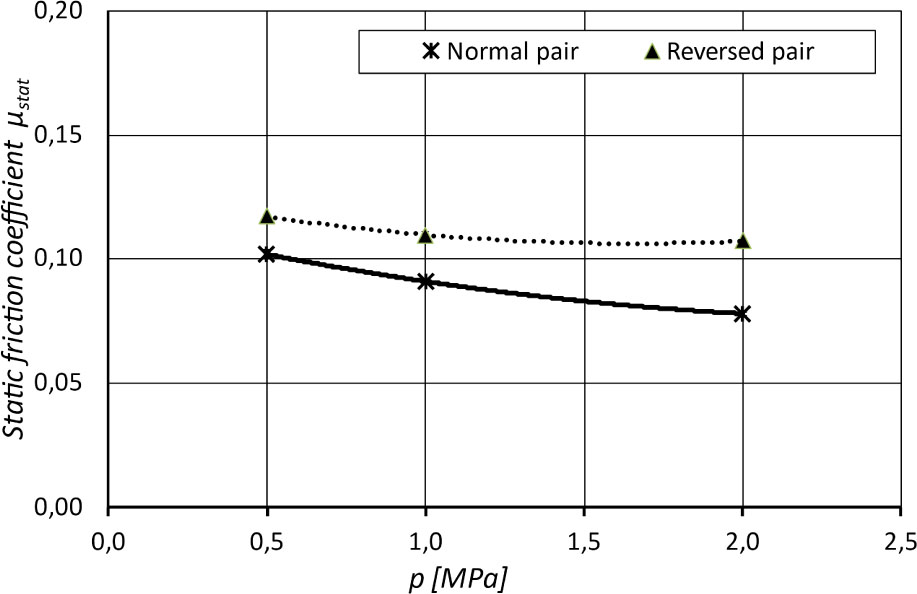
Fig. 3
Average values of static friction coefficient of tested PEUHMW-C45 contact in normal and reversed sliding pair. PE-UHMW, Polyethylene with an ultrahigh molecular weight
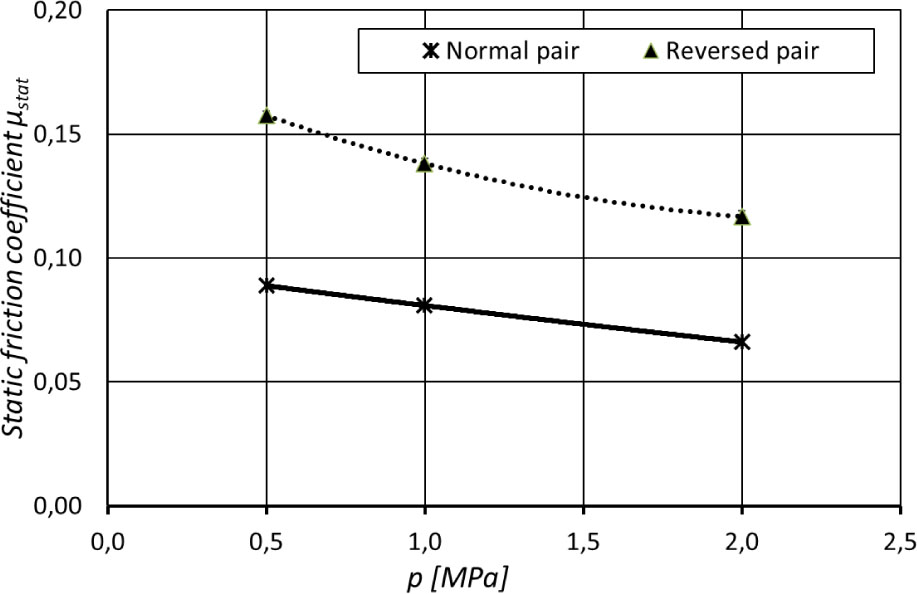
Fig. 4
Average values of static friction coefficient of tested POM-C45 contact in normal and reversed sliding pair. POM, polyoxymethylene
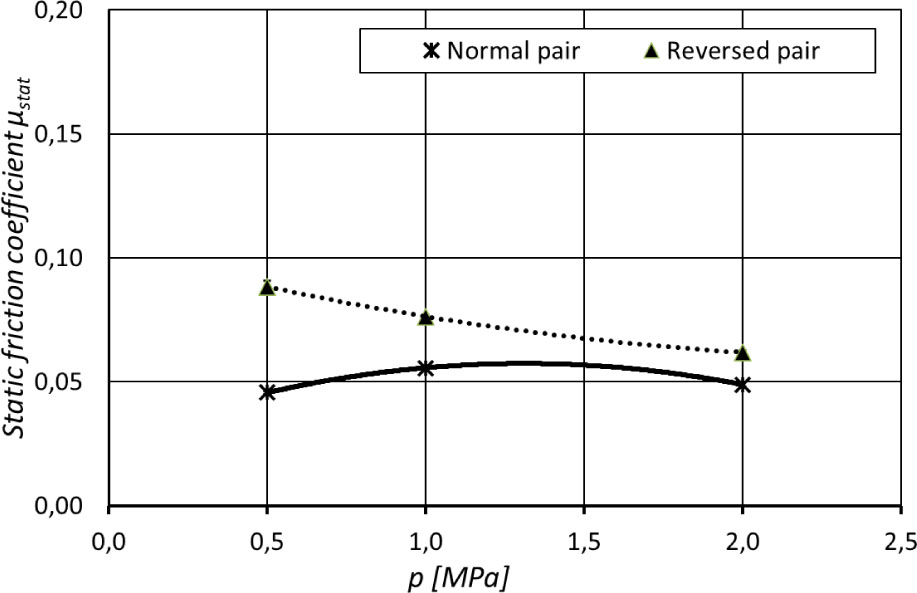
Fig. 5
Average values of static friction coefficient of tested PTFE-C45 contact in normal and reversed sliding pair. PTFE, polytetrafluoroethylene
Table 4
Percentage changes in static friction coefficient values for normal sliding pair in comparison with reversed pair
| 0.5 | 1 | 2 | Average | |
|---|---|---|---|---|
| PE-UHMW (%) | −16.7 | −18.2 | −27.3 | −20.7 |
| POM (%) | −43.7 | −42.8 | −41.7 | −42.7 |
| PTFE (%) | −44.4 | −25.0 | −16.7 | −28.7 |
[i] PE-UHMW, Polyethylene with an ultrahigh molecular weight; POM, polyoxymethylene; PTFE, polytetrafluoroethylene
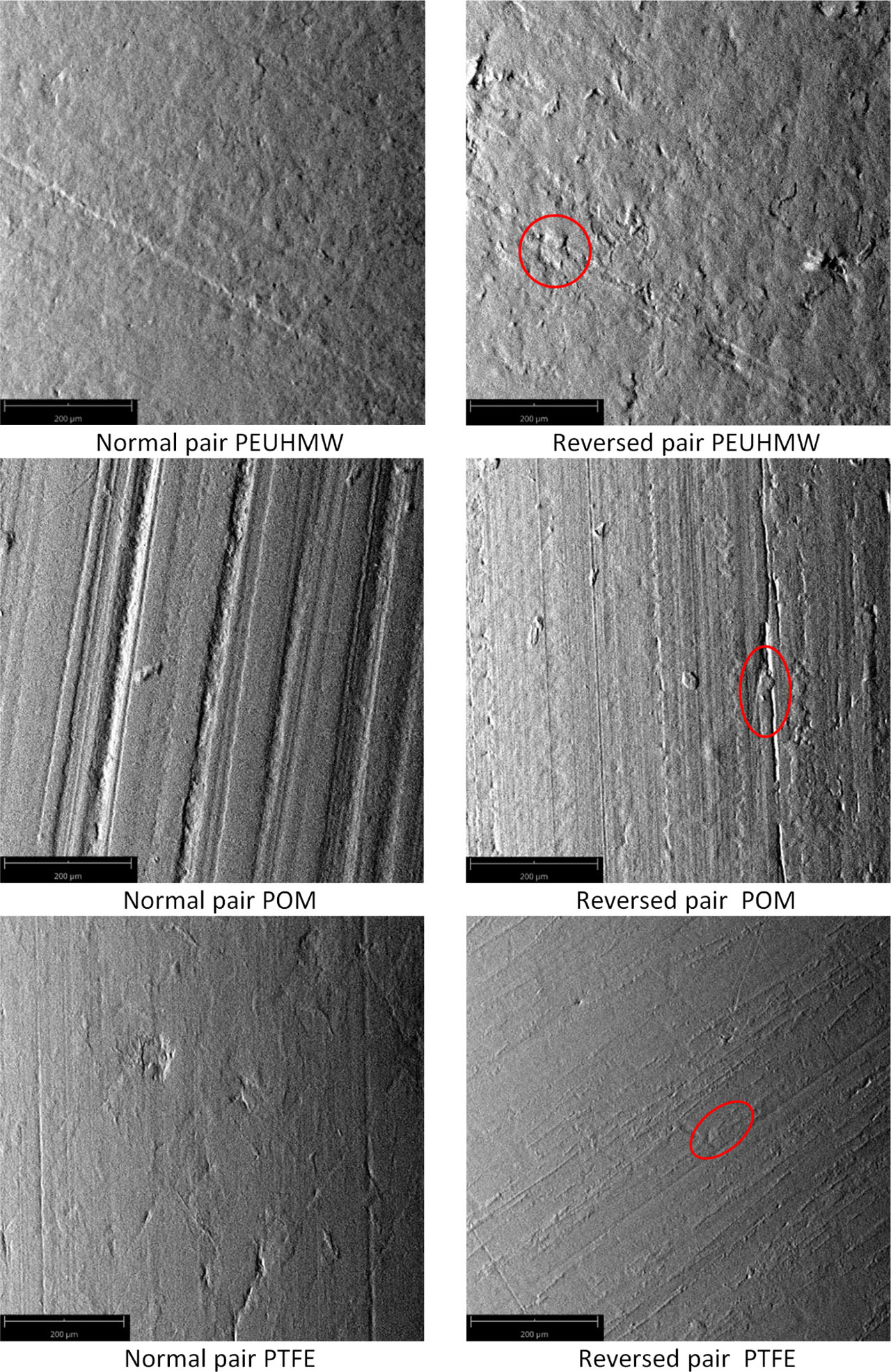
Fig. 6
Microscopic images of polymer samples' surface after friction tests. Red circles mark smeared (macrode-formed) material on the surface. SEM, magnification: ×400, topography BSD, 15 kV. PE-UHMW, Polyethylene with an ultrahigh molecular weight; POM, polyoxymethylene; PTFE, polytetrafluoroethylene
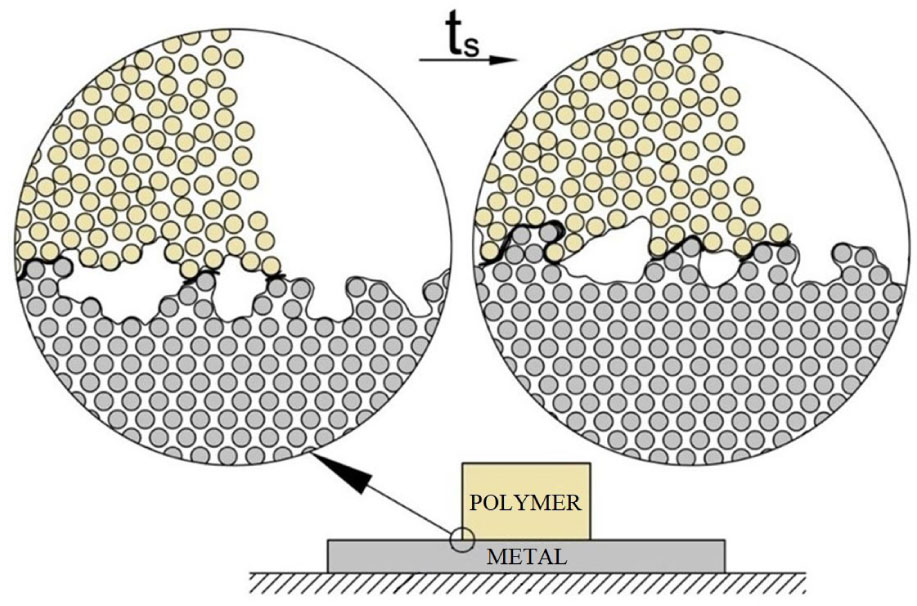
Fig. 7
A phenomenon which takes place in friction pair's contact area: increase in contact surface due to material creep at rest under load over time ts, contributing to an increase in static friction force [20]