
1. Introduction
The theory of Dynamic Capabilities (DCs) seeks to explain why some firms excel in turbulent technological and market environments while others struggle to adapt (Pundziene et al., 2021; Leemann & Kanbach, 2021; Akenroye et al., 2020). Yet, despite its influence, the concept continues to evolve as less explored and contextually divided within the dynamic capabilities’ literature (Pitelis et al., 2024; Teece, 2023). As Barreto (2010) observes, debates over DCs persist due to diverging definitions (Eisenhardt & Martin, 2000; Teece, 2007), mixed empirical evidence linking them to firm performance (Lin & Wu, 2014; Mukhtar et al., 2023), and uncertainty about their universal applicability (Castelo & Gomes, 2023). These gaps highlight the need to examine how DCs operate in emerging and resource-constrained economies such as Ghana’s SME sector.
Ghana offers an important context for study as an emerging economy where SMEs face persistent exchange rate swings (Boateng et al., 2022), regulatory reforms, and production challenges due to "dumsor" (power shortages), which caused electricity crises, with the latest rationing program starting in 2012 and continuing today (Abeberese et al., 2021), shifting market margins, and overlapping formal–informal institutional systems (Acheampong et al., 2024; Martins, 2022). Government initiatives through programs (like the National Board for Small Scale Industries, now Ghana Enterprises Agency – GEA) make dynamic capabilities indispensable (Adjimah et al., 2022; Gligah & Zaidin, 2023).
This study examines the influence of Dynamic Capabilities on SME performance in Ghana and the moderating role of government support. It aims to identify which DC dimensions most effectively drive resilience and competitiveness. By situating the DC framework within an emerging economy, this study not only advances theoretical understanding but also offers practical insights for managers seeking to build adaptive, performance-driven SMEs.
The rest of the article is structured as follows: section two is the theoretical background, which discusses the framework, highlighting the various dynamic capabilities relevant to the research. Section three is the hypothesis development. Research methodology is Section 4, which discusses the methodology, including the demographic profile of respondents, the confirmatory factor analysis, structural model assessment, path coefficient, and the moderation analysis. Section 4 presents the discussion of the findings, theoretical and managerial implications, and the last section presents the limitations and future research.
2. Theoretical background
2.1. Dynamic capabilities (DC)
Dynamic capabilities are influenced by various factors (Hartmann & Germain, 2015). The literature identifies several key elements, including digital transformation in enterprise business (Froehlich et al., 2024), firm orientation (Desai et al., 2007), and marketing orientation for customer relationship management (CRM) capabilities (Desai et al., 2007). In our approach, we have consolidated these different labels from the literature, aligning them with the framework proposed by Teece (2007, 2014, 2016, 2018). This framework highlights four main types of dynamic capabilities: sensing capabilities, learning capabilities, integrating capabilities, and coordinating capabilities (Baden-Fuller & Teece, 2020; Pavlou & El Sawy, 2011).
2.2. Sensing capabilities
Sensing refers to the analytical systems organizations use to learn, sense, filter, shape, and calibrate opportunities (Fosso Wamba et al., 2024). This capability enables organizations to gather information that helps anticipate or better understand customer needs (Dias & Lages, 2021; Wagner et al., 2017). For small- and medium-sized enterprises (SMEs), a lack of understanding of specification requirements has been identified as a key barrier to participating in public procurement (Akenroye & Aju, 2013). Therefore, SMEs may need to develop “sensing” capabilities to collect information and better understand the requirements of public-sector clients. One way to achieve this is through frequent communication with public buyers, gaining a clear understanding of their needs and then presenting strong bids or proposals.
In a framework advanced by Teece (2007), several measures are proposed for sensing capabilities (Janssen et al. 2016; Komaryatin et al., 2024). These measures focus on the assessment of firms with sensing capabilities, including these routines: (i) responding to market intelligence (Teece, 2007), (ii) generating market intelligence (Kankam-Kwarteng et al., 2021), (iii) disseminating market intelligence (Mousavi et al., 2018), and (iii) generating market intelligence involves identifying customer needs (Teece, 2007), being responsive to market trends (Prince & Priporas, 2014). Sensing capabilities may involve detecting digital evolution, users’ emerging behaviors (Warner & Wäger, 2019), and competitor-based trends. Studies by Matarazzo et al. (2021) and Soluk and Kammerlander (2021) found that sensing is important for digital transformation success by encompassing the capacities of emerging trend scanning, technological opportunity identification, and development at the initial digital transformation stage (Leso et al., 2024). The capacity to find and investigate novel domains is also necessary for sensing capabilities (Hodgkinson & Healey, 2011). This enables the business to enter new markets and establish ties with clients (Kazienko et al., 2013).
2.3. Learning capabilities
Organizations must launch new products when a market opportunity is discovered, which frequently entails improving current skills through education and knowledge acquisition (Prashantham & Floyd, 2012; Teece, 2007). While Sensing is the process of obtaining fresh market data, learning is the process of applying that data to produce new knowledge. The capacity to integrate new information with preexisting talents is known as learning capability. Learning capabilities are made up of four routines: obtaining, assimilation, transformation, and exploitation of knowledge (Melo & Machado, 2020). Gaining new insights is the first step in acquiring knowledge. Articulating and brokering knowledge is the second step in assimilation (Eisenhardt & Martin, 2000). Transforming knowledge is the process of applying new insights to creative problem-solving and innovative thinking (Goh & Ryan, 2002). Finally, pursuing new initiatives and taking advantage of opportunities is the process of exploiting knowledge (Giniuniene & Pundziene, 2020; Teece, 2007). Thus, learning fosters organizational proactivity and facilitates operational capability invention and reconfiguration (Zollo & Winter, 2002).
2.4. Integrating capabilities
According to a previous study, reconfiguration requires the integration of new resources and assets. Since modifying current capabilities needs collaborative efforts, this process calls for shared logic and interaction patterns. Since individuals frequently possess newly acquired knowledge through learning, it must be integrated on a social level (Teece, 1982). The ability to integrate individual knowledge into new operational capabilities for the organization is known as the integrating capability. The contribution, representation, and interrelation of individual input are the three main routines involved in this capacity. Contribution is sharing unique ideas across the business unit. Visualizing oneself and others within the organization, as well as the connections between the unit's actions, is known as representation. Interrelation entails combining these disparate inputs to improve the reconfigurable operating capabilities (Helfat et al., 2009). By first gathering and integrating disparate data, creating a common understanding, and creating a new perceptual schema, these procedures aid in reconfiguration. In the view of the literature, interrelation plays a crucial role in establishing a new logic of collective interaction, which is necessary for the repetition of reconfigured capacities. Dynamic capacities are viewed as a group endeavor necessary for successful reconfiguration (Zollo & Winter, 2002), and integrated capabilities enable groups to respond to novel situations more effectively. Teece (2007) highlights that the basis of dynamic capacities is the integration of knowledge.
2.5. Coordination capabilities
The reconfiguration of operational capabilities requires effective coordination of tasks, resources, and alignment of activities (Biffl et al., 2022; Mao et al., 2022). Coordination capability is essential to this process as it involves the management of these elements to deploy the new operational capabilities. It is defined as the ability to orchestrate and deploy tasks, resources, and activities in line with the reconfigured capabilities. Key capability coordination routines include assigning resources to tasks (Daga et al., 2017), placing the right person in the right role (Heaton & Teece, 2012), identifying complementarities and synergies between tasks and resources (Heaton et al., 2020), and orchestrating collective activities (Linde et al., 2021). Coordination capabilities require effective operational capability, which enables new product development (NPD) units to (1) identify, gather, and distribute resources efficiently; (2) share market intelligence inside the unit (Vorhies & Harker, 2000); (3) align the appropriate individual with the appropriate task; and (4) efficiently synchronize duties and activities (Helfat et al., 2009). Teece (2007) also pointed out that dynamic capabilities are embedded in distinctive ways of coordinating essential components of resource allocation, which improves the ecosystem of business activities (Farago et al., 2023; Linde et al., 2021). The following hypotheses were formulated from the above discussions.
3. Hypotheses development
3.1. Sensing capabilities have a direct effect on firm performance
Trisnawati et al. (2024) emphasized the direct relationship between sensing capabilities and firm performance (Kareem et al., 2024). According to Mu and Di Benedetto (2011), organizational information processing tasks like information evaluation, filtering, interpretation, and scanning constitute the foundation of sensing capacities. To assist businesses in identifying market opportunities and changes before they occur, these processing operations apply logic in complicated, dynamic, and unpredictable market contexts. Therefore, these activities of the firms for gathering diverse information support them to be vigilant and alert to take opportunities and enhance their market trends (Day & Kruse, 2021). Therefore, sensing capability, therefore, has an impact on firm performance. We can hypothesize that:
H1: Sensing capabilities have a direct positive effect on firm performance.
3.2. Learning capabilities and firm performance
According to Altinay et al. (2016) and Jerez-Gomez et al. (2005), learning capability is the capacity of a business to provide a platform that facilitates the generation, acquisition, transfer, and integration of knowledge to alter its behavior and improve performance. It includes knowledge transmission through employee training and development as well as knowledge absorption through research and development (R&D) (Freixanet & Federo, 2022). We further argue that these features of the learning capabilities have an influence on firm performance. Therefore, we hypothesize that:
H2: Learning Capabilities have a direct positive effect on Firm Performance
3.3. Integrating capabilities on firm performance
Ahmad Zaidi and Othman, (2012) contended that an organization’s capacity to adapt to the quickly changing market environment through the integration, development, and reconfiguration of internal and external skills is another aspect of dynamic capabilities. This argument emphasizes how important it is to investigate how an organization's product capability may be impacted by its integration capabilities. It is claimed that reconfigured capabilities have the potential to provide value, which directly affects the operational capabilities of the company (Wilden et al., 2016). Considering these justifications, the current study investigates how integrating capabilities affects a firm’s performance (Kareem et al., 2024). Various forms of integration and performance have been established in extant literature (Byrd & Byrd, 2012; Jiang et al., 2015; Pang et al., 2019). Thus, this study framed the following hypothesis:
H3: Integrating capabilities have a direct positive effect on firm performance.
3.4. Coordination capabilities and firm performance
According to a previous study, coordination is the process of bringing together various work units to complete a set of tasks as a group (Moisescu & Codreanu, 2022). Coordination is a way to get over information sharing obstacles in the context of developing new products. The complexity of coordination systems varies, as does the pressure they place on decision-making and communication. It also shows a positive relation with performance (Augustinsson et al., 2012; Chae, 2016). Thus, this research proposed that coordination capability has a positive effect on firm performance. Therefore,
H4: Coordination capabilities have a direct positive effect on firm performance
3.5. Moderating effects of government support in between dynamic capabilities and firm performance
Government support, dynamic capabilities, and firm performance have all been studied in recent times of SMEs' experiences in the developing economy (Malik & Kotabe, 2009). Matikonis and Graham, (2024) found that government support and dynamic capabilities positively moderated SME during COVID-19, but that same government intervention negatively moderated the relationship between DC and employment after the first lockdown. Pin (2014), after analyzing the Chinese business, also found that different forms of government assistance had differing effects on DCs and innovation, with fiscal policies having an impact on DCs and management innovation but not on technological innovation. It was discovered previously that government support was essential for promoting digital agility and adaptability. Given that the business environment is characterized by unpredictable fluctuations, SMEs should be ready to adjust their business processes appropriately. For instance, when SMEs are faced with more rivalry, businesses place a greater emphasis on the unique preferences of their customers (Charoensukmongkol, 2022; Qi et al., 2023). According to Teece (2018), a company's business model alignment with environmental changes is influenced by the strength of its dynamic capabilities, in terms of both degree and pace. In a very chaotic environment, the degree and speed of alignment of business models are especially crucial (Witschel et al., 2022).
According to Taghizadeh et al. (2023), the four main types of dynamic capabilities have been distinguished by Teece et al. (1997) and Pavlov and El Sawy (2001). These capabilities have been used in varied research (Darawong, 2019; Hernández-Linares et al., 2024; Muriuki et al., 2021), and in some instances, government support moderated the relationship by applying these dynamic capabilities with unpredictable changes (Arend, 2014; Eikelenboom & de Jong, 2019; Taghizadeh et al., 2023). In line with the above discussion, SME may be using sensing, learning, integrating, and coordinating capabilities for the firm's performance.
The government offers different prices of training and short courses to SME and individuals, like the youth employment program in the case of Ghana (Dadzie et al., 2020). These supports can be beneficial to SME and to increase performance. Government support, therefore, moderates firm performance between sensing capabilities, leading to increased competitiveness and performance in the dynamic environment (Sultan & Tabassam, 2023). Therefore, we proposed the following hypothesis:
H5: Government Support has a moderating effect on Sensing
Capabilities and Firm Performance
In Ghana, both financial and nonfinancial government support significantly correlate with firm performance, emphasizing the importance of capabilities in the relationship (Gligah & Zaidin, 2023). Start-up performance as an improved government support policies to SME can ensure the growth of the economy, and through these linkages, government support can moderate the effect of learning capabilities and firm performance (Choi et al., 2021). Therefore, this research proposed the following hypothesis:
H6: Government Support has a moderating effect on Learning
Capabilities and Firm Performance
Studies have shown that governments' support positively influenced firm performance when combined with capabilities, indicating a moderating effect between these capabilities and firm performance in the context of government support, which influences the relationship between integrating capabilities and firm performance in the emerging market (Falahat et al., 2021). In line with the above discussion, this research proposes the following:
H7: Government Support has a moderating effect on Integrating
Capabilities and Firm Performance
Government support plays a significant role in enhancing firm performance, particularly for SME. Additionally, factors such as absorptive capability and product innovation capabilities can moderate the relationship between government support and firm performance. Accordingly, we propose that:
H8: Government Support has a moderating effect on Coordinating Capabilities and Firm Performance
4. Research methodology
We used the quantitative research approach, incorporating three distinct data collection stages. The initial phase involved distributing online surveys to key stakeholders in the Ghanaian economy, including members of the Association of Ghana Industries (Bawakyillenuo et al., 2013), Ghana Association of Banks, Private Enterprise Federation, and members of the Association of Market Queens and Women (Dzisi, 2011). The second stage employed university students as field research officers. These individuals, who had undergone four months of online training, visited participants’ workplaces with printed questionnaires. This method facilitated faster data collection by allowing immediate addressing of participants' concerns and questions. The final phase combined elements from the previous two stages. The researcher maintained consistent communication and follow-up regarding the distributed questionnaires. During this stage, participants were assured of confidentiality, with guarantees that their SMEs or organizations would not be individually identified in the study's findings. The sample selection was based on specific criteria: (i) businesses had to be independent entities without affiliations to company groups or chains; (ii) firms needed to be owned and managed by individual entrepreneurs or groups; and (iii) companies were required to have complete contact information for the founder or CEO. Data were collected between June and November 2023. The online questionnaires were distributed using virtual chat software, such as WhatsApp, to respondents (Hay-Gibson, 2009). Consistent with previous studies on the number of respondents, this study analyzed data from 298 SME business operators using Structural Equation Modeling (Agyapong et al., 2024; Donkor et al., 2018).
4.1. Respondents’ demographic profile
The demographic profile contains the respondents’ characteristics in terms of Age group, gender, managerial position, level of education, and years in a position in the business (Table 1). All respondents, including managers of varied workplaces operating SMEs in various settings (e.g., CEO, General Manager, Managing Director, and Other top management positions), returned surveys from which findings regarding demographic characteristics were derived. As depicted in the table below, 64.7% of the respondents surveyed were male (n = 180) and 35.3% of female (n = 98). This result indicated that business managers are likely men. The respondents came from the age group between 20 and 29 years, constituting 31.7% (n = 88); while the age group between 30 and 39 constituting 40.6% (n = 113); and 40 to 49 age group having 21.6% (n = 60); 50 or more, of the surveyed respondents were 6.1% (n = 17). In terms of level of education, those in the “Up to 1st Degree” constituting the largest share of the respondents, 120 (43.2%). Up to second degree of the respondents constitute 94 (33.8%), and up to Diploma/HND have 26 (9.4%); up to PhD respondents 11(4.0%), and up to SHS/A’ level/O’level qualifications of the respondents constitute 27(9.7%). This implies that the managers who were managing these businesses were up to the first degree level in their education. On the managerial position of the respondents, CEO constitutes 66 (23.7%); General Manager 39 (14.0%), Managing Director 51 (18.3%), and other top management positions 122 (43.9%). On assessing the number of years for managers in a position: 0–5 = 157 constitutes (56.5%); 11–15 = 20 shows (7.2%); 16–20 = 4 for (1.4%); 21–25 = 3 for (1.1%); 26–30 = 4 for (1.4%); 31+ for (1.4%); and 6–10 = 89 for (32.0%).
Table 1
Respondents’ demographics.
| Variables | Factors | Frequencies | Valid percentages |
|---|---|---|---|
| Age group | 20–29 | 88 | 31.7 |
| 30–39 | 113 | 40.6 | |
| 40–49 | 60 | 21.6 | |
| 50 or more | 17 | 6.1 | |
| Gender | Female | 98 | 35.3 |
| Male | 180 | 64.7 | |
| Managerial position | CEO | 66 | 23.7 |
| General manager | 39 | 14.0 | |
| Managing director | 51 | 18.3 | |
| Other top management positions | 122 | 43.9 | |
| Level of education | Up to first degree | 120 | 43.2 |
| Up to second Degree | 94 | 33.8 | |
| Up to Diploma/HND | 26 | 9.4 | |
| Up to PhD | 11 | 4.0 | |
| Up to SHS/A ‘level/ O’level | 27 | 9.7 | |
| Years in a position | 0–5 | 157 | 56.5 |
| 11–15 | 20 | 7.2 | |
| 16–20 | 4 | 1.4 | |
| 21–25 | 3 | 1.1 | |
| 26–30 | 4 | 1.4 | |
| 31+ | 1 | 0.4 | |
| 6–10 | 89 | 32.0 |
Source: Own Elaboration, 2024.
4.2. Non-response bias
We followed Armstrong and Overton (1977) to check for non-response bias by performing an independent sample t-test to compare the characteristics of early respondents (first: 149) and late respondents (last: 149). The results, as presented in Table 2, show that the average values for early and late respondents were not significantly different (p > 0.05). This means that early and late respondents are similar, so nonresponse bias is not a significant concern in this study. Therefore, the results are reliable because the sample represents the intended study population.
Table 2
Non-response bias.
| Early respondents | Late respondents | |||||
|---|---|---|---|---|---|---|
| (N = 149) | (N = 149) | |||||
| VARIABLES | MEANS | SD | MEANS | SD | t | Sig |
| DC_SEN_1 | 5.2449 | 1.75792 | 5.2993 | 1.35695 | −0.275 | 0.783 |
| DC_SEN_2 | 5.1837 | 1.7242 | 5.1701 | 1.28944 | −0.575 | 0.566 |
| DC_SEN_3 | 5.2789 | 1.71928 | 5.3878 | 1.28452 | −0.745 | 0.457 |
| DC_SEN_4 | 5.2381 | 1.69339 | 5.4014 | 1.20308 | −1.514 | 0.132 |
| DC_LC_1 | 4.7483 | 1.67922 | 4.8844 | 1.33199 | −0.492 | 0.623 |
| DC_LC_3 | 4.8435 | 1.75054 | 5.0476 | 1.39634 | 0.148 | 0.883 |
| DC_LC_4 | 4.9864 | 1.72009 | 5.2721 | 1.30624 | 0.865 | 0.388 |
| DC_LC_5 | 4.9796 | 1.70603 | 5.1088 | 1.34536 | −2.192 | 0.03 |
| DC_INTEG_2 | 5.1361 | 1.69867 | 5.2313 | 1.41454 | −0.483 | 0.63 |
| DC_INTEG_3 | 4.8912 | 1.71268 | 5.1973 | 1.36311 | 0.079 | 0.937 |
| DC_INTEG_4 | 5.0068 | 1.69001 | 4.9796 | 1.38222 | −2.152 | 0.033 |
| DC_INTEG_5 | 5.2245 | 1.6585 | 5.034 | 1.57208 | −1.415 | 0.159 |
| DC_COORD_1 | 5.1361 | 1.64541 | 4.9796 | 1.44521 | 1.343 | 0.181 |
| DC_COORD_3 | 5.1361 | 1.72666 | 5.102 | 1.48847 | 0.074 | 0.941 |
| DC_COORD_4 | 4.7959 | 1.79779 | 5.1973 | 1.18576 | −0.92 | 0.359 |
| DC_COORD_5 | 5.102 | 1.77785 | 5.1361 | 1.18576 | −1.087 | 0.279 |
| GS_1 | 5.1769 | 1.68271 | 5.2585 | 1.18835 | −0.714 | 0.476 |
| GS_2 | 5.2585 | 1.7715 | 5.2245 | 1.31793 | −1.721 | 0.087 |
| GS_3 | 5.3333 | 1.73337 | 5.3197 | 1.37485 | 0.996 | 0.321 |
| G S_4 | 5.2449 | 1.88545 | 5.2993 | 1.7647 | 0.179 | 0.858 |
| FIRM_PERF2 | 5.1837 | 1.82949 | 5.1701 | 1.78361 | −0.194 | 0.846 |
| FIRM_PERF3 | 5.2789 | 1.84607 | 5.3878 | 1.77809 | 0.191 | 0.849 |
| FIRM_PERF4 | 5.2381 | 1.93061 | 5.4014 | 1.9037 | −2.91 | 0.004 |
| FIRM_PERF5 | 4.7483 | 1.57084 | 4.8844 | 1.45776 | −2.421 | 0.017 |
| FIRM_PERF11 | 4.8435 | 1.5931 | 5.0476 | 1.41187 | 3.02 | 0.003 |
NOTE(S): DC_SEN, sensing capabilities; DC_LC, learning capabilities; DC_INTEG, integrating capabilities; DC_COORD, coordinating capabilities; GS, Government Support; FIRM_PERF, firm performance; SD, standard deviation; N, number of respondents; T, computed test statistic; and Sig, significant value.
Source: Own Elaboration, 2024.
4.3. Confirmatory factor analysis (CFA)
CFA is used to confirm a theoretical model using empirical data, and it is one of the multivariate techniques in structural equation modeling. A crucial stage in CFA is evaluating the goodness of fit of the suggested model, which indicates how well the model matches the observed data, in addition to evaluating the covariance represented by the model (Brown, 2008). Below is the CFA table validating the constructs used in the research and fulfilling the established model fit indices (Table 3).
Table 3
Confirmatory factor analysis and reliability.
| Constructs | Items | Squared factor loadings (λ2) | AVE | CR |
|---|---|---|---|---|
| Sensing capabilities | 0.866 | 0.946 | ||
| DC_SEN_4 | 0.866 | |||
| DC_SEN_3 | 0.869 | |||
| DC_SEN_2 | 0.855 | |||
| DC_SEN_1 | 0.872 | |||
| Learning capabilities | 0.867 | 0.947 | ||
| DC_LC_5 | 0.889 | |||
| DC_LC_4 | 0.894 | |||
| DC_LC_3 | 0.854 | |||
| DC_LC_1 | 0.830 | |||
| Integrating capabilities | 0.910 | 0.982 | ||
| DC_INTEG_5 | 0.916 | |||
| DC_INTEG_4 | 0.942 | |||
| DC_INTEG_3 | 0.931 | |||
| DC_INTEG_2 | 0.850 | |||
| Coordinating capabilities | 0.879 | 0.976 | ||
| DC_COORD_5 | 0.924 | |||
| DC_COORD_4 | 0.930 | |||
| DC_CCORD_3 | 0.860 | |||
| DC_COORD_1 | 0.801 | |||
| Government support | 0.886 | 0.954 | ||
| GS_4 | 0.821 | |||
| GS_3 | 0.909 | |||
| GS_2 | 0.930 | |||
| GS_1 | 0.884 | |||
| Firm performance | 0.820 | 0.939 | ||
| FIRM_PERF11 | 0.643 | |||
| FIRM_PERF5 | 0.915 | |||
| FIRM_PERF4 | 0.902 | |||
| FIRM_PERF3 | 0.876 | |||
| FIRM_PE.RF2 | 0.763 |
Model Fit Statistics χ2 = 585.409, df = 260; CFI = 0.958, TLI = 0.950, RMSEA <0.8, = 0.067, AGFI = 0.851, p = 0.000); AVE, average variance extracted, and CR, construct reliability.
Source: Own Elaboration, 2024.
Table 4
Discriminant validity.
| Constructs | CR | AVE | Govt | Sensing | Learning | Integ | Cord | Firm_Perf |
|---|---|---|---|---|---|---|---|---|
| Govt | 0.944 | 0.808 | 0.899 | |||||
| Sensing | 0.936 | 0.785 | 0.336 | 0.886 | ||||
| Learning | 0.938 | 0.792 | 0.381 | 0.813 | 0.890 | |||
| Integ | 0.951 | 0.831 | 0.311 | 0.791 | 0.841 | 0.911 | ||
| Cord | 0.932 | 0.776 | 0.256 | 0.781 | 0.742 | 0.843 | 0.881 | |
| Firm_Perf | 0.922 | 0.707 | 0.162 | 0.379 | 0.300 | 0.284 | 0.302 | 0.841 |
Sensing, sensing capabilities; Learning, learning capabilities; Integ, integrating capabilities; Cord, coordinating capabilities; and Firm_Perf, firm performance.
Source: Own Elaboration, 2024.
4.4. Structural model assessment
The study hypothesized a positive relationship between sensing capabilities and firm performance. The analysis revealed a confirmation from the data at (β = 0.306, CR 2.947, p <0.003), supporting H1 in the study. The second hypothesis posited that there is a positive relationship between learning capabilities and firm performance. However, the analysis demonstrated the opposite, which shows that at (β = 0.004, CR = 0.036, and p > 0.971), H2 was not supported. The third hypothesis proposed that integrating capabilities has a positive effect on firm performance. However, the analysis (β = 0.058, CR = 0.513, p > 0.608) revealed that this does not support H3. Similarly, coordinating capabilities turned out to be (β = 0.045, CR = 0.471, p > 0.638); the hypothesis did not support H4. This implied that, except for sensing capabilities in the case of SMEs in Ghana, all other capabilities adopted in the research (i.e. Learning capabilities, integrating capabilities, and Coordination capabilities) and as proposed by Teeces do not support firm performance. Table 5 provides the summary of the findings for the path (direct) coefficient.
Table 5
Path analysis.
| Hypotheses | B | Beta | S.E | C.R | P | Decisions | |
|---|---|---|---|---|---|---|---|
| H1 | FP ← SEN | 0.306 | 0.39 | 0.104 | 2.947 | 0.003 | Significant |
| H2 | FP ← LC | 0.004 | 0.005 | 0.103 | 0.036 | 0.971 | Not significant |
| H3 | FP ← INTEG | −0.058 | −0.081 | 0.112 | −0.513 | 0.608 | Not significant |
| H4 | FP ← CORD | 0.045 | 0.062 | 0.096 | 0.471 | 0.638 | Not significant |
Note: FP, firm performance; SEN, sensing capabilities; LC, learning capabilities; INTEG, integrating capabilities; CORD, coordinating capabilities; S.E., standard error; CR, critical ratio; and P, P-Value.
Source: Own Elaboration, 2024.
4.5. Moderation analysis
The researcher tested the moderation with the continuous variable. Using the AMOS, a mean-centered interaction term, which was the product of the moderator on the independent variable, was formed. The interaction term was later determined to assess whether the interaction between the moderator and the independent variables (in this case, the dynamic capabilities elements) was influencing the strength of the relationship between the independent variable and the dependent variable. Therefore, this study assessed the moderating role of government support on the relationship among the four dynamic capabilities (i.e. sensing capabilities, learning capabilities, integrating capabilities and coordinating capabilities) and firm performance as a dependent variable. A moderator variable is a variable that influences the strength or direction of the relationship between two other variables. It helps to determine under what conditions the relationship between the two variables is stronger or weaker.
In the context of the findings of this research on the role of government support as a moderator, the result revealed a negative and insignificant moderating effect of government support on the relationship between sensing capabilities and firm performance at (β = 0.075, CR = 1.157, p > 0.247), which did not support H5. Other subsequent moderating analyses revealed as follows: Government Support (GS) on Learning Capabilities (LC). The results revealed a positive and insignificant moderating effect between GS and LC at (β = 0.064, CR = 1.052, p > 0.293), not supporting H6. However, in the case of integrating capabilities, the result revealed a positive and significant moderating effect between integrating capabilities and firm performance (β = 0.108, CR = 1.701, P <0.089), supporting H7, and Figure 1 shows that government support strengthens the positive relationship between integration capabilities and firm performance. Lastly, the coordination capabilities revealed a positive and insignificant moderating effect on firm performance at (β = 0.020, CR = 0.455, and p < 0.649), not supporting H8. The moderation analysis summary is presented in Table 6 and Figure 2.
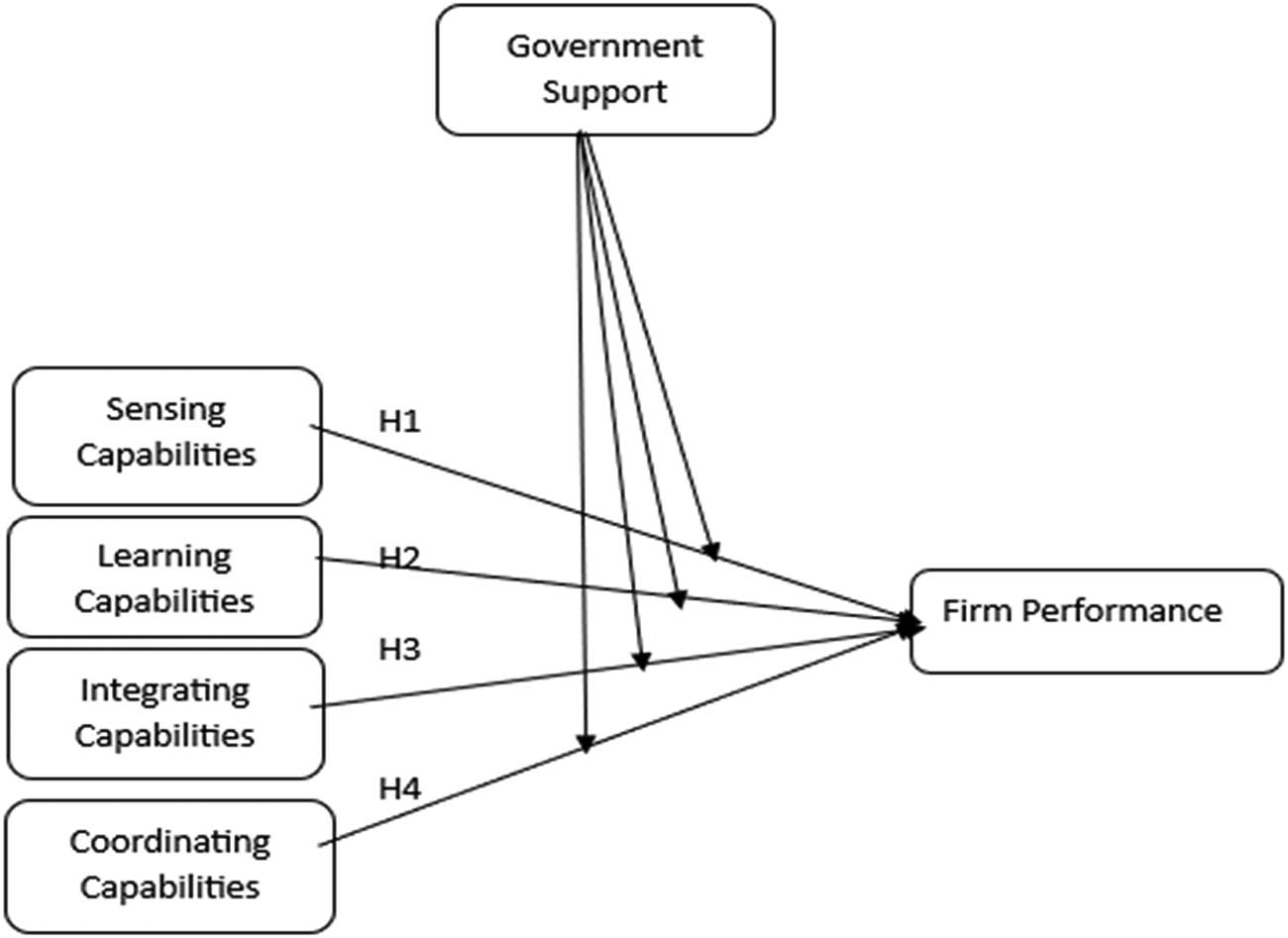
Figure 1
Conceptual framework.
Source: Own Elaboration, 2024.
Table 6
Moderation analysis results.
| Government support as a moderator | ||||||
|---|---|---|---|---|---|---|
| Hypotheses | Interaction effect | Beta | S.E | CR | P | Moderation |
| H5 | FP ← SEN | 0.075 | 0.065 | 1.157 | 0.247 | NO |
| H6 | FP ← LC | 0.064 | 0.061 | 1.052 | 0.293 | NO |
| H7 | FP ← INTEG | 0.108 | 0.063 | 1.701 | 0.089 | YES |
| H8 | FP ← CORD | 0.020 | 0.045 | 0.455 | 0.649 | NO |
Note: FP, firm performance; SEN, sensing capabilities; LC, learning capabilities; INTEG, integrating capabilities; CORD, coordinating capabilities; S.E., standard error; CR, critical ratio; P, P-Value.
Source: Own Elaboration, 2024.
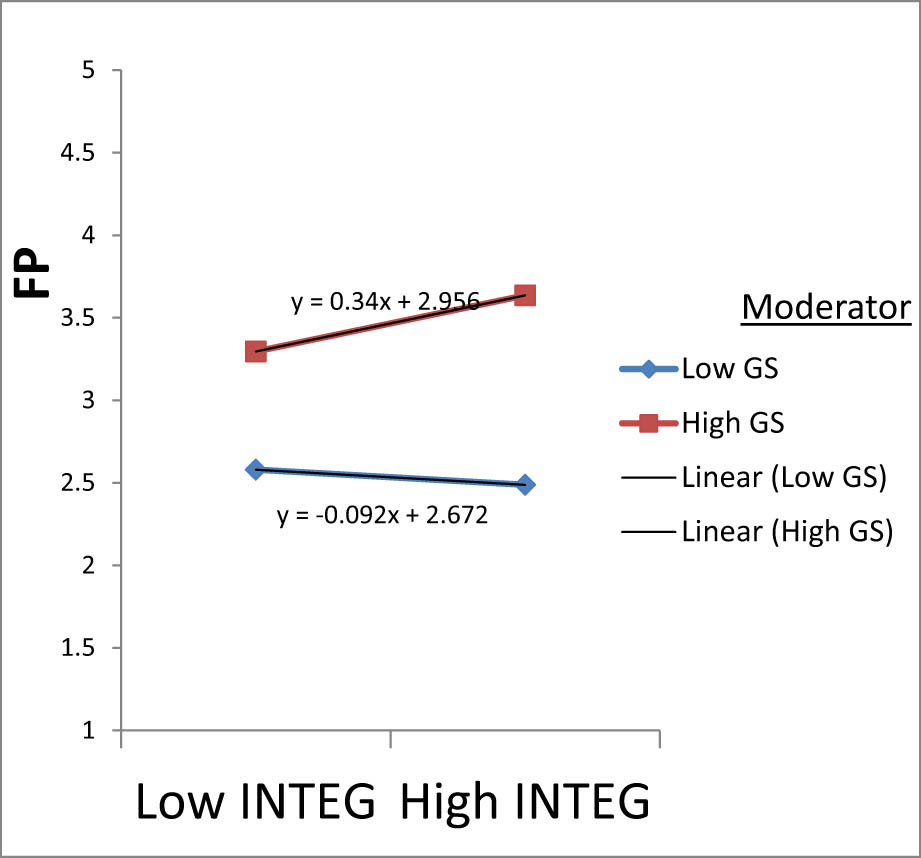
Figure 2
The moderation of government support on firm performance using the integration of capabilities.
Source: Own Elaboration, 2024.
5. Discussion of the findings
The article started by discussing the concept of dynamic capabilities and wanted to investigate SMEs, which are classified into urban and rural enterprises (Ackah & Vuvor, 2011), in the case of Ghana, using dynamic capability to examine its influence on firm performance; and the extent to which government support moderates the relationship between DC and FP. Based on the hypotheses tested, it was observed that each of the four dimensions of dynamic capabilities has a varying level of influence on the firm's performance. Our results show that there is a direct effect of sensing capabilities on firm performance at (β = 0.306, p < 0.003), indicating that SMEs that adopted the sensing capabilities through utilizing the analytical system of filtering and calibrating opportunities or focusing on the measures to assess SME with sensing capabilities routines including: (i) responding to market intelligence, (ii) generating market intelligence, (iii) being responsive to market trends and identifying market opportunities, and (iv) responding to market intelligence includes initiating plans to capitalize on this information and targeting specific market segments to seize new opportunities are going to influence on their firm performance in the SME business environment. This finding is consistent with the research conducted in Kenya on the telecommunication sector, which shows that sensing capability significantly enhances the performance of mobile telecommunication firms. Similarly, there is a direct effect of sensing capabilities on firm performance, which demonstrates that frontline sensing of operations and dynamic capabilities can predict future firm performance (Hallin et al., 2017). In a related study, Yu et al. (2022) found that green dynamic capability significantly influences the adoption of green innovation among SMEs in Pakistan and Malaysia. This finding underscores the importance of dynamic capabilities in implementing environmentally sustainable practices.
In the case of assessing the moderating effect of government support on all the dimensions of capabilities (sensing, learning, integrating, and coordinating capabilities). The results show that integrating capabilities showed positive and significant moderation in firm performance at (β = 0.108, and P < 0.089). This means that the impact of government support on firm performance is stronger at the level of integrating capabilities. SME in Ghana can get involved in the main routine of integrating capabilities by sharing unique ideas across their business unit and combining their disparate inputs to improve the reconfigurable operating capabilities (Helfat et al., 2009). This indicates that SMEs in Ghana and in similar contexts should focus on developing strong integrating capabilities, while leveraging government support where available, to provide a strategic path to enhance firm performance. A comparable investigation, undertaken in United Kingdom SMEs (Matikonis & Graham, 2024) during the COVID-19 crisis, aimed to emphasize the significance of governmental support for small and medium enterprises amid economic turmoil. The findings demonstrated that the aid packages received by SMEs influenced employment variations. Furthermore, the evidence indicates that the support measures, to an extent, strengthened the economy by sustaining and creating jobs, which is consistent with the intended outcomes of such policies (Cowling & Dvouletý, 2023; Kersten et al., 2017).
5.1. Theoretical implications
The dynamic capabilities on firm performance, from these findings, enable firms to respond effectively to the environmental changes, thereby enhancing their performance (Mukhtar et al., 2023). Research in the Resource-Based View (RBV) field has broadened its scope to address dynamic market conditions (Teece et al., 1997). The authors noted that the RBV framework inadequately explains how firms maintain competitive advantages in rapidly changing, unpredictable environments. Such situations necessitate the development of dynamic capabilities, where managers must integrate, construct, and reconfigure internal and external competencies to adapt to evolving organizational landscapes. Additionally, Barreto (2010) states that the dynamic capabilities concept, as proposed by Teece et al. (1997), is built on several core elements that underscore its theoretical foundations: nature, role, context, creation and development, beneficial outcomes, and heterogeneity. Barreto (2010) described dynamic capabilities as crucial skills enabling organizations to adapt and flourish in changing environments.
Utilizing these theories, the researcher aims to explore the influence of dynamic capabilities on firm performance and the moderating role of government support in Ghanaian SMEs. Moreover, these theories guide the investigation and analysis of dynamic capabilities trends, facilitate a comprehensive understanding of scientific research in this area, and aid in developing the research objective. Ultimately, this study seeks to employ these theories to add to the expanding literature on DC by identifying key elements beneficial to SMEs in sub-Saharan Africa, with a focus on Ghana. It offers a deeper insight into dynamic capabilities, which can enhance SME resilience and performance in a rapidly changing business landscape (Agyapong et al., 2024). The study underscores the importance for managers of SMEs in dynamic markets like Ghana to strategically develop and apply dynamic capabilities. By studying the measures required for the various capabilities, SMEs can better navigate environmental changes, strengthening their competitive position and overall performance. Furthermore, by empirically validating the influence of the DC in a Sub-Saharan African SME context, the study advances theoretical understanding of how dynamic capabilities function under conditions of environmental volatility and resource scarcity. This broadens the scope of DC research beyond developed markets, offering a more inclusive and context-sensitive interpretation of capability-driven performance.
5.2. Managerial implications
Judging from the findings of this research, the study has several notable implications to mangers of SME in Ghana. It was possible to highlight the following: (1) Managers can enhance the competitive advantages of their business with strong dynamic capabilities and innovate to changes, leading to a sustained competitive advantage. (2) The effective utilization of dynamic capabilities by managers can lead to effective responses to market intelligence, understanding the market trends and identifying market opportunities. (3) Through integrating capabilities, managers can respond to novel situations more effectively. For practitioners, this means investing in internal learning systems, staff training, and information-sharing mechanisms to improve responsiveness and collaboration. For policymakers, the findings call for targeted interventions that provide financial incentives, capacity-building programs, and regulatory frameworks that encourage innovation and partnership among SMEs. By fostering an ecosystem that strengthens both firm-level capabilities and external support structures, Ghanaian SMEs can achieve greater resilience and long-term competitiveness
5.3. Limitations and future research
The study has the following limitations: (1) One of the limitations was that, at the time of conducting this research, there was no public data available to researchers to access for use on the SME database, so all efforts to collate SME data from participants were difficult. (2) Another limitation was the absence of funds to sponsor the research projects, which could have allowed the researcher to pay particular attention to the variety of data classifications during the conduct of the survey. With the increasing importance of digital technologies, future research should examine how dynamic capabilities are adopted in a new business model in Ghana, and with the challenge of innovation in a digital era. There is still a lack of knowledge about the impact of innovative technology resources on dynamic capabilities, which also reflects the challenges of digital transformation of SMEs in most developing economies (Teece, 2020). Second, future research should focus on resilience and culture of SMEs in an emerging economy (Durst & Henschel, 2024; García-Valenzuela et al., 2023). Ghanaian SMEs operate within a sociocultural environment characterized by collectivism, informal networks, and relational trust, which may influence how firms sense opportunities, integrate knowledge, and leverage external support. These cultural attributes could either amplify or constrain the development of dynamic capabilities. Comparative studies across different African countries or between African and non-African contexts would help determine whether these patterns hold under varying cultural levels of market development. Third, while the quantitative approach provided generalizable findings, it may have overlooked nuanced behavioral and organizational processes underpinning dynamic capabilities. Future research could adopt mixed methods or qualitative case study approaches to explore how sensing, learning, integrating, and coordinating capabilities are enacted within SMEs, particularly in environments with high uncertainty and limited formal systems. Lastly, government support was treated as a single moderating construct; yet in practice, it comprises multiple dimensions such as financial assistance, training, infrastructure provision, and regulatory facilitation. Future research could disaggregate these components to better understand which forms of support most effectively strengthen the DC–FP relationship (Khalil & Belitski, 2020)
6. Conclusion
This study examined how DC influences SMEs' performance in Ghana and whether government support strengthens this relationship. Based on the premise that DC explains why some firms thrive amid technological and market turbulence while others struggle, the research used data from 298 SME operators analyzed through Structural Equation Modeling. The findings confirm that sensing capabilities positively impact firm performance, enabling SMEs to identify and respond to emerging opportunities. GS significantly moderates the relationship between integrating capabilities and performance, indicating that GS enhances SMEs’ ability to coordinate knowledge to respond to novel situations more effectively in their business operations.
The study validates the Dynamic Capabilities framework in the context of developing economies, particularly under the conditions of resource scarcity and SME volatility. It reveals that government involvement significantly enhances the impact of SMEs’ internal capabilities (Cavusgil & Deligonul, 2025). These findings have implications for multiple stakeholders. SME managers should invest in mechanisms that enhance sensing capabilities to understand evolving customer needs, generate actionable market intelligence, and foster internal knowledge sharing (Azam et al., 2024). Policymakers should design support programs that include capacity building for SMEs, innovation incentives to stimulate growth in the activities of SMEs, and regulatory stability to reduce uncertainty. Entrepreneurs/Businesspersons can use these insights to guide strategic interventions, build resilience, and adaptability. By aligning internal development of SMEs activities with their external support, Ghanaian SMEs, and those in similar emerging markets, can achieve improved performance and sustainability.
Funding information
Authors state no funding involved.
Author contributions
S.A.H. took the lead in writing the manuscript. M.G. supervised the work. All authors provided critical feedback and helped shape the research, analysis and manuscript, S.A.H. wrote the manuscript in consultation with M.G. All authors discussed the results and commented on the manuscript.
Conflict of interest statement
Authors state no conflict of interest.