
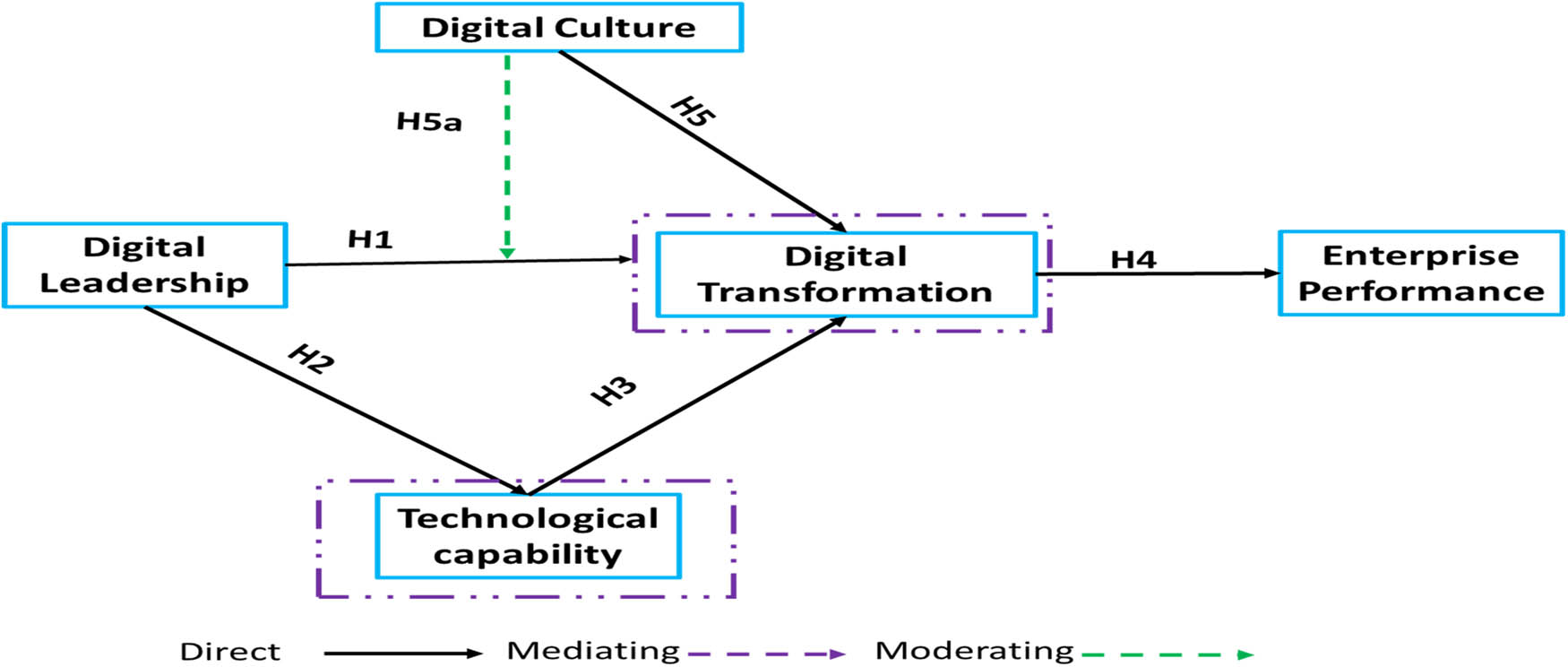
Figure 1
Conceptual model.
Source: Author s contribution.
Table 1
Demographic profile of respondents.
| Demographic variable | Frequency | Percentage |
|---|---|---|
| Gender | ||
| Male | 238 | 52 |
| Female | 221 | 48 |
| Age (in years) | ||
| ≤25 | 41 | 8.93 |
| 26–35 | 203 | 44.23 |
| 36–45 | 137 | 29.85 |
| 46–55 | 51 | 11.11 |
| Above 55 | 27 | 5.88 |
| Education | ||
| HND | 56 | 12.20 |
| Bachelors | 262 | 57.08 |
| Masters | 119 | 25.93 |
| PhD | 22 | 4.79 |
| Working experience | ||
| Less than 5 | 70 | 15.25 |
| 5–10 | 263 | 57.30 |
| 11–15 | 94 | 20.48 |
| 16–20 | 28 | 6.10 |
| Above 20 | 4 | 0.87 |
| Position | ||
| Top | 66 | 14.38 |
| Middle | 195 | 42.48 |
| Junior | 163 | 35.51 |
| Front liner | 35 | 7.63 |
Source: Authors’ own compilation.
Table 2
Item loadings, CR, CA average, and variance extracted.
| Construct | Item | Loadings | CR | CA | AVE | VIF |
|---|---|---|---|---|---|---|
| Digital culture | DIGIC1 | 0.796 | 0.929 | 0.897 | 0.767 | 1.746 |
| DIGIC2 | 0.875 | 2.545 | ||||
| DIGIC3 | 0.902 | 4.179 | ||||
| DIGIC4 | 0.924 | 4.543 | ||||
| Digital leadership | DIGIL1 | 0.905 | 0.952 | 0.937 | 0.800 | 4.026 |
| DIGIL2 | 0.911 | 4.663 | ||||
| DIGIL3 | 0.915 | 4.400 | ||||
| DIGIL4 | 0.893 | 3.723 | ||||
| DIGIL5 | 0.845 | 2.719 | ||||
| Digital transformation | DIGIT1 | 0.813 | 0.919 | 0.888 | 0.694 | 2.459 |
| DIGIT2 | 0.864 | 3.064 | ||||
| DIGIT3 | 0.910 | 3.436 | ||||
| DIGIT4 | 0.825 | 2.247 | ||||
| DIGIT5 | 0.744 | 1.650 | ||||
| Enterprise performance | ENTP1 | 0.857 | 0.950 | 0.934 | 0.791 | 3.019 |
| ENTP2 | 0.915 | 4.444 | ||||
| ENTP3 | 0.897 | 3.536 | ||||
| ENTP4 | 0.896 | 3.522 | ||||
| ENTP5 | 0.881 | 3.235 | ||||
| Technological capability | TECH1 | 0.871 | 0.952 | 0.936 | 0.797 | 2.756 |
| TECH2 | 0.881 | 3.469 | ||||
| TECH3 | 0.892 | 3.532 | ||||
| TECH4 | 0.923 | 4.613 | ||||
| TECH5 | 0.897 | 3.788 |
Source: Authors’ own compilation.
Table 3
Fornell–Larcker Criterion, R2, and Q2.
| Constructs | DIGIC | DIGIL | DIGIT | OP | TECH | R 2 | Adjusted R 2 | Q 2 |
|---|---|---|---|---|---|---|---|---|
| DIGIC | 0.876 | |||||||
| DIGIL | 0.696 | 0.894 | ||||||
| DIGIT | 0.839 | 0.779 | 0.833 | 0.812 | 0.810 | 0.547 | ||
| ENTP | 0.670 | 0.868 | 0.766 | 0.889 | 0.586 | 0.585 | 0.460 | |
| TECH | 0.868 | 0.686 | 0.818 | 0.637 | 0.893 | 0.470 | 0.469 | 0.369 |
DIGIC – Digital Culture; DIGIL – Digital leadership; DIGIT – Digital Transformation; OP – Firm Performance; TECH – Technological Capability. The bold figure is the square root of the average variance extract, indicating that a construct self correlation should be high than as compare with other constructs.
Source: Authors’ own compilation.
Table 4
Cross loadings.
| DIGIC | DIGIL | DIGIT | ENTP | TECH | |
|---|---|---|---|---|---|
| DIGIC1 | 0.796 | 0.561 | 0.735 | 0.586 | 0.701 |
| DIGIC2 | 0.875 | 0.622 | 0.726 | 0.591 | 0.763 |
| DIGIC3 | 0.902 | 0.616 | 0.708 | 0.586 | 0.767 |
| DIGIC4 | 0.924 | 0.633 | 0.763 | 0.582 | 0.805 |
| DIGIL1 | 0.640 | 0.905 | 0.718 | 0.835 | 0.642 |
| DIGIL2 | 0.620 | 0.911 | 0.684 | 0.825 | 0.612 |
| DIGIL3 | 0.635 | 0.915 | 0.705 | 0.832 | 0.610 |
| DIGIL4 | 0.581 | 0.893 | 0.638 | 0.742 | 0.567 |
| DIGIL5 | 0.627 | 0.845 | 0.730 | 0.646 | 0.628 |
| DIGIT1 | 0.632 | 0.549 | 0.813 | 0.563 | 0.569 |
| DIGIT2 | 0.687 | 0.653 | 0.864 | 0.650 | 0.611 |
| DIGIT3 | 0.754 | 0.752 | 0.910 | 0.766 | 0.735 |
| DIGIT4 | 0.649 | 0.711 | 0.825 | 0.677 | 0.605 |
| DIGIT5 | 0.765 | 0.555 | 0.744 | 0.505 | 0.882 |
| ENTP1 | 0.589 | 0.684 | 0.634 | 0.857 | 0.542 |
| ENTP2 | 0.568 | 0.758 | 0.691 | 0.915 | 0.561 |
| ENTP3 | 0.594 | 0.739 | 0.679 | 0.897 | 0.543 |
| ENTP4 | 0.620 | 0.842 | 0.694 | 0.896 | 0.585 |
| ENTP5 | 0.609 | 0.831 | 0.703 | 0.881 | 0.601 |
| TECH1 | 0.864 | 0.639 | 0.733 | 0.602 | 0.871 |
| TECH2 | 0.690 | 0.534 | 0.683 | 0.493 | 0.881 |
| TECH3 | 0.730 | 0.620 | 0.730 | 0.564 | 0.892 |
| TECH4 | 0.798 | 0.623 | 0.750 | 0.595 | 0.923 |
| TECH5 | 0.785 | 0.637 | 0.752 | 0.583 | 0.897 |
DIGIC – Digital Culture; DIGIL – Digital leadership; DIGIT – Digital Transformation; ENTP – Firm Performance; TECH – Technological Capability. The cross-loadings that arise when an indicator s outer loading on the nexus construct exceeds the aggregate of its cross-loadings and affiliations with all other constructs.
Source: Authors’ own compilation.
Table 5
HTMT evaluation.
| Constructs | DIGIC | DIGIL | DIGIT | ENTP | TECH |
|---|---|---|---|---|---|
| DIGIC | |||||
| DIGIL | 0.757 | ||||
| DIGIT | 0.800 | 0.847 | |||
| ENTP | 0.732 | 0.726 | 0.834 | ||
| TECH | 0.845 | 0.729 | 0.696 | 0.679 |
DIGIC – Digital Culture; DIGIL – Digital leadership; DIGIT – Digital Transformation; ENTP – Firm Performance; TECH – Technological Capability.
Source: Authors’ own compilation.
Table 6
Direct effect and moderation effect.
| Path | Beta | Std. dev. | T-statistics | P-value | Confidence interval | Conclusion | |
|---|---|---|---|---|---|---|---|
| H1 | DIGIL → DIGIT | 0.340 | 0.046 | 7.325 | 0.000 | [0.196; 0.350] | Accepted |
| H2 | DIGIL → TECH | 0.686 | 0.033 | 20.70 | 0.000 | [0.618; 0.748] | Accepted |
| H3 | TECH → DIGIT | 0.253 | 0.057 | 4.463 | 0.000 | [0.197; 0.396] | Accepted |
| H4 | DIGIT → ENTP | 0.766 | 0.026 | 29.673 | 0.000 | [0.713; 0.815] | Accepted |
| H5 | DIGIC → DIGIT | 0.382 | 0.049 | 7.784 | 0.000 | [0.258; 0.440] | Accepted |
| H5a | DIGIL* DIGIC → DIGIT | 0.147 | 0.021 | 6.919 | 0.000 | [0.099; 0.182] | Accepted |
DIGIC – Digital Culture; DIGIL – Digital leadership; DIGIT – Digital Transformation; ENTP – Firm Performance; TECH – Technological Capability.
Source: Authors’ own compilation.
Table 7
Mediating effect and specific indirect effects.
| Path | Impact of IV on M (a) | Impact of M on D (b) | DI (c′) | Indirect impact (a × b) | Total impact (c = c′ + a × b) | VAF | Decision |
|---|---|---|---|---|---|---|---|
| DIGIL → TECH → DIGIT | 0.686 | 0.253 | 0.340 | 0.173 | 0.513 | 33.7% | Partial mediation |
| Beta | Std. dev. | T -stats | P -value | ||||
| DIGIC → DIGIT → ENTP | 0.271 | 0.037 | 7.296 | 0.000 | Accepted | ||
| DIGIL → DIGIT → ENTP | 0.211 | 0.033 | 6.300 | 0.000 | Accepted | ||
| TECH → DIGIT → ENTP | 0.221 | 0.036 | 6.124 | 0.000 | Accepted |
DIGIC – Digital Culture; DIGIL – Digital leadership; ENTP – Firm Performance; DIGIT – Digital Transformation, IV – independent variable; M – mediator, D – dependent variable; DI – direct impact; VAF – Variance accounted for.
Source: Authors’ own compilation.
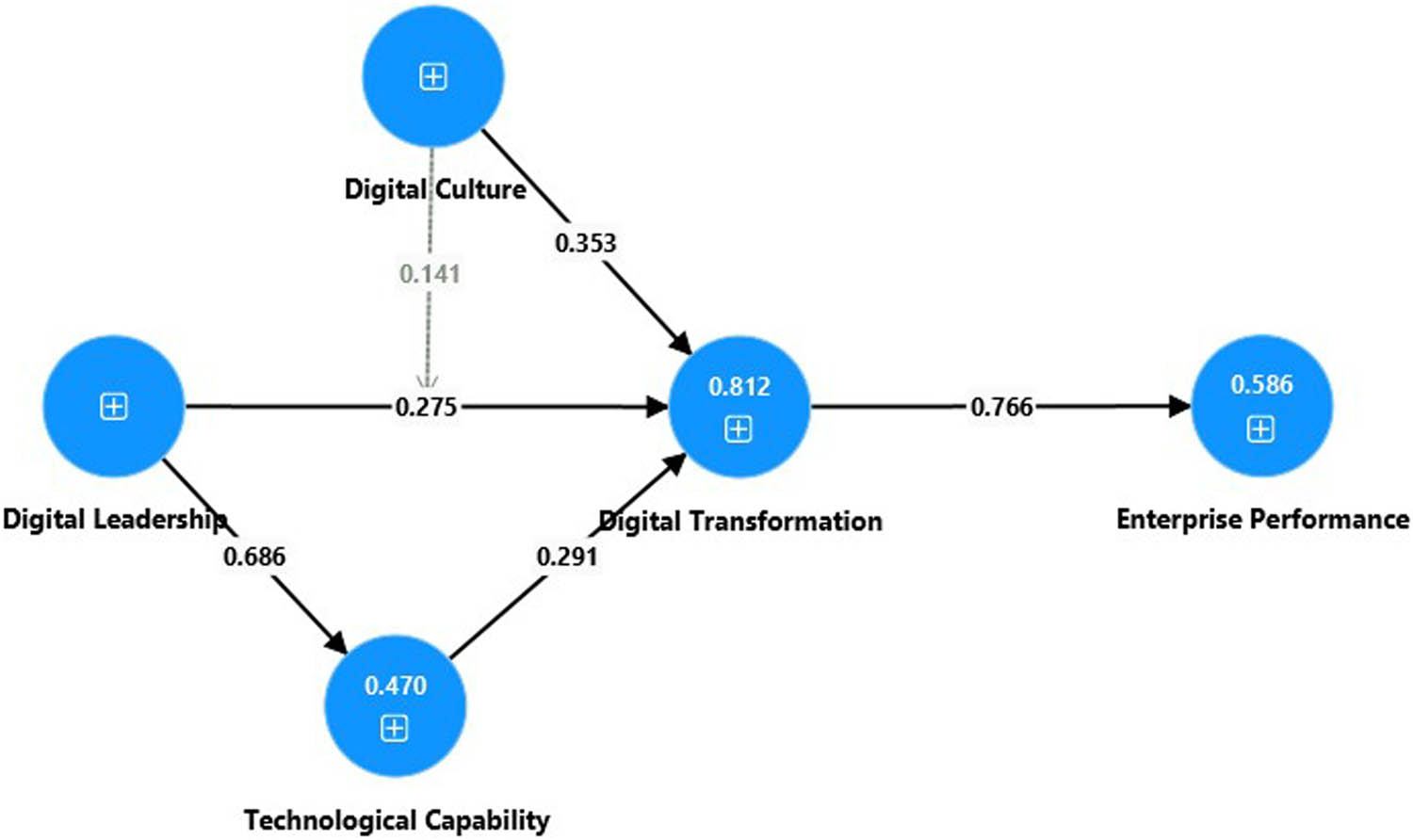
Figure 2
Structural model: Direct and indirect paths.
Source: Source: Author's own compilation from SMartpls4.