
Introduction
The relationship between tourism, development, and ongoing climate change is a common dilemma for many destinations. The Arctic is a place where many changes are occurring simultaneously, not only climatically but also economically and industrially (Middleton 2023).
The issue of climate change is also important in relation to social development, as tourism plays a significant role in the economic situation of a place (eds Gössling & Hall 2006). In the long term, climate change is also becoming a problem for the environment as it can lead to the destruction or loss of important tourism resources, which, in turn, can directly affect the economy and development of an area (World Tourism Organization and United Nations Environment Programme 2008). The development of tourism must be adapted to climate change, which is inevitable (Hughey & Becken 2014).
The daily lives of residents in areas frequented by visitors are affected by tourism (Kim, Uysal & Sirgy 2013). As a result, the concept of sustainable development has become a recurring theme in the growing body of literature on tourism development.
This strategy places great emphasis on balancing economic and social – but also environmental – aspects, and promotes the adaptation of practices that benefit both tourists and local communities (Ahmad & Ballsany 2023).
This article specifically addresses the island of Spitsbergen, located within the Svalbard archipelago.
The purpose of this study was to examine the opinions of the local community of Spitsbergen Island, and the dilemmas and challenges in relation to the growing impact of tourism on their daily lives. We analysed a variety of sources, including 84 issues of the Svalbardposten newspaper from 2022 to 2024, the publication titled The Paradox of Svalbard, and relevant scholarly articles.
For the purpose of this article, the term “local community of Spitsbergen” is used as a general reference to the people residing on the island, despite the existence of distinct and often segregated settlements such as Longyearbyen, Barentsburg, Pyramiden, and Hornsund.
Methodology
In order to investigate opinions and gain insight into the dilemmas and challenges faced by the local Spitsbergen community due to increasing tourist numbers, an analysis of various available sources of information was conducted. In addition to scholarly articles, press publications and literature on the subject were also taken into account to obtain a broader context for the issues under study.
Today, the media plays a key role in social life, and its importance is steadily increasing. It has an ever-growing impact on various spheres of human existence, and its presence and diversity are constantly expanding (Michalczyk 2009; Klepka 2016). Content analysis of the media, including the local press, is a widely used research method in the social sciences (Krippendorff 2004; Lisowska-Magdziarz 2004; Urban & Schweiger 2014; Klepka 2016). The goal is to objectively, systematically, and quantitatively describe the content of messages (Berelson 1952; Richardson 2007).
The study analysed newspaper articles published in the local newspaper Svalbardposten, which is the most important source of information on issues affecting Spitsbergen residents. It is a periodical, published since 1948 in the town of Longyearbyen, initially biweekly and, since November 2023, monthly. Svalbardposten has won the award for best local newspaper of the year three times (svalbardposten.no).
All issues of the newspaper published between 2022 and 2024 were included in the analysis, with 45 issues published in 2022 and 33 in 2023. Since the newspaper is published exclusively in Norwegian, an online translator was used for the analysis. The research process was based on established methods of content analysis (Pisarek 1983; Lisowska-Magdziarz 2004; Klepka 2016).
The second source of information in the study was Zdenka Sokolickova's publication The Paradox of Svalbard, which provides valuable data on how the local community functions in the face of dynamic changes related to tourism. In this case, the method of content analysis was used as a research tool in the study of qualitative material (Babbie 2008; Lisowska-Magdziarz 2007; Rapley 2010; Silverman 2011). As in the case of Svalbardposten, the purpose of the analysis was to obtain information on the opinions of Spitsbergen residents regarding the challenges of increasing tourism. An English-language version of the book was analysed, avoiding the need for our own translation.
The last element of the study was the analysis of selected scientific sources related to the topic of the work. Articles were considered that provide reliable data and the theoretical basis necessary for understanding the context of the subject matter under study. The selection of articles was based on the criterion of their timeliness and direct connection with the subject of the work.
The analysis of three types of sources made it possible to obtain a broad research perspective and understanding of the opinions of and the dilemmas and challenges faced by the local Spitsbergen community in the context of developing tourism.
Description of the research area
The Svalbard Archipelago is the northernmost part of the European Arctic. Svalbard extends between 74–81° north latitude and 10–35° east longitude (Figure 1) (Karahalil, Ozsoy & Oktar 2025). It covers an archipelago of several islands with a total area of about 61,020 km2. Svalbard exhibits a geologically diverse landscape, where stratigraphic sequences representing the majority of Earth's geological history are readily accessible (Nicu et al. 2023). It includes watershed peaks, vast mountains plateaus, valley glaciers, and coastal plains. The archipelago is surrounded from the north by a circumpolar Arctic basin, from the east by the Barents Sea, and from the west by the Greenland Sea (Dolnicki & Gawor 2012). Administratively, this archipelago, together with Bear Island, is a territory of Svalbard, managed by the Norwegian State Authorities (Kugiejko 2021).
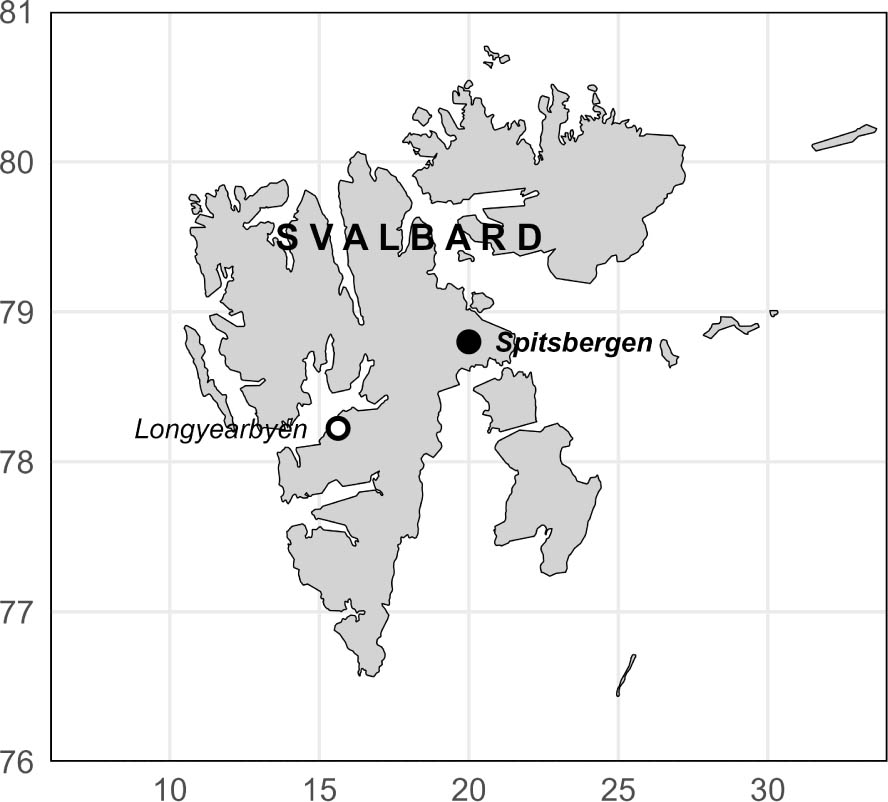
Figure 1
Svalbard archipelago showing Longyearbyen town on the largest island, Spitsbergen
Source: own elaboration
The largest island in the Svalbard Archipelago is Spitsbergen (Jaskólski & Pawłowski 2017).
The archipelago is under Norwegian sovereignty, formally recognized on 9 February 1920 by the Spitsbergen Treaty (Nicu et al. 2022). It is also the area with the highest intensity of human activity in the region (Jaskólski & Pawłowski 2017).
The study area for this research is the town of Longyearbyen, located on Spitsbergen Island.
Development of tourism in Svalbard
The Arctic is a region of multifaceted scientific research that reveals its unique qualities to the world, while, more importantly, steering the sustainable development of a liveable environment. It is an increasingly popular tourist destination (Maher et al. 2022). Hall and Johnson (1995) were the first to introduce the term “Arctic tourism” in the literature, as they attempted to characterize polar tourism in the Arctic.
Among all Arctic regions, Svalbard has gradually become one of the most popular destinations (Viken 2011; Grydehøj 2020).
The region's attractiveness primarily stems from its rich natural features, with topography being the most significant factor (Kugiejko 2021). Svalbard exhibits remarkable geological diversity. The western part of the archipelago is characterized by rocky mountains with post-glacial landforms, separated by wide glacial valleys, such as Reindalen. In contrast, the central and eastern parts of the island are dominated by glaciated mountain ranges with towering ice cliffs. Along the coastline, flat coastal terraces with deep fjords further enhance the region's unique landscape (Maciejowski 2007).
This geological diversity supports the development of geotourism and attracts visitors to the region (Kugiejko 2021). Some travellers are drawn to Svalbard's remote location and the challenges posed by its harsh climate (Stewart et al. 2005). The archipelago also provides access to fascinating industrial heritage sites (Jaskólski & Pawłowski 2017). These include abandoned mines, the ruins of residential buildings, and “ghost” towns such as Pyramiden (where only a few people remain to maintain the site). Additionally, Longyearbyen is home to museums, a university, an art gallery, and more (Visit Svalbard 2020). Due to climate change, Arctic regions have become increasingly accessible, allowing more people to explore these areas. Furthermore, an increasing number of countries are strategically considering the potential for the construction of ports, and seeking detailed data on infrastructure development in the northernmost parts of the world (Magnus Rapp 2024).
The first tourists to arrive on the island were wealthy Europeans, for whom the main purpose of the expedition was to hunt, and sometimes to write down their adventures in book form (About Svalbard n.d.).
Since the 19th century, it has played a significant role for Arctic explorers. Initially, travel to the archipelago was primarily driven by scientific purposes (Viken 2011). Over time, organized cruise ship tours from Europe began arriving (Viken 2011). Since then, the number of tourists visiting Svalbard has continued to grow (Kugiejko 2021).
In 1975, an airport was opened on Svalbard, marking a significant step toward accessibility. Starting in 1990, the Norwegian government actively began promoting tourism development in the region. Over the next two decades, it was tourism that would ensure and establish Norway's presence in the archipelago (Saville 2021). The development of tourism on Svalbard between 1980 and 2010, as determined by the number of visitors, was characterized by steady growth (just under 5% per year). However, since 2011, the dynamic development of tourism in the area can already be observed, with a growth of 10–20% per year (Prytz 2022). Between 2014 and 2018, the number of tourists increased by 45%. The largest number of tourists came during the summer, taking advantage of cruise offers (Figure 2) (Saville 2021). In 2019, just before the onset of the COVID-19 pandemic, Svalbard welcomed 190,000 tourists (Kugiejko 2025).
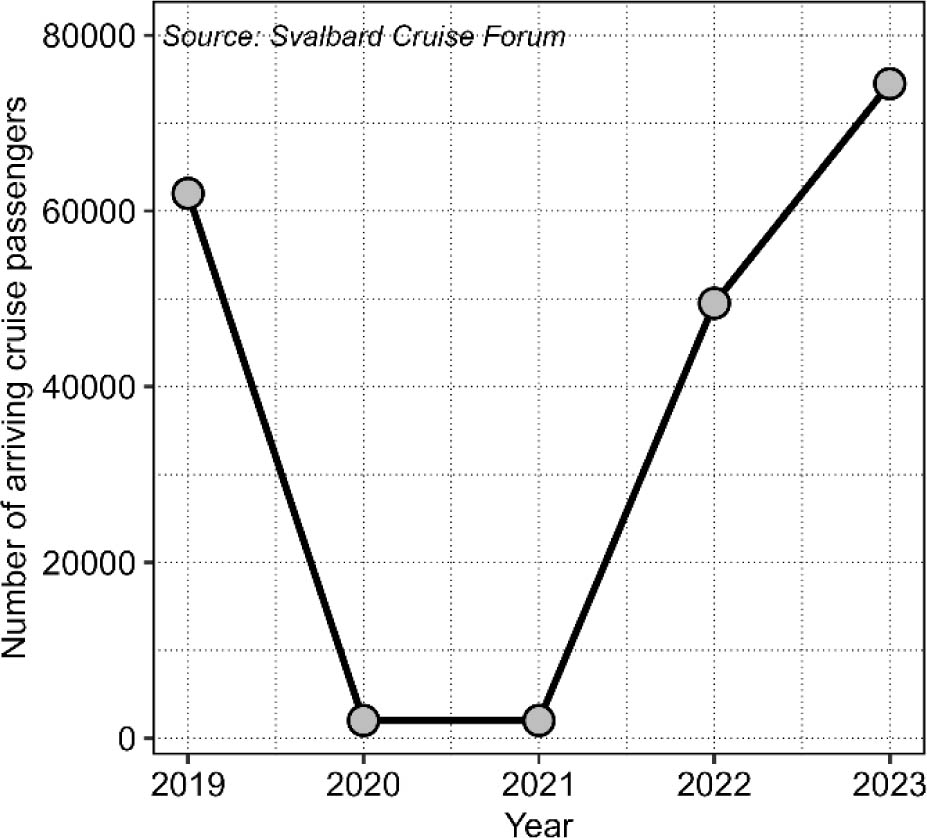
Figure 2
Arriving cruise passengers in Longyearbyen 2019–2023
Source: Svalbard Cruise Forum
Since 2007, the number of tourist overnight stays on Svalbard has shown a consistent upward trend (Figure 3). Compared to 2023, the number of visitors has nearly doubled, increasing from 88,124 to 145,017 (Kugiejko 2025).
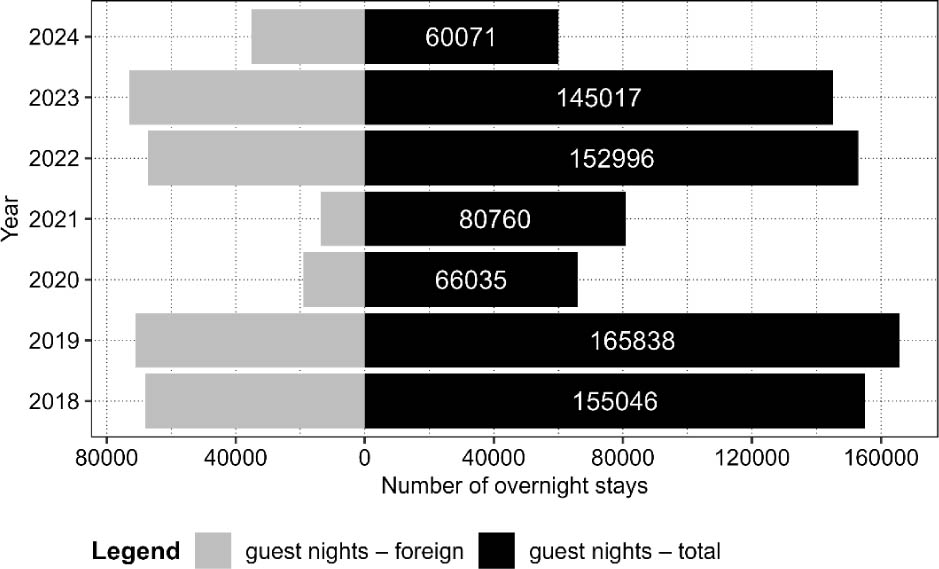
Figure 3
Number of tourist overnight stays 2018–2024
Source: Kugiejko 2025
Over the past 10 years, the archipelago has been transforming, with the number of tourist activities and research expeditions conducted in the area becoming a major part of the industry (Middleton 2023).
Longyearbyen has emerged as one of the key centres for tourism on Svalbard. According to 2022 data, the tourism industry in Longyearbyen provides approximately 500 jobs, with tourists contributing nearly NOK 1 billion to the island's economy each year (Holm 2023).
The town is distinguished by its lack of an indigenous population. It was created for economic and geopolitical purposes (Sokolíčková 2023). Longyearbyen's community is described as a group characterized by a high level of commitment and a high degree of qualification and skills (Olsen, Vlakhov & Wigger 2022).
In 2001, some 1,600 people were considered permanent residents in Longyearbyen (i.e. they reside on Svalbard for more than six months of the year for purposes other than tourism, acquiring a specific legal status, which is regulated by local law). In January 2022, the Svalbard Tax Office counted 2,561 residents, including 933 with non-Norwegian citizenship (Ylvisåker 2023).
The growing number of residents has been driven mainly by an increasing number of foreign residents, their population having risen by 196% between 2009 and 2024 (Middleton 2025).
For some residents, the change in society, from Norwegian to international, is considered a positive development (Sokolíčková 2023).
In 2002, Longyearbyen Lokalstyre (a type of local government) was established, giving the town a form of democracy. The social changes taking place, especially at the turn of the 21st century, included greater development of tourism in the area and the declining importance of coal mining, leading to a reduction in the numbers of workers and management staff at the “Spitsbergen Kullkompani” coal mining company (Brode-Roger 2023). The remaining mining infrastructure began to be used to attract tourists (Saville 2021).
In 2017, most of Norway's mines on the island were closed. Concerns that tourism revenues on the island would be insufficient for its development later diminished, giving way to new concerns about the negative impact of tourism, including its effect on the archipelago's climate and development (Saville 2021). Spitsbergen, Svalbard's largest island, is experiencing rapid climatic and environmental changes, which significantly influence the nature of tourism in the region (Dannevig et al. 2023).
Svalbard's history has always been tied to the use of natural resources. Initially, this was hunting and fishing; since the early 20th century, it has been mining. Today, environmental resource use continues through tourism and scientific research (Sokolíčková 2023). Tourism on Svalbard has been steadily increasing, and only major external disruptions, such as war or epidemics, are likely to impede its growth (Prytz 2022). However, recent developments, including stricter regulations, rising costs, and climate-related uncertainties, have made 2024 a particularly challenging year for the tourism sector (High North News 2024).
Human activities and their environmental impact in the Arctic
The Arctic, with its unique environment, has long enticed tourists eager for exploration (Tømmervik et al. 2025). It's also the place of rapidly progressing climate changes, around four times faster than the rest of the globe (Albrechtsen et al. 2024; Tømmervik et al. 2025). Since the 1970s, the average annual temperature has risen by 5°C. Precipitation levels have also increased, with a 20% annual rise and a 70% increase during the autumn season (Albrechtsen et al. 2024).
Tourism is a key and growing industry, significantly contributing to the development of the region (Ólafsdóttir et al. 2024; Kugiejko 2025). It has also impacted specific ecosystems in the Arctic (Tømmervik et al. 2025), with the most noticeable effects observed at landing and embarkation sites for Arctic cruise ships, where tourism has been shown to negatively affect species distribution and biodiversity (Huddart & Stott 2020).
One of the most popular activities for visitors to Svalbard is exploring its cultural heritage environment. Hiking around the settlements of Longyearbyen is also a favoured activity among both tourists and locals. Due to the continually increasing number of tourists, organizers are offering a growing variety of activities. In addition to hiking, these include cave exploration, kayaking trips, dog sledding, and snowmobile excursions (Kugiejko 2021). However, the large number of tourists, coupled with ongoing climate change, is impacting the condition of the environment in this region (Thuestad, Tømmervik & Solbø 2015). The increased use of easily accessible landing sites and pathways around the settlements raises the risk of introducing non-native plant species (Bartlett et al. 2021). Both climate change and the continued growth of tourism are expected to persist, further heightening the threat to cultural heritage on Svalbard. While the region's economy is heavily reliant on tourism, the latter is also increasingly recognized as a threat to the environment if not properly managed (Tømmervik et al. 2025). All these factors create numerous challenges related to the development of tourism in the studied area. These challenges are primarily associated with issues such as sustainable development, climate change, area management, safety, and the current state of the environment (Kaltenborn et al. 2024).
Locals's perspective on Spitsbergen tourism
Dynamic environmental changes, linked to a warming climate, necessitate the establishment of safe residential areas. However, this goal is hindered by the continually increasing legal restrictions on environmental protection (Hovelsrud, Kaltenborn & Olsen 2020).
Longyearbyen is often referred to as a transition town. It is associated, among other things, with tourism, which is characterized by seasonality and short-term stays in a particular place (Saville 2021). Residents realize, however, that tourism is an important part of Longyearbyen's life and how it functions. It affects the local community, creates jobs, and provides income (Brunvoll 2023). With the increase in the number of tourists on the island, trouble has begun for the residents's sense of security due to an increase in theft, among other things (Saville 2021). Tourists are often regarded as sources of entertainment, providing opportunities for locals to share stories and experiences related to Spitsbergen. However, some residents question whether the revenue generated from tourism should be invested in expanding tourism infrastructure, such as new accommodations and dining establishments, or if it would be better allocated to developing infrastructure that enhances the living conditions of the local community (Olsen, Vlakhov & Wigger 2022).
A question often asked on Svalbard is whether the island is ready to accommodate even more tourists. As the number of visitors increases, the number of accidents that may require evacuation/hospitalization increases. For example, the aeroplane that provides emergency assistance on Svalbard is only available from 8 am to 8 pm daily. At the end of February 2022, it took 13 hours for emergency air services to arrive at an accident site (Øystå 2022a). The hospital in Longyearbyen is not prepared for the increase in the number of tourists and the possible reception of many people requiring care (Markussen 2023a).
On Svalbard, the conflict between the tourism industry and bodies representing specific local legislation derived from international regulations and Norwegian legislation is apparent (Jørgensen 2023). Tourism officials have taken several initiatives and introduced various regulations aimed at both optimizing the tourism experience and controlling the environmental impact of these activities. Nevertheless, it has been observed that the dialogue between local authorities and the community, as well as representatives of local businesses, has not been as fluid in recent years, and cooperation is not characterized by the same intensity as it was a few years previously (Jørgensen 2023).
The authorities interpret tourism-related ventures in the Svalbard area, especially in the context of transportation infrastructure development and environmental protection, as significant challenges. Their perspective differs from that of selected representatives of the local community and the business sector. This can be observed in the fact that the authorities take strict measures to manage these aspects, which suggests that they are prioritized, while the opinions of residents and businesses may be more varied. Politicians often play a decisive role in shaping the functioning of the Svalbard community. Although residents are directly affected by the consequences of decisions made by authorities, their participation in the policy-making process is limited (Jørgensen 2022).
In practice, it has been observed that residents already receive ready-made laws and regulations that directly affect their daily lives, but they lack significant influence in shaping them (Sokolíčková 2023).
According to residents, some of the regulations being introduced should be viewed from two perspectives: that of visitors and that of residents (permanent/long-term). One example is the proposal to abolish the so-called Area Management 10 (an area accessible to nonpermanent residents without additional restrictions) and to impose on former permanent residents the same travel rules as visitors – for example, taking out adequate insurance (Ylvisåker 2023a). It has been emphasized that regulations introduced for the sake of tourism and Svalbard's environment make life difficult for residents. The establishment of administrative zones, where movement is restricted for individuals who are not registered as permanent residents, is one such concern (Haugli 2022). When describing life on the island, some Longyearbyen residents emphasize the segregation that prevails. This can be seen, for example, in the housing market. The more one is associated with the so-called Norwegian circle, the more privileges one has on the island (Brode-Roger 2023). In 2022, the voting rules in Norway changed. Non-Norwegians must have lived at least three years on mainland Norway to have active voting rights (Ylvisåker 2023b). The various steps taken by Norwegian authorities, among others, including changing voting rules and restricting the right to education for foreigners, but also the movement regulations introduced by environmental laws, may indicate that mainland Norway would like to remotely control the archipelago (Brunvoll 2023). All of Svalbard's major industries have one goal – to assert Norwegian presence, but also power, in the area (Sokolíčková 2023).
Senior political positions are held by Norwegians, and the largest companies on Spitsbergen employ mostly Norwegians. In jobs related to politics, conversations are mostly conducted in Norwegian, even though English is considered the universal language on the island (Grydehøj 2020).
According to the opinion of one Longyearbyen resident, if we want to talk about the development of tourism, it is important to consider the opinions of residents, and to involve them in tourism activities (Olsen, Vlakhov & Wigger 2022). A survey of residents was conducted in 2022, which showed that as many as 74% of respondents rate tourism in Longyearbyen positively (Øystå 2022b).
A properly functioning society, where residents have access to good jobs and adequate living conditions could be the key to salvaging Svalbard's environment (Wik 2022).
Tourism on Spitsbergen – current challenges and future plans as perceived by locals
Spitsbergen is often called a land of paradoxes.
According to some residents, the region's approach to development is determined by access to its resources and economic opportunities, which they see as a tool used for political purposes (Brode-Roger 2023).
In 2019, a survey was conducted, the results of which showed that as much as 60% of housing in Longyearbyen is publicly owned, while 20% is owned by private companies (Ylvisåker 2023c). In 2023, it was projected that approximately 150 individuals in the tourism sector would be left homeless before the summer season due to a housing shortage (Markussen 2023b). In response, residents have sought to take over and adapt five buildings in Nybyen, which were intended to be converted into dormitories and residential spaces for those working in the tourism industry (Øystå 2023a). There are plans to expand the Vault Hotel to the extent that it will accommodate about 100 people in 83 rooms (there are 35 rooms at the moment); the hotel will ultimately be adapted to fulfil various business needs (Isachsen 2023). In 2023, the Svalbard Museum announced that it would hire two new employees, in connection with maintaining the preservation of cultural monuments on Svalbard (Øystå 2023b). The site's authorities aim to expand the building to accommodate even more visitors. The purpose of this expansion is to share the region's history and climate change data with interested tourists. Representatives of the museum emphasize that this initiative will not only benefit the tourism industry but also positively impact environmental protection. Additionally, the development of the museum will create new job opportunities (Øystå 2023c).
These developments illustrate the ongoing expansion of the tourism industry on Spitsbergen and its increasing impact on local infrastructure and employment structures.
According to one of the articles from Svalbardposten, the problems connected with the job market are low pay, poor living conditions, and inadequate treatment of workers (Ylvisåker, Molven & Markussen 2023).
The only way to change this is to introduce new regulations on Svalbard regarding equivalent pay conditions for all groups of workers, regardless of citizenship and legal status (Ylvisåker, Molven & Markussen 2023). Also problematic is the current situation of tour guides on the island, which is sometimes compared to the living situation of miners several decades ago. Guides, like miners in the past, encounter unequal working conditions and differing standards of living on the island (Sokolíčková 2023).
In 2022, there were 522 guides working on the island, and more than 90% of them were of non-Norwegian nationality (Sokolíčková 2023).
There has been a noticeable increase in non-local tour operators who, while organizing activities for tourists, often fail to implement adequate safety procedures. Additionally, they frequently neglect to consider the long-term impacts of tourism and their proposed attractions on the pristine wildlife that the region is known for (Saville 2021). It is essential to remember that the region's untouched wildlife serves as the foundation for tourism development. This wildlife is also crucial to the lives of the local inhabitants and should, therefore, be vigorously protected (Hansson 2022).
There are also noticeable conflicts between tourism organizations on Svalbard and the Norwegian Environmental Agency (Miljødirektoratet). These include marine tourism, where the Agency has recommended the establishment of 43 areas where tourists can be disembarked from ships; it has indicated a limit of up to 200 passenger ship tourists entering the vicinity of protected areas. Representatives of tourism organizations, however, see other ways to protect the environment in the area. They emphasize that this is one of the paradoxes of Spitsbergen: while everyone is concerned about protecting the environment, each individual approaches the issue from their own perspective, leading to differing viewpoints on how to achieve that protection (Øystå 2023d). It is important to create new environmental regulations for Svalbard. Tourism is growing ever faster, with the number of visitors increasing dramatically. For tourists to continue to feel safe, it is important to create detailed regulations that would support the development of more stable and predictable tourism, geared towards year-round development (Styret & Norsk Naturguideforbund 2022). One of the problems facing Svalbard is marine pollution, which is a threat to the environment and the animals living in it. It is estimated that expedition cruise lines have collected up to 100 tonnes of rubbish from the beaches over the past 20 years. This also shows that cooperation between the Svalbard authorities and the tourism industry is possible and can be successful. This presents a significant paradox; if Norwegian environmental authorities were to impose overly restrictive regulations on traffic around Svalbard, it could jeopardize vital beach cleanup activities that involve the tourism industry, among other stakeholders (Nacke 2022).
The vision for tourism development on Svalbard is built on four key pillars: high quality, sustainability, expertise, and responsibility. Achieving these goals requires strong cooperation between various industries and authorities (Brunvoll, Skottun & Jørgensen 2022). The current tourism strategy for Svalbard does not prioritize increasing visitor numbers but, rather, attracting the right groups of tourists – those who stay longer and leave a smaller carbon footprint (Isachsen 2023). Between 2017 and 2021, the average length of a tourist's stay increased slightly from 4.4 to 4.6 days (Krystad 2022).
A crucial long-term objective for Svalbard is sustainable development, which is pursued through three main areas: tourism, research, and education (Hovelsrud, Kaltenborn & Olsen 2020). Year-round tourism plays an important role in this strategy, especially when integrated with low-carbon local activities. One of the approaches is to link tourism with research in order to create engaging and educational experiences (Hagen 2023). By fostering a research-driven tourism model, Svalbard can build a community centred on science while supporting a diverse range of services and employment opportunities (Middleton 2023). In many regions worldwide, collaboration between scientists and business professionals has led to meaningful advancements. A similar model could be applied on Svalbard by organizing meetings between researchers, guides, and other stakeholders involved in environmental studies. This would improve the accuracy and depth of information provided by guides while preventing the spread of misinformation (Sokolíčková 2023). However, a key challenge is that much of the research conducted on Svalbard is not widely shared or published locally (Sokolíčková 2023). To address this, the Research in Svalbard (RIS) web portal was created, providing access to over 4,000 projects, including more than 600 ongoing studies (Rapp 2024). Additionally, the annual meetings of the Svalbard Integrated Observing System (SIOS) serve as a platform for sharing findings with researchers, policymakers, and economic stakeholders. These efforts contribute to a more informed and sustainable approach to tourism and development on Svalbard.
Conclusion
Tourism is an important factor in the economic development of many destinations but its impact is not always unambiguously positive. In recent years, there has been a rapid increase in the number of tourists, which brings with it significant changes in areas that were previously rarely visited. One such area is the Arctic, a region formerly considered difficult to access for most tourists. Nevertheless, a change in this situation is taking place.
The Svalbard archipelago, which is part of the Arctic, attracts thousands of tourists each year who seek extreme experiences and wish to explore areas that were formerly inaccessible to mass tourism. However, the rapid growth of tourism in the archipelago creates many uncertainties and doubts about sustainability, environmental protection, and the impact of tourism on the lives of the local community.
Residents of Spitsbergen are voicing concerns about the ongoing development of tourism on the island, particularly regarding three key issues: the housing shortage in the market, the introduction of new legislation, and the attitude of the Norwegian government. The lack of housing availability in the tourism sector poses a significant threat to those in the industry. Therefore, it is crucial for residents to initiate efforts to adapt existing buildings for residential purposes. Additionally, the analysis of challenges related to the low wages of some foreign workers and their employment conditions is vital for the island's economy. Also problematic is the existing conflict between tourism organizations, Norwegian authorities, and the local community. For optimal development of both tourism and environmental protection, it is crucial to establish positive cooperation between these various stakeholders. A question that often arises is whether the island's infrastructure and resources are sufficient to handle the growing number of tourists, and how to possibly adapt to this challenge. On the other hand, the island's residents emphasize the important role of tourism as a source of employment and income, and as a contributor to environmental protection. Svalbard's Environmental Protection Fund, with funds derived mainly from the environmental tax paid by all who visit Svalbard, can offer grants for various environmental projects, and support the development of community initiatives. The development of tourism also helps improve the quality of life for some residents.
Spitsbergen faces significant challenges related to the development of tourism, with long-term strategies focusing on three main areas: tourism, scientific research, and education. To achieve the goals associated with these areas, establishing effective cooperation between authorities and the local community is crucial, as well as promoting a sustainable approach to managing each aspect.