
Introduction
Tourism was badly affected by COVID-19 as people were unable to travel (UNWTO 2023c). However, in retrospect, it became clear that, despite travel restrictions, the pandemic did not stop tourism entirely. Contrary to many predictions, following the initial lockdown period in the spring of 2020, tourism reactivated promptly thereafter (UNWTO 2023a; 2023b).
In the summer of 2020, a tourism boom was observed in Europe (Brady 2020) and specific trends in tourist demand for destinations, accommodation choices, and methods of travel emerged. Foreign travel restrictions directed tourists towards domestic destinations and tourism supply reacted accordingly. For example, in Poland, the informal tourism sector – namely private rooms and rented tourist apartments, such as Airbnb – provided opportunities to accommodate demand for travel, which tourists used en masse. A similar phenomenon was observed in Croatia (Reuters 2020) and Greece (Tsoni 2020).
When viewed from a post-pandemic perspective, the new trends in tourist demand amidst the pandemic outline interesting research opportunities. The first scholarly interpretations of changing tourist preferences and behaviour during a major health crisis referred to theories of psychological evolutionism (Kock et al. 2020), resilience (Krause & Halkitis 2020); paradox (Sigala 2020), travel motivation (Aebli, Volgger & Taplin 2021), general human behaviour (Yıldırım & Güler 2020), and risk perception (Perić, Dramićanin & Conić 2021). Among the many important research problems concerning the relationship between the pandemic and tourism, some key questions arise, namely: what was the actual role of the threat of the pandemic in inhibiting tourist activity in different countries?; to what extent was participation in tourism perceived as a (health) risk during COVID-19?; and what are the intra-population differences in public attitudes to both issues?
This paper aims to answer the above questions, taking tourism in Poland as a reference point. Polish society showcases the features of tourist demand that are specific to an emerging market in a transition economy. The cultural values in Polish society are oriented towards individualism in personal views and risk assessment, which is reflected in tourism consumption choices (Filimonau et al. 2018). The empirical analysis conducted in this paper offers a retrospective view of tourist activity among Poles in the summer of 2020 – namely, after the initial lockdown period. It further reflects on how early travel behaviour and perceived risks influenced intentions for post-pandemic tourism engagement, providing a foundation for interpreting the longer-term impacts of the COVID-19 crisis on tourism patterns and consumer psychology.
Literature review
COVID-19 as an inhibitor of tourist activity
When viewed from a post-pandemic perspective, it is clear that the halting of global tourism in 2020 due to COVID-19 resulted in the erosion of circa 2.8 % of global GDP (UNWTO 2021). Owing to the initial restrictions in March–August 2020, international tourist arrivals shrank by 70 % (UNWTO 2021). In Poland, for example, Kraków Balice Airport, once the second largest in the country, was closed down during this period of initial restrictions (Krakow Airport n.d.). In summer 2020, some destinations, mostly in Europe, started to reopen in the hope of offsetting lost revenues.
Tourism has suffered from health crises in the past (Elizabeth et al. 2021). However, COVID-19 marked a turning point, deviating substantially from the classical model of impact risk imposed by contagious diseases on tourist activities by causing public health emergencies of international concern (Leong 2020). More than any other public health crisis, the pandemic has negatively affected consumer travel behaviour (Jin, Bao & Tang 2021).
Emerging studies on COVID-19 as an inhibitor of tourism initially revealed the direct influence of the pandemic on consumer travel behaviour. This influence was exemplified by negative emotions, temporary uncertainty, and health concerns, which led to a high-risk perception of travel, reversed intention to travel, and reduced tourist demand (Elizabeth et al. 2021). Since the beginning of the pandemic, travel to and from affected areas, including for tourism purposes, was perceived as a factor in spreading the virus (Farzanegan et al. 2020; Kumar & Reddy 2022). Research on international mobility during the pandemic confirmed the contribution of travel to growing COVID-19 cases (Shaikh & Qamari 2021; Caria et al. 2024). In response, travel restrictions were introduced (Wilson, Barnard & Baker 2020), limiting destination choices for those tourists who were willing to travel during the pandemic.
(De)motivational factors shaped tourist demand during the pandemic. These were driven by the socio-psychological needs for mental wellbeing and social connectedness (Aebli, Volgger & Taplin 2021) but also by the perceived risks to health and safety (Kim & Kang 2021) and the levels of travel experience (Aebli, Volgger & Taplin 2021). Fear emerged as a key intrinsic demotivator of travel behaviour, influencing how tourists assessed risk (Chien et al. 2017; Litvin et al. 2024). ‘Travel fear’ was shaped by the perceived (non)severity and susceptibility of contracting a disease while choosing destinations perceived as risky (Zheng, Luo & Ritchie 2021). Health risk, psychological risk, financial risk, destination risk, and travel risk represent the five categories of perceived risks that affected tourist travel intention during the COVID-19 pandemic (Perić, Dramićanin & Conić 2021). Tourists tended to avoid risks; an association was established between risk avoidance and tourist consumption of accommodation services (Aiello, Bonanno & Foglia 2022), events (Gallego et al. 2020), and destinations (Séraphin & Jarraud 2021). Uncertainty in decisions regarding whether or not tourists should travel was often the result of perceived health risks (Williams & Baláž 2015), which increased when the probability of exposure during travel was believed to be high (Chua et al. 2020). As pointed out by Atadil and Lu (2021), factors such as medical preparedness, hygiene control, health communication, and preventative technology aided tourists to make accommodation choices during the pandemic by decreasing their perception of risk. In contrast, popularity of destinations was found to increase perceived risk, and this explained why, during COVID-19 tourists preferred spacious destinations, with a guarantee of social distancing, to crowded destinations (Kim & Kang 2021; Hu & Chen 2023). Most importantly, tourists’ risk perception was closely tied to travel anxiety and fear of contracting the virus (Shaikh & Qamari 2021), which drove suspension or postponement of travel plans (Mróz 2021).
Due to the increased travel and health risk perceptions, COVID-19 prompted tourists to choose domestic destinations (Perić, Dramićanin & Conić 2021). Tourist interest in travelling locally was also influenced by nostalgia and sentiment towards previously visited destinations, thus driving revisit intentions (Jian, Lin & Zhou 2021). For example, the tourism sector of rural accommodation and second homes recovered rapidly in the summer of 2020 due to increased domestic demand in Portugal (Marques, Guedes & Bento 2021), France (Seraphin & Dosquet 2020), Greece (Kourgiantakis, Apostolakis & Dimou 2021; Poulaki & Nikas 2021), Spain (Álvarez-García, Monje-Amor & Abeal Vázquez 2024), Bulgaria (Ivanova, Ivanov & Ivanov 2020), Australia (Aebli, Volgger & Taplin 2021), China (Chen et al. 2020), and Nepal (Dahal 2020). Retrospective studies (e.g. Tauber & Bausch 2022; González-Torres, Rodríguez-Sánchez & Pelechano-Barahona 2021; Gallent, Stirling & Hamiduddin 2023) suggest that many of these behaviours, initially considered temporary, have had lasting effects – particularly the renewed interest in domestic, rural, and independent travel. Higgins-Desbiolles (2020) recognized that the pandemic has created the conditions for a paradigm shift in tourism towards enhanced sustainability, underpinned by the principles of local consumption.
COVID-19 inhibited tourism activity, but its impact is uneven in space (and time) (Hall, Scott & Gössling 2020). Although tourism has largely recovered globally (UNWTO 2023c), rebuilding traveller confidence proved to be a gradual process (Jin, Bao & Tang 2021). Lockdowns decreased the tourist role in societies (Irimiás & Mitev 2020) but adequate health risk reduction strategies that were adopted by tourism suppliers (Aebli, Volgger & Taplin 2021) were effective in encouraging renewed travel and restoring tourism markets (Jin, Bao & Tang 2021; Yuyser & van der Merwe 2025). Studies has shown that certain categories of tourists in China (Jin, Bao & Tang 2021), Spain (Álvarez-García, Monje-Amor & Abeal Vázquez 2024), and Nepal (Dahal 2020) were willing to travel as soon as the restrictions were lifted. While the immediate impacts of COVID-19 on travel behaviour have been widely documented, more research is needed to contextualize these early reactions within longer-term behavioural trends, particularly in emerging tourism markets such as Poland.
Global reactions to COVID-19 and societal attitudes
When viewed from the current, post-pandemic perspective, it is clear that national governments reacted to the pandemic differently. The most common reaction was the closure of borders for tourism (Wilson, Barnard & Baker 2020). By 1 April 2020, approximately 91 % of the global population lived in countries with travel restrictions, and 39 % of countries were completely closed to transit and international arrivals (Pew Research Center 2020). In addition, safety measures were adopted to prevent the spread of the virus (Bremmer 2020). The restrictions required public compliance, which were adhered to with a few notable exceptions. For example, while up to 93 % of residents in Australia and New Zealand supported the restrictions (Bremmer 2020), regular anti-lockdown protests were observed in Germany (Kluge 2020) and the USA (Andone 2020). In Mexico (Freeman n.d.) and Poland (Milewicz 2020), the pandemic did not dominate the social debate. The level of concern among residents of these countries for issues pertaining to public health was on a par with other national issues, such as social welfare and political elections (Maj & Skarżyńska 2020; Freeman n.d.). Later studies confirmed that these divergent societal responses affected the pace and shape of recovery in different sectors, including tourism.
COVID-19 has changed all aspects of society, from everyday behaviour to general social practices (Belso-Martínez et al. 2020). As a result, the socium had to adopt preventative behaviours by cancelling or minimizing participation in certain activities. In tourism, these preventative behaviours resulted in cancelled trips and booking postponements (UNWTO 2023c). Retrospective studies (e.g. Tauber & Bausch 2022; Gallego & Font 2021) highlight that, while many of these behaviours were temporary, others – such as risk awareness and destination selectivity – persisted beyond the immediate crisis (Rostami et al. 2023; Hamad et al. 2024; Kimunio, Nandelenga & Makambi 2024).
Since February 2020, studies have been analysing behavioural changes imposed by the pandemic alongside public attitudes towards COVID-19. As the pandemic was unfolding, the public developed attitudes of acceptance, fear, suffering, or resistance (Lippold et al. 2020; Duffy & Allington 2020). Societies with high rates of COVID-19-related mortality and morbidity demonstrated very strong intentions to adopt preventative and protective behaviours – for example, Italy (Savadori & Lauriola 2021) and France (Raude et al. 2020).
Public attitudes towards the first wave of the pandemic involved expressions of fear, worry, and helplessness (Ahorsu et al. 2020; Savadori & Lauriola 2021), phobia (Arpaci, Karataş & Baloğlu 2020), anxiety (Lee 2020), problems related to productivity and work-related stress (Coulombe et al. 2020), as well as those related to mental health (Yıldırım & Güler 2022). Gender, age, education level, and upbringing determined practices in the matter of personal health and hygiene, self-isolation, and social distancing behaviours (Olaimat et al. 2020; Zhong et al. 2020). For example, age and health affect the sense of certainty and control, hence the elderly and those with underlying health conditions were more prone to feel anxious about COVID-19 (Peluso & Pichierri 2021). Anxiety, in turn, can spark mental disorders and cause a sense of stress, insecurity, sadness, loneliness, and boredom (Odriozola-González et al. 2020; Wasil et al. 2021). Some of these negative emotions stirred misperceptions of other nationalities in society and even led to discrimination (Jeung & Nham 2020). For instance, COVID-19 prompted instances of ‘hate crimes’ towards Asian-Americans and anti-Asian racism; it also fuelled xenophobia towards nationals of South Korea, Vietnam, and the Philippines (Jeung & Nham 2020).
Cross-national and longitudinal research has shown significant variations in the extent of the public adoption of preventative behaviours due to differences in the public perception of the risks associated with COVID-19 (Dryhurst et al. 2020). For example, analysis conducted in early April 2020 in the UK (Duffy & Allington 2020) revealed three major public attitudes to the pandemic: (1) ‘accepting’, (2) ‘suffering’, and (3) ‘resisting’. The minority (9 %) showcased the resisting attitude, exemplified by such perceptions as ‘COVID-19 is too much fuss’ and ‘overblown situation’. These UK residents were ‘more likely to believe in conspiracy theories’. The suffering attitude was adopted by 44 % of UK residents and implied anxiety and depression. The accepting attitude (showcased by 48 % of the UK population) was also characterized by stress; however, the socium agreed to accept all lockdown rules and follow governmental instructions to prevent the spread of the virus. This can be explained by the socio-cultural paradigm, suggesting that preventative behaviours are determined geographically through internal differentiation of residents’ reactions at different stages of the pandemic, and are influenced by the social amplification of risk (Dryhurst et al. 2020). In retrospect, such variations in public responses proved highly relevant for tourism, as they shaped the speed, scale, and form of domestic and international travel resumption. Understanding these attitudinal differences remains essential for crisis-preparedness in tourism management. There is a need to study preventative behaviours in various nations alongside their implications for tourism; this paper fills this knowledge gap.
Poles’ attitudes towards COVID-19 at the early stages of the pandemic
COVID-19 was first detected in Poland in March 2020, and coincided with national political elections (Figure 1). This was the major reason why COVID-19 did not dominate the public discourse in Poland; instead, the election campaign monopolized public attention. At the beginning of the pandemic (March–April 2020), Poles were sceptical of the risk of catching the virus. However, longitudinal public opinion surveys showed that society was slowly appreciating the danger of the pandemic (Milewicz 2020). At the start, 48 % of Poles were convinced that this was an unprecedented situation but, in Poland, it would be possible to avoid the spread of the virus (CBOS 2020a, 2020c). During the so-called national lockdown, Polish society complied with governmental safety and sanitary recommendations and the vast majority of Poles (81 %) modified their behaviour in line with the restrictions (CBOS 2020g). However, anxiety grew and, increasingly, more concerns over the infection of family and relatives were emerging (Milewicz 2020). Women (66 %) were more afraid of contracting the virus than men (58 %) (CBOS 2020a). In this initial stage of the pandemic, the public supported the government’s decisions and safety measures introduced to counteract the pandemic (64 % of Poles) (CBOS 2020b). Some 82.4 % of the respondents claimed to follow the safety recommendations provided by the authorities (Maj & Skarżyńska 2020). Nevertheless, in this initial period, 64 % of Poles believed that the government was deliberately manipulating information on the true number of infections, withholding certain data for its own political benefits (Maj & Skarżyńska 2020).
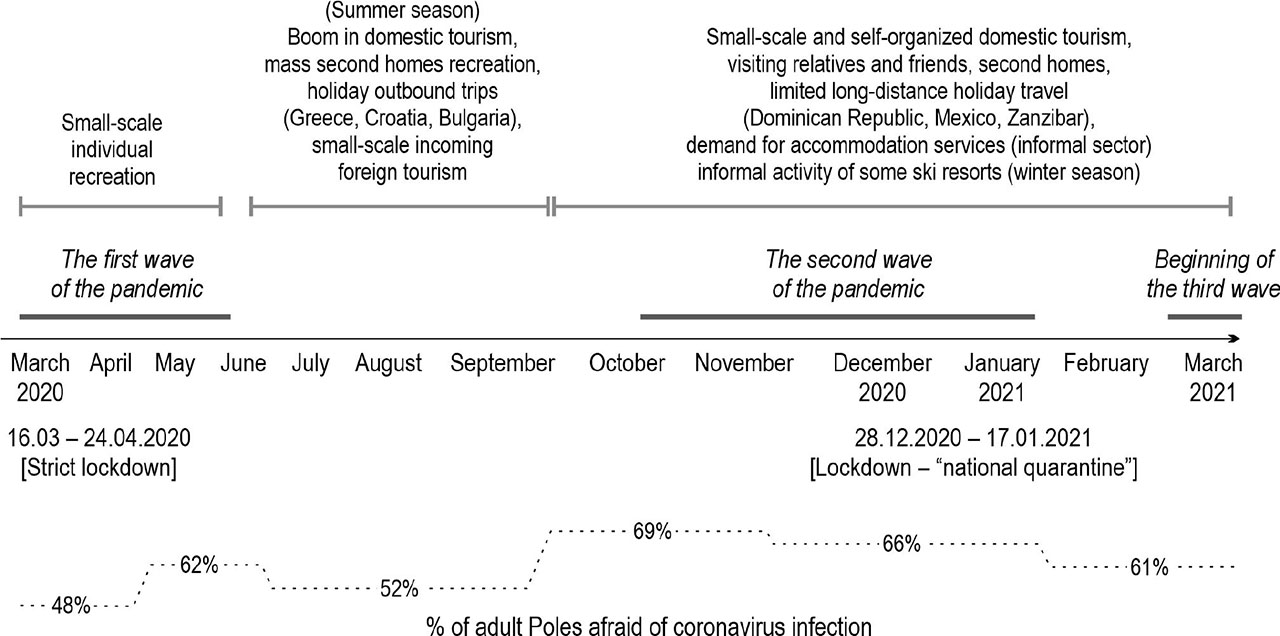
Figure 1.
Tourism in Poland during the COVID-19 pandemic (March 2020 – March 2021)
Source: own research
In May–June 2020, the number of infections in Poland decreased and national restrictions were eased. The levels of anxiety among Poles, however, remained the same: 62 % were afraid of contracting the virus (CBOS 2020d). Poles were getting used to the pandemic and many abandoned governmental rules: for example, some refused to wear masks in stores and open spaces (CBOS 2020e). In autumn 2020, only about half of Poles considered COVID-19 a risk. The second wave of the pandemic, however, increased public concerns over the risk of contracting the virus substantially. COVID-19 finally marked its presence in the social space rather than mostly in the media as had previously been the case (CBOS 2020h). Findings confirm that these shifts in public perception – moving from scepticism to acceptance and, later, fatigue – played a critical role in shaping tourist behaviour across pandemic stages, particularly the divide between those eager to resume travel and those more ‘risk averse’ (Hüsser & Ohnmacht 2023; Salman, Trupp & Chan 2024).
Tourism in Poland amidst the pandemic
The regulatory landscape governing tourism in Poland during the COVID-19 pandemic was characterized by a series of dynamic and responsive measures aimed at mitigating the spread of the virus while balancing economic and social considerations. These measures, encompassing border controls, domestic mobility restrictions, and the operation of tourism-related services, evolved in tandem with the epidemiological situation and governmental assessments (SRP n.d.). During the first wave of the pandemic, the Polish government introduced a lockdown, which heavily impacted domestic and international tourism. The restrictions imposed limits on public gatherings, forced tourism businesses to close, limited travel, and required mandatory 14-day quarantine for international arrivals (SRP n.d.).
In response to the escalating pandemic, Poland implemented stringent measures in March 2020. These included the closure of borders to foreign nationals, the suspension of international air and rail services, and the imposition of a nationwide lockdown that restricted non-essential movement and mandated the closure of hotels, restaurants, and cultural institutions. These actions effectively halted both inbound and domestic tourism activities (SRP n.d.). As a result of these restrictions, domestic and international tourism dropped by 65 % compared to the same period in 2019 (Łopaciński 2020).
As the initial wave of infections subsided, the Polish government initiated a phased reopening strategy. Starting in late April 2020, restrictions were gradually lifted, allowing for the reopening of hotels, restaurants, and tourist attractions under strict sanitary guidelines (SRP n.d.). Domestic tourism experienced a resurgence during this period, driven by pent-up demand and the relative safety of local travel. In the summer of 2020, after the first wave of COVID-19 ended and lockdown finished, domestic tourism in Poland developed rapidly (CBOS 2020c) (Figure 1). Domestic tourism involved staycations (CBOS 2020d), whereby Poles visited coastal and mountain destinations as well as national parks. During this period, tourist traffic was equal to pre-pandemic levels or was even greater. For example, the Bieszczadzki National Park registered 45 % more tourist arrivals in July 2020 and 64 % more tourist arrivals in September 2020 compared to the same periods in 2019 (BDPN n.d.).
Hotel data indicated high bed occupancy in domestic holiday resorts. In July and August 2020, 1.5 million tourists stayed in tourist accommodation facilities in coastal areas of Poland, which is only 14.3 % lower than during the same period in 2019 (GUS 2020a). Coastal tourism accounted for 25.9 % of all overnight hotel stays in Poland, with the majority of tourists (1.3 million or 87 %) being domestic (GUS 2020a). However, significantly less tourism was observed in major cities in Poland (Krakow, Warsaw, Wroclaw, Poznan) (Łopaciński 2020). Here, hotel occupancy only reached 30 % of the pre-pandemic level (UMK 2020).
The emergence of subsequent waves of COVID-19 cases necessitated the reintroduction of restrictions. In late 2020 and early 2021, measures such as curfews, capacity limits in public spaces, and the closure of non-essential businesses were reinstated (SRP n.d.). These actions once again curtailed tourism activities, with international travel remaining particularly constrained due to ongoing border controls and quarantine requirements.
Domestic tourism continued developing during the winter season despite the second wave of COVID-19 (Figure 1), taking the form of ski tourism and small-scale family tourism. The number of tourists engaging in these activities was, however, lower than in 2019 due to capacity restrictions imposed on the operation of ski resorts by the national government of Poland. In ski resorts located in the Malopolska region of Poland, the number of tourists using accommodation facilities in February 2021 reached approximately 90 % compared to figures for February 2020 (GUS 2021). Capacity restrictions were challenged by local tourist entrepreneurs and representatives of local communities, including local authorities in mountain tourist destinations (Jeżak 2021). Besides domestic destinations, Poles also travelled abroad, especially to the Dominican Republic, Mexico, and Tanzania. These destinations were popular because they did not require COVID-19 tests or mandatory quarantine.
The large scale of domestic tourism in Poland, especially in the summer of 2020, came as a surprise as Poles travelled for leisure despite the unfavourable media discourse that emphasized the high risk of contracting the virus when travelling. The first factor, in relation to why Poles travelled for leisure, was attributed to the psychological rebound effect. Social isolation in the spring of 2020 resulted in the need to compensate for the lack of physical activity. This factor was reflected in large tourist numbers travelling to coastal and mountain destinations from major Polish cities (Pietrzak 2020). The second factor was related to overseas holiday cancellations for 2020, which triggered Poles’ interest in domestic tourism (CBOS 2020d). Another factor that stimulated domestic tourism was the introduction of a social subsidy for family holidays by the Polish government; in an attempt to stimulate demand for domestic destinations, this subsidy entitled families to discounts on accommodation and travel services (MRPT n.d.).
Public support for the Polish government’s interventions during the COVID-19 pandemic, particularly in relation to the tourism sector, was mixed – and it declined over time. In the early stages of the pandemic (May–June 2020), nearly 70 % of respondents supported the government’s actions. However, by November 2020, support had fallen to 52 %, reflecting growing public criticism and the polarization of opinions between those who supported and those who opposed the government’s handling of the crisis (CBOS 2020f). Surveys conducted during the first waves of the pandemic indicated widespread dissatisfaction with the government’s preparedness and crisis management. In later waves, public opinion remained critical, though there were slight improvements: a January 2022 CBOS poll showed a modest increase in those satisfied with the government’s actions (41 %) and a decrease in dissatisfaction (49 %) (CBOS 2022). Later analyses (e.g. Markowska-Przybyła & Grześkowiak 2022) suggest that such ambivalence toward government credibility influenced citizens’ willingness to comply with restrictions, including those related to mobility and tourism. These trust dynamics help explain why large-scale domestic tourism was observed despite the continuous media messaging around the risks of travel.
In contrast, specific interventions, targeted at supporting the tourism sector, received more favourable evaluations. The Polish Tourist Voucher, introduced in August 2020 to stimulate domestic travel by offering financial support to families, was well received. Both beneficiaries and tour operators appreciated this contribution to sustaining the tourism industry during a period of severe disruption (MST 2023). Retrospective assessments of such programmes suggest they played a meaningful role in stimulating internal demand and maintaining sector resilience during uncertainty (e.g. Allaberganov, Preko & Mohammed (2021) in Uzbekistan; Stojčić & Vizek (2024) in Croatia). Additionally, the Strategic Investment Programme for Polish Health Resorts allocated over PLN 240 million to support municipalities that were reliant on spa tourism. These funds were used to improve local infrastructure and services, enhancing the capacity for health-related tourism (MST 2023). Despite these targeted measures, broader appeals from the tourism industry for financial support met with limited public sympathy. Analyses of online discourse indicated that such demands were often met with indifference or even criticism from the public.
Research gap
The cross-country data on tourism dynamics during the pandemic indicate that social responses and attitudes towards health risks of travel differed between countries (Dryhurst et al. 2020; Duffy & Allington 2020). This prompts the assumption that risk assessments for tourist trips during COVID-19 may have been culturally determined. This paper contributes to the knowledge by offering a retrospective analysis of the social reactions and attitudes to the COVID-19 pandemic and their implications for tourist activity in an emerging market and society in transition, namely Poland (World Bank Group 2017), which is characterized by the cultural trait of individualism (Hofstede Insights 2021). Such an exploration can demonstrate differences in public attitudes to travel during the pandemic and record variations in actual travel behaviour. These findings help contextualize how cultural and societal factors influenced travel decisions in crisis conditions, offering a valuable foundation for comparison with later phases and for planning responses to future disruptions.
Research design
The study used exploratory research design (Borgstede & Scholz 2021) and the method of public opinion survey to examine public attitudes, behavioural intentions, and actual tourism behaviour amidst the COVID-19 pandemic in Poland.
A questionnaire was designed, consisting of three sections. The first section was set to measure public attitudes towards COVID-19. The second aimed to evaluate individual perceptions of risk concerning participating in tourism during the pandemic. The measurement variables in these two sections were adapted from the literature.
More specifically, psychometric scales were used – from Ahorsu et al. (2020), Arpaci, Karataş and Baloğlu (2020), Cahyanto et al. (2016), Floyd and Pennington-Gray (2004), Lee et al. (2012), and Neuburger and Egger (2020). Perceptions regarding COVID-19 were measured using items from Neuburger and Egger (2020). Measures on public fear of COVID-19 were taken from Ahorsu et al. (2020) and Arpaci, Karataş and Baloğlu (2020). Measures on engaging in tourism during the pandemic were adapted from Neuburger and Egger (2020), Cahyanto et al. (2016), and Floyd and Pennington-Gray (2004). Measures on travel preparation amidst COVID-19 were amended from Lee et al. (2012). In both sections, the items were operationalized on a four-point Likert scale. The omission of the ‘unsure/undecidedʼ category was deliberate due to the tendency of Poles to provide ambiguous responses in public opinion surveys, as observed in previous studies (Filimonau, Mika & Pawlusiński 2018). Such a strategy was proved effective as it brought about a very low number of non-responses. The third section of the questionnaire was set to record the engagement of Poles in tourism after the first wave of the pandemic and to clarify future behavioural intentions towards tourism amidst COVID-19. In this part of the questionnaire, variables on a dichotomous scale (yes–no) were used.
The questionnaire was developed in English and back translated into Polish (Brislin 1970). The questionnaire was pre-tested twice using academics and tourism industry representatives and, then, piloted using a group of 12 volunteers, representing various socio-demographic profiles of Polish tourists. The feedback from this two-stage assessment of the questionnaire feasibility enabled the re-wording of some questions and statements for better clarity of expression. Data were collected in October 2020 via a self-completion, but researcher-observed, questionnaire (a PAPI survey) (Werner & Campbell 1973). The questionnaire was administered by purposely trained volunteers. As data collection took place during the pandemic, the recruitment strategy accounted for safety of both respondents and researchers. For example, social distance was maintained, and face coverings were worn at all times.
The research team approached informants in their households (one representative from one household) and asked them to fill out the questionnaire. The research team reached out to informants living in all Polish regions (i.e. voivodeships), from villages to cities inhabited by more than 500,000 residents. To recruit the sample, data from the Polish National Statistical Office (Statistics Poland 2019) were used as a guide to obtain a representative sample reflecting the structure of the general Polish population (aged 18+). The heterogeneity of the sample in terms of major socio-demographic features, place of residence, and employment status was ensured (Table 1).
Table 1.
Survey sample
| Socio-demographic characteristics | |||||
|---|---|---|---|---|---|
| Category | % | Category | % | ||
| Gender | Female | 54 | Highest level of education | Primary education | 4 |
| Male | 46 | Vocational education | 11 | ||
| Age | 18–25 | 19 | Secondary education | 46 | |
| 26–35 | 20 | Higher education | 37 | ||
| 36–45 | 19 | Other | 2 | ||
| 46–55 | 20 | ||||
| 56–65 | 12 | Occupation | Student | 26 | |
| 66 + | 10 | Full-time employed / Owner of the company | 52 | ||
| Place of residence | Village | 36 | |||
| City/town <10 thousand | 9 | Part-time employed | 4 | ||
| City/town 10–100 thousand | 15 | Retired | 14 | ||
| City >100 thousand | 40 | Unemployed | 4 | ||
| Frequency and type of tourist travels before the COVID-19 pandemic | |||||
| Frequency | % | Type | % | ||
| Very rarely (less than once a year) | 2 | Business travel | 9 | ||
| Rarely (once, twice a year) | 44 | ||||
| Sometimes (several times a year, i.e., 3 times or more) | 43 | Typical tourist journeys (e.g., leisure, sightseeing) | 91 | ||
| Often (at least once a month) | 11 | ||||
The questionnaire was administered to the informants considered to be ‘potential travellers’ – namely, those who responded positively to two pre-screening/control questions: ‘Are you one of the people who had to change their travel plans for 2020 drawn up before the pandemic?ʼ and ‘Are you one of the people who travelled for tourism or business before the COVID-19 pandemic?ʼ, as proposed by Chemli, Toanoglou and Valeri (2020). The focus was on domestic travel. As such, the achieved sample was intended to represent not just the general adult population of Poland but, more precisely, the segment of the population that had previous travel experience and interest and was, therefore, most relevant for investigating pandemic-related shifts in travel behaviour. The final sample of 388 usable questionnaires closely mirrored the socio-demographic characteristics of Polish travellers, as documented by Berbeka (2016).
Results
Descriptive statistics
Prior to the pandemic, the majority of the respondents (98 %) travelled at least once a year, and over half (54 %) engaged in tourism three times a year or more often (Table 1). Most tourist trips (91 %) were for recreational purposes. The COVID-19 pandemic modified tourism plans in 2020 for 63 % of the respondents (‘yesʼ and ‘rather yesʼ answers).
The respondents differed significantly in their assessment of the severity of COVID-19. For the question, ‘How grave do you believe the pandemic to be?’, the average score on a scale of 0–10 (max) was 5.71 (SD = 2.62). Some 45 % of the respondents assigned the pandemic a weight lower than the median value of 5. Only circa 13 % of the respondents considered COVID-19 a serious problem (weights 9 or 10). Risk-severity assessments showed moderate correlation with age of respondents (R = 0.35) – in that risk perception increased with age.
Some 43 % of the respondents believed that contracting the virus would not pose a risk to their lives; 19 % had the opposite opinion and, for 39 %, the risk assessment was difficult to make due to uncertainty. No correlation of these responses with gender or age was established. Only 37 % of the respondents agreed that ‘The spread of the COVID-19 pandemic is controlled in the countryʼ (Table 2).
Table 2.
Perception of COVID-19 and tourism in the pandemic’s context
| Category / Variable | N | I strongly disagree (%) | I disagree (%) | I agree (%) | I strongly agree (%) | |
|---|---|---|---|---|---|---|
| Perception of the COVID-19 pandemic | ||||||
| CO1 | I am concerned about the current COVID-19 pandemic | 387 | 9 | 23 | 38 | 30 |
| CO2 | COVID-19 is just a new type of flu | 388 | 23 | 35 | 26 | 16 |
| CO3 | We are too panicky about COVID-19 | 388 | 10 | 30 | 34 | 26 |
| CO4 | Information on COVID-19 does not always come from reliable sources | 384 | 3 | 12 | 34 | 51 |
| CO5 | COVID-19 is a serious threat to human life | 388 | 10 | 29 | 37 | 24 |
| CO6 | The spread of the COVID-19 pandemic is controlled in my country | 388 | 20 | 43 | 30 | 7 |
| CO7 | I get nervous when I see people without a mask in public places | 388 | 21 | 20 | 30 | 29 |
| CO8 | Right now, I fear the SARS-CoV-2 virus most of all | 387 | 38 | 33 | 17 | 12 |
| CO9 | I feel anxious, thinking about the COVID-19 pandemic | 388 | 19 | 29 | 39 | 13 |
| CO10 | My hands are sweaty when I think about COVID-19 | 385 | 72 | 22 | 4 | 2 |
| CO11 | I am afraid of losing my life as a result of infection with SARS-CoV-2 virus | 384 | 36 | 35 | 22 | 7 |
| CO12 | I get seriously nervous when I listen to information about COVID-19 in the media (TV, internet) | 385 | 28 | 35 | 26 | 11 |
| CO13 | I can’t sleep because I’m worried of getting sick from COVID-19 | 387 | 77 | 18 | 4 | 1 |
| CO14 | My heart starts to beat faster when I think I may get COVID-19 | 387 | 61 | 26 | 11 | 2 |
| CO15 | I feel anxious when there are people coughing around me | 387 | 24 | 31 | 31 | 14 |
| CO16 | I definitely move away from people who sneeze | 387 | 19 | 24 | 37 | 20 |
| CO17 | I have noticed that I wash my hands more often these days | 388 | 10 | 15 | 37 | 38 |
| CO18 | The fear of being infected with SARS-CoV-2 makes it difficult for me to interact with people | 385 | 31 | 33 | 24 | 12 |
| CO19 | I am constantly afraid that I can infect others | 388 | 32 | 36 | 24 | 8 |
| CO20 | I am especially afraid that I can infect my loved ones | 388 | 18 | 24 | 33 | 25 |
| Perception of tourism in the COVID-19 pandemic | ||||||
| TUR1 | Tourism contributes to the spread of SARS-CoV-2 virus | 388 | 6 | 14 | 48 | 32 |
| TUR2 | Staying in a hotel carries the risk of contracting the SARS-CoV-2 virus | 384 | 8 | 30 | 45 | 17 |
| TUR3 | I am afraid that tourists will transfer the virus to my area | 386 | 15 | 37 | 33 | 15 |
| TUR4 | Tourist trips should be banned during COVID-19 | 387 | 28 | 38 | 24 | 10 |
| TUR5 | Currently, employee trips to countries with a high number of SARS-CoV-2 cases should be banned | 387 | 17 | 31 | 35 | 17 |
| TUR6 | People who currently travel for tourist purposes behave irresponsibly | 388 | 17 | 35 | 36 | 12 |
| TUR7 | Domestic travel is now as risky as international travel | 388 | 16 | 28 | 43 | 13 |
| TUR8 | Due to the SARS-CoV-2 virus, travel should definitely be avoided | 385 | 18 | 36 | 35 | 11 |
| TUR9 | The introduction of additional sanitary safety measures in airplanes has made travel safe | 386 | 11 | 35 | 44 | 10 |
| TUR10 | Sanitary safety is of supreme importance today in touristic places | 387 | 7 | 17 | 41 | 35 |
| TUR11 | When choosing a place to stay (e.g., on vacation), it is essential to take into account safety of your own health | 388 | 4 | 7 | 41 | 48 |
| TUR12 | In tourist places, I am ready to rebuke a person who, in my presence, does not comply with the rules of sanitary safety in connection with COVID-19 | 386 | 18 | 27 | 32 | 23 |
| TUR13 | Currently, individually organized trips are safer than trips organized by travel agencies | 388 | 12 | 30 | 33 | 25 |
When analysing the relationship between health risk perception in relation to COVID-19 and holiday travel, the distribution of answers to the two variables, ‘Due to the SARS-CoV-2 virus, travelling should definitely be avoided’ (mean = 2.37; SD = 0.90) and ‘People who currently travel for tourism purposes behave irresponsibly’ (mean = 2.42; SD = 0.91), draws our attention as it showcases significant diversification of public attitudes towards participation in tourism during the pandemic (Table 2). These variables were not correlated with any socio-demographic features, thus indicating that the distributions of answers depended on individual attitudes and beliefs.
Exploratory factor analysis (EFA)
To identify the main dimensions of public attitudes towards health risks associated with COVID-19, as well as towards tourism during the pandemic, exploratory factor analysis (EFA) was performed for the variables in Table 2. The high values of the Kaiser–Meyer–Olkin (KMO) measures and the Bartlett’s test of sphericity supported the factorability of the correlation matrixes. The rotated solutions, following Varimax rotation, revealed the presence of four factors in public attitudes towards COVID-19 (Table 3) and two factors in public attitudes towards tourism during the pandemic (Table 4). The items with low factorial loadings (<0.5) were not displayed in the tables.
Table 3.
EFA – Public attitudes towards COVID-19
| Factor/item | Factor 1 | Factor 2 | Factor 3 | Factor 4 | Arithmetic mean | Standard deviation |
|---|---|---|---|---|---|---|
| Factor 1 | 2.39 | 0.69 | ||||
| CO19 | 0.706 | 2.08 | 0.93 | |||
| CO20 | 0.693 | 2.66 | 1.05 | |||
| CO17 | 0.685 | 3.02 | 0.97 | |||
| CO15 | 0.558 | 2.34 | 0.99 | |||
| CO18 | 0.550 | 2.17 | 0.99 | |||
| CO12 | 0.542 | 2.21 | 0.97 | |||
| CO11 | 0.536 | 2.00 | 0.93 | |||
| CO16 | 2.59 | 1.01 | ||||
| Factor 2 | 2.51 | 0.73 | ||||
| CO3r | 0.749 | 2.24 | 0.95 | |||
| CO1 | 0.736 | 2.89 | 0.92 | |||
| CO5 | 0.632 | 2.76 | 0.92 | |||
| CO7 | 0.588 | 2.66 | 1.10 | |||
| CO9 | 0.538 | 2.48 | 0.94 | |||
| CO2r | 0.532 | 2.35 | 1.00 | |||
| CO8 | 2.02 | 1.01 | ||||
| Factor 3 | 1.39 | 0.56 | ||||
| CO13 | 0.806 | 1.28 | 0.58 | |||
| CO14 | 0.757 | 1.53 | 0.76 | |||
| CO10 | 0.746 | 1.37 | 0.68 | |||
| Factor 4 | 2.79 | 0.52 | ||||
| CO6 | 0.839 | 2.25 | 0.85 | |||
| CO4r | 0.609 | 1.67 | 0.80 |
Table 4.
EFA – Public attitudes towards tourism during the COVID-19 pandemic
| Factor/item | Factor 1 | Factor 2 | Arithmetic mean | Standard deviation |
|---|---|---|---|---|
| Factor 1 | 2.54 | 0.65 | ||
| TUR4 | 0.813 | 2.16 | 0.94 | |
| TUR6 | 0.812 | 2.42 | 0.91 | |
| TUR8 | 0.795 | 2.37 | 0.90 | |
| TUR1 | 0.662 | 3.07 | 0.83 | |
| TUR2 | 0.662 | 2.71 | 0.83 | |
| TUR5 | 0.586 | 2.54 | 0.96 | |
| TUR7 | 2.53 | 0.92 | ||
| Factor 2 | 3.04 | 0.66 | ||
| TUR11 | 0.750 | 3.34 | 0.77 | |
| TUR10 | 0.700 | 3.05 | 0.89 | |
| TUR13 | 0.699 | 2.72 | 0.98 |
As for public attitudes towards COVID-19, Factor 1 indicated the public fear of getting infected with the virus and infecting others. This factor was named ‘Individual concern about the virusʼ (CONC). Factor 2 incorporated the variables related to the public perception of a threat to personal health and life in connection with the pandemic. This factor was labelled as ‘Perception of threat to health and lifeʼ (THREAT). Factor 3 included items on individual reactions to COVID-19 and its physical consequences. This factor was named ‘Anxiety related to the COVID-19 pandemicʼ (ANX). Factor 4 combined the variables related to the reliability of the pandemic information and public views on the ability of the national government of Poland to control the virus. This factor was excluded from further analysis due to its low reliability (Cronbach’s alpha <0.5).
As for public attitudes towards tourism, Factor 1 captured the items concerning public attitudes towards participation in tourism during the pandemic and it was labelled as ‘Avoidance of participation in tourism during the pandemicʼ (AVOID). Factor 2 involved two items emphasizing public expectations of health and sanitary safety in tourist destinations. It was named ‘Expectations towards sanitary safety in tourist destinationsʼ (SANIT).
Relational model – partial least squares (PLS) analysis
Structural equation modelling (SEM) was used to establish causal relationships between the variables describing public attitudes towards COVID-19 and participation in tourism during the pandemic. Given the exploratory nature of this study, the estimation technique based on the partial least squares method was used (PLS-SEM). PLS-SEM is suitable for exploratory purposes when research aims to identify new potential causal relationships in the absence of reliable measurement instruments (Hair, Ringle & Sarstedt 2011). The estimation of the relationships between the factors was carried out using the consistent PLS algorithm (PLSc). The advantage of PLSc is that it estimates the path coefficients, inter-construct correlations, and indicator loadings in reflective models, while providing scope for overcoming statistical inconsistencies associated with the use of the traditional PLS estimation algorithm (Hair, Ringle & Sarstedt 2011).
The factors obtained in EFA were used to build the latent variables for SEM. Then, the measurement models were verified from the viewpoint of the coherence and reliability of the variables and the theoretical validity of latent constructs (construct validity). The results of the structural model estimation are presented in Table 5. All latent variables indicated adequate composite reliability with the values above or close to the critical threshold of 0.7. All latent variables met the convergent validity criteria since the Average Variances Extracted (AVE) were all above 0.5 (Fornell & Larcker 1981). Discriminant validity was verified using the Heterotrait–Monotrait (HTMT) approach (Table 6). All HTMT ratios were below the critical threshold of 0.850, thus certifying that all latent variables were sufficiently different from the rest of the variables included in the model (Henseler, Ringle & Sarstedt 2015).
Table 5.
Measurement model
| Construct indicator | Standardised loading* | Cronbach’s alfa | rho A | Composite reliability (CR) | Average variance extracted (AVE) |
|---|---|---|---|---|---|
| CONC | 0.764 | 0.789 | 0.776 | 0.540 | |
| CO17 | 0.608 | ||||
| CO19 | 0.800 | ||||
| CO20 | 0.781 | ||||
| THREAT | 0.689 | 0.707 | 0.696 | 0.536 | |
| CO1 | 0.657 | ||||
| CO5 | 0.800 | ||||
| ANX | 0.770 | 0.804 | 0.776 | 0.543 | |
| CO10 | 0.628 | ||||
| CO13 | 0.661 | ||||
| CO14 | 0.893 | ||||
| AVOID | 0.837 | 0.840 | 0.837 | 0.632 | |
| TUR4 | 0.768 | ||||
| TUR6 | 0.758 | ||||
| TUR8 | 0.855 | ||||
| SANIT | 0.683 | 0.700 | 0.690 | 0.528 | |
| TUR10 | 0.656 | ||||
| TUR11 | 0.792 |
Table 6.
Discriminant validity of the measurement model (Heterotrait-monotrait criterion)
| CONC | THREAT | ANX | AVOID | SANIT | |
|---|---|---|---|---|---|
| CONC | |||||
| THREAT | 0.654 | ||||
| ANX | 0.441 | 0.470 | |||
| AVOID | 0.598 | 0.647 | 0.471 | ||
| SANIT | 0.649 | 0.781 | 0.324 | 0.593 |
The significance of the path coefficients (Hair, Ringle & Sarstedt 2011) was estimated by applying a consistent bootstrapping procedure with 5,000 subsamples. The model explained 49 % of AVOID and 63 % of SANIT variance (Table 7). The model showed a very good fit (SRMR = 0.039; NFI = 0.927). The predictive relevance of the model was also confirmed through the Stone–Geisser test (Q2).
Table 7.
Results of the structural equation model and control relationships
| Relationships | β | t-Value |
|---|---|---|
| CONC->AVOID | 0.264 | 2.641** |
| CONC->SANIT | 0.268 | 2.507*** |
| THREAT->AVOID | 0.403 | 3.929* |
| THREAT->SANIT | 0.644 | 5.410* |
| ANX->AVOID | 0.165 | 2.460*** |
| ANX->SANIT | −0.103 | 1.431 |
| Control relationships: | ||
| Gender->AVOID | 0.047 | 0.975 |
| Gender->SANIT | −0.048 | 0.863 |
| Age->AVOID | 0.116 | 2.081*** |
| Age->SANIT | 0.145 | 2.566** |
| Education->AVOID | 0.034 | 0.698 |
| Education->SANIT | −0.039 | 0.675 |
| FTTBP->AVOID | −0.130 | 2.640** |
| FTTBP->SANIT | 0.048 | 0.867 |
| R2(AVOID)=49.2%; R2(SANIT)=62.6% Q2(AVOID)=0.258; Q2(SANIT)=0.257 Model fit: SRMS =0.039; NFI = 0.930; Chi2 = 141.91 | ||
Note: FTTBP – ‘Frequency of tourist trips before the pandemic’ (Table 1)
The construct THREAT exerted the greatest influence on the differentiation of the values of factors AVOID and SANIT (β = 0.403, p <0.001; β = 0.644, p <0.001). Interestingly, public concern regarding the virus (CONC) had a relatively moderate effect on AVOID (β = 0.264, p <0.01) and SANIT (β = 0.268, p <0.05). Individual anxiety in relation to the pandemic (ANX) had a low impact on the differentiation of AVOID (β = 0.165, p <0.05). The influence of the ANX factor was also statistically insignificant for SANIT (p >0.05).
The analysis considered the impact of control variables – namely the socio-demographic (gender, age, education) characteristics and tourist activity patterns of the respondents before the COVID-19 pandemic – on AVOID and SANIT (Table 7). The results indicated that ‘age’ was statistically significantly correlated with the AVOID and SANIT factors. As the age of the respondents increased, the level of both factors increased. On the other hand, negative correlation with AVOID was demonstrated by the ‘frequency of tourist trips before the pandemic’ (FTTBP) variable (Table 1). This indicated that the higher tourist activity of the respondents and their higher level of tourist experience weakened the influence of AVOID and prompted engagement in tourism during the pandemic.
Tourist activity in the summer of 2020
The respondents were asked to indicate on a dichotomous scale (yes–no) what tourist activities, if any, they engaged in during the COVID-19 pandemic from the start of national restrictions in April 2020 to the time of this study’s administration in October 2020. This question specifically aimed to identify tourist activities in the summer season of 2020 (June–September).
The answers revealed that, despite the pandemic, the respondents engaged in tourism. 58 % went on a holiday trip and 79 % used commercial tourist accommodation. Almost half (49 %) declared they didn’t avoid places crowded with tourists, 80 % dined out, and 28 % visited museums and art galleries. Taking the frequency of these tourist activities into account and using the calculated mean value of the construct AVOID (= 2.32), the study population was divided into two clusters (Figure 2). The first cluster included the respondents whose individual AVOID factor values were below the mean value. This group covered 46 % of the sample and was made up of the ‘risk-tolerantʼ tourists. The second cluster (54 % of the sample) contained the respondents whose individual AVOID factor values exceeded the mean, thus indicating a group of ‘risk-averseʼ tourists. Both groups were heterogeneous in terms of their socio-demographic characteristics and place of residence.
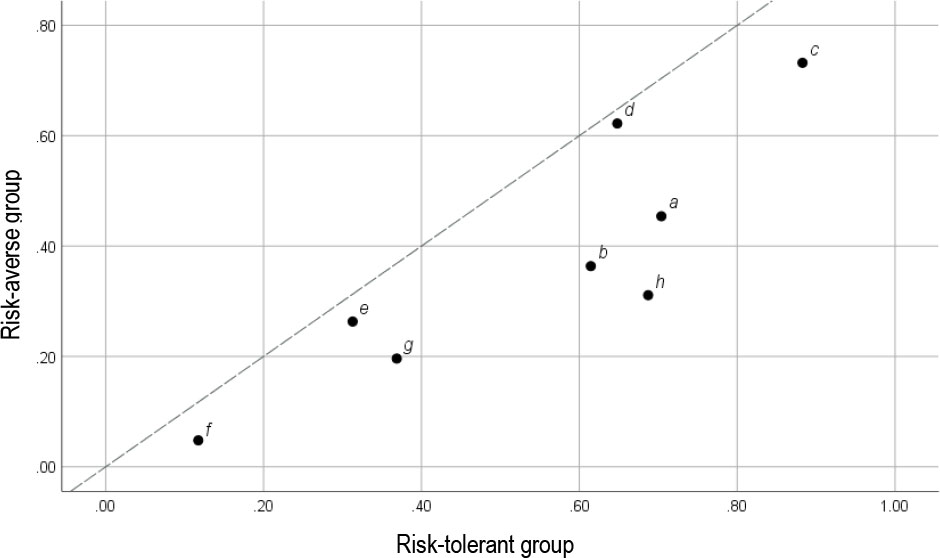
Figure 2.
Grouped respondents’ tourism activity in relation to the AVOID construct (summer season 2020)
Items: a – tourist travel; b – use of tourist accommodation facilities (e.g. hotel, guesthouse, B&B); c – use of catering facilities (restaurant, bar, cafe, etc.); d – use of public transport (in general); e – train travel; f – air travel; g – visit to museums and/or art galleries; h – visiting places crowded with tourists. The scale of responses for the variables: ‘yes’ – 1, ‘no’ – 0
Source: own research
Both groups differed significantly (t-test, p-value <0.05) in terms of their declared patterns of tourist travel (item a on Figure 2) (t = 4.54), use of commercial accommodation facilities (b) (t = 5.01), stay in places crowded with tourists (h) (t = 6.14), visits to museums and art galleries (g) (t = 2.99) (Figure 2). The ‘risk-tolerantʼ tourists undertook these activities more often. Significant differences were also revealed in the case of dining out (c) (t = 3.91), and it was the most popular tourist activity in both groups. The mean values for both groups were similar (p >0.05) for the use of public transport (in general) (d), including train (e) and airplane (f). Moreover, the ‘risk-averseʼ tourists declared more frequent (p <0.001) avoidance of social gatherings in commercial catering establishments (t = −6.95) in the summer of 2020.
Behavioural intentions
The causal model (Table 7) was used to examine public intentions towards engaging in tourism as the pandemic unfolded. Table 7 illustrates the structural model, focusing on the relationship between the factors, while the impact of these factors on behavioural intention is depicted in Figure 3. Questions on behavioural intentions towards avoiding tourist trips (item: A), commercial accommodation facilities (B), commercial catering facilities (C), outdoor events (D), public transport (in general) (E), trains (F), air travel (G), museums and art galleries (H), places crowded with tourists (I), and use of travel agencies (J) were utilized (Figure 3). Behavioural intentions were assessed on a dichotomous scale (yes – 1, no – 0). For estimating the regression coefficients, a bootstrapping procedure with 5,000 subsamples was applied.
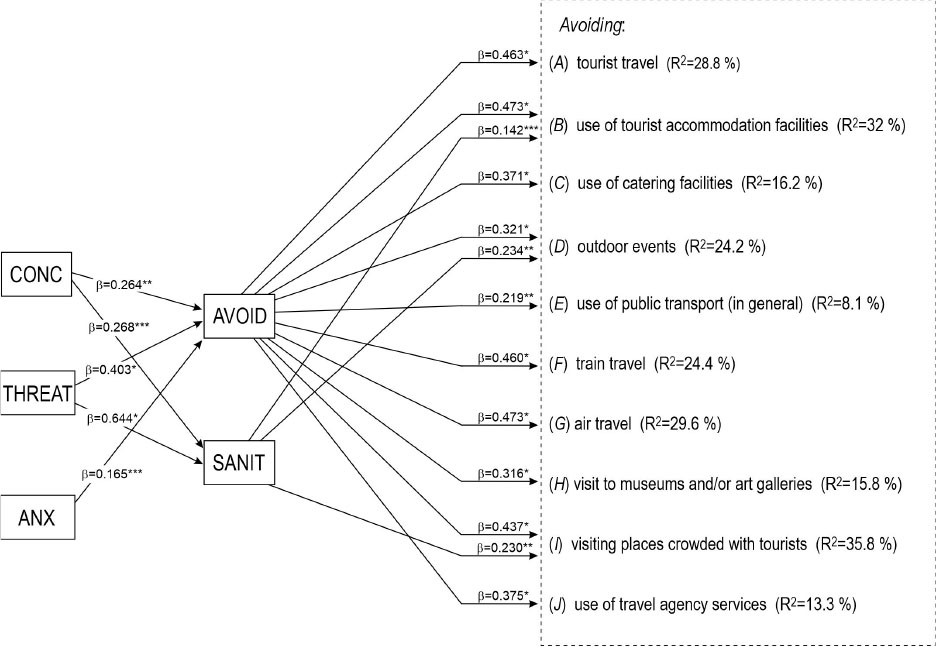
Figure 3.
Attitudes towards tourism during the COVID-19 pandemic and future tourism intentions (pandemic time perspective: 2020/2021)
* – p<0.001.; ** – p<0.01.; *** – p<0.05.
Only statistically significant linear relationships are marked (p-value <0.05)
Constructs: CONC – ‘Individual concern about the virus’; THREAT – ‘Perception of threat to health and life’; ANX – ‘Anxiety related to the COVID-19 pandemic’; AVOID – ‘Avoidance of participation in tourism during the pandemic’; SANIT – ‘Expectations towards sanitary safety in tourist destinations’
Source: own research
The estimates confirmed the role of the AVOID factor as a predictor of behavioural intention to avoid participation in tourism during the pandemic (Figure 3). Statistically significant (p <0.05) standardized linear regression coefficients were recorded for AVOID and all analysed variables, except for the E variable (avoiding public transport). The factor SANIT had a statistically significant effect only on three variables: B, D, and I. AVOID exerted the highest effect on tourist intention to avoid tourist trips in general (β = 0.463, p <0.000), but also use of commercial accommodation facilities (β = 0.473, p <0.000), train (β = 0.460, p <0.000), and air (β = 0.473, p <0.000) travel, as well as places crowded with tourists (β = 0.437, p <0.000).
Tourist activity and the sanitary regime
Considering recommendations for tourist trips aimed at preventing the spread of the virus and protecting tourists, the respondents showed high levels of acceptance and support of such sanitary measures, responding ‘Yes’ to frequent hand washing (88 %), no face touching (66 %), use of face cover in public places (82 %), safe distancing (66 %), health monitoring during and after travel (84 %), as well as monitoring of compliance with sanitary recommendations in a destination (82 %). Statistically significant differences were identified between the ‘risk-tolerantʼ and ‘risk-averseʼ tourists (p <0.001) for all these measures. The ‘risk-tolerantʼ group was more inclined not to adhere to sanitary requirements when travelling.
Furthermore, half of the respondents expressed their willingness to pay more for commercial catering (‘Yes’: 49 %) and accommodation (‘Yes’: 53 %) facilities, complying with and reinforcing their adherence to sanitary measures. Willingness to pay was particularly high for the ‘risk-tolerantʼ (60 %) tourists. Willingness to pay for business compliance with the sanitary regime among the ‘risk-averseʼ tourists was lower (45 %), yet significant.
Discussion
The results demonstrate the high determination of Poles to engage in tourism during the initial phase of the COVID-19 pandemic. The actual tourist activities of the respondents declared for the summer season of 2020 (Figure 1) and the linear regression coefficients between AVOID and future behavioural intentions (Figure 2) indicate the limited role of COVID-19 as an inhibitor of tourism among Poles. This is surprising, especially given that 80 % of the respondents agreed with the statement that tourism contributed to the spread of the virus and 61 % agreed that COVID-19 posed a serious threat to human life (Table 2).
The fact that Poles did not fear contracting the virus when going on holiday confirms the relatively low (β = 0.264) influence of individual concern about COVID-19 (CONC) on AVOID (Table 7), but also the low level of anxiety in relation to the pandemic expressed by the respondents (mean of ANX = 1.39; Table 3). Public fear of contracting the virus when going on holiday was outweighed by other factors, such as the need to compensate for prolonged isolation during the national lockdown. The social (collective) ‘exhaustion’ concerning the topic of the pandemic, repeatedly emphasized by mass media, with the subsequent desire to mentally detach from it, also played a role. These factors were identified as important antecedents of post-pandemic tourist behaviour in Bulgaria (Ivanova, Ivanov & Ivanov 2020), Israel (Kaim et al. 2021), Portugal (Magano et al. 2021), and Serbia (Bratić et al. 2021). The explicit difference between these studies and the current research project is, however, that they measured travel intentions of tourists in the early stages of the pandemic – namely in April–May 2020 – when public fear of the ‘unknown’ prevailed. Therefore, while both studies established the public desire to actively engage in tourism post-COVID-19, they also revealed significant levels of public concern over the types of holiday travel and the destinations. The unique contribution of the current research, viewed retrospectively, is in showcasing how public attitudes of Poles towards tourism changed as the pandemic unfolded, offering an early empirical insight into behavioural adaptation once restrictions eased.
The findings of this study can be interpreted in light of Bandura’s (1977) self-efficacy theory. This theory posits that the strength of an individual’s self-efficacy, which is dependent on past experiences and skills gained, affects their future choice of activity. For example, when previously applied in the tourism context, self-efficacy theory was used to evaluate the extent of public engagement in volunteer tourism (Lee & Kim 2017) and tourism entrepreneurship (Hallak, Assaker & Lee 2015). In the current study, this theory can help to understand the differences in tourist behavioural intentions and actual behaviour during the pandemic between the groups of ‘risk-tolerantʼ and ‘risk-averseʼ respondents. The ‘risk-tolerantʼ tourists engaged in tourism despite its perceived threat, believing that they would be able to handle that threat effectively. Self-efficacy theory suggests that the stronger the self-efficacy of individuals, the greater their belief that they can achieve the expected results and consistently maintain actions leading to the achievement of goals and intentions (Bandura 1977). The subjective beliefs of the individuals in their ability to handle the situation well may constitute a strong motivator to engage in tourism despite the associated risks. The relationship between individual tourism behaviour and self-efficacy is empirically observed in this study – the high engagement of Poles in tourism before the pandemic was negatively correlated with their avoidance of tourism during the pandemic (AVOID). Self-efficacy theory also corresponds to the cultural trait of individualism, which is typical in Polish society (Filimonau et al. 2018). Individualism suggests that a person believes in their own ability to handle a situation well; this belief is often grounded in knowledge and past experience. This may partially explain why circa 60 % of this study’s respondents agreed that they panicked too much about COVID-19 (‘We are too panicky about COVID-19’, Table 2). In light of subsequent research (e.g. Su et al. 2021; Truong et al. 2025), these early patterns of self-efficacy-driven behaviour offer valuable insights into how travellers balance risk perception and agency during prolonged crises.
The low public perception of the pandemic as a threat, which minimized its effect on actual tourist behaviour in the summer of 2020, could have been influenced by public distrust in COVID-19-related information. The majority (85 %) of the respondents admitted that they often obtained information about the virus from non-reliable sources, such as social media (‘Information on COVID-19 does not always come from reliable sources’, Table 2). No correlation was established between these respondents and their age or education. The potential of the pandemic to act as a (mis)infodemic (Williams, Wassler & Ferdinand 2020) is recognized; concerns have been raised over how non-reliable information sources can affect tourist attitudes towards future travel intentions (Wassler & Talarico 2021).
To reduce the threat of COVID-19, both ‘risk-tolerantʼ and ‘risk-averseʼ Polish tourists changed their choice of holiday destinations. Some 56 % of the respondents considered domestic travel ‘safer’ during the pandemic. Similar findings were reported in Bulgaria (Ivanova, Ivanov & Ivanov 2020) and Nepal (Dahal 2020). This draws well on self-efficacy theory, which suggests that the individuals see themselves as more skilful and, therefore, capable of handling unexpected situations in familiar environments. The observed shift towards domestic travel anticipated what later became a dominant global trend during the pandemic (Álvarez-García, Monje-Amor & Abeal Vázquez 2024; Chen et al. 2023; Kourgiantakis, Apostolakis & Dimou 2021; Perić, Dramićanin & Conić 2021; Poulaki & Nikas 2021), confirming the relevance of the early adaptation strategies captured in this study.
Although they didn’t resist engagement in tourism during the pandemic, the respondents showed a tendency to comply with governmental measures aimed at stopping the spread of the virus. Poles also demonstrated their expectations of tourist destinations to practise and reinforce sanitary safety, which is similar to findings reported in Romania, Serbia, Ecuador, China, South Korea, and Japan (Bratić et al. 2021; Bae & Chang 2020; Cheung et al. 2021; Gallego et al. 2020; Orden-Mejía et al. 2022; Orîndaru et al. 2021). Public attitudes towards the need to practise and reinforce sanitary measures in destinations may have important implications for the future management of the tourism sector in Poland, and beyond. The Polish tourism market is dominated by price-oriented demand (ed. Berbeka 2016). As evidenced by this current study, but also research projects undertaken in Italy (Aiello, Bonanno & Foglia 2020), the US (Gursoy & Chi 2020; Gursoy, Chi & Chi 2021), and Spain (Awad-Núñez et al. 2021), the pandemic has formed new consumer groups that expect high standards of health safety in tourist services and are willing to pay more for this safety. The sense of safety may have become a new value in the value-chain of tourism service provision and tourism operators should consider integrating this new value into their products and services permanently. To appeal to these new consumer groups, a dedicated label could be designed to showcase how ‘sanitary safe’ destinations and tourism organizations operating in these destinations are. This resembles the Safe Tourism Certification programme that was introduced in Turkey in the summer of 2020 (TravelMole 2020). Such a programme, if approved at the highest level of policymaking, could aid the recovery of tourism in Poland and beyond. This expectation for visible sanitary safety has become an embedded standard in the post-pandemic tourism economy, aligning with findings from recent studies (e.g. Orîndaru et al. 2021; Park & Letho 2021; Pereira, Marques & Borges 2023; Teng et al. 2023).
This study captured a specific and critical moment in time – the summer of 2020 in Poland, shortly after the first wave of the COVID-19 pandemic and during the initial reopening of domestic tourism in Poland. In retrospect, this period represented a transitional stage, marked by uncertainty, adaptive decision-making, and a redefinition of perceived travel risks. By focusing on actual travel behaviour rather than hypothetical intentions, the study provided a grounded understanding of how Polish tourists navigated this uncertainty, offering insights that remain relevant when analysing behavioural resilience during public health crises.
Conclusions
This study contributes to the knowledge by exploring tourist attitudes towards COVID-19 and by examining how/if these attitudes correlated with behavioural intentions; in particular, it analysed actual tourist behaviour during the first stage of the COVID-19 pandemic. It offers one of the earliest known empirical investigations of tourist behaviour in the summer of 2020 – capturing a critical moment of uncertainty in a major European tourism market – namely, Poland.
By drawing on self-efficacy theory, the study demonstrated polar attitudes towards tourism engagement among Poles. Two distinct groups of tourists were identified. The ‘risk-tolerantʼ tourists showcased indifferent attitudes to COVID-19, which was reflected in active travel undertaken despite the pandemic. The ‘risk-averseʼ tourists, albeit exhibiting more cautious attitudes, also actively partook in tourism activities in the summer season of 2020. Although the majority of Poles believed that tourism contributed significantly to the spread of the virus, this public perception did not stop them from holidaying. Tourists who travelled frequently in pre-pandemic times engaged in tourism actively during the COVID-19 crisis. This early behaviour set the tone for how domestic tourism re-emerged across Europe in subsequent months.
The study contributed to tourism management practice with empirical evidence that showcased how tourism, especially domestic, in Poland was capable of recovering promptly after the pandemic, suggesting its strong resilience in the face of future crises. The large number of ‘risk-tolerantʼ tourists in Polish society highlighted the potential for the industry’s quick reinstatement. To build public confidence and encourage travel, tourism organizations and the destinations in which they operate were required to demonstrate safety for holidaymakers. This is because both ‘risk-tolerantʼ and ‘risk-averseʼ tourists expressed their desire to see sanitary measures applied and reinforced by destinations and tourism service providers. Some tourists were even willing to pay extra for this. These insights remain relevant for shaping ongoing and future tourism marketing strategies (rebuild), particularly in terms of balancing safety assurances with consumer comfort. Sanitary safety has the potential to remain a cornerstone of tourism marketing campaigns beyond the pandemic. These campaigns should target domestic, but also foreign, tourists.
This study offers valuable insight into the behavioural dynamics of tourists at a time of heightened uncertainty, as in the first pandemic shock. Its findings now serve as a reference point for understanding how tourism behaviours shifted across different phases of the pandemic and into recovery. The segmentation into ‘risk-tolerantʼ and ‘risk-averseʼ tourists, the prioritization of domestic over international travel, and the role of psychological compensation for lockdown effects have all been echoed in subsequent research.
The limitation of this study is in its exploratory nature. The implemented inductive approach aimed to facilitate the initial search for causal relationships between psychologically determined public risk perceptions and tourist activity during an unprecedented global COVID-19 health crisis. Future research should seek to build on the findings of this study by establishing the relationships between the above variables but, also, by introducing new variables into the equation. For example, the factor of destination attachment (Halpenny 2006) could be embedded into the analysis to explore the extent to which tourists develop bonds with particular environmental settings (Mika 2014). This could further draw on the factor of nostalgia (Sedikides & Wildschut 2016), which may prompt tourists to revisit familiar destinations amidst the pandemic (Jian, Lin & Zhou 2021) and in the aftermath of large-scale disruptions. The factor of mindfulness (Stankov, Filimonau & Vujičić 2020) could also be considered to better understand the choice of remote destinations by tourists in future post-crisis travel patterns. Another limitation of this study rests in the weakness of the theoretical foundations used for interpreting its results. Self-efficacy theory, although helpful, is only an initial attempt and an early proposal to explain why consumers engage in tourism amidst a major health crisis. Future research should aim at providing a more in-depth analysis of tourist decision-making in a time of prolonged crisis.
An interesting research direction is also represented by the identification of the exact factors that contribute to the polarization of public attitudes towards the pandemic and holidaying as revealed by pandemic-era behaviour. The increasing polarization of public attitudes towards risk, governance, and media during the pandemic (Markowska-Przybyła & Grześkowiak 2022) opens further avenues for examining how trust and political context shape tourism recovery trajectories. Positioned historically, this study offers one of the earliest empirical snapshots of tourist behaviour in Poland during the COVID-19 pandemic. As such, it contributes not only to the understanding of travel behaviour under conditions of acute uncertainty but also serves as a valuable reference point for longitudinal comparisons with later stages of the pandemic and the post-pandemic recovery. The behavioural dynamics observed – particularly the segmentation into ‘risk-tolerantʼ and ‘risk-averseʼ tourists, and the prioritization of domestic travel – have proven to be foundational in shaping emerging travel norms, expectations, and risk perceptions. These insights continue to inform debates on crisis-resilient tourism systems and traveller psychology, highlighting the enduring significance of early pandemic responses in shaping the future of tourism (Yeh 2020; Toanoglou, Chemli & Valeri 2021). As a retrospective analysis of the early COVID-19 pandemic phase, this study contributes to a deeper understanding of how tourism behaviours evolved under acute uncertainty – offering a valuable reference point for interpreting the longer-term shifts observed in post-pandemic tourism literature.